




A 60-DAY INTERVENTION THAT REPLACES BRUTE-FORCE “HUSTLE” WITH A RESPONSIVE DECISION-MAKING ARCHITECTURE.
FROM MANAGEMENT OVERSIGHT ➔ SYSTEMS-LED EXECUTION
With Red Direction Driving Solutions Strategic Intensive Program, install a responsive execution engine across the 18-36 month strategic horizon via a customized 60-day adaptive framework to command market relevance.
Starting the conversation:
Uncover the hidden bottlenecks and comfort zones that keep even seasoned CEOs and founders from unlocking their team’s next level of performance and strategic clarity. Jess Dewell, Growth Advisor & Consultant and host of the BOLD Business Podcast talks about leadership habits that secretly sabotage surpassing your next revenue milestone.
The cycle of hustle is real, and today’s fast business pace means your discernment between strategic growth or faster chaos is more important than ever. Scaling with intention sounds straightforward, and it is. Yet, it is far from easy. Evolving your approach is necessary to move through your current stage of success.
Committing to self-awareness, honoring promises to yourself, and seeking deeper insight supports lasting business relevance. It is the foundation for finding and unlocking the potential within your business today to avoid growth plateaus and breakthrough strategic ceilings. This happens through regular reevaluation of your strategy and operations to ensure your business stays aligned with evolving customers and markets.
In this episode Jess shares a curated list of 11 Resources for Dynamic Growth, the common issues that create chaos instead of real growth, and how to develop your Business Instinct. Jess Dewell, Growth Strategist at Red Direction and host of the BOLD Business Podcast, talks about being BOLD to break your executive bottlenecks to command your market.
Host: Jess Dewell
What You Will Hear:
01:20 Achieving significant business growth requires different strategies at each stage.
- Early strategies that work for reaching initial revenue milestones will not be effective for reaching much higher levels.
- Scaling up brings new challenges and updated approaches are necessary to remain competitive.
- Ongoing strategic direction ensures continued business relevance in changing markets.
10:05 Taking action quickly and proactively serves as an advantage in building solutions and delivering value.
- Prioritizing action over discussion creates tangible improvements and demonstrates capability.
- A business-first approach means solving real problems with immediate, tailored solutions.
- Delivering results takes precedence over endless planning.
10:35 Decision-making benefits from using both data-driven logic and intuition, leveraging different perspectives.
- Comparing logical assessment, emotional insights, and gut feelings leads to clearer priorities.
- Recognizing what sets a business apart from competitors draws on more than just hard facts.
- Incorporating intuition and situational awareness sharpens readiness for disruption in the marketplace.
16:00 Dynamic approaches to business assessments like SWOT help identify and adapt to shifting priorities.
- Regularly revisiting strengths, weaknesses, opportunities, and threats keeps decisions current.
- Treating tools as living documents prevents outdated thinking and encourages nimble adjustments.
- Being open to change turns experience into guidance for future action.
23:05 Stepping back from constant activity allows reflection, rejuvenation, and more effective strategic decision-making.
- Periodic disengagement from day-to-day noise clarifies which efforts are truly impactful.
- Focusing on evolution over arbitrary targets encourages sustainable progress.
- Collaboration and outside input become vital for navigating growth challenges.
23:55 It is BOLD to transform successful business practices using Business Instinct because it demonstrates courage and leadership.
Resources
- Two Sources of Competitive Advantage to Drive Business Growth
- Priorities, Strategy, and Competitive Advantage
- LEAD Model for Better Decision-Making and Problem-Solving
- Neuroscience and the Three Brains of Leadership
Transcript
Jess Dewell 00:00
Today on the Bold Business Podcast, we’re doing something a little different. This is me, Jess Dewell, your host, talking directly to you. I’m going to bring in some activities for you to listen and try. I’m going to bring in some viewpoints of past guests. I am weaving in everything into this conversation has come from our last few seasons of guests, the themes that are coming through, what you can do, and synthesizing it into a specific program just for you right now. Because uncertainty has always been part of the game and it’s more of the game than ever before. And you already have capacity within you, your company and your team to face and step up to the ambiguity in your world, in your business. And here we go.
Announcer 00:58
Every leader needs a trusted partner for the moments that matter. This Bold Business Podcast conversation is that partnership. Here is your host, Jess Dewell, an insightful truth teller who serves as the catalyst for getting the right work done and who asks the questions that truly matter.
Jess Dewell 01:17
We’re tackling challenges that matter right now in today’s market. you know you’re going to get actionable results along the way. And so I want to start here with this concept of the paradox of growth because every single one of you listening has built something that you know is successful. You’ve hit your goals. You’ve hit your business goals, your revenue goals. And somewhere along the way, though, success started to feel like extra work, heavy work, weighing down, hard to let go. Sometimes we work more. Sometimes we carry that stress without changing anything at all. It turns into more effort, energy, and time while feeling less in control.
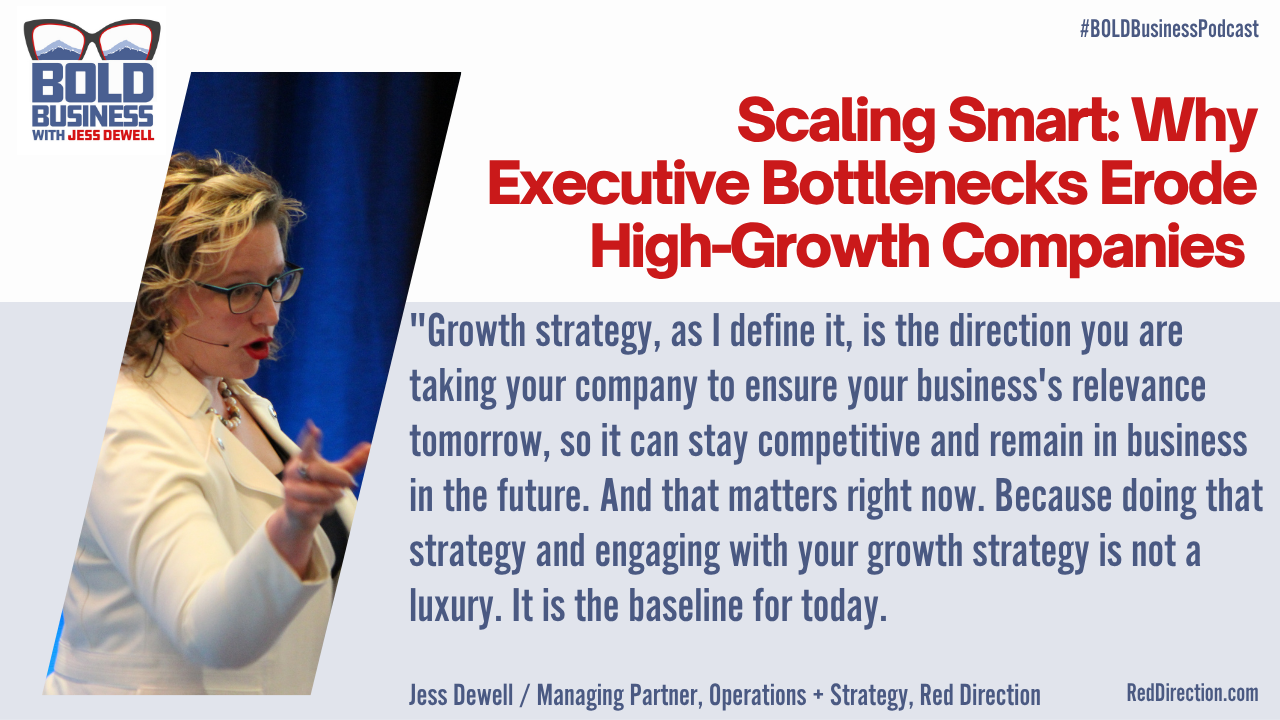
So what got you to the stage you’re at is not going to get you to where you want to go. The strategies that you’re using to get to $1 million and $3 million in annual revenue are not going to be the same as those that are going to take you from those places to $10 million and $15 million. because not only does scale in and of itself change, but it’s also because we have to continue to change. We’re facing an ever-changing market. We’re developing something we’ve never had before. And it’s pretty cool and exciting and scary all at the same time. So growth strategy, as I define it, is the direction that you are taking your company that has been identified to ensure your business’s relevance tomorrow so that it can stay competitive and be in business in the future.
And that matters right now because to do that strategy and engaging with your growth strategy is not a luxury. It is the baseline for today. Being able to stop, to react so you can respond is how you anticipate the landscape. So we’re going to focus on tomorrow’s relevance and the things you can do today to ensure it. This is a shift. It is a shift from management to management oversight to systems-led execution so that you can work on your business instinct. And to start us off, I’m going to pull a quote from Amanda Cromar, the CEO of Comptuity. She shares here how aligning risk and her tolerance for risk is necessary to achieve her long-term goals and the choices that she’s making along the way.
Amanda Cromar 03:48
Some decisions take a really long time, more so in business. I’m a slow processor in business and in conflict too. So it takes me seconds to cross eyes. And then in the moment, I feel like you have to respond right away. You have to fix this right away because, because you should, you should. But at the end of it, looking back at some of those moments, the pause and the delay to do the right thing was not detrimental, probably more helpful, but there’s pressure in the pause. It’s like a pressure cooker until the right solution has come to fruition.
Jess Dewell 04:32
Each of you will have your own risk tolerance. That’s what you’ve got to find to keep moving forward with intention and real progress instead of just spinning those busy wheels. So I’ve put together 11 dynamic resources for business growth for you. It’s completely free. It’s available at reddirection.com. it’s available in the show notes you can download it right now i pulled two resources to put in there specifically about long-term growth strategy the 11 resources you can go get it’s for those of you that are self-directed you’re self-starters and you want to scale with a new kind of energy right now just inserting additional information and ideas in to try along the way because you don’t need more generic business advice. You need a system to synthesize intuition and the data.
And this curated set of articles does just that. You can begin making improvements on your own. And the two that I mentioned that you would want to listen or read are about future-proofing. Don’t future-proof anymore. It’s about making your future instead because it keeps you proactively in this moment looking forward to meet the next step. The other one is vision to execution, rethinking success in the age of AI, because it’s not a tech test. AI isn’t where it’s, that’s not what it’s about. It’s about how to align your executive team so that you can align for the fastest way to continue to grow today. And like I said before, we’re talking today about faster versus strategic growth. And the thing to think about right now is that how you drive solutions is incredibly important.
And what got you here will not get you there. So there are a couple of bottlenecks that I wanted to talk about for a minute. And the first is sabotage, right? Where do we and our teams get in our own way? When we have this desire to act first, fix it first, take action first. By the way, that’s the way I operate. So I’m with y’all. Maybe we stop and we think too long and we wait and wait and wait because time is on our side. Not anymore. And maybe we’re seeking what is the right order with which to execute. There is some structure here. Each one of those is a bottleneck where we can get stuck. And it is a place of sabotage.
It’s a place of safety and comfort. In my world, I call those comfortable chairs. It is up to you to break through and find out where do we get the most comfortable because when things happen daily and you’re thinking about capacity, even if you’ve planned to have extra space to handle the unexpected, it’s easy for those daily things to creep in and leave zero time for their deep work. And that’s more of a cadence Then a calendar time block. Think about in the course of a week, when do you step out for your deep work time to engage with your growth strategy, to shape a new communication or approach, to do your most important work, which could be how are we communicating for raising money?
What are the things we need to do to instill and reinforce the culture we’re building? Where is the next step and what do we have to let go of to get there? That brute force hustle after dealing with everything that shows up is where our spark of interest and energy gets snuffed out. And we need to find ways to let that spark actually catch and be something that other people also have their interests piqued and fueled by it. And so it’s up to us. It starts and stops with us. I’ve put together a program called the Driving Solutions Intensive.
This is a once a year program that helps break those cycles to stop reacting so that there is space to intentionally build a resilient company that is making its own future. So think about it. If that’s something that you’re interested in, there’s more information on the Red Direction website under the Driving Solutions Strategic Intensive. And ultimately, it’s for a one time a year stop to check in with your responsive decision making process. It is a program that is six sessions and some follow up facilitated deep work sessions to have a strategic reality check.
It’s a lot of work that’s worthwhile in a short period of time so that you can keep building your plane as you’re flying it because we’re all doing that to an extent. At the same time, learning how to carve out time to do the important forward-looking work alongside the day-to-day work that will always happen. It’s where you build your strategic heartbeat and where you can find those bottlenecks to remove so that there’s a move away from isolated individuals, groups, and projects and to an integrated group motion that’s adaptive. Andy Podner, founder and CEO of Atlas Precision Consulting, shared with me about how they’re making decisions.
Andy Podner 10:09
We kind of had this idea that we would endeavor to just do things and not talk about doing something, say, hey, this is our idea. This is how we think we can make your business better. and we have the horsepower to actually bring it to life. That’s what we call our business first approach, right? It’s saying, hey, let’s focus on the business. Now let’s go build some technology that fills that void.
Jess Dewell 10:34
Listening to that, he worked to shift his focus from taking information and just using it to being more proactive, to seek out the actions to take, not only for his customers, also for the growth of his business. Business instinct is what I talk about that combines data from all of its sources that we have available to us and our honed intuition. The knowledge within the organization across the people who have been there the longest and the people who have just joined and see things differently. plus what you sense in the bigger pieces of your industry trajectory, changing customer needs, because you’re out there doing the work every single day.
That intuition combined with data creates a more faceted approach that reduces what we don’t know, because we’re always going to have imperfect. It’s important, though, when you bring the two together to note that it’s where are we not asking question and what could the blind spot be? And I bring this up because people, when I talk about intuition, they’re like, what? This is not what you use in business. And I’ll say, guess what? And I’m telling you, guess what? It is. It is. Because we’re already making decisions with our heads, with our hearts or our guts. Now I will link to this about the three brains of leadership, the head brain, the heart brain, and the gut brain.
So you’ll have that in the show notes. So let’s talk about the three brains of leadership. Head. What’s between our ears? The brain. This is what we associate with logic. We’ve collectively agreed that that’s data. Logical thinking and data. It’s metric-based. It’s evidence-based. It’s logic-based. Then we have the emotional piece, the heart-brain. This is our EQ. We’re looking at what it feels like, what it sounds like, And then the gut, which is very much situational reality. What’s really happening here? Is this a go? Yes or no? And there are some questions that we can ask around that.
So for example, when we’re doing our strategic work and we’ve got data and we’ve got information about what’s going on, we’ll just use an internal situation. You can ask with your logic head brain, do I truly believe we have the operational capacity to execute this, to deliver on this. And you can then do the same thing from the heart space. The question becomes to add depth. What are the feelings around this initiative? Where is the friction to getting the work done? What’s getting in the way of getting this work done in our teams? And then the gut piece, our gut brain, what is the unvarnished truth about this? Is this the right thing to be doing right now?
Let’s take an external view now, competitive advantage. Our logic brain might be like, okay, so we’re the same as all of our competitors on paper. So now it comes down to, this is why we’re having downward price pressure. What other features could we add? That is something you could challenge with the heart space, the heart brain. Hey, how is the way we do our work together? And what is the unique thing that we do that nobody else in our competitive marketplace does and how do we step into that more? What does that feel like? And then the gut would be how close is disruption to us in this space at this moment?
Is now the time to move on what we know and what we feel and what we have planned? And then you take all that and you can come back to the data and you can come back to the dialogue and you have more information with which to work because this is where you can see and play outcomes of long-term results, the negative, neutral, or positive opportunities. What are we finding that’s missing here? And who could we bring in to ask the questions that we know we have a gap around? Bring in an external expert.
Look what we found because we’re listening to what’s already here in ourselves, in our teams, and our organization that’s going to help us do what we do best and solve our customers problems. That’s business instinct. Consider using business instinct, the metrics with the intuition piece, the honed intuition to find and weed out assumptions, to name them and choose, keep it in the decision making process or to remove it from your decision making process so that you can get to actionable next steps. It can be really hard to do that because As you’ll hear Amanda share in just a second, she said to me, I’m addicted to the pressures of change. Hear what she has to say about that.
Amanda Cromar 15:31
I’m addicted to the pressures of change. And change has been so hard for me. I’m so type A. So change is really hard. And I need a team of collaborators. So it like takes a long time. But I’m addicted because getting to change and like being the change. And now I’m kind of like pulling the people I want with me into the change.
Jess Dewell 15:57
I’m addicted to it. Since change is upon us and it will be and it will be faster and we will change at the same pace we have always changed. This relentless pursuit of strategic truth becomes a big part of how we discern what is the next step, the next right step for evolution. because we can’t always be pivoting in big ways. There are ripples that come from that. So the small adjustments along the way from consistent work and cadence is something that is possible to do.
A second tool that I have that you have, you’ve heard of, it’s been used in business since before I was born, was the SWOT, the strengths, weaknesses, opportunities, and threats. I put the word dynamic in front of it. And the reason I put the word dynamic in front of it is because SWOT is something people use and they put it out and they put it away. And we know what our SWOT is. We know our initiatives support mitigating our risk and our threats and maximizing our opportunities. And internally, we just know. But how often do we actually say it out loud? Like sometimes in a conversation, we just need to name the things we’re working with.
This helps us make one of our weaknesses into a strength. This helps us address a threat that we have decided is in front of us as a company. And by doing that one thing, you take this document that hopefully is available to every single person in your organization when they’re especially in relationship to the initiatives they’re working on that are in it and using it in addition to building that honed intuition so that the right decisions are made right now. Sometimes I think the biggest drain isn’t the decisions we make, is thinking we have to keep the decisions we’ve already made as we’re making the next ones.
And a dynamic SWOT is just one way to have some bumpers that goes, okay, whatever we’ve been doing, that doesn’t work anymore. Our initiatives are actually showing us something else. They’ve uncovered something else. We’ve decided something else. And a change can occur and it can adjust and adapt in your journey and your path forward. Put that word dynamic in front of it, bring it into every day, maybe even include it. Here is what this initiative does. And this is the objective for the next 12 to 36 months that we are working on.
Because every time you do it, it’ll shift some. Hopefully it’s shifting because you’re intentionally working and leading your company forward instead of the world changing around you, forcing you to change. That is my suggestion for the swap. Pull it out, decide what your current initiatives are. Are they realizing opportunities? Are they mitigating your risk and threats? Are they changing your strengths, enhancing your strengths, or reducing and shifting a weakness into a strength? See how that changes your priorities and see if that changes what you can say no to right now.
Because if it’s not helping improve your business and balance where you want to go so you have the right things on the path that you are taking, then let it go. So we’re thinking about strategic shifts and we’re thinking about the impact to our business as we’re scaling from where we are that next revenue level and becoming who we need to become to not only get there and break through to it, but then to honor and recognize, look, we did that and we’re going to do it again. We’re going to be where we’re at.
We’re going to figure out who we need to become to go to our next. So the first thing is curating growth, moving away from pulling the growth levers one at a time or once in a while just to maintain things, and creating impact by instead picking a singular growth engine, a singular growth focus to reduce leadership for augmentation and encourage teamwork instead of individual silos all working on their own. The second is that dynamic SWOT over just initiatives and go. That 12 to 36 month set of initiatives, that’s a reality.
That helps with things like cash flow, pipeline capacity, operational realities. And we have to take that one step further. We have to shift it into going, ah, there are bottlenecks here. It might be me as the CEO. It might be me as the COO. It might be me as the salesperson. Honoring it by naming it and then deciding, does it fit our initiatives right now? And what could that roadmap look like? So there’s a path forward within the directives and the journey that’s in process. And third, this systems-led decision-making. It’s a process. It’s a step. You can find the steps to make decisions anywhere.
What makes this different is that you’re tying it back to your dynamic squat. You’re tying it back to your growth initiative. And you’re incorporating not only the data piece, the hard metrics, the data that can be collected in all the reports and discerned from all of the different places. It’s also asking with our head. It’s also asking with our heart. It’s also asking with our gut. These three brains create a strategic advantage when it’s used because creativity, innovation, the right order of things, what we’ve planned may show up in a different order. And that’s what the opportunity is there in updating how you make your decisions.
Because this responsive architecture, you can actually meet priorities and find out if there are competing priorities much quicker. And you’re protecting your own executive cognitive bandwidth. This is how you show up and recognize faster chaos is very different than strategic growth, even though things are changing and it may feel like Strategic growth may sometimes feel chaotic. It doesn’t have to be. You can command your market with who you are today, with the commitment to become who you need to become to take your company there. It is so bold to put your effort into this work. This is the strategic work that helps discern and filter all of the change that’s coming fast. Where do we put our stake in the ground? What is it that we want to do?
Sitting on the sidelines is less and less of an option. So it is bold to look at your already successful revenue generating business and say, hey, is what we’re doing still working the way we want it to be to get to where we’re going? Because when we can say the way we’re doing this isn’t going to get us where we want to go, that is a courageous step toward letting go of hustle and letting go of ego and turning into a navigator that you’re bringing your company along with you to solve problems. In this collective, we can face challenges and we can get to where we’re going together. This purposeful slowdown is actually a way to reclaim your time as well.
Stepping out of the noise, even if it’s just once a year, so that you can take a look in periods of time across a few weeks to understand what the noise is, as it’s always changing, you can actually find when you are in the grind and be able to remove it. Dedicating yourself to the evolution of your company and yourself and your team means stop chasing arbitrary milestones. And here’s the scoop. Those 11 resources for dynamic growth with the two specific to the topics we’re talking about today, the two activities that I shared that you can do is not about working harder. You break through this next level because you stop working alone, even when you feel that way.
And it is bold to reach out to your peer groups, to your consultants, to your advisors. If you don’t have any of those things, or you’re looking for a different perspective, me. And take the time to command and get a sense for what’s going on, because your market relevance is completely in your control.
Announcer 24:23
And that brings us to the close of another powerful and fresh perspective on the Bold Business Podcast. In today’s volatile landscape, growth is a double-edged sword. To truly thrive, you must engage with your strategy, not just react to the day-to-day. Without absolute alignment, your company faces a stark choice. Outmaneuver or be outmaneuvered. Grow or get left behind. Thank you for listening. And a special thanks to the Scott Treatment for Technical Production.