





STOP REFINING A FAILING STRATEGY – ARCHITECT A RESILIENT ONE.
FROM LINEAR PLANNING ➔ ADAPTIVE ARCHITECTURE
With Red Direction Growth Framework Reset Consultation, audit the strategic foundation via the structural stress-testing to eliminate obsolescence guaranteed by a 10x increase in modal resilience.
Starting the conversation:
Unlock the power of naming what’s unfinished, whether it’s code, strategy, or trust, and get actionable tactics to turn half-baked into done, shippable, and profitable. Thanos Diacakis, CEO and Chief Troublemaker at Cosmic Teacups, shares the underlying reasons to stop chasing arbitrary milestones and instead architect a resilient delivery system.
Hearing stories from the frontlines of software development is important today for every business person because making work visible can transform your organization’s internal strengths to real competitive advantage. Today, rigid plans are doomed and what creates capacity while making progress are small, iterative cycles so that goals remain relevant in disruptive environments.
In this episode, you will hear how conflict is a way to understand team needs, the importance of a tool to find the half-done projects, and how to name situations so that more progress can be made. Jess Dewell talks with Thanos Diacakis, CEO and Chief Troublemaker at Cosmic Teacups, about reframing conflict being the key to scaling unlocking team happiness and efficiency.
Host: Jess Dewell
Guest: Thanos Diacakis
What You Will Hear:
02:15 The discussion turns to the crucial role of mindset and humility in addressing business challenges and opportunities.
- Adopting humility, questioning assumptions, and recognizing the difficulty in uncovering what’s actually happening are emphasized as foundational to making progress when helping organizations improve.
- Starting with doubt and eliminating previous assumptions opens up fresh avenues for untangling problems.
- Viewing oneself as the easiest person to fool helps create a culture where learning and improvement are more attainable.
03:25 A story illustrates how unexamined assumptions shape team habits and organizational rules, often persisting long after their original purpose is gone.
- Rules that no longer serve a purpose, inability to remember why certain practices are in place, and the need to challenge inherited processes are highlighted as signs that organizations need to regularly re-examine their operational habits.
- The analogy of apes in a cage demonstrates how rituals and practices persist even after the original reasons are forgotten.
- Regularly questioning practices and examining their underlying rationale can uncover inefficiencies and improve decision-making.
07:00 Constructive conflict and establishing shared language for teams is positioned as a key driver for innovation and better outcomes within organizations.
- Creating an environment where teams clearly articulate their needs, resolve misunderstandings, and work through healthy disagreement leads to more optimal collaboration and business results.
- Proactively seeking out organizations open to creative conflict maximizes the possibility for productive and motivated teamwork.
- Acknowledging that conflict is not for its own sake but is aimed at surfacing needs and improving outcomes can reduce resistance and foster trust.
15:55 The dangers of premature standardization in fast-changing environments are explored, with emphasis on the balance between repeatability and experimentation.
- Organizations are encouraged to allow space for evolution; selectively standardizing while leaving room for experimentation helps avoid stagnation and bureaucracy, especially as technology changes.
- Prematurely locking into one tool or practice can hinder innovation and adaptation as needs evolve.
- Recognizing where to pave “roads” and where to preserve flexibility is critical for balancing efficiency and agility in both tech and non-tech fields.
18:15 The importance of finishing work before moving to something new is equated to both manufacturing and software, connecting workflow management to value (and employee happiness).
- Keeping too many tasks in progress creates waste, distraction, unfinished business, and workplace stress; focusing on shipping completed work quickly improves quality, satisfaction, and the organization’s bottom line.
- Half-finished tasks lead to inventory buildup and loss of value since only completed projects generate income.
- Prioritizing completion, minimizing context switching, and ensuring work is “shipped” quickly can foster both greater happiness and efficiency within teams.
30:25 The conversation centers on prioritization and the value of limiting focus to what truly matters most to drive business results and learning.
- Focusing on a single key task or deliverable at a time accelerates feedback, reduces wasted effort on bad ideas, and allows rapid iteration and adjustment based on what’s working.
- Shipping one thing at a time enables faster cash flow and learning through iterative improvements.
- Attempting to prioritize too many items equally spreads effort thin and delays feedback, whereas iterating on one priority allows for realignment and efficiency.
40:30 A tactic is shared for tackling uncomfortable team conversations: naming discomfort and diving directly into open dialogue.
- Being transparent about awkwardness, openly stating concerns or hesitations, and encouraging honest problem-solving helps teams address tough issues without blame and fosters a constructive environment.
- Addressing issues directly reduces misunderstandings, defuses tension, and keeps the team focused on moving forward.
- Normalizing both positive and awkward discussions builds trust while enabling growth and adaptability.
48:15 It is BOLD to to step back, stop chasing arbitrary milestones, and architect a resilient delivery system.
Resources
- Connect with Thanos Diacakis
- Team Metrics, see how work actually flows
- The Goal: A Process of Ongoing Improvement
- Make Work Visible
Transcript
Thanos Diacakis 00:00
Please don’t send slop to your clients. Read it. Validate it.
Announcer 00:11
Every leader needs a trusted partner for the moments that matter. This Bold Business Podcast conversation is that partnership. Here is your host, Jess Dewell, an insightful truth teller who serves as the catalyst for getting the right work done and who asks the questions that truly matter.
Jess Dewell 00:31
When a founder comes to you saying, my team is too slow, or we’re not getting the right things done, how do you cut through the noise and find the real root cause? Today, we’re exploring the raw and real truths about how to architect a resilient delivery system and create real outcomes in these crazy times. Today, Thanos Diacakis, CEO and Chief Troublemaker at Cosmic Teacups, is joining me. He has over 25 years of hands-on experience in software development. He works with founders to overcome bottlenecks, scale engineering teams, and deliver high-quality products faster and of higher quality. His background spans both early-stage ventures as well as with tech giants, and he’s led the technical integration of many lines of business, including JUMP Bikes. In today’s episode, you will hear three vital takeaways that will immediately help you with your team today. First, why constructive and creative conflict is important for teams to actually work through. Second, the reality that our goal is to make money, so the product must ship. To do it better, faster, and happier, you must know the single priority you’re working toward. And third, the power to name a situation and go forward through it. It may be awkward, yet when we do our work together, the way we work together evolves and increases our overall connectedness, happiness, and value to the end goal. Are you ready to step back and stop chasing these arbitrary milestones and remove the friction? You can and stay competitive by looking at things differently. Here’s my conversation with Thanos. So there’s this kind of this concept of mindset that has to show up in the way we think about our opportunities and our challenges today. And so you are specifically working with shipping quicker, spending less money. And so what kind of thought processes and what kind of mindset are you already in that you’re bringing to the companies that you work with?
Thanos Diacakis 02:39
The starting place for me is humility and the idea that the easiest person to fool is yourself. So if you start with that, then we’re in a good spot. If you think you know everything, then, well, you probably wouldn’t have called me. But, uh, all right. If you begin from the fact that it’s really tough to figure out what is actually going on here, then you can actually start making some gains and start picking things apart and figure out where they stand. If you think that, you know, what I’ve been doing is great and I’ll just keep doing what I’m doing, then you’re probably going to have a hard time getting somewhere. But you basically doubt everything, um, you know, eliminate all the assumptions that go into trouble, and then figure out how to untangle things from there.
Jess Dewell 03:17
Assumptions. How do you find assumptions?
Thanos Diacakis 03:23
Well, everything—like, pretty much everything—is an assumption, right? Because we don’t often have the ability to go back from square one and say, well, let’s start with gravity. Like, where—how does that start? Like, okay, well, gravity seems pretty plausible, and, you know, um, Newton figured this out and then everyone else behind that didn’t really object. So we’ll keep that as a given. But more seriously, sort of bringing that back into software engineering and product development in general, there are a bunch of things that we do. And there’s a bunch of these things that actually work. And have you heard the story with the apes in the cage? And I’ve tried to look whether this is true or not, and I haven’t found whether this is true or not. But the idea is that you have a bunch of apes in the cage with a ladder, bananas on top, apes climbing the cage. When they try to get the bananas, they get sprayed with cold water, and they stop climbing up the ladder pretty quickly. So then you take one ape, you get them out, put a new one in. He’s trying to climb the ladder, and the other apes will just pull them down the ladder, um, because they don’t want to get wet. And you keep replacing all the apes until none of the apes have ever gotten wet, but they will not dare go up the ladder, and they’ll beat everyone up that tries to go up the ladder. And it’s kind of like, hey, kid, that’s how we do things over here. We don’t know why, but if the latest ape goes up the ladder, we just pull them down, because going up the ladder is bad, right? And if you put this in real, actual terms, what we did is we had some constraint. Bob was the guy that knew everything, so we’re going to protect Bob’s time. Or Friday was a bad day for doing releases because we didn’t have testing coverage, so we’re going to never release on Fridays. So you build all these rules, and then you fix your automatic testing, but you still don’t release on Fridays. Why? Because you forgot you made that rule to protect the constraint. Um, so again, you start figuring out, like, do these things make sense? Which can we prove are plausible? Which have, like, reasonable data behind them? You’re not going to be able to do everything to perfection, right? But you can start poking around some of these ideas. And with some experience, you can kind of look and say, okay, that probably smells bad. Let’s go take another look at that thing.
Jess Dewell 05:09
You know, I think you bring up a really good point about how what we’ve always done is a place where assumptions start. And what you named, Thanos, in that sharing really points out it’s things we would take for granted every day. And this concept of an evolution of time, it is. And it’s not even knowledge worth having, let alone it is part of the core common knowledge, even if it gets wiped down and we don’t know where it came from. Uh, having—what is it—new people on the team, third-party advisors, uh, you and your team coming in, going back to that mindset piece, it’s amazing to me how many people want third-party opinion to validate, not to actually tell them the truth.
Thanos Diacakis 06:15
Yeah, that’s always fun.
Jess Dewell 06:15
How much—I mean, do you get that a lot too?
Thanos Diacakis 06:15
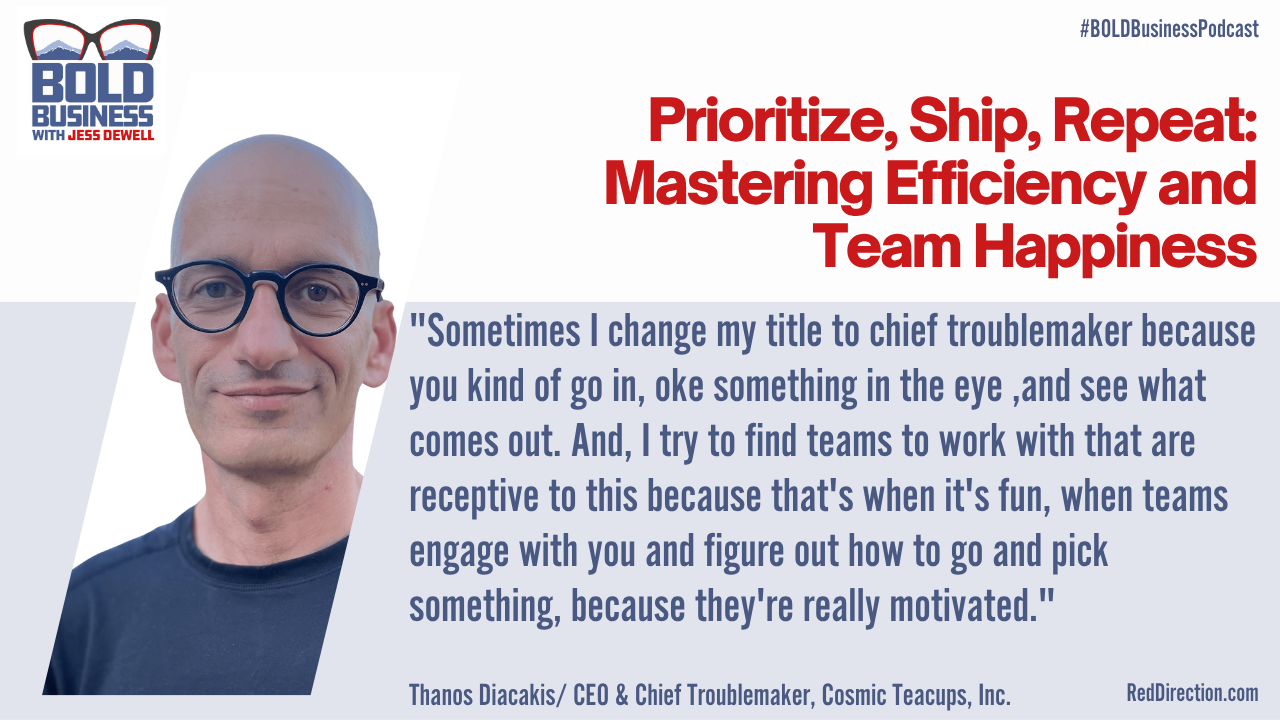
Sometimes I put—I changed my title to Chief Troublemaker because you kind of go in and you kind of, kind of go poke something in the eye and see what comes out. And, uh, you know, I try to find teams to work with that are receptive to this, because that’s when it’s fun, right? When teams engage with you and figure out how to go and fix something because they’re really motivated. I think if a team wants to, uh, you know, just go prove that what they’re doing is good, then I’d probably send them off to take someone else’s money, um, go do something, right?
Jess Dewell 06:45
Right. Yeah, I like Troublemaker. I’m a pot stirrer myself. I’m a bear poker. I also bring a lot of honey, uh, usually, though.
Thanos Diacakis 06:58
Well, you don’t want to do this. I mean, this is not having conflict for the fun of having conflict, right? But this is stirring conflict in the right way. I call it, like, constructive conflict or creative conflict, where you have two different teams and they have needs. And we can talk about specific examples of how this usually happens in software, but they don’t have the right words to talk to each other about their needs, so their needs go unmet because they don’t know the words to use with each other. Whereas when you create the right words and the right environment, you can now have each of the teams communicate their needs to the other team and have this creative conflict, which is basically resolving a way to do both in the right ratio. And then that’s how you have better outcomes. Like, if one team just keeps ignoring the other team, or the one team hides what they do so the other team doesn’t know that they’re spending time on this thing that they don’t understand, that’s how you end up with sort of suboptimal outcomes. And, you know, you kind of took me to a thread earlier that made me think of this, but people are busy. They don’t always, like, not find the right solutions because they’re stupid or not knowledgeable, but they have this one thing that they’re focused on. They don’t want to, you know, go look back and see how they do the work. So when my very much, much younger self used to think, oh, those guys are stupid. They clearly could do this in these eight different ways, but they’re not. And it turns out they were not stupid. They’re just really, really busy. And sometimes, like, going and getting outside help is something that creates, you know, just can be perspective, but it can also be time, right? Because that person—you know, you don’t have time to figure this out. So help us do this quickly. So let’s get effective in doing these things. How do we allocate the least amount of time that we can on this other thing to get the maximum amount of results that we can do? So that’s kind of the time aspect. The perspective is actually also an interesting one, because usually where there’s, like, a cause and effect, right? I press this, and that sort of pops out. It’s easy to see, okay, we want more of this. Let’s press it more. We want less of that. Let’s press it less. But sometimes the cause and effect is hidden. And it takes, you know, being burnt and having the scars or the experience or whatever you want to call it, of being able to see these things. So that’s where sometimes, like, a slightly different perspective can get you into a mode of thinking that gets you out of your rut. Because, you know, sometimes teams are not going fast enough, and the right answer there is actually we need to slow down. You have too much stuff in your pipeline that is making you churn and just switch and context-switch a lot. So if you actually want to go faster, you got to pull half of that out, and then the speed goes up. It’s like, wow, like, that was not intuitive. We wanted to ask our team to do more, and I asked them to do less. We actually go.
Jess Dewell 09:14
There’s so many things just in that. Okay. So I’m going to, I wrote some things down and we’ll see where this takes us. The first, this concept of cause and effect and rules. It’s easy to create rules. It seems harder to create standards. And by the way, I think that’s, and so I’m going to say that. Then I’m going to say, I’m listening to not causing conflict for the sake of conflict, which I think is really important. And I think when we recognize conflict keeps coming up and we look at somebody and go, ooh, they’re always going to talk about this thing again. And it’s something we always can’t get past. And it takes up all of our meeting time or whatever it is. Or man, we’ve been working on this and we just can’t make any progress. I wish they’d get off our back a little and give us a different approach or something, right? It doesn’t, when those types of things start showing up, I think that’s when the gaps are there. And that’s where an outside perspective coming in with that intention of positive outcome through understanding what the friction and the tensions are make all the difference.
Thanos Diacakis 10:23
Yeah, and sometimes it’s not necessarily that you’re going to figure it out, right? Because sometimes as an outsider, yeah, you don’t know what this thing is or how it works. But you can start by asking the right questions, right? Bob has brought this eight times and you haven’t responded to it. Like, you know, why is Bob so annoyed about this? And maybe Bob hasn’t been using the right words to express what he means. And we see this a lot with technical teams, right? A lot of technical teams have a particular way of describing and discussing things that doesn’t exactly resonate. And I fault, you know, my profession partly for doing this because you cannot be expected, let’s take like technical debt, for example, something gets talked about. You don’t be expected to get a third of your time carved out to go do these very valuable things that you ought to be doing if you can’t explain it clearly enough. Because no one’s going to say, hey, Thanos, go play for two days a week and do this thing because, yeah, that sounds cool. But if you say, hey, our velocity is kind of X and it will be half X in six months if we don’t do this. And if we do roughly this many hours of that, we will still stay at X. OK, now we can get our heads around this and get something productive.
Jess Dewell 11:22
Right. It is. It’s being able to look at the same thing in a different way and ask a different question or state something that makes somebody else ask a really good question. I’m all on board for that, too. I don’t need to know anything. But if I can say something and I can cause somebody to ask a question or to say something differently, we know we might be on the right track to finding that progress forward to the next. So rules versus standards. I was listening to you and I was hearing that cause and effect. I think a cause and effect is a rule with a yes or a no, right? Or a true or a false. Do you meet me there or do you go someplace else?
Thanos Diacakis 12:00
So rules are sort of like we’ve agreed that the best way of doing this kind of thing is this. So let’s try to do that in the future, right? And generally speaking, those work, but we tend to forget why we put that rule in place to begin with. So when the reason doesn’t make sense anymore, the rule doesn’t make sense anymore. So nowadays we try to do things where we write the rule, but we write why we did the rule with it. So when we’re going back looking at it, we can say, hey, that’s why we had this. This doesn’t make sense anymore. Let’s kill it. I didn’t fully track the yes or no aspect of this. It’s like, you know, does this new thing we’re trying to do meet the rule or doesn’t meet the rule?
Jess Dewell 12:39
Yeah, it doesn’t meet the rule. You answered the question. That was what I think that’s what I was looking for from you is, OK, so we are actually working in the same place. I was just trying to say it with less words.
Thanos Diacakis 12:49
Yeah. But again, you put rules in place. So rules are something that you put in place because it’s the fastest lever you typically have to do something, right? Someone from the top down comes and says, I will make this rule because I see this thing. Now, rules tend not to particularly be really good to change culture because culture takes a much longer time. So for a culture to change, you have to change the rule, then you have to put the rule into application by demonstrating it and doing it yourself and getting a bunch of others to imitate it, proving that the rule is actually working fairly well. Although sometimes some things get adopted into culture that actually don’t work fairly well and it still becomes sort of the culture. You’ve heard of the maybe cliche of culture eats strategy for breakfast. So you can make any number of procedures and rules. But if the culture is different, then your rules can get ignored and no one’s going to follow it and nothing’s really going to happen.
Announcer 13:40
Feeling stuck? Like, what got you here won’t get you there. The pressure to grow is on, yet the path isn’t clear. Yet. You don’t have to walk that path alone. This is the Bold Business Podcast. Like and subscribe wherever you listen. Your host, Jess Dewell, is the strategic partner you’ve been looking for, asking the questions that truly matter. It’s time to break the inertia and get the perspective you need to make your next move.
Jess Dewell 14:15
Thanos Diacakis is visiting me on the Bold Business Podcast today. I’m your host, Jess Dewell. He is the CEO and Chief Troublemaker of Cosmic Teacups. They really don’t apply the same way, right? The relational piece of how we talk to each other, and you were talking about the needs and the misunderstoodness or the problems of each part of the team in two different groups or even two different individuals on the, in the same work group that once that’s figured out, progress can be made. And I, I appreciate how you talked about rules are the fastest way to see a new result. And if that’s all they’re for, and I actually really was like, and we wrote down why we do it this way. Um, because I will tell you every, for us non-technical people listening, I have this, this is just for you because I am not a technical person that can understand all this technical stuff. And I’m like, oh yeah, it works in real life too. It works just when you’re in a meeting. It works when you’re in the grocery store. It works when you’re making your dinner and when you’re solving your own problems and doing your own deep work in your role at your organization. And I think that that’s a pretty big piece to recognize because when we’re bouncing around between standards, there’s edges, there’s different approaches, right? The way we see it, hear it, feel it. Are we action-oriented? Do we have to think about it first? Do we really like a rule to start from to create a way that we’re doing our work together? And it leaves space for that evolution to be in place.
Thanos Diacakis 15:55
Yeah. And if you standardize too early, then you often will miss out on that evolution, right? If we make a rule and say, hey, we have this new AI tool, I’m going to use this one and I’m going to sign a one-year contract—well, newsflash, that’s not going to work out really well for you, because those change so quickly that you might want a different one in, like, two months. So you probably want to keep some place for experimentation in that to allow for that change. You may want to standardize carefully, selectively, just a little bit, ready to revise those standards. We see this a lot in technology, especially where it’s, like, really quickly changing in many areas. A lot of times we make the analogy that it’s a paved road, right? Standards give you the paved road, and you can run on the paved road and things will be smoother. But if you want to experiment, go take that shortcut over there. Go for it. You might hit a cliff at some point in time. Okay, you might have to figure out how to get back from that. You might find another really fast way of getting somewhere, in which case we might go pave that over there, um, and so on. But you get the analogy, right? It’s like it gives you some advantages, but it’s not like standards do not—it’s not just a panacea where you just implement standards for everything, and now it’s like, that’s fantastic. That’s how you get really big, stiff, bureaucratic organizations where you can’t really get anything done.
Jess Dewell 17:01
And it doesn’t matter if you’re two people with a lot of it you still become a big stiff yeah organization that can’t get anything done.
Thanos Diacakis 17:13
Yeah. So, I mean, you can start with rules, but then you got to figure out, like, how do I make this into culture? How do I make sure it’s actually productive, and does it actually, um, do something for me? I was flying yesterday, and they said, for safety while we’re landing, you got to put your window shades up. Yeah, no, half the airlines do it and half the other ones don’t. So I’m sure, like, if we go look at the stats, we’ll correlate everyone that had their window shades up, they crashed; no one else did. Like, there’s some rules that just don’t make sense.
Jess Dewell 17:34
No kidding. Uh, well, so I’m thinking about this. And then we were talking—you also talked about if you pull all this stuff out, you can do so much stuff faster, right? This less is more. I’m a super fan of less is more, uh, Thanos. And so I have to tell you, I have to tell you that in my world, I talk about distraction debt. When you talk about pulling stuff out for less is more, is it also because it’s a distraction in a technical sense, or is it something else entirely?
Thanos Diacakis 18:15
It’s mostly because of distraction, but there’s other things that play in there as well. So most of these rules, by the way, that we’re talking about in software, we’re actually taken out from lean manufacturing. Yeah. So it’s kind of the same idea, the same way that they have some ideas and and you do some stuff in between, and software comes out the other end, and that’s kind of my industry. You have a factory, and you put some materials in, and you do some transformations, and a widget comes out the other side. So if you shove in too much work, the analogy there is now you’re reconfiguring the machines all the time, and you’re spending all this time switching things that is tough, and you’re sort of distracting people. Although you actually do want to get good at that, and be able to make these switches quickly, that actually makes you really efficient. But also you have all this half-completed work that is sitting around. So I worked on this. Now I switch context and work on that. Now if it’s inventory in a factory floor, it gets rusty, it gets lost, it gets tripped over. If it’s software, you can’t merge it back into your code because it gets too old. So there’s all these problems. This is a focus switching, but producing those intermediate artifacts that are sitting around that until they get shipped, they add no value. If you have a half-made widget, you can’t sell it because it’s sitting on the factory floor and things can happen to you. If you have half-built software, you can’t sell it. So the idea there is structure your teams and your projects in a way where thing go in, thing go out. And now when thing goes out in software or in almost any kind of business, that’s kind of where you collect cash, right? If you ship whatever you’re shipping to one place, like one client I work with, they work with jobs to do aircraft maintenance. The plane goes in, you can’t invoice until the plane goes out. If the plane’s sitting in the hangar, it’s taking up space and no money is coming in. So same kind of idea that you apply there. If you do less, you can get more stuff done. And guess what? The guy that you’re telling, go fix this plane, then go fix that plane, then go fix that plane. They’re not happy, right? They’re stressed because they have to do a bunch of things, jumping between things, and they quit and go work for someone else that does things in a more sane way. So you open this by saying, you know, I hope things go faster and better quality. But like one of the super duper things that we try to shoot for is happiness. Because when you do things happy, your quality actually goes up because no one’s like cranky with each other and they actually do their best work and your speed goes up. So I think we need to put that in in any kind of area of work. That if you have this thing where everyone’s kind of always on edge, we need to make it go happy again, too.
Jess Dewell 20:27
You know, OK, I think that’s I agree that what you’re talking about with half-built things, every single person listening, regardless of the role that they’re in, could look around their office, their to-do list, wherever they’re keeping it. If it’s physical papers, if it’s a digital list, if it’s whatever, and actually take a look right now and say, what has been half done for some period of time? Pick a period of time. How about, it could be as little as 30 days. It could be as many as three months. If it’s anything else, I think you should just put it in some sort of a bin, digital or otherwise. Just, it’s not the right time or place. Okay. So let’s, so in that, do you have a way to assess what it, are you just looking around like that and saying, hey, this is what we see that’s kind of half done. What is this? Or are you listening because people are telling you what’s half done or what’s not getting done? And that’s something that you’re bringing to the table and going, these are our options to find what to pause, shelve, stop.
Thanos Diacakis 21:33
Yes. So I’ll give you two versions of this. The general version is a really good book that’s called Making Work Visible. And the idea is take any kind of system, whether it’s software or anything else you’re doing and make your system visible. If you can’t see it, you can’t measure it, you can’t judge it, it’s really hard to make improvements. As you were saying, where I go just look around my office all day and look for things that are half done, that’s not going to be a super productive use of time. With software, we do the same thing. I’ve actually built a custom tool that I use with all my clients that tries to take all the stuff that you do and make it sort of pop out so you can see it with charts, right? So I have one chart that I see how many things that we do every day. I have a second chart that shows me, like, how is that stuff distributed across different categories of work? I use something called the Flow Framework for that, which breaks software into features, bugs, investments, and risk items. So we kind of need to know what is the kind of ratio of these things, right? We want to be building lots of features, but if we’re spending our time building lots of bugs, then we need to make some investments. So the quality goes back up and the bugs go down and the feature time goes down. And then how long does everything sit in each bucket? So if we see, hey, from when I file something in there till someone picks it up, it takes this long, well, I can go look and find out why. And the answer often surprises you. Or if something, you know, I put this code in here and it’s waiting for someone’s review in here because people didn’t happen to be looking in that bucket. Okay, well, let’s fix that problem. And then you can find, you know, using this tool, I can sort of start spotting where the bottlenecks are and seeing, okay, let’s go investigate this. Let’s go investigate that. And that makes it easy. So build that tool for you, right? If you’re in software, we can leave some notes and people can go play with my tool. But if you’re in any other space, like you can use and make your own kind of like, system to figure out how work flows through it and then kind of optimize that.
Jess Dewell 23:10
I like that. Well, and I guess I’ll go back to if you just look around and find half projects around that you’re not doing anything, I agree on a regular basis that is not the right thing to be doing as far as work goes for anybody. However, if you don’t believe what is being shared here, look around your office because I think there’s something here. That’s where I was going with that. How’s that for an intro where I’m going back to that very beginning where we have that. We have to shift our mindset. We know something’s not working right. So where do we go? This could be one of those places.
Thanos Diacakis 23:42
And you’ll have to find your artifacts, right? Your artifacts could be physical things lying around or they could be actual virtual things. They could be like that. You with a messy desktop, you know who you are. You with a thousand Chrome tabs.
Jess Dewell 23:55
Oh, OK. How many hands do I get? I have I am a person. Yes, my brain operates like all the tabs open in a browser. Yes, I actually still use paper, but it doesn’t stay around, actually. That just helps me in the moment. But you’re right. We do know who we are. I’ll claim it.
Thanos Diacakis 24:16
And by the way, don’t feel bad. You’re not alone, right? That’s how our brains work. That’s how we adapt. But I think the step number one is, okay, let’s recognize this. Now, what do we do about this? When I have more than 10 tabs, I stress out because now there’s things that are going to get lost because I know I’m going to just close that window at some point. Because I’ve had it.
Jess Dewell 24:31
So I go back and see if it doesn’t matter anymore. I mean, not actually. And sometimes I forget. I’m like, oh yeah, no, I was done with that a long time ago.
Thanos Diacakis 24:40
I’ll just ask my AI. Just go figure out what I was doing before and finish it off for me.
Jess Dewell 24:44
You know what? That’s actually something I will. Okay, we’re going to totally pause right there. I love having tools that are smarter than me, do research for me, distill things for me, validate things for me that I can then just use and then decide where do I need to validate more? What could this problem actually be? How could this work? And so I really appreciate you saying that because I think I can get down to maybe only 10 tabs open from just that tool from bazillions of windows.
Thanos Diacakis 25:16
The browsers aren’t quite good there yet, but I think that sort of applies to a lot of areas, because, like, at some point in time I would need—okay, some client actually asked me about this yesterday, and they’re having this particular problem. And I was like, okay, I go write, like, a three-page document explaining how to solve this. And in the before times, it would take me, like, a couple of hours to write them a nice three-page document. Yeah. Whereas this kind of took me five minutes. Claude did it. Yeah. And then I spent 20 more minutes having three or four back-and-forths, really adding value and saying, okay, that’s nice, but I want to optimize on this. Go research this and write me five more bullets for that. Go find this. So you can bubble up. Instead of, like, editing the document and making sure it’s in, like, nice English with the right sort of tenses, I can now really give you the value, and someone else writes a document. And then it was like, okay, it was four pages. That’s too long. Let’s make it two, because no one wants to read four. It’s really nicely summarized, and the reviews there are, like, key, right? Don’t—don’t—please don’t send slop to your clients. Um, read it. Validate it.
Jess Dewell 26:04
Yes. It does—it does not, uh, take away. I mean, it does not take away, and I’m not—I don’t know, it’s not even a quality-control thing. It’s a—there need—an ownership of a brand is necessary. And knowing what is going out is one of the most important things, only because we don’t know when our—well, our credibility is always on the line. How people view us and what they expect from us is always evolving based off of what we send them.
Thanos Diacakis 26:40
You are so right and it was never easier to do because if Claude had generated something just excuse me, not picking on Claude, but generated something that was incorrect. It just takes you like one sentence you can dictate to your computer and say that paragraph’s too weak, so just fix it this way. Done. So there’s no excuse for shipping out bad stuff. You can really move it up to the level of abstraction, really get all your knowledge nicely distilled and mean what you mean without putting the work on others to clean up your AI mess.
Jess Dewell 27:08
I love that a lot. You said you have a tool that we can link to in the show notes?
Thanos Diacakis 27:14
Yes, it’s team-metrics.dev with a hyphen in between the team and the metrics. And it works with Linear right now. I don’t really intend to make it work with any other tools. If you use Jira, then this might be a good time to switch to Linear.
Jess Dewell 27:29
And then, does it have a little bit of an overview? Because I’m thinking, I’m not a developer. But I definitely know that there are ways that I’m always looking for things that are half done. And prioritization, especially at a strategic level, can benefit from a tool like this versus having to sit down and really think about it because everybody knows what’s all around. We just can’t always name it. And so when we’re in doing our work, being in our space and really working to say, stay creative, find the constraints that matter today, understanding what those levers are with which we can be faster, better, more efficient, and most importantly, add value while staying happy. I really like that happy part that you brought in earlier. That is, it’s so important on that strategic level because there’s so much more and it is like a big cloud, which is okay. And we still have to prioritize because that big cloud can have all kinds of things, but it’s going to, I equate it to like ripples, wherever the rock went into the water, that is that point of origin. And that’s where the real stuff is actually happening. Depending on where it is and the ripples out, it may or may not have impact today or make sense today or be right today from all kinds of perspectives. And that’s where I tend to play is making sure everything’s in the right ripple and we’re staying as close to that action point as possible.
Thanos Diacakis 28:53
Yeah, I was in a client meeting a couple of weeks ago and we wrote a bunch of stuff on the board that we wanted to do. And then one of the people there, no names named, went and wrote the priorities next to them. And they put the number one next to like no less than seven items. And it’s like, dude, you cannot have more priorities than arms. Like, that is just not possible.
Jess Dewell 29:13
But it wasn’t quite enough for an octopus, though.
Thanos Diacakis 29:15
No.
Jess Dewell 29:16
Seven. I think you would have trouble.
Thanos Diacakis 29:18
But in all seriousness, the Team Metrics tool will help you if you’re doing software stuff and it’s in Linear. So it’s fairly limited to that. But all this stuff came from lean manufacturing. And there’s a really good book called The Goal by Eliyahu Goldratt. It’s focused on manufacturing, but it’s really fun because it’s a business novel. So it’s a really fun read because it talks about, what is the goal? Like, they had a factory, and they’re trying to talk about what the goal of the factory is, right? And I don’t want to give the ending away, but you go through a lot of stuff. The same thing we do with any business. Like, the goal is not to stay busy. The goal is not to just be in your little mouse wheel and be running all day. The goal is to be shipping stuff out the other end, because that’s how cash comes in, and that’s the lifeblood of any business. So that’s kind of how we start when we look at—so when I looked at these eight or nine priorities that we had in that meeting, it’s, okay, what is our goal here? What is the outcome they want to have? Oh, it’s this. Okay, well, that—that, you know—which of these goals do you think that highlights? Well, that one and that one. Well, why don’t we make those number one and then make everything else number two?
Jess Dewell 30:18
Yeah, and we’re going down the list. How many—how many ones did you have at the end? You went from seven or eight to how many?
Thanos Diacakis 30:27
You want to have one number one. You want to have that one and ship it, and then you want to have more when you ship that one. So, think about it this way, right? If you have five things that are going to take you one week, you can ship one the first week, collect some cash at the end of that, ship the second one, collect some cash after that, ship the third one, and so on, right? Until you’ve collected five chunks of cash as you go along. Again, metaphorically, it’s not always exactly like that, but the idea still holds. Or you could do them all at the same time. So you could do Monday on this one, Tuesday on that one, Wednesday on that one, repeat that for five weeks, and you ship them all at the end. Well, which one is better? So not only did you wait five weeks until you made any money, but also maybe doing number one informs you of, oh, crap, like, I want to take number two and do it this way instead because I actually learned something from number one. And number three is going to be completely different. Four and five, we’re never going to do them. That was a terrible idea. That, going back to the humility we talked about in the beginning. So work in small cycles. Do little iterations. Learn from these things, right? The good organizations not only, like, ship stuff, they go look at how they do the work. They change how they do the work. They learn from how they do the work and become faster. So if you’re doing the work and your competition is doing the work and being introspective of how they do it and improving it, they’re going to be eating your lunch real soon.
Announcer 31:33
If your week feels like you’re being pulled from one demand to the next, this is for you. The Daily Grind is the number one killer of business instinct, pulling you and your team away from your vision. Reclaim your strategic edge with the Present Retreat. This free guide from Red Direction is a simple, powerful framework to carve out the space you need to filter out the noise, make the right decisions, and lead with clarity.
Jess Dewell 31:59
Visit presentretreat.com. Thanos Diacakis is visiting me on the Bold Business Podcast today. I’m your host, Jess Dewell. He is the CEO and Chief Troublemaker of Cosmic Teacups. People get really hung up on March of this year, buy this thing, and blah, blah, blah. And I’m like, hey, all you’re doing is putting a stake in the sand, and you’re thinking that’s where the treasure is when you get there. It could show up the previous November. It might not show up till the May past it. All you’re doing is saying, this is the direction that we are going and everything else comes into place along the way. And that small iterative, learn as you go and find the things not to do before they’re done. I think that’s the coolest thing I have heard in weeks. Let me just be real with you. And I’m going to keep that one. No, don’t do them all at once because something is a bad idea. You just don’t know which one it is yet. It is exciting times to be alive.
Thanos Diacakis 33:00
I used to work for a company that every September, they would pull all their brightest people, bring them on site for an ungodly amount of money. And for three weeks, they would do planning. And then they’d ship them all back and we’d start executing sometime in October. And by November, the plan wouldn’t look like anything like what was on paper in September. It would be completely different. And the next year we’d get around in September and do this thing. I was like, guys, did we look at what the outcome of this three-week thing was? Like, did we actually like follow through with any of these plans. We built like 10% of what was on the list. It’s like, why are we doing this insanity?
Jess Dewell 33:29
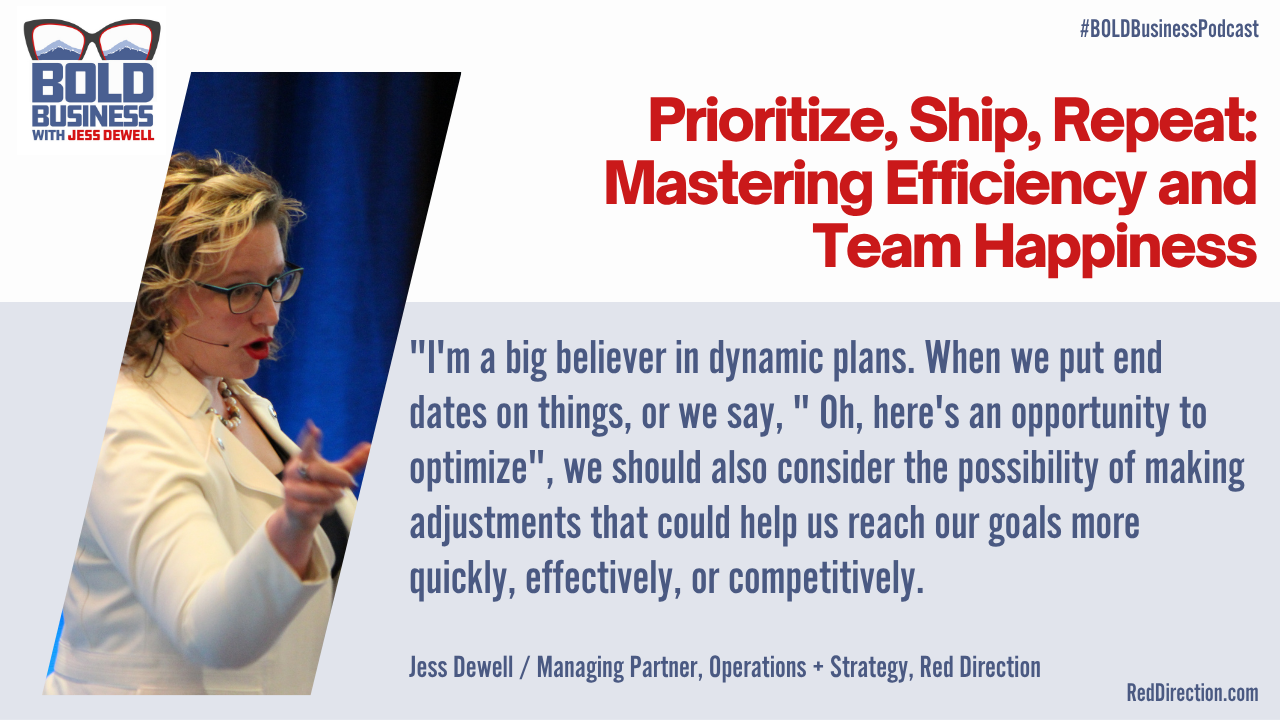
See, I’m telling you, and that comes back down to the priorities. If we think it’s the priority, or there’s a secondary or third supporting thing that turns out to not be the case, I really hope somebody stands up and says, look, let’s just get it off and evolve. I’m a big believer in dynamic plans. Yeah, you’ve got a place you’re going. Yeah, you’ve got people you are responsible for and reporting to, even, you know, as a company. I get it. And at the same point in time, when we put end dates on things, or we say, oh, here’s an opportunity to optimize, here’s an opportunity to take a turn that actually turns out to get us to where we want to go faster, or differently, or competitively, because things change. That’s actually really where we need the courage, in my opinion, to stand up and say, hey, let’s be here a minute.
Thanos Diacakis 34:25
Have you heard the—I don’t know, it’s a cliché by this point in time—but there’s the expression, um, planning is worth its weight in gold, but plans are worthless. Maybe it’s the inverse order, because, right, planning makes you think about what is the push and pull, what depends on what, what is interesting, whatever I get value from. Like, okay, yeah, again, the plan’s going to change on day two, but at least now you’ve done the thinking of, okay, now I see all that change, but I know that this one depends on that one. So maybe I’ll rejigger it this way or that way. And I found out that—and this happens a lot of times in software organizations—where they don’t have the ability to deliver. So they make these plans for a year, and they can’t—they don’t—they can’t predict, like, a week out. And they come in and say, hey—like one company I used to work with, the boss would, you know, give you this thing, and they want them to get it done in a month. And they get frustrated. And the next time they gave you sort of more details and more rules and more deadlines. And the team didn’t have the ability to execute, but they’re trying to, like, plan. So they’re spending all the time just planning, no time executing or reducing risk. So I kind of tend to flip that on its head and say, you’re not going to do any planning whatsoever until you can show me you can execute. Like, stuff that takes a day, build it in a day. Okay, now we’ve done that a couple dozen times. Now we can maybe think about two days or a week. And when we’re good at, like, you know, planning a week or a month out, then we can talk about quarters, or maybe years if you get really, really good. Like, these three-year plans—it’s just complete insanity. But if you try to execute—if you try to plan without having the ability to execute, you’re just completely doing this backwards, because you don’t know what your team is. You don’t know how your team works. Yeah. So figure out how to break things into small pieces. And usually if you go in and say, you know what? I can’t tell you anymore what, you know, what are you going to have a year from now? Like, sorry, no roadmap for now. People become a little skittish. So you can sort of defuse that by saying, well, how did the last roadmap work out? Like, did anyone really actually follow it? Did anyone deliver on time? No. Okay. So now that we established it is worthless, I’ll give you something else in return. You’ll give me something small that you really, really wanted, and I’ll get that done to you in a week. Yep. And then you can establish, like, some trust and then repeatability. And again, I think that’s what I would do in software, but I think it really works out in a lot of other places where you can just do the same thing, small chunks over and over.
Jess Dewell 36:31
It does. And, and I would say finding a way to have them work together really matters because they’re knowing what’s coming, knowing where we think we’re going, Understanding the competitive landscape, it doesn’t matter if it’s three years out. I mean, heck, three years is like three months right now. So as far as some things regarding change, and it might even be faster than that. So all we can do is say, yeah, that’s where we think. But if it arrives faster, so what? We’ve already been dynamic. We’re already doing this. And I do appreciate the call out to trust. And I was actually going to ask you, is that the biggest problem that you see teams as they grow? Start sabotaging their own scale and their own opportunity? Is it a lack of trust? Is it some of the things that we have already talked about where there’s just too many things and there’s not a way to prioritize? Is it something else?
Thanos Diacakis 37:27
I think it often devolves to a lack of trust, but I don’t think, at least in the circles I hang out with, I’ve sort of seen self-sabotage be the way that you get there. I think how I’ve seen it work is they just constantly diverge, sort of the effort to converge, and it just slowly goes to sort of a bad place, right? So, we didn’t have this discussion last time because it was a little awkward. We’ll just keep putting it off. That never actually happens. We do our thing. You do your thing. We won’t tell you about this thing that we did and the time we spent doing this thing, because last time we told you, you yelled at us. But we know we really need to do it. Let’s just not chat about it; we’ll just keep doing it. And at some point, when push comes to shove, that doesn’t work.
Jess Dewell 38:06
Yeah, yeah. No, avoidance is kind of a kind of self-sabotage. It’s a preservation thing, right? I mean, there’s a little bit about that. Um, I’m not saying it’s done on purpose. I totally believe it’s, like, a blind spot. It’s a thing that happens because we want to keep the peace, because we want to work together, because we want to see all of this stuff happen, and we don’t want it to be too crunchy and spiky along the way, either, or edgy.
Thanos Diacakis 38:35
Yeah, and I think that’s where you have to make it super, super clear and not be spiky. I was in a meeting, like, actually yesterday, and we started doing, like, a little retrospective. And it was a good team—we worked together really well—and I had to jump in before we even started. It’s like, hey, let’s just remind ourselves the rules. Like, these are blameless. We’re just trying to figure out where the system is broken. No one did anything wrong, because we were starting with, like, okay, like, we got to find who broke this. And we’re going to very quickly get to who broke it, and we’re going to be, like, extremely clear that, hey, dude, like, everyone breaks these things. I broke it. You broke it. This time it was me; last time it was you. So, really, no big deal. Here’s how we fix it as a team. And by making these efforts, these opportunities come up, and they take a little effort to lean into the awkward and just have that conversation and sound a little weird, but get that out in the open and make sure that, you know, hey, we’re all going to the same place. We all succeed if the company succeeds. We all succeed if the project succeeds. Here’s how we do it together. And I’m really not fighting you. We’re fighting—kind of—fixing the system.
Jess Dewell 39:35
And I think that, I’m going to and you, in the sense that one of the things I heard you talk about early on that really ties in here is that mindset piece. Awkwardness is great. And even if we’ve worked together, when we find a habit in the way that we work together, that comfort level, even anything that’s also good can be uncomfortable and just as awkward as something not good, like something broke. And so if we can normalize both sides of that in terms of, because that’s where I hear you coming from. I kind of hear you working around this in a couple of different ways throughout our conversation. And it’s like, oh, well, let’s normalize the really good at a very personal level. And it’s going to be awkward at first. And then when things don’t go well, it might be awkward. But hey, we’re still all on the same team and we want to fix it. So let’s just name it and go. And over here, let’s just name it and go.
Thanos Diacakis 40:32
The ‘name it and go’ is actually my favorite trick that I use when I want to bring up a difficult subject, because if I just verbalize what I’m thinking, it makes the awkwardness disappear. And saying, hey, I want to talk about this, and I feel really awkward about talking about this because I don’t want to annoy you guys by bringing this up for the eighth time, or because I don’t want to annoy so-and-so, who’s kind of sensitive about this because of this reason. But I also think it’s probably good to do this because of these reasons. So I feel awkward bringing this up, but, like, I think we should probably talk about it. Right? And you kind of, like, called out what’s happening in your head, right? So I don’t feel like I can be misunderstood, because it’s basically laid out why I think this is a little weird. And people can then challenge the—oh, no, actually, no, I didn’t feel offended when you said that. Great. Okay, let’s have a discussion. Or, no, no, no, the premise that you had for this is completely wrong. Great. Let’s talk about why that is, right? So you can, like, defuse it and just go into it. I see my kids don’t know how to do that yet, and it’s like, oh, that’s just too weird to talk about. They just, like, run away. It’s like, just lay out what is in your head, because if you just tell your whoever—teacher, boss, whatever—what is happening: oh, that seems like a reasonable concern that you had. Well, let me allay your concerns by talking about it in this way.
Jess Dewell 41:35
Um, yes. And all of us can practice today being a little awkward and weird, because I’m not sure I had the best model growing up, and I tend to be clunky and awkward. But, hey, at the same point in time, I’m willing to name things to go forward that other people aren’t. So we’ll just claim it and go, in the sake of: how do we move forward together? How do we make progress instead of spin our wheels? How do we actually get our time shifted? Because I think that’s a big part of this too, is if we can do more faster, and if we can build trust in the small processes and learn how to figure out what those bigger projects are and be able to do that over time, I also think that matters for us and our own happiness too.
Thanos Diacakis 42:21
The happiness has to come because I care about you as a person. I care about this project succeeding. You know, if you come across, ‘because I care because I want to get this promotion,’ then no one’s going to really work for you. And if you’re the boss of that person, you have a conversation.
Jess Dewell 42:36
Yeah, yeah. Did you have to go through a period where you had to rediscover your happiness? Is that why it’s a big part of what you do today?
Thanos Diacakis 42:59
Okay, fair point taken. Uh, understood. Yeah, I think I’ve had to do this many, many times, and it’s kind of interesting, right? Because, uh, one of the—I don’t want to say problems, but it’s maybe a better problem in some ways—like, I really like my work. I really identify with what I do. I really enjoy, like, bringing success to the projects that I work with and doing all that stuff. So I can really get into it. And then sometimes it’s like, you know what? You know, while I really like doing this thing and I want it to be successful, if I didn’t do this thing tonight and it happened tomorrow, it would be like, yeah, it would be a little bit late, but I didn’t miss this family thing. Um, yeah, as I get older, it’s like, yeah, you know what? That can actually wait. And it’s a little bit of a struggle, right? Because I also don’t want these people to be unhappy with me, or I don’t want this thing to be late. But at the same time, you know, sometimes I had to make these choices. If you ask me, like, what happened to that project for that company I worked with 25 years ago—yeah, that company, like, failed. Okay, so if I, you know, hadn’t missed that family thing, nothing would have happened, or it failed just the same, right? Now, again, you don’t want to sabotage your own success by doing this thing, but I think that’s something that’s in my head of, like, okay, well, how do I strike—what is the right balance to do that? And it’s always—it’s always a struggle. You always kind of lean this way, and once I’m excited, you lean back that way, and it’s just kind of keep finding and keep looking for that median.
Jess Dewell 44:04
And I know, you know, and this is—we’ve been talking about iteration for speed, optimization, cash flow. How—where do you see yourself in five years? I’m going to ask you a different kind of a question.
Thanos Diacakis 44:18
Well, if you asked me six months ago, I could tell you. Now, I have no idea.
Jess Dewell 44:22
Fair. I, I, I’m on board with that. I don’t know. I, I know I’m going to be somewhere. I know I’m going to hopefully be having a lot of fun instead of just fun.
Thanos Diacakis 44:33
Yeah, in all seriousness, like six months, not even six months ago, in February, I was sitting in front of a computer and I was guiding the agent step by step on going in the right direction. And then in March, you’re like sending off the agent and he was writing the code. And now I have like teams of agents that are kind of more or less doing the work for me. So I’m kind of moving up and up and up levels of abstraction. And it’s a little bit of fun, right? Because I wasn’t value add in like literally typing the code out for anyone.
Jess Dewell 44:59
Right. That’s right.
Thanos Diacakis 45:01
Claude is a much faster typist, but I do have a lot of expertise in running businesses sort of end-to-end, super amounts of experience in software. And now I’m finding out, okay, well, Claude can do that. Then I can focus on these things. Now, as the AIs get faster and smarter, that maybe is slowly going away. Maybe it’s going away faster than we thought. So we have to keep looking into, and my solution is I just keep, I love learning. So you just keep looking into it and seeing what’s happening. How can we get to the forefront? What is the most recent, the most coolest, the most highest performing teams to meet your goal? It’s not just having fun for the sake of fun, but you have to have a business outcome at the end of it.
Jess Dewell 45:38
Come on. Fun for the sake of fun. It’s like, I mean, isn’t kitesurfing fun for the sake of fun?
Thanos Diacakis 45:44
Yes. That is fun for the sake of fun.
Jess Dewell 45:46
It’s a skill. You get to bring things together at the end of the day. You can decide whether you go back or not.
Thanos Diacakis 45:51
Sometimes you do have fun for the sake of fun. It’s going to have no productive usage whatsoever. I wrote my own shopping and cooking app because it was fun for the sake of fun.
Jess Dewell 46:01
Okay, see, that’s pretty cool. I think that that’s important. I also think that ties into the learning piece that you mentioned. I don’t necessarily think it talks into what we’re doing and how we’re making money and how we’re contributing in the world. I do think fun for the sake of fun allows us to do the contribution for the world and the exchange of value in money and currency of any kind is only is going to continue to come more from. Do we make time to do something fun for the sake of it? Do we take a step back and not miss that family event? What is truly important in the landscape today, who we’re responsible for, our relationship to ourselves and that responsibility and the company that we are a part of. Man, it gets complicated, but it doesn’t have to be. I mean, life’s complicated, right? So, but we keep trying to tease it apart.
Thanos Diacakis 46:53
And it doesn’t have to, you know—I don’t think we’re going to get to, like, okay, I have found my permanent rules of happiness. They are this: if I do this for the—no, I don’t think it’s, like, going to be. Embrace uncertainty. Lean into it. It’s what we’re doing with our kids. You just lean into, like, you’re just not going to know what’s going to happen next, and be okay with that.
Jess Dewell 47:11
Because—well, so now I got to know, and this is—I’ve been—I don’t know why I’m waiting till the end to ask this. I should have asked it at the beginning. I love tea. Your company’s Cosmic Teacups. I actually also love the stars and space. I got to know, is it because the tea, like, dissipates in here? I got to know your story.
Thanos Diacakis 47:32
A Bertrand Russell quote, and it was about cosmic teapots. But Cosmic Teapots was taken, so I had to settle for Cosmic Teacups, uh, when I started the company. But his—it was a theoretical exercise about if there was a teapot that was floating around Saturn or some distant planet that not even the strongest telescope could see, could you say with certainty that it is there or it is not there? And his argument was, well, obviously, like, you couldn’t. Like, no one would have any reason to send a teapot over there, and no one can see it. You could relatively well prove that it isn’t there, even though you cannot disprove a negative with, you know, mathematical certainty of any kind. So, for me, that’s a fun analogy. Often when you look into software and you’re trying to figure out where the bottleneck is, you can have some guesses. You can always inspect it, and you go, you know, figure out what is up and what is down.
Jess Dewell 48:16
Thanos, what is bold? What makes it bold? What makes it bold to step back, stop chasing milestones, and actually create a resilient delivery system?
Thanos Diacakis 48:28
You’re like the monkey that’s going to go up the ladder and grab those bananas because, hey, all we’re going to do is get wet. So—but they’re really tasty bananas. So, in more seriousness, toward the software angle, I think if you look in software, there’s a lot of, like, burnout, and there’s a lot of sort of dissatisfaction, and there’s a lot of fear right now with AI. So, for me, I’m just one person, and I have some ideas of how we can do better for this. But I think it’s bold to try and sort of make some steps and make that a little better for some people, right? Where you can come out with some ideas and say, okay, there’s a very large pool of ideas of how to do software. These are some good ones. These are some bad ones. There’s a lot in the middle. Let’s pick smartly and make it happier, faster, and better.
Announcer 49:17
And that brings us to the close of another powerful and fresh perspective on the Bold Business Podcast. In today’s volatile landscape, growth is a double-edged sword. To truly thrive, you must engage with your strategy, not just react to the day-to-day. Without absolute alignment, your company faces a stark choice. Outmaneuver or be outmaneuvered. Grow or get left behind. Thank you for listening. And a special thanks to the Scott Treatment for Technical Production.