






A 60-DAY INTERVENTION THAT REPLACES BRUTE-FORCE “HUSTLE” WITH A RESPONSIVE DECISION-MAKING ARCHITECTURE.
FROM MANAGEMENT OVERSIGHT ➔ SYSTEMS-LED EXECUTION
With Red Direction Driving Solutions Strategic Intensive Program, install a responsive execution engine across the 18-36 month strategic horizon via a customized 60-day adaptive framework to command market relevance.
Starting the conversation:
Flip the script and see what happens to the traditional top-down model of evaluating employee contribution. On the BOLD Business podcast Jacob Chase, Founder & CEO The INFIN, shares about the real impact of hidden contribution from your workforce.
With every part of the world changing so quickly, we cannot forget the value contribution from each individual on our teams. Traditional systems lack the ability to measure talent contribution today. And, team member goals and development paths can become more customized. The way we reward contribution directly impacts the ability of our company to stay relevant into the future.
In this episode, you will hear that measuring the intangible as well as tangible individual contribution is vital to team development; how feedback empowers people and redistributes resources fairly while staying true to creating stakeholder value; and what it really takes to be relentless in seeking clarity. Jess Dewell talks with Jacob Chase, Founder & CEO The INFIN, about why it is BOLD to reimagine culture and begin to include non-tangible attributes to their value creation for your company’s long term relevance.
Host: Jess Dewell
Guest: Jacob Chase
What You Will Hear:
02:05 The challenge of converting innovative tools and ideas into real, everyday workplace value.
- The real hurdle is not in the tools’ potential, but in understanding how people want to use them.
- Every day is a process of working to make the thinking behind these tools more applicable.
- There is an ongoing effort to ensure that innovation connects with genuine user needs inside organizations.
06:00 How organizations can create more effective, honest feedback systems and the importance of anonymity and safety in sharing feedback.
- Employees naturally share opinions informally, and organizations benefit from channeling this into a structured, non-threatening feedback mechanism.
- Making such feedback anonymous helps protect contributors while delivering critical insights to those who need it.
- Leaders must address the challenge of enabling hard conversations, as honest feedback is necessary for growth but often meets resistance in traditional settings.
12:05 The urgent need to rethink and redesign workplace systems to adapt to changing technologies, expectations, and business realities.
- Organizations are already being driven to reimagine processes due to advances in technology and shifting market demands.
- Now is a crucial time to re-examine not only processes but also the tools and structures that underpin how work is accomplished.
- Supporting this kind of change requires a willingness to question established practices and seek new ways of operating.
17:55 Parallels between organizational structure and political systems to discuss the benefits of autonomy, initiative, and appropriate reward systems within companies.
- Empowering individuals with autonomy and freedom leads to greater initiative and positive outcomes in organizations.
- These principles need infrastructure—measurement and thoughtful reward allocation—to drive sustainable success while avoiding chaos.
- Organizations benefit when people are enabled to take risks and initiative, provided they are measured and rewarded transparently.
25:55 The importance of ongoing, real-time feedback for personal and team development reduces friction in traditional review systems.
- A clear understanding of the real impact of one’s actions grows when regular feedback is made simple and embedded in daily habits.
- Receiving timely input about one’s behavior or contributions empowers quick adjustments, enhancing both individual and team performance.
- Small, consistent feedback loops are more effective and less disruptive than infrequent, resource-heavy review sessions.
28:00 Why intangible qualities—such as leadership, reliability, or attitude—matter deeply to team success and how they can be effectively measured and managed.
- While quantifiable performance is easy to measure, intangible contributions can have even greater impact.
- A decentralized system can effectively capture and quantify these intangible contributions by aggregating peer perceptions and feedback.
- Recognizing and acting on intangibles can transform a team’s dynamic by amplifying positive traits and addressing negatives that numbers alone miss.
33:05 It is BOLD to reimagine culture and measuring formerly intangible value for all stakeholders.
Resources
Transcript
Jacob Chase 00:00
You’re helping people understand how to be top performers while creating real business competitive advantage as well. That’s a good thing for the world.
Announcer 00:15
Every leader needs a trusted partner for the moments that matter. This Bold Business Podcast conversation is that partnership. Here is your host, Jess Dewell, an insightful truth teller who serves as the catalyst for getting the right work done and who asks the questions that truly matter.
Jess Dewell 00:35
So we know companies rigorously measure financial capital. Yet, we also know through direct experience, indirect experience, and the way we feel that companies struggle to measure the true value of each of their individual team members and maybe even themselves. So you’re tuned in to the Bold Business Podcast, and I’m your host, Jess Dewell. This conversation, as well as every conversation on this podcast, is to spark an idea to get right down to business that we need right now without losing track of your long-term business strategy, staying engaged to the way that you want to grow so that you can make the right decisions right now. We’re getting real, really real about what it takes to break past your operational ceilings. I’m joined by Jacob Chase, a former Wall Street banker turned entrepreneur and the founder of The INFIN. He’s building a disruptive technology that ties individual contribution directly to business performance to strengthen cultural integrity. In this episode, we are going to unpack three key takeaways to how to support team development by measuring intangible contributions, why feedback empowers your people while driving stakeholder value, and what it truly takes to be relentless in seeking clarity. What is the core outcome that INFIN is offering?
Jacob Chase 02:05
It’s offering real transparency into how your contribution is viewed by everyone you’re working with. And it’s not just an HR review type measurement. It’s an actual quantifiable, what is your impact on the business results? And is that greater than what you’re being paid? Or what is your path to making more if your contribution is greater than what you’re being paid? That type of transparency hasn’t been at the forefront of people’s thinking before. And it can cause some apprehension or some real interest depending on where you sit.
Jess Dewell 02:38
I’m a believer in potential. If I’m thinking about a SWOT, potential for me is not in the strength and weakness side. Potential for me is in the opportunity and threat side. Are you coming inside where there’s an opportunity to increase a weakness? Sure. Where you leverage a strength? Sure. The actual potential though for growth is outside of that. When we know clearly what we are providing and the value that work is actually bringing, it allows us to find the shape and where the potential is. And do we focus more risk or more reward? Do we stay close? Do we go far? Do you view it that way?
Jacob Chase 03:13
Ultimately, the value you are bringing is very domain specific. You may be a superstar top performer in one area, but then if you’re transported into a different area, some of the things in which you make an impact on just don’t apply. Having the transparency into where and how your contribution is most highly valued gives you the insights that you need in order to keep pressing on the right levers.
Jess Dewell 03:38
So really, is one of the goals to change corporate structures and modernize them?
Jacob Chase 03:46
I think we’ve all experienced frustrations with typical review processes, feedback processes, the heavy lift, and the lack of real actionability. But we haven’t discovered anything better that solves core issues. But people still want feedback. They want to grow. They want to develop their careers. They want to apply themselves. You’ve just got to give them the insight so they tap into their intrinsic motivation rather than control them through a centralized process.
Jess Dewell 04:12
Yeah, I know that we are in a place where one size fits all rarely works anymore.
Jacob Chase 04:20
Sure.
Jess Dewell 04:20
I’m not going to say that it doesn’t because every single time we go to our tea place of choice or we’re on the go and we’re going to end up eating out. There are things that we have done to optimize there. And I do believe there’s a commonality of where we have a baseline, which I would say is, what’s my common ground? And then building from that, do you see it as the same or am I drifting off somewhere?
Jacob Chase 04:45
I think one of the core principles here is alignment, where the individual interest, like the self-interest, has to align with the interest of the bigger picture in order to get everyone working together and collaborating in the same direction. Ultimately, I think that alignment really is shareholder value. How are you maximizing the value of the organization and then aligning yourself with the work that you do in order to maximize your own self-interest in alignment with that? And I think that’s the underlying principle that is still very valid. It creates that common ground you mentioned to get everyone swimming in the same direction.
Jess Dewell 05:23
Is there a fear of creating new operational drag when we think about peer-assessed value contribution? Because if you and I are working together and one day I’m mad at you and we think about the stock market, there’s an emotional element to that. I’m guessing it’s more of a trend, not a day-by-day or hour-by-hour or minute-by-minute kind of approach that you’re taking. So alignment is for the purpose of everybody moving in the same direction. And I’m guessing there’s either fear around what the side effects could be or just a little bit of the unknown. Like, I can’t imagine us being there if I’m high up in an organization based off of where we’re at today.
Jacob Chase 06:01
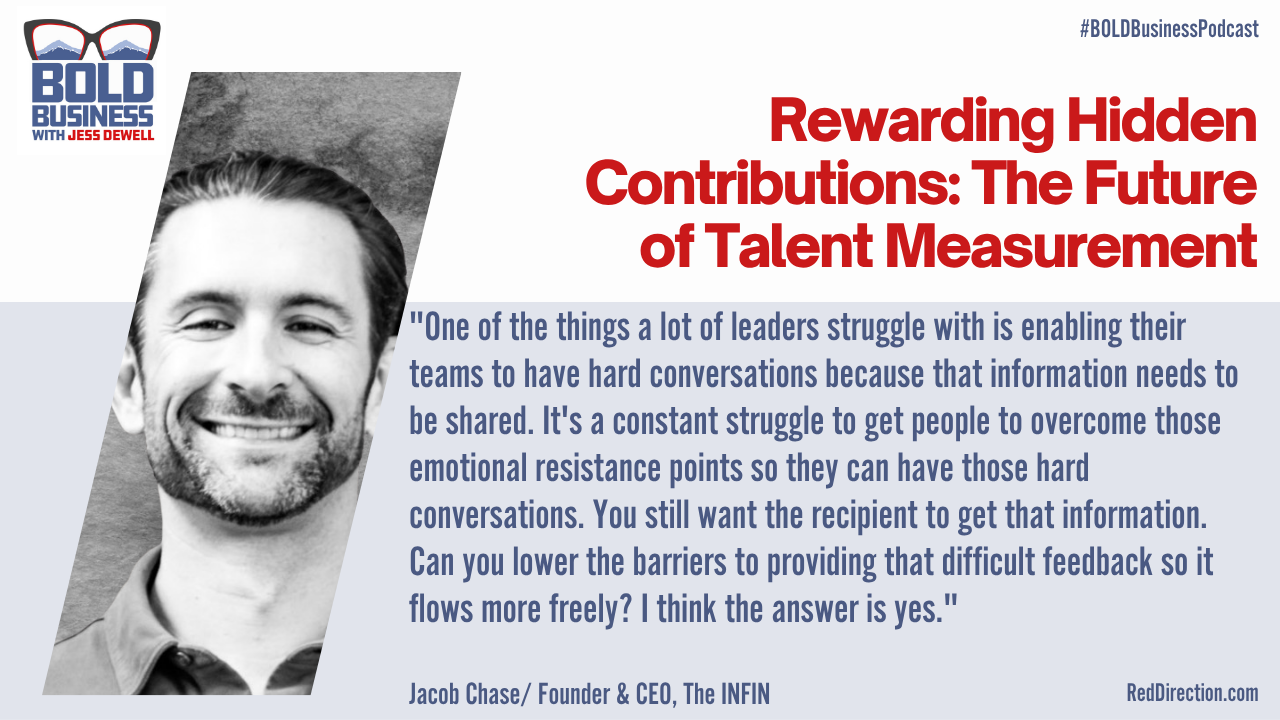
You brought up the stock market analogy. There’s interesting aspects of that where there’s a multitude of diverse perspectives, all driven by self-interest that combine to establish a market price at any given moment. People change their perspectives all the time. Prices reflect that as well. In the peer assessment approach that we have, it aggregates all of the diverse perspectives about each individual’s performance. And you may have a negative interaction with one person, but is that the prevailing opinion? And the changes in the stock market price are moderated appropriately from that perspective. The other thing is that people gossip and they talk and they have opinions and they share those opinions intuitively anyway. Capturing that in an anonymous way protects the person who has the opinion while still providing the feedback to the person who needs to hear it. One of the things I think a lot of leaders struggle with is enabling their teams to have those hard conversations because that information needs to be shared. But it’s a constant struggle to get people to overcome emotional resistance points. But you still want the recipient to get that information. Can you lower the barriers to providing that difficult feedback such that it flows more freely? I think the answer is yes.
Jess Dewell 07:25
I love how you’re describing this in the sense of it’s not just one instance. It’s many instances. It’s not just one interaction. It’s perceptions that are out there. So sure, being able to have these hard conversations, distill it. One person still has to be the bearer of the news. So what matters most to the person who has to receive the news? This could be negative, neutral, or great. Sometimes people are not good at receiving good news either.
Jacob Chase 07:53
Sure.
Jess Dewell 07:53
Hard conversations could be the positive.
Jacob Chase 07:55
It’s like the price is the news. Like that is the aggregate opinion. No one necessarily has to deliver it and nobody has to be the bearer of it. The recipient of it sometimes has to interpret the price, if you will. A lot of times in traditional assessments, you have a bunch of different categories. You have a rating scale for each one, each category to build up into an assessment. In a decentralized assessment, you’re aggregating the collective intelligence to produce the price. And then you are finding the details about the components that make up that value. And so if you rate really highly, you have to get the feedback as to why. If you rate really poorly, you have to get the feedback as to why instead of gathering the feedback first and then establishing your value from that.
Announcer 08:51
Feeling stuck? Like what got you here won’t get you there. The pressure to grow is on, yet the path isn’t clear yet. You don’t have to walk that path alone. This is the Bold Business Podcast. Like and subscribe wherever you listen. Your host, Jess Dewell, is the strategic partner you’ve been looking for, asking the questions that truly matter. It’s time to break the inertia and get the perspective you need to make your next move.
Jess Dewell 09:26
This is the Bold Business Podcast, and the guest today is Jacob Chase, founder and CEO of The INFIN. I’m thinking of your decentralized system tells me what I am worth and that it doesn’t take into account what my goals are if I have stated them or written them down and what I think I am worth. So the hard conversation actually isn’t the delivery of the news. It’s the helping to have the support of the gap. It changes the hard conversation. So me, if it’s just me, the one, whatever that is, and there’s a discrepancy, somebody’s going to need to sit down with me and say, this is our culture here and there is a gap and this is where it is. Or we know you can meet us here because we believe in you.
Jacob Chase 10:13
You can’t have a decentralized system and then totally absolve management and leadership, supporting people in their growth and development. We constantly need leadership and mentorship as we develop our own careers to help us along the way. But what those leaders can be enabled with is they’re not the messenger anymore. They’re helping to interpret. They aren’t the ones delivering the negative feedback because the collective assessment system has already delivered that. This is the aggregate of what everyone thinks. Now let me talk to my manager about what to do about it, what it means, and how to improve rather than relying on them as the channel to hear the feedback from everyone else. An important distinction there that enables those conversations to happen more easily.
Jess Dewell 10:59
Supporting team member growth changes from a task and challenge to understanding and making sure alignment is the best for each person on that team. I’m thinking about being able to grow together.
Jacob Chase 11:15
Another important point that you made is what if it doesn’t align with how I value myself or I view my own performance? One of the important attributes of a decentralized assessment system is that you can’t separate value from the system of which it is a part. Value is only measured by the system of which it is a part. If you’re a really high performer on your team and your company is doing great, your value may be one level. But if you’re on a desert island by yourself, your contribution, your value is different. It has to be connected to the results of the overall system. That’s an important way to link individual contribution to business results and start putting dollars to assessment systems where you can quantify impact in a way that I don’t think you can do with the traditional system.
Jess Dewell 12:05
Where I wanted to go really is in the way that we get in our own way. We get in our own way in our own role. We get in our own way as the leader. Traditionally, it’s like, oh, we’re big enough. We need this now. We’re going to just claw it on and bolt it on there. And hopefully it works out OK. And because it is what it is, we’ll just make the best of it. And being able to redesign the system with which work is done is more important today than ever before. And we’re finding that in our tech stacks. We’re finding that in our decision making. We’re finding that in disruption. And so it feels like a really good time not to say, hey, let’s add more to all of this stuff that we have going on, to say we’re already reimagining. Can we reimagine what we want to be doing and how can this support us as we’re making?
Jacob Chase 12:54
Totally. This is a pretty disruptive moment in all of our careers.
Jess Dewell 12:58
Yeah.
Jacob Chase 12:59
Another thing that’s happening where I think this is growing in importance is individual contribution is stratifying. People who are really diving into the technology tools and the AI capabilities are growing their own personal impacts in a way that is making them more and more valuable relative to the people who may not be diving in as much. And being able to see that and to measure it and to quantify it is only becoming more and more important. And so I think it’s almost going to demand an ability to rethink some of these evaluation practices.
Jess Dewell 13:34
How are you applying this in your own organization as you grow?
Jacob Chase 13:37
Yeah, we use it, right? We dogfood it with the results that we would expect. It’s like there’s an important incentive switch that I think is a little bit undervalued where in a traditional centralized kind of review process, there are clear and specific things you need to adhere to to gain favor or value or self-promote. And there’s an incentive a little bit to maybe hold down competition, create a little bit of a political environment because there is a centralized assessment. But in a decentralized assessment, the way that you gain value is by serving your teams, by serving the people you work with, by being a good colleague, being reliable, the intangibles that really matter for high team performance, the incentive is really pro-social. And we’ve experienced that in my current company, in my previous company, when we were rolling out these type of programs. And it has a dramatic impact almost instantly with how people show up to work every day.
Jess Dewell 14:39
Do you have an exact example you could share with us?
Jacob Chase 14:41
I was working with a client who wanted to understand the impact of a leader on the team that didn’t necessarily have the statistical performance of some of their colleagues, but they were recognized as a leader and an important member of the team, even though their underlying data, and this is a sports team, this was a sports application, the underlying data didn’t necessarily support it. If you have a traditional centralized structure that is only on-field performance data, it missed some of the important selflessness that this individual was giving to the team. And when we ran this kind of decentralized analysis, it was very clear that their contribution was very important to the team, even though it wasn’t captured in the on-field performance data. And so the incentive, and when people saw this, and they saw how this person showed up, and they saw how important that rating was in everyone else’s view, helped them realize that giving to the team in these other ways was more important than their on-field performance. And it created a team dynamic that was really positive beyond just the statistical performance.
Jess Dewell 15:55
What makes you passionate about this? Is it part of leadership that you didn’t like? Is it something you want to do better as a leader today? Is it something else altogether?
Jacob Chase 16:05
There’s two reasons. The first reason as to why I got interested in this. I was running a real estate business a couple of years ago and we had 150 people and I’m losing a little bit of visibility into who’s making a difference and who’s performing. We had an accounts payable clerk who was a rock star by reputation, by results, way above their job description, cultural torchbearer, showed up in ways we really wanted to promote. And the job market said his role was worth $55,000 a year, but I knew that just didn’t represent the impact that he was making. And so it felt very unfair for the company paying him what we were based on the contribution he was making. And so that’s what really set me on the path of trying to figure this out. There’s a fairness element. There is a distribution of resources element that’s really important to me of the best people who are showing up in the right way. They need to be rewarded appropriately and to create a dynamic where that is measurable and is fair, I think promotes a lot of the right behaviors and incentives that businesses want to see anyway. And it also enables the individual to have more ownership and agency and autonomy into their own personal results. There’s the empowering the individual side, but also what we’re seeing in a lot of our implementations is there’s a ton of waste. There’s a lot of people who are being paid for non-performance and there’s a lack of efficiency from a business perspective that needs to be addressed. I think coming at it from both sides aligns with some meritocratic ideals that I have. It feels really good to bring a tool like that to the world where you’re helping people understand how to be top performers while creating real business competitive advantage as well. I think that’s a good thing for the world.
Jess Dewell 17:55
I want to know more about that.
Jacob Chase 17:56
There’s a little bit of a political comparison between communism and capitalism. History over the last 70 or 80 years has shown that if you empower people with autonomy and freedom, they’re going to make good things happen. And I think that same principle can be distilled down to within an organization. We all want to enable our teams to take initiative, to take the risks that are going to make a difference. But you have to have a real system of measurement and reward allocation within that to keep the wheels on the bus. And I think it’s a big step forward in allowing companies to enable their people for top performance while incorporating safeguards of mitigating the risk of people doing stupid things too, because there’s a shared accountability, a shared upside and downside. When people have real skin in the game, they make decisions commensurate with their own risk tolerance and optimize for what each person is willing to do without forcing anything, without centralizing it, without controlling it in an unnecessary way.
Jess Dewell 19:05
So when you say centralized, there’s a strong theme of too many rules that hold us back.
Jacob Chase 19:11
For sure.
Jess Dewell 19:12
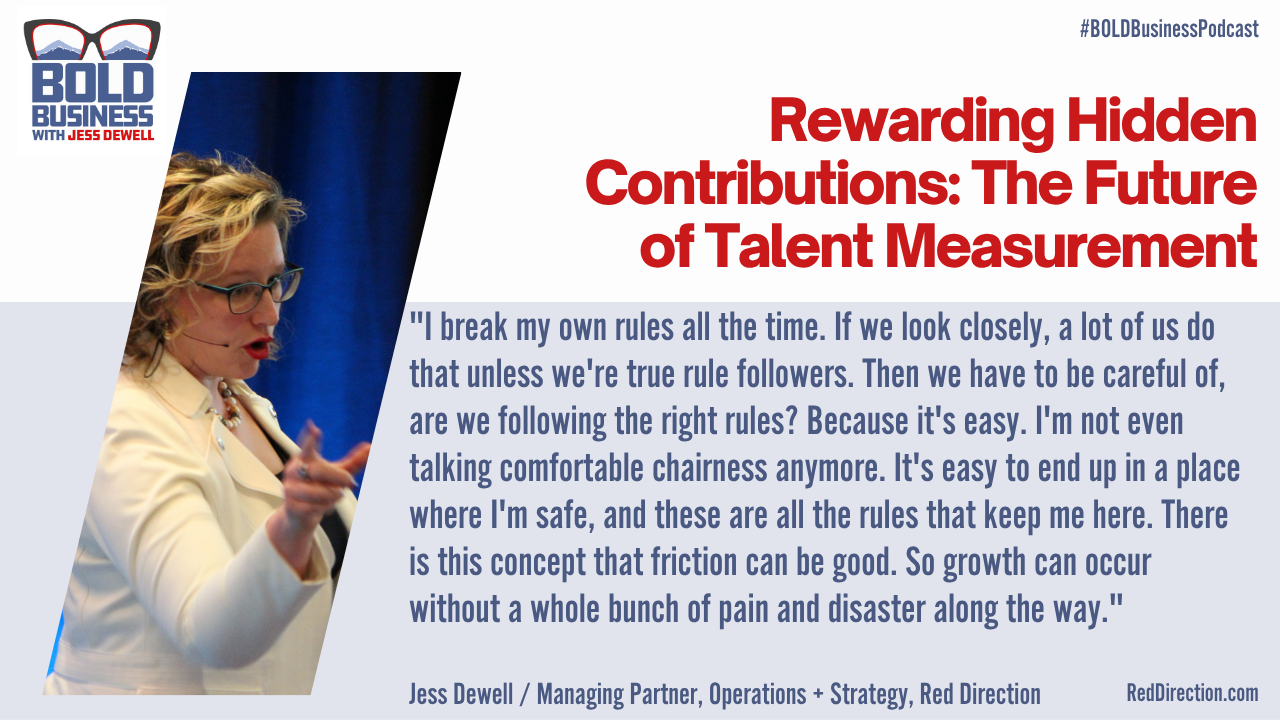
It’s easy to end up in a place of this is where I’m safe and these are all the rules that keep me here. And there is this concept of friction can be good so growth can occur without a whole bunch of pain and disaster along the way.
Jacob Chase 19:26
Sure.
Jess Dewell 19:26
We’re talking in these broad strokes, and I appreciate that you called out fairness and the way of calling out fairness of, hey, this is the way our system works. This is the way large organizations work. They kind of want to change, even though for whatever reason, they’re changing it the way that they are. Some people might be saying, and they’re not. And that feeling is real. Being able to have a new way to look at things and say, if we know what we want our culture to be, but our culture is defined by too many rules that people can’t actually get anything done, whatever those rules are. And that’s different than rules of engagement, I think. So I want to make a slight differentiation there. That might be a fun place to talk for just a second because we want to be able to creative. We want to make our job easier. We want to serve and get to the solution of our contribution in a bigger system organization than otherwise.
Jacob Chase 20:17
We talked a little bit earlier about alignment. And the only real rule is rewards are based on increases in shareholder value. And it’s tough for a business to argue with. Outside of you have to maintain compliance in a strict and centralized way. You have to legal up and up and those kind of things that those still have to be maintained centrally. But if I’m going to take initiative and my initiative is actually increasing the value of the organization, and that’s really the only thing that I’m bound to, you know, in an extreme sense, then you know that you’re never optimizing locally for your environment. You know, you’re never doing things that are contrary to the organization’s interest because it’s against your own personal interest. And you can then feel a little bit more comfortable about enabling people to do things that, as long as it’s increasing the value of the organization, should be granted. And that’s the fundamental difference between capitalism and communism again. Whereas in the capitalistic society, you go do things, you have an economic incentive that grows the overall pie for everybody. It’s like, great, do your thing. Whereas then if things get too rigid and controlled and structured, then growth gets stagnated on an individual and on a collective level.
Announcer 21:36
If your week feels like you’re being pulled from one demand to the next, this is for you. The Daily Grind is the number one killer of business instinct, pulling you and your team away from your vision. Reclaim your strategic edge with the Present Retreat. This free guide from Red Direction is a simple, powerful framework to carve out the space you need to filter out the noise, make the right decisions, and lead with clarity. Visit presentretreat.com.
Jess Dewell 22:05
I’m your host, Jess Dewell. You’re listening to the Bold Business Podcast. Today, I am talking to Jacob Chase, the founder and CEO of The INFIN, where we are talking about empowering our teams and creating shareholder and stakeholder value. What’s the biggest lie leadership teams are telling themselves when they hit these strategic ceilings and don’t address the way they’re making decisions or allocating salary resources?
Jacob Chase 22:30
Let me answer it from a personal perspective. I had this accounts payable clerk and I was trying to figure out what was he actually worth to our organization based on contribution. I had to realize and accept that I didn’t have the answer myself, that my executive judgment wasn’t enough to get the answer. And whatever process that me, the executive, wanted to put in place in order to get the information, it wasn’t going to work because the value of this person was based on the opinion of everyone who was working with him and the value he added to them. And I was a few layers removed. I didn’t depend on him for much directly. And so I wasn’t the right person to judge that contribution. Okay. Carrying forward that logic, a decentralized assessment system is really an answer here that I have a viewpoint, but my viewpoint isn’t the only one that matters. And it must be combined with the rest of the viewpoints in order to come up with a collective judgment. That’s the core mistake that leadership often makes thinking they know best rather than relying on the perspective of a lot more people in order to produce a collective judgment.
Jess Dewell 23:45
So the company Gore-Tex, they actually went to a decentralized organizational model back in the ’90s. They were one of the earliest organizations that I had first heard of that did this and did it successfully. I’m like, wait, I’ve heard this before. I understand this before. Is there enough similarity that I can just say other people might have heard of this? This would be a great thing to bring in for some context to bring them up to speed quickly.
Jacob Chase 24:07
There’s some unique features about the Gore-Tex culture that has enabled stability for a long period of time with this decentralized, no titles, you better take initiative and go do things in order to be integrated here that aren’t really replicated in most other organizations. Gore-Tex has a certain element of leadership that has fostered this culture intentionally, and it’s become stable. There’s other examples. Early in Google’s journey, when they had a team of a couple hundred engineers and they decided, okay, no bosses. And it didn’t work. The decentralization didn’t have the core infrastructure to keep it stable. Our approach is trying to be that infrastructure that doesn’t require the cultural adhesive to keep it sustainable.
Jess Dewell 24:52
I did not know when I brought this up that Gore-Tex was a unique scenario. I remember being excited when I read it and every two or three years it pops into my head because of some conversation that I’m having. And no wonder it’s the only one. Okay. Got it. There’s not many that I’m aware of…
Jacob Chase 25:08
…that really sustain that model for a long period.
Jess Dewell 25:11
So only one, meaning there’s so few, we don’t know who they are yet. Any of you listening, please tell us because now I want to know. And we both want to talk to you. Would that be fair to say, Jacob?
Jacob Chase 25:21
Totally.
Jess Dewell 25:22
So this actually is interesting because I’m thinking about relentless clarity, the pursuit of relentless clarity. And that means we have to have all of the time. And in a world where there’s so much stress and so much attention and so much effort that it takes to just stay focused, how do companies in your experience and what do they gain from your decentralized system so that they can reduce the drag, they can reduce the fatigue when they’re thinking about adding something like this and re-imagining the way that they’re working together and proving the value to the company?
Jacob Chase 25:57
So to the kind of this relentless clarity construct, a lot of it is making sure that you have current and accurate information about yourself is like making sure that you know, the impact that you’re having with everything that you’re doing. Because right now, maybe I’m late to a meeting and everyone is really upset that they’re sitting there for 10 minutes. But because I’m the boss, no one says anything and I just don’t know any better and I’m not really paying that much attention. And no one’s telling me. But if there’s a system that I have that lets me know that was the response from other people’s perception. And great. Now I’m aware of it. Now I have greater clarity. Now I can do something about it because I just wasn’t aware or wasn’t focusing energy and attention there, proportionate to the impact that it may have been having on others. As far as the aspect of a new system, a new platform, no one wants any of that right now. What you’re really doing is you’re getting rid of a major drag instead. Instead of our twice-annual reviews that consume two weeks of people’s time and completely distract us from our regular work, what you have instead is a very simple feedback loop of, I’m going to input a couple observations that are very low touch, that is prompted to me by the system, that is completely contextual based on my relationship with this person, based on our jobs, our roles, our responsibilities. And in doing that, I also receive information about myself. There’s a feedback loop that can be a couple minutes a day to keep the network current. What’s the state of everyone’s performance, as well as keeping me informed on those day-to-day things that matter and make a difference. Instead of a massive process that everyone hates and people don’t know how to act from and get very temporary value from, you’re replacing it with a very small daily habit of input a little bit of information, receive information about yourself, while building kind of the full profile.
Jess Dewell 27:50
I’m thinking about what are the skills that you have found that are the hardest to measure yet return the most value to a company and its stakeholders?
Jacob Chase 28:00
What’s easy to measure and that most companies are doing very well is the tangible performance data. For a lot of roles, they’re quantified in a way that gives some transparency into individual performance. Obviously, sales teams are the easy one. Other productivity roles, how many boxes are you putting on a shelf at Amazon or how many invoices are you processing for payables or how many customer service calls are you taking? Those kinds of things are easily quantifiable. But what ultimately matters in team performance and measurements of contribution is the intangibles. How do you actually measure the things that aren’t quantifiable, but as people, we see and interpret and appreciate or dislike that make an impact on work? Understanding those intangibles is where the real gains are to be made. You go back to the stock market analogy: it appreciates the intangibles. Every company publishes its financial data every quarter, but two companies with the exact same P&Ls can have wildly different valuations based on the intangibles. Is the CEO a crook and are they in a dying industry? Or is the CEO a visionary, highly credible, great track record, and all those other things that are intangibles? The market captures that through the collective perception of all the people buying and selling the shares. With a decentralized assessment system, you can capture those same intangibles. You can capture the measure of those same intangibles, and then you got to go get the feedback and the specifics as to exactly what they are. But when you can measure them and appreciate them for the impact that the intangibles are having, you can then either address the negative ones or promote the positive ones very directly. And those tend to have a much greater impact than just looking at the numbers of individual performance.
Jess Dewell 29:51
So I’m going to switch to your company and your company’s growth right now.
Jacob Chase 29:54
Yeah.
Jess Dewell 29:55
And as a growing company, have you hit stalls? Have you hit some stalls and what did you do to get through them?
Jacob Chase 30:01
Early on, we had a core construct. I had my own personal experience using prototypes in previous organizations and built a software platform that I wanted. And it took a lot of iterating and discovering to figure out there were some differences that maybe I individually wanted, but the marketplace didn’t necessarily. And there was some doldrums in there that just needed reps, that needed lots of exposure, lots of experience, lots of conversations to begin to hone the product in a way that was more appealing to the marketplace. And it’s brutal. Like when you think you have something amazing and no one else wants it for a long period of time, really pushing through that, being very open to feedback, being very open to change, not being fixated on any ideal I had in my own mind was really important to adapting and evolving the product in a very positive way.
Jess Dewell 30:58
How does your team approach strategic decision-making?
Jacob Chase 31:01
We try to be customer first, and we really want to understand what impact any change is going to have on the customer and making sure that we’re really being a customer-led organization. We’re not really of a scale where we’re that concerned about competitive strategy yet. And so we’re really able to stay nimble, stay close to the customer, and really enable that to pull us forward rather than pushing too much out in the marketplace right now.
Jess Dewell 31:27
So how much time do you spend on your strategic work versus the other stuff? And what does that cadence look like for you?
Jacob Chase 31:33
I have dedicated calendar time each week, Thursday mornings. I need to sit and think about these things for an hour or two. A couple members of my team have a similar type process where we’ll come up with something in a meeting and say, all right, we need to individually stew on this and then collectively bring together our assessment of the problem. Me specifically, every Thursday at eight, go down the list as like, what’s the most important thing that we need to address that requires kind of peace to think through? And that’s a habit I’ve had for a few years now that I think is a really important one to not get lost in running the business and focus on the business.
Jess Dewell 32:11
Mine’s Mondays. I do my strategic deep time on Mondays. Yeah, because if I don’t, I’m like, Thursday’s already full by 10 a.m. on Mondays if I’m not careful. So I love that yours is on Thursday and you’ve got that. I was like, Thursday, that’s so neat. Maybe I could try that. What would that look to be different? These small interruptions to even change our own thought patterns from being too stagnant.
Jacob Chase 32:31
I try to be intentional about matching my work with my energy. I find that I’m best prepared with a week’s worth of things happening to then begin to synthesize that while I still have energy on Thursdays. That seems to work well for me.
Jess Dewell 32:47
That’s awesome. I take a similar approach and mine is it’s got to percolate, and so I have to walk away for a while for the things that I need to do or come up. So, which is why mine ended up being on Mondays. So I appreciate you sharing that. And then my adding to it. So anybody listening can be like, find your way. It’s all the right way.
Jacob Chase 33:04
I think it comes down to matching the task with your energy and trying to structure your calendar around that.
Jess Dewell 33:09
What makes it bold, Jacob, to reimagine culture and make sure our organizations stay focused on value to our stakeholders?
Jacob Chase 33:17
I think what makes it bold is the whole approach. It is a wholesale rethinking about how we evaluate and reward talent, linking it directly to business results and enabling individual autonomy to pursue it with their own initiative. I think it’s a bold change for an organization, one that we’re seeing can unlock real step changes in performance. And I think that aligns very well with the boldness of this podcast.
Announcer 33:53
And that brings us to the close of another powerful and fresh perspective on the Bold Business Podcast. In today’s volatile landscape, growth is a double-edged sword. To truly thrive, you must engage with your strategy, not just react to the day-to-day. Without absolute alignment, your company faces a stark choice. Outmaneuver or be outmaneuvered. Grow or get left behind. Thank you for listening. And a special thanks to the Scott Treatment for technical production.