





A RIGOROUS WEEKLY PRACTICE THAT TRANSITIONS YOU FROM THE EXHAUSTION OF BAD GOAL CHASING TO THE CLARITY.
FROM BUSY WORK ➔ STRATEGIC COMPOUNDING
With Red Direction Present Retreat Methodology, reclaim executive cognitive bandwidth to sharpen Business Instinct and “Good Goal” alignment validated by a 40% reduction in decision-cycle time.
Starting the conversation:
Stepping back to let others lead in their areas of strength leads to more robust and resilient outcomes. Nellie Lester, WS & Co. Advisory, talks about handling change, letting go, and cultivating resilient teams.
Just like knowledge can accidentally become associated with certain people or roles, so can the story of a company. Being able to pull it into the collective so everyone knows, understands and believes in their part of making the story true can transform leadership. This is the human side of leadership and business.
In this episode, you will hear that even as a founder your journey is with others, that everyone around the table builds the organizational story together over time, and what you can do when momentum stalls. Jess Dewell talks with Nellie Lester, WS & Co. Advisory, about inviting others’ strengths to the table for collective success.
Host: Jess Dewell
Guest: Nellie Lester
What You Will Hear:
08:15 How founders’ personal ambitions can create disconnects in teams if open communication and storytelling are overlooked.
- The drive for achievement can cause leaders to overlook the necessity of building strong, supportive teams.
- When founders repeatedly internalize their vision without clearly sharing it, it can result in organizational misalignment or lack of motivation among staff.
- Effective communication is crucial to ensuring everyone within the organization understands and is inspired by the collective mission.
14:45 The value of collective problem-solving during periods of crisis or change, emphasizing humility and shared leadership.
- Crises are best navigated when all voices are brought together, fostering an environment of mutual trust.
- Founders benefit from relinquishing the need for all the answers, instead drawing wisdom and resilience from their team.
- Collective leadership encourages each team member to step into their strengths, enhancing both ownership and outcomes.
20:15 This section highlights the power of inclusive dialogue for co-creating solutions and fostering alignment within a team.
- Listening to different perspectives on the same problem helps avoid tunnel vision and builds a sense of shared ownership.
- Repeated open discussions ensure that each team member is invested in the group’s narrative and action plan.
- Co-creating solutions increases both alignment and the probability of successful outcomes.
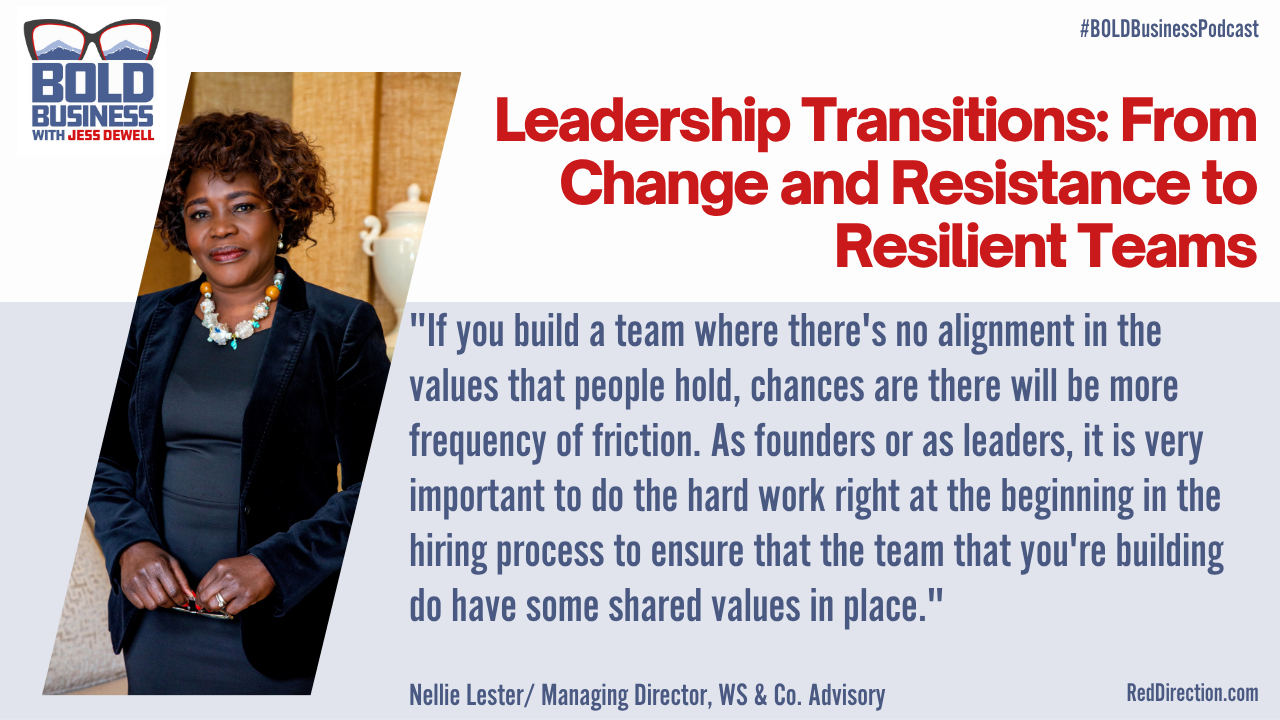
28:10 This section discusses how alignment of values during the hiring process is critical in preventing future friction and ensuring organizational cohesion.
- Picking team members with shared core values is essential to smooth collaboration and long-term synergy.
- When there’s a mismatch in values, workplace friction and misunderstandings are more likely to impede progress.
- Thoughtful hiring not only ensures technical fit, but also emotional and cultural alignment within the organization.
35:35 This portion reflects on the importance of recognizing when roles or relationships within a business have reached their natural endpoint, advocating for thoughtful succession and letting go.
- Recognizing when a person or a process has served its purpose is key to organizational resilience and growth.
- Letting go of the “indispensable” mindset supports a sustainable succession plan and reduces burnout.
- Ensuring others are ready to take on leadership responsibilities promotes a more agile and enduring company.
42:05 It is BOLD to claim humility as a leader, invite others’ strengths to the table, and invest in collective success.
- Leaders who admit they don’t have all the answers create a culture where team input is valued and innovation thrives.
- Stepping back to let others lead in their areas of strength leads to more robust and resilient outcomes.
- Bold leadership is about creating space for everyone to contribute their best abilities for the collective good.
Resources
Transcript
Nellie Lester 00:00
So it’s not so much about control as opposed to being able to influence every part of your organization, even when you’re not in the room, because then they will know that’s the story that we are all collectively building up together.
Announcer 00:20
Every leader needs a trusted partner for the moments that matter. This bold business podcast conversation is that partnership. Your go-to resource designed to break the inertia and refresh your perspective so you can start making moves. Here is your host, an insightful truth teller who serves as the catalyst for getting the right work done and who asks the questions that truly matter.
Jess Dewell 00:46
Tools, systems, processes, structures, pathways that others have done that we’re following to build and grow our businesses are all awesome. What’s also awesome are the humans that make it so. And today with me on the show is Nellie Lester. In this episode, she and I are going to be talking about the human side of difficult conversations, of how it means to work today, of what do we do when we don’t have enough, but we still have to be there for everybody and so much more. And why this is important to you is because she’s solving the leadership transitions of people coming into organizations, people moving through organizations and out to other organizations. She also knows how noisy it is out there and the importance of clarity, clarity for oneself, clarity for the story that one understands and how to listen and find alignment and build a story together with our peers, our co-workers every single day. So as a leadership advisor and strategy development specialist, she is working with executives and managers to navigate complex challenges that face businesses today. In the conversation, you are going to hear us talk about the journey that we’re taking as a founder or somewhere in the organization as our own personal growth is always with others, especially when it comes to the founders. The second thing to listen for throughout our conversation is that when we get together in a room at the table, we get to choose to hear and listen and build our story together. And it’s that story that makes all the difference for our success as a company. The third thing is what do we do when we’ve lost our own momentum and we still have to show up and keep going? Not to mention, we’re going to laugh. We’re going to have a good time. We’re going to share some pearls of wisdom along the way. And I’m really excited to get you into my conversation with Nellie Lester. Tell me what’s been on your heart.
Nellie Lester 02:53
Since we’ve talked last, business-wise, I was invited to be a speaker in Custom Experience Symposium, and I’d never been in a context where people were so focused on their day-to-day numbers. It’s like, how many complaints did we address and how many of this did we do? And so for me, it was really interesting to see from the operational side. These are like financial insurance companies. So they’re looking at how many people, how do we retain our customers that we currently have? And the stories that were being told were very human stories. And the human stories are what they needed everybody to get to the grips with and to understand. And yeah, so that’s what has been mauling in my mind lately of how do organizations, businesses retain the human side of things as opposed to just the numbers?
Jess Dewell 03:48
Okay, so then that’s actually really cool. And makes me think it’s really hard in a world that is changing so fast and the demands seem ever high in pressure to remember that, hey, we’re all humans here. And so what does true self-leadership really look like, Nellie?
Nellie Lester 04:10
Self-leadership in the context of this environment that is bombarded with AI is reminding ourselves as a leader, reminding oneself that at the least you, at the best, you are still a human and you’re not a machine. So to approach each day as thinking about the human and not necessarily too focused on the machine and the numbers, because if you can’t lead the person, it’s not likely that you’re going to have the impacts or the successes that you’re seeking for. Because in the end, the human is the channel through which we do all of that. And that’s what makes us thrive.
Jess Dewell 04:46
Natural. And it’s natural to want to please everybody. It’s natural to feel like we don’t have enough time for our teams as they continue to grow. It’s natural for us to put ourselves last in our work. Doesn’t matter who we are. We go to all the meetings that show up on our calendar and then we try and do our work or try and do our work around things. I almost wonder if there’s a place where there’s the, hey, is it? I don’t think it’s what is natural today. I think it’s more of a where do I show up the best so I don’t shortchange anybody. I want to be present for me and my deep work and my work so that I can be the best I can for you when I show up to you and when we’re working together, right? I don’t want to double book on meetings. I don’t want the last five minutes to have everybody checked out. I don’t want to be coming in hot and having this change up, right? So there’s got to be something that we either bring back or forgot about or is innate that just lost interest, big pressure. And maybe it is. Maybe it’s just we decided it didn’t matter because there’s all this other pressure that took priority.
Nellie Lester 05:56
I can’t tell you how many of the people that I interact with or clients who are just feeling completely burnt out, feeling that they’re succeeding at work but failing at life. And that is becoming a true concern to many. who’ve reached the pinnacle of their careers, their businesses are doing so well. And one lady put it succinctly. They said, if I’m succeeding in one and I’m failing in the other. And another one said, I don’t even want to hear about life balance. What’s life balance? Don’t believe in it. Don’t tell me about it. But the thing is, because we are human, the body can only take so much. It reaches a point where it sends you the signals. And the more you ignore it, eventually it just says, can’t stretch anymore. And what I found to be an interesting answer that we got to through the conversations was to say, Nelly, what if we think about it as going through a tight road? So it’s not so much about a balance, but actually being able to navigate it. Some seasons you sway in one direction, other seasons you sway in the other. So it’s not perfect balance all the time. It’s just being constantly aware of oneself and knowing in this season, this is the priority that I’m engaging in. whether it’s your child at school or a big test coming up or a big tender coming up. That is the focus then. But you’re swaying in that direction with a view that you’re going to realign yourself back again. And that’s what humans do. When we forget to do that, then we lose ourselves in our businesses and in our organizations.
Jess Dewell 07:28
And at that point, it’s not even about our why anymore. It just is the what of resource. I appreciate how you talked about that our body is actually the constraint, physical self. And I know there’s this huge movement out there that’s mainstream today. Let’s just, we’ll just put it into that realm. And even there, we’re running up against limits of what the body is. Think about, I don’t know if you’re into cars at all, performance cars would be the same thing. You have this, right? There’s only a tweak and you tweak. And then there’s this point of you spend all this time to maintain, let alone, and you don’t get any more performance in that shape, in that engine with what it is without changing something bigger.
Nellie Lester 08:16
So this organ, this body that carries us in many ways, if you think about it, it’s what, and there’s intelligence in it. What makes us different from everything else is the intelligence that the human carries. And that’s what gets us into businesses and gets us to do all these magnificent things. But the leader, the founder, sometimes can get lost in their aspirations, in their desire to reach the pinnacle, to be the best at what they do. And the doubt sometimes comes true when we are so focused as leaders on what we see as the outcome that we forget about the teams that we need to build around us. We even forget how to communicate this desire, the goal that we have in the end. So one way that I think about it in the work that I do, I work a lot with stories and metaphors. And one way is to think about the organization as the body and communication as being the bloodline that carries the nutrients, the oxygen to all the various parts of the organization. And if you as a founder fails to communicate, it means that there is It’s a dissonance within the organization, within the business. So what as being your aspiration, you don’t understand why other people are not getting it. And that’s because you told yourself the story so often that you think everybody should get the story, but they haven’t bought into the story. They see the end that you’re talking about, you’re hopping about every day, but you’re not telling them how step by step, how they would get there and what their role is into that process. So I think the leader suffers in body when they begin to feel those stresses of not being understood, of not being supported, of people not giving the answers that they’re looking for. Because for them, it’s crystal clear. But the others don’t see it because they’ve not told the story so that the others can own the story.
Jess Dewell 10:02
So I’m looking on the outside, looking in. There’s a consultant coming in myself, right? Coming in and seeing this and listening to what you’re saying. And one of the things that always comes to mind is how much of a control freak is this founder? And what I think I just heard was the answer to that. We are control freaks because we’ve told ourselves a story and nobody else gets it to the level that we have because they haven’t heard it as much. They’re missing that piece to get there. Or they’re on the boat and they’ve agreed to it all and they’ve hitched their wagon to ours. They’ve only heard it a fraction of the times that we’ve been saying it to ourselves. Does it have everything to do with being a control freak?
Nellie Lester 10:40
Well, I think it has to look to lead. You have to have this burning desire to do something different. That’s why we start a business. That’s why we want to get things done. So it’s not like anything is wrong with one. It’s really one being aware that where they are might not be where their teams are. And it’s that awareness that makes for a leader who is resilient and who can succeed and have impact in the long run because they are looking at all the other aspects that could help them communicate that message and to communicate them to the extent that every member of the organization or the business understand it. I don’t know if you’ve heard about the story about the janitor at NASA who was asked, do you do here? And their answer was, I helped get man to the moon. So if The janitor at that level was so attuned and aligned to the mission of NASA that they just didn’t think about their job as the cleaning part of it. They said, my being here is quite important to the whole. And the fact that I’m here is assisting in getting man to the moon. And so if you’re a leader leading your organization, to the extent that every member of the organization wakes up with that clear story, we’re going back to the same story. How well do they understand your story and how you are and what their part in getting everybody there? I think to that extent, then one is able to not be in control, but to influence. So it’s not so much about control as opposed to being able to influence every part of your organization, even when you’re not in the room, because then they will know that’s the story that we are all collectively building up together. They’re in every corner to seek to answer to every external or outside person asking about your organization. Any member of your organization can answer for you what your story is collectively.
Announcer 12:38
Feeling stuck? Like, what got you here won’t get you there. The pressure to grow is on, yet the path isn’t clear. Yet. You don’t have to walk that path alone. This is the Bold Business Podcast. Like and subscribe wherever you listen. Your host, Jess Dewell, is the strategic partner you’ve been looking for, asking the questions that truly matter. It’s time to break the inertia and get the perspective you need to make your next move.
Jess Dewell 13:14
I’m your host, Jess Dewell, and today, Nellie Lester, Executive Leadership Coach and founder of WS&Co, is with me on the show. There are some stages to get from where we are today to that, and then to maintain that clear story that everybody understands every day. There’s effort involved. And I’m curious for you, if the perception of the founder or the owner or the leadership team is control from, that’s the perception that is coming out. We have to control everything. And the leader, founder, management team is saying, we’re just setting out the boundaries because this is the way that it works here. And they’re coming out as rules instead of standards or goals or ways that we move together, right? So when that gap is closing, why is it going to feel messy on both sides? Not because it’s bad, but because it’s different. And we can feel that different in our body. Feel it. As the founder, we’re going to feel the changes. What does that feel like in our body? Let go of ego, delegate successfully, or there are all of these things that we could say about it. There’s the deal though. We want that. And the effort and the action is going to look the same, but it’s going to feel also. Going back to that, everything in our body, right? Have you been able to identify or do you have a sense of the experience in the room with a founder that is in the middle of that change and knowing that they’re confidently moving toward, we all know what we’re doing here and can claim it and they are excited about it.
Nellie Lester 14:46
I think you’re referring to a context where there is almost crisis, crisis management, there’s confusion, there is a need to respond. So a founder is dealing with everything. How are companies or founders dealing with that? I remember in the context in my business at the time, one of the things that I learned through that process was not to be the one with all the answers and to have built in the trust and the confidence for everybody to be part of the solution. In that way, the answers are coming from everybody else and not only you as the founder, that everybody’s pointing at you to say, what do we do? It’s almost saying this is the opportunity for us to be leaderful. Leaderful meaning each one of us is a leader in the area where we are. So how do we bring all of this together so we have collective solutions? So when we find collective solution, then it does take away that pressure of control. It takes away that pressure of ownership and saying, oh, we do this because we were told to do it, because everybody’s bringing their best to the situation. And I found that really helped us in that time that even when we opted to not cut down staff members, we agreed collectively to say, let’s cut down our pays to each other, but let everybody get something and keep everybody around the table. So I think when this crisis comes, and it could be political, it could be the weather, it could be war, you as a founder member really need to put your team around the table and say, we are in this together. How do we find the solutions? And it calls for a lot of humility as well to put ego down and say, I don’t have all the answers, but we have all the answers around this table, perhaps.
Jess Dewell 16:35
The answer will come from us all. Yeah. There’s belonging is what comes to my mind. Although that’s been on my mind a lot lately. So I’m probably going to tie everything to that. So just hang with me a little bit. So I read a new book and one of my favorites is Good to Great. And it’s on a shelf. Another one that’s on that list is the four disciplines of execution. Every time I reread those books, it’s like I just came out of the class and I’ve got fresh eyes. And that’s all I see the world as those concepts. And it’s kind of, and it’s fun. And there’s actually an awareness. So I know every time I read a book, it’s like deciding I want to buy a red car. And I’m going to see cars on over. Yeah, exactly. True. And so I think one of the things about that passion and one of the things about the desire and bringing everybody together is that we all have come to the table with a different book. And that’s why the solution is among us. And maybe from a few different perspectives, a few different seats, because between them all, whatever that lens is, that’s what we’ve got. I’m talking about the exciting kind. We also have just how life happens. We’re taking care of a parent. We have a sick child, a sick dog. We are, we’re finding ourselves in another difficult situation outside. Maybe we put too much stress on our body and we have to do some medical stuff for ourselves or our partners at home or whoever lives under our roof with us, right?
Nellie Lester 18:03
We don’t know. And it’s also about being aware of what’s in our control and what’s not in our control. And so the things that are internal to the business is in our control. We can decide what resources we are allocating, what systems we’re getting in place, what additional stuff we are acquiring. External things, however, are not in our control. So we don’t know when the climate is going to. We just had a recent storm that came earlier than expected. That’s nobody’s control. So many businesses are struggling because of the straits being closed. Goods are not getting through. So as a founder or a business owner, what do you do in those contexts? To use another metaphor is to say you have to think about yourself almost like a lighthouse, right? So a lighthouse and the storm is striking. It’s not you fighting the storm. It’s just you keeping the lights on to make sure that everybody stays clear on what the direction is. So you are helping clarify the fog for everybody. That is your role as the leader. is not rejecting what is happening outside, but simply saying, I’ll be, I’ll provide the light to show that’s where we are going. The storms are all around us. It’s not in our control, but that’s where we are going and we’ll keep the lights shining so that we are not gropping in the dark and not knowing where the end might be. I really liked the idea of sitting down at a table.
Jess Dewell 19:28
I know one of the things that I do with clients and I actually do just when somebody needs something, sit down. I call it a business base camp. What’s going on? What’s the priority? Where is the block as it is seen, felt, and heard today? What is the goal? And then sometimes saying it out loud is all that’s necessary, right? I really like the concept of the base camp because it’s a place where we get to take stock left? Is there anything we need to collect? What do we not need anymore? Oh, how about this, Nellie? What if every single meeting just changed to that? We’re not having meetings about progress. We’re having meetings about where are we at? What’s going on? And how do we get out of our own way? What do we need? What do we need to let? And the biggest one, what do we need to let go of? And having the courage to say that. I don’t think anybody wants per se.
Nellie Lester 20:18
We tried it. It’s kind of time to say it didn’t work. What’s also beautiful about being around the table, being around the company is that you get to hear everybody’s view on the same issue. You are all focusing on the same issue. And I’m hearing what Jace is saying about it. I’m hearing what Sarah is saying about it. I’m hearing what Bill is saying about it. And the more we do that, the more we are building a shared story together on how we are going to solve the problem. Because oftentimes the wheels come off when I’m going away with my own story, thinking that’s the solution. But because I haven’t shared it, I haven’t communicated it, it might be taking us away from where we need to go. So the idea, the concept of being around the table and everybody having their go at the issue is really a wonderful way for a founder or a business leader to get the team together and aligned to solve the problem or to provide solutions, I think.
Jess Dewell 21:16
It takes a huge amount of, oh, dare I say it, vulnerability to do that, though.
Nellie Lester 21:22
True, because you’re sitting on that big chair and you want to be the top dog. You want to be the leader. You cannot be seen to be weak. But I think the best leaders are the ones who ask questions, who ask good questions, as opposed to seeking to provide the best answers.
Jess Dewell 21:39
It’s almost like a king in a hose more than a bottleneck, right? It’s going to happen. Stuff’s going to happen. And people are going to go around you to get the job done because they understand the objective. Even if it’s going to be harder than it needs to be for whatever reason. I would agree that there are times. And I can say that I’ve gotten in my own way. And I have been the kink in the hose of ideas and workflow and energy in projects and organizations. Whether as a leader, as a partner, as a not silent partner. as an advisor, sometimes that is the hardest thing for us to see from the outside looking in. We can talk it, we can see it, we can say it. And it comes back to that awareness that we were talking about at the beginning. And that’s where I think having everybody around the table, taking stock in a way that’s not just updates, but actual, we’re here to do a thing together and make sure we’ve got the right things and everybody knows what’s happening next. Well, it’s not a speak now or forever hold your peace. It’s a we’re here to remove the obstacles because there’s a big hole across it. Sometimes we need to fix the bridge before we can cross it.
Nellie Lester 22:49
But isn’t that what leaders do is also helping to remove the risk obstacles along the way and providing a platform for people to be able to say, we’ve hit a block. How do we remove this? Then the leader has to say, OK, if that’s a roadblock for you, how do we get that out of the way? collectively deciding on that. And the more you de-risk the project, the more you increase your chances of succeeding at it. So it’s not dropping the project altogether. It’s simply saying we are committed to this project and we are going to do everything that we can within our means to be able to remove all the risks associated with it. And if it’s still viable, then we go.
Jess Dewell 23:30
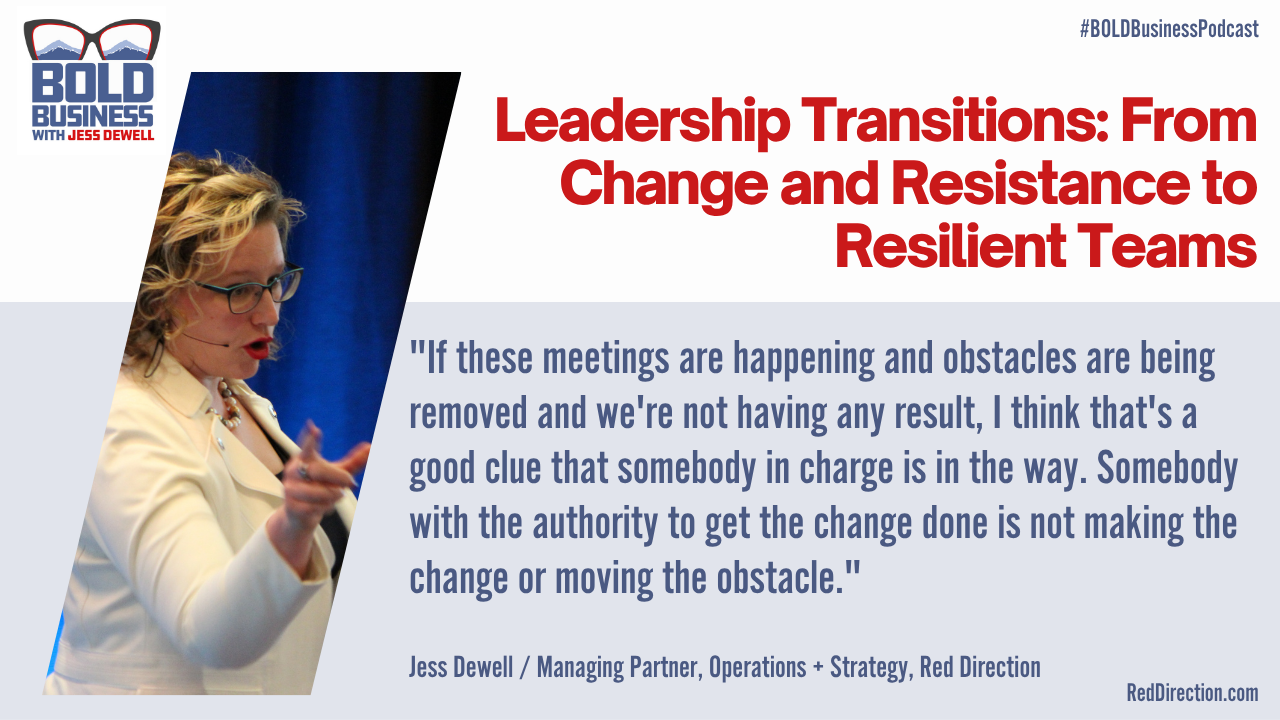
And that’s almost just to verify along the way versus having blind trust. And that’s also something where I think that kink in the hose or the bottleneck, whichever resonates best with our people watching us or listening to us. I think that’s a really important piece too, because people might be saying something without actually saying it because of the way communication is expected or because of unwritten agreements that we have in the workplace. If these meetings are happening and obstacles are happening and everything seems to be moving and obstacles being removed and we’re not having any results, I think that’s a good clue that somebody in charge is in the way or not even in charge. Somebody with the authority to get the change done is in the way and not making the change or the statement or the moving the obstacle.
Nellie Lester 24:16
Would that be a fair statement? Absolutely. Because if the context remains unchanged and you’re doing all of this and you still can’t get any movement at all, then obviously you are the problem. You are the obstacle. Also, there are contexts where people have solutions, but they’re holding them close to their chest because they said, oh, I don’t want to be the one who’s going to say this. I could be shut the door. And that’s maybe because as a leader, you’ve created an environment where there’s no safety. So I don’t feel safe enough to voice my concern for fear that I might be reprimanded or I might be shone the door. So again, the question to the leader is, how do you build safe spaces where people can bring their views, their ideas, without a fear of being reprimanded or penalized in any way because of what they’re disagreeing with the leader, so to say. And I think those that do better, organizations that do better, businesses that do better is the ones that have managed to build that level of trust within the teams that you work with so that people are able to speak their minds without feeling the concern of I could be outcasted for it. And when people go silent, you need to be worried as a founder or a leader.
Jess Dewell 25:28
So what is that? What is a step, an initial early step? Okay. I’m doing everything people are asking and nothing is changing, right? By the way, that’s a perception, probably not the way it was perceived externally. So I was trying to embody what somebody might be feeling. And so what would be something to try on the early stages to test the environment, to see if there’s some sort of change and how long does it take to, because feedback may be instantaneous, but it also may look messy before it’s useful. So what would that early stage be?
Nellie Lester 26:07
Not an easy one to do if one finds oneself in that situation, but I would say one needs to go back to the story, go and find out what stories we are telling ourselves or telling each other in terms of what the agenda is. And energy back in the room. They say leaders bring the weather. Then it means you have to create the energy in the room to have everybody going back to say, are we telling ourselves the right story? Are we putting together the right things that we need to get this problem solved? What does the end look for each one of us? What is really the essence of what we are trying to do? And that could help those who are silent to wake up again and begin sharing in the story. And in many ways, it does alleviate the pressure from the leader to be the only one who’s carrying the story. So to the extent that you ensure that your team and your members are constantly clarifying and you helping in the clarification of the story, the better it is for the business or for the organization.
Jess Dewell 27:10
So I’m thinking about friction, and it doesn’t necessarily have to be about communication. we’re doing one thing but saying another we’re fixing a obstacle or we’re removing an obstacle but it’s actually not the obstacle that’s preventing us from moving forward but here’s the thing friction is also productive it doesn’t have to mean there’s just stagnation there could be oh we’re learning how to work together we’re refining the edges of our story the kids go here the exclamation points go here the so when there’s this time where we’re facilitating like seasons of our lives that we were talking about. There’s also seasons of, here we go, all in, we’re rowing in the same direction. And other times, okay, we’re in this space. We’re actually doing all of this great work and we’re capturing all of this stuff and we’re all in our own boats. How do you know? And then how do you demonstrate through communication being typically the primary way when you’re in each of those?
Nellie Lester 28:11
Jess, what I think is that one of the challenges or the difficulties that leaders and founders in particular run into is, I would say, blankly is in how we hire, right? And the reason why I say blankly in how we hire is because this often comes when there is no alignment in value positions as well. So if you inherit or you build a team where there’s no alignment in the values that people hold, chances are there will be more frequency of friction. Not that though as founders or as leaders, it’s very important to do the hard work right at the beginning in the hiring process to ensure that the team that you’re building do have some shared values in place because those are the ones that are going to stand you in good state when the frictions come. It’s not kumbaya all the time, but if you’re in a room with people who are aligned in value positioning, then there’s no sense of threat or there’s no sense of some winning and others losing because you all have a shared value and a shared outlook into the world of your kind of perspective. Your worldview is already aligned in some way. And to the extent that you can do that as a leader with spending time with each of your team members to get to understand what’s their value position, what really drives them. I think the greatest job is there, not so much in the operational stuff, because those you can hire for. But in choosing who is in your team, what you do as a leader is managing people all the time. So you might as well hire when you hire at the spot. Isn’t the flip side of this also true, Nellie?
Jess Dewell 29:48
There’s going to be something where it’s, ooh, we’ve got too much rapport. Ooh, here, we’re working too hard to maintain the connection here. Ooh, this person has truly outgrown their time here. ooh, they actually don’t align with us anymore. And it’s been a really good run. Who’s the person who comes to you and says, guess what? This person, and they’ll name their name, no longer gets here. They gotta go. Otherwise we won’t grow.
Nellie Lester 30:16
Yeah. The human issues again, that one has to think about. And in big organizations, maybe it might not rock the boat so much, but if you’re a medium and small organization and you have to let some people go, that’s either an investment that is walking through the door knowledge and everything. So one of the things that I do with my clients, for example, is how to deal with high staff turnover rate, because that’s costly. That’s a very costly process when you think about it, because you are giving it your all. You’re trying to give them all the tools that they need to do the work. They’re giving them all the knowledge about your business. You’re giving them all your time to get them to be ready. So it’s not so easy to just say, oh, you don’t fit the bill anymore, off you go. I think as a leader, you have to think of all those return on investment and the cost implications of that. And that’s why my advice is always to say, spend time in the hiring, because if you do that well, you’re likely to get a good team in place. Sometimes we rush for, oh, they got this and that and technical this and they’re very good in that. And that’s all we need. We don’t care. Mary and James and the others can deal with the others. Let so-and-so just do what they do well. The story again, they arrived, but how many casualties did they lead along the way?
Announcer 31:38
If your week feels like you’re being pulled from one demand to the next, this is for you. The Daily Grind is the number one killer of business instinct, pulling you and your team away from your vision. Reclaim your strategic edge with the present retreat. This free guide from Red Direction is a simple, powerful framework to carve out the space you need to filter out the noise, make the right decisions, and lead with clarity. Visit presentretreat.com.
Jess Dewell 32:08
It’s time to get back to my conversation with Nellie Lester on the Bold Business Podcast. What’s coming to mind as I’m listening to you is that concept of too big to fail. Hiring is one of those things in a mid-market company or smaller that typically gets looked at as we can’t let it fail because of this investment. It’s too big to fail. I’m wondering, yeah, so I’m wondering to be able to change that mindset is great. We can talk about hiring and talk about hiring the right people. I’m actually wondering if there are things that we could take away from that whole global banking crisis that when we had too big to fail happening, it was like that phrase that came along. I’m actually wondering, like, there are some things too in the analysis part, in the instinct part. We know we need this person for the next three years for the next cycle with our private equity or our investor or to prepare for the next stage that we’re going to be at, right? Whatever that is. If we look at it with an end in mind like that, if not only how does it change the conversation of hiring, but it changes the conversation of the who and the when inside of a company too.
Nellie Lester 33:23
Just the signals are always there and people always know when there’s a storm coming, right? And again, it’s the culture of the organization where if people have got free or there’s trust enough for somebody to say, I’m raising the flag now. I don’t care what anybody else says, but I’m raising the flag the leadership can choose otherwise. We’re going to be super humans, right? So you have to ask who is for humans or who is for cyborg? So the issue is, if the signs are there, then you have collectively to be saying, how do we mitigate? How do we mitigate and get the best out of this big solution or big problem or big opportunity that’s coming that also has got side effects to it? So I think in thinking about too big to fail, we just have to carry on. We’ve invested too much already. We can’t turn back now. the value positioning again could help in toning down the rhetoric and saying there are some good things in this. We need to find a way of working in de-risking in the other aspects that could be dangerous to us humans if we should.
Jess Dewell 34:31
I do like that and I think that’s important because then it’s not everything is failing. It’s of course not everything worked the way we expected. Is that fair? Yeah.
Nellie Lester 34:44
Yeah. And it comes a point when there’s a breakthrough and that’s fantastic. But it has taken a lot of investment to get there. And so it is with our businesses as well. You start, you try, you fail, you try again. And the more one practices, the better the outcomes might be or more lessons are being learned to perfect the outcome that one is looking for.
Jess Dewell 35:05
OK, so here’s something that’s coming to mind. Tell me what you think of this. Now you know how my brain works. By the end of this, you’re going to be like, wow, Jess. Okay. I knew I was coming on here for a conversation, but really. It’s knowing somebody who’s outgrown. And actually you were talking about how to weave that through the hype and being very clear about that. And then of course, having a space where we are listening because there’s collective instinct that helps us be the best that we can be if we’re really wanting to listen to it. Something you said and it just went away. I’m going to switch gears.
Nellie Lester 35:34
Maybe it’ll come back. Just while you’re thinking about it, not to make you lose the thought. The other thing to think of is in the context of, you know, how do you let go or how do you, you know, one of the things about leaders in the way that I think about it and maybe the way that I think of bold leaders, think about bold leaders as leaders who are also able to, are wise enough to say this has run its course, right? or wise enough to say so-and-so has reached their limit on this area and maybe needs to be graduated or needs to be extended onto other areas. Because sometimes we hold things to be too precious. Me and only me can do this. So a leader that can think beyond the current by saying, if I’m not in the room, who else can do this as well as I can do it? So the succession part of it is also one way of ensuring that there is resilience, sustainability, there is growth that can continue beyond you. And that actually helped me come back to this.
Jess Dewell 36:41
There is a time, everything runs its course and being able to acknowledge it is one thing. Being able to claim it is another. And there are signs along the way. And part of doing all that heavy lifting at the beginning, all of that careful work to do the best, to get the best early, means at that time, some clues will exist for success. Nothing lasts forever. So when these occur, an evolution also is on the horizon for that role, for that project, for that team, for us as an organization. And we treat things like this concept of failing fast differently with experiments that we can do in our business and not as much when it comes to people. And so I’m wondering if there’s a little bit of an overlap there where if we bring thoughtfulness for ourselves and those around us and thoughtfulness to the experiments to fail fast as one approach, that thoughtfulness actually will blend together and be able to be a result of what you were talking about. We know it’s run its course or when things start to go too far out of where we thought they would go, what do we mitigate?
Nellie Lester 37:59
The failing fast and failing early is absolutely necessary. And that’s a good leader should be able to allow for that and almost celebrate that in a way. So if some people have to exit the organization early, then rather that than so, you know, toiling along, hoping that, oh, we are such good people. Let’s just try and find a way. Sometimes it’s actually a favor to redirect somebody to go do something else that they might be better at. And I, for one, you know, I’ve experienced this myself where I thought this was the best job that I ever wanted to be in. And then I get there and I’m like, oh, my goodness, what was I thinking? This was mid-1990s, 2000. The country was going through its own transformation. And here I was in an organization that was also transforming. And when the politics hit us, I was like, my goodness, what was I thinking that I could actually belong here? And when I look back for that season, that was the best thing that would have happened for me because it redirected me to do something else that I enjoy much better than what I was sitting with and thinking, this is the job I trained for. This is what I really want to do. This is what my why, my purpose is. And if you find yourself in those kinds of situations, sometimes it’s good to say, look at yourself in the mirror and say, maybe not in this season. I could pose and find something else.
Jess Dewell 39:23
That’s really amazing. It’s true. And being able to look ourselves in the mirror, being able to really see ourselves, there’s something to be said for that. There’s a song that I really like. It’s a folk song by a U.S. folk singer. His name is John Prine, and it’s called In Spite of Ourselves. And part of the chorus goes, in spite of ourselves, we’ll be sitting on a rainbow. This is, it’s a song about a relationship, okay? I think it applies here because that song could be about the relationship with ourselves. There are two, there’s more than one side of us. There’s going to be the side that knows when we’re happy. There’s going to be the side that knows when we’re sad, when it’s easy, when it’s hard. And those sides show up differently, even though in the end, it’s all up. And I think that not incorporating that too can also lead to burnout, fatigue, frustration, just the pace of growth or the lack of growth or the stamina necessary. And I’m talking about company growth, let alone what we get to go through, our transformation. And so there’s this concept of accidentally the momentum just is gone. In spite of ourselves, we’re probably going to succeed when there is no momentum. It’s real hard. And so what do you suggest for somebody who’s in that place or might not be there yet? And whatever you’re going to say is going to say, oh, I actually might be closer than I realized. Pause and listen to what Nellie has to say.
Nellie Lester 40:47
I would say that the quality of a leader in the environment that we’ve been talking about lies in the quality of their lives as well. So your leadership at first has to be internal before it goes external. So if you’re leading your life, I work with Life360, a framework that I’ve developed in WS&Co that really looks at areas of life. And I believe strongly, because we are humans, that we can’t be all for the business and all for the company and forget about ourselves. There are areas of our lives that we still have to be able to manage and deal with. So the quality of our leadership is really reflected in the quality of our lives. If we don’t, we can succeed for a while, but in the end, we will be under strain. And the problems that most leaders are running through is when that strain arrives, and that’s when the burnout happens, that’s when the wrong decisions start being made. And it’s often from leaders who are very successful, but because there’s that lack of alignment between how they’re leading internally, externally it begins to show. And I think we all need support. We need guidance to have people around us that can help us in these seasons of leading. Because there’s an African proverb that says, if you want to go fast, go alone. If you want to go far, go together. And leaders would do well to take heed to that.
Jess Dewell 42:08
So Nellie, what makes it bold? What makes it bold for a founder to really claim this concept of strategic foundation and seeking out awareness to grow?
Nellie Lester 42:23
Yeah, I would say a bold leader is one with humility. Humility to understand that they don’t have all the answers, but they can hire for the answers, right? You can resource for it. So be having humility enough to step back and say, I’m not the best at this, but I’m good at this. But collectively, we can get to X, Y, Z. I find that helps to deal or help that leader to have much more longevity and also to have much more impact. Because it’s an invitation to others to do the same. If we can mirror what we’re expecting of others, naturally begin to do that as well. They begin to let their guard down as well and say, I’m really good at this. Give me a chance to do this. But if you don’t as a leader, because your ego is so high up, you’ll never know that Sarah is best at doing X, Y and could do it better than you. So I would say bold leaders are those who allow others to shine and to be able to bring their best to this table that you eloquently suggested for all of us to have.
Announcer 43:36
And that brings us to the close of another powerful and fresh perspective on the Bold Business Podcast. In today’s volatile landscape, growth is a double-edged sword. To truly thrive, you must engage with your strategy, not just react to the day-to-day. Without absolute alignment, your company faces a stark choice. Outmaneuver or be outmaneuvered. Grow or get left behind. Thank you for listening. And a special thanks to the Scott Treatment for Technical Production.