





AS A BUSINESS OWNER, IT’S DIFFICULT TO DO THE RIGHT WORK AND GUIDE YOUR COMPANY TOWARDS ITS NEXT BIG INITIATIVE.
From Fragmented Focus & Reactive Resilience ➔ Unified Intent & High-Performance Rapport
With Red Direction Business Base Camp Consultation, learn how to implement and handle processes to meet your business’s specific needs and better understand your market.
Starting the conversation:
From billion-dollar boardrooms to scrappy startups, why do even “people-first” brands get workplace relationships so wrong — and how can you avoid being next? Jesse Weinstein, Partner at Phillips and Associates, PLLC, discusses how impact is made by focusing on the people performing the core work, and recognizing their essential role in risk management and organizational success.
Workplace disputes are high-stakes for growing companies. Communication prevents ignorance. And, it starts at the top. The executives in your company are responsible for dedicating support to employee needs and the ability to respond constructively to feedback.
In this episode, you will hear that every company can improve internal communication with channels to address employee concerns and how to begin, how established consistently used guidelines find and elevate the truth, and why it is important to proactively have the right resources available to employees. Jess Dewell talks with Jesse Weinstein, Partner at Phillips and Associates, PLLC about what growing companies need to know about high stakes workplace disputes.
Host: Jess Dewell
Guest: Jesse Weinstein
What You Will Hear:
05:00 Growing companies face unique risks as they scale and must be diligent about recognizing internal issues that impact employee rights.
- Problems commonly arise early in a company’s life when there is disorganization and lack of established HR resources.
- Rapid growth can create internal pressure and cause lack of oversight of internal relationships, making space for inappropriate behavior.
- Fast-growing startups may prioritize external goals and product sales over developing strong processes for employee protection.
07:45 Even small and midsize companies may eventually face the same employee rights concerns as larger organizations, so early investment in intentional culture and communication is critical.
- Focusing only on growth without equal attention to internal systems may lead to problematic gaps.
- Early-stage businesses that ignore relationship-building and culture risk future issues as they scale.
- Companies should challenge the idea that HR and employee protections are only necessary “later.”
10:50 Clear reporting channels and visible leadership engagement are essential for protecting employee rights as organizations expand.
- Reporting mechanisms should be widely understood and trusted by employees at all levels.
- Organizational culture must be shaped from the top down to set standards for acceptable behavior and accountability.
- Leadership’s visibility and approachability reduce the risk of misconduct being hidden or ignored.
26:45 Well-intentioned company policies or public values may be undermined by internal practices, risking both reputation and employee rights.
- Public-facing mission statements or people-first promises must align with daily management decisions and internal culture.
- Short-term prioritization of revenue or rapid scaling easily overrides employee protections if left unchecked.
- When internal practices diverge from stated values, organizations open themselves to legal challenges and internal distrust.
34:50 Proactive steps by leadership to address and resolve workplace issues reduce legal exposure and foster a trustworthy environment for employees.
- Investing in internal policies and processes saves organizations from costly lawsuits and negative publicity.
- When leadership handles problems transparently and early, employee trust and organizational stability increase.
- A workplace committed to addressing issues directly sees better collaboration and reduced turnover as a result.
37:10 “It is BOLD to say that you are for the people and mean it.” Jesse Weinstein
Resources
Transcript
Jesse Weinstein 00:00
Every new employee should be told there’s a zero tolerance policy for harassment, wrongdoing, mistreatment. We don’t tolerate that. The messaging needs to be screamed from the top down because culture is everything and it trickles down from the top.
Announcer 00:20
Every leader needs a trusted partner for the moments that matter. This Bold Business Podcast conversation is that partnership. your go-to resource designed to break the inertia and refresh your perspective so you can start making moves. Here is your host, an insightful truth teller who serves as the catalyst for getting the right work done and who asks the questions that truly matter, Jess Dewell.
Jess Dewell 00:47
Over the course of his career, Jesse Weinstein has helped secure tens of millions of dollars for clients and has built a reputation for taking on powerful institutions in cases that often unfold both in court and in the public eye. This New York-based attorney is representing employees, executives, and whistleblowers in disputes including sexual harassment, assault, and discrimination as well as retaliation. This focus, it’s a significant focus on matters like what’s going on in the entertainment industry as well as the Me Too related cases. He’s a former Bronx prosecutor and U.S. Navy veteran and he brings extensive courtroom experience and results to complex litigation. And that comes out in our conversation. And I’m going to tell you right now, this was a conversation I have been looking forward to because we get to see things from a different perspective as business owners and as management teams of mid-market companies. Here we go. This is what’s really important. Are we truly walking the walk? And that’s what this conversation is about. I’m talking to Jesse. throughout the show, and I want you to be listening for these three things. The first is in every company, intention and effort for communication from the top down is incredibly important. We can’t become insulated. The second thing, it really is about what is true. The truth is the real situation and how we show up in our companies. We can have our own processes and guidelines to ensure truth is always first. The third thing, knowing what the resources are and having those in place for ourselves, for our teams, for our company, and making sure that they are accessible to all. Because in the end, we’re all people, we’re all doing the best that we can, and we may not know what’s going on. Here’s the deal though, it’s still our responsibility. not only as the guide in our companies, but also as a person relating and in relation to the people that we choose to be around every single day. You’re going to enjoy this conversation. There’s much to take away. I can’t wait for you to hear it. Here we go. Your background is law. It’s specifically, I’m going to call business law, and it’s specifically in the relationships gone wrong in businesses. Is that a good summary?
Jesse Weinstein 03:19
I like that definition because it really, we don’t exist as lawyers unless something goes wrong somewhere, right? We meet our clients on the worst day, but I do really think what it boils down to are things going wrong in the workplace or things going wrong in interpersonal settings, right? Not every case I take is an employment case. For example, I’ve had cases with billionaires or high profile people who meet or have met clients of mine in a restaurant or a bar and end up sexually assaulting them. So a relationship gone wrong outside the employment context, but I would say probably 80 to 90% of my cases are things that go wrong at work.
Jess Dewell 03:56
Yeah. And how long have you been sifting through all of the things that go wrong at work with companies and individuals?
Jesse Weinstein 04:06
So I started out as a criminal prosecutor and I spent four years there. And then I’ve been going on eight years doing employment discrimination work and sexual assault, sexual harassment cases, because believe it or not, the mindset and the sort of skill set is pretty parallel being a prosecutor and then also doing what I do. It’s element driven, statutory enforcement. So I would say I’ve been doing like similar line of work for almost 11 years, but focusing on the business breakdown of things and things going wrong for almost eight years.
Jess Dewell 04:36
When you see your clients on the worst day, if you were to look across all of them, is there a phase or a time where that’s common amongst companies that you’re working with? They’ve been in business for this amount of time. They had to quickly reinvent or pivot. There was something in or out of their control that they didn’t take, that they didn’t notice early enough.
Jesse Weinstein 04:58
So in the startup context, right? I think at the height of the problem bell curve, we see bad things happen in a couple of different phases of the company’s life, right? In the very beginning, when it’s a circus and things are getting off the ground, and understandably, everybody’s getting their footing, everybody’s trying to get the routine going, things slip through the cracks. Maybe there’s not an HR person in place yet for somebody to complain to. Maybe there’s not a fully crystallized handbook. Maybe because it feels a little bit disorganized or disjointed in the beginning. It leaves some breathing room for inappropriate behavior, stressors. But then we also see another bell curve of problems forming when the startups do hit the ground running. They find the success, but they grow too fast to actually contain internal problems. I can’t tell you how many startups I’ve seen with brilliant products that everybody in the country and sometimes everybody in the world wants where they have so much work and not enough time. And that leaves a lot of room for bad behavior that because it’s not a it’s not a priority to focus on internal relationships. The priority seems to be focused on external sort of product selling and sales and meetings. Big companies, I see bad stuff happen in big companies all the time and at very different phases. starting at the interview process. People are getting harassed in the interview process. I had a client who showed up with a baby bump to an interview at a Fortune 500 company who was basically like, you should, why did you apply? And they were like, because I’m interested in working here. And the client’s like, yeah, but you’re about to have a baby. Why would you apply for a job right now? Big no-no.
Jess Dewell 06:45
Big no-no.
Jesse Weinstein 06:47
I think the problem that we see with big companies, especially with the very, very employee-friendly laws in New York City, right? Is that a low-level manager in a company with 50,000 people, if they harass or discriminate against a person that reports to them, the whole company’s on the hook. [Yeah.] And then like on the startup world, the CEO is the top person and the fifth person, there’s 10 people in the organization. Everybody’s got access to everybody. So it’s like, that was a very long answer, but…
Jess Dewell 07:17
Actually, it’s really good because I want to go in a lot of different directions. So starting where you paused right there, it makes me think of a screen, right? Or a filter, the bigger the company, sometimes the filter isn’t as fine as it needs to be. And there’s just no, with the amount of words and the amount of people and the amount of interactions, awkwardness is going to occur good, bad, or otherwise.
Jesse Weinstein 07:44
Right.
Jess Dewell 07:45
And so let’s stay there for a minute because I know some of our audience is going to be like, this doesn’t apply to me I’m not big and I’m going to put a big YET yet in capital letters, because just because you’re not big today by your standards doesn’t mean you won’t be. Just because you’re not big today doesn’t mean you won’t have these problems. That’s actually why we’re having this conversation right here. And this is why I wanted you on the show, Jesse, was because I would like to see us shift a little bit. We have the best practices. Oh, we’re a startup, so we don’t have HR and then we get big enough to have HR. Okay, fine. But I think if we start thinking about relationship and our connection differently, it changes what that role actually is for our organization. Does it not?
Jesse Weinstein 08:27
Growth can sometimes be the only engine that everybody’s looking at, but the engine on the outside is just as important as the engine on the inside and vice versa, right? And if you don’t have a well-oiled machine inside, things are going to slip through the cracks that end up getting in the way of growth. Getting big too fast can actually be a nail in the coffin for a startup, especially. And I think that with respect to every case that I have, big, small, medium companies, communication from the top down is a big problem.
Jess Dewell 09:03
How so?
Jesse Weinstein 09:04
Companies. And I’m sure you’ve heard the old trope about HR is not there to protect people, they’re there to protect the company. Yeah. Right. I’ve represented plenty of people, unfortunately, who are in HR who’ve tried to do the right thing. I have respect for people in HR. They don’t have an easy position. No. It’s a stretch of the imagination, but it seems that there is this widespread practice of trying to insulate higher ups. And I can understand the logic behind that. But then when I’m doing depositions, I’m like, what do you mean? You’re the global head of HR. How do you not know when a vice president tells somebody below them that they shouldn’t take pregnancy leave if they want to move up? You know what I mean? Sometimes willful ignorance is not helpful. People in the C-suite don’t necessarily get deposed because HR has insulated them, but also their absence can be a huge point of offense if I’m on trial. I think it can be a really ugly look. Yeah, I do. Jurors are not C-suite people, defense attorneys, judges, and plaintiff’s attorneys like myself. They’re students. They’re people who work in fast food restaurants. They’re people who are teachers. They’re nurses. They’re not people who are nerding out over legal cases like me and my adversaries. They don’t understand the intricacies of the law like we do. What they see, they might as well be seeing on Netflix. And when you see somebody get really mistreated and then you have a C-suite, I know nothing about that, about what’s going on. I had no clue. That’s also not a good look. And that has been a negative outcome for these employers.
Jess Dewell 10:39
Is there an equivalent in the everyday world of making dinner and brushing our teeth and paying our bills that we could relate this to just to understand the actual impact to us too?
Jesse Weinstein 10:50
I think it starts with clear reporting channels. I think that employees need to be assured that these channels are for their protection and that they’re going to land, that their reports or their complaints through these channels are going to land on laps that actually are invested in addressing the situation with an eye on actually addressing it. Every new employee should be told there’s a zero tolerance policy for harassment, wrongdoing, mistreatment. We don’t tolerate that. The messaging needs to be screamed from the top down because culture is everything and it trickles down from the top.
Announcer 11:36
Feeling stuck like what got you here won’t get you there the pressure to grow is on yet the path isn’t clear yet you don’t have to walk that path alone this is the bold business podcast like and subscribe wherever you listen your host Jess Dewell is the strategic partner you’ve been looking for asking the questions that truly matter it’s time to break the inertia and get the perspective you need to make your next move.
Jess Dewell 12:11
You are listening to the bold business podcast I’m your host, Jess Dewell. Today we’re talking to Jesse Weinstein a New York-based trial attorney representing employees executives and whistleblowers in high stakes workplace disputes. Okay. So here’s a, go with me on this. And I actually really like this. I’m actually really glad we didn’t continue past the other part and we’re right here. And that is, so let’s say, oh shoot. And now I just lost it. Give me just a second. Give me the, we’ve got the channels. We’ve got the people actually really care. We’ve got the, what was the last thing you said, Jesse? I’m going to catch it. It’s just.
Jesse Weinstein 12:48
The culture trickles down from the top and it has to be imposed on people from their very first day.
Jess Dewell 12:53
I got it. Standards. So I feel like we have a zero tolerance policy. That’s a rule and it’s an expectation. We do it this way and there’s only one way to do it. Culture to me is a little bit more about standards. And so while there’s these expectations and these rules, hey, don’t pass go, don’t collect your $200, right? If we’re thinking about a monopoly game, that’s one thing. What are the standards that go with that. Because one of the things I know, and you’re a parent of a young person. I’m a parent of a little less young person, but we’re, and as people out in the world, we really don’t like rules imposed on us as adults. I don’t know about you, but I don’t. Like you got to really make me understand why this expectation exists and what makes it important. Now, some things we know, but other things we don’t know that turn into these checklists. And if we have checklists, we get loopholes. So how do we close the gap between the expectation and zero tolerance and what our standards are for our culture so that we don’t have to worry about loopholes in the middle and we actually are all moving in the same direction?
Jesse Weinstein 13:59
Visibility and approachability. I think that is a responsibility of the top. I think that when people feel like nobody high up are looking, that’s where the abuse and the cutting corners and skipping steps happens, right? Now there’s the zero tolerance rule, the black letter rule in the handbook and the rule that everybody knows, right? Right. There are certain intangible things that state very loudly without saying anything that this is the culture behind the rule, right? If you have a CEO that doesn’t know the name of anybody that works on the same floor as them, other than the people that are in their offices all the time, that’s a problem, right? When you see the top dogs intermingling with everybody and approachable, there’s a boundary, right? There has to be a boundary line. There’s a chain of command. We don’t want to lose sight of professionalism, right? Not calling the admiral to fix a leak. Right. But there’s something that’s really powerful that comes with seeing that this person who’s running the whole organization is a person of the people. That to me is a sign that I’m in the know and I care about the culture here. And the person who might take advantage of that absence might think twice before actually messing with something that intangibly is so powerful that keeps that rule loud and proud without actually imposing it on people so expressly. That makes sense.
Jess Dewell 15:26
So the cat’s always around so the mice can’t play? Is that what I just heard you say?
Jesse Weinstein 15:31
Yeah, basically. When you see somebody from the top who’s there, you don’t have to speculate what they’re thinking, if they’re approachable, if they’re sincere, if they’re genuine, people are like, this is the type of person I have to be if I want to rise through the ranks in a place like this.
Jess Dewell 15:47
Yes. I agree with the modeling piece and the way we say you’re right. And it’s the unwritten things. Just because we have something that we have said we do, we could accidentally with one poor interaction because we weren’t fully present or we weren’t fully aware or we didn’t ask the question or we weren’t approachable at an earlier time. And all it takes is one thing, right? And if we’re really thinking about that, the responsibility I’m hearing you say, I’m going to reflect back to you, is people are going to act and do like we do.
Jesse Weinstein 16:26
People are humans. I think we complicate things, especially when we start dealing with sophisticated folks and lawyers and super professional types. But this is where the doing arts and cerebral thing becomes very effective in the lawyering context because we’re just people. And as lawyers, we are trying to figure out a puzzle. The other side knows the answer. And we’ve got to look at human interactions to get to that answer. That’s really what we’re looking at.
Jess Dewell 16:52
How many different perspectives can you have on what the right thing actually was for a situation?
Jesse Weinstein 16:56
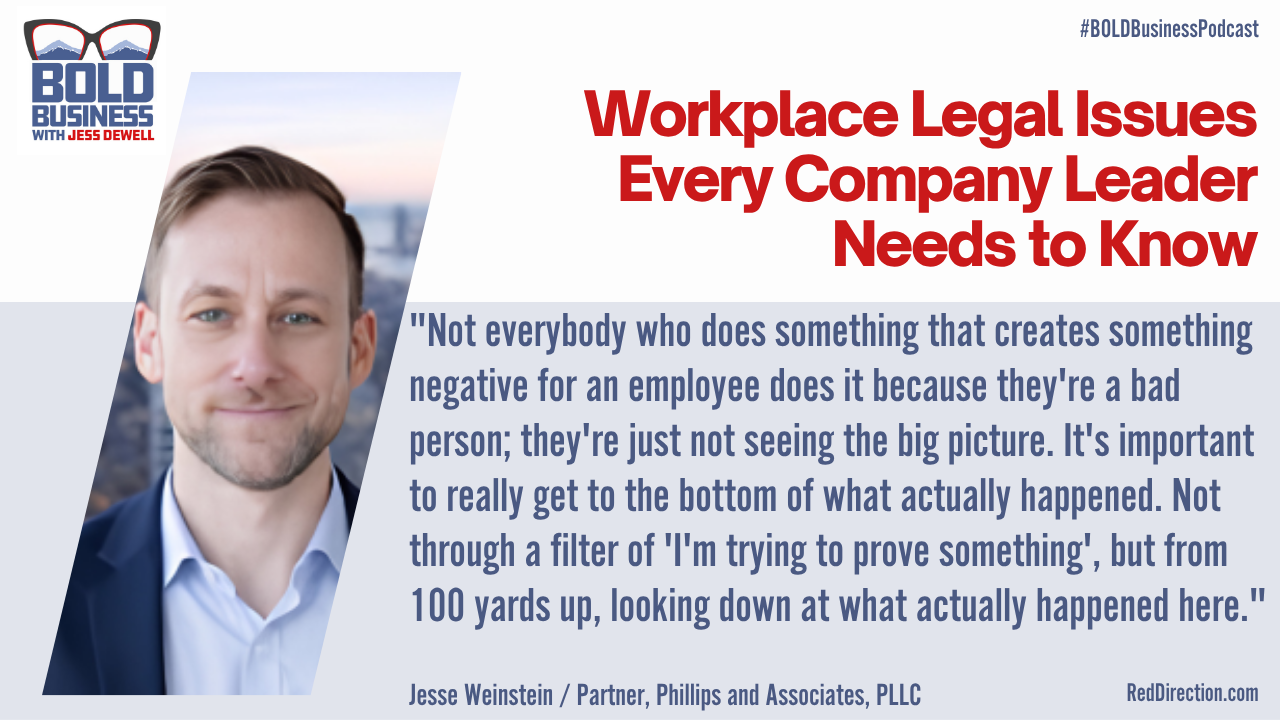
It all starts with the truth, right? They say the truth, sets you free. I will not take a case just because there’s a big name on the other side. There are plenty of people who do the work that I do by just filing a case because it has a big name on the other side or a big company on the other side. I think that’s my first line of analysis is like, what really happened here? Let’s get to the bottom of this because people who make mistakes do them thinking that they’re well-intended and not everybody who does something that creates something negative for an employee does it because they’re a bad person. I think to really get to the bottom of what actually happened, not through a filter of I’m trying to prove something, but really from 100 yards up looking down, what actually happened here? That’s the first, I think, question.
Jess Dewell 17:42
And I think it’s really important protecting that truth and ensuring that integrity is in place is paramount because in the end we are all human.
Jesse Weinstein 17:51
Yeah, that’s right.
Jess Dewell 17:54
I agree with that 100%. Can I ask you how many hours a week you work? I know this is a whole other left turn, but I’m like, first, I want to pause because I want everybody to catch up because we just digested a lot. And second, I do have someplace I’m going with this.
Jesse Weinstein 18:08
I would say in office, I’m about 45, 50 hours a week, but my job doesn’t stop there. My emails go off. I have a lot of high profile clients, executives, and I am a lawyer in the private sector. And if I’m not there to assuage my clients’ concerns, somebody else is going to be. Many of my clients are severely emotionally distressed. It’s a very traumatic thing to get fired from a job or to get sexually harassed by somebody at the job or to get sexually assaulted. And so they can spiral if they reach out to the one person who they’re probably talking to more than anybody else in their life and they get ghosted. So I would say probably 45, 50 hours in the office and probably another. I’m usually after I put the kids down on my phone and responding to emails for an hour or two every night. It seems second nature to me. It doesn’t feel so tedious because I love talking to my clients.
Jess Dewell 18:57
I appreciate you brought this up just as like a workflow, work style, because when, while court in process might have hours of operation. The actual real work is done around those hours. And that does happen in a lot of professions, I think, where, yes, there’s work time. Yes, there’s work hours. However, sometimes our work time is dedicated to things outside of our control that make the process move forward, that are important to uncovering the truth, that makes sense to ensure the process truly is protecting those who have been wronged and are choosing to speak up, which by the way, I think takes a lot of courage and the emotional piece. I can’t even imagine the emotional piece. So one of the reasons I was asking about time is that I’m guessing you’re, do you ever just take time for you to stop and assess and look at your caseload as a whole, at your clients that are waiting on you as a whole, at your past cases that have wrapped up to use that information for? Do you have a process that you already do that incorporates some of those things?
Jesse Weinstein 20:13
I’m grateful that I have an amazing team. I have multiple associates and a paralegal that work under me and I have a sizable caseload, but I’m constantly tracking everything I do in our tracking system. And that sort of opens the door for a natural tracking sort of process and analysis of my caseload as a whole. I do look to past cases to figure out what sort of things I can take from what I did well in those cases to do on my current cases. And then the other part of it is when you do these employment cases and there’s liability insurance involved, you usually have the same four or five big insurance defense firms responding on the other side. And so the circle is much smaller than you think. So I look to see how I interacted with an opposing counsel that I have on a current case and a former case. That’s part of my process. And then of course, I debrief, because this job is not just during the day, like you said, there are real-time things. I’m going to tell you a big dirty secret that probably everybody knows. Plenty of employees get lawyers while they still work where they work. Things are happening in real time, which is not always nine to five that they need advice on.
Jess Dewell 21:22
Yeah.
Jesse Weinstein 21:23
And so I’m strategizing with people who are in the lion’s mouth. Yeah. I’m also dealing with time constraints. Sometimes I have to get something back by the next day or there’s impending. So the job is not fluid nine to five. And it requires me very often to look at my caseload. I’m fortunate that lots of people now are calling to request my representation because of what’s out there. But I can’t take every case that comes to me. I can’t help every single person, even if they have a case. I’m referring cases to other attorneys. Interesting. And I make that decision by assessing the complexity of what’s in front of me. If I have multiple press cases going on at one time, that’s something that I could take up a burst of time right up front. And somebody went and had a severance agreement that’s due to be signed in three days. And I would have needed to jump in and negotiate for them that day. So time is a big variable here.
Jess Dewell 22:20
Which means you are really interwoven into the team that you have.
Jesse Weinstein 22:27
I live and die by my team. And honestly, I don’t think enough partners at law firms publicly express their love for the people that support them. But my two associates, the two lead attorneys that have their own caseloads I supervise, the two paralegals that I oversee, they’re incredible. I’m not me without them. And so I also have to keep their workloads in mind too because just because I put my name on a cool case doesn’t mean it doesn’t burn them out.
Jess Dewell 22:56
So I’m thinking about those times that we were talking about earlier where a company might grow too fast or they don’t think they need a function yet inside their business and stuff starts to fall through the cracks. Is it appropriate to call the culture or the way that we work together the soul of a business in your mind?
Jesse Weinstein 23:20
If the people are not aligned internally and they’re not working well together, then the product is never going to be as good as it can be.
Jess Dewell 23:28
So bringing some of that back into this real world piece, what are things that management teams and business owners can do? Maybe it’s one thing, maybe it’s a couple things. Two, as they’re going along, analyzing so that they can find blind spots in this particular area as they’re going and growing.
Jesse Weinstein 23:49
Yeah, I think communication with the team, regular check-ins, I think having an established set of guidelines to respond to common problems, you find the things that you’re good at and you do them the same way every single time. That’s a broad sweep. Is it going to catch every single fly in the net? No, it’s not. Right. But if you have somebody on the team who and to go with your analogy, who’s looking what’s coming at what’s coming from the screen and noticing that these are common problems that happen sporadically, then they should have systems in place to address those issues the same way every single time, as long as it’s effective. I think in the context of employment law and one of those problems being a disgruntled employee, there needs to be a war room mentality. Who’s going to talk to them? How is it going to be documented? What assurances are going to be provided? How is it going to be investigated? And who’s going to know about it? How do we keep balanced confidentiality with keeping key people who need to be involved so that they don’t get accused by people like me of willful ignorance?
Announcer 24:56
If your week feels like you’re being pulled from one demand to the next, this is for you. The Daily Grind is the number one killer of business instinct, pulling you and your team away from your vision. Reclaim your strategic edge with The Present Retreat. This free guide from Red Direction is a simple, powerful framework to carve out the space you need to filter out the noise, make the right decisions, and lead with clarity. Visit presentretreat.com.
Jess Dewell 25:25
You are listening to the Bold Business Podcast. I’m your host, Jess Dewell. Today, we’re talking to Jesse Weinstein, a New York-based trial attorney representing employees, executives, and whistleblowers in high-stakes workplace disputes. A people-first organization is going to recognize life happens, weirdness happens, We’re not always at our best and we have at least a starting process and somebody phones that process internally that is looking for other problems that are popping up because it’s only through trends or things that are happening over time that could indicate an erosion in our commitment to our people. Right. Okay. Okay. So with that in mind, I’m thinking about the time it takes, right? We think about growth. What is our most precious resource is our time. And I think that is the blessing and the curse of growth, right? I also think it becomes an excuse. A lack of time is an excuse to not remain people first. Is that fair to say?
Jesse Weinstein 26:28
Correct. I agree 100%.
Jess Dewell 26:29
So with that in mind, are there things that are set up to be intentionally good, but they actually turn out to be inherently bad that you’ve seen across cases that you could be like, just don’t do this?
Jesse Weinstein 26:42
I’ll tell you the first thing that I look for when I go after a company is what their mission statement is. Okay. Because sometimes the cases I see are so contrary to what these companies advertise. Honesty, integrity, transparency, people first, championing workers’ rights and retention. These are usually part of the mission statements of companies because they want to attract talent and they want to be respected. But then when you get a peek behind the curtains or you get under the hood, that people aren’t actually the priority. There’s a one-track mindset of short-term growth for long-term survival. We got to get as much cash in right now so that we can survive in the long run. I see that mentality in a lot of organizations. That is where the abuse happens. That is where goodness and oversight and protection disappears. When we’re in that schism of money now, we’re not people first. You can really steamroll over employees in that context.
Jess Dewell 27:44
So another question that comes up for me is around, as a business owner, we have a certain core set of lawyers. Depending on the size, it might be one versus a whole company versus many companies or many disciplines. I’m just thinking about myself. I am not a large company, but I have three different kinds of lawyers that I will represent for three different kinds of things at a minimum. So what I’m hearing you say to potentially, and I don’t let me put words in your mouth. Tell me this, though. Does it make sense to have a resource as a company to for employment related situations that could come in and do an audit or be part of a conversation or anything?
Jesse Weinstein 28:25
I was just about to say that, like, I think growth money now is not a problem, but I think part of the investment, if you’re starting a company, is that you also have to have a person in place for the not money now goal, right? You need to have somebody there who, despite the speed of growth and despite the tunnel vision that a company might have of growth, is going to be there to actually look out for the people. can’t cut corners when it comes to investigating a complaint and having reporting mechanisms, because you will get torched by plaintiff’s attorneys all over the country for not having those mechanisms in place. And it’s not an excuse that you were just trying to thrive and survive as a company.
Jess Dewell 29:06
So you said New York, I live in Washington, also a place that is very progressive in this area. Then I just heard you say there is a checklist in every single state. So just because you don’t live in, and I’m going to name a couple of others that I’ve seen, Colorado, California, Washington, New York. And I’m sure there’s a couple of others in addition to that, that are, is that, first of all, am I accurate in that? Would you reflect that back? Or would you say that differently?
Jesse Weinstein 29:32
No, different states have different standards for their own local employment laws. But I will say the EEOC has federal Title VII federal laws that protect against discrimination. That applies to every single state.
Jess Dewell 29:44
That’s where I was going. It doesn’t matter that you might be outside of a state that is seen as progressive or doing different things as a state for people.
Jesse Weinstein 29:55
Yeah, I’m sorry to talk over you. That’s right. The state of Georgia doesn’t even have a state law for discrimination. They only have EEOC. A lot of the states in the South, if you look at different parts of the map, you can deduce which states are going to be more progressive when it comes to employment-friendly laws. The higher you go, the more you find. that even in states that don’t have those local laws, there’s still federal protections.
Jess Dewell 30:20
So there is a reciprocity of we chose to put our time here to make the world a better place with this product or do this thing and make an impact here because of what this company is doing. And when a company says but not does, then there is a disconnect. And we’ve seen, Are there themes over time that you have seen come up that make this conversation over your 11 years, that make this conversation more important now than ever before?
Jesse Weinstein 30:51
Yeah. I think in my line of work, the attack on diversity, equity, and inclusion has been a public debate for a while now. And fortunately, I’m in New York City. I don’t think you can erode the desire for plaintiff, friendly laws here. but you do see a lot of companies adhering to what the landscape is and changing their policies. There are Fortune 500 companies that are literally removing DE&I from any mention. There are big law firms that are removing DE&I from every single one of their pieces of writing. That’s changed the landscape. I think that sometimes when a new law is enacted, you see a burst of cases. In New York, we have the Gender Motivated Violence Act, which I think Washington has an equivalent and so does California, but it basically revives cases that would have otherwise been outside the statute of limitations at any time in history, as long as they’re gender motivated. And those are usually sexual assault cases. Political races can impact the culture of cases. And then of course, when something really controversial happens with one major company that everybody’s got eyes on, that can also trickle, I don’t want to say down, because you’re not trickling down if you’re a startup trickle horizontally to other entities and organizations who are either assimilating to the, to what they’re seeing or they’re assimilating away from what they’re seeing.
Jess Dewell 32:14
Okay. So in the search for growth, how many times do you see a company follow another company because it worked for them and that gets them in trouble?
Jesse Weinstein 32:23
So I can only deduce that.
Jess Dewell 32:25
I know that’s a big deduction, right? I call that business instinct, by the way. We might not be able to quantify it, but we kind of know it in our gut.
Jesse Weinstein 32:34
And if there’s principles that are very publicly known to come down from very big companies, what we don’t believe in diversity, equity, inclusion, or we think that a parental leave is overestimated, or we think that it’s not sexual harassment to do A, B, and C, and then we see smaller companies emulate the same sort of messaging. But where I do see a lot of this, though, is startups. And I’m sure you do, too. I know you work with a lot of startups. Startups often work with big companies. often contracting with the military, with the government, with Fortune 500 companies. And so that’s another pipeline to similar good or bad behaviors.
Jess Dewell 33:14
So the identity becomes, it’s like in real life, somebody can look at you and tell who you are from the five people you hang around the most.
Jesse Weinstein 33:23
Oh, absolutely. Yeah.
Jess Dewell 33:25
And so let’s talk about the concept of, we’re talking about all of this. And it can be heavy, which that’s not the purpose of this conversation. This purpose of this conversation is educational and the reality of the situation, the reality of today, the reality that every person matters and every voice counts. And I think that’s something that it’s not progressive anymore, just the way that it is. I’m just going to say that. And so when a company actually does these things, right? They’re proactive. They have a process. They have counsel they can get information from and have as a resource. They are thinking and actually doing the, not short-cutting the important conversations internally, person to person. What’s the result of actually doing all of those things, Jesse?
Jesse Weinstein 34:17
Less proposed lawsuits. I think the companies that are taking more proactive steps are not getting in as much trouble. And if they are in a very progressive jurisdiction where a low level person can get the company in some hot water, the issue is usually resolved very quickly when the brass of the company has handled it the right way preemptively.
Jess Dewell 34:41
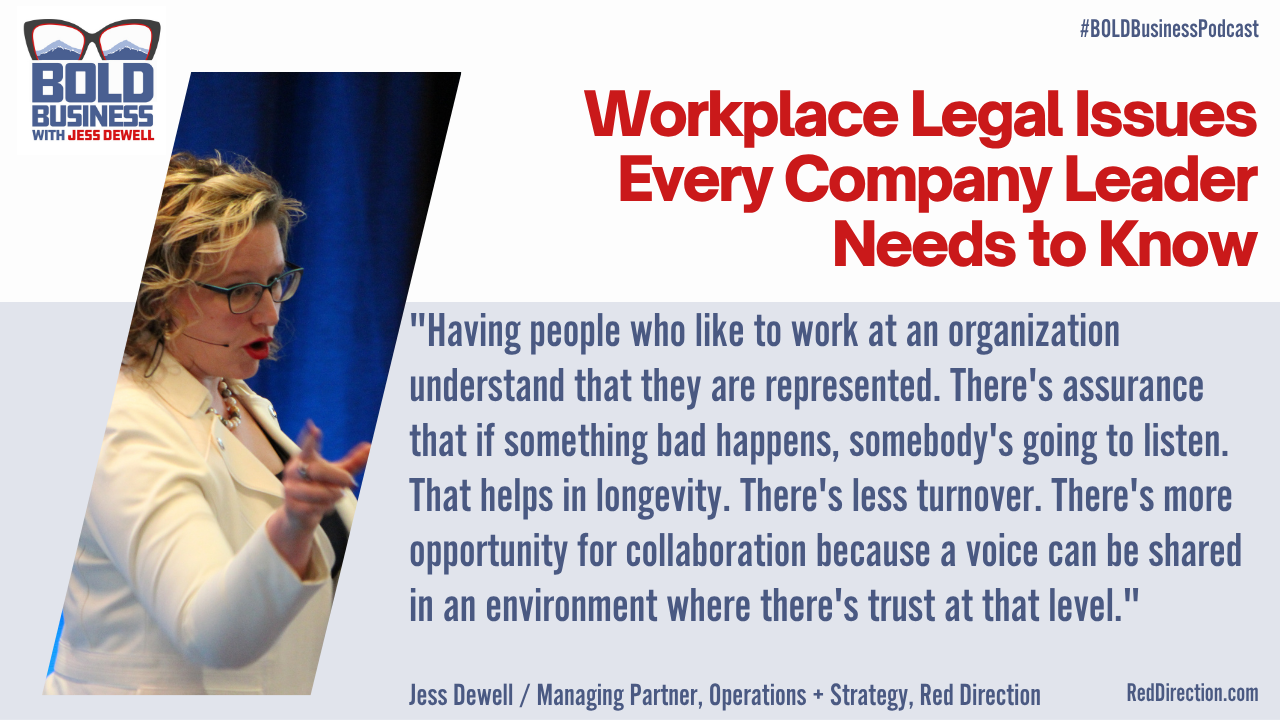
Having people who like to work at an organization understand that they are represented, that somebody there is an assurance that if a bad thing happens, somebody is going to listen. That actually, I think, helps in a longevity. There’s less turnover, right? There’s more opportunity for collaboration because a voice can be shared in an environment where there’s a trust at that kind of level. Are those things also appropriate to say?
Jesse Weinstein 35:13
I’ll just add, even though I do exclusively employee work, I’ve been invited and have participated on multiple panels and educational forums for employers and companies because I have a good relationship with the defense bar usually. One, because we’re human beings and we’re trying to get a deal done. They’re trying to convince me to get my clients somewhere and I’m trying to convince them to get their clients somewhere. But I spend a lot of time, I’ve spent time talking to insurance defense people and companies and explaining where I think they can do better. So I just wanted to give that context, even though I only represent people. I’m a huge proponent of companies because I think the world goes around because of them.
Jess Dewell 35:50
And that’s one of the reasons I wanted to clarify. And I actually think it’s really cool that you come in because one, it shows a company that cares about its people. Hey, these are the things that are actually happening here and they’re good for you. And I actually think being able to be an advisor to companies who want to do the best that they can makes sense to come from the perspective of somebody who can see both sides as you can. Right. Yeah. Is there ever a happy ending at the end of one of your cases?
Jesse Weinstein 36:21
Yeah. So a good settlement, a lawyer will tell you, is one where everybody’s pissed off. Right. Somebody wants to somebody has to pay more than they want to. somebody has to take less than they want to it’s not a win i don’t like to and i tell my clients every client this from the beginning i’m not here to win i’m here to get you out of this mess because when as lawyers when we start looking in things in terms of winning and losing we stop realizing that we can achieve things by working collaboratively right and i do i do have a mission i am loyal to my clients but really i think that’s the big thing is just how you frame the interaction to come. It’s hard because a lot of these clients want a pound of flesh. They want to burn the whole barn down while they’re standing inside of it. But that’s why you get counsel. You get somebody who’s above the trees, not in the forest looking up.
Jess Dewell 37:07
I want to know what makes it bold. What makes it bold to prioritize this type of conversation internally so that we can shift and ensure we’re walking our walk to take care of our people?
Jesse Weinstein 37:24
Say that you are for the people and it. Don’t just write it to attract people. Don’t have an ulterior motive behind your mission statement. Actually live up to it. Have people in place to actually care about the people. Don’t get frustrated because you’re getting feedback that you don’t necessarily agree with. And I’ll put it, I’m a military guy, right? I was in the military for years. And you don’t win wars from the top. You win them from the ground, right? And don’t lose sight of that. Don’t lose sight of the people who are on the ground, because those are the people who are actually the engine that’s keeping your company alive. And those are the people who end up suing you if you don’t do a good job of protecting them.
Announcer 38:14
And that brings us to the close of another powerful and fresh perspective on the Bold Business Podcast. In today’s volatile landscape, growth is a double-edged To truly thrive, you must engage with your strategy, not just react to the day-to-day. Without absolute alignment, your company faces a stark choice. Outmaneuver or be outmaneuvered. Grow or get left behind. Thank you for listening, and a special thanks to the Scott Treatment for Technical Production.