






AS A BUSINESS OWNER, IT’S DIFFICULT TO DO THE RIGHT WORK AND GUIDE YOUR COMPANY TOWARDS ITS NEXT BIG INITIATIVE.
From Fragmented Focus & Reactive Resilience ➔ Unified Intent & High-Performance Rapport
With Red Direction Business Base Camp Consultation, learn how to implement and handle processes to meet your business’s specific needs and better understand your market.
Starting the conversation:
The Two-Year Test: Would You Still Want to Own Your Company?
Forget distant five- and ten-year plans—if you picture your role two years from now, what would need to change? Hear the mindset and tactical pivots that make the next 24 months transformative for you and your business.
Whether you are steering a boutique firm, scaling a mid-market powerhouse, or navigating a large enterprise, reducing operational friction and increasing data visibility for real-time decision making is something you can influence today.
Meet your business advisors:
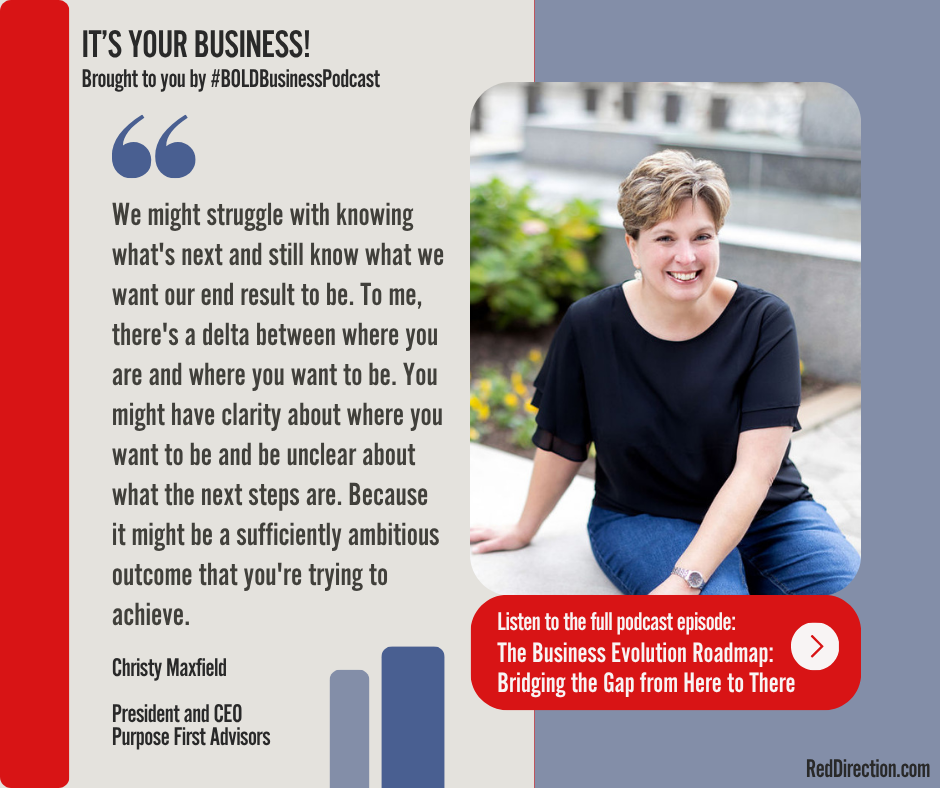
- Christy Maxfield, President and CEO at Purpose First Advisors
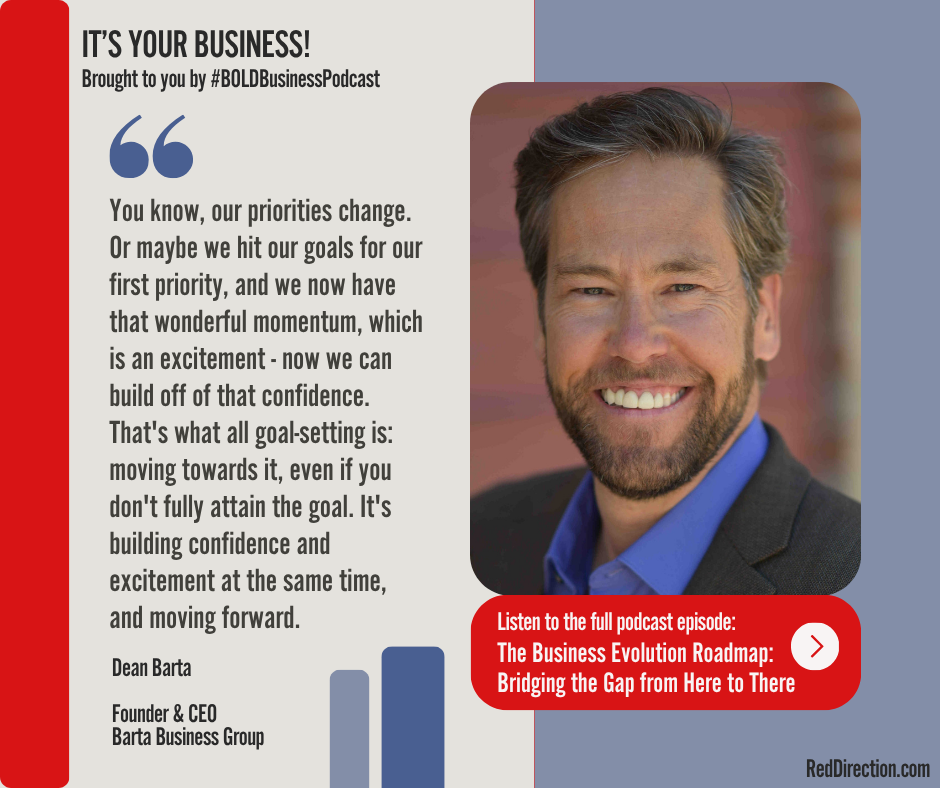
- Dean Barta, Founder and CEO at Barta Business Group
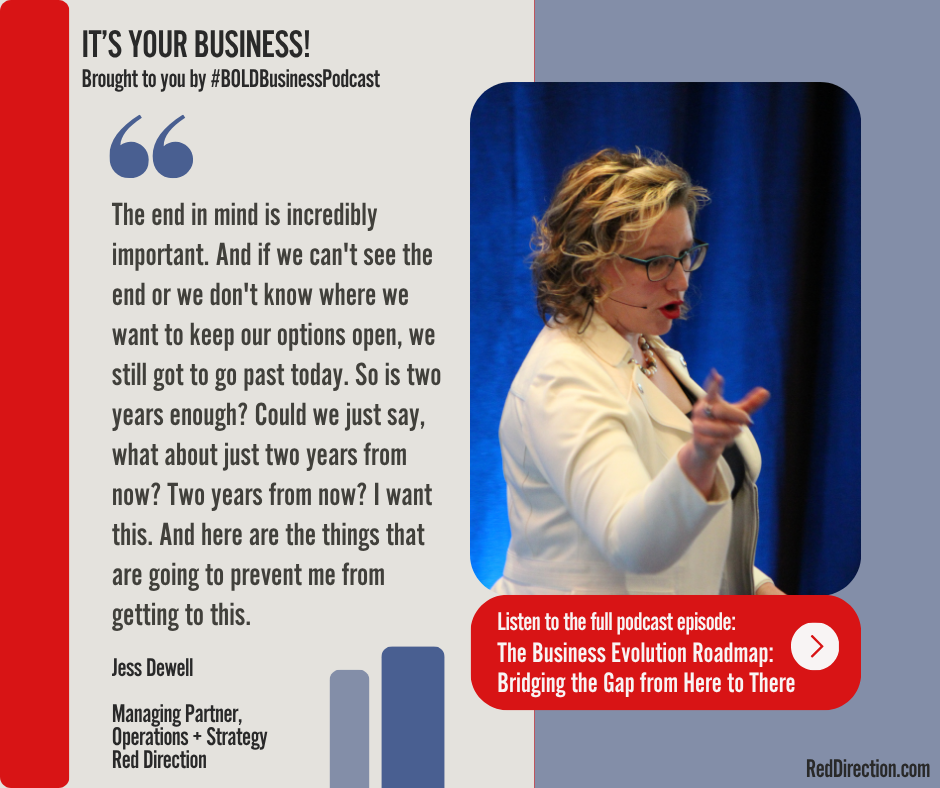
- Jess Dewell, Managing Partner and Growth Strategist at Red Direction
In this 3 part discussion they will discuss:
- The Reality Audit. Acknowledging issues isn’t enough—claiming is about taking full responsibility to drive intentional results.
- Design 2+ Years Ahead. Lean in to the cadence of your existing productivity and priority framework.
- The Execution Bridge. (Moving the Needle) Move the needle by stacking priorities and how to do it.
Move beyond surface acknowledgment; truly own where your business stands to enable meaningful growth and change.
What You Will Hear:
00:45 The bridge from current state to intentional business design and future action.
- Assessing where the business is now and where it needs to go.
- Tackling risk, growth, and taking meaningful action to shape the future.
07:10 Recognizing the gap between perception and business reality.
- There is a need for objective reality checks, as business leaders’ perceptions often differ from actual circumstances.
- Bringing in outside perspectives provides a more accurate assessment, often offering “cold hard truth or tough love.”
- Reality audits help identify the true status of a business and correct misconceptions about progress.
13:50 The danger of mistaking conversation for actual progress.
- Conversations about change can create a false sense of achievement, delaying real action.
- There is a risk that the organization talks itself out of needed change by avoiding hard truths.
- Recognizing patterns is essential to move from discussion to measurable results.
21:35 Building foundational flexibility for future business transitions.
- Planning should include foundational elements that allow for future modifications as business needs shift.
- Flexibility in design gives options for how the business evolves or is transitioned.
- Foundational strength makes it easier to pursue later changes without starting over.
29:00 Shifting mindset and architecture leads to growth breakthroughs.
- Many businesses feel stuck or saturated, but mindset changes often unlock dormant growth potential.
- Taking a staged, two-year approach to planning provides tangible steps while keeping options open.
- The focus is on looking at challenges differently to enable growth even in familiar environments.
36:15 Structured goal setting and time horizons support ongoing progress.
- Utilizing frameworks can clarify both long-term vision and short-term action.
- Breaking goals into manageable chunks helps sustain motivation and momentum.
- Consistent, defined goalposts prevent distraction and drive alignment over time.
39:35 Jess Dewell’s Impact and Interest assessment of priorities to stack priorities.
- A step-by-step approach to avoid competing priorities, mix the necessary work with the exciting, and achieve small wins to create momentum to reach 2+yr completion times.
44:25 Prioritization demands saying “no” and taking decisive action.
- Decisive prioritization is vital, even if it means declining interesting opportunities temporarily.
- Progress is achieved through focused action, learning, and iterating—not by keeping every option open.
- Being selective safeguards energy and time for what truly matters most.
3 takeaways:
- Christy Maxfield: Get all your butterflies flying in the same direction.
- Dean Barta: Break down goals to be able to move forward.
- Jess Dewell: Be courageous and make a shift in mindset to get to a large initiative 2 years from now.
Resources
- Dean Barta on LinkedIn
- Christy Maxfield on LinkedIn
- Jess Dewell on LinkedIn
- Responsive Decision Making: Unlocking Today’s Potential – A deep dive into the “Mindset Shift” required to stop “muscling through” and start leading by instinct.
Transcript
Dean Barta 00:00
Is the goal increasing the value of your business, but not killing your staff in order to do it?
Christy Maxfield 00:06
What do you have to be doing today to make you want to own your business two years from now?
Jess Dewell 00:10
What are we saying? How are we saying it? And is the reflection we’re putting out today, we know it’s going to impact what comes two years from now. And are we going to be okay with that?
Announcer 00:24
Welcome to It’s Your Business, brought to you by the Bold Business Podcast. This is your source for navigating today’s ever-evolving business landscape. In this program, Jess, Christy, and Dean share the realities of current business challenges and triumphs. Get ready to lead with depth, understanding, and achievement.
Jess Dewell 00:46
Welcome to It’s Your Business. We want to focus on assessing today, specifically, where the business gap is and where we want to go. Dean, and Christy, and I have put together a three-part program for you today. This is going to be a bridge between exactly where you’re at and move you toward the design and the actions that you need to take for the future of your business and bringing it into reality. All right. I know you know us, but we’re still going to say hello. So this is the three of us, your panel. How about if we take a minute and let’s just say hi and who we are.
Christy Maxfield 01:26
Hi, I’m Christy Maxfield, Purpose First Advisors. We help business owners improve profitability, transferability, and valuation.
Dean Barta 01:31
I’m Dean Barta at Barta Business Group. We provide fractional CFO services for growing small businesses, and our main focus is guiding entrepreneurs through the adventures of business.
Jess Dewell 01:44
And I’m Jess Dewell with Red Direction, and guess what? Growth strategy is what I’m all about. And here’s how we define it. Growth strategy is what actions do we take today to ensure our future relevance tomorrow and the longevity of our company? So what does that mean? That just means I’m in good company with Christy and Dean. I was thinking about this why now to our conversation. And we keep talking about this concept of resilience. And I actually think it’s different than that. Christine, Dean, I’m not sure if you feel the same, but I’m tired of the word resilience. I’m like, this is a duh. And if this is our new normal, quit talking about it. And what does that, what do we actually do? And I don’t sell anyway. Resilience, I’m more about let’s claim something from our new normal and let’s stand there. Let’s put our two feet there and see where things fall into place so we know what we’ve been doing, if we think it’s going to work or not with the business instinct that we have today.
Christy Maxfield 02:47
I think all of our topics inherently overlap because this is what we do. And we live at the intersection of all these things. But resilience isn’t quite enough anymore. Being responsive, being agile, that there’s more to success than simply being able to withstand the drama and the trauma of today. And so I just reminded myself that our last headline was to stop future-proofing. We’re never going to build an organization that can withstand everything that the world can possibly throw at it. So how do we make it as effective and responsive as it can be today without creating something that’s so risk-averse or risk-tolerant that We can’t seize the opportunities right in front of us.
Dean Barta 03:43
I think the first thought to my head when it came to resilience or being tired of resilience is, and it’s a very spring-like wonderful day, but my thought is when you’re hunkered down in a winter blizzard, okay, but you’re not moving. And to me, okay, that’s resilience, but there’s no movement. And today we’re talking more about, yeah, you know where you’re at there, but how can you move through those, let’s say, winter storms and keep moving forward rather than, I’ll be resilient, but that means sometimes that’s being stuck in the same place.
Jess Dewell 04:22
Okay. And that’s a really good setup for what we’re talking about today in our three-part conversation, right? We are talking about the reality of where we are today. we are talking about how do we architect for two years from now or more with what we have now, architecture, architecting our exit. And then the third part is going to be that bridge, the actual ways that you can move the needle and what you can do to shift the thinking, embrace what you need to and let go of what you need to. So with those three things in mind, how about if we just jump into this first part, which is the reality of what really is in our notes, we called it the reality audit, right? Assessing exactly where you are today. And I know I call that accidental leadership. Sometimes when we just go and we have success or we go because we have a vision and we just work toward the vision and see whatever happens, our success is accidental. It is definitely on purpose too. It’s accidentally on purpose. And so I was thinking about that and how to set some of this up. And of course, you know, me, I came with some checklists and some other things like that. But I wanted to just take a moment and say, so how do we do that? And one of the things that came up for me was that it’s easy to acknowledge it is hard to claim exactly where we’re at. So I’m going to say, starting right now, can I claim where my business is at? Go one step deeper than acknowledge. And that’s really where I want to start our conversation with this reality audit.
Christy Maxfield 05:50
This hits really close to home because I was having a conversation with an owner the other day that this is probably the language I was looking for. We were looking at the same information and they were acknowledging that things weren’t headed in the right direction and that there had made some really big investments that weren’t being fully capitalized on. And what I was struggling with was that there was no claiming. And the reality that I stated was that my sense was that for this owner, things have always just worked out. So there’s never been a catastrophe, but there’s never been the success they wanted either. So that to me, they know what they want. They’ve told me what they want, but without claiming the reality and then in claiming the reality, taking responsibility for taking the next necessary steps that are going to rub up against all sorts of other competing demands, if they can’t do that, then they will always have a business that just works out, not a business that achieves the vision and dreams that they have.
Dean Barta 07:07
It’s also what I’m dealing with a couple different clients too. And that’s why they use our services, is so that we can give them that cold, hard truth and or tough love, however you want to propose it. But we have to check in on perception versus reality.
Christy Maxfield 07:30
And we don’t say these things to shame or embarrass our clients, right? This was not a shameful or scolding conversation. I literally pulled up the QuickBooks, right? And I’m saying the way the numbers are headed, the activity that I’m seeing, it really doesn’t matter if we talk about there being five projects that you want to implement. Unless you bring in more talent and fill the pipeline, you’re not going to get the revenue you need to get the net income you need to achieve the goals that you’ve stated to me that you want to have. And so I stated out loud, fear is generally not a great motivator, not for me, not for anyone. But those numbers made me afraid for them. And if fear is not going to motivate, then can the vision of the future be so overwhelmingly compelling? Can it be irresistible so that even when you don’t feel like it, even when it’s easier to just keep doing what you’re doing, you will take the necessary steps, then do the things you feel are best designed to get you what you want so that you can have that irresistible future rather than trying to use fear of the present to motivate you to take the next step.
Jess Dewell 08:51
And I would even go one step further and challenge and say, okay, so if you’re not motivated and fear doesn’t motivate you and it’s not compelling enough, why are you doing what you’re doing? Let’s go back to that stage. Another conversation. Jump into something different around this and saying, okay, maybe I can figure it out or maybe I can’t. And even more important than that, when I’m talking to business owners that teams, right? You’re 15 or 25 or 75 employees. And we’re thinking about things like this. It’s hard to claim a reality when we have shared responsibility as a management team. So if there’s, when there is more than one of us and it creates a little bit of a, I don’t like the word complexity, but it is facets of what is real. And so when we’re not having conversations candidly and we’re not having conversations that feel hard to us for whatever reason, whatever’s hard to talk about is the thing you probably ought to be talking about in your business. Hands down. Quickest way to claim. Where do I not want to talk about things? Then I was thinking, okay, so what could we do about some of this and what are some of the things? And I know a real big one that both of you alluded to. And I’ve also seen with the companies that I’m working with right now and over time is distraction debt. And we’ve talked about distraction debt before. When things are complex or we don’t know what’s real, that usually just means we might be trying to incorporate somebody else’s version too, or we’re avoiding our part in the responsibility of not talking about it. So can we, right? Think about the growth path you’re on right now. And actually increasing impact or is it increasing the complexity of the way you’re doing it?
Christy Maxfield 10:36
Jess, before we jump to distraction debt and that brilliant question, I think the acknowledgement amongst a team can be complicated by the missmaking for morale. So the idea that what we have to put out into the world is that we’re fine, everything’s fine, everything’s great, we’re wonderful. There’s a good amount of missmaking. When it comes to marketing and promotion. And I think that myth-making comes internal where we see we need to support our team morale by managing how we talk about the reality. Right? And so can we create a space in which there can be a candor without panic and a candor with courage to say it’s not okay, we’re not okay, but we can be if we come together and we realign and we face reality rather than talking around it, avoiding it, pretending it’s not there. Boundary erosion, right?
Dean Barta 11:42
It’s also creating a sense of urgency. And that’s where the truthfulness of the conversations, even in a large management team, you’re going to get a certain lens from that facet or that angle. But, and you’re right, Christy, is that sometimes it’ll be, oh, we just want to keep everybody motivated. But, hey, sense of urgency, that’s a motivation, especially if everyone is in alignment with, okay, we’ve got to do something special because we have this common goal that we’re working towards. Yeah, I totally agree with the sentiment on that.
Christy Maxfield 12:20
Jess, what do you mean by boundary erosion?
Jess Dewell 12:24
When we, one of the things I was hearing that came up as part of, reflecting back to you, what you were saying was, oh, yeah. Okay. So there’s energy leakage somewhere and we’re accommodating where we shouldn’t be. That’s a boundary thing. So we don’t necessarily, we might be missing clear rules of engagement. We might be touching on the elephant in the room that nobody really wants to talk about. We might be going into a place that we ourselves are not ready to lead through. And so we let those boundaries be eroded because then we can think we’re making, it’s that disguise. We can think we’re making progress, but really we end up not. And we’ll stay where it’s comfortable for everybody. And so that was my, if I were to reflect back what I heard you say from my perspective and where I was at in the moment, that would have been it. How does that sit with you?
Christy Maxfield 13:17
In that context, boundary erosion allows us to have a conversation about reality or it allows us to avoid it.
Jess Dewell 13:23
No, boundary, the myth that you were talking about. Okay. If the myth you’re talking about is existing boundaries have eroded. They are eroding as we got it. Erosion has had it. Yeah.
Dean Barta 13:36
And that’s why every business has KPIs because that’s what holds the boundary, right? is the KPIs, but it takes, you know, managers, owners, you know, to hold that boundary based on the KPIs that are set up for the business.
Christy Maxfield 13:50
Yeah. But we also know that huge change efforts at ginormous organizations over time have failed to manifest because the reality of the situation, the usually the we talk it to death and don’t do anything. We confuse talking with doing. and therefore we don’t actually do and the change doesn’t get implemented is that myth-making that has ever it eroded the boundary the boundary was we need to make this change we need to have this new outcome right the unwillingness to acknowledge that we’re confusing talking with doing means that we can pretend like we’re actually making progress and not actually talk about what’s going on and what’s falling apart or not getting done. I just want to make sure I’m on the same page so that our listeners are on the same page. But that’s as we keep talking around it, like Dean, I come back to what you said just a minute ago, which is our client thinks that things are going, are moving forward, I think is the language you used. Not going well. You didn’t say going well. You said moving forward. And so they’re sensing forward movement. And I think what you’re telling us is that what you’re actually going to help recalibrate them on is forward movement does not equate to positive outcome by default. They could feel like they’re moving forward, but they’re not actually getting the result they want, which would be demonstrated in the numbers.
Dean Barta 15:29
And it’s not the results that, based on our experience as consultants, where we’ve seen businesses at that are similar that they should be at. And so we’re helping them recalibrate and re-engage. And yeah, it takes some going back to reality check or that reality audit of, okay, this is where you’re really at versus where you think you might be at.
Christy Maxfield 15:56
But also this is the delta between where you’re at and where best in class in your field is, Right? So yes, you made forward movement and that gap is still substantial. Assuming that’s the path you want to be on. When I said that because Dean referenced the expertise of compared to others in your field who we’ve worked with, compared to other like and similar company based on what you’ve told us you want and the movement you’re making, there’s still, we’re not seeing that you’re actually on the path you say you want to be on. That’s why I brought that because in Dean’s example, they want to be on that particular pin. The path has to be your path. I work out at a gym where I use these machines that give me feedback, but I’m competing against myself, right? So the only person I’m trying to be better than was the person I showed up to at the last session. And sometimes I’m not. Sometimes I’m way better than the person I was three months ago, but I’m not better than the person who showed up the week prior. right i’m not trying to be best in class for 52-year-old women in St. Louis i’m just trying to be best in my class of fair and real.
Jess Dewell 17:15
And that comes back to that question though right that i was sharing so to evaluate just somewhat distraction debt but even more that bigger topic of what we’re talking about here which i think it encompasses all the things because we’re bringing in all of the information when we sit in our monthly management meetings, our strategic time, our present retreats, whatever that work is in that cadence that is in a business, is our growth increasing our impact or is it increasing our complexity? So those were my two things for this section. What do you now want to talk about? Probably the things you need to talk about. And what is that question of, are we increasing complexity? And I thought that was a very interesting thing because if we’re doing things and that supports It’s everything that has been shared so far too.
Christy Maxfield 17:59
And I think the underlying is what are you designing for, right? If you take our topic from last time of stop trying to future-proof and instead design the future that you want for your business, and we talk about the reality audit as the place to get real about where you are, it is also the place to get real about where you want to go and what are you designing for. And if you’re okay with how the business is structured now and the outcome that structure will create, that’s okay. That’s fine. Nobody’s here to say your structure should be more complex or your ambitions should be more than they are currently. But we are saying that if you don’t build it by design, it will get built by default. And that default may not be what you’re trying to achieve.
Jess Dewell 18:47
And so what do you think, Dean and Christy, what do you think some of those things are that you, I don’t even know. I’ll tell you the companies that I’ve been most recently talking to. Let’s just even just take the last three days. None of them have really thought about what they want next. They just want to get past 20, 30, 20 to 33. Then they’re like, then we can think about that. And that’s more than two years away. And I’m finding that fascinating in and of itself. So I’m like paying attention, business instinct, there’s something here to find out. Not quite sure what it is yet. But at the same point in time, I know when we do have clarity, that is what allows us to decide if we know where we’re at and we’ll claim it. I’m hearing you say, Christy, then it’s okay, cool. So we know our stage. So we know what’s going on. And that means if we know our stage, we’ve decided we know what’s next or something else.
Christy Maxfield 19:33
We might struggle with knowing what’s next and still know what we want our end result to be. So [tell me more] to me, there’s the delta between where you are and where you want to be. And you might have clarity about where you want to be and be unclear about what the next steps are. And because it might be a sufficiently ambitious outcome that you’re trying to achieve that feels unattainable today that may require resources you don’t currently control today or expertise or any other resource that you could need to achieve that and so I could understand being unsure about what the next step is I think what we typically see are people who are very sure about what the next step is but they don’t actually know how it’s connected to a long-term end result, and they’re not sure what they want that to be, right? They kind of want to keep all their options open. I don’t know if I want to be acquired by a bigger company. I don’t know if I want to acquire a company. I don’t know if I want to pass this business to my children or have it acquired from key employees or bring. Great. But without designing with one or two of those things in mind, you don’t actually keep your options open for all of them. And that’s the fallacy is like, oh, I won’t make any decisions about what the future is. I’ll just keep building and building and building and building. But if you don’t actually put one or two of those stakes in the ground and say, I need to make sure it’s transferable so that whomever takes it on next can do it. And I need to make sure that it is profitable. So not only do I benefit from it, but the future people benefit from it. And then I need to make sure it’s valuable because I have certain financial goals I want to meet in transferring this business. Those things actually don’t happen by accident and they don’t happen simply by building without a plan.
Dean Barta 21:35
And since you’re on the theme of building and that’s where our trade service business is our main focus, at Barta Business Group is, I think if I’m tracking what you’re saying too, is you still have to build a, let’s say building a house, foundation, framing, roof, and all that. No matter what kind of shingles you put on the roof or what kind of siding you put on the house, or there’s still some basic design that has to happen that gives you the flexibility to have changes when you get to that finish line or finish product. Is that in my…
Christy Maxfield 22:13
Yeah, absolutely. We did a bathroom about a year ago and the designer said, do what you want because in 10 years, you’re going to have to do it over anyway. And so you’re not actually building for the next buyer if you hope to have this home for more than 20 years. You’re building for your next remodel, essentially. Many times we make choices in our home improvements, right? Because we want the house to be functional and work for us while we’re living in it. And we want it to be valuable from the eyes of the person who would buy it next, right? And so some of the things I’m going to do today will make my life convenient today and make the house livable and more enjoyable for me today. And they may be things that either I do or undo when I am finally ready to take it to market, right? Because when this house was built, two beds, one bath, that people before us put on an addition because they needed more living space. And by the time they were going to sell this house, two beds, one bath was not going to cut it, right? Just, it was not what the buyers want out there. So part of their decision has to be what’s going to take care of me today and what’s going to be appealing for the next steward of this asset, whether that’s your family, an external buyer, or frankly, for you, if you’re going to run it until you can’t run it anymore, what are you going to do to get the most out of it today? Which may mean it doesn’t have a lot of transferability. It doesn’t have a lot of long-term value, but that’s okay because that’s not the end goal, right? If I design this house with a basketball court where the living room is and a cold plunge on the back porch, and there’s no usable spaces for a family with kids, that’s fine if I don’t, if I’m not really concerned about resale value and I plan to stay in this house forever and whatever happens to it, right?
Jess Dewell 24:13
Let’s just say, what if I’m only looking at two years at a time? If I’m looking two years at a time and I’m a six-year-old business and I’m this big and I want to be that big, how close can I get there in two years, right? From where I am to where I’m going. So is two years enough? Could we say, what about just two years from now? Two years from now, I want this. And here are the things that are going to prevent me from getting to this. Because I was talking to a person today and they said, it’s May and I’ve already achieved my goals for the whole year. And I was like, you’re either an overachiever or an under goal setter. And so I was thinking about that. And then I was like, this actually pertains to our conversation because we’re talking about all of these things. And yes, we want that end goal in mind. As soon as we know, we have things we’ve got to do for that. But here’s the deal. If we would want to own our own business, if we would want to be the CEO of the business we are part of today in two years, we can do that same process in two-year increments until we’ve decided what we want or our board decides what they want or all kinds of other things along the way. How does that feel to the two of you? is maybe something, an alternate way.
Dean Barta 25:23
That resonates because I’m just running with the Christie’s theme of homes. You’re building that extra bedroom or deck or something onto the home, and that’s what you’re going to handle. We can handle maybe financially, but it’s still, there’s, is one, the enjoyment of it in the short term as well. This relates to employees and company goals and things like that. is the goal serving a couple purposes. So let’s say increasing the value of your business, but it’s also not killing your staff in order to do it because those could have negative effects after two years. Oh yeah, we hit our goal, but we had 30% attrition with our staff because we were running at a pace that we’re losing good people. I think there’s a couple factors that are happening And I like actually those two-year increments that even if you don’t know what that looks like 10 years from now, are you moving forward in something that resonates with your team, resonates with the vision of your company, and you’re moving in that it just feels good?
Christy Maxfield 26:32
Yeah. I actually love the two-year increment. But I think you asked a really important question. If you want to own your business two years from now, what do you have to be doing today to make you want to own your business two years from now? So at the very least, I have to think, do I want to be working the same number of hours? Do I want to be doing all the jobs that I’m currently doing? Do I want to be working with the same type of clients? Do I want to be generating the same level of revenue or more? And to Dean’s point, what are the competing variables, right? I do want more revenue and net income. I don’t want to work more hours. I have to hire more people. That lowers my net income, but it gets me the kind of lifestyle I want and make sure that me and the rest of my team aren’t stressed out, right? So even at a two-year increment, you’re making some, you have some design constraints and you have some things you’re trying to achieve, and you can do it in those two-year increments. One of the reasons why we always tell people that we need at least three to five years to really get you ready for exit is because how you’re running it today is often not how a buyer wants to run a business. So yes, it should be the business you want to run. But if one of your end goals you think is that you would want to sell this to someone, or in my opinion, if you’re going to pass it on to somebody, particularly somebody you love and are related to, is it viable to run the business the way you’re running the business? Even if it works for you, because there are a lot of people for whom an 80-hour workweek works for them, but it will work for no one else. They are not unhappy, but nobody else would run the business the way they run. A client called me back to do work with them this year, and they were orienting some other people to our relationship. Christy came in my office six years ago and told me she would never work for me. I asked her why. It’s because everybody on my team was doing more than two jobs, right? So the organization is thriving and doing great now, but it looks very different than it did six years ago. And being able to reflect on the fact that the way they were operating was not something that they would easily recruit other people into doing and which probably would impact their long-term sustainability was an important data point for them.
Jess Dewell 29:00
Sometimes the companies that I am working with are trying to figure out how do we grow next? We feel saturated. We’re not sure. Most of the time, there is untapped potential in where they feel saturated and changing mindset gets them there. So being able to maybe a two-year view on architecting, a designing is how do we change the way we look at things? Which made me come up with this thing came across my radar. You may have heard it. It’s a little meme that’s all over my internet right now, so I don’t know what it is. And it’s called What’s in Your Cup? And it’s about a monk who, or from an inspirational speaker, I don’t know, right? So whatever. Basically, it says if I’m carrying my cup of tea and somebody runs into me and it spills, I’m now shaken up. And whatever spills out, it’s not the tea I put in the cup. It’s my reaction to it because that’s what my reaction to the tea spilling is what I’ve chosen to carry inside. So I want to think about that in what we’re talking about. If we don’t know where we want to go or we know we’re going to exit someday, we just don’t know what that looks like. Two years is, so what am I carrying inside and how am I looking at my business today? Because every action I take is going to plant more of what I’m feeling inside, more of my excitement or animosity, which by the way, have the same energy, just different words, right? Joy or sadness also. Well, I don’t know if those have the same energetic thing. I’m not going to say that because I don’t think so. But there’s the flip side of both of them. And so the words we put with it reinforce that experiential feeling. And so when you hear me talk about the three brains of leadership, or you hear me talk about present retreats, that’s the whole purpose is what are we saying? How are we saying it? And is the reflection we’re putting out today, we know it’s going to impact what comes two years from now. And are we going to be okay with that? So I think that’s been an interesting part of this conversation that all of the things and don’t forget what’s here in between our ears and what’s here in our hearts make a difference too.
Christy Maxfield 31:07
A hundred percent. Another conversation I recently had where it’s the first thing we were talking about planning for secession and from the context of really doing talent management, being more intentional about the talent and career pathways for certain members of the organization. And want to overload the team. They’ve got a lot on their plate right now. And I said, so is that any different than it would be any other time in the future? And their immediate response was no. And so I said, so we’re not waiting for some time where literally there is a lull in the calendar and people will be able to take a deep breath and go. There are always going to be too many competing demands until we prioritize and shift our mindset, to your point, Jess, about the importance of this work and the need for it to be integrated into the execution of the work and the services and the products we deliver and not an ad or tack on. I got 15 minutes, let’s do some people management, right? So I think that mindset of we’re already overloaded, We can’t possibly slow down enough to have this conversation, to assess our reality, to define where we want to be in the future. That mindset alone, if we can get out of this idea that there’ll be some magic time in the future where we will have the clarity we need and the time we need to get the clarity we need and all those sorts of things and just acknowledge, if we want it different, we have to make different choices right now, which means we have to have a different mindset right now.
Jess Dewell 32:47
Yeah. And then that led to part two of my little bubble came back, which is we can either, if we’re saturated, I was talking about the fact we might not be, we just need to change the way we look. And Christy, everything you said, I really think underlined at least that for me and elevated it much more. And then the second part was, so what about diversification, whether that’s client size, whether that’s market areas, it doesn’t matter, right? All of the things that you can go there. The fact that you have that defined and that you want to do that matters because in this defining, this is going to be where I have something, but it’s not working the way that I want. So how do we dig into it a little bit further? What experiments can we run in a long, short period of time, like two years, throughout the two years to make progress? And I know a lot of the work that I do with companies is building new product lines or building new market areas with which they’re going to work in. And there’s a lot of failure. There is a lot of failure because every time we think we’re going to do something may or may not work the way we want. We may get some result, but not where we want to go. Learning. We have a new starting point for the next time. It may look completely different, but everything we did, we start from that new line. We’re experimenting. We’re doing all of this work. We’re seeing a result. And now we’re at a new line And we keep doing that and things take shape. The mindsets that we are unconscious about will be able to be seen by ourselves through that work. The way we talk about the KPIs will change to support curiosity and the experiments and the way we want to diversify and the challenges that brings because we’re willing to look at things that might be hard. since it’s going to help us with our future relevance.
Dean Barta 34:45
And it brings up, we’re working with a smaller client right now. And actually part of what, and he’s grown his business in a year fourfold. And part of the things we’re actually working with him on are processes to take more stress off his shoulders. And because they have a five-year-old and they have another one on the way next month. And part of it was we already know that just from seeing other businesses that if he stays on this pace, his family life is going to suffer, his business will suffer. And he’s really one of our most proactive business owners that this all is great and he implements it. And he’s bought in because he’s seen those immediate results, which makes him even more excited about growing the business. But there’s support there that from the conversations we had even before we started working with him, this is a great way to support him, not just profitability. We talk about KPIs and all of that and cash flow forecasting, but these processes that are really streamlined in his business is probably the most valuable thing that he’s seen in his business right now.
Jess Dewell 36:00
And so how do we get from here to there? What’s that bridge? And what are some things that we all think make a difference to having what we want today, wanting to continue to be in the role we are in the future, having that exit that we want? What comes to mind for you?
Christy Maxfield 36:18
I think using some sort of structure that if you’re an EOS kind of company, you are looking 10 years out, three years out, one year out, 90 days, right? And there’s a reason that cadence works. And there’s a reason EOS borrowed it from scaling up. And we just know that chunking things up, but having clearly defined goalposts, the goalposts aren’t moving all over the place all the time. Even if they take a long time to get to, chunking things up into years and 90-day sprints really does allow us to achieve the wins we need to achieve, to continue to feel motivated and inspired, to keep taking the action that will have a long-term payoff. So part of it is, I think, deciding what your timeline is. If it’s two years, Jess, or if it’s more of an EOS cadence, or if it’s I want to be at this point when the kids graduate from college, or I really need to be home and we’re present right now. And for the next two years, this is what my life needs to look like. And so this is how the business needs to run. Get clear on what those things that are most important to you are and then start designing around those to either maximize your time, maximize your money. I am a firm believer that you can have everything. You just can’t have it all at the same time.
Jess Dewell 37:40
Well said. Yeah, there’s actually a quote. I don’t know who to attribute it to. You can have anything, but you can’t have everything.
Christy Maxfield 37:46
It’s like when people come to me and they’re like, we want a cheap, fast, and good. I’m like, haven’t you ever heard you can only get two of the three of those? So decide which two you’d like and we can design or keep that. Well, I’ve yet to find the person who can do it cheap, fast and good. And this, I think, ties into if you’re observing a disconnect between your current action and your desired end result, that also could be a flag. So if this person’s goal was to spend more time with his family, but he wasn’t streamlining his business, right? If he was refusing to bring on outside counsel or not listening to your advice, there would be this disconnect between what he says he wants and what he’s willing to do to achieve it. And I think that’s what we’ve sometimes run up against. I would hazard to say we’ve all worked with people who, once they are clear on what they want and you help them identify the pathway to it, they take to it like ducks to water and they just keep doing the things and the momentum builds and the goodness accumulates. And there are other folks who are very clear about what they want and very reticent about doing the things that will get them there. And that’s where the dabbling in the psychology of the work that we do, that’s where one of my walls. If you’re telling me you want X, but you’re unwilling to do Y, I need you to go unpack that with somebody who’s a trained professional because there’s something going on here that it’s not about having the right time management system or the right plan or the right, what do they call them? The Kanban boards, right? It’s not a software issue. It’s not an organization issue. There’s something going on deep inside that’s keeping you from doing. the things that we’ve identified are the things that will get you what you say you want.
Jess Dewell 39:35
I think about priority stacking. And in this concept, I have an exercise that just is part of some of the things that I do. And I pull it out whenever I need. I use it, by the way, quarterly. And it’s interest versus impact. And the whole purpose is to, I have a 10-plus year goal. I also have a two-year goal. Or how about this? I shouldn’t say goals because they’re not goals. I know the destination in 10 years and I know the destination in two years. And I’m thinking about, so what do I do right now? So I’m in the general direction and all my butterflies are flying in that direction together. Right. So when I, keeping that in mind just for Red Direction, and I do use this for all of our consulting clients as needed, which is, so what are all the priorities right now? And they need to be written down. And the first thing is, and then you got to rank them in order. What is the most important to the least important? And the bottom 25% just have to go. That’s hard work. Second, after you’ve gotten rid of all the 25% of the bottom, so it doesn’t really matter. It’s just actually getting to the bigger picture. It’s getting to what’s going to move the needle. It’s going to get past action and into designing and understanding what the right group of actions is and then rearrange them. In my team, in my company, this is what’s going to move the needle. And let’s say there’s 10. Rank them. One to 10. One being the move the needle the most. Usually this relates to money or revenue to the least. And then on the other side, who’s responsible for them and how much interest do they have in actually doing it? So it’s interest. And then you rank them and sometimes they line up and the most impactful actually has the most interest. I’ve only experienced that one quarter out of all the years I’ve ever been doing this. Let’s just be real. So usually it’s somewhere in the middle. I’m like, oh, cool. Here’s where my, I use the number 10. I don’t ever have that many because that’s a lot, but let’s say my four or five and sixes are very similar. They’re all together and they’re grouped. I’m like, Ooh, I think these might be the priority for this next quarter. Let’s see what that is. How does that look for where we want to be in two years? How does that align to where we want to be in 10 years? And if they’re in the general direction and I can get all of that energy, my butterflies flying in that direction, I’ll be like, I think those might be the priorities. So what do I do with the rest? I keep them and I set them on the shelf because if they’re really the right thing to do, the team will recognize it and it’ll start showing up in the work for the highest impact and the highest interest. It’s not a compromise. It is a choice. I’m not doing the highest interest and I’m not doing the highest revenue generation. I could depending on what the status of my business is, but in my example here, I’m not. And we actually can use this as a tool. Where are we getting in our own way? What distractions do we have to remove? How good are we at saying no? All of the things that have been alluded to a little bit throughout our conversation. So that would be something I could bring tactically. And I don’t do this every week. And I would not suggest doing this every week. This is minimum of quarterly to really get the benefit of it. Because any more often than that, all you’re doing is changing your mind.
Dean Barta 42:40
And I agree with you. That’s a quarterly endeavor. And, but it’s because, Hey, whatever might be priorities in day one and match up with the team and all that. It’s always interesting to see what day 90 looks like, which would be our day 91, which would be the next start of the quarter. Oh, wow. Our priorities changed, or maybe we hit our goals for our first priority. And we’re now have that wonderful momentum that we’re, which is an excitement about, okay, now we can tackle this. And building off of that confidence that, because that’s where, that’s what all the goal setting is to set it, move towards that, even if you don’t attain the goal fully, but it’s building confidence and excitement at the same time, which that’s momentum, right? that’s moving it forward.
Jess Dewell 43:40
And then it’s not so rigid either because if we have a two-year plan, something in the seventh quarter might actually show up in the third quarter. And guess what? That’s great because it’s actually the right time because you’ve got the right energy and the right things going on. And so knowing it’s out there and just letting it, welcoming it quarter to quarter makes a lot of sense too because sometimes we don’t see the relationship between things And our teams can’t either. And I really appreciate the call out confidence and success that creates that extra momentum because now we’re all thinking differently. Now we’re all having some opportunity there. So that’s what I brought to this. What could I tactically do to take claiming where we’re at, understanding the designing process and now bridging that gap.
Christy Maxfield 44:23
I don’t have a prescribed process, right? Because it is dynamic and fluid and what my clients need can change. But it’s always about making choices. I heard you say, Jess, that in this prioritization and in this 90-day goal setting, we are actually saying no to things. That we might say yes to later, but we are not saying yes to everything right now. And the ability to make a decision, take an action, learn from it, and then make the next choice is really what we’re asking people to do. And it can be incredibly hard to do that, especially if there’s a mindset along the way of, I don’t want to close any doors. But in a house with all the doors open, either things are running in or running out. It generally doesn’t. So can I be a little bit more specific in the universe to actually get those things that we need? So if you’re working with me, you’re always going to have when you say we need to do X, I’m always going to follow up with when does that need to be done by by whom? And what do we need to do to make that happen? Right. I am all about a good deadline. I am all about clear accountability. I am all about acknowledging whatever needs to be or whatever requirements there are for success to take place. So whether you want to do that within EOS or within Scaling Up or within any of the other frameworks that exist, or if you want just a good old-fashioned task tracker that says, we need to do these things by this date in order for this thing to be considered complete and create the win we want. I’m there for it because that’s how we’re going to know. And then I would say for me, it’s also about celebrating the wins. I’m terrible at it personally, right? I’m already on to the next thing. So I thought, yeah, we did that. We hit that goal. Great. Well, already on. But having the gratitude and being able to really enjoy that win, however big, however small, however personal, however public, and to bask in that enjoyment and fulfillment of that’s where the joy is going to come in. And that’s where the momentum to keep going is going to come in. So celebrate your wins and don’t move your own goalposts just because that’s what you’ve done in the past. If I can do that, I can do more. Yes, but let’s at least celebrate what you’ve accomplished and really celebrate it with your team and acknowledge that now we’ve proven to ourselves that we can do it. And now it’s about the boring consistency of continuing to win. Right. So this the big celebration has to happen. But then we have to get back to the fundamentals of consistency, which are typically less attractive, less and less exciting, less and more just doing it because it’s what works. And Dean, inevitably, it brings us back to my limited knowledge of sports, right? You get to the mountaintop, you celebrate, but now you have to climb down the mountain. And if you want to climb the next mountain, you got to probably train between this climb and the next climb. And there’s not a lot of glory in all of that. So you’ve got to celebrate when you hit the different milestones along the way, because most of the time in order to get that win, you just got to do the consistent, unattractive, sometimes incredibly boring stuff. from which your wins are made out of.
Jess Dewell 47:58
So here we are, that your time is now. We’ve talked about architecting your business. We’ve talked about claiming where you’re at. And here’s the deal. Just came out and what Christy was just saying and what all of us have shared throughout. What your assessment of everything today, where you are today is going to be different than what day you are assessing everything in the past and in the future, it will change. It’s not a luxury anymore. It is a necessity. So my question to you is, when do you do this? Be honest. Are you doing it? And are you just doing the surfacy stuff to check a box? Or are you actually getting underneath what that is and doing some real work to create your future? I’ll start since I’m already talking. I’m Jess Dewell with Red Direction, and we are focused on growth. We are working on ways to change mindset, to show up, and to be able to make those goals that are a little butt puckery and go get them and actually get the achievement of them.
Christy Maxfield 49:03
I love it. I never thought I’d have to follow butt puckery, but I hear it goes. Christy Maxfield. Christy Maxfield, Purpose First Advisors. We help owners grow with the end in mind.
Dean Barta 49:14
Dean, Barta Business Group. We’re fractional CFOs. guiding small business owners in growth.
Jess Dewell 49:22
Yes. All right.
Christy Maxfield 49:24
I didn’t think you’d be that kind of guy, did you, man?
Jess Dewell 49:27
What are our biggest takeaways today? Who wants to start?
Christy Maxfield 49:31
Yeah, go. I’m taking away what direction are your butterflies flying in? [Oh, yeah.]
Dean Barta 49:37
That’s a good one. I like the, it’s okay to break it down into smaller goals, whether it’s 90-day goals, two-year goals, Even if what’s beyond all that is not crystal clear, but it’s keeping that, moving in that direction and whether it’s even breaking it down to week by week, but it’s moving in that direction because sometimes when you walk down a path, you don’t know what the destination is until you come around the next corner, but it’s moving forward.
Jess Dewell 50:11
Do we have the courage to recognize and claim whatever mindset shift we need to make so that we can think about our future, not only in two-year increments, but the actual exit that we would like to have? It’s your business brought to you by the Bold Business Podcast. Until next time, thanks for being here.
Announcer 50:41
And that brings us to the close of another powerful and fresh perspective on the Bold Business Podcast. In today’s volatile landscape, growth is a double-edged sword. To truly thrive, you must engage with your strategy, not just react to the day-to-day. Without absolute alignment, your company faces a stark choice. Outmaneuver or be outmaneuvered. Grow or get left behind. Thank you for listening. And a special thanks to the Scott Treatment for technical production.