





A 60-DAY INTERVENTION THAT REPLACES BRUTE-FORCE “HUSTLE” WITH A RESPONSIVE DECISION-MAKING ARCHITECTURE.
FROM MANAGEMENT OVERSIGHT ➔ SYSTEMS-LED EXECUTION
With Red Direction Driving Solutions Strategic Intensive Program, install a responsive execution engine across the 18-36 month strategic horizon via a customized 60-day adaptive framework to command market relevance.
Starting the conversation:
Clarity beats cutting-edge in marketing. Rihab Abouzaki, Expert in GCC–US Advertising at This N That Communications, discusses the increasing distrust in an online world is overcome by the power of a single clear message.
With ever-changing algorithms, it’s easy to feel left behind. But the true differentiator is consistency of message over time. The value is in the customer relationship, and a single message connects your product to people that need it as well as delivering on the experience across each customer touchpoint. To do this, your company must have a deep understanding of marketing and advertising performance and use it to adapt quickly.
In this episode, you will hear that a single clear message delivered through the right medium performs, what to do when marketing processes stall or stop working, and start from the result you want to build a strong advertising strategy. Jess Dewell talks with Rihab Abouzaki, Expert in GCC–US Advertising at This N That Communications, about why it is BOLD to prioritize building a human connection in an increasingly AI-driven and automated advertising landscape.
Host: Jess Dewell
Guest: Rihab Abouzaki
What You Will Hear:
06:45 Clarifying your message and choosing the right medium is foundational for digital marketing success.
- Establishing a dialogue and truly understanding clients is key, ensuring systems accept leads smoothly and core digital basics are in place.
- A clear message allows for higher returns on investment, and streaming TV is currently considered one of the most authentic advertising channels in the US.
- Relying on social media platforms like Meta and Instagram for the highest ROI is becoming increasingly questionable.
11:00 Maintaining your own pace and clear messaging is crucial amidst rapid technological change.
- Planning now requires anticipating upcoming changes and being ready to adapt.
- Leaders should try not to stress about keeping up with constant change and instead focus on what matters most.
- Avoid chasing every trend — stick with a clear message rather than getting lost in daily distractions online.
13:00 Focusing on your core message and listening to the target market is more important than the latest technology.
- Companies should set their message first and carefully adapt based on actual market feedback.
- Taking time to deliver well is important, as customers do not shift or adapt as rapidly as AI-driven companies might expect.
- Over-relying on AI or believing technology alone ensures efficiency is an unrealistic approach in today’s environment.
19:30 Being result-oriented in advertising requires boldness and letting go of attachment to your ideas.
- Testing ideas without emotional attachment is essential, as even strong ideas may sometimes fail.
- The fast rhythm of digital marketplaces means ideas can go viral or disappear almost instantly.
- Daily testing and experimentation allow mid-sized companies to adjust without overspending.
23:40 Acknowledging business seasonality helps avoid wasted advertising spend and drives smarter planning.
- Every industry, including consulting and coaching, has high and low seasons for engagement and sales.
- Investing effort and funds during high seasons and preparing during less active periods is more effective than pushing constantly.
- It’s unwise to focus on the same strategy year-round—accepting business cycles is strategic.
26:35 Authenticity and transparency with clients and reviews are critical for credibility.
- Companies should work hard to express authenticity in every message and be prepared for challenges to their credibility.
- Negative experiences — such as failing to deliver after promising results — should reinforce the need for open feedback.
- Both providing and requesting public, straightforward reviews enhances trust in the business relationship.
31:50 Start with the end result in mind, then build your marketing strategy backwards.
- Defining desired outcomes — such as number of sales, leads, or conversations — shapes the entire marketing plan.
- Geographic targeting and engagement levels can then be chosen efficiently based on these outcome goals.
- Building strategy from results, not vice versa, avoids costly missteps and maximizes every marketing dollar and hour.
33:55 It is BOLD to prioritize building a human connection in an increasingly AI-driven and automated advertising landscape.
Resources
Transcript
Jess Dewell 00:00
It has been working, and all of a sudden it doesn’t. That’s when I have seen real freakouts occur.
Rihab Abouzaki 00:09
Don’t rely on Google. Google ads now are localized.
Announcer 00:17
Every leader needs a trusted partner for the moments that matter. This Bold Business Podcast conversation is that partnership, your go-to resource designed to break the inertia and refresh your perspective so you can start making moves. Here is your host, an insightful truth teller who serves as the catalyst for getting the right work done and who asks the questions that truly matter. Jess Dewell.
Jess Dewell 00:44
In this Bold Business Podcast, we’re talking about not doing things halfway. When you make a choice and make a decision to do something, have a clear understanding of what the outcome is, working backwards to what the action steps are for the results that you want, and how does that align to the bigger strategy in an accountability. Today, you’re going to hear my conversation with Rehab Abuzaki, who grew up surrounded by journalists, broadcasters, and professionals. And the work that she grew up within shaped the public conversation across the Middle East. Marketing, advertising is in her blood. She started her career early on and worked in many different capacities for branding and advertising in the luxury areas. Now, here’s something I really want you to know. I really like her straightforwardness and I really like how candid she is and saying, hey, here’s what I stand for and here’s where I am because it makes it easy the way, as a podcast host, but also as a peer, also as just in a conversation with somebody who’s passionate about what they do, like I’m passionate about what I do, to find common ground quickly. And you’re going to pick that up in our conversation. There are three areas to watch out for, and each one has some depth with it throughout the show. The first is still the most important in advertising and marketing is a single clear message. And it happens on the right medium. It does not have to change or move fast. It can be the same clear message in the same right medium. The second thing is going to be, we talk about what you can do when your advertising stops working or stalls because it happens to every company at some point. And what do you do about it? Rehab is going to share some of that with you. Also, starting with the end in mind to drive your solutions in advertising is exactly where to start. When we think about today’s marketplace, one of the biggest opportunities that I have seen is how much more accessible audio, video, marketing across other channels typically reserved for conglomerates, whether they be national or multinational, to have access to. What is your take on that today? Am I right in that feeling, Or is there something else that we need to know regarding accessibility, regarding these cool things?
Rihab Abouzaki 03:16
Yes, accessibility is available and it’s important and it’s spread a lot. But also with that came authenticity problems. There are serious problems in terms of authentic content and authentic message and deliverables. Always advertising meets deliverables. So any advertiser must deliver what they are promising to client. And this is not happening on so many social media platforms and so many other mediums.
Jess Dewell 03:47
Can you define one area that if you were to stop, assess, and take action on to get closer to giving the deliverable that has been promised? Is there one thing a company could start with?
Rihab Abouzaki 04:02
Yes, don’t rely on Google. Google ads now are localized. It is by a radius of 50 miles or a certain country, and it has limitations. The algorithm does not shift an advertisement in any way that serves like used to be. It’s like an open secret that Google now is a very localized service. Like you search, and even if you don’t put Washington, for example, and you’re searching for something, It brings Washington first and then it brings all ads in that area and all content of that area geographically, while it should be the usual and the previous norm was that it should be picking up from who picked Washington as a target area. So those are two different things. And now they are very different and they are affecting performance for sure.
Jess Dewell 04:57
And I’m thinking about the small business owner, the mid-market business owner, right? So what I just heard you say was something that used to be able to get every company, regardless of size, provided they were national or internationally servicing their clients. It’s harder and harder to do that in the mainstream adopted ways because everything has become localized. Yes. And then you take that one step further and then it’s, so why would I even think about having a national or international market?
Rihab Abouzaki 05:28
This is what is not being told to advertisers that the Google algorithm and the Instagram algorithm and the meta all together is being localized and is being like having a priority of localization means even if it’s meant to be localized, it ends up giving a shorter list and making it harder to appear in the target market as a plan. Now it’s plan and then get struggles between the AI search engines and the AI algorithms and meta algorithms. And all together, they mix up and they get a mess in the results of your advertising. And most important is the bots, the bots that are showing wrong data, especially on Meta. Meta has really, like for example, Instagram, they admitted that they have 95 million bots that are allowed to respond to advertising. Those can damage your results for sure.
Jess Dewell 06:32
Okay, so let’s think about if I’m as a mid-market company, I’m looking to advertise. I can provide my services to clients that are located all over my country. What’s the opportunity for me to reach them in a digital fashion then today?
Rihab Abouzaki 06:48
Clarify the message. First, do the homework internally and then make sure that you would choose the right medium of advertising, whether it’s LinkedIn, whether it’s appearing on podcasts or creating your own podcast or digital streaming TV advertising. This is one of the highest authentic ways. But Meta and Instagram, I know we do them, but I really don’t think they are the most return on investment.
Jess Dewell 07:15
So customized to the unique selling proposition, the clientele, where connection can occur.
Rihab Abouzaki 07:23
Usually, it’s when you create a dialogue, when you understand your clients. Of course, everything online has to be running and smoothly accepting leads, but the lead magnets and all should be in place. This is, of course, the basics now. But also connecting to clients through a clear message. I suggest and always think that the best return on investment is streaming TV, especially in the U.S and right now.
Jess Dewell 07:48
So that fascinates me. I’ve had a podcast for nine years, Rehab, and I will tell you what, it never occurred to me to do a commercial. You may be right, but I’m thinking, what if, what if that’s where a listener was in some group of some streaming platform? Because we stream it, because we’re online, because we’re on YouTube, and we never made that gap. So I, after talking with you before the show, right, and now here we are recording. I wanted to say that out loud for everybody listening because it may not be right, but it may be right. And we’ve never thought about it. I do know it was an eye-opener to say, I’ve been doing online presence-related things as a podcast host and as a business owner longer than nine years. And there’s still so much to learn that we don’t know what we don’t know. And so coming with a beginner’s mindset could be the exact right thing. Starting with what you said, having a clear message and then finding the right medium for it.
Rihab Abouzaki 08:47
Every time I think I know everything, I get a humbling story with AI, with the new technologies, with the new generation, with everything happening. The pace is too fast. And probably the algorithms are not catching up with us. The algorithms are changing. Every day, some new technology tries to get attention. It’s the economy of attention. And with podcasts, yes, you create a message, you create authenticity. But when it comes to selling something, you need people to listen to you in their peaceful mind, in their time where they are enjoying a movie, enjoying a good quality time. Bombarding people on Instagram is not anymore the proper idea.
Announcer 09:39
Feeling stuck? Like, what got you here won’t get you there. The pressure to grow is on, yet the path isn’t clear. Yet. You don’t have to walk that path alone. This is the Bold Business Podcast. Like and subscribe wherever you listen. Your host, Jess Dewell, is the strategic partner you’ve been looking for, asking the questions that truly matter. It’s time to break the inertia and get the perspective you need to make your next move.
Jess Dewell 10:13
This is the Bold Business Podcast. I’m your host, Jess Dewell. Today, we’re talking to Rehab Abazaki. Company leadership has so many pressures these days. There’s so many things. You mentioned, everything’s changing fast. It’s more than just technology about how marketing works. It’s in technology for everything or the speed with which customer expectations change. And so if I’m thinking about the CEOs that we both work with, what is something that’s really important for them to consider in relationship to their next quarterly planning? When they next pause to look out past the day-to-day so that they can do something to make sure that their marketing does not fall behind.
Rihab Abouzaki 10:56
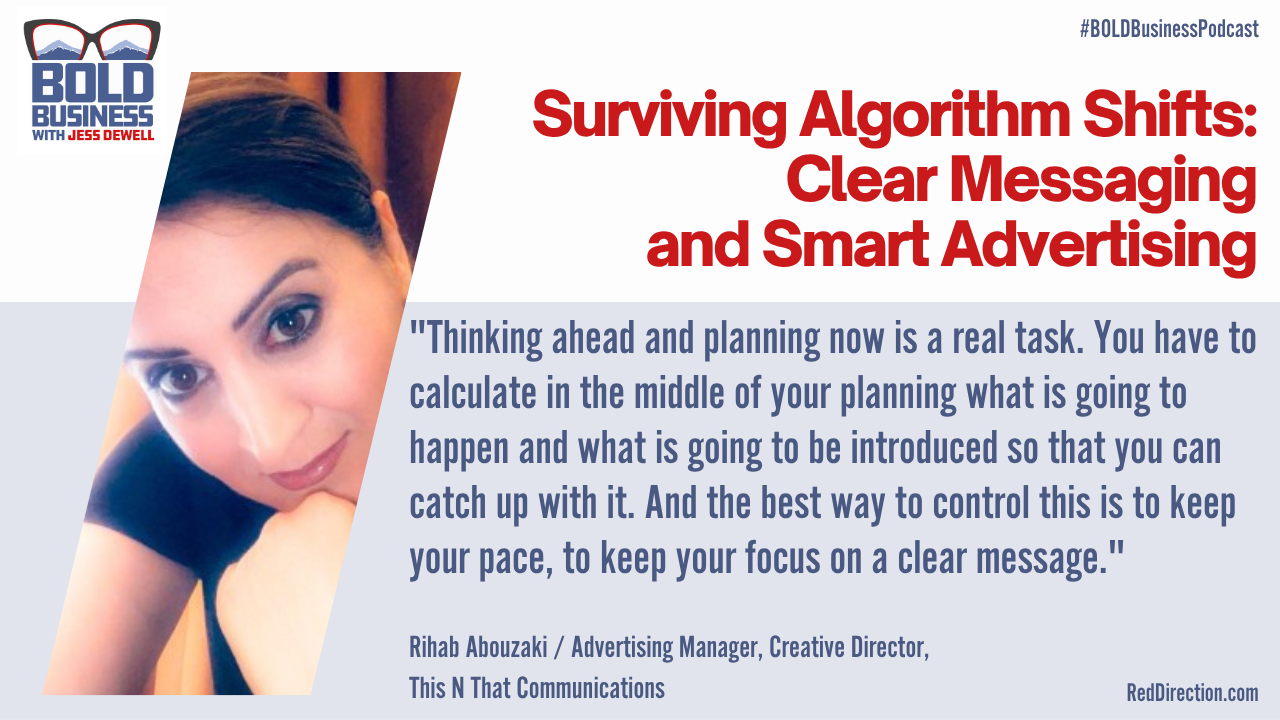
Actually, I just wrote something on LinkedIn related. I feel like as an entrepreneur, as a business person, I feel like I lived several lives. It feels like you as a person, as a leader, you have lived several lives. Every time you think you know, and then you start knowing again, and the systems all upgrade and the systems introduce something that you have to catch up with. This is what’s happening to everybody. Whether you have a clinic, whether you’re a doctor, whether you are an engineer, any sector of business, whether you have a product, life rhythm now and the level of online attention is very fast for all of us. So thinking ahead and planning now is a real task. You have to calculate in the middle of your planning what is going to happen and what is going to be introduced so that you can catch up with it. So that’s why when we work with a client, we always ask them to stress less about that because it’s a real problem for them. And the best way to control this is to keep your pace, to keep your focus on a clear message and do not get day-to-day distractions online with what’s happening in terms of attention. Don’t strive to get into the AI mania. Process things in your pace because even others, your clients, your target market is processing in their own time. The systems are not coping with us properly.
Jess Dewell 12:30
Okay, that is huge, Rehab. Go at your own pace regardless of the pace of technology. And then the next part of something that you said I’d like to dig in a little bit more is that a single clear, I heard you say a single clear message is better than being up to date on the most current technology. Yes. Can you go into a little bit more of why it’s more important today than even three years ago for this consistent, clear message?
Rihab Abouzaki 12:57
Because the challenge is so big and you have end-of-the-day limited budget. Nobody has open budgets to keep trying everything happening and everything is being introduced in the market. You need to have focus on your message first and foremost, and then you listen to the market. Do not be obsolete of the target market, what they are asking you. And this by research, by search, by listening to what’s happening online, as you can adapt as much as possible. But then for deliverables, you need to take your own pace. This is very important because your customers are also taking their own pace. Nobody is shifting as fast as the AI other than the AI companies. It’s really like an unrealistic level of incorporation of AI into our corporate systems. It doesn’t work like that. And it’s not needed. And AI is just a search system that accumulates data and that can be repetitive. And it’s not always as efficient as people are giving it credit for.
Jess Dewell 14:05
I think there’s still a lot of learning happening for sure. And that makes me think, you mentioned some crazy number of bots happening on social media that are doing responding and things like that. That’s outside of DMs, even just commenting on posts to create engagement. So if you’re watching and you’re part of a community, you might actually be a community with just a few humans and in relationship to bots.
Rihab Abouzaki 14:29
Yes, bots can affect your advertising. There are two levels. One is technological that bots can affect your results. And the other one is the crowded area of Instagram and meta in general that is affecting the credibility of advertisers. Like people now don’t believe after five courses online that didn’t work for a person, they wouldn’t register for the sixth one. There is a problem of credibility of those gurus with a camera and phone. And they try to sell you something and then they fail or it’s very unrealistic. And that created a big gap between the people who are seeing the ad and the people who are the authentic companies that are behind the ad. So there is a mistrust. Now we are in an area of complete mistrust on online, especially consulting and trade versus level. And some products also that they just advertise. It doesn’t reach anywhere. When they engage, it’s just…
Jess Dewell 15:33
So here’s a random thought. And let’s see if I can get back to it because it comes to this concept of mistrust. There is a movement right now that, and I know it’s been happening for a while. I think it actually started back in 2018, 2019, maybe even earlier than that, is sell your product and then build it. Have you heard of this?
Rihab Abouzaki 15:55
Yes. It’s failed miserably. And then they have a product and they sell it, but it’s not really authentic. For example, dropshipping. Dropshipping has took its own height and then it failed miserably because you cannot dropship. You cannot control the elements of delivery when you are not in control of the product and the inventory. This is one. And the other, consulting. Consulting has completely messed up the real authentic business and coaching business. It’s really a jungle out there. So many people, they tried everything and then they created a system and it reached nowhere. Because when they advertise, they sell you a course and or a consultancy that does not shift your company forward or does not really give you your results and end up like you don’t trust the medium altogether. We are not getting that on streaming TV. That’s the lucky part about streaming TV in the U.S. First, it’s a free market. It’s 300-plus channels. And it is authentic. It is authenticated by FCC. It’s not a gimmick. And very hard to trap on it. It’s an authentic place where if you have a limited budget, put it in the wise place. If you think that the U.S. is your market, just do not try to reach through Instagram gimmicks. They don’t work. They don’t work, especially from out of town.
Jess Dewell 17:28
So I’m thinking about supply chain, right? Companies who have a product, who have brought on people who are selling the product for them, whether it’s dropship or a pass-through for fulfillment, it doesn’t matter. The affiliates or the dropshippers actually have to wait for product in some capacity, and they’re in front of any company. And so those are small companies. The companies who are actually setting up that scenario do have a responsibility to those people. And I know that there are a lot of people out there who think that would be a great side gig. That would be a great addition to the business that we already have because we have a similar product. And I will tell you what, the credibility that goes with not being able to keep your word because of something that is outside of your control. By the way, it could be a really great company you’ve partnered with to do this and it’s outside of their control. Yes. But it’s diluted and then it’s just a big mess. And it’s really hard to be accountable in scenarios like that.
Rihab Abouzaki 18:27
Yeah. And actually, advertising now is not as expensive as it used to be. It’s very affordable. So you don’t have to risk it in terms of using the wrong, using the shortcut or like you call it, band-aid marketing. It doesn’t work like that. It’s just the idea is confine your budget in a strategy that has testing. So you test the market and you keep flexibility of moving your message forward so that if anything is not giving results, you can amend and move forward. This is the beauty of having all that technology around us.
Jess Dewell 19:07
So I’m thinking about alignment, right? This comes back to the clarity of message. What are some tips that you can give to ensure there’s alignment in starting something new or I’m going to call it expansion, right? Dabbling in a different area or a different focus of the same thing, because I think that’s really where you get where the clarity of message could be lost.
Rihab Abouzaki 19:27
Yes, a clear message and clear target. Like sometimes the market surprise you, like you put out there a message and someone else from the target market picks it up. Like, for example, you are targeting, for example, middle-aged women and then youngsters pick your product. That’s not a bad thing. Sometimes expansion happens authentically and organically. But to become a result-oriented advertiser, you need to be bold. You need to be not attached to your product, not attached to the idea. Like, when you are testing an idea, it’s okay. Let it be. Sometimes my best ideas just go to garbage. Just go on. move on. They do not get attached to the idea of the briefing. The rhythm is so fast that an idea can become viral or can be dropped out just as easy as on a daily basis. It used to take a month or two to get a result of advertising campaign. Now on a daily basis, you can test it. This is really a very important feature that you can benefit as a middle company, as a middle-level company that you don’t waste money.
Announcer 20:44
If your week feels like you’re being pulled from one demand to the next, this is for you. The Daily Grind is the number one killer of business instinct, pulling you and your team away from your vision. Reclaim your strategic edge with the Present Retreat. This free guide from Red Direction is a simple, powerful framework to carve out the space you need to filter out the noise, make the right decisions and lead with clarity. Visit presentretreat.com.
Jess Dewell 21:14
Let’s get back to the conversation with Rehab Abuzaki, an expert in GCC U.S. advertising for tourism, luxury, travel and real estate brands. I’m a big believer in finding something that feels right, looks right, sounds right with an end because then if it turns out to be triple awesome, great but if it turns out to be a triple dud great, right?
Rihab Abouzaki 21:40
Yes and it is great in the condition that you can control the budget always like advertisers pay for those spots advertisers pay for this fortune so or and or maybe peanuts whatever is your budget the problem is when the budget is spent and the money the return on investment is not as impressive this is why the new technologies all are serving the return on investment, monitoring and improvement and testing. All this just to get better results, faster leads and more reliable outcome.
Jess Dewell 22:13
And having a smart budget, spending smart dollars or whatever the currency is. One of the things that comes to my mind is the outcome. The goal isn’t necessarily an extraordinary customer experience. That is one of the outcomes though. That is a result that is measurable in its own right. And so what does an extraordinary customer experience in the digital market, whether we’re a digital company or a physical product company, regardless of where we’re starting, what are some key elements of that extraordinary experience for customers?
Rihab Abouzaki 22:45
To find you, this is the best first move is be available. Show up in front of your customers. Work on showing up. And showing up now is not anymore Google Ads. It’s not anymore Google ranking. It’s more of showing up in content, like create content so that people can find you, can relate. And, of course, answer questions for AI, do YouTube content, do TV advertising. Streaming TV is extremely important so that people can find you.
Jess Dewell 23:17
So let’s take that in a different way, too, right? Because another thing that can happen is it has been working and all of a sudden it doesn’t. That’s when I have seen real freakouts occur, Rihab. And so I’m wondering, what are your tips or experiences to show up to that when it occurs? Because if it hasn’t, it will, won’t it?
Rihab Abouzaki 23:39
Every business has seasons. People think that seasons are just for consumer produce or something. But actually, also inquiries and seasons of high return on investment and seasons of low return on investment are available in every sector. And to avoid that is not to get stuck on the low seasons to pump more money into low seasons. Like, for example, if you have no schools at the time, like in the summer, no schools, there is no point in adding much more advertising for a school item. You need to save the time, prepare to the higher season. Do not focus on one message, one season. I have to make it in every way. It doesn’t work like that. Seasons are very real in every product, even in coaching. For example, if you have starting a university semesters, it’s not the best time to approach moms for a paid service. And similar. So similar for other stuff you cannot advertise during a season of out-of-town vacations and so on. So it is wise to accept your low seasons and prepare and invest more in the high seasons or in the expected more availability of target market.
Jess Dewell 25:00
What’s one of your biggest learnings having been in advertising and marketing for so long?
Rihab Abouzaki 25:05
My biggest learning is try everything. Do not get attached to mediums or anything. Keep a very open mind because my best ideas can go to nowhere. And a surprising small idea can become viral and can get much more results and be authentic. People are now very much catching up on authenticity. They don’t want to talk to liars anymore. They have been cheated around for a very long time, online especially.
Jess Dewell 25:35
One of the companies that I started early in my career, we did just that. It was a software program, right? It was a platform online. And we kept getting these requests. Can you do this? Can you do this? Can you do this? And Ryan and I, partners in this company, along with a couple of other people, would sit down and I’d be like, why not? And sounds easy. And of course, nothing is easy when it comes to actually building it and maintaining it and supporting it per se. So there was always the thing of, we got to make sure it supports more than one or two people. It’s got to support the majority of the people using our system. And finally, I can’t even remember if it was him or me or if it was one of our other partners said, how much time is it going to take? If we can do it and we know it’s not going to take a lot of time and we can do it in a way that’s not going to hold up or interfere with any other feature we have so far, why not just try it? So I’m going to give us the collective. We got there. Why not just try it? Turned out to be the biggest feature. To your point and to one of your learnings. I was like, look at that. Yeah.
Rihab Abouzaki 26:35
Yeah. When we started first, we started with the idea of we want to do everything perfect. And we took softwares that, especially the CRM. Now the CRM is complete mess. So we took like the biggest in the market. It came up the worst. And we had to pay one year subscription for really nothing. And it hurts. It hurts when you subscribe for those advertised, well-advertised softwares and features and gurus and coaches. And yeah, don’t go by that. Just be, if you are a company, be authentic to your client. And if you are a client, just be aware that advertising is not always true.
Jess Dewell 27:17
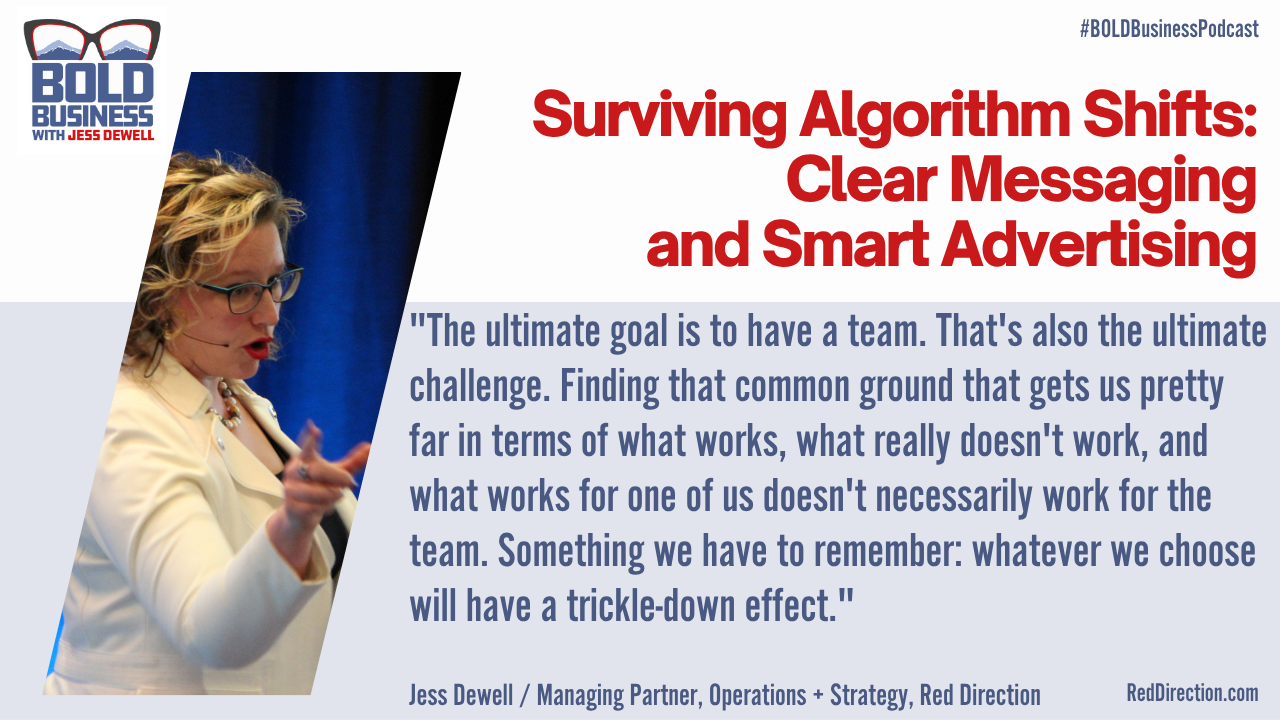
Oh, man, I’m telling you, we got to learn that one over and over again. And it doesn’t matter who we are. And that brings up a really good point, though. I’m thinking strategically, right? As a group of people, it’s not like we’re the leaders of our own lives here. We are in our own lives. When we go to work and we’re leading these companies and we’re responsible and the buck stops with us at the highest level of the organization, it’s no longer typically one person at that point. It is a team. It is a group. I don’t know if the groups are always teams, which is why I said both. The goal is to have a team, right? That’s the ultimate goal. And I think that’s also the ultimate challenge. And in today’s world, everybody has their own perspective. Everybody has their own way to go. We still face that in companies today. So finding that common ground to go, if this is where we have common ground, maybe this is where we start with this approach, this perspective, this experiment. this technology, and then watch and see to your point of not needing to go super fast. Because I think that common ground gets us pretty far in terms of what works, what really doesn’t work, and what works for one of us doesn’t necessarily work for the team. And that’s something that we always have to remember too, because whatever we choose as the leadership, it is going to have a trickle-down effect.
Rihab Abouzaki 28:36
I tell you what, now we, every service, every software we use, we tell them that we’re going to publish our experience. Like we’re going to make a review video and publish our reviews and advertise our reviews because I don’t want anyone to talk to me when they are not delivering what they are promising to deliver. And that’s how I treat every client. I tell them if we don’t perform or if we don’t show you our best and make sure that we are on your page all the time worrying about your money just like ours, I want you to advertise. I don’t mind.
Jess Dewell 29:13
Yeah, I think that’s really smart. There’s a straightforwardness in that too. And I’m on board with being straightforward all the way.
Rihab Abouzaki 29:20
You know, when someone comes and advertises online and they tell you everything is perfect and then you talk to them and you subscribe or take the service and then two or three months down the line, you are only losing money. There is no performance. Their product is not working, whether it’s an app, whether it’s a software, whether it’s CRM, website service, whatever it is, coach, trainer, anything. I want to advertise my reviews. I want to tell the world my experience. And it’s a free world. I need to do that. And the same I expect from others, but we are ready for all challenges.
Jess Dewell 29:52
And not everybody’s path looks the same. Progress can still be measured, though, can’t it? And that, I think, is the key piece, too. Communication, transparency, a willingness to be like, yeah, be talking to me along the way. Yeah, I’m going to be talking to you along the way and being able to say that. And it actually leads me into this. There’s this concept of the way we do our work together internally. And those typically, even if we don’t want them to, have unwritten agreements, right? There are things that nobody talks about, but that we do. And what I hear you saying right now is, hey, we can actually influence that when we practice a habit of being straightforward, being clear in our communication, working together the best that we can, knowing that there might be bumps along the way. We’re doing that. We’re defining how we do our work together, which means we can then avoid unwritten agreements. So that nobody’s taken by surprise.
Rihab Abouzaki 30:50
Yes. And also after COVID and all what’s happening around us. So now authenticity of accepting people as they are and not corporate has changed. Now we are more into accepting people just like they are. I made a mistake. Let’s move on. We always do mistakes and it’s okay. And we don’t have to cover it up to hide to become politically correct or corporate correct. Just be yourself and accept that others can make mistakes. And like I said, I always say, advertise your opinion of me.
Jess Dewell 31:24
I’m thinking about driving these solutions forward. The solution is, in this case, the advertising path, the clear plan, some sort of expectation of budget, some sort of expected outcome, and then the actual execution to gather the data to learn and make changes and work toward getting that expected outcome, right? And so there’s a strategy itself, then there’s the actual execution piece. How are those, how much of driving the solutions is each of them?
Rihab Abouzaki 31:52
Actually, we start from the results. We do not start from the strategy. And this is one of the biggest mistakes of companies who start from strategy and then start fitting in solutions. You start from the outcome. How many pieces I want to sell? How many clients I want to talk to daily? How many leads I want to get per week? how many services I want to give. And then we start backwards so that we can get, if you want to talk to 100 people a week, you need to be in, for example, three surrounding states. So you need to have this geographic location target, this age group, this level of engagement. So we start from the results into the strategy. To reach this strategy, you need to then talk to several mediums. It’s about starting from the end. There is a lot of wisdom in starting from the end result.
Jess Dewell 32:48
Yes, because if we don’t know where we’re going, it’s cool to try a lot of stuff. But yeah, there are a million ways to do it right. And there’s a million ways to do it wrong.
Rihab Abouzaki 32:57
And all expensive. All the ways are calculated, even if it’s your time. It’s not always about money. Sometimes it’s your time. We tried this when we were like, we became clients to other companies. and we said we need 50 leads a week it was a big target but we wanted to test them and we really paid them one of the companies we paid them 14 000 just to get us 50 clients a week and we knew it’s not possible we were just testing them they got us zero because they start we let them make all the mistakes they wanted just because we were creating a case study for our people for our clients what happens when you don’t work with the right agency, when you don’t work with the right partner. So we have everything documented.
Jess Dewell 33:50
I want to know what makes it bold, Rehab. What makes it bold to prioritize building that authenticity, that human connection in an increasingly fast-paced world and automated advertising?
Rihab Abouzaki 34:03
It depends where do you want to reach. The boldness of your actions should come from the results of your target market. You need to study your market and based on that, calculate your bold steps. Because bold has to be wise. It’s not only hunch. It’s though I believe in intuition and I work a lot with intuition, especially in advertising. The intuition of what clicks, what moves the market and all is important. But also, when statistics have it, take it forward. Do not hesitate. The problem is when you hesitate, say, I want to be on the top 100 movies in the U.S. And then you find my budget was $7,000 a month and it requires $10,000. That is a hesitation that is killing your market. Because when the calculations of statistics say just either trust it or don’t move. Don’t do half steps. This is bold. It requires a lot of wisdom and risk-taking and risk management.
Announcer 35:17
And that brings us to the close of another powerful and fresh perspective on the Bold Business Podcast. In today’s volatile landscape, growth is a double-edged sword. To truly thrive, you must engage with your strategy, not just react to the day-to-day. Without absolute alignment, your company faces a stark choice. Outmaneuver or be outmaneuvered. Grow or get left behind. Thank you for listening, and a special thanks to the Scott Treatment for Technical Production.