
How colliding macro forces and leadership blind spots accumulate Strategic Debt—and the two tools that restore executive capacity.
Executive Summary:
Margin compression, AI integration, and shifting tariffs cannot be optimized away with better spreadsheets or longer working hours.
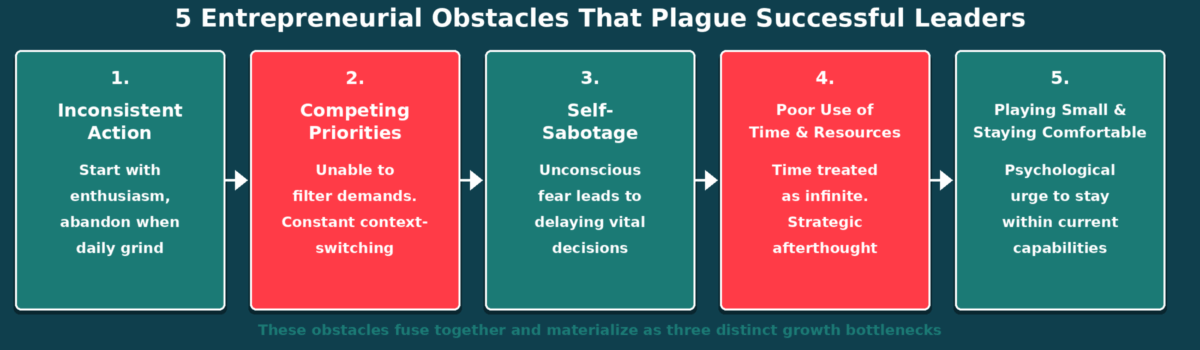
For mid-market companies ($10–$25M), the strategies that drove early success are often the very forces that stifle future growth. While market volatility, margin compression, and AI integration demand adaptive leadership, many CEOs find themselves stuck. This is not a failure of hustle; it is a structural breakdown caused by five psychological and operational obstacles—inconsistent action, competing priorities, self-sabotage, poor resource allocation, and playing small—that manifest as three distinct growth bottlenecks.
To break this strategic ceiling, leaders must transition from management oversight to systems-led execution. By adopting a Dynamic SWOT and a Responsive Decision-Making Architecture, executives can distribute authority, integrate data and intuition, and institutionalize the strategic heartbeat necessary to sustain market relevance in an unforgiving landscape.
Key Takeaways:
- The Growth Paradox: The brute-force execution and direct oversight that scales a business to $10M becomes the primary bottleneck preventing your company from reaching $25M+.
- Identify Your Blind Spots: Leaders must recognize how five common entrepreneurial obstacles (inconsistent action, competing priorities, self-sabotage, misuse of time/resources, and playing small) feed three self-sabotaging growth bottlenecks.
- Leverage Practical Architecture: Utilize a Dynamic SWOT to ground initiatives in operational reality, and a Responsive Decision-Making Architecture to synthesize logic (Head), emotion (Heart), and intuition (Gut).
What’s Really Happening: Three Forces Colliding
The AI Overlay Trap
You’re making the same mistake with AI that you made with every efficiency tool before it: overlaying delegated work and automation on incomplete workflows instead of fixing the process itself.
More and more information is being shared about how AI is being integrated into companies right now. The hype is that more and new work is being done with AI. The reality is AI is a lot like having custom software built a decade ago – it is expensive, it has bugs, and doesn’t always perform better right away. Be clear about how AI integrations support growth by architecting it over time. Action, feedback, adjustment, repeat. The trap is that automated systems get more complex while decision-making remains reactive and fragmented. Everyone looks to you, as CEO, CFO, COO, for decisions. Your company is still dependent on you.
Real result: faster chaos, not faster growth. Real-time data you can’t act on. Tools that promised to save time become another thing to manage.
The Margin Squeeze
Tariff updates and tax regulations shift. Personnel and technology stack costs creep up. Sourcing and logistics change. You can’t optimize your way out with better spreadsheets. Your product price increases get closer to what the market is willing to pay, if you haven’t found it yet.
It is typical to respond by grinding harder. Working longer hours. Pushing the team for more. Cost savings only get a company so far. Creativity comes from constraints and experimentation. Support for ideas that may fail is part of the risk. Margin pressure erodes the ability to fail fast and forward.
What actually works: adapting your internal execution engine. Strategic systems that allow failure to be a data collection point for building Business Instinct and shape future decisions.
The Decision-Making Bottleneck
Your decision-making capacity is finite. So is your time.
As CEO, every choice flows through you. Your team waits for your input. Your approval is more than a constraint. You waste organizational resources when decision-making authority is not shared. Cognitive bandwidth spent on decisions leaves no space for the deep work that moves your business forward: strategy, vision alignment, and market positioning.
Real Result: Your actions are focused on solving problems instead of preventing them.
Discover how the Driving Solutions Strategic Intensive installs the two architectures that free you from the CEO bottleneck trap—so you can architect the future instead of fighting today’s fires. Command your market.
The Root of the Ceiling: 5 Obstacles and 3 Bottlenecks
Scaling a mid-market business is an exercise in structural and psychological endurance. While external pressures like margin squeezes and market shifts are unavoidable, the most profound threats to growth are internal. When entrepreneurs hit the $10M–$25M plateau, struggles can almost always be traced back to five specific obstacles.
The 5 Entrepreneurial Obstacles:
- Inconsistent Action: The tendency to start strategic initiatives with high enthusiasm but abandon them when the day-to-day grind takes over. Promising ventures fail not from bad ideas, but from inconsistent execution and strategic drift.
- Competing Priorities: The inability to ruthlessly filter demands. When a leader tries to be the visionary, the manager, and the executor all at once, they fall victim to constant context-switching and reactive decision-making.
- Self-Sabotage: Often driven by an unconscious fear of failure (or success), leaders and their teams will subconsciously manufacture crises, delay vital hires, or overcomplicate systems to maintain control over an organization they are outgrowing.
- Poor Use of Time & Resources: Treating time as an infinite resource for management, while treating strategic planning as an afterthought. Exhausted founders make mistakes in hiring, in strategy, and in product.
- Playing Small & Staying Comfortable: The psychological urge to stay safely within current operational capabilities rather than embracing the discomfort of true scale. Staying comfortable is staying the same, and trying to avoid judgment or risk simply slows momentum and caps organizational potential.
When any combination of these five obstacles goes unaddressed, they fuse and materialize in your company as three distinct growth bottlenecks:
Bottleneck 1: Organizational Capacity Drain
The Collision: The Centralized Decision Bottleneck + Competing Priorities & Poor Resource Use
Your decision-making capacity is finite, and right now, it is the fundamental constraint on your organization.
When every choice must flow through you, organizational velocity grinds to a halt. This CEO-central bottleneck is exacerbated by two internal obstacles: competing priorities and poor use of time and resources. Trying to act as the visionary, manager, and primary executor simultaneously leads to endless context-switching. You treat time as an infinite operational buffer while treating high-level strategic planning as an afterthought.
The Result: Daily operational crises consume your cognitive bandwidth in real time. Even when you attempt to block out time for deep work, daily noise creeps in. Your cognitive capacity is entirely drained by defending the present, leaving zero bandwidth to architect the future: strategy, market positioning, and vision alignment are completely crowded out.
Bottleneck 2: The Sabotage Cycle
The Collision: The Margin Squeeze + Self-Sabotage & Inconsistent Action
Tariff updates shift, tax regulations evolve, and operating costs creep up across software, supply chains, and talent. You reach a point where spreadsheet optimization and incremental price hikes no longer protect your bottom line.
Faced with shrinking margins, leaders often fall victim to self-sabotage and inconsistent action. The fear of margin erosion triggers an intense action-bias: you start grinding harder, working 70-hour weeks, and demanding more from your team. But because this panic is reactive, execution becomes fragmented. You launch high-energy initiatives to salvage revenue, only to abandon them three weeks later when a new fire demands attention.
The Result: Solving immediate symptoms leaves root causes untouched. This reliance on reactive heroics creates a cycle of structural sabotage: your leadership team stops taking long-term strategic plans seriously and simply waits for the next crisis directive. The business becomes trapped in a loop where brute-force hustle yields diminishing returns and shared accountability is missing altogether.
Bottleneck 3: Distraction Debt
The Collision: The AI Overlay Trap + Playing Small & Staying Comfortable
AI and automation tools promise exponential efficiency, but overlaying them onto incomplete or broken workflows doesn’t fix the underlying process. It just speeds up the chaos. Much like custom software integrations over the past decade, AI without intentional architecture creates expensive, buggy systems that still require human intervention.
Why do companies fall into this trap? Because of the human urge to stay comfortable and have perceived certainty. Adopting new tech tools feels like modern strategic progress. Yet, it is often an easy distraction from the uncomfortable, high-stakes work of true scaling: making hard choices about your business model, restructuring underperforming teams, or committing to a singular growth engine.
The Result: You accumulate Distraction Debt, the compounding operational weight of managing complex technology that produces real-time data that no one has the authority or framework to act on. Instead of feeling nimble, your company’s leadership team works in isolated silos, bogged down by noise and deprived of unified, strategic intent.
The Shift: From Reactive to Responsive
The survival and evolution of your business are defined by your growth strategy, which sets the direction your company will take to ensure its market relevance and future. Staying connected and engaged with the growth strategy is not just urgent. Today, it is a requirement and more valuable than the next revenue milestone.
Reactive companies operate in a day-to-day operational whirlwind, resulting in most management teams spending less than 1 hour per month on the company’s growth strategy.
Responsive companies have made a real shift. The opposite of reactive: dedicating intentional time today so you and your management team can anticipate where the growth opportunity will be tomorrow and make decisions that put your company in the right place to benefit from it.
From Management Oversight to Systems-Led Execution
Your ability to adapt, flex, and get to where you are is the result of what you know and have learned from each new situation. To get to the next stage is similar – you will have to let go of what you know worked in the past because the situations and complexity of the business are different. Not to mention, you are different too.
You already have intuition. There are subtle shifts in customer interactions, the way the team works, and resource allocation. Being able to find the right questions for continuing to build your Business Instinct, explained more below, and define the constraints you are working with can be overwhelming at times. This is where accountability and execution become more important than before, and success lies in how you engage with your growth strategy and create 36-month initiatives.
Management oversight works at $500K-$5M. You can still hold the business in your head. You’re in the details.
At $5M+, it becomes your ceiling. Oversight becomes the bottleneck. Your team stops thinking independently. Mid-market leadership already has the skills in this area, as navigating rapid change is necessary for initial startup success. The next level of skill is to move yourself out of the center of the business while staying effective in the next version of your executive role.
Systems-led execution is different. You don’t manage people directly. You architect systems that make the right decisions without you. Especially when you don’t have all the information, the plans you make impact your company 36 months out even though you don’t know what will actually be happening then.
This means:
- Clear decision-making frameworks your team understands
- Regular rhythm practices (weekly connection, monthly reviews)
- Transparent metrics so people see what’s working
- Distributed authority (decisions made at the right level)
- Everyone learning to shoulder uncertainty together and being ok with saying ‘I don’t know, yet’
The CEO’s job shifts from being the answer to architecting the system that generates answers.
Discover how the Driving Solutions Strategic Intensive installs the two architectures that free you from the CEO bottleneck trap—so you can architect the future instead of fighting today’s fires. Command your market.
Future-Making, Not Future-Proofing
Circling back to the 5 Entrepreneurial Obstacles, what blocks you face right now are likely tied to one or more of them.
You may have heard of the concept of future-proofing, which is defensive, reactive, and protective in the face of uncertainty.
Flipping the phrase offers a different, curiosity-based view: Future-making.
Future-making is proactive. It is intentional with clarity that looks and sounds like:
- Here’s where we’re going.
- Here’s who we need to become.
- Let’s direct our efforts to build that.
The shift to architecting your future means keeping resources focused on today’s priorities while setting a direction that enables the development of an unfolding plan that supports your company’s growth strategy 36 months ahead. To become an executive who can hold both today and the future requires setting aside time solely for this. This deep work time is protected from everything else so that you have space to think.
Strategic decisions compound, and strategic work isn’t a squeaky wheel yet requires much more time than is typically given. The more commitment to doing strategic work regularly, the more time you can create. Competing priorities can be identified and addressed; ineffective meetings and processes that waste time can be eliminated; clarity in communication about the direction can be achieved; and compassion can be brought to difficult situations and conversations.
Dedicated protected time sounds like a time management tip.
That is a drastic oversimplification. Stepping out of the operational whirlwind is a skill that has nothing to do with your schedule and everything to do with ensuring you are confident in the course you are choosing to guide your company through.
Time is something each of us has the same amount of. And how it is used is what separates companies that scale and have longevity from those that don’t. I’m talking about strategic compounding, which only happens when you are intentional about what you choose to focus on and give that work the time it needs.
Becoming an executive who can simultaneously navigate today’s operational whirlwind while architecting a 36-month horizon requires dedicated discipline. You cannot build a responsive business in the margins of a chaotic calendar.
Business Instinct: The Core Framework
You make decisions daily. But how many are actually good decisions?
Observations across mid-market enterprise leadership reveal a consistent differentiator: Business Instinct. CEOs and management teams with Business Instinct achieve higher success by integrating incomplete data with their honed intuition.
Being able to synthesize current market conditions and anticipate the likelihood of future opportunities requires experience, pattern recognition, and the selection of indicators of market direction. It takes confidence to practice making risky decisions in motion when outcomes may be murky at best.
There are three components to Business Instinct:
- Data (The “What”): This includes objective facts such as financial reports, P&L statements, sales metrics, and market trends.
- Honed Intuition (The “So What?”): This is a leader’s “street credibility” gained through years of experience, allowing them to see patterns and ask critical questions of the data.
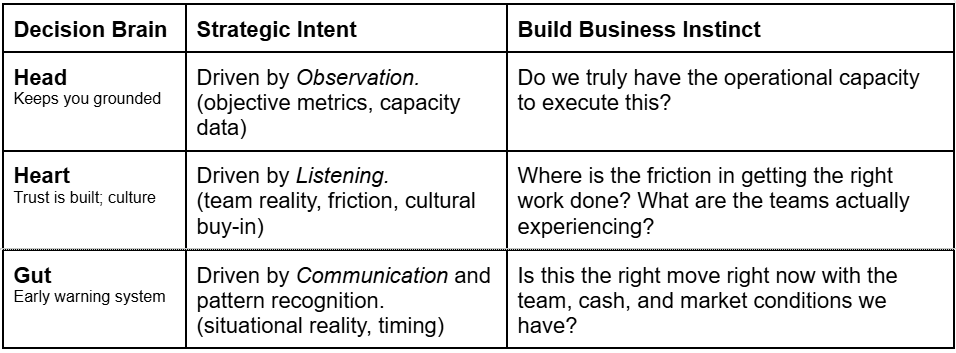
- Three Brains (The “Decision Making Default”): Instinct is typically associated with the Head (logic/data). Some leaders openly lead with Heart (vision/emotion) and others with their Gut (intuition/situational reality) to avoid analysis paralysis or reckless guessing.
The Three Brains of Leadership
Business as we know it today has conditioned executives to lead with logic. Dynamic companies that clearly state and engage with their growth strategy use all three, as each has pros and cons:
How to Integrate in Your Company
Most leaders get stuck in one brain because it is what they were taught or what previously led to success. The shift is to integrate all three for yourself and into your decision-making process.
When making a strategic choice, as a management team, ask from all three angles:
Once answered, bring in an external perspective. This is where an outside growth advisor is extremely helpful, as they can help you synthesize all perspectives and even highlight emerging patterns by facilitating conversations and strategic work sessions with your management team.
Two Tools to Use Right Now
Tool 1: The Dynamic SWOT
Traditional SWOT gets filed away after one review. A Dynamic SWOT is a living document that informs every initiative.
Step 1: Identify Your Initiatives
What are the big things you’re trying to achieve? Three to five, max. Not “grow revenue”—that’s too vague. More like: “Launch our enterprise product,” “Expand to the West Coast,” “Hire VP of Ops.”
Step 2: Map Against Actual Reality
For each initiative, ask:
- Strengths: What do we actually do better than anyone else? How does this leverage our unique capacity?
- Weaknesses: What operational gaps will this expose? Are we honest about the team we have?
- Opportunities: What market conditions are in our favor right now?
- Threats: What’s the real disruption risk?
Step 3: Name the Bottlenecks
After mapping, ask: Where are the actual bottlenecks?
Cash flow? Team capacity? Your own decision-making speed?
Name it. Own it. Then decide: does this initiative still make sense, or does the bottleneck suggest we need to pivot?
Why This Works: It forces radical honesty. You can’t pretend your team is stronger than it is. And you can’t ignore market headwinds. You build roadmaps for the team you have, not the team you wish you had. This removes the CEO bottleneck because your team can see the full picture.
Tool 2: Responsive Decision-Making Architecture
This system replaces reactive decision-making with a repeatable framework.
The Framework:
- Gather Data from All Three Brains — Head (what does data tell us?), Heart (what are we feeling?), Gut (what’s our honest read?)
- Consult an External Perspective — Bring in an advisor, peer, or consultant who asks questions you haven’t considered.
- Play Out Long-Term Consequences — Not “what happens next month?” but “what happens in 18 months if we make this choice?”
- Trust Your Integrated Instinct — Decide. Commit. The worst decision made with commitment beats the perfect decision made with doubt.
- Review Periodically — Monthly or quarterly. Adjust if new information changes the equation. Do it intentionally, not reactively.
Why This Matters: It distributes decision-making authority. Your team doesn’t wait for the CEO. They have a framework. Decisions get made faster. Quality improves because you’re using all three brains, not one person’s judgment.
Conclusion:
Build Business Instinct with two tools that will increase your executive management’s capacity and leverage Strategic Compounding regardless of colliding macro forces facing your business today.
The transition from a reactive founder to a responsive architect is the defining crucible of mid-market leadership. In an era dictated by sudden margin compression, macroeconomic volatility, and rapid technological shifts, generic growth and brute-force hustle are no longer viable strategies. Working harder and adding more complexity cannot solve systemic misalignment.
The future belongs to organizations that intentionally institutionalize their strategic heartbeat.
By implementing a Dynamic SWOT, you ground your ambition in unvarnished operational reality.
By installing a Responsive Decision-Making Architecture, you distribute authority, synthesize your team’s Head, Heart, and Gut, and free the CEO to focus strictly on future-making.
Growth at the $10M–$25M stage isn’t about pulling every lever to force a result; it is about pausing the chaos, protecting your cognitive bandwidth, and building the system that makes scaling inevitable.
Ready to implement these architectures? Knowing what to do and actually doing it are two different realities. The transition from scattered firefighting to strategic rhythm requires protected time, external perspective, and deep accountability.
Discover how the Driving Solutions Strategic Intensive installs the two architectures that free you from the CEO bottleneck trap—so you can architect the future instead of fighting today’s fires. Command your market.