





As a business owner, it’s difficult to do the right work AND guide your company toward its next big initiative.
With Red Direction Business Base Camp, learn how to implement and handle processes to meet your business’s specific needs and better understand your market.

Starting the conversation:
Make customers cheer and fix friction fast by empowering your team to turn complaints into million-dollar opportunities. Solomon Thimothy, Co-founder and CEO of oneIMS, shares his experiences about finding BOLD growth opportunities within his company.
It’s ok to reverse your previous decisions. Change and flexibility are required to navigate growth today. Choose to take action by delegating, launching tests, and listening to your customers … even when there isn’t a system built yet.
In this episode you will hear that managing energy is as important as systems, how to remove friction and get out of your own way, and the power of undoing or ending processes that hold growth back. Jess Dewell talks with Solomon Thimothy, Co-founder and CEO oneIMS, about rewriting the CEO growth playbook embracing relentless evolution.
Host: Jess Dewell
Guests: Solomon Thimothy
What You Will Hear:
08:45 Scaling a business requires shifting focus from personally solving problems to finding the right people to solve them.
- Entrepreneurs often default to asking themselves how to accomplish tasks, rather than who can help achieve them.
- Leveraging others’ skills and hiring the right people accelerates progress and growth compared to trying to do everything yourself.
- Successful leaders focus on assembling capable teams for key tasks, as illustrated by industry examples like Elon Musk.
14:10 Being a high-impact leader means modeling energy and commitment for your team every day.
- Leaders must show up with energy and positivity, setting the tone for the entire team regardless of their own routines.
- Bringing your best every day helps motivate your team to achieve and maintain high performance.
- Leadership requires consistently working hard and out-hustling, which inspires trust and productivity among team members.
22:30 Entrepreneurship provides the flexibility to invest time where it matters most, including seeking mentorship and networking.
- Business owners have the unique opportunity to create their schedules and make time for impactful relationships, like mentoring.
- Meeting and learning from more experienced mentors can provide invaluable guidance and perspective for business growth.
- Building relationships with accomplished people can help owners grow by learning what they don’t know and expanding their mindset.
27:10 Innovation in business often requires a leader’s hands-on experimentation and transformation of ideas into processes for the team.
- Leaders sometimes must return to technical or tactical work when launching new initiatives, especially when frameworks or SOPs don’t yet exist.
- Testing and experimenting are necessary for developing new products or services that can then be handed over to the team.
- A visionary leader should be directly involved in creating and refining innovative processes to keep the company evolving.
34:15 Empowering teams to experiment, share, and implement new ideas accelerates innovation and learning organization-wide.
- Initial experimentation often starts with a core group, and successful ideas are then disseminated throughout the larger team.
- Leaders should streamline choices to help teams focus, adopting tools and processes that drive productivity and creative problem-solving.
- Regular sharing and adoption of new technologies and efficiencies keeps teams dynamic and adaptable.
38:15 Prioritizing a frictionless and inclusive customer experience, even for lower-tier customers, can lead to greater retention and word-of-mouth growth.
- Strong customer service means offering high-touch support, regardless of account size, to help all clients feel valued.
- Addressing underserved client segments can help convert small clients into major supporters and reduce churn.
- Listening to customer feedback and proactively removing barriers fosters satisfaction and growth from all types of clients.
47:05 Aspiring to build a self-managing and even self-multiplying company allows leaders to step back while ensuring sustainability and further growth.
- A self-managing company runs smoothly even in the leader’s absence, providing work-life balance and operational resilience.
- Leaders should empower teams to make decisions and solve problems, preparing the business to operate independently.
- The highest level of business growth is achieved by creating organizations that spawn additional businesses, multiplying impact and opportunity.
48:35 It is BOLD to tell a CEO that their revenue breakthrough is already in their building — it’s just stuck in the friction of their current framework.
Resources
Transcript
Jess Dewell 00:00
As the leader and the vision holder, how do you ensure you, as an individual, are who you need to be and you’re on the path to becoming who you need to become so that you can lead your company and stay relevant?
Solomon Thimothy 00:15
To be a leader, it’s a tough place to be because you literally have to outwork every single person in your team.
Announcer 00:28
Every leader needs a trusted partner for the moments that matter. This bold business podcast conversation is that partnership, your go-to resource designed to break the inertia and refresh your perspective so you can start making moves. Here is your host, an insightful truth teller who serves as the catalyst for getting the right work done and who asks the questions that truly matter, Jess Dewell.
Jess Dewell 00:55
Today, you’re going to hear my conversation with Solomon Timothy. He is not only a serial entrepreneur, he is a serial entrepreneur with many successful businesses running at the same time. Growth strategist by nature, customer-centric by nature.
Right now, in this moment, his companies, there are five of them, is who he leads as CEO. OneIMS, ClickX, IMS, LingoStarts, and LeadXAI. All of them are built with a single mission to help businesses grow smarter and faster and more sustainably.
You’re going to pick that up in our conversation. Tips and tricks and where innovation and creativity come from and how to stay focused on the creativity side while being more productive in our day-to-day. He is the creator of the 10X Framework, which is a proven methodology that empowers businesses to double leads, revenue, and results without burnout or constant guesswork.
Here’s the thing, you’re going to hear that throughout our conversation. There are three things I’m going to call out to you before we get there to listen for as you’re moving through the conversation today. The first is, it’s about energy management for our vision, for our team, for the forward motion, not only in business, but in our life.
It’s really important to recognize it is likely we are in our own way somewhere. As the visionary, as the torchbearer, it’s important for us to be always looking for where to remove friction and create the reframes necessary, especially when it comes to being customer-centric and buyer-centric, because they matter and we matter. The third thing, everything that we do can be undone.
The reason is because things are always changing. Make sure, recognize and claim, nothing is set in stone. I want to talk about the two decades that you’ve been helping businesses scale.
You’ve also had to scale your own identity at the same time though, I’m guessing. That’s actually something that I really where I wanted to start today, was where was that moment that you realized that your technical excellence in marketing was preventing you from becoming the chief growth architect your company required to get to where it is today?
Solomon Thimothy 03:14
I’m a technician. If you ever read the book, E-Myth, Michael E. Gerber makes a good discussion about just being a technician, a person that does the thing that you sell.
Most entrepreneurs, they fall into that. If you love flowers, you want to get into the business, but you don’t think about growing the business. You’re in the weeds.
You’re doing the tactical thing. That’s how I started in my career. I started building websites.
It was self-taught web designers. If I didn’t do the websites, I didn’t have somebody else to do it. Guess what?
I had to do it. I would sell, get the money, go and work on the website. At some point, I’ll have more websites than I have hours in the day.
Things that I deal with even today, you create work for yourself. Obviously, we’ve hired people, but the company still had me under that kind of job. Everybody stuck.
Whatever they were doing, the designers, the developers, they just automatically go to me because I was the guy that created the process or the systems and so on. I had to realize that I’m not a CEO. I’m a job.
I’m just an employee. You’re stuck. You can’t really grow.
To answer your question, Jess, I had to become a different identity. I had to say, look, I’ve hired so-and-so to help you manage those questions so that I could create content so it can get published on Forbes, Inc. Magazine, Fast Company, GoOn Podcast.
I’ve done so many things from a personal brain perspective. I’ve left every single thing like a paper trail for anyone else to ever go and study. Since day one, I swear, I think I have every single one of the links of major publications on my personal website.
Jess Dewell 04:59
That’s awesome.
Solomon Thimothy 05:00
Yes. I’ve published crappy videos from a whiteboard, the one you have on the side that reminds me of my first office in Skokie, Illinois, Chicago. I literally stood in front of it and I would stand in front of it and talk about conversion rate optimization.
It was off to have a studio, didn’t have good cameras. Trust me, some of those videos still get thousands of views to this day. This surprises me.
I’m in front of you and I was reading off some kind of teleprompter situation. It didn’t look like it, but I knew I was reading something. I think that’s a trap for entrepreneurs that are really good at their craft.
They have to figure out how do you scale the business, which I think we’re going to get into in so much detail today, and also scale their personal brand, but not lose sight of what it is that you do, because there is magic in what you do in the business. You still could be involved, but you don’t have to be the doer.
Jess Dewell 05:55
Being somebody who likes to share and educate, as you are, having created content since the beginning of this awesome adventure of the internet. By the way, we share that in common, being part of this awesome adventure of the internet since it became mainstream, it sounds like. What was the start?
Just give me the year. What was the year that you first started all in?
Solomon Thimothy 06:16
2006 is when I created the company. By 2008, I was already creating content. I didn’t even have a camera.
Jess Dewell 06:26
I was writing content and making really bad still images since 1999.
Solomon Thimothy 06:34
Isn’t that amazing?
Jess Dewell 06:37
I don’t think they’re online anymore, so I’m going to take a line from your playbook and put them out there. I’ll make a challenge to myself to find some of them to put out there just to share, because where I think you were going is there are threads of relevance around scale. Let’s talk about that. Pick one. What is one thread of relevance around scale that has not changed from 2006-ish?
Solomon Thimothy 07:03
I have better words for this today than I did back then. I think you and I grow wiser as we get older. One of that piece of wisdom, I would like to call it, and I give this credit to Dan Sullivan, who wrote the book on it, is called who not how.
That is a very good concept. We started a software kind of development for our own business. We needed to launch and scale client campaigns and do recordings and things of that nature.
It’s a very complicated task. All of my people I’ve ever hired were doing it manually, and it would take a lot of time at the end of every month to pull these reports and make a client presentation. Long story short, what we’ve done is we’ve automated it.
We created a dashboard pulling all these custom data and doing this. The who not how concept is when you have a challenge in your business, all of us entrepreneurs are sitting down figuring out, how am I going to get this $1 million? How am I going to get whatever it is?
I have to go to this big trade show, or how am I going to go do these massive things that I need to do in my marketplace? We never think, who do I need to hire in my team to do that for me? Because we end up putting that pressure on ourselves, trying to be a better salesperson, trying to be a better HR, and then you’re a recruiter tomorrow.
It’s, are you kidding me? We are not cut out for it. We have certain innate things that we are good at.
You, Jess, you’re a content creator, a business, you do well in that space. You know what you’re good at, but if I try to teach you finances and the ins and outs of getting the company’s cashflow going or whatever it is, getting funding, all these areas that we’re not comfortable in.
Jess Dewell 08:43
Just give me the reports. I can read the reports. You are right.
Solomon Thimothy 08:46
Exactly. And today I just use that terminology and I see an entrepreneur, they get on my call, telling me the same thing, saying, hey, Bob, I want to pause for a minute. I’m going to send you a book.
He’s, what’s the name of the book? I said, the book is called Who Not How. Because what you’re trying to tell me is all the ways that you’re going to fail in trying to do this.
It’s literally not in your, you cannot, you could, thank God for AI or hire a coach, things of that nature. You could, I’m not saying you can’t do it. You’re just not going to get there fast enough.
The fastest way to get there, like Elon Musk wants to launch a rocket. He’s not sitting and pushing the thing. He could.
He’s a smart guy and wrote the first operating system for the Tesla cars. He wrote it because he didn’t have anybody. But today he doesn’t do anything.
He hires tons of developers. And so it’s a who question, right? So all of us are sitting on mountains of ideas, but no who’s to get them done.
Jess Dewell 09:43
So is that a belief you yourself had to let go of?
Solomon Thimothy 09:49
Yeah, I hired an engineering team that wasn’t the best team, but I hired another engineering team. And some of those people are to this day, knocking out what our teammates and we’re talking like so many years now. And the reason is I knew that if I had to compete and I’m talking about competing with Yellow Pages and publicly traded companies in the digital marketing space early on when this wasn’t even a thing.
If you want to remotely compete, you have to do a good job in what you do. In other words, if they go to Yellow Pages, that’s one of those companies at the time to do digital marketing, Google ads, whatever, they’re going to give you a portal, a dashboard or something. Reporting was always something people always fascinated.
Oh, wow. They got fancy reports. I cared about the results, not the reports.
But I also couldn’t do a terrible job in reports. You can’t just be like, oh, we don’t do that.
Announcer 10:41
Feeling stuck? Like what got you here won’t get you there. The pressure to grow is on, yet the path isn’t clear yet.
You don’t have to walk that path alone. This is the Bold Business Podcast. Like and subscribe wherever you listen.
Your host, Jess Dewell, is the strategic partner you’ve been looking for, asking the questions that truly matter. It’s time to break the inertia and get the perspective you need to make your next move.
Jess Dewell 11:17
I’m your host, Jess Dewell, and we are talking with Solomon Timothy. By the way, it is amazing to hear a business owner that has the longevity that you have, an entrepreneur that has the longevity that you have, that still has some of the same team. That shows the way that work is done, a shared mission, the fact that there’s still a really good problem to solve, and everybody’s excited.
Those people, that core, are excited to solve that problem. One of those things, I think, when we’re talking about, I’m hearing you talk about value creation, even though you haven’t said that yet. When you said you were creating dashboards, for everybody listening who is not of the age that we are, just so you know, that was not a given back then.
We were still doing things by hand. We were still giving them in reports, in meetings around tables. We were traveling more to do this all in person, and it started to move online at this time.
Being able to have this dashboard already online was ahead of the curve. I’m hearing you naturally go to this place of, we have a value nobody else has. We have something we can do better, and we’re going to turn it into value creation to serve the best, to be able to attract the best, and to be able to be the go-to, because we are the best.
Solomon Thimothy 12:39
And we had to sell that to the people that wanted more smaller outfit, customer service, where you didn’t have to give a customer number, and an ID, and a hoop, and a passcode to talk to somebody. They knew you, and you knew them. Some of them, to this day, text me and say, you built my website.
I’m like, oh my god, I remember this guy. But I remember you, and they’re asking me for a Google login or something, because we still have their phone numbers in our phone, and they have our phone numbers in their phone, which speaks volume. Because if you use one of those big companies, they don’t know you, the guy left, or whatever else, and they don’t work there anymore.
I liked the personal attention that we were able to give to customers, and I still enjoy that. I think business is done in a personal manner. People like to buy from people they like, and I’m here because we kicked off in our conversation, like, this is amazing.
I love what you’re doing. I want to be part of it. I want to add value to your audience.
How can I give them something so they can go and do better, be bigger? So, it’s the same thing. People like to do that.
It’s funny, because like I said, those dashboards seem like a really exciting thing, but when we looked at our team’s time, we didn’t spend 10, 20 hours at the end of the month anymore. So, my development team bought me more money than what I had to pay them, but we didn’t look at, oh, what did you code me, and how did you make money for my team, or it was like we took away time. We automated things that was done manually.
To this day, faster.
Jess Dewell 14:10
Okay, so I have a question for you, just as the leader and the vision holder. How do you ensure you as an individual are who you need to be, and you’re on the path to becoming who you need to become, so that you can lead your company to that next?
Solomon Thimothy 14:27
Every time you talk about having the same people for so many years, but I brought the smile to my face, and now you’re talking about who do I need to become is another smile. This is amazing, right? I’m like, oh, she’s got such good questions.
To be a leader, it’s a tough place to be, because you literally have to outwork every single person in your team. So, if you want to have a big team, you’re going to outwork every single person. That’s just how it is.
They don’t want to work for someone that works less than them, or taking the easiest path. Why? It’s just not how you become a leader.
You become a leader by serving and over delivering. So, I literally tell every single one of my leaders, you have to show that by doing what you need to do as a leader. So, in other words, 5 o’clock in the morning, they message me overnight.
I’m responding to them at 5 in the morning. Not when I get into the office, not when I feel like it, or not when I check my email, not when my whatever it is, I have to wait 45 minutes and do meditation, and then I’ll check the phone in the blue screen. Dude, I’m getting back to them at 5 o’clock.
Sometimes I text people, I have a meeting at whatever it is, I text them, I’m like, dude, are you up at 5? Yeah, I am. Because guess what?
I put my alarm at 4.45, and you don’t even need me to wake up. I’m already up. I’m excited.
I’m ready to go. At 5 o’clock, I’m already working. Not that I literally start my day at 5 o’clock.
I’m putting out all the fires or all the important things, so nobody’s waiting for me, if that makes sense. I’m not the bottleneck. At 8 o’clock in the morning, we have a team meeting, and I got to bring the energy.
Solomon hasn’t had any coffee yet. How do you drink your coffee? Black.
Totally black? Just black, yeah. I used to put lattes and all of that.
I have a fancy machine and all that. Guess what? I’m just, I’m on this weight loss, whatever journey, and so I went with the five calories.
Jess Dewell 16:19
I love it.
Solomon Thimothy 16:20
Coffee.
Jess Dewell 16:20
Hey, way to make the choice. I drink Yerba Mate tea with nothing in it, and it’s also very strong. How many cups of coffee do you drink a day?
Because you are bringing the energy.
Solomon Thimothy 16:29
It doesn’t matter.
Jess Dewell 16:30
It doesn’t matter.
Solomon Thimothy 16:31
It’s right here. It’s right here, as sound as I can.
Jess Dewell 16:34
I think that’s really important to think about because we’re, okay, so here’s what I’m hearing, but I have another question, and I wanted to sneak in with the coffee piece because it sounds like you are taking care of yourself. So you are working hard. You are showing up.
You are being of service for all of those in the organization when you are available. So when do you take time for yourself, and how does that look?
Solomon Thimothy 16:59
Yeah. Okay. So back to that eight o’clock.
You got to bring the energy as the leader and not expect them to bring it because they woke up and they read their books or meditate or whatever. Their first thing in their day. They’re not the owner of the company.
It’s eight o’clock. That’s their first thing they do. So I need to cheer them up because they have an eight hour shift.
I’m not talking to them after that. I’m gone, but I bring the A game to them so they can have an amazing A day, and then tomorrow they’re going to come back and report on whatever they worked on the day before. So being a leader is tough.
So you got to basically outwork and out hustle. Also, it just excites me that you even asked me that question because there’s no easy path. There’s nothing.
So I think about, do I have more energy to take on another person in my team or whatever it is? Because I want to make sure I didn’t take away from anybody I already have. And they all feed off your energy, Jess.
Every one of them. They either be having a great day or a bad day. You’re it.
You got to cheer them up, cheer them on. Literally, these are your people. So that’s how you stick to a good team for a long period of time.
So this weekend, I’m going away to Disney World, my kid’s birthday. I’m leaving Friday, coming back Sunday or whatever it is. So all the time I have time I’ve set apart and I have to excuse myself because I wouldn’t typically leave early on Friday.
I do small things. But yes, I travel a ton for work, but you squeeze in a day off here and there so I can balance myself because there are days I’m just like exhausted. But like Friday morning, I’m like, what is it Saturday?
I’m like, I don’t even know what’s going on anymore. It’s Thursday. I’m usually done.
Jess Dewell 18:30
I heard there are even though you are all in here, it sounds like you are also all in your family.
Solomon Thimothy 18:37
Yes.
Jess Dewell 18:37
In your self-development. All in.
Solomon Thimothy 18:41
Yeah. Just so you know, I try it a couple of times a week. Go drop off the kids to school.
But a little bit of time I get with them and we’re talking about what’s bothering you. What subject are you hard in? Do I got to get you tutoring?
Does that make sense? A little little thing. Are you excited?
We’re going to Disney this weekend. Just fire them up. Take a million selfies.
They’re done. Check and go on to the next thing. But you have to.
There’s just no way. And my great family, friends, finding some time off, bringing them over for lunch or dinner, whatever it is. You’ve got to emulate all of that in there.
There’s a school down here. It’s called FTCU, Florida Gulf Coast University. And they just email saying, hey, I used to be a mentor and they are opening up mentorship for this next fall.
And I’m filling out the form. And one man was like, do you have time for this? I was like, I don’t know, but I’m going to help some kid.
I have no idea that they’re going to get me as a mentor. And I hope like I can make an impact on that person. I really want to do it.
Do I have the time? I don’t have the time, but I know desperately you’re choosing a priority.
Jess Dewell 19:43
And that actually was going to come to my next question, because all of these have elements of importance. And you talked about energy management. So diving into that, right, let’s get a little bit deep.
By the way, I’m a little bit like you. I am less of a plan it, execute it, get it. I’m more of a, oh, that sounds really fun enough that I will say yes and commit time to it.
And then I’ll figure out how it all works together and make sure I haven’t overcommitted. So I’m usually getting rid of things after I’ve added them versus avoided adding them in the first time. I agree.
Solomon Thimothy 20:22
And I did take a break from being a mentor because it was really, really challenging, believe it or not.
Jess Dewell 20:27
We tried.
Solomon Thimothy 20:28
Yeah, we tried. And you lead with your heart, right? You know what you want to do.
And like I said, that could end up being an employee of mine that I would have never gone. I’m also sitting across from very highly achieved people, whatever it is that also are signing up to become a mentor. So, you know, you kind of you never know who you’re going to meet.
Jess Dewell 20:45
And we put ends on things.
Solomon Thimothy 20:47
Yeah.
Jess Dewell 20:47
Here’s the other thing. Just because we say we’re going to do something doesn’t mean it now has to become part of our world forever. And another thing to maintain.
And I don’t know about you, but there are things that I’m like, I’m not sure if this is six months or a year yet, but I know it’s going to end or other things. I can only do this if it has an end because I care so much about it. It’s important to me.
Let’s help make a difference. I got this time and this is what I’m willing to give. And so now we’re like talking a little bit about boundaries.
How do you show up to boundaries and how set are they?
Solomon Thimothy 21:23
There have been phases in my life. There have been more work than fun. And there’s been phases in my life.
There’s been more fun and work. I’ve never been that strict. First, I think you and I have similar personalities.
We go with the flow. We’re not very strict. I got to leave the office at six o’clock or this and that and the other.
I was in the office probably later yesterday, but some days I leave at five. On Monday morning of this week, I called a friend and told her after this five, 10 o’clock in the morning, I’m meeting somebody who was an employee who was basically an SAP leader who had 1800 employees under him. He just retired about a year ago and he’s been adjusting how to retire from such a job.
It was such a busy, busy, busy, busy job. He’s actually a mentor of mine. It’s my first meeting with him.
Took me a month to get to him and me together at a coffee place. But that’s what I got to do this Monday. I have a team that’s running the show.
But 10 o’clock in the morning, he’s telling me about a book he’s writing and all the things that’s happening in his life. And I’m leaving the place. I’m so fascinated.
I’m just like only an entrepreneur or a business owner gets to do that. Yeah, because you get to go and like figure out where you want to inject the time, where does it make sense? Sometimes it’s a Monday morning meeting that probably like it was a great meeting.
We’re going to try to meet once a month. I’ve asked him when I met him because he was so wise and so energetic. It’s like at seven o’clock, eight o’clock at a networking event.
And I’m like, this dude is so cool. I love like everything about him. Never met him before.
I said, would you like to mentor me? Yeah, absolutely. I’ve done that for other people in the past.
And this is probably a piece of advice for anybody listening. Never say no to somebody who’s had way more experience than you to be a mentor of you. As I’m trying to be a mentor for my kids, I don’t think I know everything about everything.
And I’m over here seeking his advice saying, what do I not know? Right. I want to give him credit.
His name is Tom. Tom is going to be huge in my life just because I don’t know if I’m going to be handling 1800 people like he did. And he was talking about how hard it was just to be like that and how to connect with every single person in his team.
He didn’t have direct reports of 1800 where you overlooked 1800 people.
Jess Dewell 23:42
You’re still responsible for them. It is up to develop the right people that helps empower and embolden everybody that we’re responsible for. So when we scale and let’s talk about just scaling.
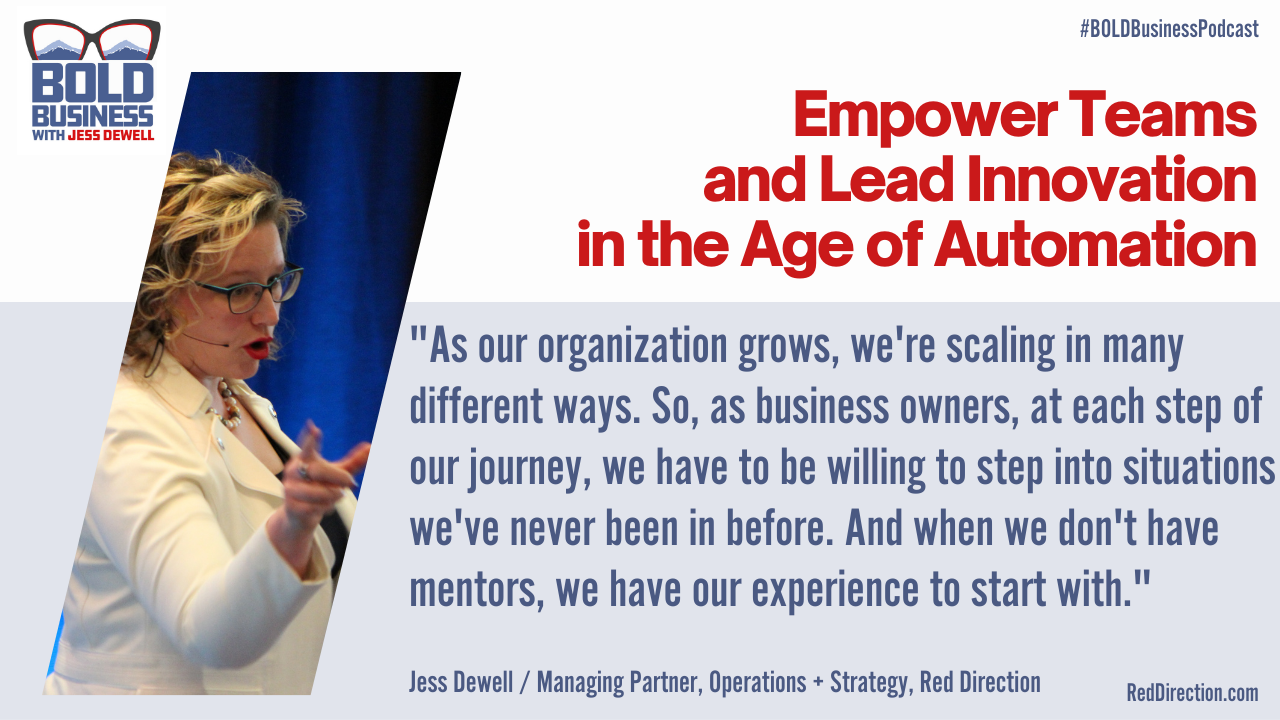
Let’s just talk about scaling the people that work for us. Right. As our organization grows, we’re scaling in a lot of different ways.
But as we’re talking about your mentor, Tom, what’s coming up for me is so we as business owners, we as each step of our journey have to be willing to step into a situation we’ve never had before. And when we have mentors, how amazing it is that we can have mentors. And when we don’t have mentors, we have our past experience to know that it doesn’t matter what shows up here.
We’ve got something to start with. And we wouldn’t be here faced with the opportunity of this choice if we didn’t see that. So as we move, we do have to become less technician.
We do have to become less. We are always an obstacle remover. But the obstacles that we’re removing, sometimes they’re tactical.
Sometimes they’re a little ambiguous. And sometimes they’re very unclear. And that’s an interesting thing as we’re adding people to our team and growing because we have more people to empower.
We have more people with different points of view that all have really great ideas. And we still have to get them into this navigating through. So we’re in the same path of this is our mission.
And here’s this idea fits now or not. And being able to be clear about that and having everybody have clarity is an interesting, that’s interesting for me to think about. So how are you specifically moving from that tactical to removing obstacles into the ambiguity of strategic growth that we’re facing that we can plan for, but we’re facing and it’s showing up the same or a little different.
Solomon Thimothy 25:37
EOS is a good system that people probably heard of entrepreneurial operating system. They have two roles. One is a visionary and the second role is called an integrator.
So those companies that have 25 people or more, they typically like to run on some sort of an operating system that helps you because of what you just said, different point of view perspective and some sort of system that moves the company forward. Even a visionary sometimes has to do a tactical work. So I’ll give you an example.
When we roll out new things, one of the things that we’re doing is actually called AEO, which is answer engine optimization, which search engine optimization has naturally evolved into AI search. People don’t go and just Google anymore. They search inside GPT to find anything from a doctor to anything they’re looking for.
I got this prescription from my doctor. Is this any good? Can I find out what’s bad about this product or company?
So go find Reddit reviews and all this stuff. So we have to help businesses get found inside this thing. It is not.
There’s no SOPs out there. There’s no software that’s doing it. Guess what happens?
My technician comes out of me and we go and try to figure something out. And then we test things. We would literally like a lab, right?
We’re just experimenting. And then I turned that into some sort of a product or a process that my team can then run with it. I still enjoy that part.
And the reason I say this, I don’t have to do that every day, but I do have to figure out how to get there. Sometimes I’m hiring somebody, a contractor, somebody I met at a networking event or wherever I may have met them saying, could you help me get from A to Z on how to give me a prototype so my team can run with it? If I know if I’m comfortable enough, I’ll go attempt it.
But these are all the new things that we’re rolling out that will get us to the next level. I like to say the word 10X a lot. So we’re looking at those 10X opportunities.
And that’s where a visionary should be spending time. They should be figuring out what is going to get them to the next jump in their organization. And that’s okay being tactical.
You’re doing that because you’re the visionary. You can’t be a visionary and just throw ideas out and just pretend they’re going to come. You’ve got to go execute on it.
It’s like, yeah, my team is doing the thing that’s already live. They’re already executing the playbook, but they need to change the playbook or upgrade it or hire new people to run the new things. Entrepreneurs get to have that fun.
We get to ideate and go find the tools, which I am always doing demo calls and things of that nature to see what’s the lay of the land. Who’s got a better product. But none of that is what we’re doing today.
These are all the future initiatives.
Jess Dewell 28:03
I think it’s really awesome that you’re claiming, I like to do this. I also think it is awesome that what you’re saying is, I heard you say this and I really, really want to bring this back. We like to brainstorm and we like to do things by committee, but guess what?
That never works. And as an executive, as a business owner, as a leader of a company that has a real stake in the real results, making payroll, having the goals, hitting the numbers, working with the investors and getting the return that they’re expecting, whatever those expectations are. I think it’s really important to call out.
We have to be clear and what, to your point, throwing things against, spaghetti against the wall. I had to overcome this. I threw spaghetti against the wall and we wanted to try everything to see what worked and got momentum.
If I had decided to throw three pieces of spaghetti instead of the whole pot, we would have moved along a lot faster. And so I think that’s a thing, whether we’re in it tactically, whether we’re in it for the outline, whether we’re in it to figure out what the constraints are so that somebody else could come up with the, even better, the thing that bubbled to the top, based off of the constraints, based off of the goals, based off of where we see ourselves going to stay competitive, to grow, and to be there for the changing needs of our customers.
That’s a big part of this too. I’m all on board for that. So maybe constraints is part of our conversation to help us work within innovation and ambiguity and still clearly lead because if there’s too many choices, nobody knows what to do.
Nobody knows what the priority is.
Solomon Thimothy 29:45
Absolutely. And I think the leader’s job is to go find the 10 tools, identify the one that they think is the best fit and the team only sees one. They don’t need to see nine more.
I try to make their job easier. My job is to make sure that they’re efficient and staying in their lane and they’re happy. And today, thank God for AI, I like every single one of them to be 10 times more productive because I tell them, you don’t have to work.
You can make AI work it. I don’t care. As long as you get done.
I’m not opposed to using AI. You’re not going to get like a F in your class, like school, like you used AI to write this paper. Negative.
Don’t let AI do the work without you using your brain, but use your brain and have AI assist you so you can be more productive. And I really hope my team is taking that to heart and like doing everything. I’m rewarding people for finding tools and bots and this and that for just using on their own time.
Say we can do this and we can do that because it takes a lot of time and energy to go and find tools. Yeah. So I like to give them their own little computers to do bot work or do this while I’m doing this.
Like they can have their own AI assistants. That’s where I think they’ll have 10 of them. Why?
Because AI lets us be more productive so we can use our brains to do more powerful work.
Announcer 30:59
If your week feels like you’re being pulled from one demand to the next, this is for you. The Daily Grind is the number one killer of business instinct, pulling you and your team away from your vision. Reclaim your strategic edge with the Present Retreat.
This free guide from Red Direction is a simple, powerful framework to carve out the space you need to filter out the noise, make the right decisions and lead with clarity. Visit presentretreat.com.
Jess Dewell 31:28
Let’s get back to our conversation with Solomon Timothy on the Bold Business Podcast. What is the culture and how are you having these conversations around ensuring that your team is not just managing bots, but actually being creative and innovative to continue growth? Because that is truly something, it sounds like it’s within your company and embracing this is great.
How do you ensure that stays that way? Because you don’t want a manager of bots. You want people who are using bots to get solutions.
Solomon Thimothy 32:02
I’m excited for bots, so I don’t mind it.
Jess Dewell 32:04
You can tell, that’s why I’m asking. I’m like, I can learn something here.
Solomon Thimothy 32:07
So the bot thing is a newer thing. So you should check this out. Just ClaudeBot, C-L-A-W-D-B-O-T.
Viral videos are popping up everywhere. So essentially you could create a computer to tell it to do anything. I would like every one of my employees to have one of those because if there’s things that they would need somebody to do for them, they should text message ClaudeBot and make it do it. That’s just an example.
Jess Dewell 32:33
We played with it, but we don’t have it integrated quite like that yet. C-L-A-W-D-B-O-T.
Solomon Thimothy 32:40
And I don’t think they’re the only ones that’s going to come out with this. There’s going to be 10 different ones. So you’re going to have 10 messages.
You can be 10 times more productive. So I’m a big 10x guy. The second thing that I would recommend everybody do is get a premium version of the other tool, the Claude AI, which is the LLM.
And then there’s a tool inside it called Cowork. You can actually take over your desktop and you can tell it to make Excel spreadsheets reports. And if they’re interested in coding little apps for themselves, Claude Code can help them do that.
If I can give every employee the power to create little apps in their desktops, I can do certain things or Claude Cowork to do some desktop automation or things of that nature. I believe you sincerely save them 45 minutes to two hours a day in their day to do something more fun than they were doing before. See, I’m not opposed to that because I would rather never do that again as an organization.
If it can’t be done by AI, why are we doing it? Now, every organizational leader has to empower their people to think like this because otherwise they think I get paid to do copy and paste or I get paid to do this. I’m going to continue to do it.
I tell them I get paid to think, you get paid to automate, you get paid to be a leader. This is like the tech people, the problem solvers, the issues, and the whatever. And we like to take those ideas, what’s working, we roll it out to every single person that wants to go and execute.
Hey, we use this tool. Here’s the login password, go play with it. The three ideas comes from here.
Then I take the three and I give it to these larger, all the people that are executing marketing campaigns remotely or wherever they might be. That is a slower-moving integration implementation. But the day-to-day, where I’m involved with those tech tools and automation or things that we’re trying to fix, it’s every single day.
It’s like popcorns. We’re popping ideas every day. We’re executing every day.
Jess Dewell 34:21
I know that there are people who are listening that are in the services-based business. They could be in professional services, they could be in personal services. How do you see the tools that we were just talking about that are empowering and creating opportunity for excitement and fun and leadership in your organization?
How do you see those working for somebody who is showing up to do plumbing or electrical or fabrication?
Solomon Thimothy 34:46
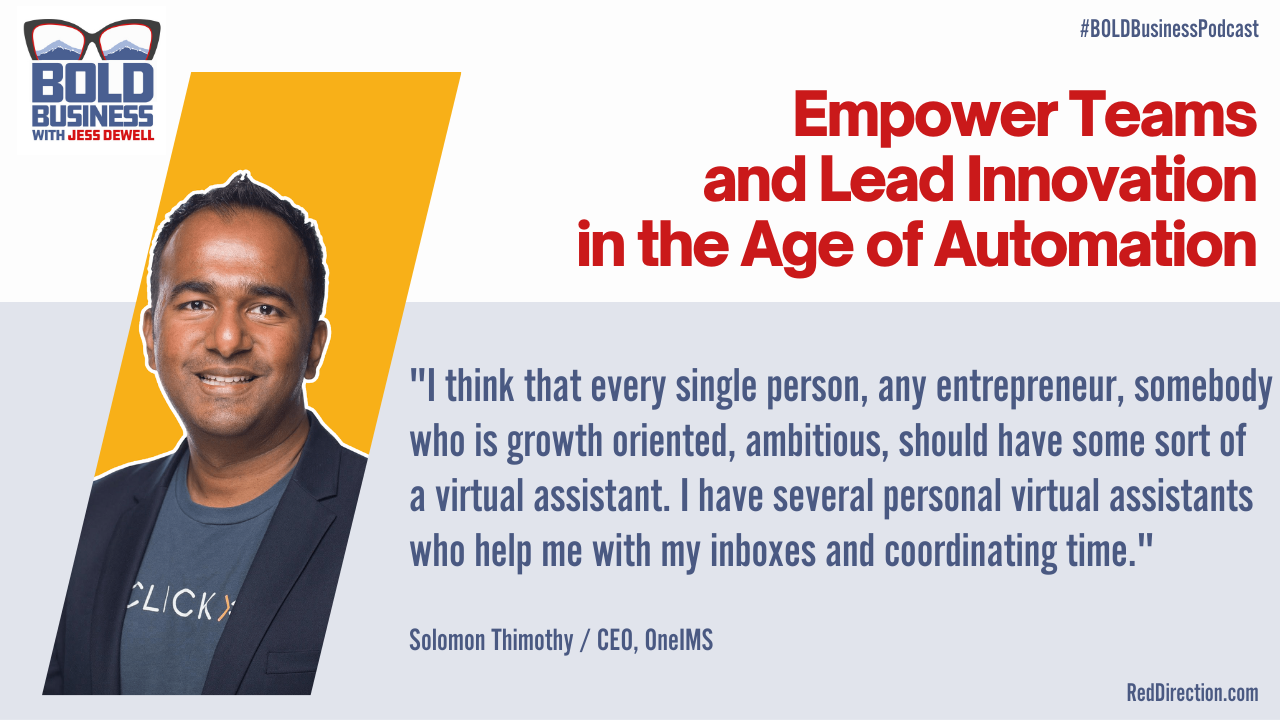
Absolutely. I think that every single person, any entrepreneur, if you’re building ours or somebody who is growth-oriented, ambitious, should have some sort of a virtual assistant helping them with things that no longer should be done by you. First of all, save that time.
I think that this thing we’re talking about, the CloudBot, is another level of virtual assistants. I have several personal virtual assistants who help me with my inboxes and coordinating this time. But there are things that I don’t need them to do anymore that CloudBot can do.
I’ve now empowered them to do more things, not that I won’t have them anymore. I get to reroute some of those things to these. Then they become more valuable in my world because they’re doing the thing that Cloud can’t figure out how to do yet.
Not ever yet. It’s my team. Certain things it’s still not good at, it just gives up.
A human and all the things it can do, it can probably do a lot more things. So every entrepreneur now has more choices. When I was saying that I wanted 10 of them, it’s because who here does not want 10 assistants at a fraction of the cost, like $20 a month if that’s it, you can do 24 hours a day.
I don’t know what you’re looking for, sales or follow up or anything, calendar management, buy you something on Amazon. I haven’t even explored all the things it can do. But the fact that I can have 10 of them excites me.
I used to look to this day, every entrepreneur has been fighting. I need cash flow to hire my next employee. I need cash flow to do this thing.
I’ve heard it like last week. I can’t hire blah, blah, blah, because I need to grow the business. There’s always been an obstacle of you have to generate the revenue before I can go hire the next swap, unless you have an investor or investment or something.
But most small businesses are just driven on make an extra million and spend $100,000 in growth or whatever. I can spend $10,000 and produce a million. And I don’t need the revenue.
First, I can go buy these tools and implement these things. A Mac mini costs $500 or $700 at Apple. If you programmed it properly, you can do that.
So I just feel like it’s going to give entrepreneurs unlimited scale if they want that. I don’t want 10. Trust me, I can’t even handle one.
Idea excites me. And I don’t think that has ever happened before where it was this accessible. Install something and text message from your phone like an employee and you can do it.
I’m fired up about the fact that every entrepreneur should have five of them if they needed it. And I’m trying to figure out how do I get all 10 of them to work at the same time. So it’s like a real business.
What a good time to be alive. Right. So exciting.
Oh, I’m telling you. Projects. I have things that I want to do.
I just don’t have the bandwidth. And then I found out that Claude Vought remembers everything you ever said. I’m like, I’ve never had an employee that ever remembered everything I’ve ever said.
Unreal. Which entrepreneur wouldn’t like that? So these are the things that I think that you and I bring to this audience so that they can go do more.
This is the bold podcast. Be bold, make more money. And it’s actually good for you.
The more impact you make, the more money you make.
Jess Dewell 37:58
So let’s look at the external with the customer side, right? There’s opportunities now to remove friction and be more buyer centric than ever before. From technology that we were just talking about to other technology, to services and companies like with what you were doing.
So how do you stay focused on friction-free and stay in time with all of the technology change?
Solomon Thimothy 38:24
Again, I think you have to put yourself in the shoes of a customer. We’ve had, we have an entry level product. We give our clients Slack access to messages so you can message us so you don’t ever have to email us.
We’d like more real time communication. We’re going to treat and I will respond to you at eight o’clock at night. I don’t have a problem.
Why? Because we’re an extension of your team. And one particular customer raised the concern that I thought this is going to be part of my thing, which is one of the reasons I signed up.
Mind you, he bought the lowest level of anything that there is. And you know what we decided? We used to exclude that group of people.
We’re no longer going to exclude those group of people. We hope that they don’t stay in that level for too long because it’s like negative. But the reason is if we don’t give them those people, they’re being neglected.
They feel like they don’t have access. They feel like they have to risk through emails or ticket. Don’t you hate ticketing system?
Jess Dewell 39:15
I hate ticketing systems.
Solomon Thimothy 39:16
So it’s an inconvenience. It’s a friction we created because of the fact that they were paying too low. I don’t want to raise the price on them.
That works for them. Great. But you know what?
Let’s use this to make them more money, more impact. So they’ll get out of that plan hopefully. And so if 10 of them does it out of a hundred, that no longer is a concern, which is why we decided to not give it to them.
But what happens is that we overlooked that segment of customers. One, they’re too low. So we didn’t spend enough time on them.
They probably would churn more because you see what I’m saying? Like I do. Friction point.
Why don’t we take the lowest paying customers with nobody ever says and figure out how to help them so they can pay you more rather than they pay too little. I do think there’s some value of thinking of why are they paying too low? Is it because they don’t know that we’re worth more or is it really a money issue?
So we decided that because of that one email, I don’t like complaint emails. This is one thing that drives me nuts. We work so hard, Jess.
Yeah. So hard. Nobody should ever be upset.
We are the hardest working company on the planet. I’m like, why is he upset? Fix it.
What do we need to do? Everybody gets slack. I don’t care as long as they’re not free, they’re going to get slack.
And I don’t mind it because now I think we fixed a future friction problem.
Jess Dewell 40:33
We’re good being customer centric this way. And you said it and I’m going to I’m going to reflect back and call it out, which is there are customers that just want to try out a service. And if you can give them as much of the full service as you can, even on the lowest based plan, you might be surprised at where they show up.
And it gives the opportunity to have conversations so that customers can grow. And these are self-selecting customers that you, instead of us, the companies figuring out who’s going to grow, how do we get our tier three customers to, right? They are self-selecting in that and we are showing up to where they want.
And I think that is an amazing shift that allows more growth along the way.
Solomon Thimothy 41:16
And I also think I changed the mindset of our folks who thought that they’re less than to say, no, they’re no longer less than we have to be just like everybody else. The reason is it’s obvious, right? All of us have clients.
Some will pay you more than others. It’s natural for us to give more attention to the one that pays more and natural for us to pay less attention to the one that pay less.
Jess Dewell 41:42
This harkens back to the 2006 realm of doing business. This is how we did business then.
Solomon Thimothy 41:48
So today, we want all of them to have the VIP customer service, regardless of what they paid, because they’re not going to get the accolade, whatever the thing is that the guy that pays 10 grand a month, or at least can get ahold of our team. They don’t have a question. And we’re going to proactively reach out and check on them because slimes do things.
Jess Dewell 42:09
My first company, Reg Now, was one of the things that a company came to us and there were these two guys. Also, I’m outside of Seattle in Kirkland. They were in Seattle and they came, I don’t even know how they learned about our company.
And they said, we’re building a game. We’d like to use you as a partner because we really don’t want to deal with the banks and e-commerce. So I was part of an e-commerce company back at the beginning of e-commerce online and at Reg Now.
And they said, we’re going to turn it on and we’re expecting it to be big, but it could be a complete flop. And we’re like, no problem. We got you.
And they said, we’re going to, we’re so excited. We don’t know how good it’s going to be. We are going to, we’re going to make our computers ding with a money sign, cha-ching, every single time we get an order completion from you.
We get to the go live date. We get to the turn on date. They had so many orders.
They had to call me and say, our computers and our systems all froze up. We can’t do what we need to do to deliver these games because all of our cha-ching noises have broken our entire network. And so we worked together really quick.
The solution was easy. We’ll turn off the notification emails that are going to you. So you can turn off the sound so that we can then turn them all back on and get them to you.
So you can get your customers their games. This was PopCap at the very beginning before EA bought them. So they were our client from the time they made their first game PopCap all the way through after I actually left the company, they were still clients until EA bought them.
We didn’t know them very well. We have a lot of people that would come our way and say, we’ve got the next big software. Guess what?
We did have the next piece as a client and we were able to support them. I know. And it’s those small things.
And they brought us a lot more clients and that gave us insight of how can we support other clients the same way. So to your point of we’re treating everybody the same.
Solomon Thimothy 44:06
Yeah. It was just the thing that we decided was not worth our time, but now we’re like undo, undo the damage. And you know what?
As an entrepreneur, you have to give yourself the freedom and the grace to go and redo what you thought was once a great idea. They always grab me and say, Osama, this terrible idea was your idea. I’m like, great.
At the time it made sense and it no longer makes sense. And we’re going to undo it. Do you know how many times I’ve done it and undo and done it and undo the same thing over?
Because circumstances change. So I have to be up front with my team and say, guys, I’m sorry. I thought wrong.
I didn’t think this. I didn’t expect this to happen. That’s right.
Jess Dewell 44:44
When you do make certain changes, you get upset.
Solomon Thimothy 44:47
And when customers get upset, you go right back. Guess what? You want to piss them off.
Jess Dewell 44:51
Yeah. We didn’t, none of us. And actually then that’s the shared, there’s a shared responsibility, right?
The shared. Hey, yes, I said. And nobody contradicted.
This is where leadership comes in. This is where we work together. Now we have this problem.
Let’s clean it up and we’ll do better together.
Solomon Thimothy 45:09
My word is it’s relative to what the market conditions are, because I have to deal with that. Nobody else here in this room cares as much as what they think about what we do. And so let’s go and make them happy.
Jess Dewell 45:21
And by the way, life too, right? It goes back to the beat. You being a mentor that ended up having a deadline and you were talking about, I had to stop doing that.
I’m like, well, you chose to end it. This is the same thing in a business sense. This is the same thing of, we had a bad dinner.
We chose to make a new recipe and it didn’t work out. So we’re never going to have that again at our dinner table. Okay.
It could be small and it could be gigantic and it still is okay.
Solomon Thimothy 45:44
It’s true. Yeah, no, very true. And by the way, nobody should be like, we don’t do that in this company.
And a final, anything is up for debate.
Jess Dewell 45:53
Love that. That’s where evolution together comes from. And probably also part of the longevity of the team that has stayed, right?
Solomon Thimothy 45:59
Yeah, it’s true because everybody’s voice is listened to, meaning there’s no bad idea. If you think it can make sense, let’s go do it. Let’s incorporate it.
And I think I just really like that. And I like them to make more decisions than me. But today I tell them it’s Dan is the boss.
Whatever she wants got to go because I’m not dealing with that anymore. That’s not my department. I don’t want to make the, I don’t want to call the shots.
Give you an example. That’s what I would do and let them all lead in their own way. And I like to see them grow. You mentioned that earlier, like every single person in the team’s got to grow. The only way they can grow is that they are making mistakes. They’re making decisions just like I was making decision back in the day. And sometimes they make bad decision, but you know what? It’s their decision. So you got to keep it going.
If that makes sense. Yeah, this is all about collectively, all of us growing together. And I want them to feel comfortable making mistakes.
I want them to feel comfortable calling shots because when I do travel, like you said, I’m away. I, everything keeps going, right? So the reason is they’ve, they can take care of customer service issues.
There’s less calls going to Solomon. Dan Sullivan calls this concept self-managing company. Every entrepreneur should have a dream is to have a self-managing company.
That’s the first step, believe it or not. The self-managing company, that means that you can be gone for a month. Nothing ever breaks down.
And once that happens, you should be gone for a month. You talk about the work-life balance and off days and free days and so on. And that’s when you know, you know, you’re not needed anymore.
You can stop the office room, get rid of the office room in your office and just give it to somebody else. The second level, which every entrepreneur should aspire to, once they have a self-managing company, it’s called a self-multiplying company. That’s when you really have figured it out, which is the best of the best entrepreneurs out there.
They don’t have just a business. They have a business that creates other businesses and that business creates other businesses. So they go, that’s when I talk about this 10X vision, is that you can’t really 10X sometimes, which is you doing more.
You got to 10X with other collaboration. Yes. Love it.
Jess Dewell 48:03
The flywheel model. Yeah.
Solomon Thimothy 48:05
So all I’m saying is that I do love the fact that I want to say we have a self-management company, but let me tell you some days it’s not managing all that well by itself because something there’s a little friction somewhere, but then we get fixed and go right back to being an amazing machine like you just mentioned. And guess what? I’m here, right?
So I’m never not here. I can go and help them out. Sometimes I’m dealing with some dirt, a problem, getting my hands dirty, like an entrepreneur says, but you absolutely love it because this is your baby.
Jess Dewell 48:37
So what makes it bold? What makes it bold to tell a CEO that you work with or a peer that their next million dollar idea, their 10X is actually already in their building. It’s just stuck in the friction of their current framework.
Solomon Thimothy 48:49
I do think that you can learn a lot from an upset customer. So maybe you got to look at where you’re not serving in the marketplace that you thought that they were like, I just gave an example of that was a niche that we didn’t think it was good or they’re too small and figure out what you might be missing out on it and maybe rethinking some of that, because I don’t think the next million dollars or whatever it might be, it doesn’t matter, 10 million or 1 million.
It’s probably already people that you’re saying no to or you’re just ignoring. If that makes sense, you’re not saying no to them, you’re just ignoring them. I believe that some companies could probably grow a million dollars just by asking their existing customers for referrals.
Instead of waiting for referrals, you ask them or automate it. There’s a lot out there. And if you see a small segment of your customers build a separate website and just serve it like you did with the games, there’s a separate website for these kinds of things.
So they will find that website valuable because that’s the only problem that they have. And you don’t have to be associating with the 80% of the business that’s making money and it’s all good. Just take the 20% and throw it out and decide and see, can this be on its own?
Because we don’t want to mix it. Maybe I got to find a separate CEO or a separate team to manage it. Why?
Because if it can be spun up on its own, I have all the infrastructure that it can use to grow. You’re always in this serial entrepreneurial mode because you’re always creating things. But to be honest, I don’t want to mess up a good thing.
I also don’t want to forget an idea that I could be growing at the same time before we literally had focus issues. We can only focus on one particular thing. But thank God for AI.
I can focus on that while I’m working on this thing. I’m never letting go of the thing that’s working. I can have other people oversee that.
So we do have multiple marketing companies that I operate. They’re all growing, but I’m not dealing with all of them at the same time. It’s because we figured out that it can be on its own and created its own team and its own pipeline and its own hotspot or whatever you want to call it.
Honestly, Claude Baud could let us have 10 more of those businesses. I promise you. Next time I talk to you, Jess, you’re going to have five new businesses.
Entrepreneurs, our job, the original definition of entrepreneurship was taking one kind of resources and then turning it into something that’s higher value, higher productivity. So you go buy rice from the store for 10 cents or whatever it is. I don’t know how much rice is.
Then you sell it as Chinese food rice, Chinese fried rice, and you charge $12 for something small. I don’t know. I’m not good with prices.
Let’s start $30. You took a $1 thing, turned $30. That’s what an entrepreneur does.
That’s your job. That’s the original definition. I don’t know, French, whoever, guy who invented that word.
You take something that’s lower level producing product, that’s a thing. The input, we turn into something so much better. I think there’s everybody sitting on those million dollar ideas.
They’ve proved it. Somebody’s willing to pay for it. You just don’t have the bandwidth to do it because you don’t have any hours in the day.
Find a who, spin it up, throw a website together, and start doing some outbound work. Don’t even spend any money on email, running ads. Send emails to people that think they can purchase this product or service.
There you go. You might be like, wow, I can’t believe it’s happening on its own.
Announcer 52:19
That brings us to the close of another powerful and fresh perspective on the Bold Business Podcast. In today’s volatile landscape, growth is a double-edged sword. To truly thrive, you must engage with your strategy, not just react to the day-to-day.
Without absolute alignment, your company faces a stark choice, outmaneuver or be outmaneuvered, grow or get left behind. Thank you for listening. And a special thanks to the Scott Treatment for technical production.