




A RIGOROUS WEEKLY PRACTICE THAT TRANSITIONS YOU FROM THE EXHAUSTION OF BAD GOAL CHASING TO THE CLARITY.
FROM BUSY WORK ➔ STRATEGIC COMPOUNDING
With Red Direction Present Retreat Methodology, reclaim executive cognitive bandwidth to sharpen Business Instinct and “Good Goal” alignment validated by a 40% reduction in decision-cycle time.
Starting the conversation:
Slowing down to develop people isn’t a luxury — it’s a requirement for long-term success and resilience. Kim Bohr, CEO at SparkEffect, talks about how high-trust organizations outpace uncertainty — and how you can build resilience by investing in frontline and mid-level managers as a strategic move for scalable growth.
Self-trust is critical to leader and team success. That starts with you. Your packed calendar could be draining more than just your energy — it might be quietly eroding credibility and trust with your team. There is a clear link between trust, retention, and your most trusted (and fragile) layer: frontline managers.
In this episode, you will hear reflection is the most strategic thing you can do right now; that it takes thoughtfulness to live stated values and engage them in difficult decisions; and how considerable discipline is necessary to bring the effort to prepare and engage with your managers. Jess Dewell talks with Kim Bohr, CEO at SparkEffect, about leadership vulnerability, authenticity, and trust-building being cornerstones to high-trust organizations.
Host: Jess Dewell
Guest: Kim Bohr
What You Will Hear:
03:35 Personal workflows, routines, and strategies need to be revisited to remain effective.
- Approaches to organizing work and time are not static and may evolve unpredictably.
- Self-awareness is necessary to recognize when previous routines are no longer serving you.
- Flexibility in reassessing and adjusting your methods is essential for ongoing productivity.
07:00 Reality: continuous re-evaluation of systems and priorities is necessary, especially amidst the rapid pace and pressures of business.
- ou must be willing to regularly analyze your processes and be open to change.
- There’s rarely a “set it and forget it” moment when it comes to productivity and strategy.
- What worked before may not fit current needs, and leaders must adapt in real-time.
11:35 The importance of building trust within organizations, and that trust is concrete and measurable.
- Trust between team members and in oneself are deeply connected and impact organizational effectiveness.
- Without mutual trust, even the best strategies or workflows will eventually struggle or fail.
- Measuring trust offers clarity and drives improvement, moving it beyond just a conceptual or intangible value.
20:25 The importance of recognizing limits and intentionally managing energy.
- Self-trust involves honoring how you feel, even if external validation comes later.
- Leaders must recognize the importance of intention and self-care — even when planning for high-visibility roles or offsite retreats.
- Learning to validate your own instincts leads to better performance and authenticity at work.
27:55 Research shared on trust during organizational change plus the importance of transparency, fairness, and thoughtful leadership.
- Communicating candidly about uncertainty and decisions helps maintain employee trust during times of flux.
- The treatment of employees, particularly during difficult changes, deeply affects organizational trust levels.
- High-trust organizations are proactive about aligning stated values with actions, especially when responding to disruptive changes.
30:40 There is value in tailored leadership: recognizing that effective leaders consider individual perspectives and communication styles within their teams.
- Leaders must adapt their messaging to the unique contexts and needs of each team member.
- Consistent effort is required to align intentions and actions so that they are perceived correctly.
- Leadership discipline in communication prevents misunderstandings and supports stronger team alignment.
38:35 It is BOLD to stop the relentless push for tactical execution and declare that trust only scales when leadership does, making manager enablement primary to strategic infrastructure.
Resources
- Connect with Kim Bohr on LinkedIn
- Get the Trust Report Kim talks about here for free
- The reason most transformation projects fail
- Technology won’t fix trust
Transcript
Jess Dewell 00:00
CEO says, anybody can email me about anything. What is the first thing that popped into your head with that?
Kim Bohr 00:06
You don’t know what you’re asking for when you say that, because as much as you’re trying to be transparent and authentic, you just set yourself up for major failure.
Announcer 00:19
Every leader needs a trusted partner for the moments that matter. This bold business podcast conversation is that partnership. your go-to resource designed to break the inertia and refresh your perspective so you can start making moves. Here is your host, an insightful truth teller who serves as the catalyst for getting the right work done and who asks the questions that truly matter. Jess Dewell.
Jess Dewell 00:47
Change still requires effort and it requires effort of a different kind, a little more discipline, a little more preparation to make the connection that we want to make and maintain high trust in our organizations as we go out and create our future relevance with our actions today. Kim Bors, the president and CEO of Spark Effect, spent her career working at the intersection of people, organizations, and performance. She leads in scale Spark Effect’s team and services, partnering with leaders to solve problems that matter most, building trust, accelerating transformation and delivering measurable outcomes. I’m excited that she’s going to talk with me today. And in this conversation, there is a lot of information to start mulling over what you’re doing now and putting this lens of how do I build trust in myself, between myself and others, and between the others that come to work with me every day. There are three things I’m going to start us out with that you’re going to be listening for throughout the conversation. The first is reflection is the most strategic thing that you can be doing right now. And we talk a little bit about our reflection process and the power of it. The second thing is that when you can put something on paper, an idea, concept, something that needs to be shared, then it’s in a space that you can be more thoughtful in how the decision-making will occur and what needs to happen to support the care of our people in our companies. And the third thing is it takes effort. It takes effort to build trust and be intentional in our work so that we are fortifying, developing, staying connected. And that’s just discipline and it’s time. And with the higher demand that we’re experiencing today, it’s worth the challenge and facing it. Definitely subscribe on YouTube or Apple Tunes or wherever you are listening to this podcast and make sure you’re pressing the button that you need to press so that you know when our next show comes out, which by the way is every Thursday. All right, enjoy the show. It is the hardest thing I have ever done. I talk about my present retreats all the time and do them. And there are times I just can’t, don’t, or won’t. And it’s the human piece of it. And I think that’s something to, even when there’s intention around us, oh yeah, no, that’s not happening today for whatever reason. And the reason could be a negative reason. Something really got in the way. It could be a neutral reason. Maybe it’s maybe I don’t feel really good or I’m, I didn’t I don’t feel grounded or I can’t get in the headspace. Or then it’s also it could be super positive where it’s like, oh, here we go. And for six hours later, it’s I didn’t want to stop yet. Yeah.
Kim Bohr 03:33
No, you’re in the flow. You’re like, I know I thought I was gonna do these other things, but I’m in the flow of this other thing now. And I keep it going. I totally get that. Yeah. It’s calendars and finding that right combination takes consistent just maneuvering of it. So I think it’s it’s just finding what’s working right now and going with it and then adjusting. There’s the key piece.
Jess Dewell 03:55
What’s working right now? It can change. It will evolve. And I know that happens with me a lot and it’s not on a regular schedule, Kim, for me. I can check in and go, is this still working the way that I wanted to quarterly or biannually, but at the same point in time, it could be three weeks from now. I’m like, nope. Okay. How does this need to change right now? And there’s an awareness in that and a self-trust.
Kim Bohr 04:18
One of the things I’m doing, I was just working with the team the other day around my to-do list of my top three things became 15 things. It’s okay. That system is clearly, what do we need to do now? And I had to go back and try to just figure out, okay, this isn’t working? What’s the new, what do I need so that it doesn’t become a dumping ground, which seems like so simple. And yet when our workflows change, it’s not as simple. It’s like you just said, it requires us to be like, you know what, that just isn’t working now. So I need to think about it differently.
Jess Dewell 04:49
And so that’s, I’m right in the midst of that. It’s not silly. And it’s just easy to say, how come you just don’t throw your list away and start over? Oh, I kind of did. I have a list.
Kim Bohr 04:58
What I did was through this help with Claude, I actually said, give me, I said, here are the inputs. Here’s what I’m challenged with. Here’s the workflows I have. And tell me if I should think about this differently. And it came back and said, yeah, option A, option B, we kind of think you should think about it differently. Here’s the thing. I’m like, okay, show me what you think. And so in that, it didn’t wipe out all my to-dos, but it did have me imagine how they should look. And then it did have me saying, OK, these things really aren’t. So I did get to, in a sense, I didn’t completely throw it out, but I did completely reimagine it and just was like, what’s really the most important stuff I have to focus on right now?
Jess Dewell 05:37
How often do you get to schedule time right now for your deep work?
Kim Bohr 05:41
So it’s one of the things that I did make a real intentional effort in is starting that in May because April was just I got overbooked. There was so much happening in our business, in the role I was taking on, in speaking engagements and stuff. And so I really started to block out more time in May. And I’ve been doing that. So I’m getting ahead and starting to just block chunks where I don’t know exactly what I have to work on at that point, but I have to start doing it. So that was something that has been a game-changer. It’s not new. I have done it before. But when the business goes through its rhythms, at times you start to overcommit because it’s like, we got to get this thing in this week. I’m trying to better manage that. And the team’s doing a great job of what they take on and when I need to be in stuff. So it’s some of it’s asking more of those questions, too, around what is the most important use of me? And I trust the team that they’re doing what they need to do. And if they need me to pull in to help think through something or whatever. So it’s having more of those conversations. But I would say it really started this month in May when I was really starting to look ahead.
Jess Dewell 06:43
Yeah, it does take a little bit of time to transition into a role. And you are brand new in that role. And being able to find it fast, like that’s actually pretty amazing in and of itself, showing the fact that it showed up and you recognized, ooh, I could benefit from this right now.
Kim Bohr 06:57
The gears start off really quickly. And so in some ways, a lot of the things that I was doing before didn’t completely change. But my focus did have to shift to other stuff. And I did have to ultimately let some things go, which is natural. And so, yeah, I think, but I do what we’ve talked about before. I think so much of that is also a very much about we have to, we’re constantly reevaluating. It’s, I don’t think anything’s a set it and forget it. I think that constantly requires just reevaluating of how we look at time and systems and what works and what doesn’t work.
Jess Dewell 07:29
It’s true. And I know one of the things that I have found is when I, do you have a word for it? I call mine present retreats. Do you have a word? Is it just blocked time?
Kim Bohr 07:38
Yeah, I just call it blocked time. But I think I like that naming it something like that sounds much more interesting. And I didn’t know this.
Jess Dewell 07:45
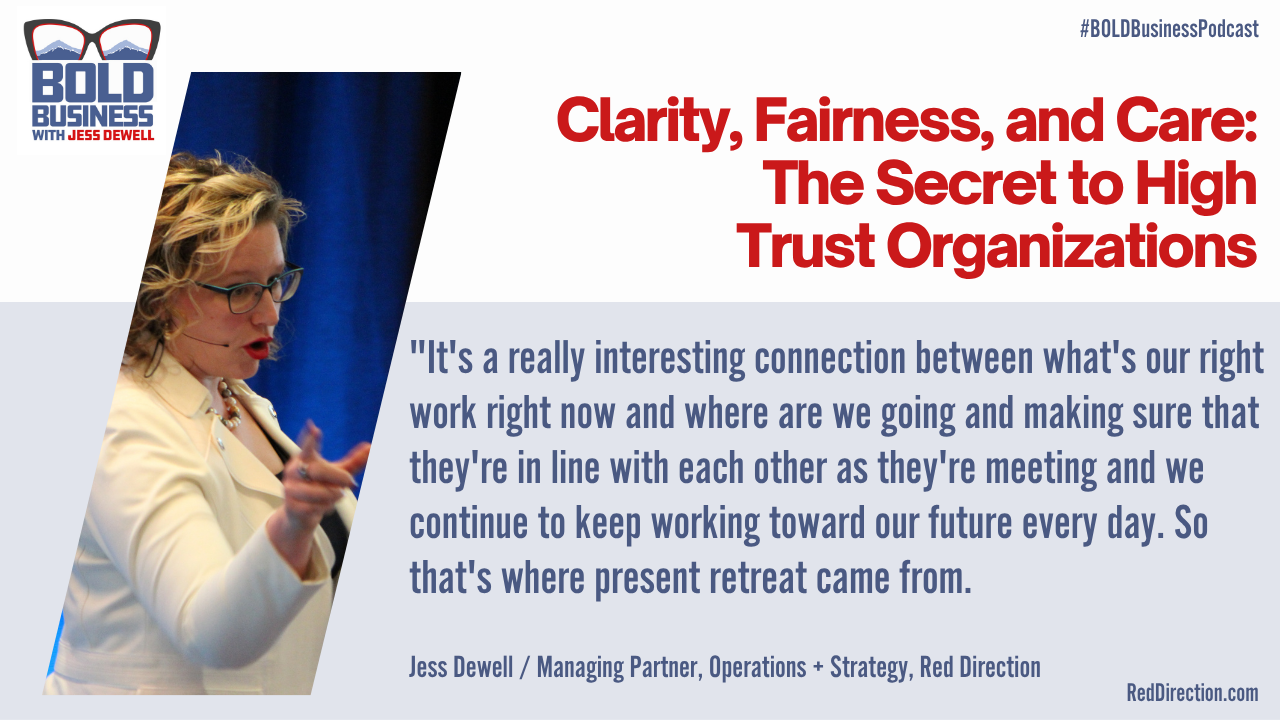
I grew up in a time of mostly peace. Part of a retreat, though, is actually taking stock of where you’re at, not just relaxing or getting out of the day-to-day. It’s where are we? What’s happening? What do we have? And how do we go forward now with this? You were talking about reimagining. We’ve got to reimagine with what we have for our best next step right now. And that’s a really interesting connection between what’s our right work right now and where are we going and making sure that they’re in line with each other as they’re meeting. And we continue to keep working toward our future every day. That’s where Present Retreat came from. It took me a little while to come up with that. And it sounds a little obscure. If you’re in EOS, they call it what they call them rocket fuel meetings. And if you’re in other systems, they call it CEO time. And if they’re this and whatever works, name aside, the time is important. And you said something that I want to bring back up right here. And that is, I don’t necessarily know what the right work is right now, but stopping is going to help with that. And that’s one of the things I thought we could really talk about and dig into a little bit because not only is it super strategic to recognize, I don’t necessarily know where I’m going. It’s also though, I think it’s a cultural thing too. We’re moving together in the same direction and it doesn’t have to be aspirational. It can be actually tactical, even if we don’t know what the tactic or the approach or the practical is yet.
Kim Bohr 09:04
We’ve got these macro forces that we can’t control. We’ve got whether it’s economic, political, war, whatever the case is. We’ve got the reality of AI, what AI is doing. We talked about Google making changes that it’s made recently that kind of like ends a lot of go-to-market strategy. So carving out that space becomes even more important to say, okay, what we see to sit and like literally look around. Okay. What are the moving pieces? Because it’s coming out as so fast. And I find that I’m working to become more disciplined in that area and trying to think about how does that time get preserved because there’s so much change happening. We think about we’ve got these three-year plans. And yeah, we have and we know what the endgame is. But the road to get there is really twisty and turny. And we have just set some plans that, like I just mentioned with the Google site, part of our go-to-market strategy just got blown up with some of the changes they just made. And we’re like, OK, we’re back to rethinking this one. But we still have the eye on the prize, yet it’s taking that space so that we’re not just firefighting to realize, okay, where does that adjustment need to be made?
Announcer 10:16
Feeling stuck? Like, what got you here won’t get you there. The pressure to grow is on, yet the path isn’t clear. Yet. You don’t have to walk that path alone. This is the Bold Business Podcast. Like and subscribe wherever you listen. Your host, Jess Dewell, is the strategic partner you’ve been looking for, asking the questions that truly matter. It’s time to break the inertia and get the perspective you need to make your next move.
Jess Dewell 10:52
This is the Bold Business Podcast. Our guest today is Kim Boer, CEO at Spark Effect. I was also mentioning earlier about self-trust. One thing that makes blocked time, present retreat time so important is that there is a self-trust that doesn’t matter what’s going on. I’ll take that for myself. I will put this priority here right now and make sure there’s a cadence because that’s how we, us, everyone, you, me can show up. And that’s actually something that I think is really important. And I know trust is something that Spark Effect is really focused on in teams. And have you found a way to build team trust without self-trust in its leaders first?
Kim Bohr 11:35
No, I think you definitely have to have that self-trust of giving yourself the space and thinking through things. And I think they’re very interconnected though, too, because you can trust how you’re thinking about going about stuff. But if you can’t trust your colleague to have your back or to look out for the best interest of what the team is trying to accomplish, it’s all going to break down. We think of ourselves as authorities on how you build really healthy trust inside organizations that’s actually measurable and not the squishy kind of stuff. And I don’t mean that in that I’m dismissing trust. That’s how it’s often been thought of, of course, but if only it could be measured, it’s actually can. It really can. So I think that self-trust is deeply, is absolutely the foundational starting point. And am I trusting my decisions? Am I trusting the way I’m thinking? Am I trusting somebody to help balance it off if I do have some doubt? And if you don’t have that, then it really is a matter of, I would wonder, how do we get the right systems in place for you? Are you in the right leadership kind of role?
Jess Dewell 12:38
And I think like businesses go through seasons, we do. And there are times where we have more trust and we can be really intentional and have effort around developing ourselves maintaining that so that the next steps can occur and so that any repair, hello, we all mess up. I’m a human. I make mistakes all the time. Some are little, some are not so little. Some seem like they’re not little and actually feel like they’re really big to other people. And there’s a repair process in that too for trust. It’s just like problem-solving. It didn’t work. Still got to close the loop. Still got to close the loop. If I let somebody down and I don’t know, I can’t repair it and try and make sure that I understand what my part in that was.
Kim Bohr 13:20
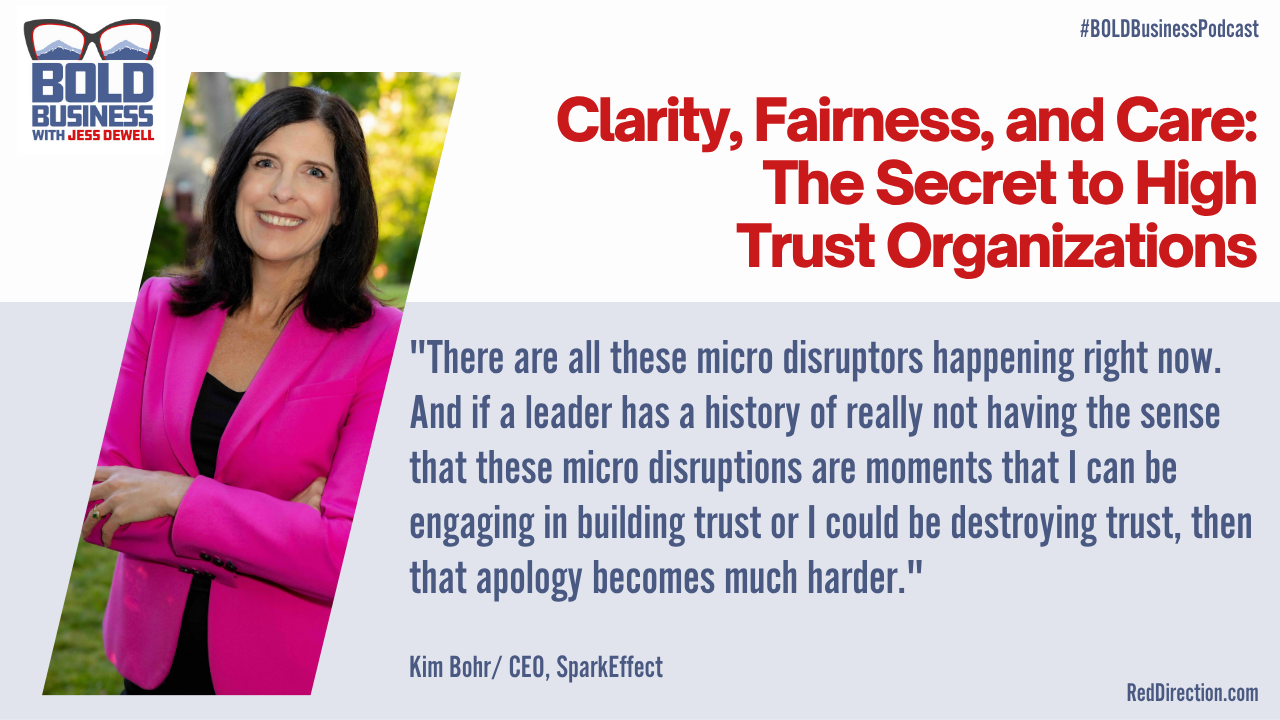
I think what’s important about what you’re saying and what came through this research we did that we experienced inside organizations ourselves is there’s all these micro disruptors happening right now. So you think about, yes, there’s layoffs. Yes, there’s turnover. Yes, there’s AI and systems changes happening. There’s also elder care, child care, all of those other things on that side of the scale. And if an organization has a history or if a leader has a history of really not really having the EQ or the sense of like these micro disruptions are moments that I can be engaging in building trust or I could be destroying trust then that apology becomes much harder and so then when you have something big happen whether it’s at the leader level organization level that’s really the key indicator of whether that trust, we called it trust elasticity, whether you’re going to see that elasticity really come through the other side and be stronger and create this dividend in trust, if you will, or whether you’re going to have a deficit. And it plays really strongly to those high-trust, low-trust organizations. So we all are human. We all make mistakes. I think a big part of it is how do we handle them? And are we saying we believe in trust more like it’s something posted on the wall. And yet we literally turn around and do all the things that we identify that are really trust breakers. And I think because people don’t realize that that thing is more important to maybe to some people where the context is missing. And as a leadership team, we’ve been talking about it for months, but these people are just now getting aware of it. And why can’t they just see that it’s good for the business? It’s a very short-sighted, but deeply impactful way of thinking.
Jess Dewell 15:03
Okay, so here’s just a random thing. About 20 years ago, plus or minus four years on each side, because I don’t remember the exact year, it was after my first company was acquired. There were some issues with what was going on, belief in the management team and all kinds of things. And the CEO says one day, he just stands up and he says, anybody can email me about anything. This is a thousand-person company. What is the first thing that popped into your head with that?
Kim Bohr 15:29
Oh my gosh. You don’t know what you’re asking for when you say that, because as much as you’re trying to be transparent and authentic, you just set yourself up for major failure. Yeah. In every area.
Jess Dewell 15:40
Yeah. People might feel like they’re heard, but guess what? Their bosses are going to feel like they’ve been told on. Exactly. There’s no trust. Everything between the top and the bottom is now at risk.
Kim Bohr 15:52
And you have just the sheer nature of that is just very difficult to literally tactically manage and do it well. And so you just start to set yourself up for breaking trust in all those ways that you just described and finding that some of the things that people may want to email you about, you may just not think of the most important things, but maybe they are to them. And that’s where that trust and that direct leader is so important to have them empowered to be able to have people feel like they can come to them, to be able to translate the big strategy of the organization down into those individual conversations of what it means for our team.
Jess Dewell 16:28
I was very young. I didn’t have a lot of experience. And I turned my head and was like, I’m so glad that that’s over there. Because I’ll be real. There’s so much of work I could do today, leading a company, growing a company, navigating through all of these things. And I look back at my past self in that moment, as you’re talking about this, I’m thinking and I’m going back to that moment. I’m going, okay, I am not good at this yet. But I don’t know how this goes. How comes into these daily dynamics, conversations in terms of, because it’s measurable, but it’s not measurable. We see some of the results and we’ve learned what not to look at. If I was assessing trust in myself or in our conversation, I’m assessing some sort of level of comfort and openness. And I’m trying to understand that. Does it always start in a gut? What are some things that we could do in that moment? And maybe it’s something really well-intentioned, but like that example.
Kim Bohr 17:22
There are some people who don’t have that gut or intuition well-honed in. They end up doing a lot more from an analytical perspective. They think a lot more around if I have data and the data tells me how I should be proceeding. And if I don’t get data, then everything’s fine or it’s not or whatever. And so I think that for those who have that intuitive gut need, you get that feeling of, huh, that person just looked a little different in that meeting. Like when I made that comment, that’s certainly an indicator to go check in. What I think that was also true is that leaders who aren’t as in tune in that way can certainly still learn many of the things they can do. Like it’s an acquired skill that can be taught and learning how to check in and getting those responses becomes data that somebody like that receives of, oh, that person responded. Oh, I got a better sense of who they are. That’s another data point. So I think it’s absolutely thinking about it from a, this is a skill is really a healthy place to be because that feels like we have agency and control and what we can learn and what we can do?
Jess Dewell 18:27
Somebody who has to take that big vision, that big strategic focus, especially during times when it seems like it goes against everything that is happening, happens more than we think. And usually it’s because of a communication thing. There’s communication elements in this. So, how does an executive team, a business owner, take this? But how do they translate that into language and be able to successfully gauge its receptiveness in the way that it’s intended? I think not overthinking it is a starting place.
Kim Bohr 19:01
So in the sense of, hey, do we actually, how do I connect with my team today? Is it that if we’re on site together, is there some kind of ritual that happens through the day of me connecting and checking in with people? Is it that I do know who their family is or like I get a sense of what’s going on? Like I’ve got those things. When I ask for them to share what’s going on or to give me feedback, there’s not a sense of sort of retaliation that’s in there. And so I think that a lot of that’s like, what are the rituals? And even if we’re not on site with people, even if we are virtual, there’s still this sense of what’s going on. And I think that’s where that biggest disconnect happens is people. We’re not in the land where we could separate ourselves in how we come to work anymore. Everything is blended. And that was something that this research really called out was like these disruptors that are personal and professional are no longer really separate. So when somebody comes in and their behaviors have changed, they’re probably trying to keep things separate, but that’s really hard to do. And so trying to understand what’s going on is really critical. And so I think that’s where it’s not that we’re being called to fix it. It is that we’re being called to show up and try to understand what’s really going on so that people can feel like they have that sense of being seen and heard. in a way that’s like, they’re like, okay, they get what I’m going through. I can, I could be focused and be leaning in.
Jess Dewell 20:25
And I think there’s a way that we can embody that in ourselves too. I hike a lot and sometimes it’s as little as one mile. Sometimes it’s as much as 10. And usually it’s somewhere in between. I will tell you what, there are days I go out and I’m expecting to do six or seven miles and I get started and I know this is going to be a two mile day. And then now Now, this is where I really have had to claim and own. And I’ve now can translate it into other parts of the world because being I trust myself that showed up. How much is in my head? And is it the thing or is there something else nagging at me to get to my attention because I feel like I should be spending my time some other way? Got through that. No, my body says I’m tired. And guess what? Now we have these cool tools, whatever things that we use to keep track of all of that. This happened to me just last week and I got, I have an aura ring and I said, yeah, you’ve already achieved your goal. And I was at the start of the thing at the beginning of the day. So I needed that external validation that my inside knowing was already right. And then I was like, next time I need to just trust myself more. So that actually happened. And the thing is, we could say we’re supposed to have this offsite retreat and this is my role and here’s how I’m supposed to show up. And my aura ring said, you’ve already achieved your whole goal for the whole day and it’s 9 a.m. And we still can show up the best we can with that intention.
Kim Bohr 21:57
And I think people see that. I agree with you. I think what’s important about that is how do we then recognize if we’re having that off day, how do we just recognize it? And we just then know that when we show up, maybe we have to be a little bit more patient or we have to be a little more aware of those dynamics and meetings that sometimes we feel like we can navigate much more smoothly. And today we’re just, we just don’t have the same capacity and acknowledging that. And I’ve been in meetings where I’ve said, look, I, I’ve apologized for coming into a meeting hot and it had nothing to do with anything except that I just had to realize, well, this is a day. And it had been just bringing that in of, Hey, I’m sorry. That’s, this is on me. I think a lot of leaders feel like they can’t do that. And I think that’s where when you can’t bring that kind of authenticity in, that’s not going to help build trust. And when you can’t own, like you said, when you make mistakes, then that’s, those are some really significant trust breakers. And in doing that consistently is going to really erode the sense of people thinking you’ve got their back or any of that kind of stuff and owning it and translating it into how we show up the day is really huge.
Announcer 23:09
If your week feels like you’re being pulled from one demand to the next, this is for you. The Daily Grind is the number one killer of business instinct, pulling you and your team away from your vision. Reclaim your strategic edge with the Present Retreat. This free guide from Red Direction is a simple, powerful framework to carve out the space you need to filter out the noise, make the right decisions, and lead with clarity. Visit presentretreat.com.
Jess Dewell 23:38
You are listening to the Bold Business Podcast. I’m your host, Jess Dewell. I’m excited to get you back to the conversation that I am having with Kim Boer, CEO of Spark Effect. Do you have something like that you can actually experience in your body? Mine is hiking, but do you have something like that where you’re getting that feedback that you may or may not be applying to that knowledge and experience to other parts, but you still have something that you could?
Kim Bohr 24:03
So for me, there’s a couple of things. So jogging for me is one. And as you described the hike, I can say the same thing where I’m like, yep, I’m going out for a jog today. And then I get started and I’m like, oh boy, my pace is much slower. I’m doing it, but I’m not going to probably go as far today as I was thinking, or I’m going to do it differently. It’s the fact that it’s not a jog today. It’s a walk. It’s just what it is. It’s going to be a walk. And so realizing like that, it’s like being, it’s like, it’s okay. Like it’s okay to make this adjustment and then to move forward is really critical. And I think for a lot of leaders, we’re hard on ourselves around accepting those, the ability to make those adjustments and not necessarily being always aware of what’s that energy we bring in then in other situations. I can really appreciate the energy.
Jess Dewell 24:46
I know it’s something we hear more about today than we did even three and five years ago. It’s always been there. And when I look back over my mentors and I look back over the people who have chosen to mentor me either direction, they all had a sense of energy management in themselves. And you don’t always understand. You don’t always know. There’s always just this way about them, but you kind of felt it. And it was like, oh, some, there was some, right? There’s some cue going on. Today’s not a regular day. This meeting isn’t a regular meeting and we don’t know why. And it takes a lot of courage to ask. I am one who has that courage and have gotten a variety of different answers from I can’t tell you to the last what you shared the last meeting I was in just went off the rails and we ran out of time and it didn’t end well or whatever it is and I know you didn’t sit off the rails part but you just came in hot is what you whatever this whatever the answer is and I think that’s important too that whether we say it or not it’s felt.
Kim Bohr 25:47
A few months ago now I had come into a meeting and I genuinely nothing was going on I genuinely was like they’re in the meeting and it was a topic that the team was really trying to like hey this is why we need to do this and making the recommendations and I was listening but there was something that I don’t recall what I did but there was something that I had my one of my key people after messaged me saying hey are you okay you seemed like that didn’t land well to you and I was like no it didn’t I think I had been processing and it was just the way wheels were kind of was thinking about okay how is this fitting into something else and so it was just as I was really thankful that she came to me because I certainly didn’t want me to give that impression. And it was just one more of those pieces of awareness of, oh, I didn’t realize. And I was glad that we got that cleared up right away because I wouldn’t want to have that sense of that. I don’t want there ever to be a sense that somebody can’t come and check in. That’s not the culture we’ve created here. I think that’s really healthy just to say, hey, I just felt like something was off. Are we good? No, nothing was off. Or yeah, this had nothing to do with us. There was something else going on over here.
Jess Dewell 26:48
How do you, you were talking about the micro disruptions and the pace of change and the fact that something stop and start over before they actually get too far off the start line. Those are the times where culture in my experience, in my observation are really tried the stated values versus the lived values. And because they’re happening all the time now, there’s almost decision fatigue. There’s almost some sort of a fatigue around that of, we just don’t even have time to address the difference that we see, which also impacts. And that has other residual compounding effects too. Do you, in the work you have done and in the trust report that you have, are there things that stand out about that that can provide a little bit of, I don’t think solace is the right word, but maybe it is exactly the right word amidst the uncertainty of how quickly Things move, yet change is staying the same in terms of pacing.
Kim Bohr 27:53
Some of this stuff, let me talk about from the place of what emerged first from the report. So some of the things that really were clear indicators at a very high level, the report goes into more nuanced aspects of it, but just at a really high level, things like open and honest communication during when we know that there’s change happening. So why we’re doing this? What do we know about it? What are we uncertain about it? How we’re going to follow up? That sort of thing. really fair treatments of employees. So if we have to make really tough decisions, how are we going about doing that? I was in a conversation not too long ago where someone was recounting that they had to cut headcount. And instead, what got pushed down was that they just looked at the numbers. They didn’t actually look at what the headcount and the talent did and what the impact would have. So there was just this real disconnect between how to be thinking about that. And so what ended up happening was they got rid of the A players and the C players stayed. And that was very much against this idea of fair treatment. Like, why did that person go? And then, of course, the other A players that were left started to leave. And that’s like a classic story. So I think thinking about that and understanding, like, why are where’s the visible alignment between what we said we’re doing and what we’re doing now? And where’s that translation? So I think when we’re moving so fast, we take some of those things for granted. And what the research shows with high trust organizations are being very thoughtful about those things. It doesn’t mean their business is moving any slower. It doesn’t mean it’s any less complex. Exit’s practice is probably much more complex, but it is about taking those things into consideration, giving people space to voice the concerns to be heard, not because they’re expecting a change, but that they want to just be a part of where the company is going and the solution. And that’s part of the process. I think inside our own organization on a smaller scale, we’re doing those things too. And one of the, but what’s helpful is that we, because we’re moving so fast, sometimes it does take somebody to say, Hey, maybe we need to message this differently because we’re, it’s, we’re going really quick. Maybe we should stop and recalibrate. And you know what? You’re right. We should. So having that team aligned in the way that we’re trying to do things, then where somebody could say, well, we’re going a little too fast. Let’s catch everybody up is really important.
Jess Dewell 30:05
And it takes a lot of courage to do that, especially in an evolving or actively intentionally changing set of behaviors, activities in the way that we show up, doesn’t it?
Kim Bohr 30:18
Yeah. And I think for the most part, people aren’t trying to come in and wreck everything, but subtle decisions or what they think are subtle actually have really profound negative impact in many ways.
Jess Dewell 30:30
Yeah. So you’re describing your CFC check model, right? Clarity, fairness, and care.
Kim Bohr 30:36
Part of how you can do something is you can take that kind of model in. And what we talk about in that model, which is one of these tools that we produced as an output of this data, was really thinking like, yeah, how do you bring clarity into a conversation? If you could actually put this onto paper, then you’re really able to have a more thoughtful conversation. You’re able to think about this in a much more effective way. And that is one of those tools that can help you just make sense of when, especially when things are just going at a really crazy pace. You think about it, when you think about that model that we propose, it’s doing a couple of things. So one is it’s taking like, it’s getting that, the neuroscience of the fight or flight, getting us into really grounding us and especially in a really stressful situation of, okay, let’s go back and let’s think through how can we be empathetic in this situation? If we can just take time to write, we talk about write three sentences that forces your brain to come back online. It really helps you regulate where you’re trying to communicate or what your situations you’re seeing. The other side of what it does is it creates us discipline. And I think most leaders are trying to obviously be fair and caring, but the way they do it doesn’t mean their actions and their intentions may be misaligned, or just may be that the way they do it isn’t really effective for the person who’s on the other end. And so really trying to use that activity as a way of saying, OK, is this going to show up right for if I’m thinking about for this particular person on my team who maybe has a different kind of context or experience? Is this going to land the way I want it to land? I think so much of leadership is around influencing. It’s influencing people not to manipulate. It’s influencing to really say, okay, how do I need to think the message for you in the way you take in information and in the way your role is structured for the work you do? That doesn’t mean that’s the same for everybody else. It may be four different ways throughout a team. But if my goal is to make sure everybody’s aligned, everybody feels like they have the opportunity to voice what is of concern to them or what the excitement about this opportunity is, I need to put that effort in. And it takes effort to lead. It takes effort to do an approach like this because people are really complicated.
Jess Dewell 32:50
People are complicated. And effort equals time in the calendar where we’re back-to-back, overbooked, before we arrive, running. I don’t know about you, but there are days I’m like, what was my past self thinking? Why did the people who helped me with this calendar let this happen with my past self was super excited, right?
Kim Bohr 33:11
I can say it’s going to be busy, but I’ll be able to handle it. I know what’s coming. And then you’re in it and you’re like, oh my gosh, I didn’t even have a moment to process what we just talked about. We just moved to something else. And it just, that feeling is, I think that’s a very common trap that many of us are falling in and times. I think so because time does not equal quality time.
Jess Dewell 33:34
There is something to this concept of effort. And we hear it in context of whatever this technology is right now it’s AI. You put something messy in, you get something messy out. It’s been that way with every technological, same with websites, same with e-commerce, same with social media platforms. Now we’re here and those are all still using technology, but let’s talk about what we don’t even can’t imagine yet. It’s going to happen again then too. And that’s okay. It’s, that’s part of the coolest. It’s the coolest part about us. It’s almost the time that we get to reset and go, oh, do we actually like what’s happening here? Because the more prepared we are before we start, the more we’re ready to adapt and change and be able to communicate along the way. Because some people are more willing to speak up and say, hey, getting left behind or I’m left behind or I think we’re moving too fast. Can we just check and make sure everybody feels like they’re caught up? Whatever that might be. I think there is something to be said about this piece of effort and effort equates to time. And the way we use our time has a higher demand. It doesn’t necessarily mean it’s higher impact.
Kim Bohr 34:40
I think that’s absolutely correct. The other thing I’d add is what we could see through this study of high-trust organizations are people who feel their leaders take the time for them. And so I can’t tell you how many conversations I hear where people haven’t had their one-on-one with their leader in many months, or the one-on-ones become just such a block and tackle that there’s literally no time for this real what’s really going on. And we know that high-trust organizations, leaders who are doing things that are more consistent in the way they have these connecting points, formal and informal, but are absolutely directly correlated to a high-trust organization. And we see that through the statements that we had people answering through this research process that the to your point of like, when we have these back-to-back calendars, we tend to see things like that be the thing that gets thrown out. and that we need to really, that shouldn’t be the thing that gets thrown out. Maybe we have to shift some of the, hey, can we shift it to this time, but we’re still gonna have it. That’s very different.
Jess Dewell 35:39
Yeah. And I would say every five minutes matters. And if it takes, if I know I need five minutes to just wrap up, complete whatever needed to be completed from where I’m at to be able to show up to the next, that’s two and a half minutes from each meeting or somebody loses five minutes of my time. And that is something I have had to learn the hard way is that it’s not fair to either side, nor me, actually, in that sense. And as customized as you were talking about a scenario, regardless of the team, there may be one way, there may be four ways, there may be four people on the team, there may be 16 people on the team. It matters that it’s the right way for the right person at the right time. And that’s what I’m hearing you talk about in this thoughtfulness piece. And what’s funny is it sounds like a lot, but it doesn’t, I don’t really think it is. And I think my experience in that is that it’s not as big as it sounds. Is that also your experience?
Kim Bohr 36:36
I think we feel that it’s, yes, it would take some, it takes discipline and it takes some preparation. However, it saves you a ton of time on the back end when you’ve had somebody quit or you’ve had a huge fire come up because you didn’t actually take the time before. There wasn’t the space given where some of these things could surface. We are predominantly virtual. We have those moments where it’s like moving from meaning to meaning, but we also have to create the space where it is just some of that meaning is connection time. It is a, hey, what’s going on? How is your dog? I know you said this thing is happening because that’s real. And if we can’t figure out how to bring that in, we’re going to end up losing talent that just does not feel like it is valued. And it’s just a cog in a machine kind of thing.
Jess Dewell 37:24
And I’m glad we’re moving past that. I wish our systems and operating processes would move faster to support that. Because I do know there’s a lot of movement. Yet the fact that particular conversation is still a primary conversation always surprises me. Every time I hear about it, I’m like, wow, okay, interesting. It’s like somebody going, I just got a website. I’m like, what do you mean you just got a website? It’s Twix. Still. And so to me, those are equated in my brain and they sound completely different. They’re actually real. And so I think for everybody who’s listening and watching us right now, just remember, we have, I would call that a blind spot when somebody says they don’t have a website yet, or they just got a website today. And I’m like, where have you been? Their reality is just different than mine. And it’s a little bit of a wake up call. And it’s actually a blind spot of mind that my first reaction was like, what? Versus cool. How was the process?
Kim Bohr 38:26
That’s really what I want my answer to be. Yeah. Right. And it can’t be, but I’ve been in those situations too, where you’re like, whoa, that caught me off guard. I didn’t see that come. I didn’t have times.
Jess Dewell 38:36
So talk to me. There’s this element of, we’ve been talking about a lot of different things and all of them are bold. And so I want to know what makes it bold, Kim, what makes it bold to stop that relentless push for tactical execution so that trust can scale.
Kim Bohr 38:52
I think it’s really bold because it does go against what some of that instinctual nature is around, hey, we’ve always got to push harder. We’ve got to ship faster. We’ve got to hit the numbers for the quarter. And really what we’re arguing is that if you can slow down to invest in your managers, it’s not luxury. It’s actually the strategic move because you’re setting them up for the bigger capacity and capabilities. And it’s really fascinating to see organizations that maybe just they carve off this really small percentage that they think are deserving of that type of investment. And then you wonder why you have so much turnover. Those earlier stage managers, those are the ones that could be actually filling your pipeline at a much more earlier point of your talent cycle if you were thinking of it differently. Even in our own research, one of the data points that really jumped out of us that was that the part that fills in, too, is that trust in direct managers obviously is much higher than trust in executive leadership. When disruption hits, that manager trust drops the hardest by over 4.1 points. And that’s the steepest decline of any of the groups we looked at. So that means that your most trusted layer is also your most fragile layer. Yet they’re carrying all the stress that comes from being in that more of those frontline kind of roles. I think the bold move is to really name this out loud and really act on it and say, look, our growth is going to be capped by our manager’s capability. And we’re going to invest in them just like we think about infrastructure. We’re going to actually think about them as like the more we give them the tools and the skills and the capacity, the more they’re going to be able to scale. And that’s very different from thinking about this as like a training item. This is more around, no, we’re talking about this whole individual. And that’s on us as organizations, because the pipeline without managers who can’t hold trust in the way we’re talking about it and seeing it as a strategic move and a measurable move is really going to be a problem in their organizations.
Announcer 40:59
And that brings us to the close of another powerful and fresh perspective on the Bold Business Podcast. In today’s volatile landscape, growth is a double-edged sword. To truly thrive, you must engage with your strategy, not just react to the day-to-day. Without absolute alignment, your company faces a stark choice. Outmaneuver or be outmaneuvered. Grow or get left behind. Thank you for listening. And a special thanks to the Scott Treatment for technical production.