





STOP REFINING A FAILING STRATEGY – ARCHITECT A RESILIENT ONE.
FROM LINEAR PLANNING ➔ ADAPTIVE ARCHITECTURE
With Red Direction Growth Framework Reset Consultation, audit the strategic foundation via the structural stress-testing to eliminate obsolescence guaranteed by a 10x increase in modal resilience.
Starting the conversation:
How much discomfort is worth it? In the face of AI disruption, skyrocketing costs, and rampant burnout, today’s discussion dives into the uncomfortable truth: It’s not a strategy problem, it’s a comfort problem. This panel of advisors challenges the notion that strategy alone is what’s holding you back.
Your Expert Advisory panel is:
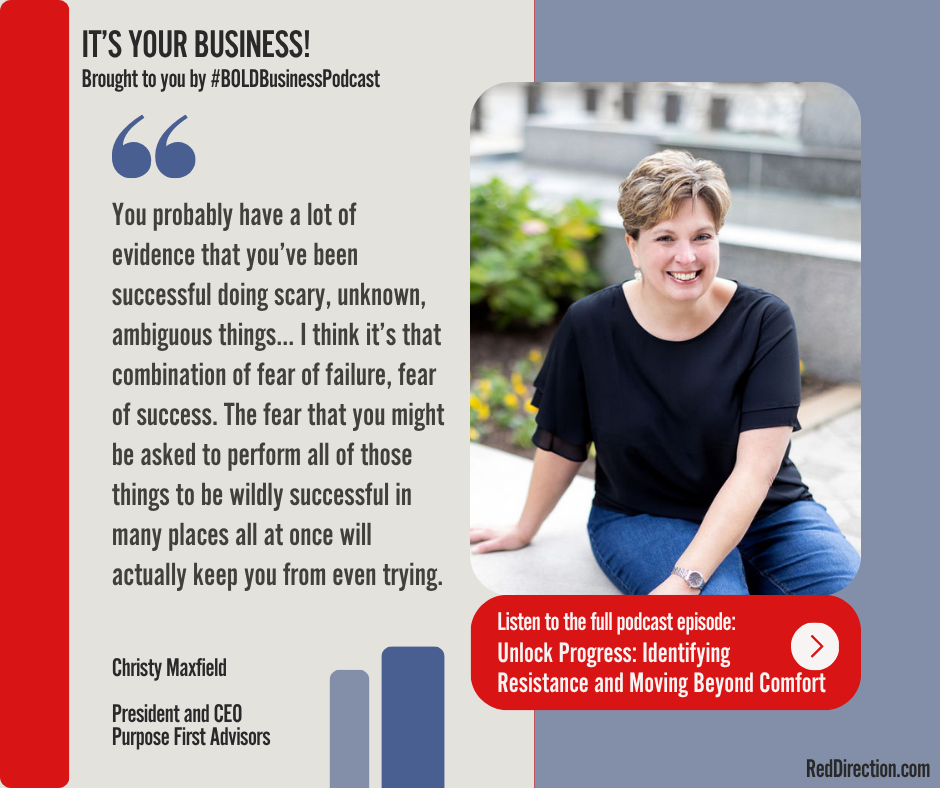
- Christy Maxfield, President and CEO at Purpose First Advisors
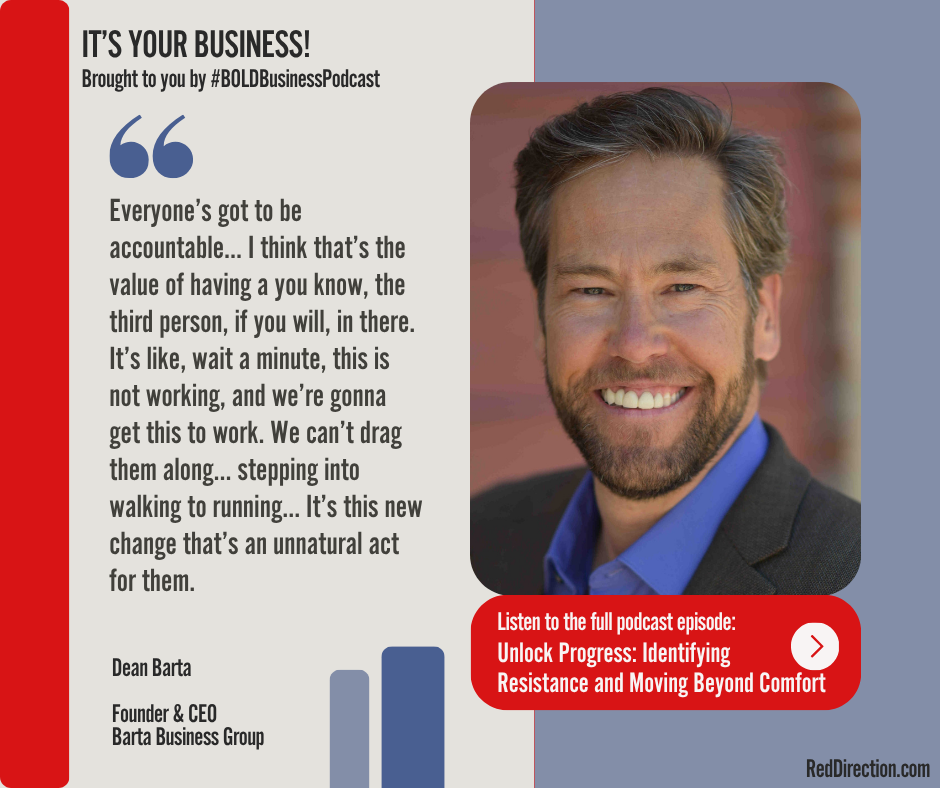
- Dean Barta, Founder and CEO at Barta Business Group
- Jess Dewell, Managing Partner and Growth Strategist at Red Direction
The root cause of resistance to change is moving away from what is known. To move beyond the status quo, change may be welcomed to a point. What we’ve found is that moving past that point, into new territory, can be daunting even hiring outside experts. Sometimes it is that the amount of stress and frustration is big enough that change has to be made. Other times it is a lack of a compelling future.
Through candid stories and actionable advice, this panel unpacks how to bridge the gap between planning and execution one uncomfortable, necessary action at a time.
In this program you will hear choose one thing at a time, find the meaningful way forward that outweighs the friction of change, and root out where checklists have replaced accountability. Real transformation occurs when commitment and accountability come from the whole team, not just leadership, through explicit agreements. Find and face resistance within your company to unlock progress.
What You Will Hear:
00:43 The current business climate faces unique pressures and escalating challenges, impacting leaders and their ability to move forward.
- Uncommitted leaders often stand aside, claiming there will be time later, which only leads to erosion of their efforts.
- Even well-made plans can falter at the execution stage, not because they’re flawed because of deeper obstacles.
- The root cause of stalled progress is identified as resistance and uncertainty about what practical steps to take next.
07:10 How discomfort, rather than lack of strategy, blocks business momentum, especially when taboo topics remain unaddressed.
- When someone brings up issues that have long been ignored, it often results in uncomfortable silence, revealing the group’s real struggle.
- Fear of facing these identified issues keeps decision-makers from taking needed action, even when the solutions are clear.
- Organizations are often closer than they think to change, if they can just address these unspoken fears together.
14:55 The group explores how comparing past successes with current efforts can create new resistance and self-doubt, making progress more difficult than expected.
- Expecting past formulas to yield the same results leads to disappointment and hesitation.
- Stepping into familiar stages with new people, markets or technologies challenges the expectation that success can be reliably repeated.
- Internal narratives about failure and comparison can create powerful, unnamed forms of resistance that are rarely acknowledged.
23:45 Attention turns to the critical role of honest reflection and outside perspective in helping businesses move from talk to action.
- Objective measures, like tangible results, cut through discussion and bring focus to what’s actually being achieved.
- Sometimes those brought in to assist are more ready for action than the business itself, signaling a gap in commitment and readiness for change.
- Progress often requires straightforward conversations, persistence, and a willingness to confront what’s not working without sugarcoating.
30:35 The conversation warns about the drawbacks of over-reliance on systems, numbers, and rigid processes at the expense of culture and instinct.
- Focusing only on quantifiable assets and forecasts can overshadow the importance of relationships, mission, and organizational health.
- When leaders operate outside their personal strengths, critical areas like team spirit, reputation, and retention can be neglected.
- Lasting business success depends on balancing data-driven practices with empowering people to make instinctive, value-driven decisions.
40:15 Accountability is dissected as being more about continuous practice than documentation, with a need for simplicity and personal ownership at the outset.
- Accountability can be disguised as checklists, and this does not promote real responsibility.
- True progress is built on the discipline of addressing one area at a time, ensuring focus and follow-through.
- Sustainable cultural change starts with individuals modeling accountability themselves before spreading it throughout the organization.
45:20 Accountability is further deepened by exploring how agreements, not just expectations, ensure collective ownership and follow-through.
- Clear agreements require explicit, spoken commitment from everyone involved, not just silent assent.
- Mutual understanding about roles, responsibilities, and outcomes creates the foundation for holding each other accountable without blame.
- If someone cannot genuinely agree to the team’s direction, it’s acknowledged as valid for them to move on rather than impede progress.
Three practical takeaways to help you start moving forward:
- Dean Barta says choose ONE thing: Don’t write endless lists of to-dos. Pick one action—just one—that will create momentum. Only move to the next when you’ve mastered the first. This simplicity keeps your team focused and accountable.
- Christy Maxfield advises to make the future compelling: Lasting change happens when your vision is so exciting and meaningful that it outweighs the discomfort of change. Don’t just move away from pain; run toward a future that truly motivates you.
- Jess Dewell challenges that accountability starts with you: True accountability isn’t a checklist, it is lived commitment. Set clear expectations, model the behaviors you want to see, and make accountability about agreements, not blame.
Resources
Transcript
Dean Barta 00:00
When you get the one thing dialed in, maybe you could do that one thing and yet another thing.
Christy Maxfield 00:05
Everybody just submit your receipts. That one thing will make everything so much better. And if you want to do it while walking out in nature, we support you in doing this.
Jess Dewell 00:16
I love that.
Announcer 00:23
Welcome to It’s Your Business, brought to you by the Bold Business Podcast. This is your source for navigating today’s ever-evolving business landscape. In this program, Jess, Christy, and Dean share the realities of current business challenges and triumphs. Get ready to lead with depth, understanding, and achievement.
Jess Dewell 00:43
AI disruption, rampant burnout, skyrocketing costs. There is unprecedented strain right here, right now. And here’s the deal. It’s easier to claim time is on your side, stand aside, and stay uncommitted. And we’re here to tell you today that you’re going to stay in that familiar place, which is painful and unsure, and continue to just have pieces erode away at what you have. All this intentional effort that you’re putting in, don’t let it go to waste. You have a viable plan, yet execution may be stalling. And when this is happening, you no longer have a business planning issue. You have a resistance problem rooted in not knowing what to really do next. So here, you’re going to have three advisor perspectives to talk to you about how do you actually commit to what you need to do to make progress on your initiatives right now. Hey, Christy. Good to see you. You’re here.
Christy Maxfield 01:48
I’m glad to be here. Christy Maxfield, owner of Purpose First Advisors. We help business owners navigate the changes that create profitable, transferable businesses. Dean, how are you?
Dean Barta 02:02
I’m doing great. Doing great. If I was any better, I’d be twins. So Dean Barta, Barta Business Group, providing fractional CFO and controller level services for mostly trade service businesses. So, and happy to be on this panel.
Jess Dewell 02:21
And I’m Jess, Red Direction, and we’re working at the scale level and the capacity level because at some point we all hit that capacity problem and it’s actually shows up in so many other ways. But when you dig down and peel it all back, that’s it. We can, we actually have more capacity than we think we have. And it starts with knowing exactly what you will or will not do. And so here we are. We’re going to jump right in and help you confront your internal friction, embrace the discomfort of change, and bridge the gap between strategy and execution. I’m telling you, this is a pretty big, big topic. And I know there are a lot of places we could go with this, and I know we narrowed it in. I’d like to start here, because right as we were recording, this became very clear. When we were talking about this topic before, when we were revisiting it and re-anchoring into this conversation right now to have this panel discussion, we all agreed we don’t have strategy problems. We have comfort problems, and I think that’s the place to start. So if we’re thinking about that, comfort kind of implies resistance, eh, Christy?
Christy Maxfield 03:39
Well, comfort, we can have resistance because we are resisting the discomfort that change creates. So while we’re in the state of being comfortable, resistance usually is pretty low. Then we come to a meeting with one of us and we say, hey, these are my big dreams. These are the big things I want to make happen in my business. And we’re like, we are totally with you. We want to help you make those big changes. And we outline a few things that have to start to change in order for those things to happen. And those things feel uncomfortable. There’s a reason you haven’t done them already. It’s not that you didn’t know about them. I don’t think any of us have met owners who are like, I never thought of that. It never occurred to me that I really needed to let someone go or be more rigorous in my financial accounting or dive deeper into my numbers or really get a handle on my capacity or adopt new technology. Nobody looks at us and goes, you just, you’re so smart. You just know so many things that never even occurred to me. What they say is, you know, I’ve been thinking for a long time that I need to do X, Y, and Z, A, B, and C, and a dash of this and a few more other things here. And you go, well, there’s a reason you probably haven’t done it already. And if we can help you identify what’s holding you back, what’s creating that friction so that when you say you want all these things and you recognize what has to be different in order to get those things, What’s that thing that’s making you still pause even though you want this? You really want this. You want it so much you’ve hired us to do it. That’s where we’ve been exploring is like what’s going on there? And one way to name it is resistance. So then it becomes about figuring out what are you resisting?
Jess Dewell 05:48
What about you?
Christy Maxfield 05:49
I could go on.
Jess Dewell 05:50
I was going to say, I can tell. I can too. I was like, hey, Dean, what about you?
Christy Maxfield 05:55
Exactly. I will pause now for others.
Dean Barta 06:02
I’m with you, Christy. I’m with you. And, you know, when even a business owner gets to a point of even reaching out to us, I think the decision is like, is finally, finally, the decision to change. Maybe less comfortable or, you know, more comfortable than staying where you’re at. I mean, that’s probably the, you know, the impetus to like call us or email us or reach out to us. And, you know, that, that transition, that’s where the difficulty can really lie is because it’s, it’s a whole new way of probably an approach, a mindset, a process that, that has to change that might be pretty entrenched in your organization. And, you know, just like a seed coming out of the ground, it’s got to work through the crust in order to get to the light. So that’s what we do is we help you, you know, break in, you know, break in past the surface. So.
Jess Dewell 07:10
Yeah. And I’m thinking about what you both said and what I could add as a perspective around not a strategic problem, but a comfort problem. And I recognize that very quickly I can ask a question that gets silence in the room. And the basis of that question is naming everything that was swept under the rug that everybody steps over now and tries not to trip on. The big elephant in corner that nobody will see, but exists. And nobody’s ever told me about this and I find it and it just comes out. And then there’s this space of what’s going to happen next, which also means there’s a little bit of a trust issue here too, because if that kind of silence shows up around a table with the people in the room that make this, that are making these decisions and they’re afraid or nervous or worried about what is going to happen next when something is named, everybody’s holding back. And to me, that comfort, that, that comfort problem, that’s where that shows up. The fear, the fear is not worth facing, even though instead of miles away from the goal of change, we’re probably inches away from the goal of change. If we could face that fear and speak up with each other. And that, and that’s a whole different thing outside of some of these things. So I will hold the space from that perspective as I’m sharing and contributing today, because I could easily say the same things that you two could say, and you could do the same with me too. I know because we think enough similarly, sometimes we have to go, okay, we can’t, what else do we say? So we get more perspective in here, which I think is really great too. That’s something I like working with you too.
Christy Maxfield 09:01
Well, and dean’s perspective is really the pain got great enough that you were willing to change I would also offer that the opportunity got compelling enough that you were willing to change and the difference there being that what my work has just unearthed for me is that the resistance we feel that desire to like the elastic band and then go right back to where we had started back to that comfort zone is because the thing we’re trying to get to isn’t compelling enough the pain is compelling to get us to start but the outcome isn’t compelling enough to get us to do the hard part and stay in the resistance and move through it and transition so I might also offer that having that compelling visceral thing that you’re like, wow, the day I can wake up and not have to worry about cash flow, the day I can wake up and not have to worry about performance, the day I can wake up and not have to worry about client satisfaction. If you could feel that in your bones, as much as you feel the pain of your current situation, that could be the impetus that keeps you going and helps you push through the fear, the shame, the regret, the previous times you’ve all acknowledged that some, you know, so-and-so needs to go, such-and-such can’t continue, we can no longer tolerate these other things that are going on, and nothing’s changed. Maybe it’s about making the alternative, the change, the outcome of doing something different so compelling that you can’t spring back to where you used to be and the comfort zone you’re preparing to leave.
Jess Dewell 10:53
Bringing our listeners and viewers along with us, we’ve jumped right into defining that first part into the first of three sections where we’re talking about the root of resistance now. Christy took us right into that. And I’m going to call it out and say that because after we talk about this, we’re going to move right into potentially seamlessly and jump in after the fact and be like, hey, we moved. Come with us to pivoting to what is that source and how can a third party really like us really help you there, that pivot in the way that you think can show up. And then the third section of our conversation today is going to be how do we bridge the gap from where we are to where we want to go. So diving back into Christy, what we’ve been talking about here. And Christy, do you have more to say or dean did you want to jump in here when we’re talking about this um this resistance to change and that familiar pain just being something I kind of want to say crave but that sounds horrible.
Dean Barta 11:53
Well, and I’ll even add that that was really astute christy is is you know you have the pain but there’s got to be that opportunity and I think the other is that you’re you’re reaching out to an expert like one of us that I had another consultant give me this quote just the other day is a CEO’s ego is not their amigo. And I’m like, oh, that’s really good. I got to write that down, which I did. And because, you know, you’re not the subject matter expert and grab, you know, Finding someone like one of us to help them. Now that’s where the action part of all that, instead of, you know, dreaming about it to happen, you know, might know what the risk is, opportunity. But you got to have that third party to, to create the action that will manifest.
Christy Maxfield 12:52
I think it’s the dialogue that comes from these relationships, too, of why do you want this? Why is it worth now making these changes? Changes that maybe you haven’t even really approached in 10, 15, 20 years of running your business. And how can I support you in doing those? So I think of certain clients in particular when I’m looking at this and really trying to understand what is it now that’s making it compelling enough to do? And how can we acknowledge to your team that, in fact, you are showing up differently? And that not only is it going to be weird and different for them, but it’s going to be weird and different for you. Because sometimes after I meet leadership teams, after I’ve been working with an owner for a while, they’re like, oh, you’re why they came in and said X, Y, and Z. Oh, you’re the reason they’ve decided to finally let go of somebody we’ve been talking around and working around for years now. And then helping the leadership team understand what that compelling vision is that, you know, was enough for someone to work past all of the things that kept them stuck for so many years. But, you know, resistance that we’ve been talking a lot about what’s familiar versus what’s different, what’s comfortable versus what’s uncomfortable. But also just acknowledging I work with a lot of folks who are embarrassed by past decisions, feel some kind of shame about choices they’ve made in the past or the things they’ve allowed to go on for a long period of time. They’re like, I’ve never liked this. I’ve always wanted this to be different. And I let it persist. And now I feel bad about myself for doing that. And I try to really create a space.
Jess Dewell 14:54
That’s something that I have to own on a regular basis, not only for Red Direction, also in my life and also in every single business. I don’t like to. I’m a peacemaker. Sometimes at all costs, even though I will stir the pot really quickly. In the end, I really want peace. So how’s that for an interesting polarity? And I’m, I’m listening to you both. And I’m thinking about that because what was coming up for me was why didn’t my second exit go as well as my first, it didn’t go at all. My second one failed and it failed almost worse than the success of my first one that, um, and I, I, it’s really interesting how and where we start comparing ourselves to other things or what expectations we have taken on for whatever reason. And so I’m listening to you both and I’m like, oh yeah, I have to, I can, I guess I will. I’m going to say it out loud. I can’t believe I haven’t had more successful big jumps because of the successes I have had. I’ve had probably 10x or 100x failures compared to those successes. And it’s hard sometimes to say, hey, why do I keep going forward? Is this really worth it? And to be able to say, cool, every single time, even if you’re doing the same thing, you’re at the same stage of business, you’re ready to scale the thing, you’ve done this business before and you’re doing it again, we think it’s going to repeat. And I will tell you what, that is a point of resistance we don’t name very often. We’re different people. The people who are working with us are different. The market is different. The technology, our supply chain and tech stack will be different than it was ever before. And so it can’t be the same, but we think it should be. What? Speaking from both sides of this conversation, I got this one.
Christy Maxfield 16:52
So I think what I’m hearing you say is like, I had a positive experience before. I should be able to take everything I learned from that and replicate it. And why can’t I? And again,
Jess Dewell 17:02
And again.
Christy Maxfield 17:03
And you’re really like you’re grasping and, and clinging to the, the, the desired outcome. Right? And the thing that makes, makes me reflect on this, it’s like having a great meal and then going back and ordering the same meal. And it’s just not quite as satisfying as it was the first time. You’re like, damn it. It was supposed to meet all my needs. Every single time I come here, I want to be able to order this and have it meet all of my needs the way it did that first time. And so that’s a really interesting perspective of like, I’ve done it before. Why can’t it be as satisfying and successful again? And what you’re saying is, well, things change. And I also think there’s the counterpoint to that of what happens if it’s even better? You know like I’m gonna hold back because it you know it might not be as good as it was before and then but also what if I go all in and then we do it differently and it’s even better.
Jess Dewell 18:09
Have you worked with people that can name that? Because I think in some cases I can look back and I can say you know what Christy and I’m only going to speak for myself here I can see that maybe I do because what will people think or what will I think of myself and do I actually want the extra the extra credibility expectation whatever that comes with that that everybody else is now going to want again I can see some of that but I also think I can see something else that you are talking about that I haven’t named yet because I can’t like experience it in my own body which makes me wonder if I’m avoiding it myself let’s just be real. Okay, well what I mean Dean can you relate to this at all? Christy, can you relate to this at all? Like being on that side? I’m just curious.
Dean Barta 18:54
Yeah. I mean, the, one of the thoughts I had was also let’s, let’s flip this upside down for a second is that is maybe the lack of competence because, you know, oh, this is not going to work, even though there’s no concrete evidence that it would fail because you’ve never failed in that before, you know, and, and, but it’s, you know, the ego or the psyche or what, you know, the mind is, is, is the fear is talking you out of it, even though, you know, you, you have no track record of it failing before.
Christy Maxfield 19:33
Yeah. In fact, you probably have a lot of evidence that you’ve been successful doing scary, unknown, ambiguous things or trying new approaches or all those kinds of things. So when we look and we try to undercover, like, why are you being resistant? Why are you telling me you want to change? And then when I help you create a roadmap for it, you don’t make the key decision or you don’t have the key conversation or you don’t get me the information you say you’re going to get me when, you know, in order for us to build the next version of what you want to see. You know, I think it’s that combination of fear of failure, fear of success. If I am wildly successful, oh my God. I know there are people I’ve talked to, I’ve worked with clients who are like, well, if I put all those proposals out at the same time, I’m not going to be able to do all that work. I’m like, in the event that every single proposal gets accepted at the exact same time, I promise you, I will personally help you call everybody and sequence and manage their expectations about start times and outcomes, right? Because like the likelihood of that is fairly low, but the fear that you might be asked to perform all of those things to be wildly successful in many places all at once will actually keep you from even trying, right? So the more we can be in dialogue with each other about what we hope, our hopes and our dreams, our fears, our, our, um, the things that make us feel a little wiggly and, and, you know, um, just unsettled, right? Like I can’t even name it, but it’s like, I don’t even know what I’m anxious about, but I’m anxious. I don’t know. I could, that I can relate to generalized anxiety and has been a friend. Um, but the more you can name it or even just, you know, what expectations. I once had a client who wrote a book and we’ve created lots of go to market strategies with it and how we would leverage it to increase sales and all of that. But the people closest to them hadn’t read it. And because those people hadn’t read it, they didn’t really feel like they had the credibility they needed from the people who are really important in their life to go out and build this entire line of business around it, which kind of blows my mind and is like, well, until you can do that, it’s not about a better plan. It’s not about an accountability phone call. It’s not about disappointing Christy or not showing up prepared. It’s you got some deeper work to do, work that I probably can’t help you do, but I can at least help you surface it so that other experts can help you maybe work through the deeper layers of what you’re encountering here.
Announcer 22:38
Feeling stuck? Like what got you here won’t get you there. The pressure to grow is on, yet the path isn’t clear yet. You don’t have to walk that path alone. This is the Bold Business Podcast. Like and subscribe wherever you listen. Your host, Jess Dewell, is the strategic partner you’ve been looking for, asking the questions that truly matter. It’s time to break the inertia and get the perspective you need to make your next move.
Jess Dewell 23:10
Dean, you feel very strongly about being able to meet people and call it out and put a name on it and find, hey, this isn’t being done. This isn’t being done. And I know that’s a pivot that you bring to the table. And you’re coming at this from a financial side. You’re coming at this from a very specific question. I’m sure somebody has asked you about their business and the things that the dialogue and the back and the forth that’s needed. So, you know, talk about, tell us about how you handle those pivots and into this. Here’s how we get to the real work and actually make progress.
Dean Barta 23:49
Well, yeah, you know, results speaks for themselves. OK. And that’s where, you know, you talk about, hey, we want to do this. We want to do this. And and if I see it, you know, really, we’re not doing this, you know, and that’s part of my job is to, you know, provide that mirror that this is not being done. This says, you know, we, we got to move forward. And, and I know when people engage with us, it’s, you know, you better saddle up for the ride because we’re ready to go. And, and sometimes we’re more committed to them than they are to the change. And I’m like, Hey, we’re, we’re saddled up, we’re ready to go. So, you know, and so it can transition into where, you know, it’s difficult conversations and I, you know, I’ll call it tough love, but it’s, it’s about, hey, you know, it’s calling them on the map that this is not being done and we’ve got to transition into, you know, it being done and, and working into what is that roadblock that, that, you know, that they were, were trying to help them overcome.
Christy Maxfield 25:05
When Dean, when, when folks come to you because you’re in the accounting space, it’s like we want better numbers. We want cleaner books. We want to understand what’s going on financially. I imagine that’s a lot of what’s, what’s happening. Right. And then like you need data. Right. You either need to them to give you what they already have or to clean up what they already have or to adopt a new way of doing something so that you can get another layer of detail and understanding in the business. Um do you think they’re sometimes just afraid of what the numbers are going to tell them or or like how how has like I know that there are just sometimes they don’t get you the thing that you need to get them the detail to get them the insight that they told you they want um. And how is that?
Dean Barta 25:55
Yeah. You know, ownership, they have an understanding if their business is going well that you know pretty much and you know I present to them as like hey you should have numbers that if you got this warm fuzzy feeling about your business the numbers should reflect that okay that’s where that’s the scorecard right is the financials and uh and you know nine out of ten business owners that is not their happy place you know diving into the numbers, their operations or marketing. And, you know, and, and so, you know, we’ve gone into the companies, we sometimes we’ve had to revamp their entire accounting department, because we couldn’t even do the analysis, you know, cash flow forecasting or strategy, because they’re not even a step one, which is, you know, solid financials. So, so yeah, that’s a, You know, we’ve got to just reveal what is going on. I mean, they know there’s an issue, but they don’t know how to approach it and how to, how to fix it. Because, well, you know, we hired this person and they’re great with their culture. And yeah, but they’re not a great accounting person. You know, they probably should be, you know, you know, resourced into a different part of the company or out of the company. And but we’re going to, you know, we’re going to talk really straight with them because, you know, the numbers, you know, that’s our, that’s our forte. The numbers are not speaking, you know, accurately. They have to for various reasons within business. Then, you know, it’s like I said, it’s that’s it’s the scorecard. And and but yeah, we’re yeah, we can be black and white about things on that. But, you know, so that’s but, you know, that’s what we’re we’re being hired for is that, you know, I’m you know, I rarely I think you hire any accounting person to give you the warm and fuzzy feeling. Now, I love, I love providing that when things are going well. I do. But, you know, sometimes this is really straight talk.
Christy Maxfield 28:08
And that’s so interesting to me because I’ve had a recent client experience where I’m obviously not the accountant. I wasn’t specifically brought in to help them clean up their accounting or get better numbers. But I’m looking at the numbers because they’re like, I feel I don’t know that I have the right information to, to take the company for the next step. And I’m not sure my team can help me, help me get it the way I need it. And then if I look at that particular situation through the lens of you don’t have a strategy problem, you have a comfort problem, is that owner is really very comfortable moving fast, doing a lot of things all at once, starting up new things before the last new thing they spun up has actually settled in and has a good cadence and rhythm. I was actually the one being like, whew, we need to, like, take a breath and get cash flow under control and look at the sequencing of new initiatives. And I think for them that was actually really uncomfortable because the comfort was in the constant momentum and the constant excitement of starting new things. And when the number said, well, like, we still need to help this other line of business find its sure footing and move into the zone of profitability that you want it to be in. And, hey, my recommendation would be to not take on new things while you’re trying to stabilize this other thing. That didn’t actually go over that well. And that’s also an interesting take. Like sometimes comfort is in the doing it all the same way, the same cadence, the, you know, it ain’t broke, don’t fix it. And sometimes the comfort’s in let’s just keep moving and always have something new. And it can be, you can encounter resistance with owners who are either side of that equation, who want to keep it comfortable and steady, but also those who like to keep it going fast and furious when it might behoove them to slow down a little.
Jess Dewell 30:36
And I’ll add to this in a different way, which is we rely so much on one thing. What else adds to the whole picture of what I call a business instinct gets lost. And so we lose that business instinct. And the example that I can bring is a client that I had came to me, was on the verge of burnout, had a 10 person company. And this business owner had every single asset known, here is the value it’s going to bring to my company. So if I move this many, it does this. If I do this much of that, it brings this. And had it down to per person, per day. And it’s all of these different things. And the weight of that became so heavy that managing all of that, when the forte for this person was not the manager of the business, they let their culture slide. They let their integrity of the way that they did their work slide. It started to show up in reviews online and people started to quit. And now you have a company that is very clearly, we know when we’re doing really well, yet it was still falling apart. And because there was too much emphasis on not the business owner’s strength. And so that’s what I’m bringing in here. I think they were doing everything right. I think the systems, the way they financially looked at things made sense. And in fact, I learned some things that I had never seen in business before. And I bring that to other businesses today. It is that important to how we work. Where is our money coming from? Our highest and best use of our time, each role, what is the highest and best use of the role’s time? And then we have to add, and what is the strength of the person? And how can we do that and empower them to be making those decisions to do that? Because that’s where whatever happens with reviews out there, whatever happens with the word of mouth, whatever happens in our culture, and are we actually naming the things that we need to name can occur or won’t occur. And we benefit or we lose from that if we forget some of it.
Christy Maxfield 32:57
That’s really interesting.
Dean Barta 32:59
Yeah, I had a conversation just today with a business owner that, I mean, just stressed out, you know, about, and I really, I was directing traffic on it. No, you need to focus on this and this. We’ve got this handled. We’re going to take care of it. And, and it was, you know, an immediate relief because she’s so used to, you know, taking care of everything that it was just, okay. You know, I know, you know, Dean and his team are going to, they’re going to, they’re handling it. You know, I said, we, we got, you know, we got it under control, but you got to take care of this. That is a, that’s a priority. We’ll meet you, you know, you know, by the end of the week, I honestly, And and and so we’ll we’ll get through this, you know, and so, you know, even though, yeah, I can, you know, tough love straight talk is really still coming from an empathetic level. But, you know, sometimes that hard talk is, you know, it has to happen just to move people off that bubble, you know, or get them out of the freak out mode. It’s like, no, you know, this is the way we’re going to do it. And, uh, yeah, so it’s, but it’s with every client, there is ebbs and flows and how we, we work, you know, it can change from week to week.
Jess Dewell 34:23
So it’s true. And, you know, and I started to allude to that, um, that strategy gap because I was here and I actually, I’ve seen it now in both sections that we’ve talked about so far, right? The resistance piece. And then how do we, how do we pivot and actually take action and can and having somebody who will tell you what’s what to the best of their knowledge with the most intention of good. And I think we forget that sometimes. And so when we’re in our day-to-day, I find it really fascinating that for whatever reason, the politeness becomes courtesy or courtesy becomes politeness. And then there’s just silence. And you get this concept of, you’re all going to learn something about me here. Just let them. Well, guess what? I’m going to tell you what. I don’t like that in real life. And I definitely don’t like it in business. I think it’s an interesting concept. I think it’s a great way to know what do I want to be involved in. And we have to choose what do we care about and what do we not care about. I’m going to tell you, you can’t just let them in business. We’re all got to road the same direction to get to where we’re going. We all have to have our wagons pulling in the same direction to get to where we’re going, whatever that is. So we can’t just let them. And I think that’s something that comes up. And I actually think if we can identify that gap, where are we? Where have we moved into this place of, well, this is what I’ve got to work with and actually say, this is what I am working with. Is it actually working? Can we, how does that sit with you both from kind of like starting to identify this strategy, this gap of, okay, so we have a strategy. We’re too comfortable. We’ve got to define that space and really be able to commit to something.
Christy Maxfield 36:20
I think for me, it comes up in the context of the committing to taking action and then facing the reality about, do we have the people on the team that we need to do the level of work that we’re asking this organization to do? So I think I’ve mentioned before, too, is that a lot of times we recognize that we’ve let performance issues go. It’s been easier to work around somebody than to address them directly. It’s been easier to deal with somebody who’s not rowing in the same direction by working around them, ignoring them, taking responsibilities away from them. Um, and then really coming to terms with the fact, I think to then say to yourself and then to the team member who’s not actually able to, to row with everybody that, um, I know I’ve, I know I’ve tolerated this. I know I’ve let you do this. I know that, um, that I’ve contributed to this behavior and I’m telling you it’s no longer acceptable because I’m not willing to live with the outcomes anymore. And that, like, level of not of taking back the responsibility for making sure everybody’s aligned, I think is really critical because that’s where it becomes the non-negotiable anymore. Where we say, I just can’t, you know, as much as I want you to be happy and to do you, we all need to be rowing in the same direction. And so I’m inviting you to be part of the team to do that. But if you’re choosing not to, I’m not going to create a space for you where that’s okay anymore.
Jess Dewell 38:25
Yeah. I think that’s, I think that’s huge. How about you, Dean?
Dean Barta 38:31
Yeah. Accountability, You know, it’s everyone’s got to be accountable. And, and, you know, if we’re the ones that are, if you will, refereeing that, that’s fine. But I think that’s the value of, you know, having a, you know, the third person, if you will, in there, like, wait a minute, this is not this is not working. And we’re going to get this to work. We’re going to move people, you know, you know, we’re going to be the catalyst to help them move but you know they you know we can’t drag them along you know they’ve got a you know we’re like helping them to take those those next steps and uh and you know stepping into walking to running you know so that you know they can do this you know more you know naturally but you know it’s this new change that’s an unnatural act for them but it’s all about we got to get to where we’re creating actionable results. And to me, that’s, you know, otherwise we’re just, you know, talking at each other and we’re wasting each other’s time.
Announcer 39:48
If your week feels like you’re being pulled from one demand to the next, this is for you. The Daily Grind is the number one killer of business instinct, pulling you and your team away from your vision. Reclaim your strategic edge with the present retreat. This free guide from Red Direction is a simple, powerful framework to carve out the space you need to filter out the noise, make the right decisions, and lead with clarity. Visit presentretreat.com.
Jess Dewell 40:17
You know what I find interesting? We’re talking about accountability, and we can define it, and we can say what it looks like. But you know what? Actually starting it is something that’s this really elusive thing. So I spend a lot of my time trying to pinpoint where does accountability actually start? And I’m going to toss this out here and I want you to, I want to hear what you both think about this. So I think of accountability differently than a lot of people. When I start talking accountability with business owners and we’re in a room, you know what they want to do? Take a guess. How do you think somebody starts being accountable or saying this is how we can become accountable? Any ideas?
Christy Maxfield 41:01
No. Tell me.
Jess Dewell 41:04
Let’s make a list that we can check. Okay. This is the death of accountability before it begins. If we are going to be accountable by writing everything down, guess what? We have a handbook that has all these weird little things in it because somebody did it once and we had to address it. But if it’s not in the handbook, then we can allow it. So all we’re doing when we make lists are ways for loopholes, are ways for people to not fully step up, are ways for people to feel micromanaged and like, what if this doesn’t work anymore, but I can’t change the process and it’s too hard to change this system. So let’s start with, I’ll just say this, to start accountability, when the first go-to is a list, cool, write everything down because it’s in your brain and it wants to come out. And then set it aside and now we’re going to do the real work to make accountability, which is one thing at a time. That’s it. And we have to pick one thing, one thing at a time. We’re going to end all our meetings when we say the meetings will end. Maybe that’s it. Maybe another thing is I don’t check in with my people as often as I would like. And I’m going to put on my calendar and every week I’m going to speak with whatever it is for how many number of people we have. And I’m going to seek them out and spend just five minutes asking how they are in their life, crossing paths with them. I’m going to be accountable because I need to know my people more. I want to know my people more. It’s important that we are all growing together. And I can’t make sure they’re on the right seat in the bus if I don’t know them. So what is the one thing, that’s what I would bring from an accountability perspective, that we can do? And then it starts with us. So until we can do it, not only are we committed, not only can we do it and we’re successful enough. Let’s say I have a high school student, so GPA is really important, but I can also go with percentages because we can go on a scale of one to five. If we can get to a four or more out of five, like if we have five-star reviews, wherever we’re getting those. If we can get to four more or how we choose stuff when we’re deciding to buy something, what did other people say? How well was it rated, right? If we’re in that place where we would listen to somebody else, now we can share it with the team and ask the team to do the same thing and just do that one thing. And it is so counterintuitive because people also think accountability is, let’s bring in somebody who’s a process and a systems person, and they’re going to tell us all of these things that we’re going to do differently. Well, all of this is change management. It just depends on do you want it to stick or not. So having been there, done all of those things, by the way, there are times those are very necessary. At the same point, in general, we change one drop at a time. It’s how you fill a bathtub, one drop at a time. It’s how you climb a mountain, one step at a time. It’s how you eat a whale, one bite at a time. Whatever your thing is, right? I could probably go off, Christy.
Christy Maxfield 44:06
Well, and I was just going to say, so, Dean, if somebody said to you, like, where does accountability start? What would your answer be?
Dean Barta 44:15
Well, it starts, you know, within every single person. OK. And I like the one step, you know, let’s just focus on one thing, because if an organization can’t even do the one thing, well, then we got to, you know, basically have to back up. And I like that. Let’s do the mind dump. Let’s do, you know, the list. Yeah, exactly. Let’s clear the, clear the decks of all that stuff that’s in your head. And then we actually get down to work. And and really, you know, it’s, you know, that personal accountability. And, you know, it’s you know, we’ve mentioned it before in this particular call today is about rowing in the same direction. You know, it just doesn’t work if only eight out of 10 people are, you know, you’re going to be off course. And it’s got to be a 10 out of 10. You know, there’s, you know, nobody or that person has to be replaced.
Christy Maxfield 45:17
Yeah.
Dean Barta 45:18
And yeah.
Christy Maxfield 45:19
And I agree with you. For me, it starts with commitment. So have we all committed to each other, the plan, the company, the goal, whatever the case may be? Can we verbalize our affirmative commitment? And then when it comes down to personal accountability and team accountability, have we stated our expectations and turned them into an agreement? So even just your example, like we’re going to start and end meetings on time. That’s an expectation until everybody agrees. Yep. Right. And then when everybody agrees, we have a we know what it looks like to fulfill that commitment. And when one of us doesn’t, we come back and talk about the failure to meet the agreed upon expectation. Not you’re a bad person, you’re failing, you’re not good at what you do. It’s we made an agreement like we, we chose to commit to each other and to commit to the process we made. We identified what we wanted to see. We know what it looks like when we’re successful and you’re not living up to that agreement. Because so often account of we think accountability starts with you do what you were told. We actually have to make sure a we actually told people because most of the expectations in our head are unspoken I just assumed everybody knew they were supposed to dot dot dot right and then um they didn’t so they must be either incompetent or insensitive because doesn’t everybody know how to do that thing and wouldn’t everybody just normally do it show up on time be prepared and the meeting on time do the thing that they were asked to do. So that, you know, it really comes down to having these frank conversations and making sure that we are very explicit as owners and as leaders about what it is we’re trying to accomplish, what we’re asking people to commit to, what they’re agreeing to be a part of. And if they don’t agree, that’s okay. But it doesn’t mean they get to stay there. Like, that’s, that’s the piece I think sometimes people miss is like, I’m inviting you to be part of this experience. It is going to look and feel different than what you’re used to. If you do not want to live in the discomfort, if you do not want to go through the change and transformation, if you would rather stay where you are, that is absolutely fine. Just not here. Yep.
Jess Dewell 48:08
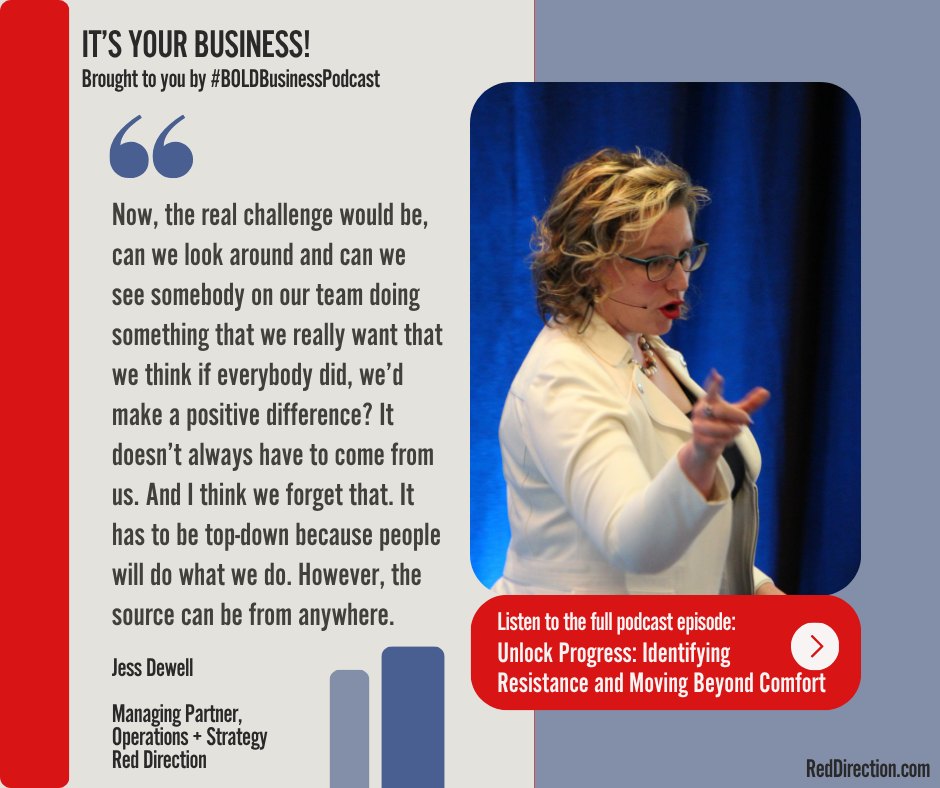
Yeah. Here’s to that. You know, and I’m listening to you and I think I actually, I’m going to, I’m going to add to something. And I was talking about us because if we can’t do it, we can’t expect other people to, to your point, Dean and Christy. 100%. Now the real challenge would be, can we look around and can we see somebody on our team doing something that we really want that we think if everybody did, we’d make a positive difference. And that could come back to the agreement and we can find accountability. It doesn’t always have to come from us. And I think we forget that. It has to be top down because people will do what we do. However, the source can be from anywhere. It could be from the neighbor. It could be from the business down the street. It could be from, It’s Your Business. You’re welcome. I know you got something today from Christy and Dean.
Christy Maxfield 49:00
You’re welcome.
Jess Dewell 49:01
And me. You’re welcome. So, you know, I actually, but how do we start with the one thing? And I came up with two questions to share about that too. So wherever it’s coming from and however we’re looking, maybe we answer these two questions to find that first one thing. And by the way, even though technology is changing fast, people don’t. So when I say one thing, this is probably a 90-day exercise to practice, get to where we need to go together, make adjustments because the first iteration rarely is the final iteration, all of those things. So grace in time as well. And maybe to find out what that one thing is, here are the two questions. What do you really want to be happening for your company? And why, so why are you doing this thing you’re doing? Because it had some expected outcome that’s not happening. So can you name that? And the second question is, what changes are willing to be made to reallocate the time, energy, and resources to do the necessary work to get there. And whatever has the highest on both or has the most, whether it’s business instinct, whether it’s you, whether it’s a team, whatever that is, then I think that that’s, those two things will help you find what can you do, what do you want to do first and where do you want to go. So that’s my, that’s my little, here’s how you close the gap.
Dean Barta 50:24
That’s good. I like it.
Jess Dewell 50:26
I like it. It’s actually not little. Let’s be real. It’s easy to say, hard to do.
Christy Maxfield 50:32
It is very hard to do. I mean, if everybody could simply say I want to do x and achieve y and then the next day walk more eat less spend more quality time out in nature uh treat people kindly give the benefit of the doubt show up uh you know vulnerable and willing to grow and change I mean like like where there would be entire industries that would not be needed if if we could all just do these things like the reason we exist the reason why the the services we provide and others provide is important is because being a human is really hard. And then interacting with other humans in a way that’s productive, enjoyable, and successful, that’s really, really hard. And then to make money on top of it and create excited employees and satisfied customers and strong vendors and a good community presence like none of this is for the faint of heart this is this is hard work right and so the the owners who think oh I’m supposed to have this all together I’m supposed to know how to do it all and I’m certainly supposed to know how to do it by myself I’d say like no respectfully no um respectfully like this is this is the time where super high performing people still need to tap in resources because creating the change you want, getting different outcomes, growing, building, achieving is a team sport. And your sheer force of will got you really, really far. And it’s not going to get you to the greatness that you aspire to. So please let us help you.
Jess Dewell 52:32
Yes. And we’ve been talking today, you don’t have a strategy problem. You have a comfort problem. We’re talking about high stakes initiatives that get stuck or regular initiatives that we haven’t been able to unstuck. And it’s never about the plan. It’s about whatever the fear is about taking the driver’s seat, whatever the, whether it’s confidence. There were a lot of great examples given by earlier in the conversation about that. So let’s, let’s hope, I think we’ve done a very good job of tearing down this illusion and being able to take this next step forward so that we can make a difference in our own businesses and you can make a difference even more by reaching out and asking for some help. And we’ve talked about this in three parts. We’ve talked about the root of resistance. We’ve talked about pivoting the way we think about our resistance and really becoming direct with it. And we’ve talked about the gap, how to identify it and how to start closing it so that momentum initiatives can start moving forward at the pace of human change, not technology change. And we have to remember that, too. So we’re now at the part of our conversation where we get to talk about what was our biggest takeaway? What are our three things? I can’t wait to hear from you. What were your what was the thing from each of you? And I’ve got one, too. So let’s go.
Christy Maxfield 53:52
Dean, you go first.
Dean Barta 53:53
Yeah, I actually, I, I, my biggest takeaway, I really, and like, let’s just do one thing. Like that is such a great starting point and people, you know, want to jump in. Okay. Everyone’s going to get these 10 tasks to do. And, and it just overwhelms it. It’s like, let’s just keep it simple. Let’s just, you know, to use an example, let’s get, let’s go out and walk in the grass and be in nature every day or where, what, just do the one thing. And when you get the one thing dialed in, maybe you could do that one thing and yet another thing. But let’s just dial in the one thing first. I love that.
Christy Maxfield 54:31
Everybody, just submit your receipts. That one thing will make everything so much better. And if you want to do it while walking out in nature, we support you in doing this.
Dean Barta 54:42
I love that.
Christy Maxfield 54:49
Exactly. Can you make the future so compelling that it’s worth the discomfort of the present, right? You know, can, rather than, is the pain big enough for you to be willing to change? Can the, can the joy and success of what lies ahead be so compelling that it’s worth going through the process of making changes and being uncomfortable to do it. Because that’s what I hope for you. I hope that that level of joy and expectation is so compelling that you can’t not do the thing differently moving forward to get the thing you want more than anything else.
Jess Dewell 55:39
I think a thread that we talked around and nobody came out and named is my one thing. And that is that the, the, no matter what action is being taken. So what if we held hands with the thing that was holding us back while we were taking that action? There’s probably a way better way to say that.
Christy Maxfield 56:09
Well, feel the fear and do it anyway.
Dean Barta 56:12
Yeah.
Jess Dewell 56:12
The mental toughness of, hey, we’re already here. We’re already facing all of these challenges. Let’s embrace, let’s arm and arm this thing and keep on going and keep taking that action. Yeah. Mental toughness all the way around. Awesome. So that’s it. I think that’s it for today. We have covered it. We’re here. You’ll hear us again on another It’s Your Business. Until next time.
Announcer 56:40
And that brings us to the close of another powerful and fresh perspective on the Bold Business Podcast. In today’s volatile landscape, growth is a double-edged sword. To truly thrive, you must engage with your strategy, not just react to the day-to-day. Without absolute alignment, your company faces a stark choice. Outmaneuver or be outmaneuvered. Grow or get left behind. Thank you for listening. And a special thanks to the Scott Treatment for Technical Production.