





STOP REFINING A FAILING STRATEGY – ARCHITECT A RESILIENT ONE.
FROM LINEAR PLANNING ➔ ADAPTIVE ARCHITECTURE
With Red Direction Growth Framework Reset Consultation, audit the strategic foundation via the structural stress-testing to eliminate obsolescence guaranteed by a 10x increase in modal resilience.
Starting the conversation:
Getting comfortable with “no” might be your most profitable decision ever. Modern leadership means removing barriers by proactively addressing obstacles, clear communication, and individual support so people can do their best work. John Sansoucie, CEO at CogNet, shares insider lessons from surviving and thriving through 600x growth.
Changing and evolving your tech stack is challenging. Claiming your growth strategy, knowing you don’t know what it will actually take, and choosing the right systems to reduce the risk of internal infrastructure ceilings is paramount. Technology takes time and is influenced by culture, the way you do your business, and the ability of your team to connect tech stack use to work flows.
In this episode, you will hear that new technology doesn’t always work the first time and is harder to implement than you think; that Business Instinct matters more than ever before as real critical thinking and reasoning is required in every role today; and to turn your strategic engagement cadence into a routine as routine is the precursor to success. Jess Dewell talks with John Sansoucie, CEO at CogNet, about being OK with the uncomfortable acknowledgement that your growth strategy is likely changing as quickly as the market.
Host: Jess Dewell
Guest: John Sansoucie
What You Will Hear:
02:35 Scaling from 67 to 600 employees brought unexpected challenges and lessons.
- Hiring and onboarding for a massive client required rapid coordination and effort.
- Expanding the team also meant upgrading leadership and formalizing company practices.
- The transition inspired implementing budgets, strategic plans, and a shift toward big-company operations.
09:55 Integrating AI and technology solutions requires balancing autonomy, structure, and security.
- Developing in-house AI tools introduces flexibility in ingesting and processing diverse data.
- Some teams thrive with permission to experiment with external AI, bypassing traditional IT channels.
- Protecting client data and maintaining security standards remain central when implementing AI at scale.
15:35 Evolving the business model means charging for technology, not just people.
- Shifting away from purely headcount-based contracts is essential for business sustainability.
- Automation and process improvements are part of the value proposition alongside human services.
- The ability to flex between technology and human touch depends on process requirements.
22:45 Finding the right pace of change is a challenge – balancing urgency with patience.
- There is a constant tension between the desire for immediate results and the practical realities of execution.
- Frequent updates and a push for rapid progress help keep projects on track.
- Adopting patience is necessary when moving people and initiatives into new roles or systems.
29:45 Client-focused operations demand adaptability to external processes and systems.
- The business often works with whatever technology or documentation the client provides.
- Essential operational work must be completed, even if not glamorous.
- Incremental improvements, even small ones, are valued and contribute to operational efficiency.
36:40 Cultivating experimentation and resilience in the workplace supports innovation and growth.
- Encouraging employees to trust their instincts and try new things can lead to valuable discoveries.
- Failing in pursuit of progress is embraced as a key learning tool for both individuals and the company.
- Testing ideas and learning from outcomes matter more than always being right.
42:25 It is BOLD to stay true to your company’s growth strategy even when you actually have to uncomfortably acknowledge that it’s going to change quickly.
Resources
- Connect with John Sansoucie
- Blink: The Power of Thinking Without Thinking
- Essentialism: The Disciplined Pursuit of Less
Transcript
John Sansoucie 00:00
Can we, as this is a strategic question that any person running a business today should say, can I stay right where I am with the number of employees and grow revenue by using AI or technology?
Announcer 00:15
Every leader needs a trusted partner for the moments that matter. This bold business podcast conversation is that partnership. Here is your host, Jess Dewell, an insightful truth teller who serves as the catalyst for getting the right work done and who asks the questions that truly matter.
Jess Dewell 00:34
Today, my guest on the Bold Business Podcast is John Sansouci. He is the chairman and CEO of Cognit, bringing more than 27 years of experience across third-party administration, human resource outsourcing, and professional employer organizations. He and I started our companies the same year into the global service operations became cornerstone to global offshore delivery, focusing on supporting HR outsourcing businesses. Now, this matters because the companies in the areas that he is providing services for is constantly changing anyway. And now you add speed with which we are seeing technology change. Hearing the evolution of his company is amazing. So in the last five years is really where we’re spending time and into the future is where we’re spending time in our conversation. You’re going to hear some of the early day stuff, what the lever was in terms of where growth focus scale changed. And it was him evolving as the CEO and then where they’re going in the future. So as you’re listening today, there are going to be three things to watch out for and listen out for as I’m talking with John. The first is new technology does not always work the first time, and it’s harder to implement than you think. The second thing, business instinct matters more today than ever before because real critical thinking and reasoning is now required in every role. And the third thing is you have a cadence, and if you don’t make one, keep that cadence because routine is the precursor to success. I’m really excited for you to listen to this. Let’s get to the conversation with John. You really have a history of scale. And I would love to hear your reflection as you transitioned from 67 to six employees. What was that, looking back, what was that like for you? And where were you, looking back, the most surprised where it was easy? And what was surprised you that it was hard?
John Sansoucie 02:38
One large client came out, but we needed about 150 people for that one. We had to hire them all at the same time, get them trained, get them moving. We got luck involved in that one. We pulled it off. We hired a little higher level person because of the contract. And now what I realized after the good news is we’re doing this fresh off my trip because now I’m transitioning our company to, okay, this is the way this 600 person company should be working guys. And we’re going to have a budget. You’re going to have written strategic plans by position. I worked in big companies and this is the way we did stuff. And guess what? welcome. Unfortunately, I’m about a year too late on that, but it is changing the organization. They’re all going to be like, I have two heads. I’m like, no, this is the world we should be living in. Okay.
Jess Dewell 03:18
What made it too late?
John Sansoucie 03:20
I had to do some moving around the management. We’re bringing new management in. The old guys don’t like it. India in general has a sphere of ever firing anybody. They don’t like conflict. I’ll be blunt with you and may not say that, but I had to fire a couple of people on this trip. And there were people that were hurting the organization. your good people are getting irritated because you got somebody who’s causing trouble and nobody wants to do anything about it. And that’s here in America, we just get, get out. It’d be that, not there. So what we’ve been putting infrastructures, like we put Zoho in, so like HR systems are fantastic. We’re putting a CRM right now. I’m formalizing everything that we do. And next year they’re going to have a budget. They never had a, Hey, I run this division and I have a budget now and I have a bonus and I have all the things that I’m used to. So it’s an interesting time to watch how they all react too because they right now it’s just like i told them this is coming it’s really going to come in a couple months when they come back.
Jess Dewell 04:13
What’s interesting I agree with you that I’m listening to you think about the the conflict and the fact in business in the u.s we have gotten i don’t know if it’s clinical sterilized right that that just this is something that’s got to be done rip the band-aid off here we go that is true and then also opposing that even here is, have we done everything that we could? Is there anything else that we could have happen? And it sounds like in your case, part of that too late was doing those things. In hindsight, it was too late. Is that a good inference on my part or am I off?
John Sansoucie 04:47
It is. In fact, we’ve got all this data where we look at productivity. I know what everybody did every second of every day and how long it took the road. Payroll, this client, that system, I have it all. We never taught our managers to use that data to manage their people. So now we’re doing that. And they’re looking at us like, what do you mean? I’m like, here’s the mathematical measurement of one of your people who’s not cutting it. So let’s retrain them. Let’s move on. Let’s figure it out or they can leave. But in the past, they’ve just, they’ve not managed. And when you grow that fast, you find out my managers learned by fire. They’ve never been formally trained to be managers. So we either bring in outside people from big companies, which don’t always fit, or we grow them and take nurture them and take care of them, which is like right now I’m moving around three senior people they all love it one of them loves it one of the one one’s a superstar in my company i need him no matter what but i have to have him do different things so that i’m learning more what my real job is than probably ever.
Jess Dewell 05:45
Okay so that was going to be one of my questions later on but i’m going to ask you right now since it’s showing up right now which is what would you consider your traits when you started your company that made you good in your role and what are the trait today that make you good in your role for the stage today?
John Sansoucie 06:03
Totally different too the quickanswer was in the beginning it was revenue let’s just get enough to pay the bills guys and i did that through my relationship now it’s a real organization with real revenue real employees we’re not going to manage it as i watched my ceo bosses manage it and it’s more about people relationships right now i hired a cro and i hired a customer service person so that me and the president can step up and level and do our jobs. Whereas I did everything. I hired a new employee. I’ll give you a little bit of stuff. Natasha joined us and went to India. She just started. She’s going to be customer service person to take care of all clients. I had to set her up in payroll and I screwed it up. So I joked with her. I said, well, let me call the payroll department. They’ll get right back to you on this. And she goes, who’s that? I go, it’s me. Well, I had three employees of the U.S. So I’ll employ you there in India. Portillo, smart ass answer, matter of fact, because we forgot something on the trip and she’s sat-xated to us. She goes, I’m now the shipping department. So let me get you over your stuff. You forgot. That’s right.
Jess Dewell 06:59
We wear all the hats.
John Sansoucie 07:00
You learned. I don’t want to wear those hats anymore. Like I’m playing for my client. I don’t want to do that. I did that for 30 years. I’ll do it because it’s a great thing to do. But what you learn now is how do I step out? How do I get myself out of the things that don’t add the value that I need to add to the organization? But they still got to get done.
Jess Dewell 07:18
And what are those today for you at the stage of business that Cognit’s in?
John Sansoucie 07:22
For me, it’s getting up to referral sources, private equity guys, getting out. I have no verse getting me in the press, doing this, writing articles, being on panels. It’s the things I need to do to give exposure to the world to us versus having a meeting an hour from now about God knows what.
Jess Dewell 07:38
And I’m with you on that. So I’m thinking about the stuff that you’re doing now. And this is all, it’s awareness, right? So the highest and best work for you today is awareness of your company, leveraging relationships and making sure the levers are correct. And then you having the right people in the organization, working those levers at any point. Did I miss anything?
John Sansoucie 07:57
You’re on it. Cause the most disruptive guy I got, I hired from a company. He’s a six Sigma guy, Black Belt. Oh, he’s running a Lucy organization and they’re all like, oh my God, what is this guy doing?
Jess Dewell 08:08
Especially for people who are avoiders and they don’t like.
John Sansoucie 08:12
Oh my God. I’m going to be held to this crap. I better pay attention and learn what’s going on. So it’s a cultural shift within the company. What I think I learned on this trip is that I need to be more actively face-to-face involved. When I’m there, it has some impact with employees. That part I realized I’m good at, but it’s more important than I thought it was versus, hey guys, just do your job and get stuff done. That’s not, especially when there’s a shift in stretcher or where we’re going, we mean, hey, so what I learned is also the scares and bejesus out of my employees. So I need to vary or break, like a good politician. Here’s the three things I’m going to talk about over and over again.
Jess Dewell 08:50
That’s right.
John Sansoucie 08:51
And I’m going to beat it into your head until you understand.
Jess Dewell 08:54
And I will tell you what, the flip side of that is, boy, I hate repeating myself. And at the same point in time, I think once I get sick of it, I’m probably saying it just starting to say it enough. How do you feel about that? Is that also your experience?
John Sansoucie 09:10
No, when I know I’ve finally been effective is when they stop me and they say it for me, then I know, oh, it works.
Jess Dewell 09:15
Okay, good. Okay. So you have, there is a place where you have to get through that. Okay. Well, here’s a total tangent because this is on my mind a lot. I know that in today’s world and you come from the CFO background. So you have, you’re the, you wrangle all the things that have lots of budget that would include people. And now it’s including a lot of technology. So I’m seeing, and I want to know what you think about this and what you’re seeing, where does technology and operation and technology for the tech stack of actually doing business with a company? Are both of those in your with Or are they spread out? Or are they in your finance department? What are you seeing outside of you, by the way?
John Sansoucie 09:55
I just had this conversation. Okay. So I’ll give you a world to work. We have our own product called Drive, which is AI. It’s more about ingesting any data at any time, putting it where I want, and then using other tool sets to put that somewhere and do something with it. And the client, we’re about 150 people to service one client. that leader said, guys, you can use ChatGPT. You can use Claude. Come bring me ideas. And we don’t, we’re not waiting on the IT department. Let’s just do it ourselves. And they’ve been highly effective. And I’m like, wait a minute. Over here, we had the IT department and the guys had built drive and you’re supposed to go to them, like give them your problem and make your case and then they’ll do it or they won’t. Or they’ll eventually come to me. So I’m like, is the distributive model good? Or is AI made it so simple that my employees can do it themselves, but we just need to structure make sure they don’t do anything for us it’s security our clients data is private PHI it’s stuff that can’t yeah never see one a day our tool set internally built to wear that firewall to debt that nobody’s ever going to have access to it versus you know if you use an LLM at your desk that might have a different outcome so i worked for a large code data registry i worked for we had i embedded in each area so we had our own like oh you don’t believe that model works anymore i think AI has made it simple for people to solve their own problems and they get caught. There’s the IT department. Let’s get them involved to get you over your speed bump.
Jess Dewell 11:13
So who centralizes the spend then, right? So this is the thing too. If you’ve got operations doing one thing and you have finance and marketing doing another, and then you have IT that typically what has the responsibility of data security and safety and making sure that all of the right things are known to report back into finance. It sounds like they’re getting served. and finance is just ending up getting it all as different lines in the expense list over trying to actually keep track of things and how does it work and are we staying true to the integrity of our tech stack and solution.
John Sansoucie 11:52
We’re in that transition. So I’ll give you a first one. I hired the right executive team there because I am the CFO as well as the CEO and I’m the majority owner. So one way or another, they end up with me, whether they like it or not, which was by design. My president, CEO is an ops guy. I used to work for, we used to work together at another company. And our guy in India, Salim, is a, is a tech guy. Built data centers and software and all that. So our skill sets match those buckets, right? And it flows up through us. So that by, by luck or design, that happens at every company eventually. Yeah. The funny thing about AI is that you have this dissonance where, hey, I can just do this on my cell phone. Claude. I don’t need to wait around for you guys. It’s not getting done quickly. So we’re in a, we’re in a flux there. Okay. We want you to, do we teach them how to use our own tool? benton where do we go with that but you’re bringing in i did some consulting for smaller companies at one time in my life and there’s that they don’t have these functions they don’t have they don’t know what finance is they don’t know what hr is they don’t know all these things.
Jess Dewell 12:47
And they’ve they’ve outsourced it all if anything right in the smaller mid-market companies one or more of those buckets tend to be outsourced and then they out yeah that’s and then how do you and this is an interesting thing so i would love your perspective so if i’m a smaller mid-market And I reach these tipping points where I have to make stronger, more creative. I don’t know if that’s the right word I want to use. Relationships to continue to outsource versus bringing it inside so that I can leverage other outsource relationships different. It’s an interesting thing. Is there a question or an approach or something that you’ve noticed in all of your years that go, this is the time to do a little bit of that evaluation? because I think it applies to our previous conversation too, so far, where we’re talking about what is the role of IT? Where does it live these days?
John Sansoucie 13:40
Yeah, it’s funny because I was in the PEO space, which is Professional Employment Organization. The 50 and under are CEO actors. You’re a small company. You just want to outsource HR. You don’t want to do this crap. It’s boring. It’s hard. It’s tedious. Oh, you got benefits? Great. Let’s step in there. Around 50 to 100 employees, they grow out of that. So those companies said, okay, do we lose them to ADP? And they move up to scale of what the things they need or do we keep them? How do we do? Uh, how do we say sticky? I see that with what we do. We’re at range our own. We stay in our lane. That’s what we’ve always done for 19 years now. However, what I’m looking at as it relates to technology is okay. Most of our clients are smaller providers. We’re small to mid. Big boys go up to Accenture and Cognizant and all those, and they can have, or they have their own shop, which is even better. But I want to be like their pimp for the lack of a better term on both sides. Meaning, Hey, we have an AI tool. We have the expertise. You don’t have an tech guy. You got one tech guy. He can’t do all of this. I’m not only your BPO and your processor of transactional stuff. I’m got this tool set. Let’s use it together. Let me be your AI department. So I had this conversation with our CTO and I was there. He’s like, which one is it? Are we going to be an AI company or we’re a BPO? I’m like, both. Because that’s what the world’s demanding. If we were a billion dollar company, that’d be a different discussion. I’d probably be a tech company.
Jess Dewell 14:54
Do you really think that? Because I was actually thinking we’re consolidating all the way around. from large companies like what you’re alluding, maybe it might be different to what you’re doing, what you’re saying it is different and both are required. And now I’m thinking about the kids in college or getting ready to go to college. Engineering doesn’t look like it did five years ago and it won’t. I have a high school student and it won’t by the time my student graduates. And so the roles are gonna look different. And what I’m noticing is in the roles that we would traditionally have in college, provided that the A path would be, they’re gonna end up dual by default called something new or then and still called something old.
John Sansoucie 15:33
Yeah. I tell them don’t go to college because the tools. You do tell them that. Yeah. Yeah. I went to way more than I ever really needed to, but, but for the position I ended up in the CFO, I had to. That was part of the gig. The gig is changing quickly. I think people need to understand that. I’m not a big consumer of a, I believe my own tone and voice should be in everything I do. It’s funny now because I see my employees send me ChatGPT crap. When they’re raised or wanting this or that, I’m like, you think I don’t understand where you did that? Come on. So I said, well, back to one of them the other day, just say, touche. What we’ve learned about AI is leading to your question, Berger. Yeah. It doesn’t always work, but it’s harder than anything. And I think people believe, I’ll just get into Claude and it’ll do it. But what Claude will do the next time it does whatever he has to do is it’ll learn and change it. It’ll probably make mistakes. So corralling that is harder than I imagined it to be. And you need a partner for that when you get into complexity. And that’s where we want to be. Now, the long-term business model is that the tech’s not free, but we spend a lot of money building it, but I charge you for it. And that’s become the sale in our business. It’s no longer, hey, I’ll throw you 100 Indians for 100 people in another country. No, that doesn’t work anymore. It’s, I’ll throw you 50, but we’re going to put some tech in here to automate some of these processes for you, which is why we’re ISO. We just think process, period. Whether five steps of that 10-step process is done by tech or a human, I’m indifferent now. I prefer probably the tech, but there are touch points where humans are always going to be in that process.
Announcer 16:58
Feeling stuck? Like, what got you here won’t get you there. The pressure to grow is on, yet the path isn’t clear yet. You don’t have to walk that path alone. This is the Bold Business Podcast. Like and subscribe wherever you listen. Your host, Jess Dewell, is the strategic partner you’ve been looking for, asking the questions that truly matter. It’s time to break the inertia and get the perspective you need to make your next move.
Jess Dewell 17:41
I’m your host, Jess Dewell. Today, I’m talking to John Sansouci, CEO and chairman of Cognit. Okay, so now I’m curious as far as the stages in the growth of Cognit. At one point early on, did you just say yes to everything?
John Sansoucie 17:54
Yes, and we lost money on it. Yeah, we lost money on some of that. One thing I’ll never do again is piecework. So I was in the healthcare business, the TPA. I took it on, we got paid by the claim. We didn’t realize how hard the claims were. So it took, yeah, he’s a friend and it was cashflow, but never again. So you learn those lessons. For a while, we do hourly instead of by the seat. And say, okay, I know you can’t afford a whole person. Hey, I’ll do it by the hour. No, we don’t do that anymore either. So you learn some lessons the hard way economically along the way. But we also, it needs to be simple to sell too. My pitch is easy. You want a person great, $2,000 a month. There you go. And they’re like, well, wait a minute. What about taxes? Nope. What about this? Nope.
Jess Dewell 18:33
Yep.
John Sansoucie 18:34
There you go.
Jess Dewell 18:34
So I had a young entrepreneur, probably late 20s. I was in a conversation with them yesterday, actually. And they said to me, what advice would you give me? And I said, we met in a place where there was some talking being done and they had to approach me. And so I said, you got to keep doing this. And you get really clear about what you’re selling. And then I said, whatever you’re selling, get your first 10 clients. And then you know. Did you know within your first 10 clients what worked and didn’t work? Or did it take you a lot longer to go, okay, we can pay our bills. And now we can start saying no to things where we know we’re losing.
John Sansoucie 19:08
It’s exactly there. I said yes to everything. And then I started saying no. Now the luck is I came from an industry and my clients were in the industry I used to be in.
Jess Dewell 19:17
Yeah.
John Sansoucie 19:17
It was easy. So those are PEOs. They always say they’re different software. They do things. It’s like, what I’ve never done, you can’t compromise on this work now. I don’t want to do voice ever. I’ve been to every call center in Bangalore. I know the people that own them and run them, and it’s great. What I also know is what people don’t see is, you’re frustrated, right? You’re talking to some poor Indian kid trying to change you. When that call’s ended and they hang up on you, the kid’s got a master’s degree, and he’s like, who do you think you are? Seriously? It’s a model where both parties may not be happy. It may be the same with AI answering our phone calls going forward at a frustrating speed. Well, but stick to those. That was a boundary I never broke. I refer people to the Philippines that have some great providers there. This is probably where you should be. And I know culturally my 600 employees will be really pissed at me if I say yes to all of us. But that’s… Six four years. Now my largest client is… Ten years. You can play a center. Lead maybe, but I don’t want to do it in my old age. Stick to some principles. We’ve said delay is a… It was PEOs. Now I’m like staffing companies are great. Employmenters of HR technology are great. We have some of those partners or the technology companies themselves are. I’m not getting into general ledger. I’m not. I’m not. I’m going to stay there. I think the tough part for entrepreneurs probably more than they stand and be true to that. Make the lane wide enough, but don’t take everything comes in the door.
Jess Dewell 20:37
I like that. Make the lane wide enough. Now. OK, so something that came to me as you were just sharing is and it goes back to your pitch is clear, straightforward. And that came with some time. And so knowing that you know what you’re saying and you can say it with clarity and that opens conversations or, and people can opt in if they’re there. How do you feel both internally to your company and to the companies that you’re serving as a, that, how do you avoid shiny object for the sake of short-term progress?
John Sansoucie 21:11
Like the plague typically. And then the discipline comes for me because I’m the one that’s going to sales are not the deal as well. But yeah, I know I guide clients away from that. Why do you keep switching payroll systems? The one you have works. Maybe it needs some improvements, but there’s other ways to get those. Let’s walk our way through process and stick to process as the base. Yeah, it’s funny because the win-win perfect client for us is one that’s growing as well. It really is. That company says, hey, I’ve got 20 people and I’m rocking. The next 20, can I add over with you instead of here? And I can be doing sales and service here instead of being in the that’s where everybody’s very happy. Also, I will admit my first client was me because I moved jobs and I took us with us. Yeah. So that didn’t hurt either. But yeah, that transition from, Hey, I’ll do anything and I got to pay the bills to not. Now it’s the same way for me. I hate to say, well, I have a one seat account that calls me and wants me to go and do them back. I’m like, I don’t think we’re going to do that. But let’s be honest. You got to get to a financial position to where that’s possible.
Jess Dewell 22:10
And some of the things that you’re working on right now, referral processes, PE, media exposure all of those things require planning as much as they require action and execution how and then of course making sure that you’re relevant tomorrow your own growth strategy for Cognit so my question to you is what does your cadence look like to make sure you have the time to spend thinking and being and mulling over all of these things to help you ensure you’re clear and people can repeat back to you what the goals are.
John Sansoucie 22:45
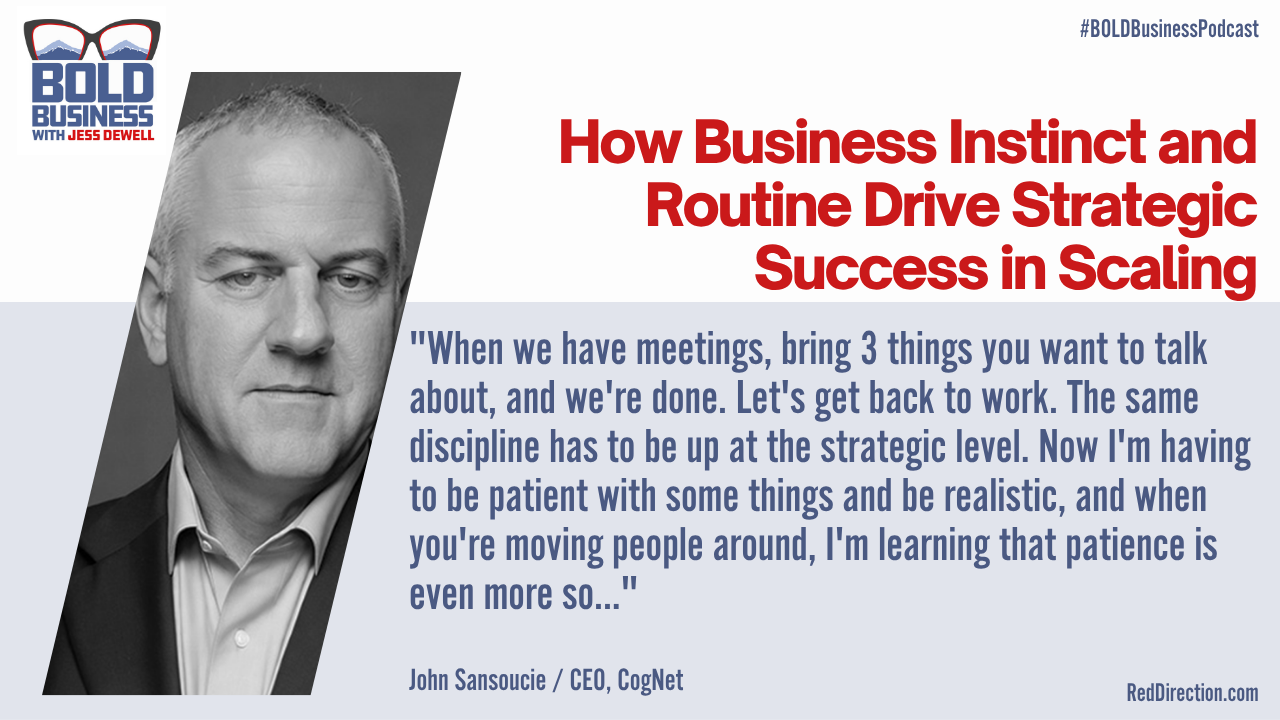
Yeah. It’s my daily walk. I walk around the lake for an hour with no phone, no interference. And that’s my thought process usually is what are we doing? What’s the message? Where are we going? And I think for the leadership side, all like all three of us are always on the same page. Period. So when somebody asks us in our organization, what about the AI? Here’s where we’re going. Here’s what we do. Here’s what let’s talk about it. I think companies lose sight of that. And I joke about it. It’s three things. What have meetings? Bring three things you want to talk about and we’re done. Let’s get back to work. The same discipline has to be up at the strategic level. Where are we and what are we doing and where are we going? And they know, I’ve learned this recently. I’m Mr. Yesterday. That’s what they all call me behind my back because I want it like now. I put it in CRM and internally, I’m like, when’s it going to be done? Next week? Can it be done before I get to India? And then they just laugh at me. But it keeps things moving at the same time. Now I’m having to be patient. with some things. To be realistic, that’s probably just, and when you’re moving people around, I’m learning that patience is even more like I’ve got to let them settle into their new role and help them and say, I said this to four or five people while I was there, is anyone getting in your way, call me, I’ll make sure it’s not. And they just back up on me like, what? I’m like, yeah, if there’s an obstacle to where you want to get, you let me know. People are usually uncomfortable with that, but I think there’s a way to keep things moving because where I’m at now is that, can we, this is a strategic question, that any of Any person running a business today should say, can I stay right where I am with the number of employees and grow revenue by using AI or technology? Yeah. That’s our goal in ’27. I don’t want to hire one person, but I do want to grow the company.
Jess Dewell 24:22
I have had that conversation with every single one of my clients in the last quarter, either at the end of the second quarter or here into the third quarter as we’re recording this. And everybody has a growth goal. And they also have their extra goal. have their expected goal, but then they have the one they really want to have. And so, yeah, exactly. Their BHAG, that’s exactly right. Cheers to Jim Collin. And so I’ll turn it into a percentage for this because the questions have always varied, but it comes down to how do we grow by X percent with what we have today? And I think it’s an important question.
John Sansoucie 25:00
Well, I’ll tell you, people would say, hey, you’re in the service business. People are like running payroll you can’t measure that oh you bet i can and we have a proprietary system where we measure everything and we use an employee monitor system that watches what they’re doing and we make sure they met so what i was told i can’t measure managers john oh but we can we do every day here’s the trick here’s the data and i always knew the data so you got somebody that’s worked here for two years he’s only 40 productive something’s wrong are you coaching what are you doing and oh you can’t possibly manage numerically in the business we’re in? Oh, you bet we can. Now, the tough part is teaching the manager how to take that data to a human level and manage human beings with it without it being cold.
Jess Dewell 25:46
Fair.
John Sansoucie 25:46
Does that matter? Yes. We’re a large family. We’re like an Indian family. We’ve got 600 people in our family. How do we keep it to where that’s warm and doing the right thing for the company? But at the same time, what I see is our productivity could be a lot better, which means I could not hire and I could grow at the same time. There’s a breaking point of that. You have to be realistic.
Jess Dewell 26:06
And this is, I think, a new opportunity with all of my and the new technology and the speed of change is there is something to be said for slowing down and spending effort and energy into the way we think in every single role. Because that is actually what’s going to change to allow that growth to happen that we were just talking about. Growing without adding people.
John Sansoucie 26:32
Yeah, I agree. It depends on what you’re doing. So let’s look at the finance and accounting space. I don’t speak for clerks because I, that was my job for them. It is in our core business, but we do it. I was doing an AR call before I got on the other client. Okay, great. What I know in five years, those jobs are gone. Because what I know the big boys are like Town of Consulting and India is doing right now. There are already an AR, AAP and all that. You don’t need those clerks anymore. What you do need is a person like me to kind of look at trend statements and go, okay, that’s wrong. That’s wrong. Check this out. Tell me this. Tell me that. Thanks. So the knowledge worker is going to survive in that. It’s true in all parts of our business, but what I see is AI is good at some of it. Like accounts payable, AI is built for perfect. Running payroll, not so much because there’s too many moving parts in that. What we’re trying to learn is where does it work well and where does it not work well? These big companies are getting no eye on their AI. They’re just puzzled. The question is, what did you attack the harvest problem with or did you cherry pick?
Jess Dewell 27:28
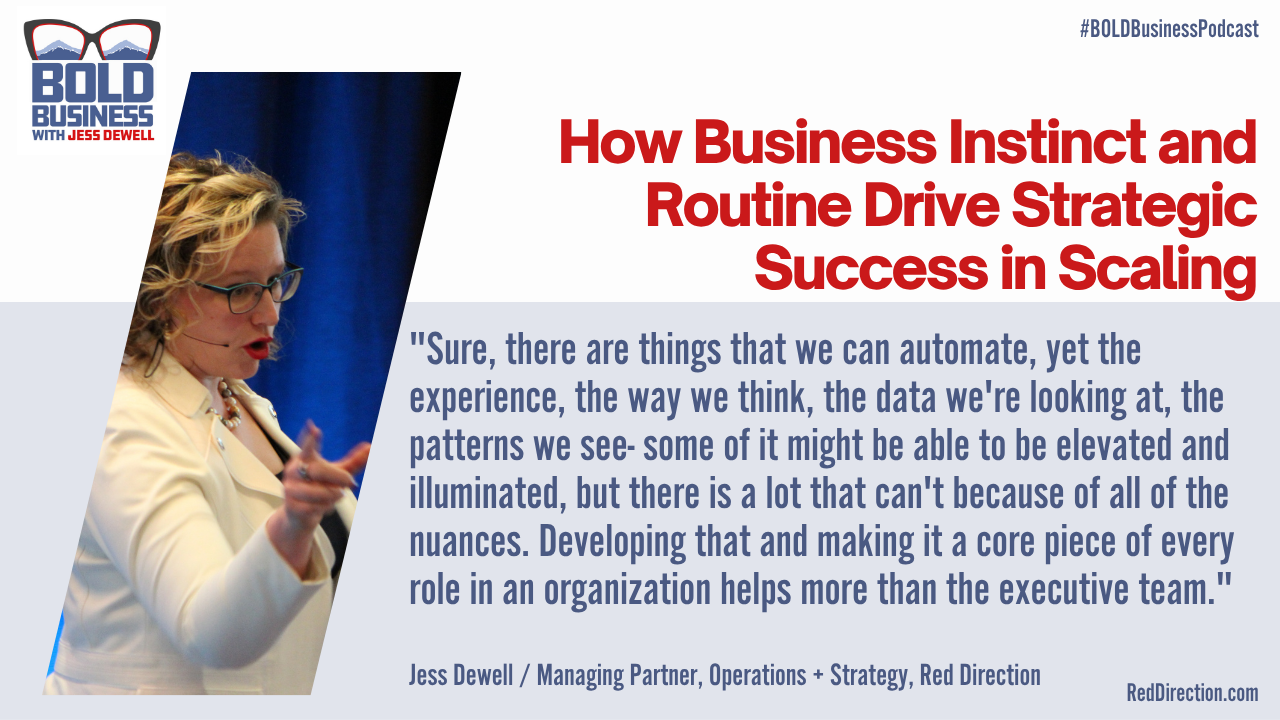
It makes me think of something that I call business instinct. That’s what you’re talking about. You’re talking about, sure, there’s things that we can automate, yet the experience, the way we think, the data we’re looking at, the patterns we see, some of it might be able to be elevated and illuminated, but there is a lot that can’t because of all of the nuances of the, using your word, the knowledge worker. And so being able to develop that and have that become a core piece of every single role in an organization actually helps more than the executive team.
John Sansoucie 28:01
Yep. I’ll give you a fantastic example because within our own company, we do benefit reconciliations for people. It’s highly demplized. Healthcare sends you an ugly PDF invoice. You got a payroll system and you know what people have. You need to compare that data and go, is the bill right? Oh, look, that person got divorced and they changed their coverage and we didn’t. We missed it. Let’s fix it and get our money back. That was tedious work. We have developed an AI tool that does all the comparative. It automatically takes the invoice, goes and gets the data. Boom. There you go. Done in 20 seconds. We’ll use the same week. However, I still need the skill I need for my people today. I don’t need as many of them because it’s automated the first half of the job. Okay. Here are your three differences and they don’t make sense to AI. I need the knowledge worker who goes, oh, I’ve seen this before. If I go look here and here, I’ve got this problem solved. Yeah. Or it’s a head scratcher and a human person, him, a being needs to do it. This is where one of my biggest goals, and America’s getting worse at it too, by the way, cognitive, like real actual critical skills, critical reasoning and thinking. Our education system is a little better than maybe some others, but not great at any. So that’s where we are. Are we trying to solve that problem of, hey, you got stuck. How did you think your way through that and get out of that paper bag? That’s a skill we’re really trying to own for us for the competitive advantage.
Jess Dewell 29:17
So knowing you don’t like the operational weed thing, do you?
John Sansoucie 29:21
I’ve been in it and I detest it. And that’s why I have a bunch of smart people working for me.
Jess Dewell 29:26
So are there times that the operational weeds that are necessary to make the business go are at odds with where you’re going or the things that you’re trying to move or the speed with which things happen? And what do you do about it internally? How do you, the three of you, how do you work through that?
John Sansoucie 29:44
We’re kind of lucky in a strange way. We use our clients’ technology. We don’t sell technology to them. It is what it is. Either they had great tech or terrible tech or no process documentation. We’ll do that for you, I think. The cadence is you still, the world needs dish diggers, as they say. We’ve got to still get things done. But the shift here is, hey, there’s some easy tools that we can get half of this done with. Or I see people give up. John, this is Lincoln Assault, 10% of the whole problem. Okay, great. Now you’re only doing 90%. Explain to me why that’s a bad thing. It isn’t. The Pareto principle comes into effect, I think, in most of it, which inverse portion of the 80-20 wheel you are on. Any improvement incrementally, I like to cook. And the chefs are one of my guilty pleasures, like to watch the shows. The sign of one of the kitchens is every second counts. And I’m trying to get organizationally for us to think the same way. John, let’s only save 10 minutes a day. Okay, great. Do that every day. That’s right. And it hits the bottom line, guys. It’s not a fictitious measurement.
Announcer 30:48
If your week feels like you’re being pulled from one demand to the next, this is for you. The Daily Grind is the number one killer of business instinct, pulling you and your team away from your vision. Reclaim your strategic edge with the Present Retreat. This free guide from Red Direction is a simple, powerful framework to carve out the space you need to filter out the noise, make the right decisions, and lead with clarity. visit presentretreat.com.
Jess Dewell 31:17
How much of your work is the actual doing and the productivity that you’re doing in your role these days versus the more abstract necessary? It takes time and it still has the same amount of impact.
John Sansoucie 31:28
I’m trying to turn it into the other. You’ll make fun of me. I can be the prophet of AI. I don’t use it much. And I did this.
Jess Dewell 31:36
Oh, nice.
John Sansoucie 31:37
Wow, this is freaking great. And we have like internally, what we hire, we let chant, right? Our toast for jobs. Yeah. The job description and all that stuff. And at HR, we used to pay people a lot of money to sit around right there. Criff. Yeah.
Jess Dewell 31:49
No more.
John Sansoucie 31:50
I have no intention to get knee deep in a, personally, I understand what we’re building and I understand how it works because I’ve had a technology background as well and worked in software company. So I always want to know how it works and why it works. Penn, what you said earlier hit me, by the way. I would tell everyone, don’t go into coding because it will not exist in five years. Codex and these companies will just crush that out. But what good product managers do at software companies is what do I want it to do? And will human beings interact with it well or poorly? I think we’re no different. What can we trim off of transactional work to where we can put good critical thinking and get in front of our clients and say, how can we help?
Jess Dewell 32:28
Yeah. What’s a skill you’re actively working on as CEO today for the role that you’re stepping into now?
John Sansoucie 32:34
What I spend more time doing now is with my people. I used to not go to India as much, but now I see the need for that. The soft skills matter a lot. And as you have younger employees, we’re all finding out that they are required really.
Jess Dewell 32:46
Yeah.
John Sansoucie 32:47
Yeah, it’s the same as the U S on that. The young ones want a promotion tomorrow for showing up. Mom and dad gave them participation trophies. Fantastic. I’m a little older, so I’m like, no, you have to go earn it. So there is a divide there where leaders have got to figure out, okay, I do have to placate some of this because I do need them. They’re sharp. They’re great. They’re altruistic. Are they going to be working on a 14 hour shift today? Maybe not. So it’s, I don’t know how all leaders will deal with this. I have told my people, I got here because I work 100 hours a week and work on Saturday and Sunday. That’s how I got in my seat. If you want my job, do that.
Jess Dewell 33:21
When did you stop working 100 hours a week?
John Sansoucie 33:23
Probably about five years ago as we grew.
Jess Dewell 33:25
Yeah.
John Sansoucie 33:26
And how many years? I put people around me to do it.
Jess Dewell 33:28
So five years ago, so from zero to five years ago is how many years?
John Sansoucie 33:33
A lot.
Jess Dewell 33:33
Yeah. Okay. We’ll go with a lot. So majority of your career, you worked really hard and then you shifted.
John Sansoucie 33:39
Absolutely. You know, I only wanted to get my first CFO job because I had people to do the segmented work.
Jess Dewell 33:45
Yeah.
John Sansoucie 33:45
And I took jobs in places that were raising money, doing deals. So then I have a finance background.
Jess Dewell 33:50
Oh, hi. That’s a lot. I would say that’s a high demand. That’s your head, your heart, your gut, and your time.
John Sansoucie 33:56
Yes.
Jess Dewell 33:56
Everything. Yeah.
John Sansoucie 33:58
Did you ever burn out? Oh, absolutely. Now I manage my days a lot better. I will tell people like I am going to literally be traveling for the next eight weeks. And I went to India and came back. take care of yourself because that’s exhausting is more than you want it to be with me i spend more time on my health and just having some clarity i take an hour and i don’t work i walk around my wife’s like what are you doing in the yard you’re supposed to be working i’m like i need to clear that one out for a little bit i don’t please because it is part of your your own well-being is going to make you more effective and i think i saw myself to almost having a heart attack sitting at my desk like okay i’m not affected anymore but just the sitting here more hours and being more active and maybe yelling at a couple of people, that doesn’t really get you everything that you do.
Jess Dewell 34:42
So you said you’re going to be on the road for eight weeks, but you can’t take your lake walk with you. What do you do when you’re on the road?
John Sansoucie 34:48
Treadmill.
Jess Dewell 34:48
Okay. Still nothing? No headset? No, no.
John Sansoucie 34:54
I’m only a Marriott guy, so I have Netflix at least. We try to do walking out. That doesn’t go as well. You’ve got to keep your routines. Our company has a routine, and I always look at our executives, keep it rotating. Keep the same meetings, keep the same cadence, touch people that you touch once a week or daily. But we’re saying with our clients, we set them up on a cadence that the routine is a precursor to success in many ways.
Jess Dewell 35:19
I love that. So you mentioned Jim Collins, you’ve mentioned the Pareto Principle. I kind of want to know what you’re… I usually don’t ask anything about this, but I’m just thinking we probably share some of the same love of some other books and resources, and maybe there’s going to be a new one I need to add. So what are some of your go-tos that you’re with?
John Sansoucie 35:37
This is where I’m going to disappoint you here. I hate these books. I was a favorite for Jim Knowles last year. It was a special one. I love Blink and those books. I’m trying to think of the author. I used to read them. I actually read, we’ll go back to the sanity thing. I like to read history and nonfiction. And it keeps me kind of, I’m in business all day. You don’t ever give me a book about that. Well, you know what I love?
Jess Dewell 36:00
I love business books because I see a lot of things and other people are seeing the same things and they’ve usually seen more than me or they allude to something that allows me to go, oh, that was a pattern they alluded to. My business instinct for today, actually, that matters. So you have this baseline and you have what they were seeing on a periphery or outlier scenario. And then I’m seeing it in the conversations today. And it makes me really excited because then I have this baseline of this work has already been done and they actually mentioned this. It’s not like that today. The concepts, though, how could we use those for a solution? So that’s what I do to bring it.
John Sansoucie 36:42
I told some of my people read Blink because they got their guys and they’re analytical people and they go, this is what we should do. And then they talk themselves out of it. I want my folks to spare. You’re going to learn by failing, guys. I’m okay if you fail, as long as you’re trying to advance yourself or the company. It’s the greatest teacher of all things. I just had lunch with a guy who gave me two books to read and one was himy. So it actually leads to our conversation as well. It’s about two CEOs. One is somebody who seeks, look at me. I need accolades. I need this. And that kind of person is always looking for that validation. The other one is the quiet who leads by example. And you want your employees to, this is your idea. They’ll go with it. Support them. They compared those two companies and their financial success and their performance. And they’re ready to guess which one won. The leader that leads by example. And I said, great. Glad I was a point guard and a quarterback because that’s what I feel like I am today. And that I don’t need to score the points. It doesn’t matter to me, but we want to win the game. I really am more assistant points. Then what I’m learning leadership wise is you got to do that. You got to get people motivated. They got to believe. I’ll joke. My wife wants me to believe it’s my idea, even though it isn’t. It’s no different managing down at an organization. I support you. That’s a great idea. Go with it. I planted it and I got the heck out of the way and saw what happened.
Jess Dewell 38:00
By the way, that goes back to your comments of more connection, a cadence of connection, helping people remove their obstacles as they need. So by even thinking about that and stepping into that or leaning into what you already have and going, oh, what a cool book. And really, I got to start well and I’ve got to start. What else can I do to make sure as people change over time, as our companies change over time, as the way we measure productivity is going to remain incredibly important, yet change over time. Right. All of those things. Okay.
John Sansoucie 38:36
I even got more scared on this one. One of my people I’m bringing up to be a pretty high level guy. He wrote a book. He went, he got an MBA, wrote a book since the last time I was an Indian. When do you have time? I’m obviously not working you enough. I need you.
Jess Dewell 38:50
I was just thinking, wow, that person’s working a hundred hours a week on where the thing.
John Sansoucie 38:55
He just didn’t sleep. Yeah.
Jess Dewell 38:57
I know people like that too.
John Sansoucie 38:59
I will tell you, I love this. It’s due to one of my executives, Sam Papad. He’s fantastic. He reads a lot. And then he goes out on the floor and says, hey, have you read this book? There’s a couple of parts of this that I think really have validity here in our company. He’s the prophet of some of this stuff. He gives it to me and I’ve been working, what, 36 years? and I go, yeah, whatever, I don’t have time to read that. But I hear you. Give me some little pieces of it. I think you get nuggets out of that information. At the same time, we’re pretty heavy on culture. We have a cricket team. We have, we, it’s been the hardest thing. As I’ve always said, we’re communations. This is our family. This is not just a business. We’re family. Sometimes people go in and out of family. So don’t forget that it is a business, but keeping that seal has been important. It’s getting harder to do, obviously. Our party, we just went 600 people at a party. dancing. I’m running out of hotels that are big enough at this point, but they, we listened to our employees and they said, we just really want to dance for three hours and do all our Bollywood stuff. Okay. And then that’s what we’ll do. We’ll give out five awards and let’s dance. When you give people what they, when they hear, when they feel heard, it matters. And what I think executives need to understand is you need to do more of that. Walk out and sit in a cube and listen a little bit. But that I learned from a mentor of mine, imagine if by walking around, I believe is one of the most powerful tools you have and I practice it does.
Jess Dewell 40:22
I ‘m trying to think there’s a book I’m listening to you and I’m thinking about our conversation and a book that comes up for me is called that I go to on actually a regular basis is called Essentialism because it comes down to have I thought about it enough and I am I saying it clear enough that my intention in the words I’m using are actually received and understood from mind and hearing you say that over and over again And that’s actually the nugget of the book, right? It’s really good. And it talks about it from contracts. It talks about it from responsibilities. It talks about it from all of the things. I think that’s really cool. That popped into my head in our conversation. Now, I want to know, we know where you started as CEO. We know where you are today. What do you need to, who do you need to become three years from now for where Cognit is going then?
John Sansoucie 41:13
Yes. It’s something I outsourced as well. And you know this because you talked to my outsource marketing company. Yep. That one is, hey, I am an expert, but people need to understand that I am. So panels, articles, podcasts, they all have residual on there. Of course, they’re great to wear out on LinkedIn. But what I’ve learned about my clients is they don’t know, even my existing clients, they, oh, you guys do that? Yeah. And you didn’t know that. Why? Obviously, I failed beating the seven things we do in every client’s head. I’ve hired some people to go do that now. And we’re going to continue to do that. I know I could grow revenue with just what I had. And we just miss those opportunities. But where it pertains to me is I need to do that more and be, I went to Key West for 4th July. I had three of my clients and one of them was hosting the party. I’m sitting there going, I don’t ever do this. I have learned more drinking with these guys about their company than I ever will sitting at my desk. So growing up, my dad was a small town commercial banker. They don’t come walk into the bank. You got to go leave the bank and find them. then that’s where my role needs to be as well. And set it on boards of some of the organizations we’re involved in. The CEO’s job is to be the communicator of what’s the company’s goal. What do you do? What are we good at? What are we bad at?
Jess Dewell 42:28
What makes it bold, John? What makes it bold to be able to stay true to your company’s growth strategy that you actually have to uncomfortably acknowledge that it’s going to change and maybe quickly?
John Sansoucie 42:39
I learned that in the last spurt because we probably doubled again. And we’re going to, we spent the last couple of years on the 5,000 list too, which was great accolade, but what did it do to your company? And that was where we had to kind of, I had to do the reins back on myself and say, I’m not selling anything for a little while. Let’s let the company catch up. Let’s put all these systems and people on. We didn’t have a VP of HR, but we didn’t go. There were holes that had to be filled. That was hard to do because I could have stepped on the gas and been at double where I am today. And that’s not a bad thing for me personally. It was terrible for the organization. So I think people have to look at that. Like, when can I grow? Am I ready? This last trip put it in my hand.
Announcer 43:26
And that brings us to the close of another powerful and fresh perspective on the Bold Business Podcast. In today’s volatile landscape, growth is a double-edged sword. To truly thrive, you must engage with your strategy, not just react to the day-to-day. Without absolute alignment, your company faces a stark choice. Outmaneuver or be outmaneuvered. Grow or get left behind. Thank you for listening. And a special thanks to the Scott Treatment for Technical Production.