




AS A BUSINESS OWNER, IT’S DIFFICULT TO DO THE RIGHT WORK AND GUIDE YOUR COMPANY TOWARDS ITS NEXT BIG INITIATIVE.
From Fragmented Focus & Reactive Resilience ➔ Unified Intent & High-Performance Rapport
With Red Direction Business Base Camp Consultation, learn how to implement and handle processes to meet your business’s specific needs and better understand your market.
Starting the conversation:
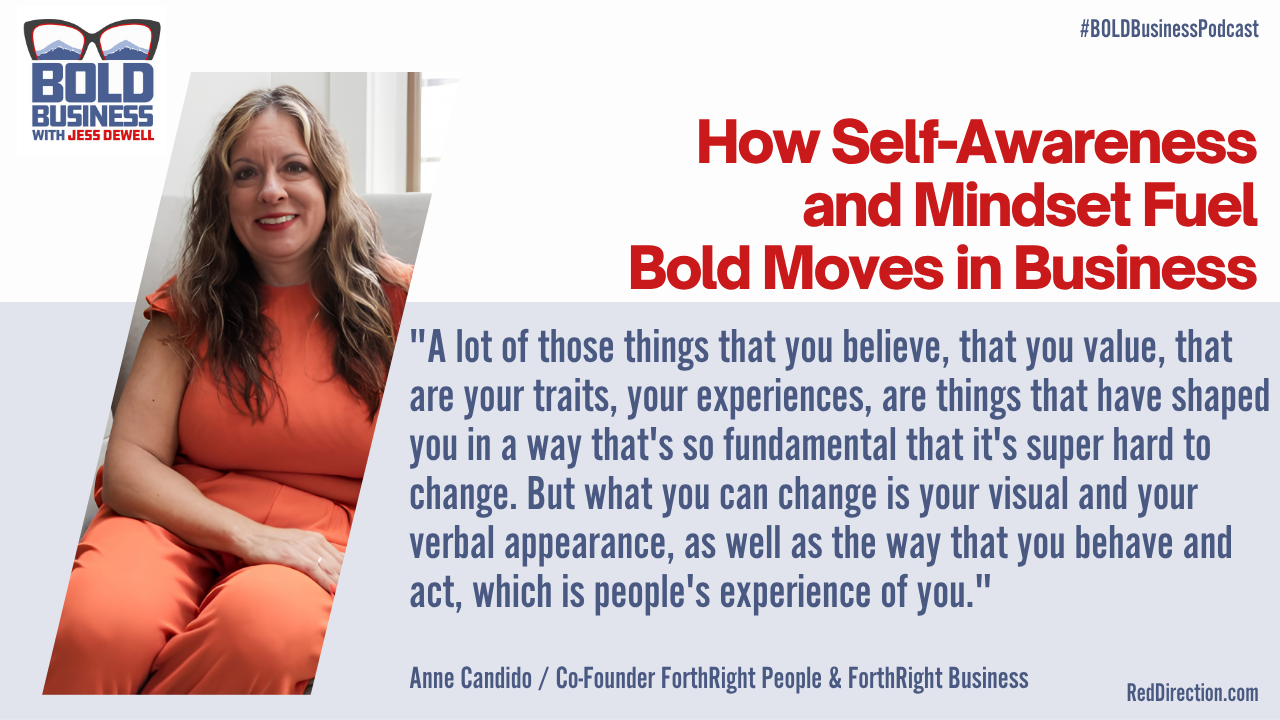
Intentionally investing in your own and your team’s personal brand is the single most powerful advantage to scale your company — especially during the high pressure and rapid change you face today. Anne Candido and April Martini, Co-Founders at ForthRight People, share how self-awareness fuels BOLD moves in business.
Achieving big ambitions requires being bold, vulnerable, and taking responsibility for shaping perceptions and building supportive relationships. It’s more important than ever for leaders and managers, like you, to show up authentically and harness your unique strengths. It is from this place that you begin to be intentional and to cultivate the experience others have of you — specifically, the way you want to be known.
In this episode you will hear that many times trust issues stem from an experience gap in company values that block achievement (what is the value, how you show up demonstrating that value, how do others demonstrate that value, in addition to the company definition); that now is the time to slow down and build the foundation so that the right behaviors speed everything up,;and that the first step is to get started by saying out loud what is happening and lead from your personal brand.
Jess Dewell talks with the Co-Founders of ForthRight People, Anne Candido and April Martini, about how BOLD action comes from aligning behaviors with your truest self, even as circumstances shift.
Host: Jess Dewell
Guest: Ann Candido and April Martini
What You Will Hear:
02:45 Today puts pressure on you to stand out, and the importance of authenticity in personal branding amidst competition and change.
- There is a strong desire for individuals to differentiate themselves and add value.
- Many approach differentiation by adopting external personas, believing it will lead to popularity.
- The key to successful personal branding is embracing and expressing one’s authentic self.
10:35 A key theme that emerged was self-awareness and situational awareness as fundamental for adapting how to show up and be perceived.
- People must be aware of their own state and the context in which they operate.
- Core beliefs and traits rarely change, but behaviors and appearance can be intentionally managed.
- Others’ experiences of you are shaped by how you choose to visually and verbally present yourself.
17:00 The discussion explored the disconnect between organizational values and individual interpretations, pointing out the need for clear communication to align expectations.
- Different definitions of core values like integrity create misalignment within organizations.
- Misunderstandings arise when leadership, management, and employees assign varied meanings to the same value.
- Clear definitions and ongoing dialogue help close the gap between stated values and actual experiences.
25:55 One concept discussed was the discipline to slow down and intentionally invest in building individual and team foundations for faster, more effective future results.
- Teams experience increased speed and productivity after investing time in foundational work.
- Minor, intentional time investments can lead to substantial organizational improvements.
- Those not ready to commit intentionally should return once prepared to focus.
27:40 Several points were raised, including how to manage organizational demands and set boundaries to address burnout and shifting priorities.
- Organizations expect individuals to set limits, boundaries, expectations, and priorities.
- Managers and leaders must have conversations to clarify and adjust priorities and resource requirements.
- Team and self-management depend on honest dialogue and continual retraining on organizational behaviors.
35:15 A key theme that emerged was the importance of taking the first step, however small, to improve mindset and kick-start transformation for leaders and teams.
- Leaders can begin with simple exercises to start positive change.
- The first step should be acknowledging when the current state isn’t ideal and moving quickly toward improvement.
- Shifting mindset and morale starts with incremental action and pattern recognition of small wins.
44:55 The discussion explored how overextending empathy and trying to fix others can be counterproductive, highlighting the importance of boundaries in emotional investment.
- Over-empathetic reactions drain energy and reduce effectiveness.
- Recognizing physical and emotional cues helps prevent emotional over-engagement.
- Visualizing emotional separation aids in maintaining boundaries while supporting others.
46:55 It is BOLD to prioritize and actively embody your personal brand despite challenges, creating empowered authenticity and inspiring transformation.
Resources
- Connect with Anne Candido and April Martini
- Book: The Power of Your Personal Brand: A playbook for struggling middle managers who want to do big things
- Role AI Should Play in Strategic Planning
Transcript
April Martini 00:00
A piece of feedback that I was given by my coach last year was, April, you need to start being a human being, not a human doing.
Ann Candido 00:06
We like to blame the team before we look back on ourselves like, well, what did I do here to create this mess? I probably did something in 99.9%. Yes.
Announcer 00:21
Every leader needs a trusted partner for the moments that matter. This Bold Business Podcast conversation is that partnership. Here is your host, Jess Dewell, an insightful truth teller who serves as the catalyst for getting the right work done and who asks the questions that truly matter.
Jess Dewell 00:41
Intentionally activated personal brands are a competitive advantage at the individual level, at the team level, and at the company level. April Martini and Ann Candido, co-founders of Forthright People and authors of Power of Your Personal Brand are here to share depth around that. They challenge the idea that personal brand is something you manufacture and they actually talk and live. How do you uncover what’s under the covers that you can uncover that’s already there and use it to guide your decisions, shape your presence, and accelerate your growth. And this conversation is going to be in three parts. So listen for these things. Number one, trust issues stem from an experience gap in company values. So take your value, insert it right here, and then define it. And then think about how you demonstrate that value. And then think about how others in your company demonstrate that value. And then think about what your company definition of that value is. There’s a gap and you can learn from it. Number two, slow down. Because the more that we slow down and build the foundation, even to say, these are the things we’re not going to do, is what is necessary so that the right behaviors can be found and practice, which speed decision making and opportunity evaluation up, which means achievement and value creation is also sped up. And the third thing, just get started. Say out loud what is happening, define the place where you are at, and then decide where you want to be. And everybody shows up and builds this together because leading ourselves from our personal brand is how we create tight, interwoven, high-functioning teams. I’m really excited for you to hear all that April and Ann share with me today. More than ever before, we have to be thinking about our own personal brand and the way that we are showing up. And I’m curious what you find in today’s high disruption, high change, super high pressure world. What makes that true?
Ann Candido 02:46
Yeah, I’ll start. It is a high pressure world. There is a lot of competition out there. It feels even though the world has gotten bigger, it feels like to some extent it’s gotten smaller. And so there’s a lot of desire to want to stand out, to want to differentiate, to want to be able to bring value. And so a lot of people will go out and do that from an external standpoint. We call it donning a persona where they’re like, oh, if I, if I want to be charismatic and I’m going to be funny and I’m going to don all of these things that I think are going to make me extremely popular. And then they go out and do it. And then nine times out of 10, it falls flat and it falls flat because it’s not coming from an authentic place. Right. And so what me and April talk about from the context of personal branding is that it’s really important that it’s coming from the inside out because your insides where your competitive advantage really is held. And so when you can harness that, when you can really take that and bring that forth into your appearance and behaviors and actions, you can show up in a way that is very differentiated because you’re the only you there, right? You’re the only you that exists. And so if you really want to be able to differentiate, if you really want to bring value in this world as very competitive, that feels like there’s tons of people vying for the same thing, the whole goal is to be yourself. And it sounds very cliche, but it is so very true.
April Martini 04:05
Yeah. And I’ll just add there that when we do this work with people, We always say it’s not super easy to do the work, but once you do it, you have an objective toolkit by which to show up in the world. And that’s one of those places where people are like, you can see I’m kind of processing a toolkit. What do you mean? And we always say, yes, because you are very well aware, and I’m sure we’ll get into the process that we follow, but of your characteristics, which means, you know, all of the different things that you can flex up and down in order to interact with other people. To build consistency and authenticity in the way that they experience you. And we believe that you are responsible for that, for yes, how they take you, but also for yourself and the way you show up because you need other people to achieve what we call the big things in life.
Jess Dewell 04:51
So this is something that I’ve been sensing and I’m curious what your take on it. And it’s coming from a variety of what you both just shared in April. And it’s about the world getting smaller again. I’m noticing that in my career, we went from very close, who could you call, who could drive, where could you drive or walk or bike to have goods and services. And maybe you went a little bit further if people had a bigger radius or you needed a specialist, but it started out, if you didn’t have that good, strong local network, it was stuck. And then we got to this place where we can get any kind of skill, strength, addition for any kind of project position need that we have across the globe. And what I’m noticing is that as the world of technology is changing, we saw a rise in who could get the most followers and then who was what whatever information was that. And there was a downward price pressure and there’s a change of the way that the business models work. And then it was how long can I keep those eyeballs of those followers that I have? And there’s a different kind of downward pressure because there’s a lot more noise there. And I actually wonder to that point, and I’m noticing and I’m hearing teenagers talk today, college students talk today about I’m tipping my friends for the work that they gave me. They gave me a hint to find a great pair of jeans or to read this book to help me do this study or to hem my pants right all the way backwards so I’m curious if you’re noticing some of that same trend or if I’m just making it up because you’re the first people I’ve talked to that have said anything Like this and so why not start right there
Ann Candido 06:39
No I love it let’s start first of all with what a personal brand really is because I think it’s really important to have a common language because as I said initially a lot of people think personal brand is like the things that you can wear or the the way that you act in order to build some sort of influence. And that is a key, a personal brand, but personal brand really at its core is people’s experience of you, right? So that is what you’re cultivating. That’s what you are trying to bring to the forefront. And that’s what drives the connection. So to your point, just when you have value to add, maybe it’s an intellectual, I would call it intellectual property. It’s a big fancy word for, I have knowledge that maybe you don’t have, or I have like experience that you don’t have. Right. And that could be from a teenager all the way up to an adult. What people are really craving is someone in that case to teach them. And that’s part of being a thought leader. And that’s part of actually integrating that with your personal brand to say, Hey, when you guys need that expertise, when you guys need, like for me and April’s case, it’s when you want to know how to develop your personal brand, we want you to think of us. It’s that attribution. And that becomes really important. If you want to stand for something, if you want to bring value to people, it doesn’t matter if you’re trying to get people to believe that you have the best taste in clothing, or you’re trying to get people to believe that you are the best, like for me, strategic action planner that exists, right? You’re trying to cultivate that attribution back to yourself. And in so doing, you’re developing that experience of you that reinforces that.
April Martini 08:09
Yeah. And I would say too, to the point of things getting smaller, and you touched on it a little bit, Jess, with things coming back to word of mouth. But it’s word of mouth in a different way. And so when I think about what you said about Connects and how much time do I have their attention and all of that, over the course of the past, call it five or six months, I have been dedicating my time and energy to developing the experience of me, as Ann said, my personal brand, really authentically on LinkedIn. And what has started to happen is, yes, not only am I making a lot of connections, but coming back to the personal piece, it’s people reaching out to me to want to take the conversation off the platform. And if they’re local, meet in person. And if they’re not, then meet virtually over Zoom. And what’s happening there then is I’m starting to build a different word of mouth referral engine that’s much broader than my existing network before I did all of this work. But I do feel like it’s making the world smaller again, right? Because think about when I remember this between my sister and me, when LinkedIn became a thing, we competed to see who could get 500 connects the fastest. Did any of those people reach out then? No, they just clicked accept, right? Now, when I do this 150 connects a week, inevitably, I get a handful of people. Yes, some are sales pitches, which I quickly delete. But the other ones are ones of, hey, I looked at you and your profile. And oh, the book always helps. You just wrote a book or I can tell you’re actually writing your posts. And that means something to me. Let’s connect on the human level and see what we can do to help each other out. And some of those have now developed into relationships where I’ve met with folks three and four times. They’re referring me to other people and it’s starting to head into the space of, oh, hey, we need a coach on X project. Would you be interested in joining our team on this work? So when we think about the world getting smaller, I think it is more of that human to human interaction that’s evolved because of digital platforms, but that people are still craving.
Jess Dewell 10:08
That’s interesting. And I’m sticking with this thing that I was sharing and I’m what you both are saying. And even though I think it truly is emerging in our next generations coming up, I think that those of us that aren’t teenagers anymore, whether maturity level wise, we are not, we still have the opportunity to take our experience and show up in a different way today than ever before. I’ll tell you what I’m doing today is way different than I did 20 years ago. The internet was still around then.
Ann Candido 10:38
A thousand percent. It’s just your context has changed, right? Your situation has changed. And so there’s about self-awareness of how am I in this situation, but it’s also situational awareness of who are the players? Where am I now playing? What kind of environment am I in? What kind of industry am I in? What is my goal? What is my big thing? So that context starts to then change the way that you show up, but the core of who you are really changes. A lot of those things that you believe, that you value, that your traits, your experiences are things that have shaped you in a way that’s so fundamental that it’s super hard to change. But what you can change is how your appearance is, your visual and your verbal appearance, as well as the way that you behave and act, which is the people’s experience of you. So it’s important that you’re mindful of what your context is because that really shapes and defines how you want to show up, how you want to be perceived in order to achieve your big things.
April Martini 11:39
Yeah, and I think a lot of that comes from the experience, like Ann said, and also the maturity and the ability to read people and anticipate what’s going to happen within any given experience that you’re having, right? So when you say what you did then has fundamentally changed for any of us that are high achievers in life that want to continue to grow and are curious and want to further develop ourselves, of course, beyond the teenage years, like you said, I hope, but forever, right? This is one of the reasons that I hate when people are like, where do you see yourself in 10 years? I’ve hated that question forever because I don’t think any of us can predict that. But I think the really fun thing is that those of us that are grounded in our personal brand but still want to evolve beyond that, really do work hard and intentionally to figure out what’s next for us and to go after that thing. And it’s not just about achievement, but it’s about life experience and where we might see our careers go or our personal lives. We can’t predict any of that. And I think that’s the part about the journey, but I think being intentional is where you can guide the ship, so to speak, so that you can be achieving big things upon big things along the way.
Jess Dewell 12:50
Okay. I want to put a pin in that because I had five things show up in my brain that we could talk about. And I’m fighting this every single time we have these moments in the conversation and we’re just a few minutes in really. So I want to take a step back and say, okay, we’re, you’re working with leaders, you’re working with managers in this, and this is a really big focus of who you wish to help. So I want to hear from you why you think leaders are losing their focus today and it’s diluting or preventing that actual self authentic self from coming forward in a personal brand.
Ann Candido 13:28
April, why don’t you start with that? April does a lot of our coaching. So
April Martini 13:32
I knew I was going to get the clap for that. Yeah. So when we think really specifically about the book right it’s The Power of Your Personal Brand: A Playbook for Struggling Middle Managers Who Want to Do Big Things and the importance of that specific target if we just start there is number one when Ann and I were coming up through our careers there was nobody helping or giving you a playbook to that transition right? So you’re a really great typically high achieving practitioner of the work you’re responsible for every day. And now all of a sudden you’re promoted and you’re supposed to be managing and leading people. How are you supposed to make that leap without anybody helping you in that transition explaining what the difference is even just helping you understand that it’s not just about you as an individual anymore right? So that really pivotal time in anyone’s career is what I would say is the first kind of quote unquote pain point when we think about building leaders right? And then beyond that the structure by with by which or the framework by which we help people identify their personal brand is applicable no matter your age or level of experience. And so you can come back to that time and again. There’s another transition from manager to leader, right? I’m managing someone’s schedule and what they do in a day versus now they’re leading at this higher strategic level. And I think one of the reasons that we see people lose sight of that or, and I wouldn’t even say that they lose the ability. I think they maybe never develop it is because it does take intentional work to get there. And there are so many day-to-day distractions. So before we got on this call, I was talking about a session that I ran today. And what was said in that meeting was just finding the time to carve out for us to have this single session, let alone lead teams on a day-to-day basis with all the distractions is a huge undertaking. And you said before about how something around technology changing or the way I go with it is how many messages are we hit with? How many channels do those messages come from? How much of that is even outside of just our day-to-day job? And so when we think about these leaders, it’s really about coming back to the intention to be able to take a minute, think about who you are. And then again, like Ann said, the experience you want people to have of you. And like I said before, being intentional that you’re showing up in a way that they know how to receive and what to expect from you time and again.
Announcer 16:02
Feeling stuck? Like, what got you here won’t get you there. The pressure to grow is on, yet the path isn’t clear. Yet. You don’t have to walk that path alone. This is the Bold Business podcast. Like and subscribe wherever you listen. Your host, Jess Dewell, is the strategic partner you’ve been looking for, asking the questions that truly matter. It’s time to break the inertia and get the perspective you need to make your next move.
Jess Dewell 16:37
You’re listening to the Bold Business Podcast. I’m your host, Jess Dewell. Today, you are listening to my conversation with April Martini and Ann Candido, the authors of The Power of Your Personal Brand. What kind of information or place would you start when that type of gap exists?
Ann Candido 16:56
Yeah, I think this is a really common one, Jess. It’s a really good question because when you’re an N of one and you’re pursuing your own personal growth and your own personal performance, that’s one thing. When it becomes an N of many and all of a sudden you’re responsible for multiple people and you’re responsible for a bigger scope of work, then the context that we were talking about, the situational context is different. There’s more people that now are in consideration set for how I am expected to show up and how I’m expected to behave and act. And what we see frequently is what the expectations of the organization aren’t clearly communicated in a way that the people actually internalize and get them. And so I’ll use an example. We see these values on the wall all the time. Integrity. What does integrity really mean? Because it means if we all went around the horn here, I’m sure we’d all have a different definition of what integrity means to us. But we all say integrity, like it’s supposed to be something that everybody gets and understands. So leadership’s definition of integrity, the manager’s definition of integrity, the people’s definition of integrity. If those all mean different things, it’s hard then to align about what does it look like to show up with integrity. So those expectations get missed. So we call it the experience gap. So you have to close that experience gap. And you do that by clearly defining, and this is April’s area, you’re clearly defining what those mean. And how does it mean to show up with integrity and having a continued dialogue about in calibration of what those things mean? Because the other thing that tends to happen, Jess, and this is like where a lot of the breakdowns happen in where April was saying where the struggle really starts to get feel painful is when we bring in our own personal brand into the situation right so if the leadership is saying we want integrity my personal brand says okay integrity means that I’m going to make sure that everybody does exactly what they’re supposed to say and we have no flexibility because if we don’t do exactly what management says then therefore we are not showing up with integrity And then the team sees it as, oh, so we’re not allowed to have an opinion. We’re not allowed to change our minds. We’re not allowed. So you can see how that misunderstanding of that one word could be so detrimental to the organization and why then it starts to fall off.
Jess Dewell 19:19
That’s a really good thing to add to the conversation because of the speed with which we feel like we have to go leading organizations today. This is one of the first things that I think we overlook, right? It’s that worn down piece of the carpet that’s not a hole and so nobody’s tripping yet by the time they’re tripping we now have a really big different kind of problem and it’s not it’s no longer let’s grow together it’s a how do we repair this plane while we’re still flying and make sure that we don’t get any more of these holes along the way kind of thing oh I just mix two things together whatever carpet airplanes okay but you’re both making your head so I’m like cool at least you’re You’re tracking me.
Ann Candido 20:00
This is good. I love metaphors. Yeah, Ann loves them. April tries to put them together and it gets a little disparate too. So she, so we understand we have the same experience.
Jess Dewell 20:10
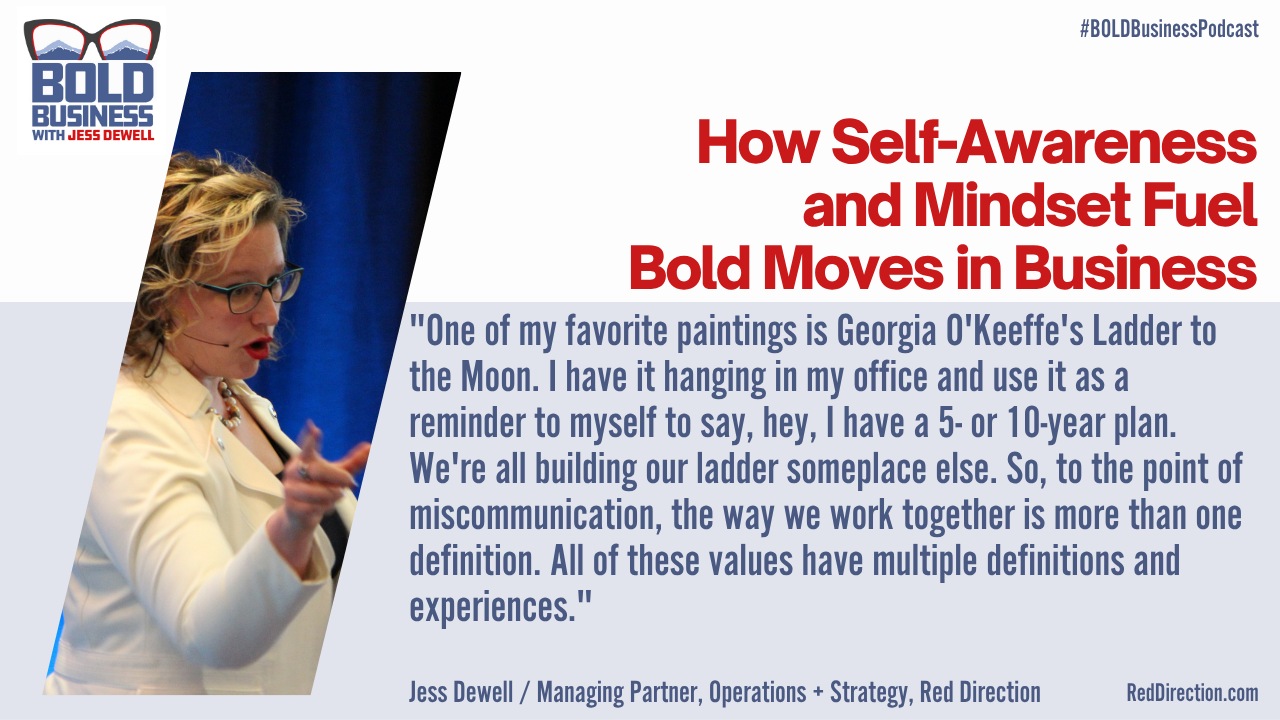
Fair. One of my favorite paintings is by Georgia O’Keeffe and it’s a ladder. And it’s actually the one of the very few things that’s not bones, not flowers. It’s a ladder and it’s called ladder to the moon. So there’s a moon and then there’s a ladder. I actually have it hanging in my office. And I use that as a reminder myself to say, Hey, I have some five or 10 year plan. Hey, my business has some five or 10 year plan. Hey, every single person in my organization has their five and 10 year plan or what they’re working on. And when you put all of those things together, you get this ladder and we can go anywhere. So that’s how I’ve taken something that was very unusual for her that always caught my eye. And then was like, I was like, this explains so much. We’re all building our ladder someplace else. And each one of us is a rung in that. So to the point of the miscommunication that can occur, the way that we work together is more than just one definition. All of these values have multiple definitions and experiences. And I think that’s what I hear you talking about is we have to get ultimately below the words and below the other things because we have, what are we, what did we agree to versus what it means? What did we say it and what is the actual experience when we’re actually doing it? I’m wondering, have you ever had to sit down with a management team and say, you’d be toxic? I’m going to put this one on April.
April Martini 21:36
I didn’t know we were having therapy today, but sure, I can go. Maybe not in those words. So, of course. It never comes out that way. Yes. Funny thing I always reference, and Ann and I share this, is that we are both very direct, But I have learned over the years how to modulate my directness in a way that people can hear me based on the ability to read the rooms in those situations. But all of that said, yes, of course. And I think one of the interesting things, and Ann said that we do, she said I do a lot of the coaching. And as part of that is also organizational development. So that sitting down the management team is usually some combination of that work, right? Team alerts me to the fact that something is not working or I’m coaching leadership together or separate and finding these holes. But I think that the best thing we can do in those situations is take it to an objective place as fast as possible. Of course, never attacking anyone’s character. That should be pretty obvious to folks. But also helping them understand how we got to where we are without blame and what ultimately needs to happen to fix that. And so my role in those situations is yes, to turn the mirror, to exemplify enough so that people can be led down the path of how we got to this behavior and specific examples of what that behavior looks like, because it can be really hard to hear that message, let alone either your mind floods with lots of things or you have no examples in my experience. So giving them some, here’s where we’ve seen that show up. And then rule becomes, guys, I have no skin in the game. If I were not a good consultant or coach, I would come in and tell you everything’s great. I have nothing to lose. In fact, now I’m in the situation of please don’t shoot the messenger, right? So yes, of course you have to shed light on that. But very quickly, we try to get to actionable things that can be done pretty immediately with the caveat that everyone has to allow for some grace because behavior change is so ingrained and it’s one of the hardest things to get people to adjust, that it is turning the knob over a course of time. Is that a good analogy? And I’m not sure. So that you can Turn the knob, you didn’t turn the lever this time. So yeah, I turned a lever in a previous one. I got yelled at. [unclear]. But basically you’re dialing things up and down is the way that I typically reference to people to say, it’ll be incremental in the change. The first thing is to agree that we have a toxic environment. If they don’t, that’s where I’m forthright people and kind of say, okay, I’m out. If you’re not willing to hear it and do the work. But beyond that, it really becomes an exercise in, okay, we are where we are, not worth rehashing how we got here. What things can we put in place coming out of this meeting and then into the foreseeable future to start to correct it so that the organization trusts and then sees the change and then starts to believe in what we are ultimately trying to be on our best day, despite where we are right now.
Jess Dewell 24:35
I hear a lot coming out of that and a theme that’s showing up for me at least, and maybe I’m reading into this. The trend one, or I should say a thread, a thread that’s coming through is very much slow down, slow it down. And slowing down takes time. Time is something we all feel very scarce about regardless of our level of where, what our role is. We don’t have a lot of it. Managers are working and they’re managing people. Executives are working and they’re managing people and they’re in all of these other meetings as our managers. And it’s a very, it’s a very tricky time. It’s a very tricky thing to navigate these days. And I know we have tons of stories about it. So my, by, I’m guessing you run into, wait a second, we don’t have time for this.
April Martini 25:25
How do you start? Also where I spend a lot of time. So if I turn the mirror on myself for a minute, a piece of feedback that I was given by my coach last year was April, you need to start being a human being, not a human doing. And that was a tremendous reframe for me because I am a three on the Enneagram. I am, I love a good list, type A, right? All of the recipe for disaster of I’m just going to race through life as fast as I can, get as much done on that list and not really think about what’s going on in between.
Ann Candido 25:55
And a perfectionist.
April Martini 25:56
And a perfectionist. Again, we’re having a therapy. There’s a lot of things at play here. Ann knows me very well. But the point that we make to people, and I said this before about doing the work for yourself on your personal brand, and then we do help teams work through it and businesses ultimately use personal brand effectively as well, is you have to slow down in order to build the foundation to get this right. And then actually things still happen fast. They’re always amazed that things often happen even faster than they were before because they’re functioning as a team. And also the level of productivity of what we’re seeing come out speeds up. I am asking in those moments for the belief that is true and that it’s not going to take months of your time, right? Like I said before, we try to come up with something coming right out of the first session that can be done to start fixing or elevating things. And also that if you can’t take the time to hear that and do that work, that’s where we will say not the right person or not the right time. There’s been times where we have seen that people, there’s a glimmer that they want to do it, but you can just tell that they don’t have for a lot of reasons, the capacity to jump in. So come back when you are ready to spend the intentional time, not even a ton of time, just intentional time to set this up right.
Jess Dewell 27:18
So in this world, we’re fighting against burnout. And so my question would be is how do you do more with less without adding the pressures that would go toward burnout of just general, the stuff I’m responsible for and the dates that I have to do them by regardless of our role, because that’s at every role.
Ann Candido 27:37
Yeah, this is a really good conversation. Every organization should have. And we just did a couple of episodes on our podcast, strategic counsel by forthright business on burnout, but then on another aspect, which isn’t burnout, but it’s more of when you just are so I you so identify with your career, like you can’t disentangle the two, right? So there’s a couple of different aspects to look at it. And we really understand from a personal standpoint, what are you creating? And what is the business creating, right? Because there’s a lot of times within our own selves, where we are, especially if you’re three, like April, you’re super ambitious, you’re a overachiever, you want to be the best, you’re willing to basically do anything, even if that means you’re going to work 80 hours a week to go do it. Now, is the organization ever going to say no? Probably not. I worked at P&G for 20 years. They hire us to be insecure over achievers. That is the profile, right? So they, they’re going to take whatever you can give them. It’s up to you to decide what you want to give them. So first you have to identify what, how are you part of the problem? What are you doing? Are you setting up the right boundaries? Are you setting up the right guidelines? Are you setting the right expectations? Are you setting priorities? All of these really important things that not only help you to manage your day-to-day, but helps your team know what’s important. Now, then we get all that set and we feel really good about that. And management comes down from on high and they’re like, Oh, you know, all that stuff you’re doing. Yeah, forget that. We want you to do all of this. Now that becomes like, again, the role of the leader, the role of the manager to be like, okay, got it. What is now going to come off the plate? What are we now not doing? What are we having to shift? If you want it all done, we need this from with regards to more money, this with regards to more time, this regards with more resources, it starts becoming a dialogue. Now I’m not saying everybody’s gonna be like, that’s really great. That happens in a very idealistic situation. But what part of that, what it is, is April, I kind of alluded to is like, it’s the training, the retraining that has to happen with regards to this is how we are going to behave as an organization. So when you do come and you blow up my whole entire day, my whole entire week, expect to have a conversation about what it’s going to take in order to get done what looks like 10 priorities in two days, which is impossible. So it’s part of self-managing, but it’s also about using your leadership skills and your characteristics that really help you to shape what that looks like and having the right conversations and pushing back when it’s necessary and realizing that not only are you taking care of yourself, but you’re taking care of your team in the process.
Jess Dewell 30:09
The more you two get to know me, Ann and April, I’ll just tell you, I’m a nine. I see possibility in everything. That’s my wing.
Ann Candido 30:18
Yeah, I’m on my nine wing. Opportunity everywhere. April loves it.
Jess Dewell 30:23
I know. And everybody, and I will tell you, one of the hardest things for me to learn first managing people was how to get people’s buy-in and I couldn’t figure it out. So I used to manage by self-help book. I instituted a mandatory self-help meeting book meeting. And we would read a chapter of these books every single week. This is my first management job when I was 21 years old. Okay. And love it.
Ann Candido 30:44
I was gonna say, how did that go?
Jess Dewell 30:46
Failed miserably. I was And here’s the thing. I was trying to get to some of the things you were talking about, and I didn’t have anybody to tell me or help me. I didn’t know it came down to the fact that they were just hearing what I was saying from their own lens. I was intentional and thoughtful and tried all these different ways. I still was going to need to say it multiple ways so that I can get everybody’s buy-in. The other thing that I learned, because I was the only one reading the books, that’s the other reason it failed.
Ann Candido 31:14
I was going to ask that very specific question.
Jess Dewell 31:16
I was the only one that did it. I learned a lot. And that was, okay, we can’t take ourselves so seriously. And I think people think all of my ideas are things that they have to do. And that was a huge self wake up call. And thank goodness I did it early on because I was able to find it early on because possibilities are everywhere. Ideas are everywhere. And to the point, the first question is, if you feel like your day is blown up, you gotta say something because the other person probably doesn’t know that’s what they just did. Fair. And then maybe they do know, and maybe it’s just a bad, a bad situation. Then it’s the courage piece to show up and say, Hey, okay, so I hear you. And this is also here to your point. Let’s have a conversation. And, or if you don’t have time for a whole conversation, tell me what goes to the bottom of the list at a very minimum. And that’s a small action that I found in myself being that nine with lots of potential, I had to speak for others, because of course I can do it. Of course I can do it all. How much stuff can you fit into a day in addition to the other side of, I have so many ideas. So, so you’re a nine, two.
Ann Candido 32:22
A nine’s my wing. I’m an eight.
Jess Dewell 32:28
You’re an eight. Okay. People always think I’m an eight and I’m, I am not, I am truly a nine who pretends to be an eight.
Ann Candido 32:35
That’s your eight’s your wing too. Yeah. And I think that’s really important. Even understanding each other’s personal brands, you need to understand that with your team too. That’s really super important because your culture is really the collective of everybody’s personal brands. And so if you know that you keep putting opportunity out there and people are going to continue to do what you’re going to say because you have a people pleaser, that is going to be a problem. And so you have to be really aware that when we start to share what actions you want your team to take, you are very clear about how they’re going to receive that.
Announcer 33:11
If your week feels like you’re being pulled from one demand to the next, this is for you. The Daily Grind is the number one killer of business instinct, pulling you and your team away from your vision. Reclaim your strategic edge with the Present Retreat. This free guide from Red Direction is a simple, powerful framework to carve out the space you need to filter out the noise, make the right decisions, and lead with clarity. Visit presentretreat.com.
Jess Dewell 33:40
Your personal brand is your greatest competitive advantage. And here talking to me, your host, Jess Dewell. About it are April Martini and Ann Candido. For those of you listening and watching, April, Ann, and I are talking about Enneagram. We forgot to say that actual word. So several of you probably know what that is, but let’s just bring it on. And if you use something else like Myers-Briggs or Kolbe or what are some of the other ones? Yeah, StrengthsFinders.
Ann Candido 34:07
StrengthsFinders.
Jess Dewell 34:08
All of these, put your own language into what we’re talking about, because you will be able to peg each one of us in your own system to play with what you already have and see what we’re talking about in real time. How’s that? That’s fair. As a podcast host, I was having the same thing. Oh, we should include the audience if they’re not sure what the heck we’re talking about here. Yeah. People who listen in any regular frequency over time, this is something that never changes with me. We’ll eventually get there, but we don’t know where we’re going to go. So wild. Okay, a lot of what we’re talking about too is mindset. We have to decide this is something we want, even if we’re not mentally programmed in a way that is beneficial yet or reprogrammed in a way that helps us actually see whatever our strength or weakness are or the actual reality of possibility or the reality of risk, if I want to flip up, add another layer to that. So what is something that you have both seen when we’re talking about, we could be talking about founder founders we could be talking about that higher level mid-level management that has to Be made to be able to drive transformation
April Martini 35:16
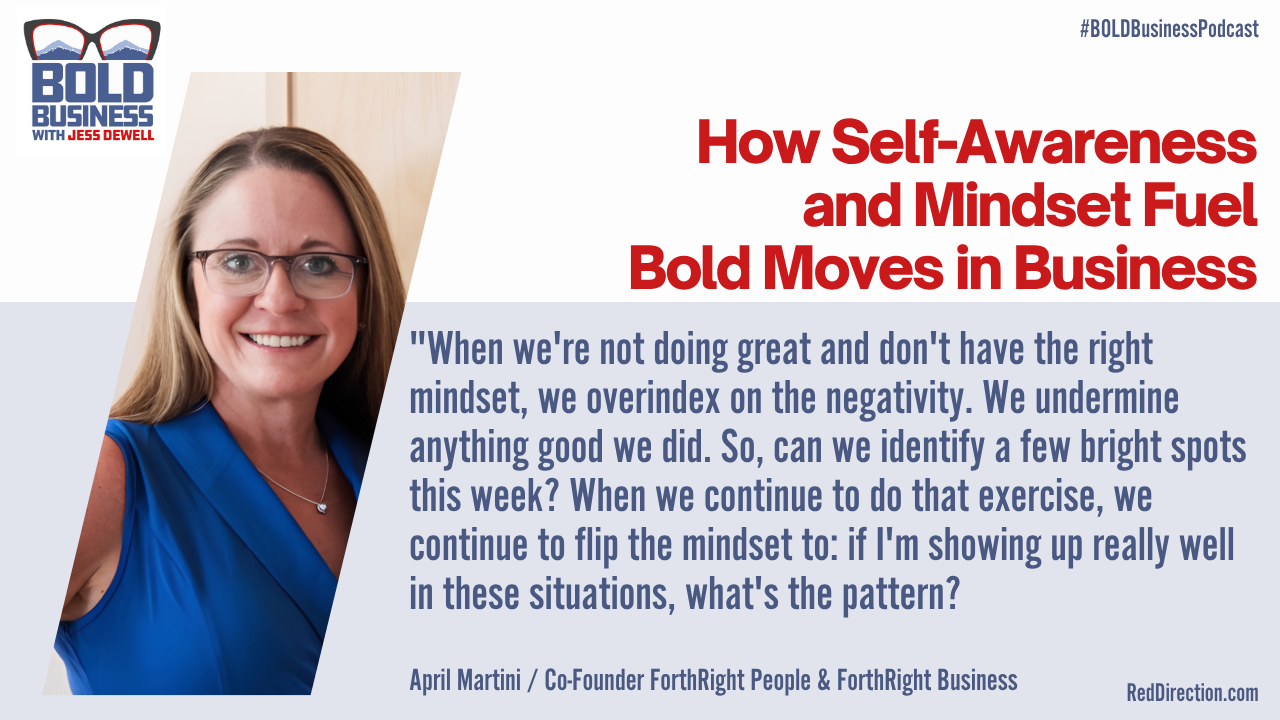
Yeah so you said slow down so I’m not going to reuse that one but I think what ends up happening is there’s so much pressure at those levels and then if you pair that with all the other things we’ve talked about in this discussion whether you were ever taught how to do it whether you have the tools in your toolkit to know how to do it whether you got got promoted to a new role now and you’re not really sure what you’re doing. Right. So I always think about it like a ball of wax. Right. And so the first thing that I’m trying to do is alleviate any of that tension and pressure. And that’s looking for a starting point. I tell people all the time, just get started, just do something. And there’s simple exercises that I’ll assign and I get mixed reactions to these. Right. But when we get to these leaders that are in these spaces, one of the really tactical ones I’ll say is, okay, hear you. We are not in a good spot with where we are today. We need to jump on that and get to a better place quickly in order for you to be able to feel better so that you can be in the right mindset to go and do the job that you’re supposed to be doing. And so I will assign three times you showed up this week and you felt good, three times you showed up and you didn’t feel so good. Because when we’re not doing great and we don’t have the right mindset, we over-index in the negativity. And so we kind of live in that swirl and we undermine anything good that we possibly did. Right. So just first identifying, oh, I did have a few bright spots this week. And then over time, when we continue to do that exercise, we continue to flip the mindset to where it’s okay. If I’m showing up really well in these situations, what’s the pattern? What’s the reason why? Who am I with? What time of day is it? How was I feeling when I woke up this morning? Right. All of those different kinds of things. And so we try to find ways to then put the leader in the driver’s seat of managing their mindset and putting themselves proactively in that place when they are starting versus letting that negative swirl, which is so much easier for all of us to let in, allow us to slide to a place and stay in a place that’s not helpful.
Ann Candido 37:13
And I was just going to build on that and say, as a leader, and I think I said this already once, but I’m going to say it again, because it’s that important is you need to be careful about where your personal brand might be driving the truck. Yeah, good point. Yeah. So when you talk about being risk, if I’m a naturally risk adverse person, and I start leading my team from that standpoint, a lot of the way that the team experiences is, okay, we’re just going to play it safe. We’re not afraid. We can’t fail. There’s only one way of doing these things. And then all of a sudden the leader goes, how come my team isn’t proactive? How come my team never wants to stretch the boundaries? How want to come up with creative solutions. You created that atmosphere. So the mindset shift is, okay, let me look and let me be curious about myself and where I, as the leader, may be causing this friction because of the, we like to turn to the team and be like, my team, they just, they’re just not collaborative. They just don’t like to share. I just, I have a couple of bad apples. I’m like, we like to blame the team before we look back on ourselves. Like, what did I do here to create this mess. I probably did something in 99.9%. Yes, you did create something. And so once you can kind of see that you can start then to address it and bring forth other characteristics that can help you manage it because you’re not going to, you can dial that one down, but you’re not going to be able to totally say, I’m not ever going to be that way. I’m never going to be not risk adverse, right? But you can put in things like testing and learning that helps your team to have more flexibility. You can bump up the timeline or bump back the timeline. So you can give yourself a bit more chance to think about it and develop it and so there’s lots of different things you can do so just be careful when if you are seeing what’s going on and you don’t look back at yourself first And say hey what am I doing
Jess Dewell 38:57
The self-leadership thing is really important and I hear you talking about it and I think I don’t know if you see this across gender or if you see it more in the feminine I will tell you as a woman business owner trying to have woman business partners I think it’s awesome some of you two are in business together or business partners of other gender or peers that I am working with, I will tell you what, there is stuff other people just don’t get about me. And every single time something happens, it’s, duh, don’t you know me by now? We’ve been working together for however long. And it makes me think about that. What’s my part in this? Because it’s always external. Why don’t you get this about me? What have I avoided? What am I assuming? What did I set up? I can tell you a lot of things I set up. I set up a lot of bad habits in my teams over the years accidentally. And then it’s like, ooh, look at me. I felt like I had to do it all. But it comes from other places too. One time I had a breakup with a friend during my professional career and it hurt really bad. I turned around and all my decisions and contributions to meetings came from that place of hurt and a broken trust, which made everybody else a little more cagey and less willing to share. And I didn’t understand what changed until I was able to stop and hold up a mirror and go, oops, that’s on me.
April Martini 40:15
And your behavior changed in a way that people weren’t used to. That’s the other piece, right? So that’s the danger of when Ann talked about before knowing your characteristics and leading through your behaviors and actions. If all of a sudden one day you show up and you’re not what they expect and you don’t explain it, which sometimes you don’t because you don’t realize it yourself. You’re not in a place of good self-awareness. Then that’s when everybody kind of starts to tiptoe backward because they’re like, something has changed. I don’t know what’s going on. Then you have the people that are like, did I do something? And then that starts making people scared and they play small. And then the next thing you’re looking around like, wait a minute, we had such a good team rapport and it takes so long to build trusted, respected relationships and not very much to erode them, which is why another reason why Ann and I are so passionate about the personal brand piece because if we are always on and thinking through it in that way, that goes back to the objectivity, but also preparing yourself every time you’re going into these situations to be like, okay, like with you, I had a bad breakup with a friend. Okay. What can I do in this instance so that I’m not showing up in a way that people are going to be like, who was that? And sometimes it’s just guys, I am not myself today. I’ve had a really hard personal time. Don’t know, you didn’t even share it. So what today might not be what you’re used to. And I’m just letting you know, it’s not you and I will get back there.
Jess Dewell 41:35
I’m telling you, I was raised and the model that I was given in my early career was you just leave it all at the door. So that’s what I thought I did. And so all of us who think we’re leaving it behind or putting it at the door to be picked up later, we are not. So thank you for saying that, April. I really, I’m glad you said that because that is something still to this day, we as individuals, team members, leaders have to say out loud and model so other people will do it for themselves too.
April Martini 42:03
Yep. The responsibility of us as leaders, I think.
Jess Dewell 42:06
Yeah. What was the time in your careers, whether in this company or in other parts of your journey, that you realized that your alignment was completely off and you were actually either operating on brute-force hustle, you were bringing something you didn’t know you had, but there was something that you were doing that was getting in your way. And how did you find out about it?
Ann Candido 42:26
So me and April have several examples of this in the book because it’s such a fundamental aha moment. And it really depicts the struggle when we talk about struggling middle managers. So I’m trying to think of one, maybe that’s not in the book. I think if I was going to pinpoint, I’m trying to pinpoint a recent one. So I have another business, which is, it’s a franchise called Tint World. It’s a car stylizing franchise, right? It’s a totally different industry than what my primary business is, right? And you kind of go in day one and you’re like, all right, 20 years at P&G. I run my own business. I’ve done this and that and the other. I know how to run this business. That’s my personal brand is that kind of the know-how, like they come in the expert. I like to kind of be the expert. And then you quickly figure out, I have no idea this business at all. Right. And it’s like some of the fundamental pieces are the same, but there is a lot of nuances that are totally different. And so the parts of my personal brand that work and the forthright people weren’t quite working here, especially with my people that work there. They’re totally different type of people than what I work with here. Not good or bad or just different. Right. So I had to pull another characteristic from me, which is the learning characteristic. I had put myself into a learning space. I’m like, okay, I need to take a couple steps back. I need to just let this place like almost like infiltrate into me so that I can understand where this place is, where these people are, not what I expect this place to be, or I expect these people to be right. So that’s like a really important moment where I had to realize if I want this business to successful. I need to kind of turn off or turn down what I thought I needed to be or how I needed to be in that to come in. I’m going to fix it. I’m going to make this all run smoothly and just take, like we said about tech, kind of taking some time, but taking some time to just learn to understand that I’m not familiar with this new context. I’m going to have to meet these new people. I need to figure out where they’re coming from. I need to listen. I need to dial up all these other characteristics so that I can be effective leader in this situation.
April Martini 44:40
Yeah. And I won’t use one of the ones from the book either. I had some time to think there. So I can’t, I know you got that. Hopefully that wasn’t too garbled.
Jess Dewell 44:47
Very clear. I liked it. It was very detailed too. Yeah. Okay. So before you start April, hello nine, I see you.
April Martini 44:53
So Judy everywhere. There’s my nine showing. So, okay. We’ll go back to my three, right? So one of the, on the Enneagram three, one of the things that is a really good skill of mine, but that can get dangerous. And I’ll explain is that I am really good at chameleoning, if that’s a word myself, in order to quickly perceive who I’m with, and then get them to understand and hear what I’m saying. And so in coaching, it’s really good, because I mentioned like modulating directness before. It’s that right. So if I say something, I can watch the person in real time react, and I’ll be like, Oh, sorry, that was way too far. Let me rephrase that and try again. Okay, where this can be a not great thing is when you pair this ability to be what my coach will say is overly empathetic, leaning into it too far in a way that you shouldn’t. And my natural desire to fix everything and everyone. And those two things come up. And in this situation, they came up in spades. So I always say, believe whatever you believe. This was a situation where I had several situations personally and professionally of people in my life. And it was this weird crux of coming to the realization and saying out loud, I am my worst version of myself. When I care about the person, I know what the answer is and I’m powerless to fix it for them. And that was one of those lightning rod moments where I’m like, did you hear what you just said out loud? And so what I have had to learn really and truly is where to lean into empathy and where to just have sympathy for somebody’s situation and just recognize for myself, what are the symptoms, the physical symptoms I actually get when I start leaning too much into that, right? So my coach used this reference, which I think is so good of when you used to go to the bank and they had the tube and the screen would come up, right? So you put your deposit in and it would go, that’s what I should envision when I can feel myself reacting too empathetically, meaning taking on their emotions and just lean into sympathy. I’m so sorry that’s happening for you. I’m here to listen, those types of things. So that would be my example.
Jess Dewell 46:56
I don’t know enough about Enneagram, but I got the three in that very clearly. So awesome. All right. I want to know what makes it bold to really prioritize your personal brand, especially when your role, your goals, your company’s goals are really facing the speed of change or market volatility.
April Martini 47:14
Yeah, so I can start with that one. I’ll give Ann some time to think this time. But I think the biggest thing is we can easily as people, especially in the world we’re in right now, get caught up in fill in blank, right? Caught up in the speed of things, caught up in the day to day, caught up in checking the boxes if you’re like me, caught up in the wrong things. And I think that it can be easy to go with the flow until you wake up one day and realize, what am I doing? If you can start from the place of your personal brand, and like I said before, lean into doing the work, just get started. Yes, it is work. No, it’s not overly hard. And it does set you up for literally the rest of your life. But you do have to be brave enough and bold enough to one do that work and then start showing up from that place. And if you can, and I encourage all of our clients to do this, owning that this is what’s happening in real time to people. So explaining to them that this is what you are working on and why and what you believe it’s going to do. And sometimes that goes against the grain of fill in the blank, what people are used to from you, you start setting up boundaries. People don’t like that. You start changing your behaviors. They don’t like that. Your boss wants you to do something different. You have to decide if you’re willing to do that. If you’re also going to show up within your personal brand authentically, is that a rub? And so I love the moments where people feel empowered and confident enough to be bold in spite of whatever is going on around them because they’re so in tuned with who they are and unapologetically so ready to take things on from that standpoint. And I think that’s the definition Of being bold through your personal brand.
Ann Candido 48:57
I will say when you think about your big things, which me and April always encourage, when you think about your big things, you think about what your personal ambitions are. So this is, we all want to be good parents, good employees, good siblings, whatever the good proceeds. But sometimes we ignore what we really want out of life, where we think we have been put on this world for, where we think we can drive the most impact, where we just feel that calling. And being bold in that context is saying, I want these things. And it’s okay that I want these things. But in order to get these things, I have to realize I need other people to unlock my big things. I can’t get to my big things alone. And April said this, which means you have to do the work to understand what your competitive advantage is, which is your personal brand so that you can go achieve your big things. It’s sometimes it’s to be extremely vulnerable. You have to kind of go there. It doesn’t always feel good, but when you can start using your, coming from a place of your personal brand and using that as the foundation for how you’re showing up, you can start to create that consistency in people’s minds that they start believing. Yeah, I’m definitely going to help Jess because Jess is showing up in a way that feels like it’s adding a tremendous amount of value. And so therefore I’m going to help her on her big thing. But a lot of times instead we think that, oh, again, we talked about that person over there is the problem, right? If you have to take responsibility that it is your, it’s on you for that person to understand why your mission, why your big thing matters. It’s not their responsibility to all of a sudden like just accept it. And if their perception has a certain bent that is not the right perception for you. And if that’s not matching your personal brand, it’s also your responsibility to go out and fix that because their perception is their reality. So therefore you need to be bold enough to say, I got that. What am I going to go do about it? Because at the end of the day, that is all data. That’s going to help you put you on your path to your big thing. So you can either ignore it and wonder why you’re not achieving your big thing, or you can embrace it. And you can use that as data to fuel your personal brand and your big thing.
Announcer 51:16
And that brings us to the close of another powerful and fresh perspective on the Bold Business Podcast in today’s volatile landscape growth is a double-edged sword to truly thrive you must engage with your strategy not just react to the day-to-day. Without absolute alignment, your company faces a stark choice. Outmaneuver or be outmaneuvered. Grow or get left behind. Thank you for listening, and a special thanks to the Scott Treatment for Technical Production.