





A RIGOROUS WEEKLY PRACTICE THAT TRANSITIONS YOU FROM THE EXHAUSTION OF BAD GOAL CHASING TO THE CLARITY.
FROM BUSY WORK ➔ STRATEGIC COMPOUNDING
With Red Direction Present Retreat Methodology, reclaim executive cognitive bandwidth to sharpen Business Instinct and “Good Goal” alignment validated by a 40% reduction in decision-cycle time.
Starting the conversation:
Stepping up is essential for you, your team, your customers, and your service to create real impact. Heather Gibson, Owner at Big Hearted Breeders, shared on the BOLD Business Podcast that she is BOLD in order to meet the self-doubt that arises by remembering her purpose.
More than challenging misconceptions, outdated traditions, and external judgement is your dedication to your work. And, that your work has value. Profit is not a dirty word. It is survival. You can indeed run a profitable business, stand in your power, and share your passion with on-purpose work.
In this episode, you will hear that remembering your purpose is a powerful ally when self-doubt shows up; the three questions to ask in order to discover what no longer works, so that you can let things go; and the way to create change is to find commonality with others as you move along your path. Jess Dewell talks with Heather Gibson, Owner at Big Hearted Breeders, about how recognizing self-doubt is necessary for self-acceptance in the process of facing industry disruption.
Host: Jess Dewell
Guest: Heather Gibson
What You Will Hear:
02:45 What we do to please the invisible committee really can highly impact how we view ourselves, how we treat ourselves, and also how we go about our business.
- There is significant judgment and criticism from outsiders who don’t understand the industry, which creates pressure to conform.
- This external pressure can lead to feelings of shame or influence business practices to please others instead of staying authentic.
- The concept of the “invisible committee” highlights how unseen and unspoken opinions can have a heavy impact on self-perception and decision-making.
04:15 All those different opinions like I was sharing land very heavy and sometimes they’re surprising
- Criticism and unsolicited opinions often come unexpectedly and can suddenly undermine confidence.
- Staying grounded in your own purpose and identity helps mitigate the negative impact of external judgment.
- When caught off guard by criticism, it is easy to start doubting yourself even if you were previously confident.
07:15 Have a regular evening gratitude practice as well as spending time breathing and thinking about what you are moving towards.
- Consistent morning and evening routines help maintain clarity of direction and purpose.
- Daily gratitude and intention-setting practices make it easier to handle unexpected events without getting off track.
- When these rituals are skipped, it is noticeably harder to stay focused and productive throughout the day.
13:50 The fact that it helps us meet our vision faster, that we have new tools to create, copy to create.
- AI and new technologies are leveling the playing field for business owners by making powerful tools affordable and accessible.
- There is a sense of excitement about how these tools can accelerate achieving business goals and visions.
- It’s important to be informed and careful about how these tools are used, particularly when it comes to verifying information and sources.
19:55 There’s also so much power and connection and we have so much more in common than people talk about.
- Recognizing flaws within all sectors of the industry leads to a more holistic and solution-focused perspective.
- Rather than pointing out differences and faults, focusing on what is shared allows for greater collaboration and positive change.
- Building bridges and common ground across differing groups can lead to stronger communities and broader impact.
25:55 It’s important to take the time and make sure that you’re refocusing and recommitting.
- Regular reflection and strategic pauses help ensure that you are intentionally headed toward goals that genuinely matter to you.
- Attending events and engaging with others outside your usual environment can recalibrate your business direction and personal purpose.
- Intentional reviews keeps you from drifting into objectives or destinations that no longer serve your vision.
34:30 It is BOLD to step away from the daily operations of your business to protect your bandwidth, ensuring you remain the visionary the future of this industry needs
Resources
Transcript
Heather Gibson 00:00
Power sometimes has a dirty connotation, but as far as taking on the responsibility, stepping into the ability to serve others in your fullest capacity is something that unless you take ownership of it, unless you claim it, it’s really hard to do.
Announcer 00:23
Every leader needs a trusted partner for the moments that matter. This Bold Business Podcast conversation is that partnership. Here is your host, Jess Dewell, an insightful truth teller who serves as the catalyst for getting the right work done and who asks the questions that truly matter.
Jess Dewell 00:41
What does it take to break the mold without breaking your business? That is a question that when we start to feel trapped by the way things always have been in our industry or by our predecessors or by who’s mentoring us. We must ask ourselves more than ever before. And today, Heather shares more about that. Heather Gibson is the founder and CEO of Big Hearted Breeders. She has built an ethical breeding program. She is leading a nationwide educational movement. She is the powerhouse in pet nutrition and wellness, not to mention a business mentor for other breeders. Heather challenges conventional industry norms, and she’s empowering breeders to step up, to be open and claim the skill it takes to be a breeder and to be profitable at it. We’re going to dig deep into running a business aligned with its biggest good goal and its everyday action. There are three powerful insights. The first is how to remember your purpose, even when self-doubt shows up, because taking that next step is a must. Second, there are three crucial questions that you can ask yourself to help identify what no longer serves your work and how to confidently let it go. And third, finding commonality, working with peers, coaches, and going to industry events shortens the path of where you’re going so you can get there faster. Protecting our bandwidth, stepping into your visionary role, understanding how to adapt in ever-changing markets and claim what you still need to claim to get to where you want to go is what you’re going to hear. Let’s get to my conversation with Heather. I was thinking about self-acceptance and you were also talking to me a little bit about self-acceptance. Was there ever a time as you’ve been in your career as a breeder and part of the breeding community that you didn’t accept yourself in this role?
Heather Gibson 02:42
I think we all do. No matter what business we work in, we all have areas where we hold back or we diminish what we would normally do because of how we view ourselves or how we allow ourselves to be impacted by how others view us. So the breeding world is a very controversial business. Even saying it’s a business is very controversial in my world. And so there are a lot of armchair quarterbacks, different people putting in their opinions. A lot of times people that don’t even know our industry or understand it are very critical of what we do. I think that can create a little bit of shame or retreating into what we think we should be doing to please the invisible committee. I love the term invisible committee. I recently heard it on a training by Anniston Riekstins, who you guys should look up. But what we do to please the invisible committee can impact how we view ourselves, how we treat ourselves, and how we go about our business.
Jess Dewell 03:42
So many times I’ve been in a room and I thought I was ready to be there and I look around and I feel like I’m an adult dressed up in my mom’s clothes. There was even some confidence back then, dressing up in whatever I could find in the closet, whether it was my grandma, my mom, my dad, right? It didn’t matter. But when you find yourself in that flip side of, oh, am I really supposed to be here? That concept, I’ve heard it called imposter syndrome. I like the way you’re describing it better because we can be really confident and then all of a sudden go, “Wait, what are we doing here?”
Heather Gibson 04:14
It can be very disorienting if we’re not grounded in our purpose and who we are because different opinions land heavily and sometimes they’re surprising. You walk into a room and you’re not expecting to hear certain criticism and all of a sudden you feel small and you start to doubt yourself.
Jess Dewell 04:30
Did you start out confident or were there specific times from when you started to today that you look back on and go, yeah, those were the times my invisible committee was really loud or that I had self-doubt and I lost my self-acceptance?
Heather Gibson 04:47
I feel like I’ve always been a people pleaser and as a people pleaser, the invisible committee is very debilitating. And so I think I have gained in confidence over time, but I definitely was not born innately confident or outgoing. I think some people that have known me would say, Heather, actually in high school, I think you were pretty confident and outgoing in some ways. But I just remember always having so much self-doubt and so much self-criticism growing up.
Jess Dewell 05:15
Yeah, I still do. I don’t know. Here’s the thing, though. The frame I put around it, maybe this is wrong, Heather. What I realized was my self-doubt turns out not to be because of my belief in myself. It comes up because the perception, sometimes it’s within, but sometimes it’s without, is that there was some sort of mistake or failure. And it took me a long time to be able to hold that or walk with it and keep going. Because you just said, it shows up unexpectedly.
Heather Gibson 05:39
Yes, it does.
Jess Dewell 05:50
And we still take those steps forward. We still show up with the, you want to call a game face, great. If you want to call it confidence, great. I show up with whatever I have. If it’s 10%, I’m going to look 10%, but I’m going to give you all I’ve got. That’s how I walk with that. Usually when that happens, I’ve been under pressure too long. I haven’t taken a break in too long. The pace is supposed to be weeks and it’s turned into months. It’s usually a sign for me that there’s something else happening. Could there be change? And am I growth-oriented? Sure. But that doesn’t mean I’m immune to that. How about you?
Heather Gibson 06:24
I know that in my journey with growth mindset, we talk a lot about early wounds, like what happened in childhood, the thoughts and beliefs we took situations to mean about us and how then even though we’re adults, we still react as that five-, six-, or seven-year-old child with the same wounds, the same worries, the same concerns. And I definitely think those come out much more if you’re too overwhelmed, too tired. When we take care of ourselves and we spend some time remembering what our purpose is, remembering where we want to go, then we can move forward so much more confidently. And the invisible committee just becomes background noise. We don’t have to listen to it anymore. It doesn’t matter. We can go forward with that vision clearly before us.
Jess Dewell 07:13
Have you found something that works for you to do that?
Heather Gibson 07:16
I have to keep coming back to it because I think with any good practice, it only works as well as we practice it regularly. Having a regular evening gratitude practice where I’m grateful for things and I kind of have a wind-down at the end of the day. And then in the morning, just as powerful and probably even more powerful is spending some time breathing and thinking about what it is that I’m moving towards, what my big goals are, how I want to impact the world. And when I have that clearly in mind first thing in the morning, and then I wrap it with gratitude in the evening, my days go much better. I tend to get less off track. Things don’t bother me or fluster me as much. I’m able to get further in my day and accomplish a lot more than I do if I don’t do that.
Jess Dewell 07:59
Three words popped up in my head while I was listening to you. I’ve heard those things and I’ve done those things, but I’m not consistent. I’m going to pick one and make it a practice, because I’ve done them all but I’ve never done them all consistently. There might be something about the consistency of it. And this is where the three words come in, Heather: ritual, routine, and habit. What’s the difference?
Heather Gibson 08:19
I don’t know. Maybe ritual is tied to something that you do with it. You tell me.
Jess Dewell 08:29
I don’t know either, but I was listening to you and I’m thinking, okay, so I could ask the next question and I could use the word, okay, so you’ve made this habit of doing something in the evening and doing something in the morning and it compounds. Then I was thinking, wait, it’s a routine like brushing your teeth or eating breakfast. You’re just providing yourself the fuel to be as optimized as possible. And then I went, wait, in reality, those are rituals that are also part of our soul and nurturing our soul. So I was like, I better just ask you: what do you think?
Heather Gibson 08:51
I like your answer way better than mine.
Jess Dewell 08:55
So if I were to ask you, what do you call that? Would you call it one of those words or something different?
Heather Gibson 08:58
I think innately, I would probably call it a routine, but I do like you pairing it as a ritual in that I do feel when we take care and we nurture ourselves, there’s power, there’s a spirituality to taking care of ourselves.
Jess Dewell 09:09
That phrase, cobbler’s kids have no shoes, is very true for our own selves and it applies here. So I like the term ritual from that perspective. It’s almost like there’s three ways. Do I show up in structure? That would be a routine. Do I show up in action? That would be a habit. Do I show up in pause or perception? That would be a ritual. All three words could work depending on who you are. Just pick one and don’t get hung up on the others. What do you think?
Heather Gibson 09:41
I think that sounds great. Any way it gets done. I think maybe it starts as a routine. Maybe that’s the most basic level and then moves from there.
Jess Dewell 09:51
All right, Heather. I’m thinking about goals, right? I know you have some big goals and you’re working on some big things. And I want to know what you think is a good goal.
Heather Gibson 10:03
The older I get and the more I’m in my business, the more I think about a good goal as something that outlasts me, something that’s bigger than myself. Personally, with raising and training dogs, I think about the impact that every single one of those dogs can have in a home. A good goal for me is to place the healthiest, most outgoing puppies in the world. I think there are a lot of good breeders out there, so I don’t feel like I can say that mine are the most, but as much as they possibly can be. That goal really drives me. I started breeding for the results I saw with my kids, emotional benefits I saw with my kids, my foster children, and my natural children. When I think about them and look at how I can replicate the impact pets have had in their lives in hundreds of other homes, then I’m very driven and I’m very focused on making sure that I’m up on the latest nutrition, the latest socialization, the latest practices with matching families and educating families so that I can hit that goal. I think the biggest goals that any of us can look at in our business are the ones that live beyond us and impact lots of other people.
Announcer 11:19
Feeling stuck? Like, what got you here won’t get you there. The pressure to grow is on, yet the path isn’t clear yet. You don’t have to walk that path alone. This is the Bold Business Podcast. Like and subscribe wherever you listen. Your host, Jess Dewell, is the strategic partner you’ve been looking for, asking the questions that truly matter. It’s time to break the inertia and get the perspective you need to make your next move.
Jess Dewell 11:55
You’re listening to the Bold Business Podcast. I’m your host, Jess Dewell. Today I’m speaking with Heather Gibson, the founder and CEO of Big Hearted Breeders. Have you ever thought about whether somebody is going to carry on this good goal that you’ve created at Big Hearted Breeders down the road, or whether you’re just going to work until you’re done and then there’ll be another company that will be able to fill the space?
Heather Gibson 12:19
I don’t know how my exact breeding company will live on. We’ve kind of chatted about off camera that I run a breeder-training business. And I try and instill that in other breeders because I don’t think I own that space alone. And the more people that own it, the more impact we have. My daughter has talked about breeding down the road. She’s got my love of animals in the family. I don’t know. We’ll see. I don’t want to put that on her. She definitely needs to have her own dreams and her own goals. So we’ll see where it goes.
Jess Dewell 12:45
How cool to have just put the invitation out there with your training community, with the education, with people who are doing this, to be part of your good goal. Come join me in my good goal. I think that there is power in that of the impact that it brings. Let me tell you, wow is all I have to say. Not many people think like that. And it allows for new ideas to come. It allows for everybody to be lifted up. It allows for evolution as much as disruption, right? Disruption happens and it’s usually a, oh, we have to jump in here. Whereas when I look at it from an evolution perspective, sure, there’s disruption. The way we do things is going to change, like when websites came on or when we started to get cell phones that had screens, right? And where we’re at right now with agents that help us be more creative right here from where we’re sitting. I’m super excited to see how all of this goes. Unless you’re a technology company, it really doesn’t change the function or the mission of a business. It helps that business’s mission and vision become more real and have more impact.
Heather Gibson 13:54
All the changes with AI, I know there’s a lot of fear for some people around it. But I think we have to embrace the hope that’s in it too. The fact that it helps us meet our vision faster, that we have new tools to create copy, even some of the training stuff it does. And of course, you have to verify what you’re reading there and be careful with sourcing. But it does open up the world to a business owner in a way that we previously have had to pay thousands of dollars for consultants to come in and do some of these things that AI now does for us for 30 bucks a month. It’s amazing. And I love it. The accessibility of it is great.
Jess Dewell 14:27
The fact that you still need systems, you still need a vision, still need some initiatives, a place that you’re going, maybe a year out, maybe five years out. In your case, the good goal to outlast us too. It makes me think too, I’m going to switch the subject just a little and I’m going to be thinking about the rigidity. You had insinuated earlier: a lot of people with a lot of opinions about the work that I do. Just putting that back on the table, I have no doubt you’ve felt locked into a box. How did you build the knowledge and the skill that you need to do the education, to do the work, to do the breeding, and to do the matching with everybody and still have that instinct piece of business to go, okay, this is where the business is. This is how we make a difference. This is where we get to keep growing. How do you keep the good parts of what’s good in your industry, and how do you get rid of the parts that no longer really serve?
Heather Gibson 15:21
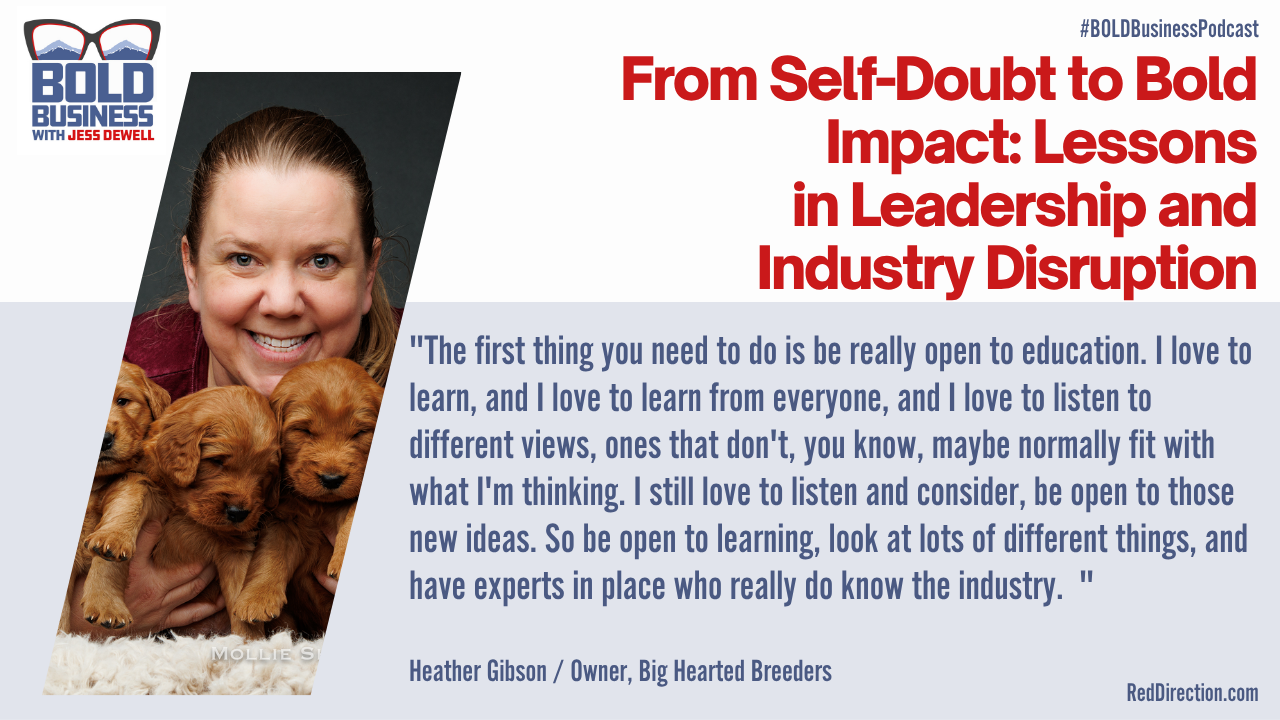
There’s that story about the person who cut both ends off the ham before cooking it. They’re like, well, you have to cut both ends off. They’re like, why? Like, because mom always did. Grandma always did. When they went back to Grandma, everyone thought it was because it made the ham taste better, but it was really because that’s what she did to make it fit in the pan. And yeah, so sometimes we have these ideas in our business, in our industry that no longer serve. I think the first thing you need to do is be really open to education. I love to learn and I love to listen to different views. Ones that don’t, you know, maybe normally fit with what I’m thinking—I still have to listen, consider, and be open to those new ideas. And so, if you’re open to learning and looking at lots of different things, you also need experts in place who really know the industry. In my industry, for example, if I completely disregarded everything veterinarians said, I would be in a bad place. Because veterinarians are very important. They have a skill set that we need. Making sure that we’re doing health testing according to the latest science, with guidance from veterinarians, is important. Getting their opinion on things that need to be covered, but are not in my realm of expertise or knowledge, is also important. But then maybe breaking the mold in certain areas. Like I mentioned, a lot of breeders get a lot of flak, a lot of pushback if they say that they make money or call it a business. Any of these kinds of interesting mindsets I think are outdated and probably never were implemented for the right reasons. If you’re not taking care of your customers in any business, then your business is going to fail, whether it’s working with puppies, kittens, or cars—it doesn’t matter. You have to show up and serve people, answering calls and emails in the right way. If you disregard the business side of breeding, you’re really putting yourself in a spot where you’re not going to be able to do as well as you could for the animals you’re serving. And the same goes for not making money. I was meeting with my accountant yesterday, and I think I’ve paid $50,000 so far this year to vets. A lot of that has been health testing. We do extensive health testing on all of our parents. If I didn’t make money, I couldn’t do it. And I wouldn’t be serving the animals in my program or the people who come to me to buy. I’d be too overextended, too worn out. I think as you pull apart the mold and you look at it, you have to come in from a curious angle. Instead of being rigid about what’s been done, be curious. Why do people say that? Is that actually true? Where did that come from? And I think for breeders, part of the reason why we feel like we shouldn’t make money or breeders say that they shouldn’t make money is there’s a lot of shame put on us by the rescue world and by other breeders. By not making any money for what we’re doing—by working for free or at a loss—we’re giving a reason why it’s okay to breed, when we don’t need to. There are families out there that absolutely need what we’re doing. When we pretend like what we do isn’t valuable, that we shouldn’t get paid for it, we diminish ourselves and all the impact we could have.
Jess Dewell 18:44
How long did it take you to say that?
Heather Gibson 18:44
I think this is the first time I’ve said it out loud.
Jess Dewell 18:49
Well, I’m glad you did. The reason I was asking is that you’re saying it naturally. You’re saying it with confidence. And I’m listening. Look, this is the synthesis of all of the conversation, all of the education, all of the hard facts of here’s what it takes to run a business. Here’s what the business costs are in the breeding industry I’m working in. And here’s how I feel about it. Here’s what I sense about it. Here’s what seems to be changing. I’m so glad to have this community because they’re seeing things change too. And that is business instinct right there. You just named it. That was awesome. And say it like that every time.
Heather Gibson 18:56
I will work on that.
Jess Dewell 18:56
It was really good, Heather. There’s this concept of status, prestige, and tradition from the show side and from the artist side that we’re not supposed to make any money. That’s really flawed. And that’s friction on both sides because they’re all in the same space. Did you always know that there were flaws in the system? And when did you decide you wanted to see that change?
Heather Gibson 19:55
I’ve been breeding for about 12 years. And when I got started, you don’t know what you don’t know. And I was just having a good time. I started out in the purebred world. I immediately saw some pushback among purebred breeders—the feeling that you haven’t put in enough time, you can’t come into this, you’re not qualified enough for this yet. A lot of times they call purebred breeding “preservation breeding.” I actually worked in preservation breeding longer than I’ve been in mixed breeding. So I’ve been on both sides and traditionally, they don’t get along. It’s a dynamic that comes from flawed beliefs in the system. As I walked through that, I saw some things I didn’t agree with in preservation breeding, some things I don’t agree with in mixed breeding, and some things I don’t agree with in the rescue world. There are flaws in all of it, but there’s so much power in connection, and we have so much more in common than people talk about. It was that journey of seeing everybody pointing out what was wrong with each group, and pointing out the flaws instead of celebrating how close we actually are in doing the same work together. I think in any business that can be the case, we get so caught up in this coworker or that part of our leadership team. And when we can stop and find our commonality together and move forward in that, that’s where we have real power and that’s where we can create real change. I want to be a bridge builder between these different communities that maybe don’t see yet how we are very alike and we could do so much good together.
Jess Dewell 21:29
Am I right that you host an event in person in Utah? Is that for everybody? Is that for every kind of breeder there is?
Heather Gibson 21:41
Yeah. So cat and dog breeders are mainly who come. We wouldn’t turn down some of the other breeders out there, but we bring in experts that cater specifically to cat and dog breeders.
Announcer 21:55
If your week feels like you’re being pulled from one demand to the next, this is for you. The daily grind is the number one killer of business instinct, pulling you and your team away from your vision. Reclaim your strategic edge with the Present Retreat. This free guide from Red Direction is a simple, powerful framework to carve out the space you need to filter out the noise, make the right decisions and lead with clarity. Visit presentretreat.com.
Jess Dewell 22:25
Our guest today is Heather Gibson, the CEO and founder of Big Hearted Breeders. I know you also do online summits, right? You need to go check out the Big Hearted Breeders community because I got to visit one of their summits as a speaker and it was amazing. Heather and her team did an awesome job. The community is fantastic. So definitely go take a look, take a listen and see what they’re all about. Is there something different between the online ones for ongoing education and actually getting out of the day-to-day and coming together in person?
Heather Gibson 22:50
It is a night-and-day difference. I think anybody in their job is running 100 miles an hour. We don’t do enough self-care. Pulling yourself out of the environment you’re in, putting yourself in a completely different environment to then be educated and connect with other people is so powerful. It’s so funny because I bring in top speakers. I flew in someone from Australia last year. We have two well-known speakers coming in this year. But every time, what I hear back from the people who come is that it’s the connections, it’s the conversations at lunch and at dinner. And we do a very immersive retreat because it’s all in the same place. We stay in the same place. We have the training in the same place. Everybody gets to hang out with everybody the whole time when they come in person. And the power of connecting with other like-minded people, the power of getting away and just stepping back and looking at your business or your life from a different perspective outside of what you normally do is so powerful and something I think everyone should do at least once a year.
Jess Dewell 23:58
What’s the biggest takeaway you’ve had in your own leadership from events like this?
Heather Gibson 24:03
I invest heavily in having my own coaches and attending retreats, business-minded retreats, business masterminds with other women or business leaders. And I feel like it shortens the time it takes us to get where we’re trying to go. When you go spend time with people that are doing the same things you are or thinking the same ways you are, something magical happens. It’s like we’re dealing with a combination lock and we’re trying to get three or four pieces in place. And we might have one digit that we’ve been struggling with for years. All of a sudden we’re in an environment like that and it just falls into place because we’re in the right environment around the right people and it just naturally happens. It’s powerful to shorten the time it takes to get where you want to go.
Jess Dewell 24:49
How does it help you in the day-to-day or the week-to-week, or across the year to have these experiences? I’m thinking there’s that protected strategic time where you’re looking forward to making sure your goal is still good. You’re still looking to make sure you’ve got the initiatives in place and then moving forward. I want to know a little bit about how you work that into the always-changing, never-stopping work?
Heather Gibson 25:11
As far as making the time, it’s a priority. And it’s not even the time, it’s sometimes finding the money. I’m in a mastermind this year. I paid $35,000 for the year. And I don’t say that lightly, that was—and is—a significant investment. Sometimes the biggest investments we make end up changing us the most because there’s kind of this energy exchange when we say, yes, we’re all in. I’m showing up to this. You show up differently. So there’s definitely the matter of making it a priority and being there and doing what we said we would do.
Jess Dewell 25:41
Do you have time you prioritize on a schedule, routine, or rhythm?
Heather Gibson 25:53
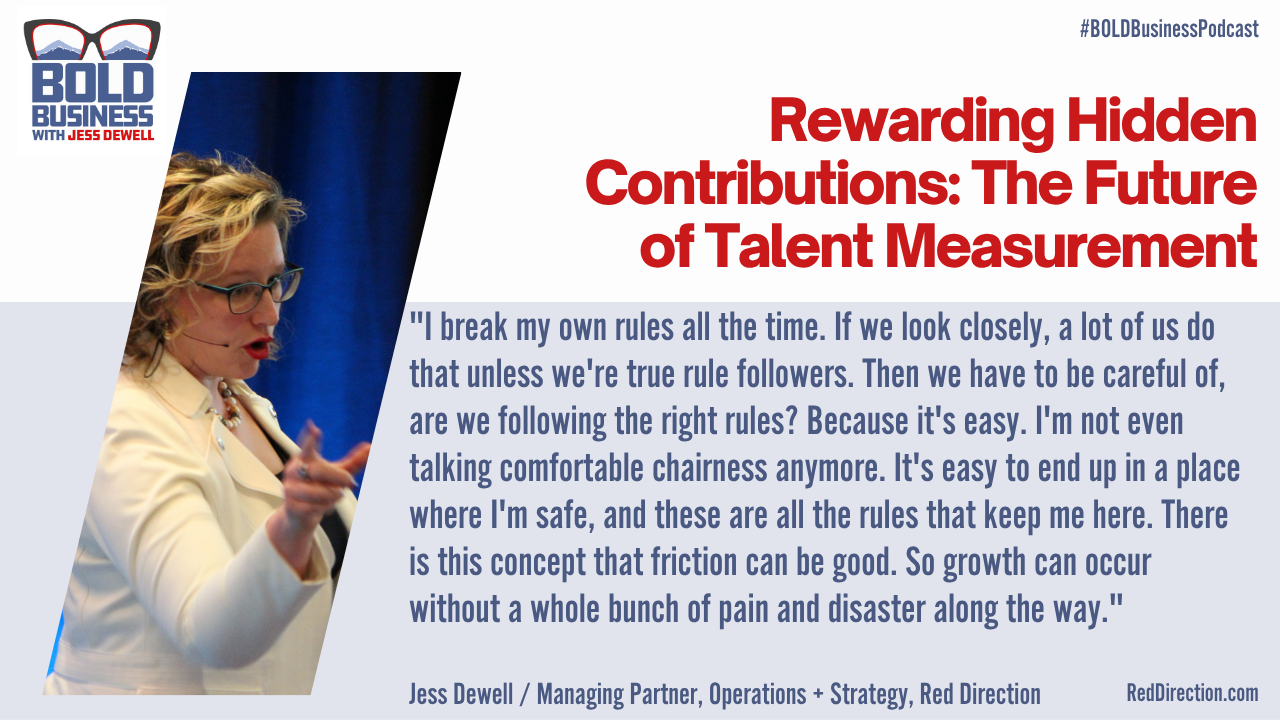
Sunday night is my time when I look at the week and figure out what I’ve got going on, make sure that I didn’t double-book myself anywhere. That helps me, though sometimes there are still some double bookings. So taking that beginning of the week look at everything and getting a good idea of what I have coming up and then on a nightly basis doing kind of a nightly review, that really helps me from a strategic standpoint. But going to events like this, you recalibrate a little bit. You sometimes have new ideas about where you want to go. They say all the time that a plane is off course most of the time. And it’s just those little micro adjustments that they need to make to get where they’re going. And I think any business is like that. As we set aside time to check in with ourselves, to look at what our goals really are, that’s how we get where we really want to go. And we don’t get somewhere and then realize, “Oh, I actually never wanted to be here,” or, “I made that goal five years ago, and this is actually not where I want to be now.” So it’s important to take the time and make sure that you’re refocusing and recommitting.
Jess Dewell 26:56
The big events, and then bringing what you learn into the week-to-week—I appreciate that. I appreciate hearing how you’ve opened up, learned something new, and been reminded, and then based on what the right next step is for you, you’re bringing that into your Sunday nights and then your daily reviews. Once a week, I look 10 days out, and mine is Monday. I look 10 days out and I make sure that I have a certain percentage of my calendar empty outside of deep work time, meetings, podcast recordings, because things will come up. Clients will need things. There will be an opportunity that really is the right thing right now. And instead of having to rearrange everything, there’s just space to put it there. And that little bit of space, that one action, I’m not good at it. Okay. I hate taking things off my calendar and I hate saying my calendar is full and I hate saying not right now. Even when I have an option or something else I could offer as a soft no, it’s still a no. And so I’m not very good at it. I am committed to it. I think it means I’m confident. That’s where my heart and my soul really come out. It changed my business. It changed my ability to say yes. And it changed the amount of impact I can have because of that one small thing. So I’m listening to you and I was reminded of that myself. Everybody’s going to have something. Where are you learning? What are you putting into practice? And then from that, what is the change that you see happening from putting it into practice?
Heather Gibson 28:27
Even just one thing. Just clearing off some space to have time to yourself. I had a coach that challenged me to do that and I’ve been living that for the last four months. It has drastically changed my life. It gave me more breathing room. It gave me time to get done projects that I needed to get done, but didn’t have space for because something else had come up. It gave me more of a chance to rest and be with myself too. I think that in a lot of the culture around CEOs, business, and success, there are certain groups of people who are like, work harder, go faster, don’t stop, sweat until you die. And the truth is, I don’t know—I’m not a man, so maybe men can do it better than I can. But for me, that just drains me. And then I don’t show up in my full ability and capacity to serve others and to do what I’m really called to do and what I’m really good at. So taking that space to rest and catch up—I just have to second that.
Jess Dewell 29:28
It’s phenomenal. I’m curious if you would say this about yourself. You are a powerhouse when it comes to pet wellness and nutrition. I was doing some research and it seems like you are a top person in the field. Am I correct in that?
Heather Gibson 29:38
I have a coach that tells me I am. I’m trying to step into that belief a little bit more. Okay. I do have a lot of education and certifications in that area.
Jess Dewell 29:50
Yes. Way to claim it. Sometimes other people need to tell us that a lot, don’t they? How about being a CEO? Was it similar for you? Oh my gosh, I’m the CEO of this. Was it ever like that for you?
Heather Gibson 30:01
Yeah, it’s all kind of a learning experience of taking on the—I wouldn’t even say power. Power sometimes has a dirty connotation. But as far as taking on the responsibility, stepping into the ability to serve others in your fullest capacity is something that unless you take ownership of it, unless you claim it, it’s really hard to do.
Jess Dewell 30:24
Being in the space that you’re in, with the credentials that you have and the work that you’re doing, do you see opportunity with the massive corporations that surround these topics when it comes to cats and dogs?
Heather Gibson 30:38
Yeah, there’s definitely a lot of interesting dynamics in the pet wellness space. Unfortunately, like anything, I think there’s a lot of misinformation. And so I think our role as business owners is to know how to educate and help people understand and break down some of these bigger, more complex things, helping people see the benefits and the drawbacks to different things and providing that education to the point where you can actually get through to the consumer is part of our job. And it’s definitely one of the trickier parts.
Jess Dewell 31:11
I’m coming all the way back around, right? We’ve talked about the way things have always been done and how you shed that. But what we really haven’t touched on—and what I’m curious about—is this: when we do our own business evaluation, and for you in the breeding industry, how well do the CEOs and business owners in your communities—including you—recognize when their values differ from the actions they’re taking and get them back into alignment? Or does it take outside eyes? Does it happen often?
Heather Gibson 31:45
I can’t really speak to everybody else’s organizations. I think about what we do to stay true to our values. When I place puppies, I think about the impact every puppy we’ve had in our family has had with my kids. And I want to share that same impact with other families. And so we have certain SOPs—standard operating procedures—for health testing, socialization, care, and veterinary care. And we wrote those with that in mind as we were thinking about our greatest goal. So you have to take your greatest goal, reverse engineer it into standard operating procedures, and then make sure you’re following it. I have a couple of people that are gatekeepers within my organization to make sure that we always follow the standard operating procedures that we’ve set. And they do evolve, meaning that if we realize that there’s something we could do better based on what’s been published in the scientific world, or we have an expert coming out and saying, hey, this is the new way to handle things, then we’re always looking at it and up-leveling our standard operating procedures to match. And I think that’s where it gets really powerful: if you have the standard operating procedures to back it up, and then you have more than one person looking at it and making sure it’s being followed within your organization.
Jess Dewell 33:04
What’s a thing you had to do to claim the role of CEO, torchbearer, for your organization, maybe even one step further for your community?
Heather Gibson 33:14
The hardest thing I’ve done—and have continued working on over the last year—is stepping into that role and showing up more that way on social media. So I’m starting to do more videos where I talk about how nutrition impacts pets, whereas before I hid behind cute videos of puppies. And that has taken courage. Like we talked about, the invisible committee can be loud for a people pleaser even when I do my routines and I’m trying to stay in my core values. And so it does take courage and grit to show up in a new way. That’s what I’ve been doing to claim who I am, making sure that I stay in alignment with those goals by reviewing them and making sure that on a weekly basis, part of that review is: Okay, this is what I said I was going to do this week because of this goal. How did I do with it? And if I didn’t do it, not berating myself, but being a little curious: What do you think held you back from that? Why didn’t you go and film that? You had the time. Let’s be honest. You had the time to do that thing, but for whatever reason, you didn’t show up for yourself with that. Why? When we get curious and take away the emotion, the blame, the shame, that’s when we can really change some of the behaviors that we have.
Jess Dewell 34:33
Now I’m thinking about your community. You were talking about the perception and the acceptance of not being profitable, of not being elite as a breeder. So I want to know what makes it bold for your community to face these demands and start asking the people in the community to do the work to see themselves as those elite, profitable CEOs?
Heather Gibson 34:57
So the bold thing is showing up myself and leading the way by being what I’m telling people to be. If I can’t show up and do it myself, it’s very difficult to ask anybody else to do it. So I would be the bold one. I’m not the only one. We have some other amazing trailblazers out there that are showing up in amazing ways to say, hey, some of these beliefs about breeders are broken. The amount of work, time, effort, and passion we put into what we do is not being seen. I think it’s linking arms with other people that are being bold and it makes you more bold, right? Because you’re like, okay, let’s go. We’re going to be bold together. And then you can go out and feel more confident and stand a little bit taller. And sometimes you have to do it on your own, unfortunately. But when you can, linking arms with other people doing the same thing is really powerful.
Announcer 36:02
And that brings us to the close of another powerful and fresh perspective on the Bold Business Podcast. In today’s volatile landscape, growth is a double-edged sword. To truly thrive, you must engage with your strategy, not just react to the day-to-day. Without absolute alignment, your company faces a stark choice. Outmaneuver or be outmaneuvered. Grow or get left behind. Thank you for listening. And a special thanks to the Scott Treatment for Technical Production.