





STOP REFINING A FAILING STRATEGY – ARCHITECT A RESILIENT ONE.
FROM LINEAR PLANNING ➔ ADAPTIVE ARCHITECTURE
With Red Direction Growth Framework Reset Consultation, audit the strategic foundation via the structural stress-testing to eliminate obsolescence guaranteed by a 10x increase in modal resilience.
Starting the conversation:
At a certain stage, founders risk becoming liabilities if they don’t adapt. Self-transformation is critical for continued growth. Alexis Sikorsky, Sikorsky Consulting and KnightScale Partners, shares about the loneliness, sacrifice, and realities no one tells founders about success.
Scaling your company will have unique demands. Recognizing your own capacity and willingness to navigate scale is essential for your well-being and success. Part of that is to choose your partners based on your trust in them more than their expertise. Skills can be learned, yet trust is irreplaceable and necessary for growth.
In this episode, you will hear that at the $5-15 million level SELF-transformation is required; FRICTION is necessary to grow; and to LEAN IN and question when something isn’t quite right — plus business wisdom the guest learned from his entrepreneurial grandfather. Jess Dewell talks with Alexis Sikorsky, Sikorsky Consulting and KnightScale Partners, about claiming the exhaustion of being a founder and how to overcome it.
Host: Jess Dewell
Guest: Alexis Sikorsky
What You Will Hear:
03:25 Founders must transform themselves as the company grows.
- At a certain stage in company growth, founders shift from being an asset to potentially becoming a liability.
- Recognizing this shift is crucial as it consistently occurs, typically around specific revenue milestones.
- The transformation required at this point is both organizational and personal for continued success.
08:30 Replacing early team members becomes necessary as the business scales.
- Early team members may not have the skills or experience needed for higher-level roles as a company grows.
- Transitioning from a small team to a larger one requires tough decisions about who stays in key positions.
- Outgrowing initial team members is a normal and necessary part of business evolution.
17:45 Trust is more important than skills when choosing business partners.
- The foundation of successful business partnerships is built on strong personal relationships.
- Long-term bonds formed before business ventures can provide stability during company growth.
- Reliable, trusting relationships are prioritized over technical skills when forming a leadership team.
23:10 Spending less is a crucial strategy for survival and growth.
- Controlling expenses provides a straightforward way to improve business sustainability.
- Reducing costs is often a simpler and more attainable fix than increasing revenue.
- Imposing financial constraints encourages resourcefulness, creativity, and innovation in business.
31:40 Only do work where you provide genuine value — and, sometimes, that means saying no.
- Turning down work is necessary when it does not result in meaningful benefit for both sides.
- Declining opportunities that aren’t a good fit help preserve reputation and integrity.
- Frequently, the best practice is to ensure mutual value before agreeing to any business arrangement.
38:20 It is BOLD to acknowledge exhaustion and claim it as a founder.
Resources
Transcript
Alexis Sikorsky 00:00
I try to be lucky but that only work up to a point if you play russian roulette every day you can be the luckiest person in the entire world at some point you’re going to lose so i’m just not enough for my personal finance.
Announcer 00:11
Every leader needs a trusted partner for the moments that matter this bold business podcast conversation is that partnership your go-to resource designed to break Take the inertia and refresh your perspective so you can start making moves. Here is your host, an insightful truth teller who serves as the catalyst for getting the right work done and who asks the questions that truly matter. Jess Dewell.
Jess Dewell 00:45
There are strategic partners and then there are strategic partners. Somebody who’s been there, done that, has been on the road that you are on right now, just before you, they’re farther down that journey, is invaluable. in so many ways. And that’s one of the things that when somebody understands growth, they understand the actual journey that you are on as a business owner and a founder. They have been there. They have some context of where you’ve been because they’ve been there or it’s close enough to where they’ve been. They can provide support and questions and guidance to get you around through over whatever you’re facing. I’m really glad that Alexis Korski has come to the Bold Business Podcast and you’re going to get to hear our conversation. I get a little bit of advice and coaching in it, which is fun for me and a little different than our normal episodes. And I pulled out, like normal, three things to listen to as you’re going through. You’re recognizing each of the sections of the program. The first is every founder and every business owner gets to a point of self-transformation before more growth can occur. The second, friction is necessary to grow. And while it is perceived as a negative or a bad thing, it’s actually the opposite. And the third thing, this concept of urgent versus important shows up more and more based off of the level of pressure we put on ourselves, our investors put on us, and what we think society demands of us as founders and business owners. Remember how I said there are strategic advisors and then there are strategic advisors? Well, Alexis is the second. He is an advisor to founders focused on scaling fast and exiting strong. Alexis Cerkowski has a nine-figure private equity exit from his company, New Access. So his real-world experience building, scaling, and selling businesses is being shared with us today. It’s shared in his first book, and it’s going to continue to be shared in his next book coming out. At this place in his journey, Alexis is helping growth-stage companies unlock values, scale efficiently, and prepare for private equity. He is known as the CEO whisperer and offers direct practical insight that helps leaders gain clarity, increase cash flow, and build toward lasting freedom. Let’s get to the program with Alexis.
Alexis Sikorsky 03:24
I call it exhaustion. Exhaustion. When you’re exhausted. Exhaustion in the sense that you get to the point that you confuse what’s urgent with what’s important, and that’s the actual bottleneck. Bottleneck is not, oh, how much time I can spend on the company. That comes earlier, actually. And that’s solved with, it’s not solved by a deep, profound transformation. But it’s exactly like you said, the buck stops here. And now all I’m doing is stuff that not only could, but should be done by somebody else. And then you get to the point where the founders is too much in the company and not enough on the company. So I actually developed a super basic framework to identify and solve that problem. That’s been working fantastically well, because first of all, you need to get the founder to admit that. And it’s not easy.
Jess Dewell 04:23
I actually think that is the hardest thing to do.
Alexis Sikorsky 04:26
So I’ll give you the little method I use.
Jess Dewell 04:28
I’m ready. Bring it.
Alexis Sikorsky 04:30
At the end of every day, before you go to bed, you open an Excel spreadsheet and you list all the tasks you’ve been doing during the day. It’s boring as, I don’t know, can I swear?
Jess Dewell 04:42
Oh, sure. I will bleep you just in case. But yeah, you can swear.
Alexis Sikorsky 04:46
But then you end up with a massive list of tasks, right? But you already, instinctively, you already know that. But just seeing it is interesting. And then you identify the task that you’re uniquely qualified to do. Not the task that you haven’t delegated yet, not the task that you don’t have somebody to delegate to. What are you uniquely qualified to do? I’ll give you a very simple example. What we’re doing tonight, we’re both uniquely qualified to do. And if my company had 500 people instead of the 14 it has one, I’ll still be sitting in front of you. Same with you, right?
Jess Dewell 05:22
We would not be, it would be us or nothing.
Alexis Sikorsky 05:25
Yeah, because if I told you, oh, by the way, it’s going to be my sales manager, you’re going to say, fuck you. And same with you. I’ll say, oh, by the way, you’re going to be interviewed by interviewer number seven. I’d say, no, thank you. So that’s the stuff we’re uniquely qualified to do. And interestingly, the bigger the company, the shorter the list. And if you go to
Jess Dewell 05:45
Wait, can you say that again? You said, Alexis, that the bigger the company, the shorter the list of uniquely qualified individuals to do certain jobs?
Alexis Sikorsky 05:54
No, of you as a founder or as you are uniquely qualified to perform.
Jess Dewell 06:01
Okay. So I’m going to say it again. As a CEO, my list of uniquely qualified items is shorter than everybody else’s.
Alexis Sikorsky 06:10
It’s shorter, the bigger the company goes. There you go. Shorter, the bigger company goes. Do a mental exercise. Put yourself in the shoes of a publicly listed company. Okay. BP, you’re the CEO. There is one task you’re uniquely qualified to do, investor relations. That’s it. That’s your last task. All the rest you delegate because you have no time anyway. You’re employing 100,000 people. You have people managing. But when JP Morgan, who owns 5% of your company, wants your investor calls, that’s your job. You’re the CEO. You cannot delegate. That’s the last task that you’re uniquely qualified to do pretty much. It’s a bit extreme, but not far. So that’s the first step. Like you identify what you can delegate and what you can’t delegate.
Jess Dewell 06:58
Okay. So you and I work with companies of different sizes, I think, in general. And you run a bigger gamut that overlaps with mine. So I’m going to tell you something that I do with companies. And I’d love you to tell me the size that it breaks. We think we could get there. You ready? So one of the things that I do is we’re trying to find out and get the awareness and the acknowledgement of the exhaustion is real and there is a, the buck stops here with too much. And so I actually do an interest and impact evaluation. So they’re, however, they’re going to write it down. They’re going to list everything that they’re doing and everything that is going on and all of their priorities. And then they rank them two ways, right? That’s just a stack rank, the impact to the company. And usually that’s dollars. It’s going to grow us faster. It’s going to get us there faster or whatever. And then interest. We have the skill and the desire to actually do that job. And then the bottom part, you just take off and let it go and have to deal with that. But then the rest is actually going to help you make better decisions and do the right next step.
Alexis Sikorsky 07:57
Yeah. The problem you’re going to see, and you probably already see that, is the list by interest and the list by impact are nowhere near the same, right? And I think when you do it across management teams, the answer is you do get the list, right?
Jess Dewell 08:08
So if you’ve got three to seven people in a smaller company that are doing this, you actually find that overlap and can have a similar path. You are right though, as anything less than that, or if not everybody’s involved, you’re right. That is the obvious problem right away is that they don’t match up at all.
Alexis Sikorsky 08:31
I think that like this exercise you do, it should start with a million-dollar company and never stop. I think every company should do that like once a year. And that was also a fantastic way of knowing if you still have the right team, because that’s the second roadblock you’re going to hit, right? First, you’re a solo founder. I’m not because I’m never, I cannot work alone, but you are a very small team at the beginning, fellow founder or very small team. And then you grow. And at some point you have to realize, and it’s hard, but you have to realize that your cousin who does your accounting is fantastic, but he’s not a CFO. He’s not who you need anymore. And then you get to the third problem. So that’s the second problem is like not having the right team. And the third problem is you, And that’s specific, again, to that ditch, plateau, whatever you call it, around the 10 million mark, which is you need C-level people, but you cannot afford C-level people.
Jess Dewell 09:34
Yes. Small companies run into that with just getting to a controller or a CFO.
Alexis Sikorsky 09:39
CFO is the most obvious one.
Jess Dewell 09:41
Yes, it is.
Alexis Sikorsky 09:42
And that’s why the fractional CFO industries, the problem is, at least to my knowledge, and I’ve obviously been studying this market a lot. Most companies that sell fractional CFO actually sell bonafide accountants.
Jess Dewell 09:58
They do.
Alexis Sikorsky 09:59
If you’re a CFO, you can make half a mil per year in a big company. Why would you want to work on five different small companies who can barely pay you? That’s right. The way we sold that is we actually use retired CFOs.
Jess Dewell 10:12
Oh, that makes sense.
Alexis Sikorsky 10:13
And I decided after my retirement, when I decided to get back to work, that I’m going to only work with people I love. It’s that simple.
Jess Dewell 10:21
It doesn’t remove friction when we only work with people we love.
Alexis Sikorsky 10:26
Oh no, it adds way more friction.
Jess Dewell 10:27
But it sure does create much more potential, doesn’t it?
Alexis Sikorsky 10:31
And who said friction is bad?
Jess Dewell 10:32
Oh, I think friction is fantastic.
Alexis Sikorsky 10:35
Friction is life. That’s where you cannot light a fire without rubbing pieces of wood, right?
Jess Dewell 10:41
I agree with you. You need that spark. And if it’s people that you love, there’s already relationship built. So that whole process of we know if we get mad and whatever our own tendencies and warts and bad habits are, we’ll still be able to repair and continue to work together, sometimes slower than others, but always.
Alexis Sikorsky 11:01
Yeah, and it’s trust as well, right? When I send one of my CFOs to a client, I know, like, for example, I work with the CFO who was my CFO in my software company for 12 years. So I know this guy and he knows me, which is equally as important. So I can tell him, hey, go see that client, but go easy on him is a bit overwhelmed. So you do that, that you leave that for a bit later. And I know it’s going to be done. I don’t have to like check. And same, he doesn’t have to check on me. when I said, okay, so you do that and then I’ll take over. And I think what makes us a little bit different is we do that with all C-level roles, with operation, with tech, with HR, sales, marketing. We have people in, only C-level people because I suck at operations and I really wouldn’t want to hire me to run anything operational. But strategic level, we fulfill all the roles.
Announcer 12:00
Feeling stuck like what got you here won’t get you there the pressure to grow is on yet the path isn’t clear yet you don’t have to walk that path alone this is the Bold Business Podcast like and subscribe wherever you listen. Your host, Jess Dewell, is the strategic partner you’ve been looking for, asking the questions that truly matter. It’s time to break the inertia and get the perspective you need to make your next move.
Jess Dewell 12:36
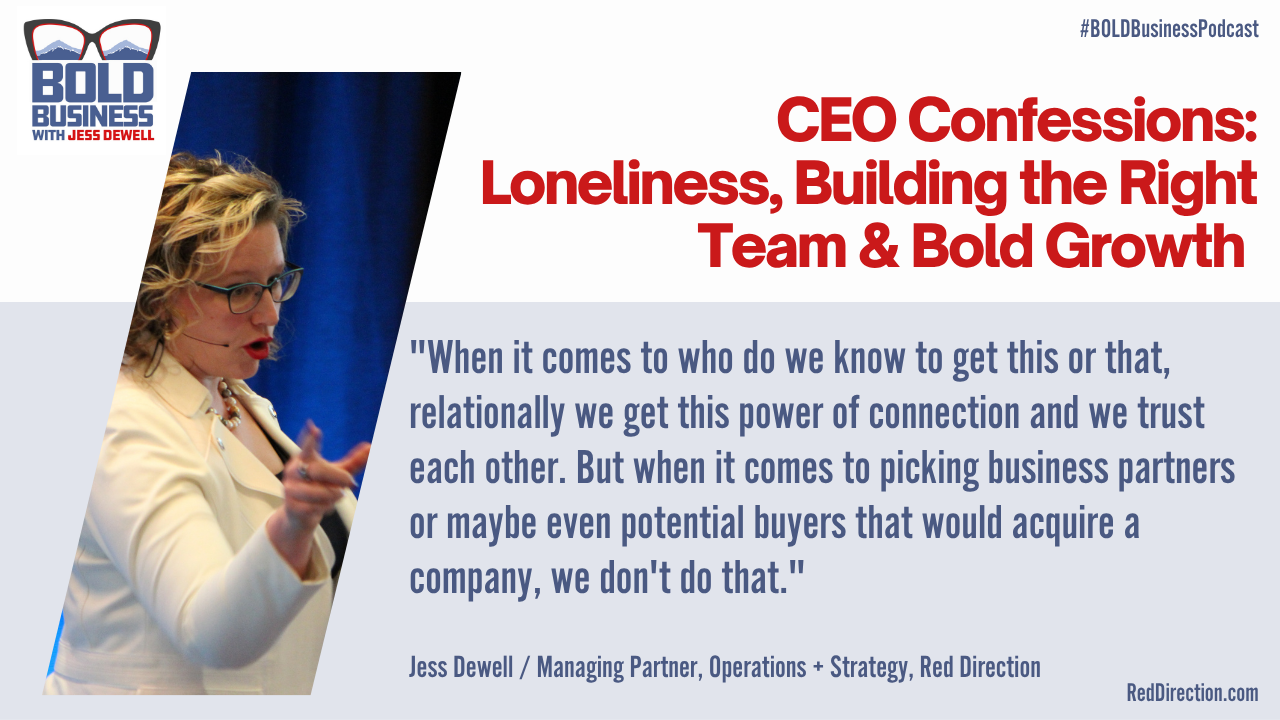
This is the Bold Business Podcast, and you are listening to my conversation with Alexis Sikorsky. There’s this bridge of what do we have to do right now? Who do we know that we can rely on that knows us, that can rely on us? We overlook this in business all the time. We don’t when it comes to who do we know to get this or that? Who do we know to help us open a door? Who do we know? Right, relationally, we get this power of connection and we know, trust each other. When it comes to business and picking business partners, or maybe even potential buyers that would acquire a company, we don’t do that. Do you think that there’s an opportunity there?
Alexis Sikorsky 13:19
Most companies do it a little bit in sales. At the beginning, they rely on their network for sales, but definitely not on operation, tech, everything else. Yeah. Which is all I do. Like the other day, one of my clients wanted a media manager. I find a media manager. So I went to my Oxford network, find this guy who worked his whole life for the BBC. Fantastic guy. I say, okay, go talk to that guy. And that’s it. That’s the extent of my job.
Jess Dewell 13:48
Yeah. And I’m even thinking going back to your software company, were there lessons that you learned or things you wish you had known either because you were lonely as the founder or because you just didn’t know them yet regarding how do I build that relationship of love and trust with the people who are making decisions that can make or break our future?
Alexis Sikorsky 14:08
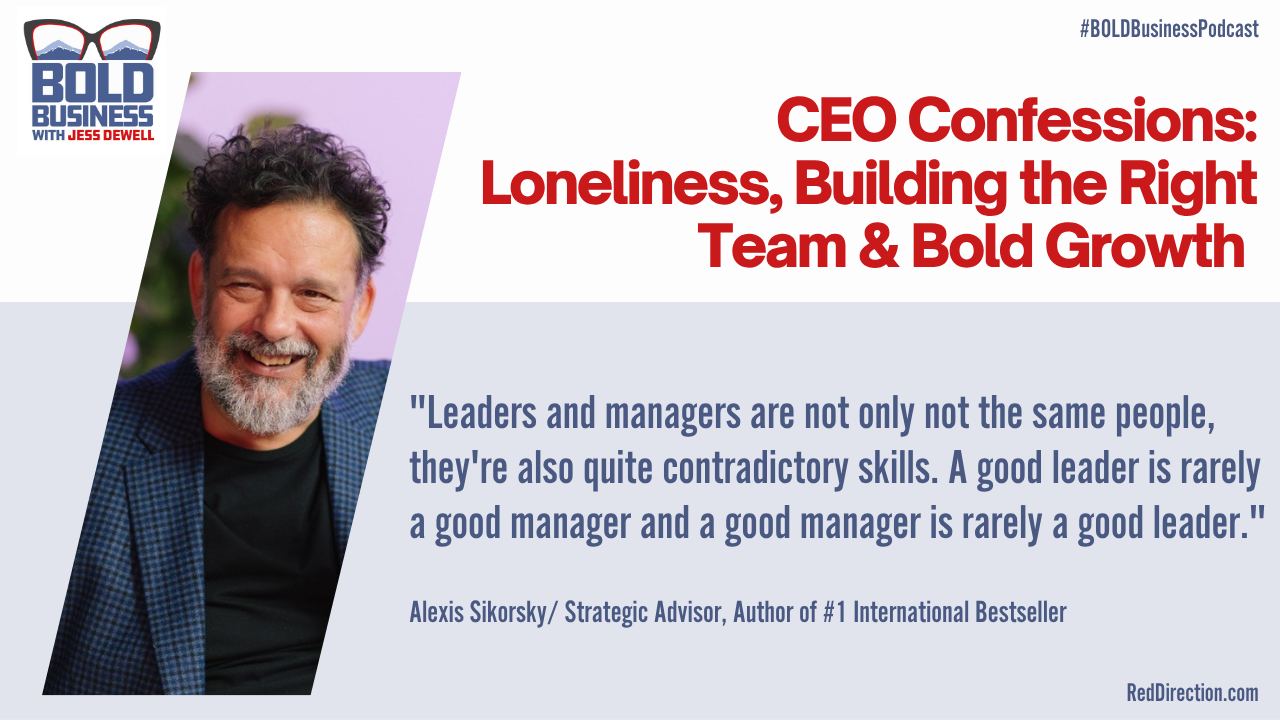
Okay. So that’s actually of the millions of problems I had and millions of mistakes I made. That was probably the only one that was not a big issue for me because by luck, I instinctively knew at the time the difference between a leader and a manager, which is one of the big lessons I always try to give my client. Leader and manager are not only not the same people, they’re also quite contradictory skills. Good leader is rarely a good manager and a good manager is rarely a good leader. There are exceptions, but usually these are your billion-dollar company guys who can do both.
Jess Dewell 14:50
How about they do it, but it may not be well.
Alexis Sikorsky 14:52
Yeah. My circle of love, the people who started the companies with me and who grew with me was actually always super solid. And to be honest, it’s still there. It’s still the same people. The one that they either work with me or I go to the kids bar mitzvah. Like they are like, they’re still there. They’re still in my life. And they were in my life before the company. They were with me some of my multiple failures before I got successful. And they were here to pick up the pieces when I fucked up, which happened a lot. And that was actually my strength. Everything else was not, but that was actually my strength.
Jess Dewell 15:29
I was hoping to crack the code and I’ve had incredibly horrible failures over time because I’ve wanted to figure out how to find a business partner and grow that relationship while growing a company. And every single one of them failed. And that’s interesting that you instinctively, you got some of that difference. And even more importantly, though, you had a sense for we’ll work our way around it because I’d rather work with people I know.
Alexis Sikorsky 15:57
How did you choose a business partner? What criteria are you looking for?
Jess Dewell 16:02
I’ve done it a lot of different ways. And the one that I thought was going to have the most success was we became aware of each other and we were in some similar circles before we decided to start a company together. And we, on the surface, it was very much, we talked like we had the same values. We understood where we want to go. We understood each other’s uniqueness and what we would bring to the table to get to a deliverable and to get the right people at the table to do everything that we wanted to do. We actually had success. We had clients in the pipeline. We did a big kickoff event. We brought a whole bunch of people together for it. And at the kickoff event, we imploded. And I don’t, and I actually don’t, and I think it was self-sabotage on, it had to have been both our parts. I’m going to own my part, even though I don’t quite understand it. The other person was like, cool, I’m just done. What we were delivering required both of us at that time. And so we had to shut the doors and return all the money and keep on going. But there was a lot of self-doubt on their part. And I tried to carry too much, I think. Right? So that was part of it. But that makes sense.
Alexis Sikorsky 17:09
Did you choose, is it a him or her?
Jess Dewell 17:10
Her.
Alexis Sikorsky 17:11
Did you choose her based on skills, value, friendship, personality?
Jess Dewell 17:17
Values. And I felt like in the moments that I really messed up and there was going to be pieces to clean up, that she would stand beside me.
Alexis Sikorsky 17:25
Yeah.
Jess Dewell 17:25
She would take me for all the good and the bad.
Alexis Sikorsky 17:27
Let me get you to think a little differently there. Do you have a best friend, a girlfriend that’s been your friend since you were in high school?
Jess Dewell 17:36
Yes.
Alexis Sikorsky 17:37
She’s hopeless in business, right?
Jess Dewell 17:39
She’s a very different path than me, yes.
Alexis Sikorsky 17:42
She’s your business partner.
Jess Dewell 17:44
No way.
Alexis Sikorsky 17:45
Skills can be learned.
Jess Dewell 17:46
Okay.
Alexis Sikorsky 17:47
Trust.
Jess Dewell 17:47
Skills can be learned. Trust cannot. Okay. I’m going to call my friend. Her name’s Christy. Christy, we’re starting a business. Yeah. It’s Disney.
Alexis Sikorsky 17:56
It’s business partner.
Jess Dewell 17:57
I didn’t know what you found for you too?
Alexis Sikorsky 17:59
100%. Okay. I never had anybody in my C-suite that I wouldn’t be happy to have lunch, dinner, a round of golf together before. Like my number two guy, who’s now my best friend, his kids are like my kids. We actually met playing a round of golf.
Jess Dewell 18:20
Yeah.
Alexis Sikorsky 18:21
I love, he’s like my absolutely best friend in the world. He just quit his job as an HR in manpower or something like that. He was completely desperate, like completely desperate. We had a hand of golf. Then we had lunch. Then we had dinners. Three days later, he came working with me as head of services and he ended up being my number two. My tech guy, we were friends way before. But let’s say when we started the company for simplification, a bit younger than me. I had a day job. I was running a computer training school.
Jess Dewell 18:59
Yeah.
Alexis Sikorsky 19:00
And we started the company, the two of us. And like literally this guy would give his left arm to save me a finger and the other way around. And honestly, turns out I got lucky. That happened a lot. He’s a fantastically skilled software professional. It’s funny. The company was just the two of us at the beginning. So we were actually coding together. And it was literally, I was feeling like I was playing tennis with Roger Federer. Like this guy, he has 40 IQ points on me. Like literally. And I’m not being humble. The guy is a PhD in theoretical physics and I can barely read. These are the people you build with. One caveat. Yeah. Not your husband or your wife. I learned that too. Don’t do that because…
Jess Dewell 19:50
It becomes your whole life. I’ll speak from experience there. Our first yeah our first company it became our whole life.
Alexis Sikorsky 19:59
Not a good idea and also there is a very different power dynamic for example i’m the boss of all my companies and my wife is the boss of me so if she starts working to me that would be a very weird power dynamics yes and don’t get me started on who’s the boss but who’s the boss is one of the most important question immediately run a company by committee it’s they need to be one captain that’s something i’m convinced about Skill can be learned. Trust is way harder.
Jess Dewell 20:25
Trust is way harder. So as I was sharing and you’re giving some feedback, which, by the way, I’m very grateful for. It would have never occurred to me. And to have that insight is fantastic. So for everybody listening to this is really important because it goes back to that. It’s that old trope, the tell me who your five closest people are and I’ll tell you how successful you will be.
Alexis Sikorsky 20:46
Exactly. And they don’t have to be fantastic business people. They are like the stones you build your church on, right? They’re your cornerstones.
Jess Dewell 20:57
We’ve talked a little bit about that trust. We’ve talked about the fact that there is a transformation that every founder goes through for themselves. I’m curious how we take, and all of this could be happening in any combination of order out in the world, right? I want to think about that forward look. We’re doing work right now. We have objectives right now. Most of the time, especially early on or at any growth stage, it’s how do we keep the runway? How do we not run out of that runway? How do we do what we want to do? All of the things with all of the constraints. And yet how we also have this moving three-year, I think that’s the current norm, right? Three-year trajectory, five-year trajectory of how you balance the where your lane is being built to versus the action that you’re actually doing today.
Alexis Sikorsky 21:42
Can I give you one word?
Jess Dewell 21:45
Done.
Alexis Sikorsky 21:45
Man makes plan, God laughs.
Jess Dewell 21:48
Yes.
Alexis Sikorsky 21:49
So I have a rule. The way I operate usually is I talk to a founder and I ask him what his number is. Like how much do you want to sell? That’s the beginning of the conversation. I don’t do 5 million exits. That’s not what I’m good at. I don’t do 1 billion exits. That’s not what I’m good at. I do 100 to 100 million exits. let’s say 50 to 200 million exit so if the person i’m talked to goal is within that range then the only question i ask myself is can i get that there in four years if not four years yeah if not i’m out yep like 10 years plans and everything i’m out and again very different in company stage right if you’re coca-cola it’s very easy to do a 10 years plan because of course you’re gonna work on very small variables at the end of the day if you’re a startup you’re gonna do what the market tells you to do. It’s that simple. You’re going to pivot and react like Airbnb survived by sending cereal boxes, right? That was never in anybody’s plans. Plans are important and they get more important when you get close to the exit because that’s what the people who are buying you, especially if you talk private equity, that’s what they want to see.
Jess Dewell 22:59
They really care about. It’s interesting about the four years. If you were doing the same thing 15 years ago, would it still be a four-year timeline or would you have given it a longer or a shorter timeline?
Alexis Sikorsky 23:07
Hard to answer because I was doing that 15 years ago and I had no plan. Yeah. At all. At all. Just survival. And just basically my time horizon was payroll. Yeah. Basically. Not a big deal. How do we make payroll? And that’s one of the big questions my clients are asking at the beginning, but how do we make runways? How do we get finance? And I have one single that f* spend less money. I’m in agreement with you on that.
Jess Dewell 23:37
There are advisors out there that say the exact opposite. Go find your loans, go find your something, go find your something so you can spend money to make money. I’m not in that camp. That universe does exist.
Alexis Sikorsky 23:51
I’m not disputing that. It’s just not the universe I know. And if you’re building an AI company, a med tech company, a satellite company, that totally makes sense. If your job is to do service software. I’m working with a fantastic, I have to stop saying girls, a fantastic woman. I say girl because she’s 30 and I’m 57. Who does, who launched a new hydration, fantastic drink with electrolyte and stuff like that. Spend less. Okay. For his whole life, he was a carpet dealer. And he just gave me two or three pearls of wisdom that I never, ever forget. Which one?
Jess Dewell 24:31
Tell me.
Alexis Sikorsky 24:32
So you are not, you are losing money. You’re sending, you’re not sending enough or you’re spending too much. Different in spending less. It’s a very easy fix. Sending more is a hard fix. So start by spending less. And that’s usually when I lose the client, because that’s not what most people want to hear.
Jess Dewell 24:52
Isn’t all that really doing? Spending less is confirming constraints and making sure the right constraints are in place to explode creativity and innovation.
Alexis Sikorsky 25:03
I just say spend less.
Jess Dewell 25:04
I’m just thinking out loud of what that actually turns into is whether it’s whether it was the assessment that you were talking about with how do I start this transformation and this very unsexy thing of all the things I’m doing at the end of the day or interest and impact that to do something to just check in and make sure you’re on the right path. This is one of those things that a constraint that matters and a lever you have complete control over.
Alexis Sikorsky 25:29
Yeah. And also it used to be super common in business, right? You ask your parents or your grandparents, they didn’t have VCs. They didn’t have angels. They maybe had a cousin who gave them $10,000 to start the business, but they didn’t have VCs. And that’s a little bit, to be honest, that’s a little bit the VC’s fault. And they’re starting to recognize that. Basically, they tried to create a parallel universe where raising money was a good thing. That all the time. Oh, my company is super successful. I just raised that 50 million round. Your company is not successful. If your company was successful, you wouldn’t need to raise that 50 million. So I keep telling your clients, said, OK, you’re going to raise money. Fantastic. I’m out at that point because, again, that’s not my skill set. Raising, I hate that. With ADHD come rejection syndrome disorder. And I hate when people say no to me. So raising is basically accepting 90. No, it’s like sales, but worse. But you have to keep something in mind. When you take money, you take a liability, right? It’s a liability. Even if it’s equity, at the end of the day, it’s a liability on your company. On your balance sheet, it goes as a liability. What’s the asset you’re putting in front of your liability? You must see that all the time, right? Oh, I’m going to raise money. And with that money, I’m going to buy lots of Google ads. Yeah, but that doesn’t work because you’re raising a liability and you’re not putting an asset. So your sales are going to do like that. And when you burn all the money, they’re going to go like that. because you didn’t build an asset.
Jess Dewell 27:01
We do that in our personal life. Theoretically, I don’t know, maybe people don’t. I do.
Alexis Sikorsky 27:06
I’m absolutely miserable in managing my personal finance. Everything I do is a liability. One time I decided to be serious and buy a plot of land, very expensive plot of land. That’s going to be the money I cannot spend. The market completely crashed, and now I’m trying to sell it for half the price I bought it. Don’t ever ask me anything regarding personal finance. I’m the worst in the world.
Jess Dewell 27:30
So you’re unlucky there, but you’re really lucky other places. That’s not being unlucky.
Alexis Sikorsky 27:35
That’s just being stupid. I’m incredibly lucky, but that only works up to a point. If you play Russian roulette every day, you can be the luckiest person in the entire world. At some point, you’re going to lose. So I’m just not enough for my personal finance.
Announcer 27:53
If your week feels like you’re being pulled from one demand to the next, this is for you. The Daily Grind is the number one killer of business instinct, pulling you and your team away from your vision. Reclaim your strategic edge with the Present Retreat. This free guide from Red Direction is a simple, powerful framework to carve out the space you need to filter out the noise, make the right decisions, and lead with clarity. Visit presentretreat.com.
Jess Dewell 28:22
I’m your host, Jess Dewell, and I’m excited to get back to the conversation with Alexis Sikorsky, Sikorsky Consulting and Nightscale Partners. Speaking of luck, this word is being used a lot in our conversation, and I appreciate it. The right place and the right time. It comes from somewhere, though. Sure, I could go out for the first time and buy a lottery ticket and make a big return. Usually, though, it’s that, what effort am I putting in? How am I showing up? Am I whole with myself? Am I making everybody else around me whole? Am I giving more than I’m taking, right? And probably a whole bunch of other things that set up the opportunities for luck to show up.
Alexis Sikorsky 29:04
Okay, so that’s actually a very interesting point. I think there is luck, pure luck. Like I give you an example. I sold my company two months before COVID. Okay, that’s pure luck. I’m not like the genius who anticipated COVID.
Jess Dewell 29:18
By the way, I also did the same thing before the dot-com crash.
Alexis Sikorsky 29:21
Yeah.
Jess Dewell 29:22
Yeah, right.
Alexis Sikorsky 29:22
I did for the dot-com crash. I did on the global financial crisis. By the way, 2007, I have a 12 million software company that sell 100% or 100% of my clients are banks. I’m the king of the world. Nothing can go wrong. I’m so intelligent and so smart. And what can go wrong?
Jess Dewell 29:43
What could go wrong?
Alexis Sikorsky 29:44
Yeah, what could go wrong, right? When 100% of your clients are banks in the beginning of 2000, 75% of my revenue in one Monday. Yeah. So there is everything you say is true. There is. And if you’re lucky enough to be a person of faith, you can believe that what you give, you get back. I do believe that a little bit. I cannot go through life without believing that at the end of the day, good guys get rewarded. They don’t always. No, they don’t always. But I like to see life as an American rom-com. At the end of the day, the guys and the girls are going to meet each other, get married, because the alternative is too depressing. If the assholes win and the good guys lose, maybe it’s true. But if it’s true, I don’t want to believe it.
Jess Dewell 30:31
Yeah.
Alexis Sikorsky 30:31
So there is a bit of, call it karma, call it faith, call it luck, whatever. Plus there is luck. Luck is a big part of everything. Sure.
Jess Dewell 30:39
Okay, so does this concept of where we’re talking about we’ve got luck as luck is, and then we have the things that seem to fall into place that could be considered lucky actually though we’re by some sort of action and intention on our part and that takes me back to almost the beginning of our conversation where you were talking about urgent versus important and that being found in a way that most people not only overlook they seem to ignore. So how do you I wanted to circle back to that and I’m trying to think about what haven’t you said about that’s really important right now.
Alexis Sikorsky 31:11
So that’s going to sound really like a cliche but there are actually think you learn with age and there is no real shortcut for that. And one thing I understood in retrospect, it’s most of my biggest failure where when I did something that I knew wasn’t right.
Jess Dewell 31:33
Okay. I don’t feel like, okay, you have this expensive advisor who tells you to do something.
Alexis Sikorsky 31:40
Doesn’t sound right. Doesn’t sound something a good guy would do. Doesn’t sound fair. Another piece of wisdom my grandfather gave me, he always said a good deal is a good deal for both parties. If you are in a deal that you feel is a good deal for you, but not the other party, you’re probably not in a good deal. And that’s super important. Like you talk to a client and that happens to me all the time because people have no way to understand how to pay mentors and advisors and all that time and I’m expensive but not crazy expensive. I want to price myself as a lawyer because I think I bring more value than a lawyer and I’m looking forward to all these people being replaced by AI. So there’s many times I say oh I could price that way higher but then does it is it still a good deal for my client and if it’s not I don’t do it. I don’t do at least on purpose I never do a deal that I don’t think is a good deal for my client because karma is a it’s also like even if you want to be strictly Cartesian and pragmatic and don’t believe in any of that your reputation do matter like a guy that you say sorry sir I’m not going to do that deal because I don’t think it’s a good deal for you that happens to me I’d say 80 percent of my of the people who call me I say no and I say because I don’t think I would bring enough value to you for the money you need to pay me. And some get pissed at me. And at the end of the day, nobody is going to shit talk you because you didn’t want to take their money.
Jess Dewell 33:17
So I have clients all the time that are coming to me and they get really offended with a single no and they pride themselves on only getting yeses when it comes to pricing or what do you charge or some things like this. And it’s really interesting that it’s either or, right? I am. There’s this expectation of worth that the market doesn’t hold up. Or there’s this, I just want to make sure I can do my part, but it might be to my disadvantage in the end, because I’m not, I’d rather do my part and give than make, than actually make money that can keep my company open and grow it. And I challenged somebody today, and this is a small company, actually. And last week they were very different, but similar. It was okay. You’re not, you got one no in how much time. And it doesn’t matter the amount of time I was like, can you multiply? that by a hundred. You got to go, you got to do that. And I know you don’t like being told no. I don’t like, and I don’t like to be told no. And our reasons for that are different. And our physiology around that is different yet. No, is that market testing of where is that balance, right? What is the market going to withhold and what do they see the value as versus what you see the value as for reality, for the longevity, get to year four, for an exit, Let’s get to year four for whatever that next step is. And there’s something to be said for that too, Alexis.
Alexis Sikorsky 34:37
Yeah. And to be honest, I’m almost cheating at that point. Now it’s cheating because I’m competing about companies who needs money to run. And I’m in an incredibly almost unfair, lucky situation that I don’t need any money. So I only do stuff that interests me and do stuff that 100% sure I bring value. I do. At least once a month, I make myself the absolute promise that I’m not going to do pro bono stuff anymore. Obviously, I keep doing tons of pro bono stuff because I love people. And when somebody comes to me and say, ah, shit, definitely not a good client for me. They cannot afford me. I could help them, though. But I can afford that. Most companies cannot. So that’s why it’s almost cheating.
Jess Dewell 35:27
I’ve never framed it that way. And I find myself in the same boat and we are similar in that way as well. Yes. Yeah. We, in the end of the day though, right. When we think about, and I want, I really want to call out the things that you have said that are sticking with me in this conversation. It doesn’t matter if we’re bootstrapping at the beginning. It doesn’t matter if we’re doing it for the challenge of doing whatever the reason is, the things that we’ve been talking about really matter. And I think they matter more today than ever before because of how fast things go, because of the pressure, self-imposed and external imposed of being a founder, a business owner, somebody who’s scaling. The cost of money in general isn’t as cheap as it was in our recent past and won’t, seems to not be, right? The forecast forward looks like it’s not going to be. And then we have all the stuff between all the people around all the globe, which is heightened all the time in different ways and now is impacting us in different ways than it did five years ago. And it’ll be different in five years from now too.
Alexis Sikorsky 36:31
So don’t forget to throw AI to the mix.
Jess Dewell 36:34
And technology. I’m glad you’re bringing the tech. Yes.
Alexis Sikorsky 36:36
That’s huge. Everybody is an expert now because of Claude and ChatGP. So like the value becomes way cheaper in a way. And also the value that at the moment AI cannot achieve, like looking you in the eye and telling you, I promise that’s something chat GPD cannot do yet. Something I noticed recently, I was having a conversation about one of my clients who was not working. He was not working enough. And one of my partners said, I don’t understand. That’s his dream. And that’s what he wants to do. And I started thinking, I said, no, actually, that’s his dream. And that’s what he wants to have. And I actually find a very good analogy. I have a dream, which is to speak Chinese. I would love to speak Mandarin. I had a French friend, very close friend, who was in Beijing and he was like really French looking and he spoke perfect Mandarin. And every time we went to a restaurant, I was so jealous of the face he can generate with a Chinese waiter. Anyway, I dream of speaking Mandarin. I don’t want to learn Mandarin. So that’s a big difference. Like people have dreams and that’s actually almost where I’m gearing towards. OK, you have them, but you don’t want to actually work for your dream. So that’s something I can maybe do for you. Make your dream come true. OK, you’re wasting so much time and so much energy on stuff that you shouldn’t have to. But you could be in a situation where you don’t have to have your kids tell you when you come back, say, who are you, sir? Please leave my mother alone. You do not necessarily have to go through that to be successful if you have the right people around you. It is not the same as working for your dream.
Jess Dewell 38:22
So Alexis, I want to know what makes it bold. What makes it bold to really not only acknowledge exhaustion that founders get to that point of in their journey, but also claiming it? What makes it bold to claim it?
Alexis Sikorsky 38:38
Have you seen how the founder is portrayed? Fucking Superman. I know it all. I have it all. I do it all myself. We are in the era of personal branding. Have you seen this guy, these fucking gurus that tells you, oh, I run a hundred million companies on my own because I’m so disciplined. And yeah, excuse me, but that’s not real life. So how hard it is to admit that’s not real life when it’s like, you’re a woman, right? You’re probably too young to remember the 80s, but the 80s were like, where you put a fantastically beautiful girl next to a car because that’s what women were supposed to look like.
Jess Dewell 39:16
Oh yeah, I remember that. I’m 48, so I got that advertising.
Alexis Sikorsky 39:20
It’s exactly the same dynamic now with personal branding. And I know some of these guys, I’ve been working with some of these guys. They go out on the internet and say, my life is all rosy and I’m like, oh, a fucking robot. I don’t sleep. And I know they have a people team behind them, but that’s what they see, what they show is the personal branding, right? It’s the era of personal branding is hurting us a lot because, but okay, maybe there are guys like that. Maybe there are some Elon Musk who sleep two hours a day and who are massively autistic and who are tyrants and who are completely crazy and who are at 220 IQ, but you don’t have to be like that to be successful. Am I a little bit like that? I sold my company for nine figures. And when I opened the internet, suddenly I’m a dwarf because companies are valued for trillions. I don’t remember which one, if it’s Chad GPT or got a hundred billion valuation. Yeah, okay, my hundred million look like a dwarf, but you know what? It’s still better than a few people. So stop measuring yourself. So the snake will come, measure itself against the trunk that will leave a trace and that how they know that the barobab is ready to be cut.
Announcer 40:43
And that brings us to the close of another powerful and fresh perspective on the Bold Business Podcast. In today’s volatile landscape, growth is a double-edged sword. To truly thrive, you must engage with your strategy, not just react to the day-to-day. Without absolute alignment, your company faces a stark choice. Outmaneuver or be outmaneuvered. Grow or get left behind. Thank you for listening, and a special thanks to the Scott Treatment for Technical Production.