





A 60-DAY INTERVENTION THAT REPLACES BRUTE-FORCE “HUSTLE” WITH A RESPONSIVE DECISION-MAKING ARCHITECTURE.
FROM MANAGEMENT OVERSIGHT ➔ SYSTEMS-LED EXECUTION
With Red Direction Driving Solutions Strategic Intensive Program, install a responsive execution engine across the 18-36 month strategic horizon via a customized 60-day adaptive framework to command market relevance.
Starting the conversation:
Making the leap to a new way of working and scaling requires faith and a willingness to change course from previous habits or approaches. Erik Dodier, EOS Implementer and entrepreneur with successful exit, shares about being in business long-term and the Business Instinct required to remain relevant.
There are hard decisions in business, from narrowing focus and overcoming bottlenecks to making bold pivots that include the shift to specialization, responding to market signals, and leveraging systems for clarity and execution. Business ownership is lasting when the value of team alignment, having the right people in the right roles, and anticipating changes to customer needs might try to be avoided but can’t be ignored.
In this episode, you will hear about what really happens when things get hard, how to know you have the right people in the right roles, and business models will evolve (and even pivot) to keep a business relevant over time. Jess Dewell talks with Erik Dodier, EOS Implementer, about why it is BOLD to be ruthlessly focused to scale from $10mm to $100mm.
Host: Jess Dewell
Guest: Erik Dodier
What You Will Hear:
02:25 The journey to understanding freedom of time and money is often longer than people realize.
- The realization of having true freedom of time and money often comes much later, after years of work and pivotal changes.
- Building and exiting a business over the course of 30 years led to the ability to manage a schedule more freely and prioritize family and lifestyle.
- Not everyone’s idea of financial freedom is the same; for some, pursuing more can mean more problems rather than more happiness.
09:00 There are frameworks to push you to clarify your vision and focus.
- EOS (Entrepreneurial Operating System) guides a company through a disciplined process of questioning values, focus, and strategic direction.
- Leadership is challenged to articulate what the company truly wants to be great at, why it exists, and to make decisions accordingly.
- By mapping large targets and then working backwards with specific timelines and accountabilities, EOS helps business leaders stay focused and avoid distractions.
16:35 Clarity of vision and consistent communication can transform and accelerate growth.
- Repeatedly communicating the company vision and keeping it alive fuels alignment, energy, and momentum within the organization.
- After years of slow progress, this discipline made it possible to dramatically increase the company’s growth rate and scale.
- Focusing on long-term vision and short-term execution cycles allowed significant strategic goals to be achieved in less time.
22:40 Accepting less than excellence in people and roles quietly holds companies back.
- Organizations commonly settle for employees who are only partially effective, which often creates underlying obstacles to growth.
- Having people who genuinely fit and embody company values is crucial for vibrant culture and performance.
- Ensuring everyone is in the right role for their strengths and motivation has a profound impact, especially at the leadership level.
29:25 Old habits rooted in survival-mode are hard to break, even as the business grows.
- Early-stage business owners say yes to almost every opportunity for survival, which creates a pattern of activity that is difficult to outgrow.
- Over time, simply being busy and productive can take priority over asking whether the work is the right fit for the business.
- Without strategic reflection, the habit of constant grind can persist long after it’s needed and can divert energy from true priorities.
34:35 Well-intended efforts to shape culture or values don’t always work if not integrated or sustained.
- Many leaders launch initiatives to encourage specific behaviors or values, but these can fail to take root if not consistently reinforced.
- The creation of detailed booklets or exercises does not guarantee team-wide adoption or engagement without follow-through and leadership modeling.
- Often, such efforts leave behind literal and figurative stacks of unused tools, illustrating how hard it is to change habits and culture in practice.
40:05 External forces and the right strategic bet can completely alter a company’s path.
- Becoming a Salesforce partner and focusing on a specific platform shifted the company’s business model and elevated its market position.
- Sometimes decisions are shaped as much by external events—like a platform acquisition—as by internal planning.
- Strategic acquisitions of complementary businesses reinforced the company’s focus and ultimately made it attractive for a larger buyer.
41:35 It is BOLD to admit that the solution that got you to $10M is the very thing preventing you from reaching $100M.
Resources
Transcript
Jess Dewell 00:00
If we are not actively working to make ourselves obsolete, our business will be.
Erik Dodier 00:05
What happened was I finally said to my partner, we’ve got to get specialized in something. And if we don’t pick, our customers are going to pick for us. And that’s going to be a painful journey.
Announcer 00:20
Every leader needs a trusted partner for the moments that matter. This Bold Business Podcast conversation is that partnership. Your go-to resource designed to break the inertia and refresh your perspective so you can start making moves. Here is your host, an insightful truth teller who serves as the catalyst for getting the right work done and who asks the questions that truly matter, Jess Dewell.
Jess Dewell 00:46
On this episode of the Bold Business Podcast, I am talking to Eric Dodier. He is a former business owner with a successful exit. He is a lifelong entrepreneur and today he is an EOS implementer. At 24, he co-founded Pixel Media and spent almost three decades growing it to a leading global Salesforce commerce system. They adjusted along the way. They grew and they changed and they adapted to what they saw, what their clients needed and who they were serving. And they were on that cutting edge every single step of the way. In this conversation, you’re going to hear a lot of great information from Eric. And there are three things that I pulled out to listen for so you know that you’re on track with the conversation as well as make sure and really listen to what he says at those places. The first is when it gets hard in our business, it comes down to, have we really committed to what we want to do? And the answer is usually no. The second thing is that there’s a question that management teams, founders, and business owners don’t want to ask that actually holds them back. And that is, do we have the right people in the right roles? And the third thing is that growth is evolving as a definition as the company does. And there are many small pivots along the way and adjustments to make sure that growth happens, evolution happens, and that your company is creating its future relevance right now. Everybody wants freedom of time and freedom of money, but I don’t think they know what that really means. Eric, I want you to tell me, in your experience, having both right now, did you always think you had freedom of time and money, or was it only because of where you’re at in your life now that you can see you do now?
Erik Dodier 02:42
Yeah, no, I definitely do not think I always did. It was a long journey, right? I started one business at age 24 and built that over 30 years to finally have a really great exit and kind of find myself in this position to where I can manage my schedule how I want. I can take trips where I want. And again, everybody’s freedom of money is going to be different, right? Some people just want more, more, more. I’m not really in that camp. Sometimes more is just more headaches, more problems, but definitely in a place where I can take care of my family, do the things we want to do. I live a great lifestyle and I’m super blessed for that.
Jess Dewell 03:19
I can remember we had this inkling to get on a plane for three days, starting on a Tuesday. And I looked at my calendar and I was like, oh, I could do that one from the road. And the rest of this, I can reschedule. We bought plane tickets on a Sunday and left on a Tuesday for three days. Awesome. The first time I did that, I had the, my mind was blown.
Erik Dodier 03:45
Yeah. It’s funny you say that because in my brain, you always used to have to take a vacation for at least seven days because otherwise you weren’t getting your money’s worth on the plane ticket. I always had this sort of scarcity mindset. If you didn’t go from Saturday to Saturday, you’re being, you’re not being frugal enough. Like wait, yeah, you can take a four-day vacation. It’s okay. But yeah, that’s funny.
Jess Dewell 04:03
That’s funny. I’ve never taken a seven-day vacation. Oh, wow. I think part of that, Now, I will tell you, in my whole career, we have had a lot of flexibility because even when we were building our first company, and even in Red Direction today for me, now that we’re doing separate things, right, I actually built my first company with my husband and two other people. In that realm, we’ve always had some sort of flexibility. We can work from the road. We can do this. But we’ve also always had pets. So if they can’t come with us, we were limited in that. And so I guess in a sense, I’ve always had a freedom of time and didn’t really think too much about it. It was that time I could do that thing that, oh, we can buy a plane ticket two days from now and it’s just fine.
Erik Dodier 04:47
And I’ve always been able to adjust my schedule, running a business, owning a business. But unfortunately, you’re physically present sometimes, but not mentally present because your brain is going 100 miles an hour. you’re trying to solve the next problem and that I’ve been able to let go because I’m not at the helm of three, 400 employees and thinking about them. So that’s another nice gift.
Jess Dewell 05:07
How do you name that freedom?
Erik Dodier 05:09
What’s that?
Jess Dewell 05:10
How do you name that freedom?
Erik Dodier 05:11
Boy, that’s just freedom of your mental energy. I think you can direct it where you want it instead of it just being directed for you. What’s the next thing being placed on your plate that you got to go try and think about and solve? Okay. Which one? Now we’re talking about three.
Jess Dewell 05:26
And by the way, you’re right. And I think it’s really important to say we may have freedom of time, even if we don’t have freedom of money. We may have freedom of money and we’ve created a life that we don’t have freedom of time. And now we’re talking about freedom of mental energy, which is new to me. And I’m really excited to be talking to you about this because I think it’s always been there. It’s one of those things that’s never been named around. So let’s name it and call it Eric. Sure, yeah. And so even if we have one of those, we are incredibly blessed.
Erik Dodier 05:56
For sure.
Jess Dewell 05:57
And usually it’s the one that we want the most that I would say is where the clues are for us. It’s like almost there if we’re really willing to step in and look. What do you think?
Erik Dodier 06:11
Yeah.
Jess Dewell 06:11
Lean in.
Erik Dodier 06:12
Yeah. All of these things are made up in our mind that we need these things, right? If we truly ground ourselves in the present moment, we’re all probably in a great place. But we get caught up and we’ve got to get to this next plateau and so forth. But at least in my case, building and running a business, I thought in the beginning was the ultimate freedom while running the business, while owning a business. What you find is you’re so on the hook for so much. People say, oh, Eric, take day off. You’re the boss. No, it doesn’t work that way. You’ve got to be there. You’ve got to keep things moving. You don’t want to be the bottleneck. In my experience, I got in it so heavy. I just had to get through that whole arc to see myself to the end. And I enjoyed doing it. I wouldn’t have done it any other way.
Jess Dewell 06:52
What do you think is the biggest?
Erik Dodier 06:54
Many times from when you start when you’re just two people and two partners to 10 people to 20 to 100, then you get investors and all those stages. That’s probably why I could do it for 30 years. People say, oh, you had the same job. No, I really did not have the same job for 30 years. It changed quite a bit.
Jess Dewell 07:10
Do you ever… Okay, so this is an idea that I’ve been talking about recently. I wonder how this sits with you and the work you do as an EOS implementer. And that is, if we, as the owners, management team, CEO, president, executive team, whatever, all of those people, if we are not actively working to make ourselves obsolete, our business will be.
Erik Dodier 07:32
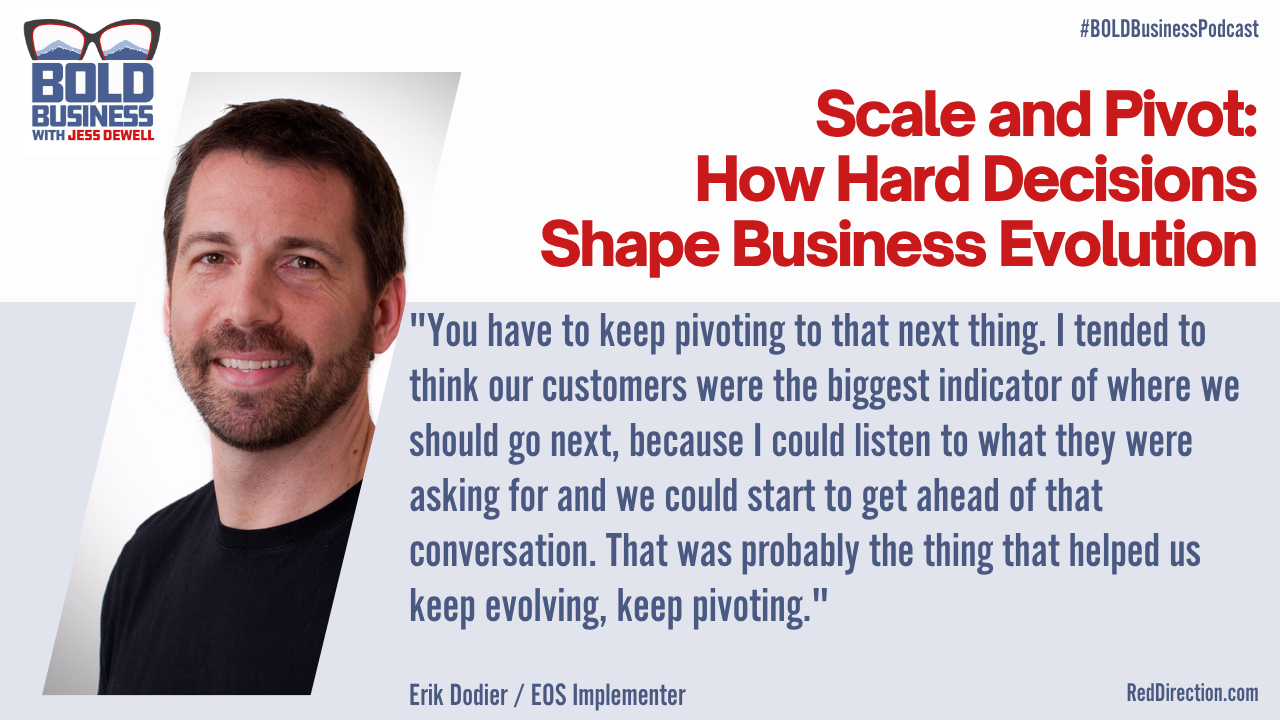
You got to keep pivoting. From 1994, we started out putting content on CD-ROMs to where we ended becoming a Salesforce partner. next thing. I tended to think our customers were the biggest indicator of where we should go next because I could just listen to what they were asking for. And we could start to get ahead of that conversation. And that was probably the thing that helped us keep evolving, keep pivoting. And then once we found the thing that we said, this is where we can stake our ground.
Jess Dewell 07:57
Before you continue, how long were you in business when you found that?
Erik Dodier 08:01
20 years.
Jess Dewell 08:02
Yeah. Okay. It’s a long journey.
Erik Dodier 08:05
I like to say we were figuring things out for 20 years, pivoting, moving, adjusting. And it actually took a really painful time where the business started to a bit contract. We were spread way too thin doing too many things, right? Because we grew up saying yes to everything. And what we really weren’t good at is saying no to a lot and then saying yes just to what was right for us. And then once we realized we had to decide what we were going to be great at instead of just jack of all trades, when we made that decision, the whole world changed, right? We started to go in all in on e-commerce in 2014 and 15. And we just, it becomes easier who you need to hire, what trade shows to go to, what technologies to invest in. Like every decision you make now becomes easier. And then we ran into EOS three or four years after that.
Jess Dewell 08:53
Okay. Cause when I hear what we decided what we were going to be best at, that makes me think of Jim Collins, but it also traction. Does traction cover that as well?
Erik Dodier 9:03
Absolutely. Yeah. EOS, when you build out your vision, they call VTO in EOS terms, there’s these eight questions. What are your core values? The second question is, what is your core focus? And it gets you to really think hard about what do you want to be great at? Why does your company exist? And then make every decision focused in that arena so you don’t get distracted because every company can get distracted by other offshoot ideas. And then the other questions, core focus, 10-year target, marketing strategy. Then you start working backwards, your three-year picture. one-year plan, quarterly rocks, and then your issues. And it really just captures big picture where you’re going, where you should be focused on. And then a very 90-day March approach to how to start to do what’s most important in the present time to move towards that vision. It’s masterful how it’s put together.
Jess Dewell 09:50
I’d like to pry a little bit, if you’ll let me. You had mentioned a difficult time. It took a difficult time for some growth to occur. And what you were saying yes to is like the beginning of an answer, I think. Was it true? Was it a pivot at that point? Was it truly a friction? How much of a break was there? Did you feel like there was a solution or was there a part you felt like, man, I don’t know if we’re going to make it?
Erik Dodier 10:15
Oh, wow. Your instincts are so good, Jess. Absolutely. When you’re in business for 20 years in a certain, the Northeast, my whole identity was in the business, right? At that point, we were involved with nonprofits. We did all sorts of things, but the business was always attached. And when it started to get a little shaky, I was really personally concerned. If we can’t keep this thing going, we were a services company, professional services. You’re always chasing that next client, right? You never quite feel like you’re out of the woods. You always feel like you’re one client, one mistake away. And I remember thinking personally, and I didn’t share with a lot of people that it was an emotional time. I’m like, this business, I can’t, I’ve built my whole identity around this business. I’ve got to find a path through. I’ve always been able to just continue to keep my head down and keep grinding. I had a great business partner. We still had a great team, but the times were changing. A lot of technology was popping up around us. We couldn’t keep up with everything and competitors doing things better than we were. And so what was happening is we were losing business to companies that were very specialized and we were more of the generalists. And what happened was I finally said to my partner, we’ve got to get specialized in something. And if we don’t pick, our customers are going to pick for us. And that’s going to be a painful journey. So we basically just dug in and focused on this e-commerce part of our business that was at that time our strongest part of our business and made a bet, pushed all the chips into that area. And that made all the difference from where we went from that point.
Jess Dewell 11:46
That’s okay. So you had some inkling that that was not even an okay way to go, but the way to go. And the only experience I have is personal in terms of business. I made business decisions, but sometimes it’s really hard to describe unless you’ve actually been in it. A lot of people listening and watching will have purchased or looked at or attempted to purchase some sort of real estate. So if I do that, when we were looking for our last house here in Kirkland, Washington, it took us four years. I hate to admit that. We started out too specific, and then we got too general. And then we found this sweet spot, and we came up with this phrase called A1, not the house, A1 house. So it was like a house that was number one at the same, could be both things at the same time. And that was how we got rid of some noise to really help ourselves out when we both knew what we wanted. We both understood and were on the same page. We got, when it came right down to it, we couldn’t get to the close in a lot of situations. We got in our own way. And if you apply that to business, heck, you were even saying it. There are a lot of things we were good at. There are a lot of things we were doing. I could see all of the things our competition are doing different or better than us. And I have been there. I totally can like personally relate. And so I’m guessing you had a few A1 solutions that ultimately e-commerce went out on. Am I sensing that right? Or was your process totally different?
Erik Dodier 13:15
The way we landed where we were going, it was a part of our business, but we just hadn’t committed to it 100%. We would say yes to that. And then yes to these other things. And eventually we said, you know what? We can’t do all of this. We can’t cover all this ground. and we just looked at the parts of the business that I think we liked the best, that we were really good at, that we loved the clients more. There were clear signals that this was the right direction for us. And once we got it to, we said, if we announced this to our company, this is where we’re going to go in all in on this. So let’s get it up over at least 50% of our revenue. And then we’ll say, Hey everybody, this is where we’re going. Because at that point, what happens is people will decide if they want to go on that journey with you, right? They may say, hey, and it did happen. A couple of boys would say, hey, we like doing these other things. We like building iPhone apps. We like building other applications. And we’re saying, we’re not going to do that anymore. And we ultimately let those people leave on their own or off board, which was painful because I bet for a year, I’d have someone come to my office that’s been with us for 10, 12 years saying, hey, I love you guys, but I got to move over here. And if not, they also were nervous because we could pull this off. So to change the engine on the plane while it’s flying, I think.
Jess Dewell 14:21
I think. It does take a certain kind of an employee to stick with a small company through that, for sure.
Erik Dodier 14:26
But ultimately, we were blessed to have a good core group that was in this part of the business. So they loved it. They said, yeah, let’s keep going. So I’d say a third were already doing it. A third made the transition to the new direction we were going. And a third off-boarded at their time. But what’s great about that is when you off-board those people, you then can hire the people into your new vision where you’re going. So it almost speeds up the process. The faster they leave that don’t want to go with you, the sooner you can get to where you want to go.
Jess Dewell 14:56
A real big blessing.
Announcer 15:02
Feeling stuck? Like, what got you here won’t get you there. The pressure to grow is on, yet the path isn’t clear. Yet. You don’t have to walk that path alone. This is the Bold Business Podcast. Like and subscribe wherever you listen. Your host, Jess Dewell, is the strategic partner you’ve been looking for, asking the questions that truly matter. It’s time to break the inertia and get the perspective you need to make your next move.
Jess Dewell 15:34
This is the Bold Business Podcast. I’m your host, Jess Dewell, and today I am talking with Eric Dodier. I do believe in serendipity and I do believe in the positive that comes from coincidence. And that is just that exchange of energy, right? And if the energy is such and the communication is such and the intention is such so that the priorities are this way, it’s very clear. I can be here or my journey here is done.
Erik Dodier 16:03
Yeah.
Jess Dewell 16:03
It’s hard to make, especially on a heart level and maybe even in a logical level, but the energy can make that happen. So we’re talking about a little bit of bottlenecks. Employees have their own bottleneck. Do we want to grow this way or not? You, as a company, we have bottlenecks. How do we want to grow? And can we be consistent with that no matter what? What are we going to commit to? So, in the role that you played, what were some of the places you ended up actually as a bottleneck, either consciously or subconsciously?
Erik Dodier 16:33
I think up until, say, 20 years or so, we didn’t have it figured out. The bottleneck we were is we, me, was not being super clear on what the vision of the business was, where we were going. I thought I was communicating it. I thought I was sharing it. I’m like, wait, I’m here every day working. Don’t they see me working towards this? Where are we going with this? And that’s something that when we ended up using it in our business, we got super clear on the vision. So not only did we pick a direction and we got started, the flywheel started to turn. That’s also when we found EOS and EOS found us and we said, wow, there’s a better way to organize all this human energy in this business. And that was the tools in EOS, like getting the vision super clear and communicating it, right? It’s not just enough to have one. It’s you got to keep communicating it. What are your core values? Where are you going? What’s your core focus? So we got that flywheel turning. Everything changed. It just started to, the business started to accelerate. We were about 15 million in revenue and 75 people after 25 years. In the next three years, we started using ESS. We grew that by like 5X because we just opened our aperture of how we could grow this business, including investment, including private equity, including merging other companies in that complemented what we did. It’s like sometimes we should stop worrying about how we’re going to do something and just focus. Okay, that’s where we want to go. We’ll let that unfold over time. That’s what we did. We set out this big vision and instead of taking 10 years, it took like more like four, three or four years to make it happen.
Jess Dewell 17:57
Were you writing down goals? Did you have some sort of a process and it just wasn’t as leveraged?
Erik Dodier 18:03
We used to do this sort of yearly plan and we create a picture and put it on the wall. But it was always it was done a little bit. I like getting employees together and let’s do some exercises and brainstorm and stuff like that. So we always were doing stuff like that, but it wasn’t cohesive and methodical of how we were going to get to those things, right? Because that’s the other thing EO has introduced is your quarterly rocks and setting your priorities and not trying to do everything all at once. And we probably were a victim of always trying to do too much, right, at the same time.
Jess Dewell 18:32
Yeah.
Erik Dodier 18:33
And if something came up, we got distracted, right?
Jess Dewell 18:36
That’s right. We have to find out, is there potential here for us right now?
Erik Dodier 18:39
Yeah. And that’s hard, right? You never really can dig in. So once we got more clear, tackling things, setting priorities, and honestly, just a better, healthier leadership team, honestly, has made all the difference, right? Getting leaders in place that could really own their areas instead of looking at me, like saying, hey, you guys, you know how to do this better than I can. You run with that.
Jess Dewell 18:59
And that changes your role, too. I actually think a lot of companies have these concepts of priorities, and I think you described it really well. I’ve encountered it in my own business. oh, that wasn’t clear enough because all of a sudden I don’t have a rock. I just have this big mess here and I’m actually not on track to meet my goal. And we got, so that’s an indicator, right? A clue that it’s not clear enough because it’s not solid enough. And one of the things I found was contribution from everybody makes it hard. So somebody has to take the role and go, yes, no, never, or yes, not now, never. And somebody has to go, here’s what is now and see what happens. And one of the things that I have found as hearing it all, and then having that decision made by a one to two people, maybe three, depending on the leader, the management team to take to the board, if there’s a board and all of that really comes down to me to be, That’s where any rifts will show up. And so there’s no way to diagnose or put the attention someplace else because whoever made those choices, that’s where the buck stops. It does it not.
Erik Dodier 20:13
The leadership team definitely has to set the big priorities, right? What are we going to get done? And then ideally, though, if the team’s bought in and the leadership team’s communicating, then the rest of everybody wants to participate in how do we help achieve those rocks? And so that everybody’s collective energy is all contributing, funneling up towards the common goal. But yeah, we tell the story. It’s like a team of people chopping a road through a forest. And someone yells up, oh, we’re making great progress. But somebody has to climb the tree and look and make sure are we going in the right direction? And that’s up to the leadership team, right? They need to make sure they’re sharing are we going in the right direction.
Jess Dewell 20:47
Going through the forest is very rarely everybody in a line together. It’s usually a trail.
Erik Dodier 20:53
Yeah.
Jess Dewell 20:53
One foot in front of the other, following. I think that’s a big part too. And that’s not to say there isn’t accountability and ownership and leadership in every single role. I think that makes letting the how unfold like what you were talking about, that’s truly how it occurs.
Erik Dodier 21:09
Getting everybody to understand where it is in the organization impacts the bigger picture is even another way to harness that energy, right? Because now everybody’s saying, hey, yeah, maybe I’m the delivery driver, I’m the warehouse person, I’m the salesperson, but we’re all contributing to this ultimate vision, right? And I understand how my role impacts it. I understand the things that I need to get done on a daily basis, a weekly basis. And it’s very clear lines, right? So that they don’t jump into everyone else’s role, right? Just because they feel like it, or, oh, I got to go jump over here and help this person out. Do your job mentality.
Jess Dewell 21:43
It creates a little, which by the way, is a better direction of resource, time, and energy for each person too, right? If I felt like I’m supposed to go help somebody else all the time for whatever reason, my work gets neglected and, or I get neglected or I’m unavailable for the things that people need from me to help remove the obstacles that actually make everything move forward. And I hear you loud and clear there. Thinking about what you’ve learned, and I know I’ve learned a lot too, not only through exit, but through mergers and acquisitions of acquiring companies and growing through down markets. I’ve got a lot of questions, but I want to know from you. I want to know, what do you think the top question that a founder, owner, management team is either afraid or wants to avoid asking when they’re truly sitting down to find out if they’re poised for future growth?
Erik Dodier 22:37
In their roles, and maybe the business has grown and you’ve outgrown some of the people or you’ve got some weaker areas it’s or you’ve got some people that you know maybe are causing more challenges than they should being able to have those conversations and then make hard decisions about getting people all in people right seats people being they believe in the core values of that business right they fit there they’re they just show up every day and go hey these are my people and then right seats are they in a job that suits them and that they get it and they want it, capacity to do it. I’m weaving in some EOS terms here, but that’s magic, right? We all will settle, right? Oh, it’s tough. It’s a tough job market. They’re doing 70% of the job. It’s fine. Just let them do it. And that I think is what a leadership teams can struggle with, or it’s probably what’s holding them back, right? If they’ve plateaued or stuck, it’s probably some people’s stuff in there below the surface that they’re not quite tackling.
Jess Dewell 23:36
I really like how you said that. They’re only doing 70% of the job. That is a metric disguised as justification. For sure. And I want to call it out because I think the thing, if it were flipped around, tell me what you think about this. So here’s where my mind went is someone is doing 100% of their job and is at 70% capacity. How is that different than only doing 30% of the job? Let’s keep the numbers the same.
Erik Dodier 24:06
Yeah. 70% of the job, the way I view it is there’s of the responsibilities that need to get done and 70% is getting done and these other 30%, whether because they don’t like to do those things, they don’t know how to do those things, they don’t want to do those, whatever the reason is, whatever that chunk is, they’re not getting done. And it’s impacting their ability to execute on that role. And if they’re in a leadership position, I should also say it’s compounds exponentially, right? So that leadership team that has managers down below or even on the leadership team that aren’t executing well, Now you’ve got compounding issues, right? But that’s people. And again, that happens because people outgrow. The company maybe has outgrown their ability to elevate up. Maybe they’ve taken on so much. They’re not willing to delegate down because sometimes the opposite happens. People try to do 130% and they can’t. And they’re not using their team. They’re not pushing down. So you have a manager that’s saying, I have to do these things because no one else can do it as good as me. So that’s equally as constricting, right? Because now they’re the bottleneck, right? They’re not executing on the job in its full capacity or they’re trying to do too much. And that’s causing them to struggle.
Jess Dewell 25:13
That’s interesting because I’m thinking about this and I’m like, I want my people to have capacity. I don’t want them 100% tapped out every single day, all of the time, day in and day out. That’s a sprint. Yeah. Because it’s easy. It takes one thing. It takes one thing to push everything else over. And then now we’re at a new level and we have to. There’s more to actually do than there is time or resources to get it done. And I’m thinking, and I know some companies, and this will be interesting to hear your take because this is all brand new. Some companies are like, oh, let me AI that. Whatever AI means to them, right? That’s why I used it that way in a little bit of a cheeky fashion. How do you feel about that?
Erik Dodier 25:52
AI is not going to help the person that doesn’t know the relationship side, the processing, the information side. there’s a certain amount of thinking about what AI gives back to you that you got to then eventually make a decision on. It speeds up the research, but then you get to execute on those thoughts and ideas within your business. You got to communicate those ideas. You got to get people on board with those ideas. You’ve got to figure out how to share those ideas. So I don’t know that AI might be a little bit of an accelerant to arrive at decisions or give greater choices or options to think about, But the execution of it, you know, is still the people moving that forward.
Jess Dewell 26:30
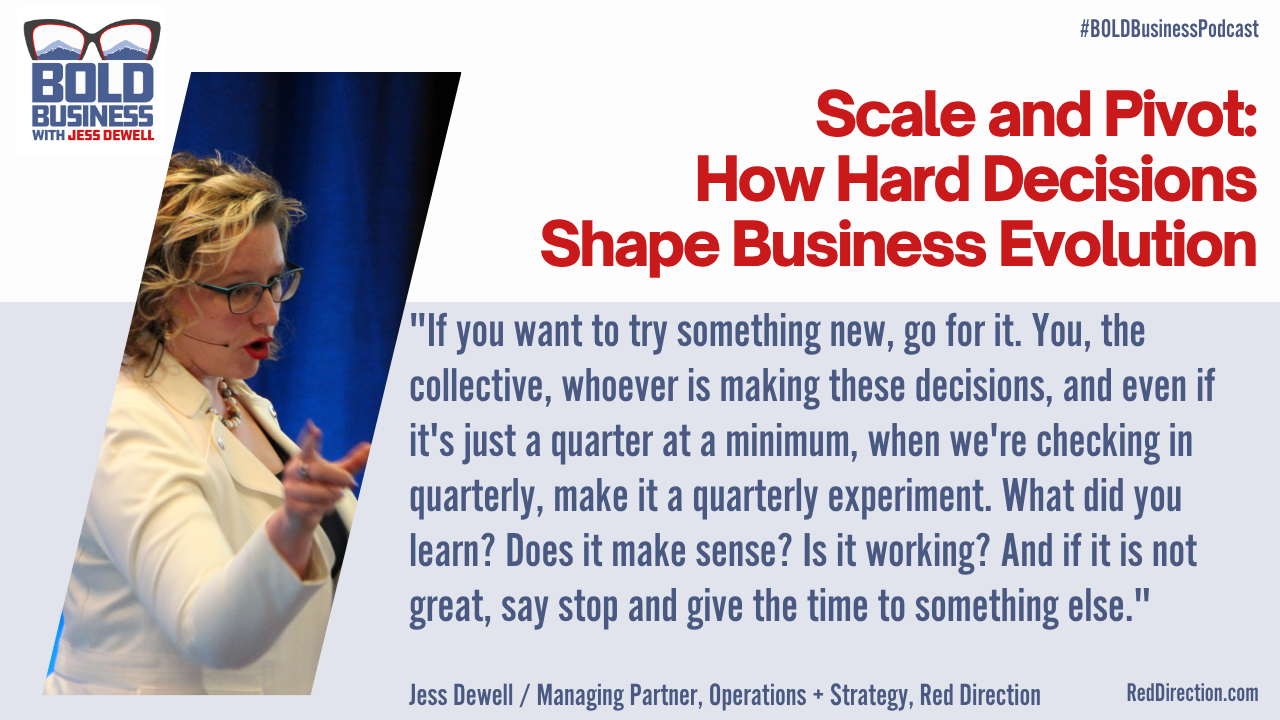
I think it’s fun. I think that being an early adopter in a company, regardless of industry, has its benefits because provided it’s okay to say no and let it go. Right. You had mentioned earlier you were part of a company that said yes to everything. By the way, I’ve been there and said yes to everything. And so now I’m thinking about all this cool time and all these neat things. It’s we can’t do all of the experiments. So which experiments do we want to do? And then my thought is, well, put an end on it. Because if you want to try something new, go for it. You’ll know, and you know what you, the collective, whoever is making these decisions, and even if it’s just a quarter, at a minimum, when we’re checking in quarterly, make it a quarterly experiment. What did you learn? Is it working? And if it is not, great, say stop and give the time to something else. It was worth an experiment that didn’t take up everything. But if we never say no to the things we said yes to, then we get into this trap of a really big problem for execution. Because it goes to what you said at the beginning, which you didn’t say like this, but I will. We got squirrely and we have all kinds of things going in every which direction. And we’re actually going nowhere.
Erik Dodier 27:41
There’s definitely an element of every once in a while, think about the things you should stop doing. Sometimes that’s even as individuals, right? I’ve done this for so long, I just keep doing it, even though it’s not adding value to anything in my life. Yeah. Or as a business, what should as a business we stop doing, right? Because it just isn’t serving us anymore.
Jess Dewell 27:58
Yeah. So have you ever, I’m trying to think about, we’ve been talking about execution here for a little bit. And how is having a strategy, being clear and communicating it different than having a habit of execution?
Erik Dodier 28:17
I think when you have a habit of execution, you just stay in the keep grinding mode, right? Rather than pulling your head back and going, we actually executing on the right things if i’m understanding your question i think when you have a strategy what you’re doing is you’re more tacking to the strategy like sailing a boat you’re never going exactly out of you’re doing these things you’re doing these things but you’re always finding your way there i think a habit of execution is what we had prior to having a clear strategy we just thought we were so productive that we’ll get to some destination but if you don’t know where you’re going any which on any old which way we’ll do i guess the expression goes but i think that goes deep, right? It’s, oh, we’re so good at doing all these things. These things really leading us to where a better business or a bigger business or the business we want to have that’s serving more people, whatever it is, or we just grinding every day. So I don’t think…
Jess Dewell 29:06
Every day is really hard, and not being able to stop that is really hard. Do you feel like that was part or most of the first 20 years of your journey? Was that a habit you had? You had a habit of grind today? I hear that in the present tense. [What’s that?] I heard that in the present tense, not the present.
Erik Dodier 29:25
I think now it’s more personally, like, all right, do I need to get up every day at five and go, I can adjust my schedule now. My world has changed a little bit. But in the business, we just started, we would just do stuff and show lots of productivity and win new clients and the win. And was it the right, we didn’t think, was these the right type of clients to win? Or is this is this kind of business good for us? If we want, great. More work. Let’s go. More work. And it led us to some good places. We got the business to a point where we could then strategically decide, all right, we’re now going to go in this direction. And some of that is early days of starting a business. You say yes to almost everything because you just have to.
Jess Dewell 29:59
We got to keep the lights on. Here we go.
Erik Dodier 30:01
But that’s the habit. That’s the habit. That’s where it forms early on.
Jess Dewell 30:06
Okay. So looking back, I want to know what are a few things that if you were going to do it all over again, you would do differently this time because of who you’ve become today looking at your past self?
Erik Dodier 30:24
Some of this is the lessons I’ve learned with EOS. I would get clear on the continue that make sure we’re being we’re filtering the type of people that join the organization instead of just all that they can do that task, just hire them, they can fill the seat, like you get caught up in trying to check the box, be very intentional about the people you bring in, be more clear about the direction of the business and communicate that. And then just continue to always find those right people and give them the responsibilities that they deserve to have execute on their role. I’m not one of these people that looks back and says, oh, I wish I did it. It all happens. It all goes a direction because it’s funny. I see people that build and sell businesses and it takes them like six, seven years, eight years. Then they try to do it again. That one fails and they lose everything they got in the first one. I think to myself, thank God it took me 30 years because if it didn’t, I probably would have done another one and I would have failed miserably. I’m actually looking back on the 30-year journey and saying it’s like a perfect window of time to take you from like your 25 to 50-ish window. And I’m 55 now. It’s because it’s like your life’s like in these four chapters. Your early years up to 25, 25 to 50, 55. Everyone’s going to live to probably 100 these days.
Jess Dewell 31:40
I want to be triple digits.
Erik Dodier 31:42
Yeah.
Jess Dewell 31:42
The last time I got a digit was when I went from 9 to 10.
Erik Dodier 31:46
I got to get a third digit. But this is like a whole new chapter of 25 years of just how can I enjoy this part? But because I see people that dive back in, they do it all again. I’m thinking, why do I do it all again? Enjoy the reward and take a different path. But everybody’s got their own path.
Jess Dewell 32:01
Oh, yeah. In my house, we got two paths. And because you look around at the community you built, you look around at the businesses that you’re serving, and I’ll look at the businesses I’m serving. And there’s a reason I jump back in. There’s a reason I go do that. And I have had spectacular failure. Yeah, let’s bring it. No, I really didn’t feel that in the moment. But looking back, of course, because we can control and we can influence.
Announcer 32:30
If your week feels like you’re being pulled from one demand to the next, this is for you. The Daily Grind is the number one killer of business instinct, pulling you and your team away from your vision. Reclaim your strategic edge with the Present Retreat. This free guide from Red Direction is a simple, powerful framework to carve out the space you need to filter out the noise, make the right decisions and lead with clarity. Visit presentretreat.com.
Jess Dewell 32:59
You are listening to Eric Dodier with me, your host, Jess Dewell on the Bold Business Podcast. Let’s get back to the conversation. Was there something that you did or ever that, because I did, and when you were speaking about what you had learned, I was like, oh, I did this thing and it was ridiculous. Was there anything you did out of a really good intention? And you look back and you were like, why the heck did we ever try that? And I want to know from a leadership perspective, right? Guiding and bringing people along more than a personal skill or something like that. Yeah. It’s funny. People ask, do you look back on a situation?
Erik Dodier 33:33
I don’t dwell a lot on because it’s, I always, my energy is always almost in forward motion, right? So it’s hard for me to then go back and go, oh, what was that thing I did wrong? Cause I probably never looked at it as wrong. I had an awesome business partner. We compliment each other very well. That was a great decision. Yeah. We had some little missteps with business to certain client things we did and so forth, but sometimes they would just, when you’re trying to get technical projects and all people work on the same thing and the clients are different and the timeline’s different. Some of that stuff just happens. It happens.
Jess Dewell 34:03
It sounds like we started our businesses about the same time. Our first businesses. I was 20 years old. I had never been in a management position and I had eight people and I was like, I got to learn. I guess everybody else is going to want to learn with me. So I turned 15 minutes of every staff meeting into help self-help book club. [Okay.] Nobody cared about that except for me. I did. And I didn’t listen. I’m like, we just have to have some practice at this. But after a few weeks, I was like, no. And I dug my heels in it took it after eight weeks. I was like, okay, fine. I’ll read this on my own and we’ll just try it. I’ll just try stuff out and we’ll figure this out. And that’ll be fine.
Erik Dodier 34:45
It was pre-EOS, but we had core values, but we did do an exercise where we tried to come up with, and it could have worked, but I don’t think I stayed with it long enough, but I would read books and I was a Vistage member and CEO peer groups. I’d come back with ideas. And I think after a while, Eric’s got another idea. But this one was about getting the core behaviors that you wanted to encourage. So beyond core values, how do you want people to act? And we would define them and we had these little booklets. And I remember thinking, this is great. This is going to tell people everything they need to know, what to do in any moment, act this way, do the right thing. And it was detailed in a booklet. And I just remember, I still remember seeing when we finally sold the business, I still had hundreds of these booklets around. I’m going, I don’t think that’s really stuck. I think it was a good exercise. If any of the employees are listening, they’re probably going, oh yeah, Eric, we remember that one. The 22 behaviors, whatever it was. And well-intentioned, it just didn’t.
Jess Dewell 35:43
I was like, I’m going to pretend I know nothing and learn with me. That was, nobody liked that. And I love that. You said 22 habits.
Erik Dodier 35:49
Yeah. I can see the booklet now. They fold it up into threes.
Jess Dewell 35:54
And that’s like I said, I wouldn’t have changed it because it’s actually who I was. And it sounds the same for you. Ooh, new idea, something that we can all grow together. Why not do something that makes sure we’re, that basically solidifies our path. It turns out one of us isn’t going to know what the whole path needs. All of us do.
Erik Dodier 36:08
I heard another, like sometimes things that are, I just didn’t probably stick with it long enough. Like an entrepreneur, I’m like, Oh, I’m onto the next thing. And they’re like, Eric, what happened to the thing we just did? And now, luckily EOS, we did, we put that in 2019, 18, 19, we sold the business in 2022, but that actually everybody loved. Everybody loved it. I don’t know. In fact, some people are like, Eric, thank God we put that in before COVID because like when COVID came, we all were, we were an in-office company because we had started way in the nineties. We went remote, but we used the EOS sort of tools and vision and metrics. I said, hey, no matter where you are, if you work at home, whatever, just stay focused on what we’re trying to do and your role. And it just kept us glued together.
Jess Dewell 36:57
We didn’t feel, yes, to not feel dispersed teams are very interesting and it’s very different than in-person teams. And so that’s cool that you found a bridge actually that was a positive, especially in a time of big struggle for a lot of people. Okay. So I’m going to go back to the other thing. How much, and maybe still today, right? Owning a business, exiting a business, working now with other companies who are growing and scaling. How do you know what’s in your control?
Erik Dodier 37:26
Me personally or the business itself? [Sure.] It’s funny. I probably over… A lot is… I’d like to think a lot is within your control. You have a lot of agency of what you do. The world is going to… Things are going to happen, but you have control over how you react to what’s happening, right? Do you just throw your hands up and give up or do you try to pivot and weave and move or do you got to go find a new team member do you got to find another client do you got to pivot to a partner so there’s so many creative things you can do to solve any problem I mentioned I was part of a business group and there was a gentleman in there and I remember one day he was going to lose his IT guy and he was at the end of his rope because he’s the IT person knew everything about the business right like IT people they’re so dependable. And another person says, just says, look, everything is figureoutable. But it was like, it’s fine. And I think we catastrophize these things that really you just need to think of a creative path forward, right? What’s the next best step we can take given the situation? And in that, if you stay in that mindset, you always have control. You don’t have control of what’s happening, but you have control over your reaction to it, your next steps, what you’re going to do. Are you going to get crazy about it? Or are you going to just stay calm? And that probably was a skill of mine. I was pretty even-keeled. That helps me manage these ups and downs.
Jess Dewell 38:39
That’s cool to know about yourself. And it’s cool other people see that in you too, Eric.
Erik Dodier 38:43
Yeah.
Jess Dewell 38:44
That’s really awesome. How many business model pivots? It sounded like switching to 100% e-commerce was one of them. How many pivots did you have in that 25 years of business model?
Erik Dodier 38:55
There were so many more early on because the internet was coming along and people over at least 45 or 50 is we started out the business to put content digital content on cd roms this is in 1994 and i started to go talk to clients and one day my client’s saying eric what about the web this web thing’s coming along we don’t want it on a cd rom we want on the web on the internet thinking oh darn that’s not what we started to do so i went back and talked to my business partner and he was the technology guy i was more of the sales guy he took a html 1.0 book home and basically read the book over the week and came back on mine and said, no problem, we’ll build websites. And that was the first pivot. That was only six months in. And so we learned quickly. I’m like, okay, we’re going to be adjusting a lot as we go.
Jess Dewell 39:39
I love that they weren’t really big pivots. That’s actually a really cool thing. And pivot as adjustment versus pivot as we got to figure out something new or else, right? Those are two very different things. And I appreciate how you’re using pivot as it’s a good reminder to say, hey, it doesn’t have to be drastic. It has to be open, aware, and we have to be curious about it so we know where we’re stepping next.
Erik Dodier 40:03
The later one was the bigger pivot specifically to this one platform technology. And by the way, there is a bit of luck that happens. The technology that we had selected to go all in on, it was this technology called Demandware. And it was a commerce platform for big brands, Sketchers and Echo Shoes and Stonewall Kitchen. And that’s why we love that. Bigger brands, bigger projects. The Salesforce ended up buying demand just as we went all in on it. And we’re like, this is either going to be really good or a disaster. And it turned out that all of a sudden, all this attention got put onto this platform. And we were one of the handful of probably a dozen to 20 partners, really, in the U.S. that were doing this in a meaningful way. So all of a sudden, big Salesforce clients were calling up saying, hey, we use Salesforce. They don’t know how to do the commerce piece. You guys know how to do it because they just acquired it. And so we were getting all of a sudden brought into the Salesforce conversation. And that’s the direction we finally went. We became a Salesforce partner, not really by choice, but because this company got purchased, we said, all right, we’ll go in that, we’ll continue. And we ended up, the acquisitions we did were two more Salesforce services companies that complemented what we did. And then we built this one larger company that was very attractive to an IPG, an interpublic group in New York, and they bought us in 2022. I think there’s one or two founders still there, but everyone is also living a similar exit on. But two of them started another business. One’s doing some consulting. They’re all kind of finding their own path.
Jess Dewell 41:32
It’s amazing, huh? It’s pretty cool. So what makes it bold, Eric? What makes it bold to admit that the way that you got to $10 million is going to be very different from the way that you reach $100 million?
Erik Dodier 41:46
I think what makes it bold is you have to have faith. You have to unlearn everything you learned that got you to 10 and say, it’s going to be a different, what got you here won’t get you there. And so I think you do have to make some bold moves. And they feel bold in the sense that it’s different, but it also feels necessary. Yeah, it’s bold, but it’s not because I’m brave or courageous. It’s just what we got to go do. Let’s just roll up our sleeves and go do it. And in that sense, I think people looking in from the outside are like, wow, you guys really went for it. You went all in on this one thing. And then took advantage of that opportunity, built around that one thing and complemented and took it from 75 people to 500 people. And Salesforce was booming at that time. This is in the early 2020, 2021, 22. People were investing heavily in digital because of COVID. COVID actually was good for our business because people thought no one was ever going to go in a store again. So everybody said, we’ve got to get everything on e-commerce. So all of a sudden we’re getting phone calls. Like, hey, we got to get our business really tuned up for e-commerce because no one’s ever going to shop in person again.
Jess Dewell 42:51
Yeah, it’s true.
Erik Dodier 42:52
We just rode that wave. But that’s it’s create your own luck is what you get to do sometimes.
Announcer 43:04
And that brings us to the close of another powerful and fresh perspective on the Bold Business Podcast. In today’s volatile landscape, growth is a double-edged sword. To truly thrive, you must engage with your strategy, not just react to the day-to-day. Without absolute alignment, your company faces a stark choice. Outmaneuver or be outmaneuvered. Grow or get left behind. Thank you for listening, and a special thanks to the Scott Treatment for Technical Production.