





As a business owner, it’s difficult to do the right work AND guide your company toward its next big initiative.
With Red Direction Business Base Camp, learn how to implement and handle processes to meet your business’s specific needs and better understand your market.

Starting the conversation:
Most mid-market companies hit a wall around year eight. The processes that got you here are exactly what’s stopping you from going there. This panel discussion is breaking the ‘future-proof’ habit and starting to execute for relevance.
Your Future-Maker panel is:
- Christy Maxfield, President and CEO at Purpose First Advisors
- Dean Barta, Founder and CEO at Barta Business Group
- Jess Dewell, Managing Partner and Growth Strategist at Red Direction
Listen to hear the difference between playing defense and offense, the unintentional throttling of growth, the power of curiosity, and how real accountability drives forward progress. With practical insights, from empowering teams and celebrating small wins to building a business that supports succession and growth, the insights equip you with tangible tips to shift your mindset, prioritize the right work, and cultivate a culture that commands tomorrow.
Your business’s future relies on your actions today. Each small win with a commitment to accountability accelerates momentum. Whether you’re committed to staying competitive or preparing for an exit, this episode gives you a BOLD perspective and actionable strategies to make your business a future-maker.
What You Will Hear:
00:25 The execution gap comes from shifting focus from future-proofing to future-making.
- Empower and explore what must happen instead of only preparing for what might happen.
- Risk mitigation is necessary, but intentional choices create options for the future.
- Playing offense—instead of just defense—unleashes creativity and innovation.
06:55 Be aware of hidden protective strategies within your team during periods of growth.
- Growth can be throttled unintentionally by individual choices—your team could be holding back without asking for help.
- Rigid decision-making and loss of curiosity lead to contraction and stagnation.
- Too much risk management and protection stagnates forward progress and creativity.
14:10 Creative time fuels future-making—companies must provide space for innovation.
- Intentional creative time, like Google’s or a “Dev Day”, invigorates employees and benefits the company.
- Autonomy and development for employees create future value for the organization.
- Making space for creativity is a choice, and structured development days drive rejuvenation and innovation.
20:50 Deconstructing rigid systems to create agility is necessary for organizations to grow.
- Frontline employees must be reprogrammed to accept and take creative space; this doesn’t happen overnight.
- Shared consciousness and decentralized decision-making beat rigid efficiency in complex environments.
- Vision holders must make time for clarity so others can experiment and innovate.
28:15 Transitioning leadership across generations brings fresh innovation, but requires trust in new approaches.
- New eyes reveal opportunities missed during prior optimization or future-proofing cycles.
- CEOs must make space, hand off leadership, and recognize when new guides are needed for progress.
- Next-generation leaders, especially in family businesses, challenge old ways and bring vital innovation.
35:55 Know what you’re working on—and don’t try to be curious about everything at once.
- Focus your curiosity; selective exploration prevents overwhelm and exhaustion.
- Celebrate small wins—learning something new or asking a different question is intentional growth.
- Staying on track means acknowledging the work and celebrating progress, not just big results.
40:30 Rest is essential for resilience and agility in future-making.
- Rest and repair are necessary to leverage the disruption created by innovation.
- Space between strategic sprints is essential—too much nonstop effort leads to burnout.
- Cycles of work and recovery, like training bursts and rest, are crucial for sustainable strength and future growth.
- 42:40 Chris Carter asked: What helps leadership teams realize they have achieved the shift to future-making and can avoid growth plateaus?
3 takeaways:
- Jess Dewell: Accountability and future-making are choices; using time intentionally, planning for curiosity, and embracing agility will keep you relevant, profitable, and valuable.
- Christy Maxfield: Create time intentionally, cultivate curiosity, and celebrate intentional disruptions to ensure relevance and business value.
- Dean Barta: Pausing for rest, fueling curiosity, and celebrating small wins are essential, and embracing these choices will build sustainable strength for the future.
Resources
- Dean Barta on LinkedIn
- Christy Maxfield on LinkedIn
- Jess Dewell on LinkedIn
- Fortune: 63% of U.S. entrepreneurs are planning to exit their business
- Corporate Visions: B2B Buying Behavior in 2026: 57 Stats and Five Hard Truths That Sales Can’t Ignore
- Responsive Decision Making
Transcript
Announcer 00:02
Welcome to It’s Your Business, brought to you by the Bold Business Podcast. This is your source for navigating today’s ever-evolving business landscape. In this program, Jess, Christy, and Dean share the realities of current business challenges and triumphs. Get ready to lead with depth, understanding, and achievement.
Jess Dewell 00:24
It’s your business. Today, we’re talking about the execution gap. We’re talking about how do we shift from future proofing, which is contraction, to future making, which is more of the innovation on an ongoing basis in this ever-changing market. The is that are larger than us are slow. Our competitors that are smaller than us might feel or accept a little more risk. Wherever we are on that scale, there’s this future spot just for us, and it’s up to us to find it, and that’s what Dean, Christy, and I are going to be talking about with you today. We don’t want you to be bogged down in what it takes to get to the future. We want to empower and explore what are the things that you can be doing so that in addition to preparing for what might happen, the focus actually is on what must happen and executing it. This is the place on the Bold Business Podcasts. It’s your business where we’re tackling risks to your business growth. Today, that focus is a real cost to you, and we want to bring you some practical tips to help you keep moving forward intentionally and together. And we’re gonna take a moment right now, and I want to all of us to introduce ourselves really quick, so we know who the voices go with as we’re listening and watching.
Christy Maxfield 01:39
Christy Maxfield, Purpose First Advisors. We help business owners evolve to build the future they want.
Dean Barta 01:46
Dean Barda at Barda Business Group. We serve growing small businesses with fractional CFO services.
Jess Dewell 01:52
I’m Jess Dewell with Red Direction, and I provide strategic guidance for CEOs and management teams that are in the process of leveling up what they want their growth strategy to be so that they ensure their company’s future relevance. Alright. Man, we could start in so many places, but I know we have an agenda and an outline, which is really helpful for the three of us because we can go anywhere, and if all helpful, just might not be on topic all the time. Right?
Christy Maxfield 02:17
No. Let’s definitely lean into the tool you spent so long creating. Let’s start at the beginning.
Jess Dewell 02:23
Sometimes it’s just a starting point, and that’s actually, I think that’s a really great place to start. Because we have a plan doesn’t mean it’s the right plan once we take the first step. Really.
Christy Maxfield 02:32
We’re only putting this up on the right foot. Now. Let’s be clear. It gets us off on the right foot because prior to us going live, we were just explaining how we could answer three versions of a question. It doesn’t even matter what was actually asked. We have three different answers to accommodate all the variations of what was actually being asked. So Yeah. We’ll do it.
Jess Dewell 02:52
Let’s do it. So let’s start with this. I know in our preparation, each one of us will have been thinking about this. So what and to the point of three different points of view, Christy, that’s spot on. So let’s talk about this, right? We’re talking about the need to stop future proofing and you having a guide, creating this guide to future making, And so each of us, I’m sure, has come up with a statement or a thought about this. Right? What is this point of view we’re coming from? What are yours?
Christy Maxfield 03:23
Well, mine, I reflected on the fact that I actually have written that blog post of how to future-proof your business. Me too. And, and I’m sure you have and other people have, and we’ve read those posts. And at the same time, it is that mindset shift from how do I protect what I have, which is important and necessary. Don’t get me wrong. Risk mitigation is a really important part of your responsibility as a business owner. But then how, rather than being subject to the whims of the futures that might evolve, really taking responsibility for deciding what future state you want to create for your business, consequently, what kind of future state you wanna create for your life, and then making intentional feel like for me, for helping business owner with the end in mind is that I’m helping them make intentional choices so that they have more options in the future, and that it’s not just one outcome that becomes inevitable because of limiting choices they made early on. I want them to make choices early on that give them as many options as possible along the way.
Dean Barta 04:28
Yeah. I, I agree with that. And my first thought, because I am a sports mindset, of course, is the difference between playing defense and playing offense. And are in a sports team, if you’re playing defense, you’re preventing scores from happening or your risk management, whereas offense, you’re trying to create, and there’s usually a lot more creativity involved in innovation happening on the offensive side. So that’s my, maybe my, probably not the only sports analogy I’ll have today, but that’s what came up for me.
Jess Dewell 05:03
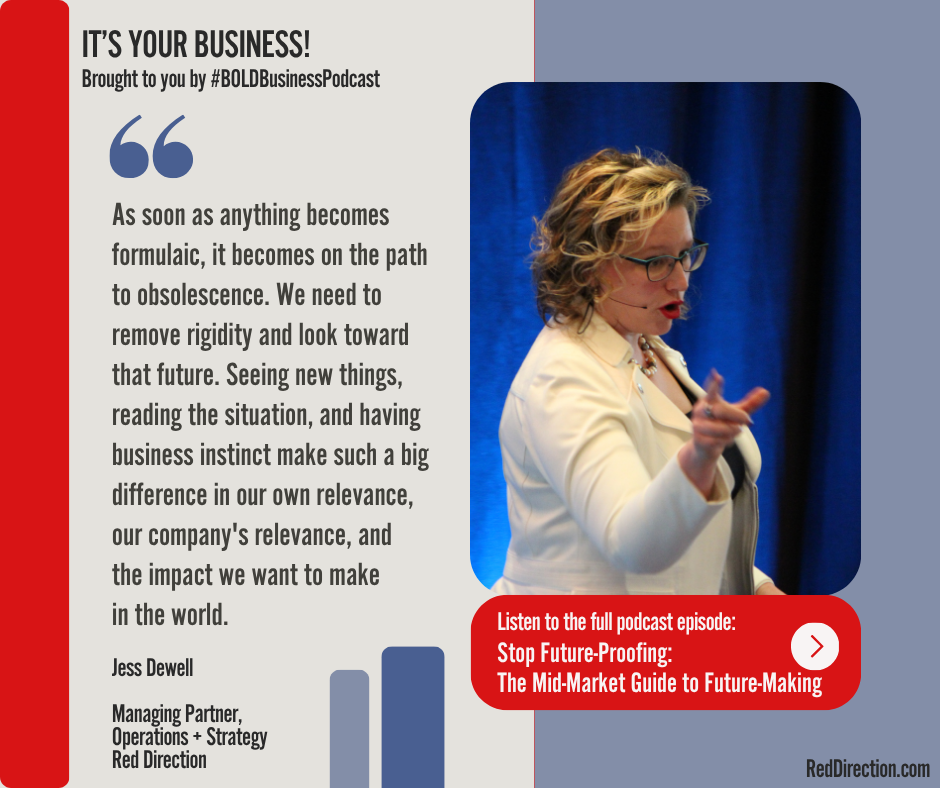
Alright. And as I was thinking about this, I’m really thinking about agility and how we’ve resilience has a range of meanings and it also has become so specific that it is actually a rigid word, even though we think about it as bouncy and adaptable and flexible and all of those things. So how do we move in? How do we make it really resilient versus what resilience has come to mean? Because what as soon as anything becomes formulaic, it becomes on the path to obsolescence. And by the way, in our past conversation we’ve had, we have said that about the CEO role too. So let’s just be real about this and where we have the we need to remove rigidity and looking toward that future, seeing new things, reading the situation, and having that business instinct makes such a big difference so that we are working on our own relevance, and our company’s relevance, and the impact we wanna make in the world. Well, and so we’re talking about three sections here, right, with these three points of view, three sections, I think we have a theme going on, that’s cool. The first section we’re gonna talk about is the future-proof fallacy, and it’s about a mindset shift. The second is gonna be execution over optimization and this is gonna be what we’re doing in action. And the third is commanding tomorrow. This cultivating that shift and we’ll be talking about, we’ll probably take a few detours along the way because that’s how we get good deep conversation. So here we go. So right into this first step, how do we break that future-proof fallacy? Right? We talk about protection so that we can keep going forward. We talk about protection so that we have that runway to pay our bills or to have this or to achieve that or to invest there. But then what happens?
Christy Maxfield 06:53
Things can stall out if we’ve figured out how to do it the most efficient way. We probably aren’t innovating as much as we could or should, and things can really plateau. So I think when I was thinking about this phase, I’ve had the experience with some clients where there’s an unintentional throttling of growth, and it comes from a sense on the team that there’s more work coming than we can handle, and you have to either make a proactive choice to expand capacity, or your team will make a reactive choice to protect themselves and their workload and their sanity by throttling back the amount of work they take on. So that might show up at phone calls that don’t get returned as quickly or conversations that are is not as deep or as thorough with client, maybe less upselling, maybe less cross-selling, more about the efficiency of getting the work done rather than the out seizing the opportunities to grow with those clients and outsource and resource different things. For me, that’s what I’ve been noticing lately is that when you have that employee who you say looks like we’re getting a higher volume of business, that’s directly impacting your workload. How is everything? And the answer is, I’m fine. I’m good. I’m fine. I love all this. I love being busy. I love having lots of things. I love switching all the time. Great. You tell me you don’t that tells me you don’t really want me to take anything off your plate, but I also know that it when you have too much, rather than asking for help, you’re gonna do other strategies to try and protect yourself, which aren’t necessarily in our best interest. So really digging in when it feels a little too comfortable to just take the I’m okay. I’m alright. I’ve got it, I’ve got it handled and examine that for whether or not that’s an actually a protective strategy that maybe you as the owner aren’t even taking, but your employees are taking unconsciously on their behalf.
Dean Barta 08:50
Yeah. And I think is if a company is making decisions based on mostly on fear and risk management, which it’s important to manage risk. But if the majority of those decisions are that, it’s the difference between future proofing and future making is, yeah, you still acknowledge risk, but you’re doing something different about it. It’s there’s a lot more proactive moves. And so that’s one indicator I’ve seen is it’s all about protecting, protecting, which really can stagnate creativity in moving forward.
Jess Dewell 09:27
Yeah. The way we make decisions is coming up for me here, and it goes alongside what both of you have said, Christy and Dean, because when we make decisions, we are optimizing it. We have a way we do things here, the way we do our work. When that is something that can that we’re starting to see people opting out, we’re starting to see ourselves go, that’s not really relevant here, we’ve lost our curiosity, and that is where I know I really look to contraption can be on by choice, and I know in our description we talk about that as let’s cut costs, let’s do cost savings, how do we do all of that as a future proofing mechanism? And here’s the thing, we actually become stuck and rigid when we don’t stay curious in our decision making process because there are so many right ways to do things, and what I love about this time more than anything else is that while there’s always been many right ways, there are more many right ways that will get you to where you wanna go as a in an organization, on your personal professional development, or guiding your team through a project. And so listening becomes a bigger part of this, and so when we’ve optimized the way we engage with each other, it’s also a limitation. It becomes a constraint to be aware of in our world, and that’s what comes up to me just like our old technology that can’t update anymore because it’s forced obsolescence because the operating systems just don’t support it. Right? Our phones eventually do this and all of that. The way we do things interchangeably with each other is impacted more than ever before that way and not in a bad way. In a way of, wow, how do I pause in and say, oh, there’s something else to think here. Oh, there might be a question to ask here instead of just going, here we go, because we gotta get there the way we gotta get there, and these are our constraints, and this is the way we’ve always made decisions. So I would challenge and add to that shifting a mindset could be as simple as how do we engage one other possibility that would seem out of the norm for our company to do when we’re making those choices?
Christy Maxfield 11:38
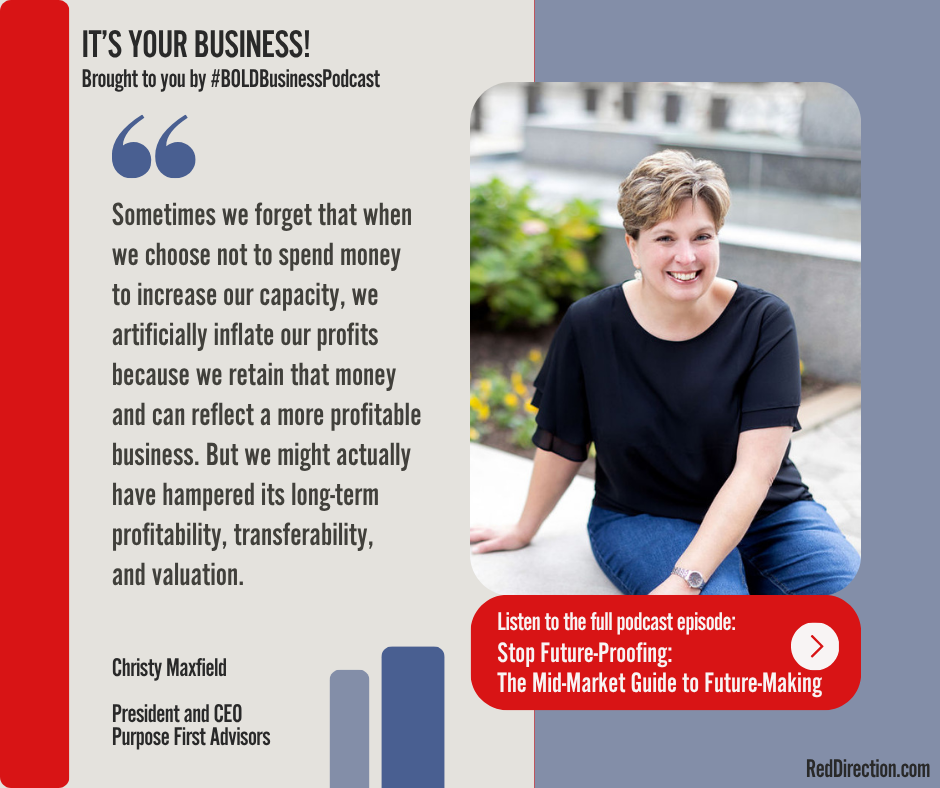
Yeah, and I think sometimes we forget that when we choose not to spend money on increasing our capacity to take on new work or to do work differently, even in the adoption of technology that might actually require fewer people, right, things like that. But when we don’t make those investments, we artificially inflate our prop because we have retained that money, and we can reflect a more profitable business, but we actually might have hampered its long term profitability, its long term transferability, and certainly its long-term valuation. So that those decisions that are deferred, those the failure to be curious and interrupt the old patterns we have about when we decide to bring on new people, how we decide to invest in new technology, what’s most important for us to grow not only now but in the future, then we really we have an artificial view of what our business is capable of and how it can grow and whether or not it’s actually as successful as we think it can be From the standpoint of bragging rights, the standpoint of, am I creating what I need to support my family, my employees, my community in the way I want to? I’ve shocked them into silence.
Dean Barta 12:56
Hard to do. It’s a drill.
Jess Dewell 12:58
I know. It is hard to do.
Christy Maxfield 12:59
But I’m very impressed. I just had to point it out.
Jess Dewell 13:01
Yeah. Okay. So, let’s talk about this. Think that there’s so many places that we can go here, and I know So, I’m thinking about this, okay, all the words really do wanna come out all at once. So some people would say, we’ve gotta reduce complexity, we can boil everything down, and I think that’s true when we have time, and I think there are some things that we don’t have time for anymore, and so for us to boil it down, we have to prioritize our own thinking time instead of the doing time at a certain level in our organizations to ensure that we are able to look forward, that we are able to do this because you know what comes out of that? Is accountability. Where do we put in processes so that we can be accountable to ourselves, to our teams, and our teams to each other, and to their own individual work? And so this is where I think the door opens into this other opportunity of this path of future proofing moving along to future making. It can only be done with accountability. Instead of doing more, being optimized, or cost savings, it’s how are we doing it, and what are we building, and how intentional can we be?
Dean Barta 14:11
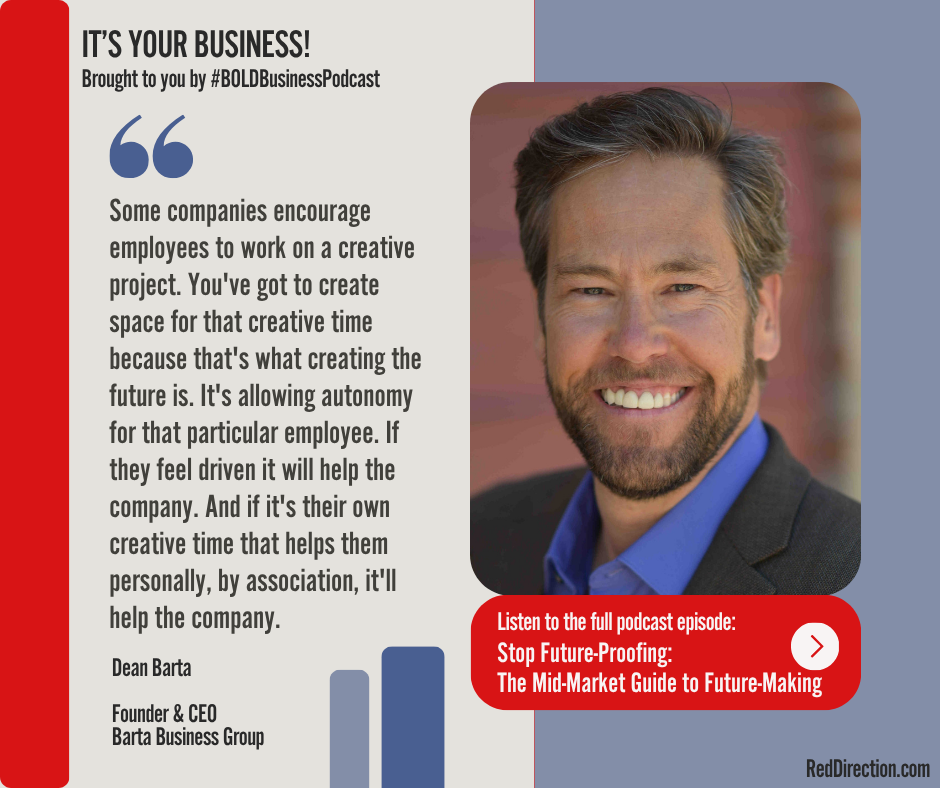
Yeah. Popped into my mind is basically creative CEO time, but we’re all aware of there’s I can’t name a company right now that but they’ll encourage employees to work on a creative project for four hours on a Friday or something like that so that you’re still taking care of what needs to happen, say, in your job function or as a company, that there’s you gotta create space for that creative time because that’s what’s creating the future but fueling the creativity is fueling the future. And once I remember what this company is, I’m thinking of my whole reach.
Christy Maxfield 14:52
Google does it.
Jess Dewell 14:53
I wanna see.
Dean Barta 14:54
Yeah. Google does.
Jess Dewell 14:55
They have a lot of programs that were around for a long time, and I was really sad when the projects went away. But they were really cool, and they were somebody’s pet project. And they turned around and had hundreds of thousands of users, and you still have to make a decision to end those. I have a client that does right now that does that. She and her company has decided to call them Dev Days, so you, you’re taking a half of a day or yep. A half of a day on some rotation, and you are investing in your own development. You’re investing in rejuvenation. You’re investing in a side project idea that would help the company based off of their bigger roles, and it’s time dedicated that has the expectation is whatever you make of it.
Dean Barta 15:35
Right. And that’s how innovative is that? Because it’s allowing an autonomy to happen with that particular employee that, hey. If they feel driven that it’s gonna help the company, great. But if it’s their own creative time that just helps them personally and wish really by association, it’ll help the company because if that makes for that creative time makes for a better employee that may translate that creativity that creative project for their own their own personal interest, it may translate into creativity on the job.
Christy Maxfield 16:11
And I think that reflects a choice from a values perspective. So if we think about business owners making decisions from their values, if you value creativity and innovation and curiosity more than you value being optimized and as efficient as possible, and you’ll create those opportunities. Jess, you then said something earlier of we can deal with complexity if we have time. And I would say time’s not sufficient to deal with complexity, and we actually can’t really make things less complex. And it brings me back to the book Team of Teams by General Stanley McChrystal. And he basically said, we were optimized to fight a war when he he reflected on his time in Iraq and Afghanistan. We were optimized to fight a war we were no longer fighting. So even though we had all the money and all the resources and all the techniques and all the training, we were being outmaneuvered by a small, more agile, more responsive force. And his analysis with his coauthors was what we really needed was a shared consciousness of what was going on and a decentralized decision-making structure because that beat efficiency. And what I really appreciated was him taking the reader through the history of how did we get here with the advent of the assembly line and the emphasis on reducing the amount of time per task but not increasing the amount of knowledge across the organization. And we’ve all we’ve designed this system, and it works really well until it doesn’t. And so then being able to step back and understand what parts of the system no longer serve the environment we’re in, and right now we’re in an environment where it is we are unable to predict what things will trigger outcomes that we have not yet imagined. Things interact in such a complex way and without a clear point A to point B that we have to have this shared consciousness and this decentralized decision-making structure if we hope to survive the complexity that we live in today, and that’s really stuck with me.
Jess Dewell 18:16
I think that’s really powerful, and to get to that, I’m gonna just go from there, to get to that point took time and energy and a lot of thought, probably with a lot of trial and error to be able to articulate that and find this is the point we’re at. We’re doing something and it’s not the right thing for this, we have the wrong tool here, is basically what I heard was a one way to take away what you were saying, and so to tie that back, yeah, if we don’t have the time, it is up to whoever is that vision holder, whoever is in charge of that growth strategy and what the priorities actually are, to make their own time to say it simply so that others can go be creative and curious about it because…
Christy Maxfield 19:00
And to create the time to explore a new way of operating.
Jess Dewell 19:05
I will say think they come together, yeah.
Christy Maxfield 19:06
If I represent the author’s intent too, it’s like, he had to take the time to deconstruct something that was meticulously built, reconstruct it in a new way, and test it real time in your situation in order to figure out how this would work best in the environment they were now operating in. And to Dean’s point, you we could think of decentralized decision making based on a shared knowledge base of what’s going on as permission to be created. That when you’ve encountered something you absolutely have no frame of reference for, but enough about what’s going on and what the goals are and what we’re trying to achieve and what resources are available, that you, on the fly, in the moment, can rearrange those things to get the desired outcome you want. That’s creativity in its rawest form, and unless we help people practice that on a regular basis, we not only are not optimized, we wil,l we will grind to a halt. We won’t even have the chance to be resilient because we will be quagmired.
Jess Dewell 20:07
By the way, all of you listening and watching, I think you might have followed along if you remembered the three points, but we moved from the mindset shifts, what that was, right into the execution over optimization and getting into the action. So I’m gonna just do a quick pipe in of, Hey, we’re here now.
Christy Maxfield 20:24
Even when you didn’t follow the common threads that we like, I thought we wove them together beautifully, but things That’s were so right. I.. Exactly.
Dean Barta 20:33
You mean there wasn’t a queer Hawaiian departation between adventure transition point.
Jess Dewell 20:38
And markers that are laying on the ground who don’t actually know which way the trail goes when you have free options. So I’m just helping us along the way.
Christy Maxfield 20:46
Thank you. We need a guide. We need a sherpa.
Dean Barta 20:48
Oh, and that’s the way, Christy, you describe it is deconstructing and then reassembling in a different way. Because, yeah, it’s there’s a reprogramming that happens with this. Not the visionary or leadership team, but it’s a reprogramming. You’re a frontline employee. Right? Because they’re used to doing it a certain way. And, and we just all of a sudden change. Okay. You got four hours of creative time on whatever day to, to work on something. There’s a there’s a a transition time that occurs. It’s not like it’s gonna magically change overnight, but it’s basically providing the space for that creativity.
Jess Dewell 21:30
Yeah. And that is such a I think about execution, and I think about priorities, and then I think about these stats that are wild to me. So I’m just gonna throw out two stats right now because both of these relate to our conversation, so not sure where we’re gonna go from these. But the first stat is that sixty three percent of entrepreneurs in The US are planning to exit their business, and as of March 11, in relationship to this weeks ago, they are looking more and more toward the fear of or despite, excuse me, despite tariff fears, despite recession warnings, and despite all of the other fear that that you hear about out there, entrepreneurs are more optimistic than ever, and I think that’s an interesting thing to latch onto. We’re not alone in our optimism and we don’t just have to be scared, and I like that. And the second piece, right, so that’s one side. Where are we going as businesses, entrepreneurs with businesses? And the other side is where are we going in relationship to our own relevance in our company? And that comes back down to a stat that a few years ago I had a conversation about sales, and it was something like seventy six percent of customers were dissatisfied with the service they got during and after their purchases, and as of 2025, that’s went up to eighty one percent. Eighty-one percent of people and businesses are dissatisfied with the process of getting their product. We have nothing but opportunity here from both of those stats. That’s all I see.
Christy Maxfield 23:03
Yeah. I wanna make sure I understand. So 80 of the people aren’t getting the solution they need or want for the problem they have.
Jess Dewell 23:10
Or they don’t like the way they’re acquired.
Christy Maxfield 23:12
Or they don’t like how it’s being I think it’s that.
Jess Dewell 23:14
They don’t like the way it’s being acquired or what they have to do to keep it or all of those types of things.
Christy Maxfield 23:19
So we’re optimized for something that nobody wants us to be optimized for anymore. So that the opportunity is to reinvent how we do that. And then the first statistic you cited, what did you say 63% of the those entrepreneurs plan to exit in the month? And so I would say and what as the question is, have they actually designed the business to be exitable? Meaning Right. Do you have can they actually sell it? Can they go to market and have a reasonable expectation of selling? When we know that about 80% of those businesses that go to market don’t sell. And so they are now anticipating a future that they may not have been actively working to create. And without time, it’s very hard to create up those options in the moment based on wanting to do something now that maybe you didn’t wanna do before. Yeah, I could go into that 63% statistic from 16 different angles, so I’m gonna control myself, but through a
Jess Dewell 24:21
link, Fortune, it was from Fortune that I got that stat, so that’ll be in our show notes just so everybody will be yeah. I’ll have a direct link.
Christy Maxfield 24:28
But, yeah, I think but just briefly, I think it shows optimism because if people think they’re gonna sell, then they must think there’s people who wanna buy, and those people must believe that there is a way to continue to deliver value that will make the business sustainably profitable in the future. So that screams optimism to me from that viewpoint. And I just wonder how many of them created that future. How many of them have actually designed the future they want, which is one in which they can sell?
Jess Dewell 24:55
Yeah. And, and I really think that’s important because I think you can sell more when you are prepared. I know I have been through at least two cycles where there were buying frenzies in different industries, and it didn’t matter what the business looked like. It mattered the top line revenue, and it mattered the profit, and it mattered the clients, and the rest of it didn’t matter, and I think that there was a difference between the positioning in how much you could demand and say this value is actually here from those that were prepared to not. But we are in a time where there are industries right now that people just are going that companies are just going to start acquiring because we if we are moving toward recession, that would make entrepreneurs optimistic because the quickest way to get your revenue up is to buy other companies.
Christy Maxfield 25:40
Yeah. Dean, go ahead.
Dean Barta 25:42
Business brokers is that I work with too is actually one of the hottest businesses for private equity firms buying our HVAC businesses.
Jess Dewell 25:52
Right now. Yeah. Oh, yeah. 100. And communication companies.
Dean Barta 25:55
Yep. Communication. Yeah. So, yeah, it’s and gosh, I saw yeah. I think it was on another podcast that, that because of AI that in five years, plumbers or trade service, could be being paid or have a higher demand for them than lawyers.
Christy Maxfield 26:14
Easily. And I just saw where they ran a tax filing through AI, and AI actually found $20,000 that the CPA missed. And the CPA was still needed to check the work, but for all intents and purposes, the AI did the return with the same fidelity, if not more than the human operator. So yeah. And those so that that changes the economics of either buying into, building up, or exiting from a business in that industry. But there will always be a strategic buyer who will pay for stuff that’s not well designed, depending on the industry.
Jess Dewell 26:53
True. And I would add to that that again, there are so many right ways these days that there’s not just one way to be ready to be purchased, or there’s not one way to go out and acquire a company in terms of how are we looking and what is that right fit. And Yeah. So I think whichever path we take, the more preparation, the better the outcome on both sides, no matter what.
Christy Maxfield 27:15
There may even be more challenge in that the for those owners who wanna keep the business in the family, don’t want to sell, are they building it to support as many family members as it may need to in order to do the transition they wanna do on their timeline? So if dad the business and mom works in the business and now the kids are in the business and mom and dad wanna retire, have you actually built a business that can support two retirees, their replacement, the children who are taking over leadership, their retirement savings, the employees that you need to keep operations going, and the profit you wanna make from it. Right? So that’s not even will somebody come in and buy. It’s can the business handle the load you’re putting on it and expectations? Was it built just to support mom and dad and two kids, or was it built to support mom, dad, new hires, kids, retirement savings, and growth in the future? Those are two very different businesses.
Dean Barta 28:14
And, Christy, you probably have seen this too. Let’s say that transition happens where it is given to the kids, and I’ve seen this again, whether it’s the skiing industry to is or it could be a in the trade service businesses too. The next generation, they come in with fresh ideas. Say mom and dad did it a certain way that served them for maybe thirty years, and really, the next generation has really taken it because it’s through that innovation, through that creativity that they might have part of the motivation might be is, hey, we’re not gonna do it the same way that mom and dad did in the business. So that may be one motivation, but they just come with a fresh set of ideas because there’s you know, they grew up with tech technology, and their parents probably didn’t. So I see and then you see where the next generation doesn’t and the business creators. But my experience is, boy, the next generation comes in. They are already on, or they seem like the ones that are really moving and shaking. They’re on that that future making, innovation, creativity track.
Christy Maxfield 29:24
They all a 100% are. If for no other reason than when new folks come in with new eyes, they see opportunities that those of us who have been optimizing and future-proofing simply are blind to right now. And then the question becomes, how quickly can one generation successfully transition out and be able to give that new generation the space it needs to be innovative? Because a lot of times, that’s also perceived by the older generation as being reckless or irresponsible or jeopardizing what would they spend so much time and energy building. So that brings in a whole emotional piece and also values, like values of protect and preserve run up against values of expand and explore. And neither one is necessarily the right or better, but they are two very different worldviews. So if we can acknowledge that the founder was at one time the future maker, and now they are in future-proofing mode. They have other goals and aspirations, and they are making decisions accordingly. So when can that power shift? Really fascinating in terms of what it means for the business, but also what it means for the family. Yep.
Jess Dewell 30:37
And sometimes then just an out exit or a stop of one generation to the beginning of a new generation through an internal family sale for that matter, because now I’m thinking about businesses that I’ve been working with which are tend to not be tend to not be family businesses very often, and what I’m experiencing just with mid market companies is that we have the we have CEOs that get to the end of what they know, and CEOs and executives are bringing that knowledge along. And when they run out of the knowledge that they have on that path, it’s time to hand off everything to the next set of guides, the next set of people with the next set of experience to take off that next path. And there this relay exists, and this is something I’m really excited about where we’re at, and I’m really excited about being able to bring in accountability in new ways, and figuring out where the stop gaps are the way we do things, unwritten agreements, competing priorities, distraction debt, all of those things, we actually have more control than we think we do over, and we can become the leaders that take us as far as we want to go, and when we are that, we when we get to that destination, we have a choice. Maybe we bring in additional help to get us, maybe we step out of the way, and yes, all of those other things happen, I just think that we have this opportunity here for we’ve where does accountability, and without that accountability we can’t find the distraction debt. We can’t find all of the operational noise. We can’t find competing priorities, and because it’s just the way that we do our work with no question. So breaking out of that, it is an execution piece, and to execute well with forward movement does require accountability at every step, every day, and me and I will tell you what, I’ve been practicing some things just in my own development, and some days, I’m like, Stephen Covey, why did you tell us to be a beginner once in a while? I’m feeling like that 500 times a day right now. Could I have a break? And it feels like that some days. It feels like that some days, but here we go, and then it’s and that’s okay, so we’re, we can meet it, and I am, every single day, I’m meeting it. Okay. I’m gonna be a beginner at something today, or I’m gonna be Monday is yesterday, my present retreat. I was in it and I was thinking something, and I had this idea, I went and I did a little research, and I was like, do I start all the way over? No, I’m not starting all the way over. I did some work and I got some new information, I’m not going backwards, I’m just making a new start line for where I am right now with the information I had, adding new information, and building from it. One step at a time. We don’t have to go backward to be making progress. We don’t have to go backward to get those leaps forwards. We just be where we are and accept it, and ask a lot of really good questions, and have people like us that business owners can call, that executive teams can call and say, hey, I’ve been thinking about this, what else should I be thinking about? Hey, what have you seen? Hey, is there some extra information I could bring to this table to make sure whatever work has been done can continue to have that forward progress, whether it’s little steps or big steps. [Yeah. And I don’t know about you, but]
Christy Maxfield 33:55
I was gonna say, Dean, I don’t know about you, but a lot of times also the call I get is this is really hard and this is really uncomfortable, and I need you to, like, help me stay in the discomfort of this new choice that I’m making. Yeah. And talk me down or talk me through the staying the course and experiencing that discomfort. So everything Jess has described is exciting and very disruptive to the individual who’s accustomed to doing it their way and not constantly looking for new beginner opportunities. So, Dean, where do you see that in yours? Because I know I get those calls of, oh, god. Just please tell me it’s not as bad as I think it is.
Dean Barta 34:39
I just said the anticipation is I just flat out just tell, this is gonna be tough. And, and it too, because I’m certainly not gonna blow sunshine up their South End because that doesn’t, but let’s say it’s a workout program or whatever, but it’s, it used the work has to be done, but it it’s how can we make this where it’s not drudgery, but there’s a a curiosity and discovery. I think that’s what Jess is talking about is you’re in that beginner phase, but it’s a curiosity stage. I think just in my life is, like, when I’m constantly in a curiosity or I’ll put it in like, every day there’s some adventure that happens, it keeps me engaged. And so accepting that, okay, these changes are gonna be will take work. Okay? They can be perceived as difficult, but at least they just take work. And but just be fueled by the curiosity. Be fueled by the uncertainty of it. And things you thought were uncertain today, ninety days from now, you’re like, wow. I thought that was so uncertain. I was worried about it, and I’m like, it’s already it’s old hat, if you will. So, yeah, it’s, it, it but that’s that’s essentially, I’m not saying that’s growth. That’s growth.
Jess Dewell 35:53
And I guess to have a choice to do not 10,000 things at once. I’ll be real. Is a lot of new stuff happening, and it’s by choice. And some of the things that come up to actually practice this concept of what I was like, I wanted to practice and make sure I was really prepared for this conversation today, and if we actually do that, it can become overbearing. So it comes back down to, let’s talk about commanding our tomorrow. Let’s go into this third section of what are the practical tips? And the practical tips are know what you’re working on so you’re not curious about everything because you will run out of stamina, and it can become drudgery. At the same time, that just is really awesome in relationship to the acumen that we have and where we want the data that we need for the decisions that we have to make building that business instinct to hopefully be part of the 19% of people who actually are satisfied, and we’re our customers are that 19%, not the 81%. Did I do that math right?
Dean Barta 36:55
Yes, you did.
Christy Maxfield 36:56
You used I no idea. It Did it come out?
Jess Dewell 36:58
Don’t do You noticed I was mapping in my head, Dean? Well, damn.
Christy Maxfield 37:01
No. No. That’s not happening.
Jess Dewell 37:04
That’s great. So practical, right, the practical piece, I’m just I just started out. Hey, the clarity of where we’re going, what our growth strategy is, and what our priorities are become more necessary than ever before for discernment of doing the right work. So what can we say no to? Because if we’re gonna be as curious as if you want to try being as curious as what we’re talking about here, be very selective. Or it’s tiring. I can tell you firsthand practice. What not
Christy Maxfield 37:31
for me. And we’ve all had the visionary in our life who is constantly coming up with a new way of doing something and rethinking something that already works and trying to optimize in some different or experiment in some way. I think that to your point, Jess, of what are the priorities and why are those the things we need to focus on right now and test and get data from and understand how they’re working, there’s still a place for all of that. And to Dean’s point, because the work is the work, we also have to get accustomed to celebrating small wins, and a lot of us are programmed to just say, check it off of the list and move on to the next thing, and never really enjoy that we learned something new, thought about something differently, approached a situation from a new perspective, asked a different question. Those are the kinds of wins you need to celebrate because that’s not just a incidental thing that happened along the way. That was an intentional choice. And I think for all of us as advisers, what we’re looking to do is work with owners and leaders who want to make a choice and who recognize that one intent I think we need to, when we’re really making cultivating that shift, commanding tomorrow, is also about staying focused and celebrating those shifts along the way.
Jess Dewll 38:53
What would you add to that, Dean?
Dean Barta 38:54
I like it because you have to celebrate the small stuff because the small little changes because, yeah, it can be overwhelming. That’s about all I could add to Christy. It was well said, so.
Jess Dewell 39:04
That is. And I would say, Hey, my first step everywhere, how do you figure out where accountability goes? How do you figure out if you have competing priorities? How do you figure out where the distraction dead is? Through a present retreat. And I say it like that, and I’m like, meh. Of course, I know that, but let me just say it, through a present retreat. And that is dedicated time where we can be curious. We step away from the daily operations so that we can look a little bit bigger, so that we have space for that, and just having that means that there are guidelines and suggestions about time frame. Whatever time frame you have to give it, you’re stepping out of that day-to-day and on the operational side so that you can see tomorrow because this is this innovation, resiliency where we actually bounce forward, not just all these other things that go with it, capacity and flexibility and all of that. We’re really talking about agility. We’re talking about how do we make a decision, how do we know when it’s time to shift, and by the way, time still is something that we can leverage. So not being strategic every single day is okay, and in fact, space between strategic deep work sessions actually allow us to see more. I’m not sure there’s gotta be some analogy or something, Christy and Dean, that are associated with this that I there’s something that’s, like, knocking around in my head, but it’s not coming out.
Christy Maxfield 40:28
Of my limited knowledge of, like, physical training, and Dean, you’re gonna have to back me up on this, is that rest is an integral part of it, Right? That to build muscle, literal or figurative, you actually need to if we think about real muscle, you’re damaging it, right, in order for it to rebuild itself and become stronger. So if you’re disrupting your business or you’re disrupting your mindset, you also need, just like that muscle, to have time to rest and repair and get the benefit of having created that disruption, having strained not strained necessarily, but created the environment in which new growth could happen. And I think that was the most liberating idea was that I needed to rest as much as I needed to work in order to get the outcomes I needed. Dean, tell me there’s…
Dean Barta 41:17
You’re you’re on. You’re spot on with that. Using the analogy just as from a physical fitness right there because that’s how you build muscle, and it’s the direct correlation to you when you’re in future, future making mode is it’s those, hey. Yeah. Bursts of energy, if you will. It’s okay. We need these great strides, and then some people even use it when they’re running, say, a 10 k race or a marathon cases. It’s think of the technical term as a fart lake. So I have heard that word from my training method, but what it is a series of sprint. And a series of sprints, you actually walk. And, and you they finish faster. And this is more on recreational-type races and stuff. But but fart like is one of those things that it will help you build faster than if you’re just going slow and steady all the time. And there’s a time and place for that. But, yeah, you’re spot on. You got well done, Christy, in explaining that. Because, yeah, rest is so important because I spend a majority of my career in seasonal businesses, and it would be hard for me to and I think it’s the way a lot of people burn out in corporate is because it it there’s there doesn’t seem to be a seasonality. It’s a 100% of the time, and that’s just not sustainable. It’s just not.
Jess Dewell 42:39
So we have a question that came in before the show, and I wanted to bring it up now because we’re actually talking about it a little. So maybe we could succinctly answer or give a tip or two just about this. And this is Chris Carter asked us, what usually helps leadership teams realize they’ve achieved the shift to future making to avoid growth plateaus?
Dean Barta 43:01
They do to me, there’s just a lot more creativity involved with the process, and there’s enough both creativity and pause and sprint and pause that, you know, people aren’t getting burned out. Growth plateaus are right. They plateau. You’ve gotten to an area, whether energetically or by the numbers or whatever, it’s just not moving forward, but sustain where it’s at. And to me, it’s more of a it’s an internal feeling. You certainly have the numbers to back it up, but to me, it’s more of an internal feeling that, hey. Does this feel like growth, or does it feel like stagnation?
Christy Maxfield 43:37
I think if I was looking for an indicator, it would be something like I’m acquiring customers that my competitors used to have. Or, Dean, I think you mentioned earlier that the idea of acquiring customers who weren’t previously in your target market because now you’re providing value for them in a new way. So if I was looking for, like, a metric, a KPI, I’d probably try to evaluate the source of my acquired customers and what brought them to the fold to that indicates that I’ve shifted into a future-making mode and away from a growth plateau. It also made me think about an analogy that doctor Henry Cloud uses in his book, Necessary Endings, and it’s of this idea that a rose bush, an award-winning rose bush, requires you to do three things. It’s to actually prune healthy buds because the plant produces more than it can sustain. And so if you want the very best blooms, you actually have to sacrifice some of the healthy, strong buds that are, are produced. Then you also then have to prune those that are not healthy and not well and prune the dead ones. So it’s not just the unhealthy and the dead ones. It’s also good viable blooms that have to be sacrificed for that. And so for me, that internal barometer that Dean was talking about, what is it feeling like, is that you’re willing to make some choices that objectively are you are getting rid of trimming down, changing, or altering something that’s not broke, but that is in order for your business to have the best possible blooms in the areas that you’ve chosen to divert those resources to. And so that’s a very different way of thinking, and I think something that most of us aren’t very comfortable with, this idea that something that’s good enough or even very good might have to go by the wayside because we can’t sustain it all.
Jess Dewell 45:34
That’s true. And I would add, and it’s a variation of both what Dean and Christy have been sharing, and that is, is the leadership team keeping promises that they make to themselves? We go to one meeting at a time. I will have time to do some strategic work. I will make sure that I am home for the family obligations that are important to me. That might be a good first step, and that’s real practical accountability because if I can keep promises to myself as the leader of the company, then I know I’m setting an example of not overdoing it, not creating something unsustainable for my team to follow, and I’m also saying this is all important, so it helps everybody. It reduces. Goes back to what I said at the beginning, what can we say no to? Keep our promises to ourself would be my answer.
Christy Maxfield 46:20
Interesting. Like that one.
Dean Barta 46:23
There’s the mic drop. Lots of my drop.
Christy Maxfield 46:24
We all have That our was our takeaway, Jess.
Jess Dewell 46:25
Okay. Was that the takeaway? Okay. Because Love that.
Christy Maxfield 46:29
Yourself.
Jess Dewell 46:30
Keep promise and it can start with your work calendar. Everywhere you’re double-booked, just stop it.
Dean Barta 46:35
Yeah.
Jess Dewell 46:35
And it’s by the way, it’s really hard.
Christy Maxfield 46:37
But that’s also the sticker for It’s Your Business.
Jess Dewell 46:40
Right?
Christy Maxfield 46:41
It is wherever you’re double-booked, just stop it. Stop it.
Dean Barta 46:44
I like it.
Jess Dewell 46:45
And then I, I was gonna say, okay. So let’s do a quick. You made it this far, everybody, and this is It’s Your Business. And I’m Jess, and I’m here with Christy and Dean. And we’re gonna reintroduce ourselves really quick to you so you know who we are and what we’re about.
Christy Maxfield 46:58
Christy Maxfield, Purpose First Advisors. When I’m not coming up with little quips that we should put on T-shirts or stickers, I’m working with business owners to help them evolve and build the future that they want.
Dean Barta 47:08
Dean Barna at Barna Business Group, we guide small businesses through the adventures of business with fractional CFO services.
Jess Dewell 47:18
And I’m Jess Dewell with Red Direction, where we’re working on building companies and having those growth strategies that create their future relevance by their actions today. And we’re talking about we’re talking about becoming future makers here. We’re talking about the fact that future proofing actually brings in constraints we might not realize we have, and have put on our business, and we’ve been working on expanding those today, and I think I don’t know about you two, but I think we did a really great job, and like usual, we took some tangents that were really great tangents that added depth to our initial outline. So and we all have these growth plateaus. Right? The processes that got us to where we are today are not the ones that are gonna get us to where we are going, and I can speak for myself and my company, and I can speak for the companies that I am advising and working with. We heard it from Christy. We heard it from Dean. So this is the deal. Let’s start figuring out how do we take that one first step to become future makers today. And with that, let’s do our biggest takeaways.
Dean Barta 48:20
Yeah. Go ahead, Christy. Go ahead.
Christy Maxfield 48:22
I would say that I’m gonna take Jess’s various comments about time and using time both to create time in a way that we don’t necessarily think we have control over it, but we do, and then to use that time to our advantage to be able to have that curiosity, to be willing to make disruptions, and to shift the mindset that allows us to look for what helps keep us relevant, profitable, and valuable, that’s what I’m gonna take away from this.
Dean Barta 48:51
Yeah. One of the things is, it’s simple curiosity, but also the pause that you gotta have you gotta rest along with the sprints. And that’s a reminder for myself and many of the business owners that we work with, and that’s how I become stronger, is through the rest.
Jess Dewell 49:10
I think my biggest takeaway, and it comes from the discussion summarizing a couple of things, is that accountability is a choice. Future making is a choice. So usually our choices have always been how know how do we scale? How do we optimize? How do we make our business run without us or somebody else on this efficiency scale? And we’re changing that, and that accountability is becoming, are we really doing the right work in those areas, and are we innovative and questioning along the way and pushing our own boundaries for growth?
Christy Maxfield 49:44
Awesome takeaways.
Jess Dewell 49:45
Oh, no. So here we are. This is I’m telling you, in 2026, the CEOs that simply survive the next year aren’t gonna last as long as the CEOs that are using this moment right now to design today, tomorrow, and the next day throughout this entire year. So grow a transferable asset in whatever that asset means to you and your growth strategy and plans, and don’t build a fortress you can’t leave. Build an engine that works while you’re gone, and somebody else would wanna take away from you at some point for an awesome exchange of value. Thanks for being part of Get Your Business today, and if you found value, please subscribe to our YouTube channel, and make sure and connect with us on LinkedIn, so that you can stay in touch with the other things that we say and share in these programs. Hey, don’t forget to save this and share it with somebody that you know could use it and hey, I bet you have something to say from something that you heard in this show. So give us a review, leave your comment, let’s keep this conversation forward so we can keep growing. Thanks, and we will see you next time.
Announcer 3 50:57
And that brings us to the close of another powerful and fresh perspective on the Bold Business Podcast. In today’s volatile landscape, growth is a double-edged sword. To truly thrive, you must engage with your strategy, not just react to the day-to-day. Without absolute alignment, your company faces a stark choice. Outmaneuver or be outmaneuvered. Grow or get left behind. Thank you for listening, and a special thanks to the Scott treatment for technical production.