





As a business owner, it’s difficult to do the right work AND guide your company toward its next big initiative.
With Red Direction Business Base Camp, learn how to implement and handle processes to meet your business’s specific needs and better understand your market.
Starting the conversation:
The era of having all the answers is over. Find out why humility, experimentation, and vision are now the true superpowers for modern executives. Steve Brown, AI Futurist, shares about how small and mid-sized companies can lead rather than just keep up in an AI-first economy.
Being able to lead and not know exactly where you are going is the new normal for Founders and Management Teams. Change is here for every part of business AND for the way to do business. There will continue to be impacts on the workforce. Beyond efficiency and reducing expenses, it is also about embracing new mindsets to not just survive in business, but multiply your impact in the years ahead.
In this program you will hear what traits to develop to 300x your business with AI; three steps to embrace and integrate AI into your business; and with so many more choices available — the power of deciding what NOT to do. Jess Dewell talks with Steve Brown, AI Futurist, about being BOLD by strategically preparing for the next version of your company that you literally cannot imagine yet.
Host: Jess Dewell
Guests: Steve Brown
What You Will Hear:
08:30 The massive transformational impact AI will have on people and businesses.
- AI will enable everyone to amplify their own capabilities, making individual and organizational growth possible at unprecedented scales.
- The arrival of widespread AI is likened to previous pivotal moments like the creation of the internet, but even more empowering for business.
- Organizations will move from incremental thinking to considering how they might grow exponentially using AI as an operational amplifier.
16:00 The foundational mindset for modern leaders to ensure all key stakeholder groups benefit from change.
- Leaders must balance the needs of customers, employees, and shareholders to be successful.
- The focus should be on creating value for everyone, not just optimizing for one group.
- The ongoing process of adaptation and transformation means there may not be a clear ending point, only continuous improvement.
23:50 The urgent role of leaders in adopting and embedding AI agents within organizations.
- Integrating AI agents is necessary to improve team performance and organizational effectiveness.
- Offloading repetitive or low-value tasks empowers employees to focus on higher-order, creative, and relationship-based work.
- Every employee, regardless of seniority, will need to learn to manage and collaborate with AI agents in the modern workplace.
29:55 The importance of distinguishing between Steve Brown’s types of AI support: offload, elevate, and extend.
- Many people initially gravitate only toward automating away the tasks they dislike, but the real opportunity lies in finding areas where AI elevates or extends human capability.
- Focusing on agents that elevate performance helps individuals and organizations achieve more meaningful, lasting impact.
- Developing discernment in selecting the right type of AI partnership for each situation is a key skill for the future of work.
35:20 The dangers of collective blind spots and failing to recognize paradigm shifts.
- Repeated success can breed overconfidence and lead to missing transformational industry changes.
- Organizations need to remain vigilant about questioning their assumptions and being willing to adapt when the game changes.
- Missing a disruptive technological inflection point can result in massive missed opportunity and long-term decline.
39:40 AI-first thinking and imagining bold, unprecedented futures for your organization.
- Leveraging AI allows companies to eliminate traditional constraints, enabling them to think far beyond incremental improvement.
- The future belongs to organizations that collapse costs, compress timeframes, and empower people to be more creative and valuable.
- Leaders should continuously reimagine the potential of their business by asking what unexpected goals are now possible with AI.
44:05 It is BOLD to claim that the strategic opportunity of today is to prepare for a company that you literally cannot imagine yet?
Resources
- Book: The AI Ultimatum: Preparing for a World of Intelligent Machines and Radical Transformation
- Steve Brown on LinkedIn
Transcript
Jess Dewell 00:00
I feel like writing is a skill of communication. If I gave that up, I might lose part of my skill of communication.
Steve Brown 00:07
Your ability to point to things you have built using AI. That’s what the resume of the future is. What is your ability to partner with AI to get amazing stuff done?
Announcer 00:25
Every leader needs a trusted partner for the moments that matter. This bold business podcast conversation is that partnership, your go to resource designed to break the inertia and refresh your perspective so you can start making moves. Here is your host, an insightful truth teller who serves as the catalyst for getting the right work done and who asks the questions that truly matter. Jess Dual.
Jess Dewell 00:51
I remember when people thought websites was a buzzword and it was going to go away. It never did. And here’s the scoop. We know AI is here and stay, yet it still feels like a buzzword. So we have to embrace and change our relationship with that. It’s not just about what can we do in the old paradigms to do business differently, better, cheaper. It’s what can we do to add value and change our world for the better. My guest today is Steve Brown. He is a leading force in the conversation on artificial intelligence. His newest book, The AI Ultimatum, Preparing for a World of Intelligent Machines and Radical Transformation, is a guide for business leaders on using AI to amplify their organizations and increase their impact. He’s a former executive at Google DeepMind. He’s a former executive at Intel. And there are three things that I’m going to point out in our conversation, so as you’re listening through, you’re on track with what we’ve talked about. The first is traits of CEOs are changing. What do we have to evolve to as a CEO to not just 10 x our company, but 300 x our company? It’s rooted in the skill of change management and the intelligences that support that. Second is that he shares three steps to embrace and integrate AI today. And the third, AI gives us the opportunity to have so many choices that it’s not becoming what could we do, it’s a lot of what do we not want to do? What can we avoid doing so that we can find the right and best options for who we are as a company and the change that we’re making and the value that we’re adding to the world? Listen in. You’re going to enjoy this conversation. What do you think about content that is created by AI these days?
Steve Brown 02:47
I think there’s a place for it, but it should be guided by a human. And just creating content for content’s sake, I’m not sure has a lot of value. People do it. I’ll be transparent. My marketing guy does it on my website because now that search engine optimization is dying because of the shift over to, to chatbots and more AI interfaces, The way that you game the system now is not by buying keywords, it’s by creating content on mass. And so you’re seeing people be drawn into doing that. But is it boosting the quality of life for humans? Probably not. That said, it can be something that is valuable. And I just saw the editor of cleveland.com, which is the Cleveland local newspaper in Ohio. They are redefining the role of a reporter and saying the role of a reporter is reporting and writing can be done under the guidance of the reporter by the AI. So the human can spend more time on the beat finding stories, interviewing people, gathering information, and then the AI becomes the writing engine that frees them up to do more of that. So as long as it’s guided by a human, I think it’s fine, but it’s when it just becomes a machine to generate content that’s a problem.
Jess Dewell 04:06
Okay. And I’m struggling with this a little. And it’s not because I don’t grasp it. It’s not because I don’t experience it, it’s because I feel like writing is a skill of communication and if I gave that up, I might lose part of my skill of communication. Do you see the opportunity of that being replaced or elevated with something new based off of what we’re seeing AI that could be being able to be used? Or do you see that as a real problem?
Steve Brown 04:34
It depends how you do it, Jess. When I think about the future of AI agents, there are three types of agents. There’s offload agents, elevate agents, and extend agents. And talking about those three different types, I think, helps me answer your question. And offload agent is pretty obvious what it does. It offloads a task that you don’t wanna do as a human. And I think people who offload entirely the task of writing, you can do that, but maybe you’re missing out a little bit because there’s a lot to be said for writing and thinking through an argument and communicating in a way. I mean, we give something of ourselves when we communicate well. And so I’m much more when I mean, I write a lot. When I work, I’m creating content all the time. And I use AI to help me do it, but I don’t replace my writing with AI. I use it to help me think through ideas and how am I gonna structure my thoughts. Sometimes I’m having trouble getting a sentence, and I’ll take my poorly worded sentence and drop it in and say, hey. Make this good. And copy it back, and then I’ll edit it a bit more. So it that’s more of the elevate type of agent or AI where you’re not offloading. You are partnering. You’re collaborating with an AI so that the AI is elevating our performance. It’s helping us do something we could do without it. Yeah. And then the extend type is is where it extends our abilities and enables to do things we couldn’t do before. And in my case, I love drawing. I’m not very good at it. And I need to create images for my presentations. And so I use AI to do that. It helps. I talk with it about the ideas I have. It helps me make those ideas better than it renders them and makes them look beautiful. So that’s an example of extending my abilities into realms that I wish I possess but don’t.
Jess Dewell 06:25
And I think that’s so the way you described Elevate and the way that you were using AI for just your own thought creation, I am similar in that capacity. I use it to help come up with what would the general talking points be for us to be here today so we can bypass some of that initial surface-y things to get really in quickly to where we want to be and what we want to be doing. And for me to get to know you faster, being able to have something compiled about you that I’m asking for.
Steve Brown 06:55
Yeah, isn’t that great?
Jess Dewell 06:56
Very helpful. It’s super great. I don’t know if you did that to me, but I did that to you. Which is neat to be able to recognize that to your point to where what is important for us, for who we are, and what we’re doing, and what can we now do on our own with the help of technology, in your case, with the graphics. I stick with stick figures, and so if I have to draw anything, it’s gonna be a stick figure and it’s fine. But I I haven’t I I think the imagery that I’m seeing come out of AI and the art that’s coming from that is very interesting. So I’m gonna take a quick tangent because I know you have all of this background and you have been working in this space for how many years?
Steve Brown 07:40
Depends how you count it. Digital transformation, which is the broader field is over thirty years. Exactly. But the third ten.
Jess Dewell 07:47
So even longer than mainstream, you’ve been in it since the very beginning. But you’re right, digital transformation. So you’ve gone through what? Four digital transformations in that scope of thirty years, right? Is that enough? Did I give enough credit? Because I feel like I was preparing and I was like, I think that’s four. I could be wrong. You might count differently than me.
Steve Brown 08:09
I’m old enough to have been around when the PCs were just arriving on people’s desktops and they were moving away from creating slides with overhead projectors and pens on celluloid and using typewriters and handwriting stuff and living in a document paper based world. Yeah, I’ve seen a lot of transformations over the years and we’re about to enter the mother of transformations in the next two to three.
Jess Dewell 08:34
What is that?
Steve Brown 08:34
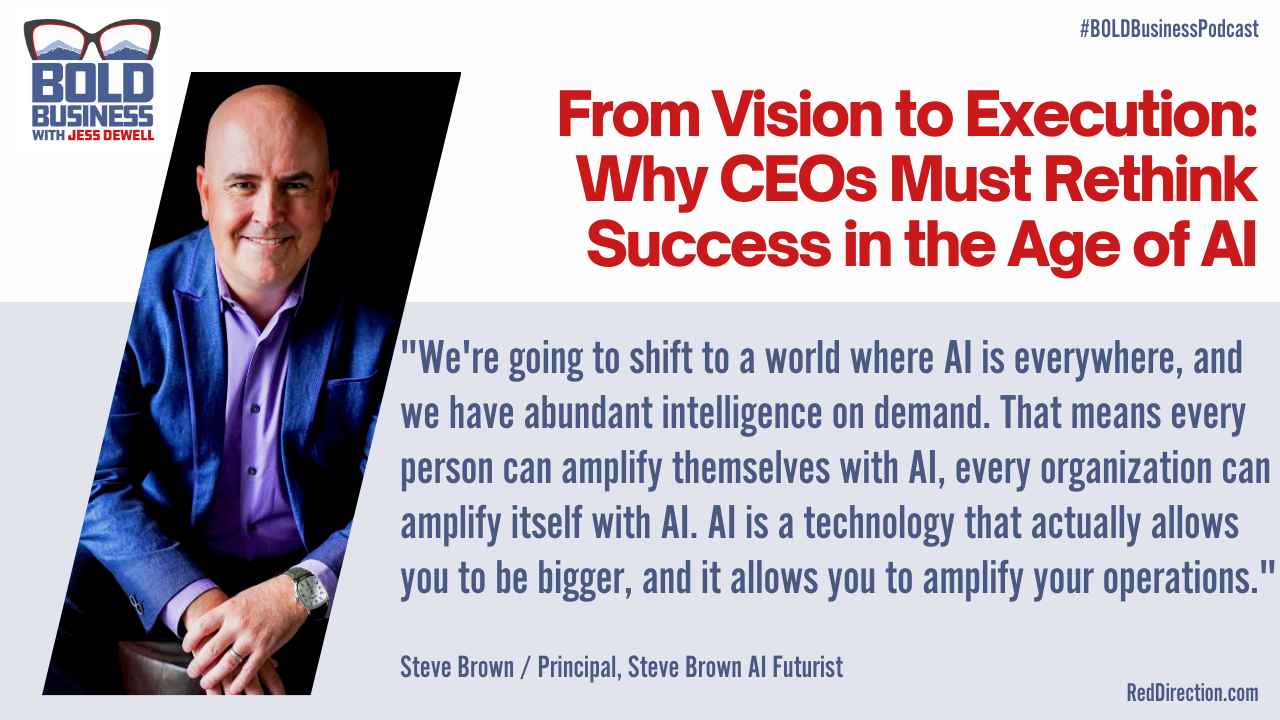
We’re gonna shift to a world where AI is everywhere and we have abundant intelligence on demand. And that means that every person can amplify themselves using AI. It means that every organization can amplify itself using AI. When the Internet came, it enabled small businesses to appear because they have a website just the same way as a big company had a website. They could level the playing field and appear and present themselves as bigger. AI is a technology that actually allows you to be bigger, and it allows you to amplify your operations. So the opportunity, and we can dig into the how of this, is instead of thinking about, let’s be ambitious, let’s grow the company 20% next year or 30%. Now you can start thinking about, let’s grow 300% or 500% or 10x the business next year by amplifying ourselves with AI. And that is a different way of thinking for most people.
Jess Dewell 09:37
Who are the people who are already thinking like that? Are there names that we would know? I know that there are names in our past that I would put into that category, but who’s living today?
Steve Brown 09:46
I work with 1,400 companies. Who would be a good example?
Jess Dewell 09:50
Or if, if you wanna avoid that, what we could do is we could talk about the traits that those people inherently have. So then because maybe that’s a little bit better for quick self-reflection, we can rate ourselves on…
Steve Brown 10:01
An adjust.
Jess Dewell 10:03
Happy to adjust, and we’ll make it practical at the same time.
Steve Brown 10:05
I think of some of it as attitude. Right? You have to have the right attitude. Mhmm. And we’re about to go through a time of enormous transformation. That means that leaders need to put on their change management pants and remind themselves of all of their change management skills and bring them all to bear on this because this is at its heart a huge change management problem. You have to define a new vision. You have to marshal resources. You have to motivate people. You have to communicate and communicate, get people excited about an imagined future. It’s classic John Carter change management, paint a picture of an imagined future and then lead people there. And I love Simon Sinek’s view on this. He says, leaders need only one thing, followers. And you get followers by painting this an exciting vision about what’s in it for me. There’s two things I talk about in my book, WIFM and WIFU. For each individual in your teams, you have to explain what’s in it for them, WIFM, what’s in it for me, and then collectively talk about the mission, the purpose of your organization, and what’s in it for us. How are we gonna use AI not to make more money for the shareholders by canning people and reducing costs by laying people off? That’s not motivating, bizarrely. What you need to do is tell a story about how you’re gonna amplify the team’s ability to execute against the company’s mission and deliver value for other people. Jensen Huang, the CEO of NVIDIA, was asked I wanna say it’s October 2024. He was asked, what’s your plan to grow the workforce, the human workforce at NVIDIA? He said, oh, we’ve got about 32,000 employees right now. And over time, I plan to grow that to about 50,000 people, supported by a 100,000,000 AI assistants across every group. So that shows you how people should be thinking about workforce planning, not how can I substitute and save money and put in AI and then not have to hire as many people? Instead of that, how do I wrap people around a core of my business, which is now built on AI, and amplify my ability to serve my customers so I can 3x or 5x or 10x my business. So it’s a different mindset. And so you have to change management skills up the wazoo. You have to have a strong vision. You have to have courage to be able to execute against that vision. You’re gonna have some management chops to be able to lead through that and be an exquisite communicator and inspire other people. But I think it also requires a level of humility. Leaders have got the positions that they’re in largely because they’ve been around the block a few times. Right? They know where the skeletons are. They know where the bodies are buried. They know how to get things done because they’ve they’ve done these things a few times. I’ve been through, as you said, multiple waves of digital transformation before. But this is different. And in many ways, we’re all making this up as we go along because A is a it’s a beast.
Jess Dewell 13:22
And I’ll tell you what, you know, when you say that, I think that’s the most exciting thing, and I think that’s probably one of the things that holds everybody back. So when I hear you talk about change management and humility and some courage and there were a couple of others in there. I guess each one of those people could rate on a scale of one to five. Are you one star or five stars? Either like a hotel or your favorite restaurant. Every single person listening and watching us has the ability to be a five out of five in all of those. They just have to decide that’s what they wanna do and surround themselves with people who are similar in thinking enough that we can get that picture painted and it’s one person could carry it in a small in a smaller organization or a mid market size company. The more we have, the easier it becomes.
Steve Brown 14:08
And the way I’ve summarized it for some people to help because this is an identity issue. Right? The identity of leaders has been that they are sages. Right? That because they know a lot of stuff, they got to their position because they have deep experience and they have a lot of knowledge. And that’s why people come to them, hey, boss, what do I and they get guidance. And we’re used to being in this position of being a sage. I think in this new era, we have to admit we don’t have all the answers because we’re making this stuff up as we go. And so you have to shift your identity from a sage to more of a philosopher explorer, Being thoughtful and being willing to say, you know what? I’m gonna lead the way. You’re gonna follow me. I’ve got my compass out, and we’re gonna figure this out together.
Jess Dewell 14:55
Together.
Steve Brown 14:55
And that’s a very different way of showing up for your teams, but it’s the only honest way to show up in this time.
Jess Dewell 15:01
Do you know that work is the exact work I’ve been doing with small and small mid-sized companies and large small companies for the last twenty years? Because that’s how we survive in the smaller markets is we are philosophical. We do have to have that change. What I love is that some of those strengths and so I’m a everybody who’s listening, go back to that the traits that he he shared and listen to what Steve was saying and rate yourself because this is your opportunity to decide who do you want to be in the role that you’re in right now for your organization six months from now, twelve months from now, twenty four months from now even. And I think we have the opportunity to embrace making ourselves obsolete enough that we get to change and grow too because now not only are we leading by example, but we’re also demonstrating, ah, we’re change managing ourselves, we’re change managing our teams, we’re change managing what we wanna do, and we still are delivering the product or service that we want to. What is your take on that?
Steve Brown 16:01
It starts with you. Yeah. Right? How are you going to show up for your colleagues, whether that is people that you manage, people that you work alongside, people who you work for, how are you gonna support them all? Because this is a time of extraordinary change, and organizations need to be adaptable. And one of the ways that you can be adaptable as organization is to lean on your coworkers, and you have to support each other through a time of dramatic change. It’s not something that everybody knows how to do. You have to be willing to step forward and say, okay. I’m up for this task. I’m gonna do what I can to help us make this transition in a way that is good for our customers, good for our employees, and good for our shareholders. And you want to try and hit all three of those. It’s the CEO model. Right? Customers, employees, and owners. You need to be able to show up in a way that helps make sure that all three of those are gonna be happy bunnies at the end of this process. Not that there is an end, because this is gonna be an ongoing process over time.
Announcer 17:11
Feeling stuck? Like, what got you here won’t get you there. The pressure to grow is on, yet the path isn’t clear. Yet. You don’t have to walk that path alone. This is the Bold Business Podcast. Like and subscribe wherever you listen. Your host, Jess Dewell, is the strategic partner you’ve been looking for, asking the questions that truly matter. It’s time to break the inertia and get the perspective you need to make your next move.
Jess Dewell 17:45
Thanks for listening to the Bold Business Podcast. I’m your host, Jess Dewell. And today we’re talking with Steve Brown, an AI futurist. Let’s get back to the conversation. Instead of tag on AI, how do we build that into what we already have in our culture?
Steve Brown 17:59
Yeah. One of the things I help my clients with is I’m always trying to give them frameworks, right? Because this is an overwhelming topic. AI is not a monolithic technology. There are different flavors of AI that solve different business problems. And there’s going to be a continuum of change over time. And I tell people there are three main steps in the process of AI transformation. Step one is where a lot of my clients are now, which is enablement. Right? They’re bringing in AI tools or they’re working with providers of tools that they were already using and getting the AI-enhanced versions. Right? They’re getting a license for Copilot with Microsoft or whatever it might be. They’re getting Agent Force in Salesforce CRM. They’re just bringing in AI tools to help their employees be more efficient. That’s necessary, but insufficient. That’s probably three to 5% of the work, maybe one to 2%?
Jess Dewell 18:57
How generous you’re being. Yeah. I agree with you.
Steve Brown 19:00
I work with some CEOs, and they’ll they’ll say before I go and do a keynote, hey, Steven. We’ve got a license for Copilot, and I have to tell them, you you’re 1% of the way there. Keep going. Keep going. So that’s the first big step. And it’s not underestimate. That’s an important foundational piece of work that you need to do because you’re gonna work with your existing vendors and make sure that they are bringing the AI heat. And then you’re gonna find gaps in that and say, hey. We need to also bring in some new vendors that are we’ve never worked with before because they really have some really hot capabilities that are gonna help transform our workflows. That’s the first work. It’s just that pure enablement stuff. Some of my clients are already moved on to the second part of that, which is reengineering workflows, looking at workflows, looking at processes, breaking them down into tasks, and then asking which of these tasks is still best done by a person, and in many cases, the answer will be many of them, and then which of them now based on the capabilities of agents and robots, which are now best done by agents, which you could you should think of as digital employees that work for electrons
Jess Dewell 20:11
Okay.
Steve Brown 20:11
Not dollars. And you can get then get more granular and say, is this an offload task? And if there’s a physical aspect to your work, then there may be some of those tasks that are now best done by a robot. And if you haven’t seen what robots can do lately, you will be shocked. That’s the next chunk of work is to go through those business processes, document them all out, and then decide how do I reengineer that workflow based on the capability of agents today and in the next six months. Mhmm. And agents are far more capable this month than they were last month, and they’re more capable than they were the month before. And the big breakthrough with agents, if you haven’t looked at agents and AI and its capabilities for a few months, the breakthroughs are huge. And in large part, it’s because you can now connect them together to things. So there’s a new standard. It’s called MCP. It doesn’t matter what it stands for. It’s model context protocol. But you’ve already forgotten what I said because it’s boring. It’s very boring. But think of it as the USB of agents and AIs. So it allows you to plug things together. So it allows you to plug your agent, which, again, think of as a digital employee, to tools. So it can do an Internet search. It can run a tax calculation. It can check the weather. It can use these tools to get stuff done. And you can also use MCP to connect to your legacy data systems. So you connect it to your CRM, to your messaging system, to your ERP system so it can actually do useful work for you. The reason they’re called agents is because they have agency. They can act in the world, and they act using this Connection MCP. So that’s a big deal that’s really starting to get implemented just in the last few months. So if you haven’t looked at agents for a while, now is the time.
Jess Dewell 22:03
I actually think it’s really cool for us to think about because I know over time, the biggest part of change management isn’t what we’re moving toward, it’s how do we keep the important parts of what we have or have to And leave I think you just explained that and when as soon as you said, we’re getting to the place we can plug this in for all of our legacy stuff. It made me think of everything that I have on DVDs, family photos, and I’m like, I’m gonna have to go buy an external DVD drive the next time I wanna move these. Or if we go back even further, right, what used to be on a cassette tape that we put on a CD or a disc that became a CD that now is in the cloud. So those are actual we don’t I shouldn’t say, there’s a certain size of company where that starts to become the reason we don’t get to move fast.
Steve Brown 22:53
Yeah. And if you can bridge that legacy world, then it allows you to keep moving forward and bring all of the value that you’ve built over perhaps decades and bring it forward with you.
Jess Dewell 23:03
And that I think is one of the most exciting things. And I think that also from the conversations I’m having with larger companies is we’ve never actually had to do this before. We either got a go or no go because if we can’t take our stuff with us we just really have to figure out around it and now we get to go with it and so I get excited about the potential of everything. What else would you add to this? There is a huge we’re unlocking potential that’s already there. We’re actually breaking into new ways to grow our business that we never thought possible. To your point at the very beginning, what else is still in this step two that is if we can just get past the enablement, we get to play here and we can probably play here for as long as we want.
Steve Brown 23:49
Mark Benioff’s view on this, he’s the CEO of Salesforce, he made a comment, I don’t know, probably six, twelve months ago. And he said, this is a new leadership skill. Leaders need to understand how to integrate agents. It is not just a leadership skill, it is a leadership responsibility. This is another thing that’s on our shoulders as leaders, is you have to understand how to do this or at least figure out. Because what you’re doing is you’re amplifying your team’s ability to execute. So you can serve customers better. You can have happier workers because you’re offloading the tasks that are stressful and boring and repetitive and freeing them up to do the work that they really enjoy, where they can start to develop new business for you and grow things in new ways. And that’s great for everybody involved because it’s great for the shareholders because you’re hopefully building new businesses. It’s great for employees because they’re doing work that they actually enjoy and feel rewarded by. So at the end of the day, they’re not beaten down by having to done do a bunch of repetitive tasks. That’s now handled by agents.
Jess Dewell 24:54
Yeah.
Steve Brown 24:54
What it means is every employee, no matter how junior, is now a manager of machines. And that’s a different way of thinking about things. It means we are the opportunity here is to shift from us all doing the work to designing the work and then overseeing the work. So the work is largely done by agents and robots with human oversight, and then that frees up the human to be more creative and think, okay, how could I redesign this work now so that I could do more or I could expand into a new business or I could go compete in five different new ways? That’s what it unlocks.
Jess Dewell 25:36
I have so many places I want to go, but I don’t want to take a tangent too far. I’m thinking about all of the young people that are coming up through college right now, and they are in programs that they now have to make this leap in maybe one year to seven years depending on where they’re at in high school or college or their post-education and whatever capacity, provided they choose that path. How do you jump to that ability to design? Because promotion has always come there’s been some development and some other things, and now we need to empower people and give them the opportunity to practice and learn this well before. So do you think the people who would already have been on that path are actually already on that path wherever they’re at in high school or college or graduate? Or is it something different?
Steve Brown 26:23
Maybe. So two comments here, Jess. Because you bring up a really important point. The first thing is we are seeing some businesses reduce the hiring of junior employees, and it’s showing up in the data, because they think we’ll just have AI do that. Very shortsighted because you’re killing off your pipeline of talent. The other thing that’s shortsighted about that is you can, if you use an AI that you pair with a person to elevate their performance, what you can do is pair a junior employee with an agent, have them collaborate together, and together, they will perform at the level of a more experienced employee. So if you hire more junior people and then use AI to amplify them, you’re actually doing yourself a favor. So don’t cut off your air supply of new talent coming through and use AI to amplify talent. The message I would have for younger people listening to this podcast, in fact, anybody listening to this podcast.
Jess Dewell 27:27
I would say parents or adults that know somebody that’s in this space right now.
Steve Brown 27:31
Or just people who are in the workforce today, no matter your age. Lovely. The first thing you have to do, invest in yourself. It’s like they detoned the airplane. Put on your oxygen mask first so you can help others. You invest in yourself. How do you do that? By building your AI acumen. That means not just learning about AI and the different flavors and the kind of problems they can solve to help fuel your imagination and help you understand what the possibilities are, but actually trying this stuff out. You know, get on to Suno and go make music. Go on to chat GPT and don’t just ask it questions. Go and make images. Use it to create content. Try Lovable to go and create right apps, but learn how to use this stuff. Because my view is the resumes of the future are not a list of all your experience. Mhmm. They are your ability to point to things you have built using AI. That’s what the resume of the future is. What is your ability to partner with AI to get amazing stuff done?
Jess Dewell 28:39
Thank you for addressing the whole scope from the young people because I know there several people, kids who I’ve talked to and young people, they’re not kids anymore, they’re young adults that are worried about this. Then you’re right, there’s a whole segment of the workforce that is also worried about this. And I appreciate that reframe from a perspective of not only is it at our fingertips, not only is it accessible and we don’t have to pay anything or very much to actually play and try this out, that investment truly is a time investment which could also then fuel interest and passion to continue to figure out what are we doing. Can I add on that? Because here’s what came in my mind and I’m just thinking, so as I’m playing with it, I want to know maybe I need to identify. Am I offloading something using AI? Am I elevating something myself using AI? Or am I extending what I’m doing for AI? And actually practice articulating that, would that be helpful in this sense of the language that you see coming forward, not only for wherever we are in our organizations of how we’re talking about this and asking for buy-in, leading by example for buy-in, and just proving the experience because of what we’re doing and being able to name it?
Steve Brown 29:56
Yeah. I think understanding those three different flavors is really important. I do workshops with my clients, workflows, and we identify where would an agent be helpful in your business. And one of the mistakes I see people do is they only want to generate offload agents. I don’t wanna do my and you they’re basically saying, I don’t like my job, and I don’t want to do it. I want an agent to do it for me. If you do that, then there’s no you’re not you’re not in this picture anymore. So that’s not a good idea. So you really want to be finding agents that are elevating you and amplifying your impact in the world. Those are the ones you need to practice using. So ones where you’re partnering with an AI to generate or create something together.
Jess Dewell 30:46
What I’m hearing you say too, there’s an element of discernment or even judgment in it that goes along with creativity.
Steve Brown 30:52
It comes back to the beginning of our conversation. How you use AI matters, and the role that it plays in your life matters. So figuring out what do you want to do and what do you want the AI to do and how will that complement you make up for deficiencies that you have? I’m not a great artist. I wish I was. Or does it if you’re a great writer, you don’t really need AI to write stuff for you. If you’re not a great writer, then sure. Use it. But it’s figuring out what your skills are, mapping those out, and then saying, how can I use AI to amplify myself and fill all of those gaps?
Jess Dewell 31:33
You’ve started to talk a little bit about CEO development, right, and the response, the skill of responsibility regarding this. Also, is your phrase steward of intelligence or did my AI make that up?
Steve Brown 31:49
I think your AI made that up. That was a hallucination.
Jess Dewell 31:52
God, I want to give you credit if it’s yours because I think it’s…
Steve Brown 31:54
It sounds like something I would say, but no, I don’t think it was on my…
Jess Dewell 31:58
You’re welcome to take it after this if it is actually Yeah. I might do. We are talking about the role of the CEO is changing. We’re needing to be more philosophical and adventurous and steward is actually a really good word in this. So thank you Gemini because I had Gemini’s help with that. Across the change management of the technology changes that you’ve experienced over your entire career, what was a time that you have had to really lean into what you knew and looking back it’s a bright spot, you had to trust your instinct about this change and you just went and it might have been bumpy but it all worked out.
Steve Brown 32:36
Over thirty five years, whatever it is, something I did that I had to have vision and confidence to do and it worked out. Is that kind of what you’re asking? Uh-huh. I mean, the things that come to mind are career changes where I took a leap of faith and just jumped. Sometimes I had to be coaxed. It wasn’t like I had a burning building behind me, but, you know, I had to have someone tell me, no. I know you trained as an engineer, but you could be successful in marketing. Come on. The the water’s warm in here. Jump. There’s more free cake and parties. And I jumped and I would turned out I was very good at it. So it yeah. There’s it’s those moments, I think, where you’re a little hesitant because you’re steeped in and living in the current world. Mhmm. And the old world, while it seems shiny and exciting, is also foreign and new, and you’re not it takes a little bit of courage to let go and and have a go. And it’s we often think of this as a one way ticket. And the opposite’s true. If I had gone to marketing and it hadn’t worked out, I’m sure I could have got a job back in engineering again.
Jess Dewell 33:52
What’s the worst-case scenario? You go back, right?
Steve Brown 33:54
Right.
Jess Dewell 33:55
And how bad is that? Is it really that bad?
Steve Brown 33:58
There’s less cake in engineering, but that’s the only downside I could find.
Jess Dewell 34:01
But you could change that, Steve.
Steve Brown 34:03
That’s true. That’s true.
Jess Dewell 34:06
Everything is subject to evolution when we’ve been someplace else and we bring it back to what we know.
Announcer 34:15
If your week feels like you’re being pulled from one demand to the next, this is for you. The daily grind is the number one killer of business instinct, pulling you and your team away from your vision. Reclaim your strategic edge with the Present Retreat. This free guide from Red Direction is a simple, powerful framework to carve out the space you need to filter out the noise, make the right decisions, and lead with clarity. Visit presentretreat.com.
Jess Dewell 34:43
I know you want to hear more from Steve Brown, the AI futurist that I am talking to today on the Bold Business Podcast. Let’s get back to that conversation. Were there times along the ways, and maybe it was still in career change, or maybe it was in one of the projects that you have been involved in, where there was actually a collective blind spot because everybody bought into the vision so much, there were a few extra, the bumpers or the guardrails actually became too rigid along the way. Was there a time for the reinvention or pausing to adjust versus large pivots?
Steve Brown 35:19
I watched colossal errors at Intel during the time I was there because of collective hallucinations. Andy Grove, one of the, I think, employee number four at the company and a legendary CEO on the cover of Time Magazine. One of the pieces of damage he unwittingly did to Intel is he coined the phrase, the PC is it. And when mobile came along, Intel’s attitude was, the PC is it. Collective blind spot. They didn’t realize this was a new paradigm, and they lost out on billions, hundreds of billions of dollars worth of business because they were too late to market, and they had believed this collective hallucination that the PC was it and would be forever. And, of course, that’s not true.
Jess Dewell 36:06
Wow. I’ve had a few of those in the experiences in the companies that I’ve worked in too and they haven’t been as big as that but maybe everybody listening and watching can actually relate to that in their own and can we find that and go hey we’ve been there and both of them right? The first one too, hey here’s the bright spot and here’s the pitfall, and we’ve done it all before, so let’s go again.
Steve Brown 36:32
When you’ve been to the Super Bowl 25 times and won every year Yeah. You feel like we’re just gonna show up and play the same game we’ve always played because we’ll win again. No. Because Yeah. The game has changed fundamentally. So, yeah, that’s the danger is if you are successful year after year, you can build calluses and a blind spot that says you don’t recognize when the game has actually changed on you. And by then it’s too late.
Jess Dewell 36:57
And today it’s really too late. There are some things that accompany that phrase code yourself into a corner.
Steve Brown 37:06
Yeah. But sure.
Jess Dewell 37:07
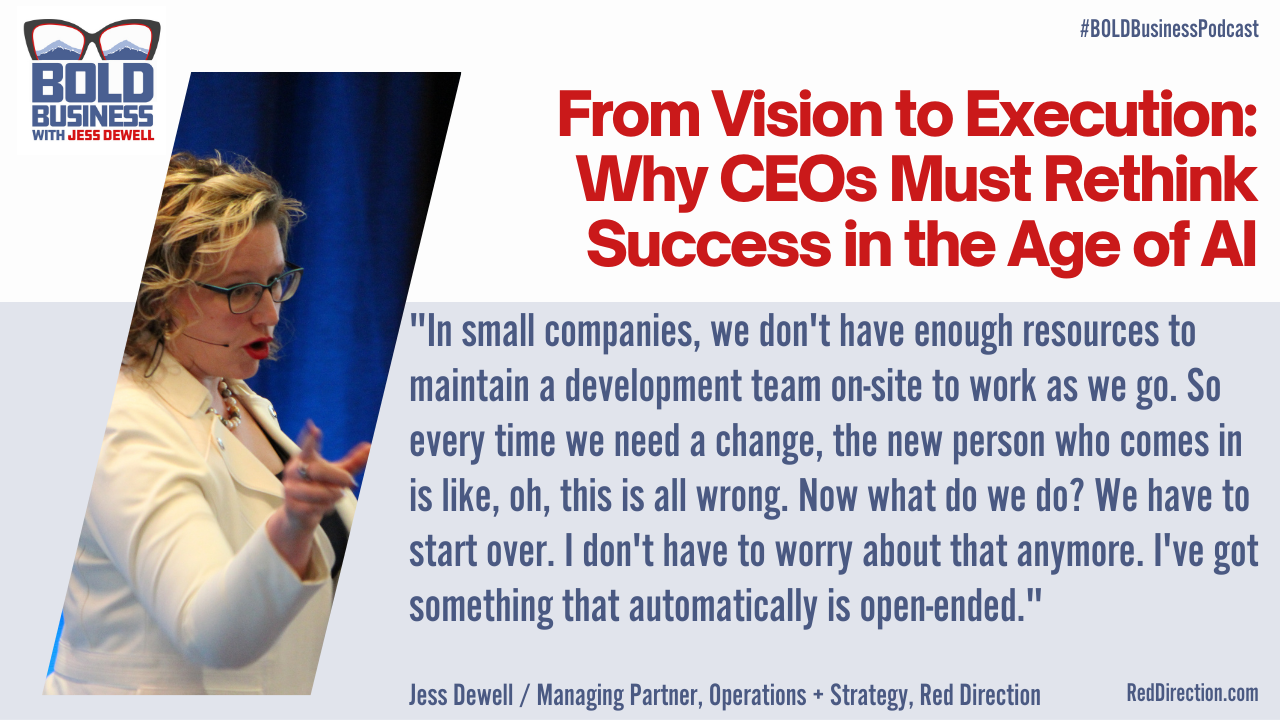
Oh, really? Okay. So I grew up in my early and my I grew up. My professional career, I grew up around independent software developers and small software development teams. And what I found was that people get this flavor of the way they show up to whatever they were making, and they have these blinders on. And in these blinders that they have on, all of a sudden there’s something new and to the point, like going back to our conversation about the legacy piece being able to carry forward, all of this there was no way to connect to the legacy. So this became the legacy but you couldn’t connect to anything new so you get stuck here. And what happens in small companies is we don’t have enough, and I count myself in this, we don’t have enough resources to have a development team on-site to work with these as we go. So, every time we need a change, the developer we had was gone or the team that we had changed and the new person that comes in is, Oh, this is all crap. Now what do we do? We have to start over. I don’t have to worry about that anymore. I’ve got something that automatically is open ended. It can take whatever I’ve got. It can help me make something new and I’ve never been a coder. The closest I got, Steve, I don’t know if you actually did any computer programming, but I made a two d dog that wagged its tail and said, woof.
Steve Brown 38:27
Strong work, Jess. Strong work.
Jess Dewell 38:28
That was a long time ago. I was like, thanks, I’m done. I’m done with that. Yeah.
Steve Brown 38:33
Absolutely.
Jess Dewell 38:34
We’re not limited by the way we think today because anytime we have a new idea, it’s easier than ever to adapt that into this new way.
Steve Brown 38:45
Yeah. And the new programming language is human. You just express what you want. And all of the software companies are now figuring this out. They’re checking in more software that’s written by AIs than they are that’s written by humans, and soon that will all be AIs. In some companies that’s already the case.
Jess Dewell 39:03
Ambiguity is a big part of this. And we were talking about the traits needed for leadership today. We were talking about the skills that are still going to be necessary for a CEO and the three groups that they’re always talking to and finding that balance and that integration of keeping everybody as on board and understanding as possible with everything going on. But what about the ambiguity in general? This future potential is truly unimaginable. Like, we don’t have a playbook for this, and we’ve been alluding to that. So what can stay the same, and what must we have flexibility around as we’re thinking forward?
Steve Brown 39:39
We certainly live in an ambiguous world. One of the things I advise clients is AI opens up a much broader landscape of possibility than you’re used to. You have a lot more choices, lot more options, and you’re now in a position where it’s more focused on what you have to decide what not to do than what you’re going to do because there’s so much opportunity. And one of the ways you do that, my company’s name, it’s Possibility and Purpose LLC. And I named it that because the challenge now, and I named it twelve years ago, the challenge now is to look at this landscape of possibility. And then the way you figure out what you’re gonna do and all the things you’re not gonna do is you look at the intersection of your company’s purpose, your humanistic purpose, and this landscape of possibility. And that’s how you identify what you’re gonna do and help to shape that ambiguity, give you that direction. The other things that you can do, learning as much as you can, understanding what’s possible and what isn’t, but always trying to think about this through a humanistic lens. I think I talk in my book about the difference between twentieth-century and twenty-first century thinking is what I called them. Twentieth century thinking being old leadership style of, okay, how can we cut costs? How can we cut costs today? Right? How can we maintain the level of service we’re delivering but do it cheaper? And maybe that means we have fewer people because we’re using some technology. And that’s what IT largely has done for fifty years. Twenty-first century thinking is how do we use AI and other technologies to amplify our people, deliver new value in new ways, and in a world of abundant intelligence where intelligence is available on demand twenty-four hours a day for very cheap because digital employees work for electrons, not dollars. What’s the world I can now imagine that I couldn’t imagine a year ago? What is it we could build together? And I’m now starting to get us into the stage of that one, two, three jump, which is AI first thinking. How do you unlock potential because you are collapsing costs, you are compressing time, and you’re elevating your people and turning them into superheroes to the point where as a business, you can contemplate showing up in the world in a way that was not possible six months ago.
Jess Dewell 42:17
What about let’s say we’re offloading stuff, we’re amplifying stuff, we’re extending stuff in the way that we work. I’m thinking about the extra time. Right? The extra time to do this. Is there how long is profit and ROI going to be the core of things in the sense of if I can get another if I can get half my week back, if I can get 20 of my 40 work week back from being able to amplify offload and elevate, then what is the company going to want to do with that? Do we want to do with that and what is our expectation of being part of this company and hitching our wagon to their mission?
Steve Brown 42:56
And about, I don’t know, twenty-five minutes ago, I was talking about leadership qualities that are required. One of them was vision. Right? You have to show up with a vision that says, what would we want this company to have grown into ten or twenty years from now, and how do we do that next year? That’s the kind of way people need to be showing up. How can we accelerate time and do things that we could not we didn’t imagine were possible because we didn’t have enough people. One of the things that managers and leaders live with is they are there to fundamentally, what we do is we manage scarce resources, right? We have fixed headcount. We have certain amount of budget dollars, we have some capital equipment, and we’re trying to get our jobs done using those constraints. If you can use AI to unshackle yourself from some or all of those constraints, what would you do? And if you don’t have the vision for what that is, you probably want to step aside and let someone else who does have that vision take over and still make you wildly successful.
Jess Dewell 44:08
So what makes it bold, Steve? What makes it bold to claim the strategic opportunity that we can’t even imagine tomorrow?
Steve Brown 44:17
Really, it’s about being able to deliver value in new ways, come up with new business models, create value for people that wasn’t possible before. So I give you an example. A robotics company, Figr, their first robot was hand built, cost a fortune to build just one. They got to the second version, figure two. Each one was hand built. Now it was optimized with all its capabilities. They cost a quarter of $1,000,000 each to build just one. And then the third version, they’re gonna get to the point where they can sell them for $30,000. And those robots will now be available to people to not just be in your home and clean and tidy and maybe do some yard work and maybe cook for you. But because they’re an AI, they can also be your personal trainer and your doctor and do the laundry and be your bartender and maybe your hairdresser and all the things. And suddenly now you’ve created this thing, this capability that everybody can have access to or many people will have access to, and the prices are gonna keep coming down. But suddenly you have something that will work twenty four seven you can have in your home and in factories and in logistics and doing deliveries. And it’s going to mean that the cost of delivering goods and services to people’s homes collapses, becomes even cheaper for us to have what we want when we want it. Now we have to figure out the employment issue there because at the moment, that’s done by humans, and we need to keep the economy rolling. But we need to just make sure we can keep people working productively, but use these type of capabilities to collapse costs, to collapse time frames, to make things possible that weren’t possible before, and you can start to now deliver new services. Once you have a robot that costs $10,000, I can buy a bunch of those robots and then show up and paint people’s houses for a lot less than I could do before.
Jess Dewell 46:21
I was talking to the guy at the grocery store, and he goes, someday, some robot’s gonna be able to take the apples out of the refrigerator and come rearrange them and put the other ones back and just rotate them out. What am I gonna do? And I was like, You get to choose, I think. And you have basically said that today, and I had never thought about it before. So, I was like, Start thinking about it now because somebody may ask you. Now you can be that person. I appreciate conversations like this because I see so much more good coming out of them than any sort of bad in the long run.
Steve Brown 46:53
Yeah. I have three questions in my book that I not quite close with, it’s in that final chapter about what do you do? And the questions I suggest people ask themselves now is, who am I? What makes me happy? And what’s important to me? What’s worthwhile? And if you most of us don’t ever take the time to stop and ask and answer those questions, so we just drift through life. And if we really thought about that, that helps us decide what are we gonna do when the apples move from the refrigerator automatically. It’s thinking about a new mindset that allows me to to do things I couldn’t do before. As I look around, I live in Portland, Oregon, some beautiful homes here in beautiful condition. And I see other homes that are dilapidated and rotting wood frames because the people who live there can’t afford to do the work to make them beautiful again. But now you’ll be able to do it at a price point where you could actually make that happen once you put robots to work. So that’s the kind of thinking is think a few steps ahead. What kind of capabilities could you harness to be able to deliver value at a much lower price point? And what I’m talking about here without saying the term is Jevan’s paradox. If you can collapse the cost of something, the volume of the demand goes up so much that net, you’re all making more money and you’re providing more value to society in the process.
Announcer 48:23
And that brings us to the close of another powerful and fresh perspective on the Bold Business Podcast. In today’s volatile landscape, growth is a double-edged sword. To truly thrive, you must engage with your strategy, not just react to the day-to-day. Without absolute alignment, your company faces a stark choice. Outmaneuver or be outmaneuvered. Grow or get left behind. Thank you for listening, and a special thanks to the Scott treatment for technical production.