




As a business owner, it’s difficult to do the right work AND guide your company toward its next big initiative.
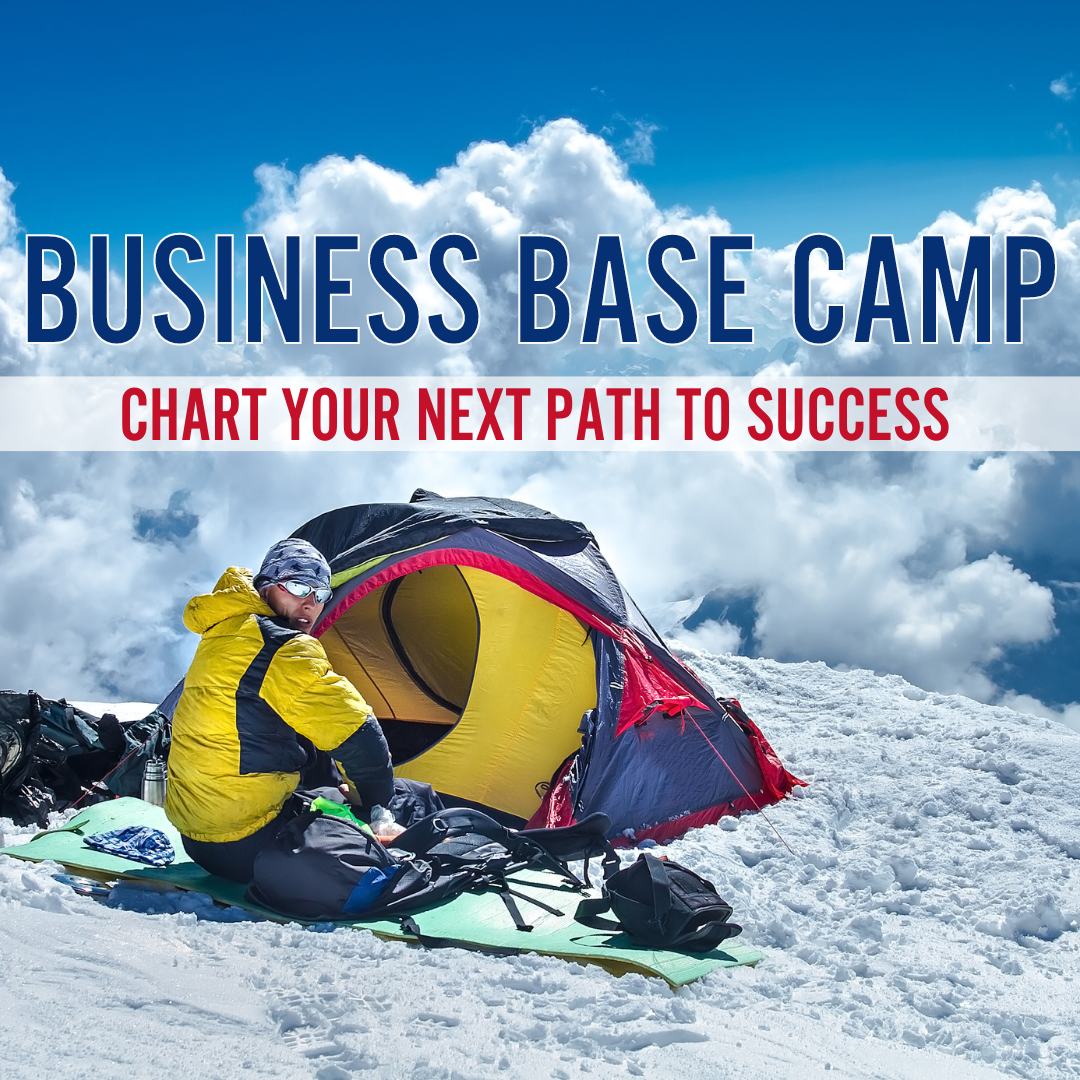
With Red Direction Business Base Camp, learn how to implement and handle processes to meet your business’s specific needs and better understand your market.
Starting the conversation:
Yesterday’s playbook is useless for tomorrow’s problems. Smart companies evolve their people, keep clarity around priorities, and navigate uncertainty and grow. PeopleCap Advisors Co-Founders Meg Crosby, Principal, and Howard Cleveland, Leadership Coach and Confidante, share how to lead through uncharted territory in quickly changing markets.
The Gauntlet of Growth for sustainable growth has six parts: sharpening focus, calibrating culture, strengthening leadership, elevating talent, aligning structures, and amplifying communication. These insights are derived from hands-on work with high-growth companies that help founders and leaders scale their organizations.
In this episode, you will hear what working within change really means, that your role as CEO changes as your company does, and that aligning your actions across your company makes a stronger organization. Jess Dewell talks with PeopleCap Advisors Co-Founders Meg Crosby, Principal, and Howard Cleveland, Leadership Coach and Confidante, about what makes it BOLD to be willing to evolve as a founder through experimenting, failing, and learning to make confident decisions in new situations.
Host: Jess Dewell
Guests: Meg Crosby and Howard Cleveland
What You Will Hear:
07:20 Practice what you know by bringing it to a new situation.
- Recognizing it’s vital to experiment.
- Creating a culture that allows for failure and learning.
- Determine resources to support learning while maintaining the core business.
13:20 As the company grows, talent management becomes strategic — HR shifts out from under finance.
- Talent management and development are transformative.
- HR begins with transactional functions, but must evolve.
- The company must see talent as a strategic imperative.
21:40 Knowing and leveraging strengths — as cofounders and for any team — is key for structuring work.
- Using assessments and outside coaches to understand strengths.
- Open communication about strengths avoids ego and focuses on best work.
- A strengths-based shorthand helps delegate tasks and accountability.
29:20 Business growth unfolds in four distinct stages; leadership must adapt at each phase.
- Emerge: proving concept with creativity and risk-taking; Operationalize: building systems for predictability.
- Thrive: scaling, building sales, and grabbing market share.
- Explore and expand: new markets, acquisitions, and leveraging strong culture.
34:15 Adopting a goal-setting framework is crucial to navigating competing priorities and building accountability.
- Use frameworks like EOS traction or OKRs for accountability.
- Structure focuses energy where it’s needed — finish tasks before starting new ones.
- Investors want discipline — seeing priorities through before shifting focus.
39:15 Lack of focus creates confusion and frustration — clarity unlocks team performance.
- Builders and innovators can become disengaged when maintenance work dominates.
- Frequent pivots leave work incomplete — eroding pride and confidence.
- Knowing priorities helps match team strengths to company needs.
44:20 Curiosity, humility, and asking for feedback are core characteristics of bold leadership.
- Self awareness requires feedback, including how others experience you.
- Feedback is data, not criticism; bold leaders seek it out.
- Bold leaders are curious, humble, and committed to acting on what they learn.
45:00 It is BOLD to surrender to self-awareness and evolve as a founder.
Resources
- Meg Crosby on LinkedIn
- Howard Cleveland on LinkedIn
- Running the Gauntlet: Proven Strategies for High-Growth Leaders
- The Journey of a Founder CEO: The Shadow of a Leader
- www.PeopleCap.com
Transcript
Jess Dewell 00:00
About 10 years ago, I said, I think operations officers will shift. I don’t think that they will be standalone anymore. I think they will become technology-oriented.
Howard Cleveland 00:10
Where am I trying to get to and what are the gaps? And then from there, looking at just what is the smallest, simplest action that has the greatest impact that moves there?
Meg Crosby 00:23
And so creating a culture that allows for experimentation and failure and learning as you go and incremental learning is so important.
Announcer 00:37
Every leader needs a trusted partner for the moments that matter. This bold business podcast conversation is that partnership, your go-to resource designed to break the inertia and refresh your perspective so you can start making moves. Here is your host, an insightful truth teller who serves as the catalyst for getting the right work done and who asks the questions that truly matter, Jess Dewell.
Jess Dewell 01:04
Today on the Bold Business Podcast, you’re going to hear my conversation with Meg Thomas-Crosby and Howard Cleveland, the co-founders of PeopleCap Advisors. Meg Crosby is a strategic advisor to CEOs, boards, and investors. Sitting on multiple boards, she serves as an operating partner with healthcare companies, software services, and SSM partners.
She has a 20-year career in human resources that she brings to the table to work with companies at each stage of their growth. Howard Cleveland is a voice for confident leadership, meeting growth with curiosity and courageous authenticity. He is a former labor and employment lawyer turned executive coach and co-founder.
He spent over 20 years in the trenches with leaders, helping them navigate growth, change, and high-stakes challenges. They have co-authored the book, Running the Gauntlet: Proven Strategies for High-Growth Leaders. In this episode with Meg and Howard, you’re going to hear about the fact that change is inevitable and the fact that we are willing to experiment and learn is as important as doing the learning.
The second thing to listen for is that, hey, the CEO role changes as the company changes. It sounds straightforward and easy on paper, and it’s hard to do in the day-to-day. So understanding that who we are today is going to evolve to take our company and evolve our company to where it needs to go.
And what does that actually mean for us? And the third thing, our actions as a management team help us stay aligned. The cadence that we follow helps us keep that alignment because we become a stronger organization when anybody on the executive team has the opportunity to speak up, name competing priorities, or other challenges that could slow the momentum of growth down.
Enjoy this conversation that I’m having with Meg and Howard. Knowing we have all these things facing us, wherever we’re at in our journey as a person, as part of a team and a company, the company’s journey, what I find fascinating, and I’m very curious to hear what your takes are right now, is everybody’s facing brand new situations and all the same things that we have been asked as CEOs, as executives of our organizations continues to be true. Keep and retain talent, integrate new technology, adopt it before it goes out, and hopefully, it lasts longer than we think it will.
Doing new things in new ways inside of our organization. So if I’m like putting all of this together, and I’m thinking about how do you know what to focus on first? From your experiences so far with this.
Meg Crosby 03:58
Clarify that a little bit. How do business leaders know what to focus on first?
Jess Dewell 04:04
When you’ve got all of these things, right? All of this whole array of things. Yes, the decision makers, the people we are all working with.
How do we know? How do we know? Because we can’t do it all. True.
Meg Crosby 04:16
Yeah. Yeah, so I think you’re absolutely right. This is a perfect opportunity to go back to the fundamentals and recognize that there is a lot of change going on, but the core drivers of your business have not changed.
And especially as it relates to people. So I think you’ve got to engage your team on thinking about these new ways of doing things and experimenting with AI, thinking about your customers, thinking about how they might use AI, what that’s going to be like for them. And recognizing that this change is coming and there are ways to prepare for it.
I just ran a retreat for a group of CEOs who are all CEOs of SaaS businesses, software as a service, which is really in the direct line of fire for AI. There are lots of articles out there right now predicting the demise of software as a service in favor of AI. And all that remains to be seen.
There’s a lot of fear. But at the same time, I think what’s clear is being able to look at the assets that your company has. What does their talent look like?
And what do our products look like? What are our opportunities to be more efficient, which you should be looking at anyway? And then thinking about, I think the new thing people are thinking about and need to be thinking about is their data.
What does their data look like as an asset for the business? What kinds of proprietary data do they have? And how does that drive a shift to using AI more effectively for both their customers that are either internal or external?
Howard Cleveland 05:59
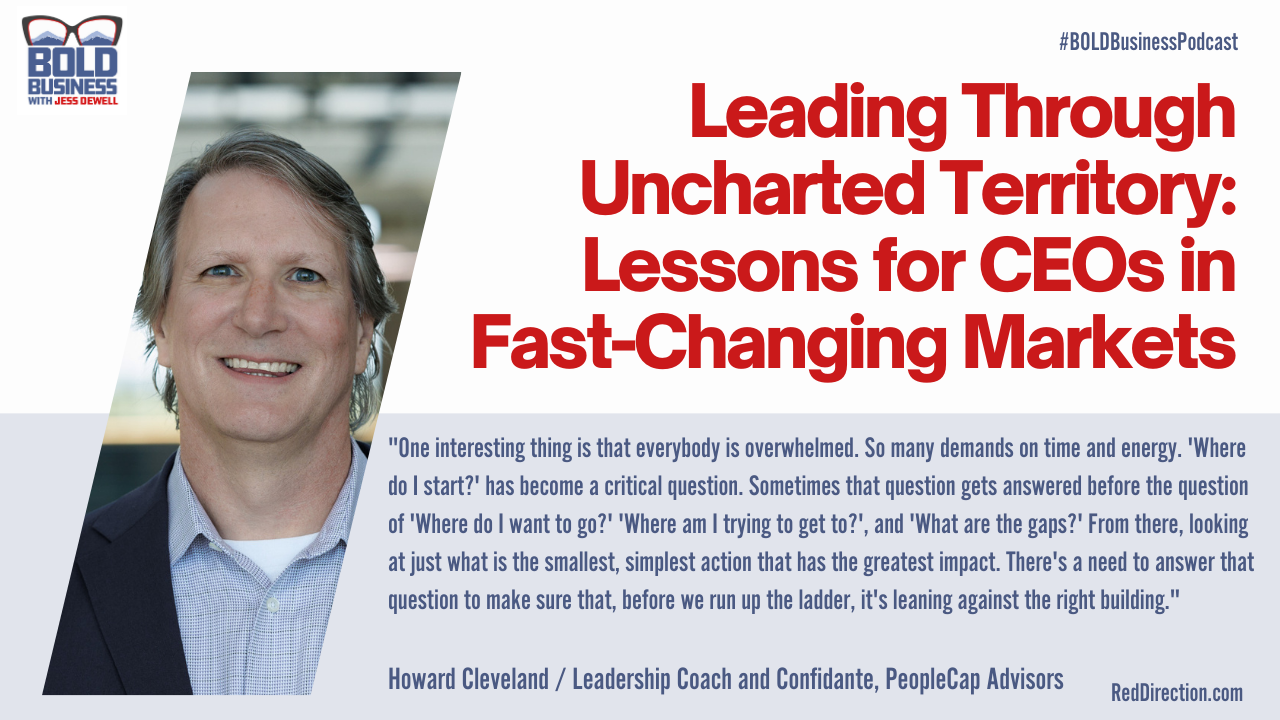
I think one of the interesting things is with everybody being overwhelmed and so many demands on time and energy, that where do I start has become a critical question. And I think sometimes that question gets answered before the question of where do I want to go? And so where am I trying to get to?
And what are the gaps? And then from there looking at just what is the smallest, simplest action that has the greatest impact that moves there? And so I think there is a need in answering that question to really make sure that as they say, before we run up the ladder, we make sure it’s leaning up against the right building.
Jess Dewell 06:47
What? You don’t want to end up in your neighbor’s dining room?
Howard Cleveland 06:53
We’re going to put in a ton of time and work doing something. And so you would like it to be something that’s not completely reactionary.
Jess Dewell 07:01
And it’s true. So I’m listening to both of you and I really appreciate the two different viewpoints, even within your same organization. And this is very cool because I’m thinking about if we started here, which was, by the way, it was on purpose because I would figure out where we’re going to go next.
And where we are going to go next is this, is it sounds like we all have some opportunities. We all have these things that we think we know and maybe we lack confidence about. How?
And so I don’t know if it’s a how question or a what question. So I’m going to just say some words here, which is as somebody who knows that and sees that now has to go practice that and do it for other people when they may not have had the experience themselves or in this situation as a new situation.
Meg Crosby 07:51
What would you say to that? First of all, let me just tell you that I think our answers to the last question mirror our personalities. And I am probably somebody who I might move too fast on something.
My tendency might be to move too fast, faster before I have all the information. And Howard’s tendency might be to wait and have all the information, before he moves. And I think we represent the polar opposites.
And somewhere in between is where people need to be on that. I think recognizing that it is important to do your homework. It is important to learn about these new technologies before jumping in with both feet.
But also recognizing that nobody knows how to do all this stuff. This is a brand new uncharted territory for everyone. And so you’re in a place where it is vital to experiment.
And so creating a culture that allows for experimentation and failure and learning as you go and incremental learning is so important. And I think just determining what kind of resources you can put towards that, both people, financial, technical, what can you put towards that while still maintaining your core business? You don’t want to cannibalize or bet the farm.
But at the same time, you’ve got to take some risks here and move forward because that’s the only way you’re going to learn. And there is no playbook for this.
Jess Dewell 09:29
Okay, so now I’m going to, let’s take a slight change because I’m curious of, do we have to throw a playbook out the window?
Meg Crosby 09:36
I think I said before, and I still stand by the fact that most of the elements of the playbook remain the same. We have a methodology we call the growth gauntlet. And I think everything in that remains the same.
You still need to sharpen your focus. You need to be strategic and be focused on what you’re trying to achieve. I love what Howard said about that before moving.
Let’s remember where we’re headed in the first place. You still need to have a culture that supports the strategy of the business. So calibrate your culture to where you need to go.
You still need to strengthen leadership. In this case, strengthening leadership could be adding new skills to the leadership team who perhaps have more experience with experimentation and with the technology that we’re talking about. So that could be an important add for people.
And or adding people who understand more about data, everything from data security and privacy to understanding how to monetize the data that people have. I think you talk about elevating talent. There is certainly an opportunity to elevate talent in multiple ways.
So elevating it in terms of bringing in new talent, but also training the talent that we have to understand new technologies and to experiment with that talent. And perhaps moving people out of the organization who aren’t interested in doing that experimentation. They’re not.
Maybe they’re resisting change because change is definitely coming or they’re not willing to make that leap. And then you’re probably going to see some structures change. We talk about aligning structures to this new way of doing things.
I’ve read a little bit about organizations collapsing IT and HR into the same department. That’s a really interesting thought. I don’t know how that’s going to work, but I think it’s a very interesting experimentation.
And then the last thing and probably the most important is communication and amplifying your communication and perhaps adding to your communication a layer of change management. So helping people with the uncertainty and the change that is.
Jess Dewell 11:43
Before we go on, I want to say HR and AI or HR and technology is what you said were combined together. Meg, that’s coming together. That’s interesting.
About 10 years ago, I said, I think operations officers will shift. I don’t think that they will be standalone anymore. I think they will become technology-oriented.
And I was not quite right. It does seem like the trend today. So I would be interested in knowing what both of you have seen.
The trend I’m seeing is not that. I’m seeing the trend being that technology is actually in the finance function and that the COO role or equivalent in an organization is actually fading away. And I don’t particularly think that’s a good thing.
And I think it will come back. But I thought it was interesting since HR is already a big cost center. So it goes under finance.
Technology is going to be a big cost center. So it’s already so it’s falling under finance. But so then what here and people aren’t hiring operations officers.
They’re starting with their CFOs and having them do that work too in at certain stages of companies. Are you seeing a different path emerge or trend?
Meg Crosby 12:50
I’m happy to speak to that a little bit. I think that you mentioned in particular HR being a cost center and being under finance. But our philosophy is that certainly that’s where HR begins, right?
Because when you start an organization, the type of HR that you need in order to get up and running is very transactional. You got to make sure people have they’re on the payroll. They got an email address.
You got to have benefits. So it’s this very transactional work that and all of that requires expense. And a lot of it relates to financials.
And so that’s why it starts out under the CFO. But as the company grows and talent itself becomes a key strategic imperative, HR moves out from under the CFO and moves into its own discipline at the leadership table with talent management. And that is the transformative side of HR.
The talent management, talent development side, talent as a key strategy for the business. That is very different from the transactional functions where HR starts. Those transactional functions are still really important.
It’s kind of like Maslow’s hierarchy of needs. Those are your basic survival needs at the bottom of the pyramid. But if you’re going to be a highly successful growth organization, you’re going to need talent as a strategic imperative.
Howard Cleveland 14:12
And I think on the specifically with respect to operations, a lot of our clients are founder-led. They are in that visionary, still getting market fit, proving out rapid expansion and then moving from that emerge stage to operationalize where consistency and building the mousetrap, if you will, is important. And so whether or not it’s a COO or a president or some other function, a lot of times for a founder, that being in the details in the operations is not exactly what their strength is.
And so that role, the evolution of a CEO or that founder in their organization to bring in somebody who is a specialist. A lot of the clients that we deal with are actually pulling that role in as an integral part to make sure that they can create the infrastructure to scale.
Announcer 15:39
Your host, Jess Dewell, is the strategic partner you’ve been looking for, asking the questions that truly matter. It’s time to break the inertia and get the perspective you need to make your next move.
Jess Dewell 15:53
You are listening to the Bold Business Podcast. And this is my conversation with co-founders of PeopleCap Advisors, Meg, Thomas Crosby and Howard Cleveland. OK, I’m going to switch gears just a little and I’m going to ask you a direct question about how you do the cadence of your work.
And I’m very curious, both of you having founded this organization, my question to you is, what is your cadence as an individual and what is your cadence as a duo in the time that you spend working in your business, on your own work, and then strategically on your own where you’re going, but also together for the benefit of the organization together?
Howard Cleveland 16:35
I think it varies individually. It’s probably try to spend about 25%. I tend to, as Meg said, I tend to be an idea generation person.
And so I like to think about what’s possible and what’s next and whatever. And so I can get caught up in creating and thinking about the business for extended periods of time. We spend weekly thinking about not only what we’re working on, but also the business and where we are, what we’re seeing, what’s coming up the most in our conversations and maybe what we need to evaluate.
And from our perspective, or at least from my perspective, our strengths are really complimentary. And so like Meg said, I can be in a lot of generation without a lot of execution. And so our cadence in getting together and having that personal accountability is key for me to move.
Meg lives in a constant state of inspiration, but she’s got a high bias towards action. And so that combination and accountability is important for us to keep it a regular cadence. What would you add, Meg?
Meg Crosby 17:53
I would just agree with that. I think I definitely err on the side of execution, probably to a fault. But we spend time weekly thinking about the strategy and thinking about where we are with our business, collaborating on that.
And then we spend a lot of time individually with clients or sometimes if it’s a big project, we work on it together. And that’s always fun too. I would say that’s about right.
Howard Cleveland 18:18
I think we try to be intentional, but probably the greatest breakthrough in our business was almost unintentional. We were on site working on a project and we’re up late at night getting this together and figuring out what we had seen and realizing that the pattern of what we were seeing there was the same as the pattern we had seen in other clients. And so started thinking about that evolved into that was the birth of the six imperatives.
And from that, it was like, wait a minute, is this a business model that we really want to pursue? And so that project then turned into our framework, which eventually led to the growth gauntlet.
Jess Dewell 19:06
I want to get there. And I want to, you both have talked about strengths twice. So is there a tool that you have used for each other to help you know where you compliment?
Or are you just, this is how we work together and we’ve figured it out since 2012?
Meg Crosby 19:19
That’s such a great question. We have used several tools and we have used them with clients, but obviously, we feel like you have to turn them on yourself first. And that was a big, 10 years ago or more, we did Myers-Briggs.
I think that’s probably where we started. And that was just super helpful. Just one example, I’m a person who loves to get in a room with a whiteboard and let’s brainstorm and think about things.
And what I learned in that process about Howard is that Howard likes to, he’s a deep thinker and a strategic thinker. And it’s best for him if you give him the information to prep a day or two before that’s where you can really dig into it before you get in the room with the whiteboard. And that was a huge unlock for me in working with him.
And it changed the way we work together. I think that we’ve done Myers-Briggs, we’ve done Strength Finder, we’ve done the Circle Leadership.
Howard Cleveland 20:14
Leadership Circle Profile. It’s amazing the number that we’ve been in and we’ve been very intentional about bringing in outside coaches to help us. But what’s really emerged from that is not as much the assessment and what came out of it, but it was the fact that it opened up the communication.
And so we are constantly running that sort of strengths thing like, oh, this isn’t, I’m gonna need some help here. This isn’t my strong point. Or, hey, this is really where you shine.
Why don’t you take the first crack at it? And so with that open communication and then we’ve just been very fortunate that there’s not a lot of ego in the room. And so the goal is to do the best work.
If I can contribute to that, great. If it’s mostly Meg, great. If it’s both of us, great.
And so we just look for who’s got the strengths that are particularly relevant here.
Meg Crosby 21:15
There are so many examples as I’m thinking back. Howard has a great eye for design and stuff. So whenever there’s something marketing or we’re gonna redo our website or something like that, he should take the lead because he is stronger like that.
I mean, there’s so many things like that. He likes to edit, not draft. So sometimes I’ll draft something or now we can have chat draft something and then we can edit it.
[I love that.] There are all these examples of these different mechanisms for understanding your own strengths and building self-awareness that has really given us such a shorthand and helped us to structure our work because a task will come up and we’re like, oh, this is more you or this is more me. Or he’ll say, oh, I need accountability on that.
On execution. So I’ll make sure that I’m checking in and that gets done. So it has been so helpful for us over the years.
Now we just have a shorthand and that’s good.
Jess Dewell 22:17
So now you know a little bit about me. Everything is exciting. And so where do we start?
This is interesting. So the gauntlet has come up a couple of times and for people who are listening and watching and they are not familiar with your book or your philosophy, I’d like to take a few minutes and let them learn about it. So as we continue to reference it and maybe even dig into a little of it, there’s a starting point and some context.
We heard about the breakthrough. Did we want to be in this business? Is this the model we actually really want?
And we heard that was how this effort was born and where you came together on. So tell us about all six of the areas and this whole gauntlet of evolution for a business.
Meg Crosby 23:02
Let me give a little preamble and then Howard, maybe you jump in with explaining the imperatives. There’s a great stat from HBR that talks about only about 25% of founders make it all the way from startup to say an IPO stage of a company. And I think that really frames the reason for putting this model together.
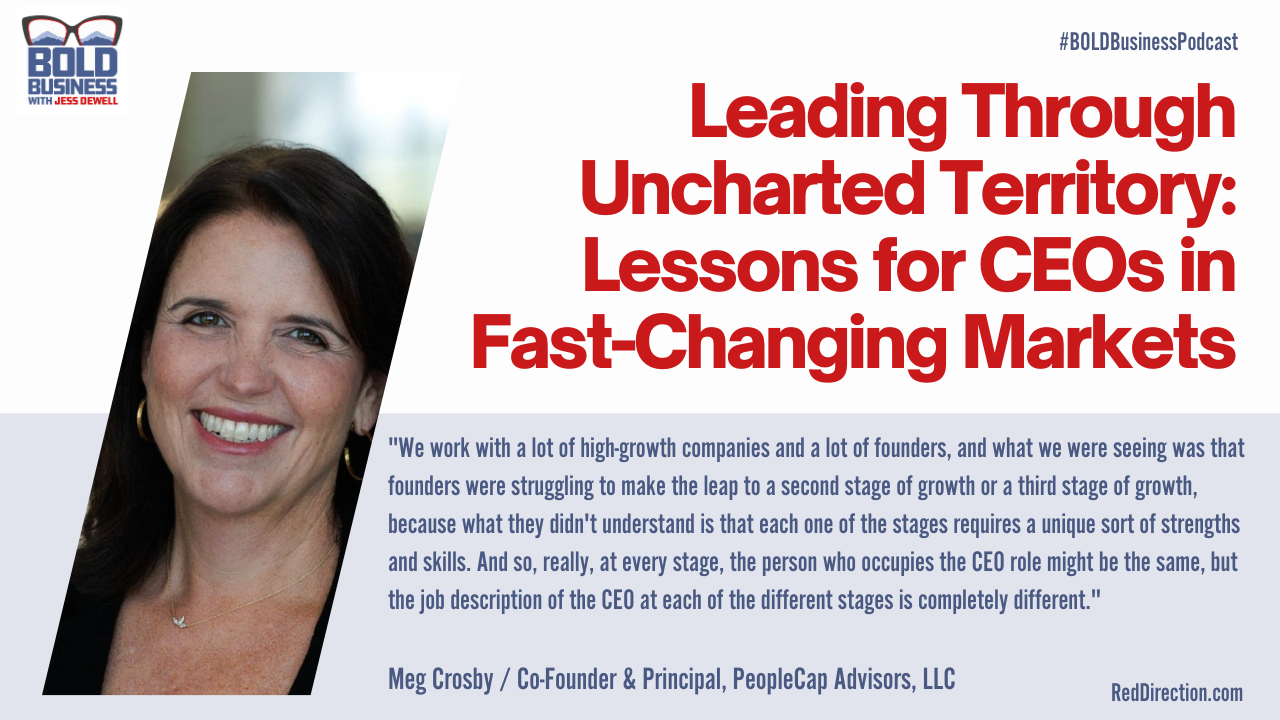
We work with a lot of high-growth companies and a lot of founders. And what we were seeing was that founders were struggling to make the leap to a second stage of growth or a third stage of growth because each one of the stages requires unique strengths and skills. And so really at every stage, the person who occupies the CEO role might be the same, but the job description of the CEO at each of the different stages is completely different.
And what must be accomplished is completely different. And so we felt that we needed a mechanism for explaining that to leadership teams to help them understand that what goes, it’s the old adage, what got you here won’t get you there. And we really wanted to put together something that was almost like a map where we could help CEOs say, this is where you are.
This is where you need to go. Let’s have a real honest conversation about what it’s going to take to get there and whether or not you’re the right person to lead that. So with that, I’m going to let Howard introduce the model.
Howard Cleveland 24:42
Sure. And it’s important to just know the arena that we play in because we play in the arena of people strategy and people in leadership and culture. And so with Meg’s background at Google and looking at that from a cultural side and a leadership side, and then my background, I grew up in the labor and employment world, looking at the impact of leadership.
That’s really our focus. And so the six imperatives are really the things that we found are the most impactful areas that leaders need to pay attention to scale successfully and sustainably through their people. And so the first being sharpened focus.
And so as you’re evolving and as the company grows, sometimes the very initial vision needs to evolve. And then as you add more people, it’s got to be so clear that people can align around it and make their decisions because you can’t be involved in everything. And then with that, really calibrating culture and understanding that an effective culture, there’s not a universal model of what a great culture is.
And that Edgar Sean said that a culture is effective if it helps you achieve your strategy. And so as the company grows and the strategy may shift, sometimes the culture needs to shift as well. And so sharpened focus, calibrate culture, strengthen leadership.
And that’s just making sure that leadership team, we talked about understanding strengths and resources and cohesion, but making sure also that strategic table has somebody who’s in charge of every strategic initiative. And then making sure that the leaders along the way are strong because as people grow and get promoted, sometimes they get promoted because they’re great individual contributors without that leadership training. And then elevating talent through hiring, developing, or as Meg said, sometimes it’s liberating.
And what you’re looking to do is elevate your entire talent level to be able to achieve the strategy and then align the structures. And so the org chart changes as the strategy changes, but also the compensation, the reward, the recognition structures, the incentive structures along the way to make sure that all of those things are driving towards the strategic goals and the culture that you want. And they’re reinforcing that.
And then the sixth being amplify communication. And as a small organization, everything can happen in the hallway or in the break room. But then as it gets older or gets a little bit more mature, got to be more intentional, but that’s still top down.
And so to avoid silos, you want to make sure that communication in every direction, sideways between departments, but also from, if you will, the bottom up so that you actually know what’s going on. And so sharpening focus, calibrating culture, strengthening leadership, elevating talent, aligning structures, and amplifying communications are those six imperatives. And that’s the framework.
And as we were looking at companies and helping them assess where they are in each of those, that’s when we started noticing they show up differently at different stages. And so what you’re looking for in calibrating your culture in say the emerge phase may be different than operational phase, which may be different than the growth stage, which may be different than explore and expand. And so really being able, it ended up being a six-by-four grid and it’s just like you were here.
And so that’s really been the birth of it. As we had it as an internal document at first and then we shared it with somebody and they’re like, oh, wait, this is where I, wait, can I share this? And we’re like, okay, can we like slap a border and a logo on it first?
And that was really it. And somebody, they felt seen.
Jess Dewell 28:51
And- But it’s not bingo. It’s you are here so you can choose your next step.
Howard Cleveland 28:55
No, and it’s not linear. Ideally, you don’t necessarily progress in all six categories at the same time. And then as you grow, sometimes you have to go back and pull along.
But generally, if you grow without them moving relatively similarly, then it just, it creates an unstable foundation. So those are the building blocks of a strong people strategy.
Meg Crosby 29:22
So I think it might be worth me just quickly running through the four stages of growth. The first is we call the emerge stage and that is a startup. That is a founder-led organization that is just one big team working to prove their concept or their product and to have some success.
It is highly reactive, ad hoc, very flexible. Everybody’s communication is yelling from one side of the room to the other. The next stage, once there is that proof of concept or proof of market, then you move into the operationalized stage.
That’s the, how do we set up the processes? How do we begin to have some consistency such that we can make this product the same way every time, deliver results to our clients every time. And so setting processes in place is the hallmark of that operationalized phase.
Very different leader that you need in place that you can think about the startup leader being somebody who’s got a lot of creativity, but high tolerance for risk. Someone who thinks out of the box versus a leader in operationalized phase who might be a systems thinker and is thinking about how to do this well and consistently every time. And then once those processes are in place, you move into what we call the thrive stage and thrive is season for growth.
It’s an outward-facing, let’s take this and grab as much market share as we can. Let’s grab as much revenue. Let’s build a sales team.
Let’s get out there and make this work. And then once you’ve had great success there and you’re really good at what you do, you’ve developed this organization, a sustainable organization with this key competency of selling this product and developing this products or services. It’s time to lift your head up and look at the horizon and think about the stage four, which is explore and expand.
That’s where you start to think about, OK, we’ve got this mousetrap. Can we deploy this in a new geography? Can we deploy this in a new market?
And we make an acquisition. We’ve got a strong culture. We know who we are.
It’s time to bolt on new companies and grow through inorganic growth. What works there? And so those are four very distinct phases in the life cycle of a company.
And so we try to help leaders grow sustainable organizations across those.
Jess Dewell 31:45
You may not know this about me, but I love to read. And as I’m listening to both of you talk, I made a note like around minute seven. I was like, oh, there’s got to be a place to bring in a couple of these other books, because only because they’re oldies, but goodies.
And I think that you are providing the contextual flex and adapt way to actually get to the nut of what their work was in search of excellence, good to great. And then one, and I think it’s more along the lines of between those two things. Jim Collins wrote another book, something like The Mighty Fall.
I think that’s one of his books too, because I’m not sure if you know this, but all of the companies that were in both of those books, none of them stayed there. None of them stayed great. And that’s so I think Jim Collins wrote a follow-up book to that.
What I heard you just describe was, and which is one of the reasons I really liked the word gauntlet when we first started talking about that, because it is, right? It’s a challenge almost every day. It’s a challenge at definitely every stage.
It’s am I the right person to become? Do I have what it takes to become the CEO? We need to get to there.
All of those things. I think that’s so huge. And I know that’s a big part of the passion that you bring is, well, let’s get more people to claim their strengths so they can find their own way and become the CEO at that.
To stay there, to keep driving that. So maybe we should stay there. Amidst your experience and what your work is, how do you help people choose the right priorities?
Meg Crosby 33:17
Because when so many are possible and all of them are right, but what are the best ones? I think that is right in the sharpened focus playbook for us. We spend a lot of time working with leaders on exactly that.
And it comes down to what is your strategy? What is working? What is not working?
You only have 24 hours in a day. What is the strength of this organization? Where’s your energy?
All of those things are important questions when trying to figure out how to focus. And I think that is one of the biggest challenges of an emerging leader, a startup leader, who then tries to move into operations. We call, we’ve seen several of those who are, those are the people who love to ideate.
They love to brainstorm. They want to think about the next new thing, but they’re not in the stage of the business to do that. And so sometimes we call them the chief distraction officer because they come to the focus meeting and want to talk about doing 73 new things.
And we’re like, you are now going to be excluded from the focus meeting because we aren’t adding 73 things to this. But that’s when the company developed some discipline around, and we always say, adding a goal-setting framework. So a lot of our companies use EOS traction.
Others use OKR methodology for measure what matters. And there are plenty more where that came from. But adopting a goal-setting framework that really is all about building accountability and making sure that you finish a task or see things through before you start something new.
And I think investors struggle so much with that with startup organizations. They really want to see, hey, we invested in this business because we saw the potential in this product or this technology. We want to see that through before we give you funding to then go off to the left and pursue another.
So really a struggle for organizations, but incredibly important. Does that answer your question?
Jess Dewell 35:22
I’m just waiting to see what else bubbles up. That’s all. Because there were three of us, I’m like, I don’t have to talk in between everything.
Howard Cleveland 35:28
Well, I think sometimes in prioritizing and when there’s so many things on the table, some of them are opportunities and some of them are just naturally things that you have to react to. So the frequency of when things are coming up, what keeps bubbling up, what issues, what opportunities keep coming up in conversations and then also friction. Where are things not working?
Either lack of traction or friction and which areas in that, if you resolved, would be most helpful. And so ideally, you’re not reactionary and you get to spend all your time in the strategic space, but that’s not always the case and you have to do both.
Jess Dewell 36:43
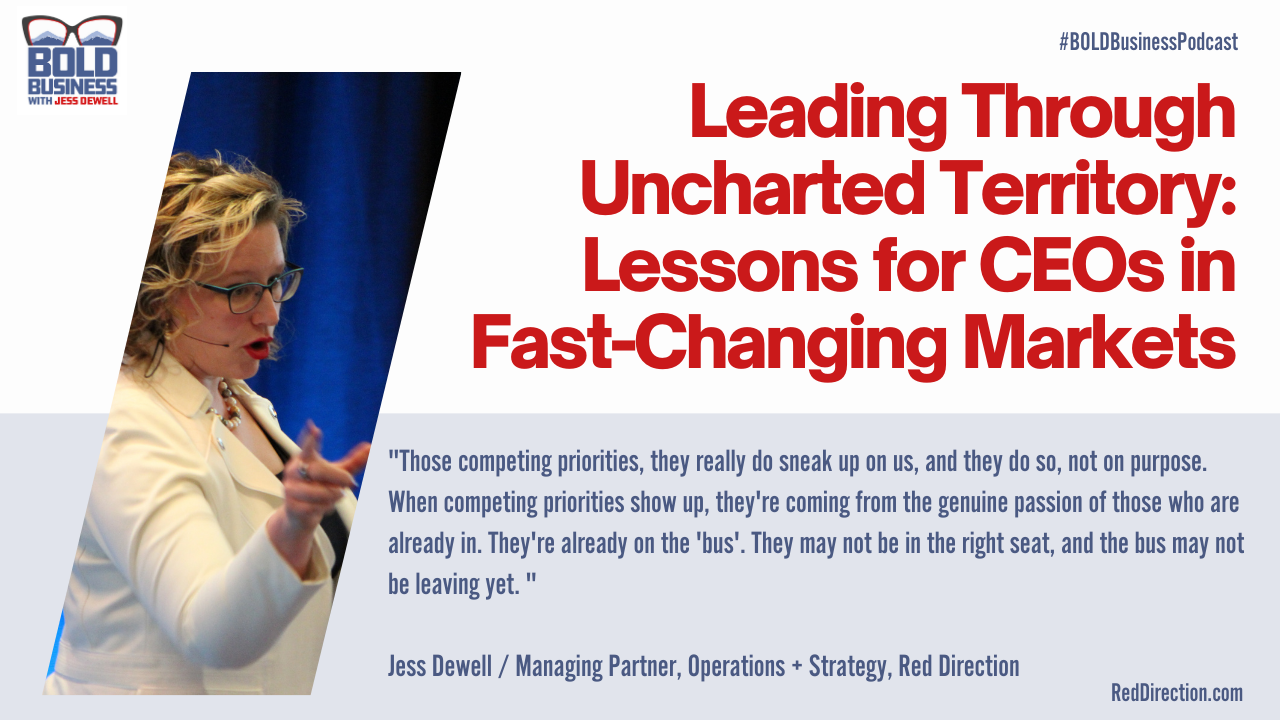
You are listening to the Bold Business Podcast and this is my conversation with co-founders of People Cap Advisors, Meg, Thomas Crosby and Howard Cleveland. Well, those competing priorities, they really do sneak up on us and not on purpose, right? I believe that when competing priorities show up, they’re coming from the genuine passion of those that are already on the bus.
They just may not be on the right seat and the bus may not be going yet. That’s all.
Meg Crosby 37:16
Yeah, I love this notion of everybody has choices. They just don’t always like what they are. I got an organization that we worked with that was moving from the emerge into the operationalized stage and they had built a software that up until this point, they would just really customize for all of their customers.
At some point, you have to move from customizing your product to cementing what it is and then taking that to market. But the result was they had a technology team that had three competing priorities. One, service the bugs and the complaints and the feature requests that the current clients had that they were inundated with because they had totally different customizations for each one.
Work on the actual product that they want to take to market that would be consistent and then deal with technical debt for the underlying systems that over time are becoming obsolete. And so it was really important. That’s not the CTO’s call.
That is a leadership team call to say, where are we going as a company? And it’s painful to tell our biggest revenue-producing clients that we’re not any longer going to service those products or the software that we have in the field with them. But it might be what’s necessary or you might have to say, we’re at least going to cordon that off into 25% of our time.
We want to spend 50% of our time on our product. And then we still need to make sure that 25% of our time we’re addressing technical debt, which is underlying everything that we do. So it’s really important for the leadership to make some of those hard calls.
So then, again, the CTO, that direction so that everybody’s aligned with what the board, the investors and the CEO are seeing. And there’s the biggest opportunity for the business.
Howard Cleveland 39:17
And in that situation and in others, that lack of a specific focus or scattered focus was creating a great deal of frustration and confusion among the team because you had a team that was, they were builders. That’s what they wanted to do. They were innovators.
And now you’re asking them to spend time minding bugs and they were frustrated. And then you would do that, but there was another revenue opportunity. So there’s a huge pivot.
And now they’ve got to leave the work they were doing incomplete, which was a source of pride and frustration. And then until you’re really clear about where you’re going and what your priorities are, it’s hard to get the right team in place because sometimes you need somebody who’s a builder. Sometimes you need a maintainer.
Sometimes you need this particular strength. But if you don’t know that, everybody eventually is not working at their best and big opportunities for people to get frustrated.
Jess Dewell 40:19
And what role, what position, who is the one who has to say competing priorities exist in their own words? We got to have this hard conversation because together we’re going to make the choice that aligns with what we’ve already worked on so that we all know what we’re doing to support that. Whose job is that?
Meg Crosby 40:39
I think that’s the job of anyone on the leadership team to call that out, see that there’s not alignment. And I think anyone sitting at the table who notices that ought to call it out. We’d love to say that it’s the CEO’s responsibility, but everybody has competing agendas, right?
It’s just that tends to come out when there’s a high level of trust and people feel OK saying that something’s not going well. And creating that culture is incredibly important.
Jess Dewell 41:09
You know, what’s really interesting is I’m thinking back to the part of our conversation where you were describing how the two of you work together in your organization. When companies don’t do that, what you’re describing and the problems that tend to come up tend to be bigger, harsher, sharper, require more risk to speak up about when and when we’re all talking on a regular basis and we’re all doing the strategic work and we all have the opportunity when things are small to speak up. Not only are we building trust and working together, we start to learn how we’re working together like you two articulated.
We just know when something comes up, who’s going to take the lead and how to support each other. And you say it out loud so it’s not unwritten.
Meg Crosby 41:56
And I’ll give you another example of a practice that we’ve been doing for years, which is whenever we have a client deliverable, we get in a room and the lead on a project puts it up there and the team shoots at it. And we say, okay, this is the meeting where you got to shoot at this. How does this look?
What is not good in this? And we are so much stronger when we finally deliver to the client if we have been through that because we have the benefit of multiple perspectives, multiple knowledge bases. We have everyone is aligned that wanting to put the best product out.
But we have people who say, you know what? That doesn’t make sense to me or this slide could be better or I think what you’re saying is this. Is that what you mean?
And a question I would have if I were the client is this. And I sleep so much better the night before a client presentation having gone through that gauntlet on our side of things before going to the client because I know that I’m prepared, but it also takes a lot of trust to do that. But it also builds a lot of trust because as you’re going through that, your skin is thicker, but also you have to, you’re defending your life. Yeah.
Howard Cleveland 43:14
And something else that Meg said about building a culture where people can speak out. As we think about the role of leaders and is it the CEO? Is it somebody else on the executive team to look and see those things?
A lot of times like what Meg said, it’s as much listening as it is looking and seeing because at some point you just can’t know. And so when we were in the particular company that Meg was talking about, when we did our interviews and talked to people and brought that back, it was really a surprise. The impact of those pivots was a surprise.
And once that data was out there, it was really clear to see, but not everybody felt like they could say that.
Meg Crosby 44:01
Yeah, it wasn’t obvious to them what was happening.
Howard Cleveland 44:04
Yeah. And so there is a, certainly you think about the higher you are in the organization, it is your responsibility, but I think it’s not your responsibility to know everything, but to be listening and to learn.
Jess Dewell 44:18
It does come back to self-awareness, doesn’t it?
Howard Cleveland 44:21
Yes. And I think there’s, as we have talked over the years and looked at characteristics of clients that we really like working with and seem to have the greatest impact, there are a couple characteristics. One is being curious about what they don’t know and humble enough to hear it and then committed enough to do something about it.
And it really is that sometimes it’s self-awareness that you don’t have self-awareness. Just the willingness to ask the question, what do I not know?
Jess Dewell 45:01
So what makes it bold to embrace that need, that necessity of self-awareness to evolve as a founder from stage to stage?
Meg Crosby 45:14
What makes it bold? I think it’s, first of all, there’s a lot of vulnerability in it. So you have to be brave to be vulnerable, but it is such a huge unlock when people realize that the weight of the entire company is not on their shoulders, that it exists across the team.
We talk a lot about distributed leadership as a destination that people should, you meet with the founder and there they’ve got their hands and everything and they’re not in the hours and the day and they’re micromanaging because they have this vision. The organization has whiplash and you say, hey, let’s build a leadership team. Let’s bring some people in that we trust who are really good at some of these things and you can really delegate to.
And to talk to someone who has moved through those stages successfully and now has a leadership team that they can count on to run the business every day and that the CEO can then elevate their game and their role to being a more strategic leader, to being an externally facing leader, to managing the board and doing the things they want to do versus being involved in the weeds. The company is so much stronger. The CEO is so much stronger for having done that.
There is a huge leadership bench about so much value in having a leadership bench, meaning you’ve got a team of people that any one of them may be capable of running the company in case of an emergency or all could be a successor candidates. Watching that to me is one of my most gratifying things as a consultant of working with the company and taking them through that. It may take a couple of years, but to see that growth, both in business, it is such an unlock for the business and the sustainability of the business, but also in that CEO and how they can rise to a level of doing the work they really want to do is fascinating.
Howard Cleveland 47:14
Yeah, the vulnerability of it and the willingness to set aside ego, especially in a position where you think either you’re supposed to have all the answers and be the face, but also just understanding that like Meg said, if you recognize that you don’t know and you’re not expected to, then partnerships are a lot easier. The board is not something to be feared or held off at arm’s length. They’re a strategic partner, but you have to do your part to do that.
And I think that so much of our identity gets caught up a lot of times in our roles and responsibilities. And so when those shift, or maybe we decide that new job description for the next stage of growth doesn’t necessarily align with us, then our identity, it’s really, it is bold to challenge that. And sometimes it questions where we’ve placed our identity.
Self-awareness requires some form of feedback. And the safest form is with assessments because there’s some algorithm that spits out, these are your strengths, but at its core and to be most effective, it involves learning how other people experience you. And so asking for other people’s feedback.
And I mean, for as many books as are written on how to take feedback and all of that, it’s naturally defensive. Like it means you’re not enough is what the initial take is. And if you realize that’s not what feedback is at all.
It’s data. And then you can adjust. And so I think the people that are curious about who they are, how they’re being experienced and humble enough to hear it are the most bold leaders.
Announcer 49:07
And that brings us to the close of another powerful and fresh perspective on the Bold Business Podcast. In today’s volatile landscape, growth is a double-edged sword. To truly thrive, you must engage with your strategy, not just react to the day-to-day.
Without absolute alignment, your company faces a stark choice. Outmaneuver or be outmaneuvered. Grow or get left behind.
Thank you for listening. And a special thanks to The Scott Treatment for technical production.