





As a business owner, it’s difficult to do the right work AND guide your company toward its next big initiative.
With Red Direction Business Base Camp, learn how to implement and handle processes to meet your business’s specific needs and better understand your market.

Starting the conversation:
There is a real cost of fuzzy strategy and that lack of clarity erodes real value.
Think you’re scaling just fine? Think again. Melanie Nabar, Vice President at Volition Capital, unpacks how unclear objectives and scattershot initiatives can burn cash and destroy opportunity — and offers actionable steps to keep up your momentum.
Supporting bold vision with clear direction and reality checks is vital. Recognizing your growth x-factor and then staying aligned to the problem as your company navigates facing new constraints and points of friction is always a challenge. It is no surprise that this means that you, your team, and your investor partners will reach the biggest goals through working together through challenges.
In this program, you will hear how to prevent the “stay in your lane” problem from holding you back, the importance of disrupting your own company before the market does, and that strategic clarity is non-negotiable. Jess Dewell talks with Melanie Nabar, Vice President at Volition Capital, about how BOLD founders push themselves as leaders into constant learning and transformation.
Host: Jess Dewell
Guests: Melanie Nabar
What You Will Hear:
08:27 Bringing friction into the open is essential to breaking down silos and making real progress.
- In-person leadership meetings create space for difficult conversations.
- Openly expressing disagreements helps build team commitment to shared goals.
- Addressing friction directly leads to stronger cross-functional collaboration.
16:32 Market disruption attracts investment, and timing matters.
- Investors seek companies leading or benefiting from industry change.
- Capital is used to accelerate growth and capture unique opportunities.
- Both offense and defense play a role in strategic investment during times of disruption.
24:05 Founders must be able to make hard decisions and demonstrate passion for their problem.
- Founders must evolve their teams and approaches as companies grow.
- Making tough choices regarding people and strategy is essential for success.
- Deep, personal connection to the business mission drives enduring commitment.
32:16 Coachability and willingness to take feedback matter especially for solo founders.
- Adept founders invite and consider advice from experienced partners.
- Two-way communication and transparency foster effective board relationships.
- Being open to feedback strengthens leadership and decision-making.
40:03 Lack of strategic clarity leads to wasted resources and measurable value erosion.
- Unfocused teams dilute efforts by pursuing too many new ideas at once.
- Value erodes when companies burn capital without clear ROI or growth objectives.
- Boards play a role in ensuring focus and challenging initiatives for better outcomes.
46:07 As founders scale, focusing on their unique skills and delegating is crucial.
- Founders should shift from doing it all to leveraging complementary talent.
- Delegation enables focus on the founder’s greatest strengths and value-add.
- Successful scaling hinges on building effective support structures and teams.
47:30 It is BOLD to recognize the growth x-factor and stay aligned to the problem you are solving (and the answers gained) for yourself, your investors, and your team.
Resources
Transcript
Melanie Nebar 0:00
I know I’m tuning out when I hear the thing. The real problem and passion that you’re solving. So making sure you start with that’s one problem.
Announcer 0:16
Every leader needs a trusted partner for the moments that matter. This bold business podcast conversation is that partnership, your go to resource designed to break the inertia and refresh your perspective so you can start making moves. Here is your host, an insightful truth teller who serves as the catalyst for getting the right work done and who asks the questions that truly matter. Jess Dewell.
Jess Dewell 0:43
Today, I’m talking with Melanie Nabar, vice president of Volition Capital. Her organization is a minority investor in companies. And in my conversation with her today, we talk about a lot of different topics.
And one of the things that I wanted to pull out were three items for you to tune into in addition to all of the information that we cover. The first is there’s a problem about staying in your lane. We actually really it’s a problem that’s created by staying in your lane and how to fix it.
The second thing is our company exists and is on the edge of something and we’re solving a problem in the world today. So how do we stay? We do that by disrupting ourselves internally.
And a third topic that definitely to listen out for is that a lack of strategic clarity does tangibly, measurably create value erosion. So what can you do about it? Let’s get to the conversation that I’m having with Melanie.
Have you seen a time in the founders and executive teams, founding teams that you’ve been working with in your work, a time where vision wanes?
Melanie Nebar 2:04
That’s a great question. And yes, yes, I have seen that typically when a founder first sets off, quits their job, builds a business because they’ve seen a big problem. They probably have experienced it themselves and they’re out to solve it.
What happens sometimes is the company is successful. Maybe it reached 10 million in revenue. It’s growing nicely and it solved that main problem.
What happens often is that you end up needing to bring in executives that were not a part of the initial period. And I don’t necessarily mean the CEO. I mean, you’re augmenting the team.
Maybe you need a chief revenue officer to think about sales and you need a new chief technical officer and a product officer for the first time. And what can happen when you do that is you can lose a little bit of the magic of that founding team, the folks who had that vision, the passion. And it’s really important that when you bring in those other senior leaders, you don’t lose some of those key members of the team that have been there from the start, because it’s not just the vision of the founder, but it’s also the people who’ve signed on for this vision.
There’s a lot of magic and power in that. And so sometimes when folks go from the initial problem to the scaling stage, they can lose that vision. And the best companies, they figure out who those core members are that brought the magic in the first period and they bring them with them for the second.
And then they also are always iterating on what more could we do to broaden this vision? Because what’s going to bring you from zero to 10 versus 10 to 100? It’s going to be a much broader product roadmap.
It’s going to be a much broader vision. And so that can be an area where you’re bringing in some of those quote-unquote professional talent level people that you can lose a little bit of the magic if you don’t lead the team appropriately.
Jess Dewell 4:10
Oh, man, there’s so many places we could go there, Melanie. So I’m going to stick with this because it came here in my heart first. And actually, then my gut said, oh, there might be something interesting here, which is around the it’s that magic and that growth.
Have you ever experienced the stay in your lane problem actually holding a company back?
Melanie Nebar 4:32
I’m a big believer that doesn’t matter what functional area you’re on. You need to be all operating towards the exact same goals. So a problem arises when you say, all right, sales, your goal is to hit, you know, five million of new revenue this year and marketing.
Your goal is this many leads at the top of the funnel. If you get too functional in your goal setting, people will end up focusing on their lane and won’t think about what they’re doing as it relates to impacting other people’s goals. There’s a book called The Strategies of Highly Effective People, and it’s almost written as like a fable, but about a company that’s struggling.
And it’s a really good read as you think about this problem, because at the end of the day, a real goal for a company should be we’re going to have this many satisfied customers. That’s not a sales problem or a product problem or a customer success problem. That’s all of the above.
And so if you’re setting your goals properly and holding folks accountable for them, it should help to push away that stay in your lane. I think that can be a big inhibitor if your senior leadership team is combative in terms of whose responsibility is what. Everybody is responsible for these goals.
You can’t solve it from one function.
Jess Dewell 5:52
That is also my experience, the experience that I’ve seen and some of the problems that I have helped solve in companies include we hear the phrase break down the silos, and I think that’s part of it. It came from good intention, which is the unfortunate truth. We need to achieve these and you need to achieve those.
But now we have two groups competing for the same amount of resources, competing for the same amount of energy. And they actually create friction and can work against each other. Yeah.
And so if a company is finding themselves there, what have you seen work to take that first step toward that lasting, sustainable change to shift how it works so that those goals can be more than said? This number of satisfied customers was an example you gave. Then how can we like make our department goals supportive of each other without competing?
Melanie Nebar 6:51
Yeah, absolutely. I think it’s key to have a in-person planning session with your senior leaders because it does come tops down this friction between the functional areas. And part of that leadership meeting and planning meeting can’t just be, all right, here’s the goals.
It’s cross-functional check. We’re done. Part of that meeting is actually folks sitting together, talking about what are our strengths and weaknesses across the organization, putting out there the problems that they see, ideas for solutions.
That way, even if you don’t agree with the direction, you’ve said your piece and you’re more likely to actually follow on to like, all right, we sign up for this goal, even though I’m giving away resources from my function to support yours, because ultimately we’ve decided as a team, that’s the most important thing that we can do to support our goal. And I’ve said my piece. Maybe I don’t agree with it, but because I’ve said it and I’ve been heard, I’m more likely to sign on for that.
And so I think making sure you’re spending time in person, putting it all out there, disagreeing is just as critical as the kumbaya moment of our, OK, we’ve broken down the silos and we’re working together. You almost need that friction out in the open ahead of time.
Jess Dewell 8:12
OK, let’s talk about that. We live in a time where it’s hard and we avoided all costs. I have not walked into a company that does it, that maximizes friction and positive disagreement for the sake of testing the boundaries.
Where are we going? What do we want? And I’m not sure what’s causing that.
I think there are a lot of different things. Have you experienced and have you seen like buckets of things that might be the cause of that, like the root behind the scenes?
Melanie Nebar 8:43
Gosh, there’s a lot there. There’s a lot culturally, et cetera. But I think from a business perspective, it does come from your central leader.
If that leader, if people are hiding things, they don’t think that they can share problems with that leader. It’s going to trickle down to everybody. People are going to be protecting themselves.
They’re going to be protecting their units, their functional areas, and they’re not going to be focused on the goal. So it comes tops down. And I think what can be helpful, too, is having an external party.
And, hey, a board member can play a role like this. A consultant can play a role like this, where somebody is coming in from the outside with almost an objective point of view of, hey, I just want this business to be really successful or hired me to help this business be really successful to almost force like a mediated conversation on what’s working, what’s not working and to open up and open those conversations. And that can be a starting point.
Cultural ships are hard. If there was a if there was a golden ticket, we could all purchase to ensure that we’re OK with conflict and we’re OK with having those tough conversations. But I do think it’s an important starting place, because otherwise you don’t even know the problems.
You don’t even know where to start. Tell us a little bit about you. Yes, I am a growth equity investor.
So I’m a vice president at a firm called Volition Capital. And what we do is we come in as minority investors. So we don’t want to own the whole business.
We don’t want to run the whole business. But we’ll write checks between 20 million and 75 million for a company to accelerate its growth. Go after building that next product.
Give a little bit of wiggle room on the balance sheet for, hey, let’s test out this idea without worrying about making payroll. And as partners, we’ll typically take a board seat. And our job in a lot of ways as board members is one, let’s help avoid some patterns that people fall into, because a lot of founders, it’s the first time on their vision and their journey to building a business.
So let’s not make the same mistake. Ten other folks have no two businesses are alike. But hey, at some point, hiring is a difficulty.
Finding the right executive to bring on to a role that maybe I didn’t need before, but you need now. We have a financial operating partner. So we’ve tried to bridge some of those gaps that tend to be pain points typically coming up when we’re working with companies scaling from, say, five, 10, 20 million of ARR to hopefully achieving that 100 million plus growth outcome.
Jess Dewell 11:23
It sounds like you come in when it needs to shift from the founder being the center. Yes, the founder. And of course, it’s that support of you can’t. You’re now the roadblock. Exactly.
Melanie Nebar 11:36
And you were the vision. You grew force, blood, sweat and tears, the business to get where it is. But now how do we scale it? How do we take it to that next level?
Jess Dewell 11:45
So you bring it, bring that vision. And how do we scale? Because it’s going to be both of those together.
Announcer 11:56
Feeling stuck like what got you here won’t get you there. The pressure to grow is on. Yet the path isn’t clear yet.
You don’t have to walk that path alone. This is the Bold Business Podcast. Like and subscribe wherever you listen.
Your host, Jess Duhl, is the strategic partner you’ve been looking for, asking the questions that truly matter. It’s time to break the inertia and get the perspective you need to make your next move.
Jess Dewell 12:31
Let’s get back to the conversation with Melanie Nabar, vice president of Volition Capital. One of the most rewarding things I have seen for every team that I have worked with is that constraint of knowing and whether it’s self-funded or receiving equity from somebody like you, Melanie, where but that the constraint, the expectation, because there’s now an expectation and this desire and really committing to a path versus feeling it out. And it’s cool to hear that your organization has all of these other supporting elements in it.
Because, yeah, companies are companies regardless of the uniqueness. And there are things that can be supported that are the same or can benefit specifically through the scale period.
Melanie Nebar 13:23
Yeah, absolutely. You brought an interesting point that I think sometimes founders don’t consider when they talk about taking on capital, where you said you’re resetting that finish line, right? Because taking on an equity partner, that equity partner has two customers, right?
You have your portfolio companies that you’re trying to help grow, but you also have the folks who are giving you capital where your job is to grow that capital. And sometimes people fall into the trap of saying, oh, I want to raise that 30 million dollar round. But really, that’s the starting line, because now the folks that are on your cap table and on your board, they want to see that investment grow three, five X.
And so it is resetting that goal line. And so the question ends up being for a founder personally, like, what are you looking for? Do you want to build?
You see this vision. You want to build this business to be whatever, 100 million. And you think that if you take on 30 million, you can get there a lot faster and with a higher guarantee.
And that’ll mean a better outcome for you, even though you own less. Like that makes sense. But sometimes it doesn’t make sense.
If you have a nice business, it’s growing at a solid clip. You don’t think it’s going to be five X what it is in a few years. And there’s really no way cash on the balance sheet is going to get you there.
Then it does reset the goalposts. It may not be the right move.
Jess Dewell 14:53
So let’s talk about disruption, because one thing that came up for me as you were speaking about that, Melanie, is that maybe there’s also a timing element of if an industry is in the middle of disruption and this expectation that brought in this extra capital happened. Now we’re set on a path in the face of possible obsolescence or change or other things. Is that something that you’re thinking about on behalf of the companies you’re investing in?
Or is that something that can come after? And how does that work in the bigger picture of, ooh, now we’ve got all this money and we’ve gone down this path. But and we’re going to have to pivot big.
Melanie Nebar 15:38
Yeah, no, it’s a good question. Hopefully we’re investing in companies that are not becoming obsolete during our time period, but there is a reality that you are always innovating. And a big reason why a lot of folks will bring on capital is because they see an opportunity and they’re actually a part of the disruption.
So you’re saying, wow, I am seeing the shift in the market. The time is now. Other folks are really not doing this yet.
We think that some will start to. But sometimes they’re bringing on capital because they’re saying, hey, if I had a war chest of whatever amount on my balance sheet, I could go capture this opportunity way before anybody else does. And it’s going to set me apart.
There can be a defensive element to raising capital where you’re one, you’re making sure that you’re staying ahead of everybody. And two, you’re making sure you’re going after the opportunity when that disruption is happening, like at that right time. It’s both offensive and defensive.
And disruption in a market is really attractive to an investor when you’re coming in with the company’s disruption.
Jess Dewell 16:49
Part of the disruption. OK, so maybe what I was saying, because I’m watching industries at different times are attracting investors or looking for companies to buy part or all of because they see the market that was really big is now condensing and the players that are in it are going to compete and only the best will win. And so there becomes this buying frenzy within an industry.
And that’s where my mind went. And then as I was listening to your answer, I’m like, oh, yeah, you’re a different kind of investor than that. How cool is it that we have so many different kinds?
And how do you know it? Do you know and would you have advice for a founder to go?
Melanie Nebar 17:32
Which one am I in? Yeah, no, it’s a good question. You can feel it as a founder as to where you are in that adoption cycle, because when you’re creating a category, which is what I would describe as like a big disruption, you’re either you’re trying to solve a problem that other people are solving in one way and you’re the better way.
So you’re trying to convince folks that your way compared to the legacy players is different and better. There’s also the adoption cycle where the category doesn’t exist at all. So you’re trying to educate people on the problem.
They’re not even necessarily focused on the problem. And so you’re trying to explain how you can solve that problem. You’re really evangelizing the market.
I think when a market is big enough as well, it doesn’t necessarily need to be a winner’s take all market. In that case, you could be a founder that’s pretty far along the adoption cycle. But because the market is so big, so much of it has still never adopted a solution like you.
And there could be 10 other solutions doing the same thing. And you could still be winning because the market is big enough that you all have enough room to go after. That’s a beautiful thing as well.
So I think where it starts to get hard is when say there’s five solutions that everybody looks at every single one of those five solutions. And the differences are not that great. And most people have one of them because then you’re waiting for kind of the refresh cycle.
If you’re a founder in that situation, my advice would be like, disrupt yourself. Just what is everybody doing the same thing? Like how could we be doing it substantially different?
And what can you do to go from being one of the quote unquote like legacy or standard providers to becoming one of those disruptors?
Jess Dewell 19:22
I think that’s important. Especially for companies that wish to remain relevant over time. Yeah.
Ultimately that’s when I look at growth strategy, that’s it. How are we creating our own future as a company?
Melanie Nebar 19:36
Exactly. This year you have to have a budget. You have to have goals.
But you also need to be thinking, what do we want to be in three years as a company, as a product? Who are we solving for different people, different segments of our existing customers? Are we providing new products that needs to be always going on in the background or you do end up being stuck on your back foot when somebody else is trying to disrupt that industry.
Jess Dewell 20:04
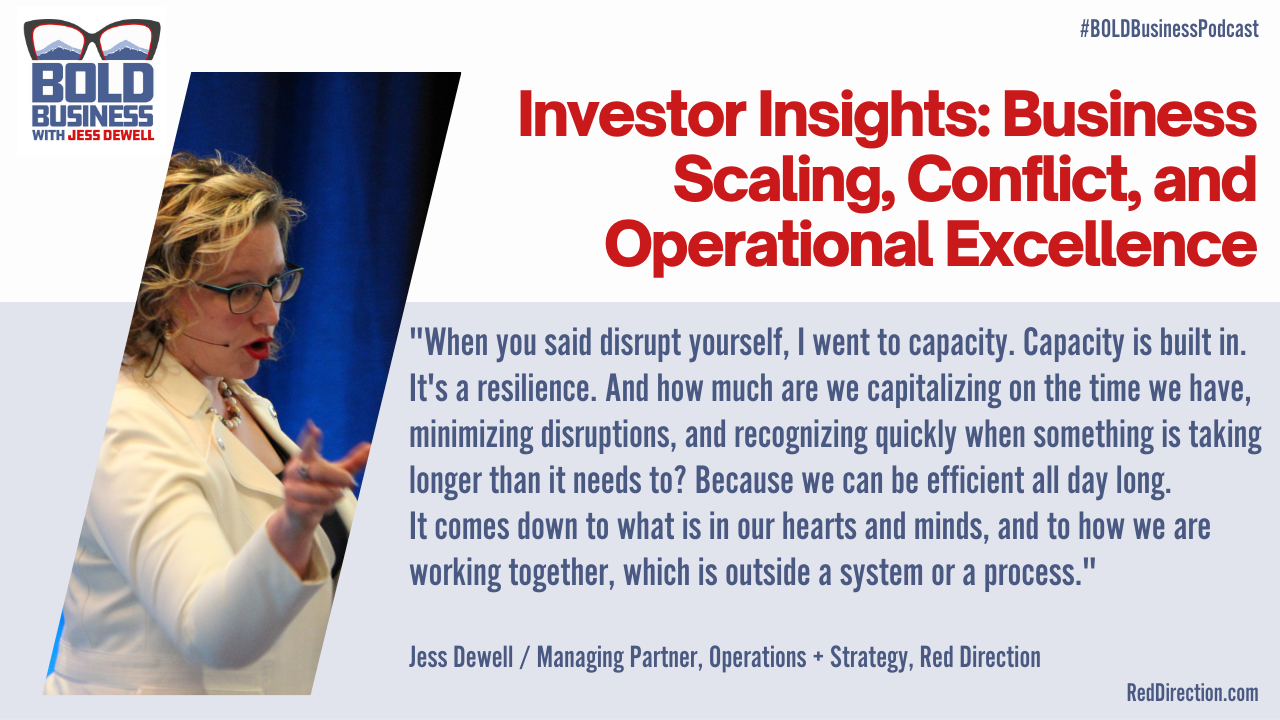
Yeah. It makes me think about burnout and in the sense of burnout, because one of the things that is required to do what we are talking about here is to have stamina and to recognize the capacity and really what is capacity, capacity is a built in, it’s a resilience and how well are we capitalizing on the time that we have and minimizing disruptions and recognizing quickly when we have something that is taking more time than it needs to be. And that’s outside of systems and processes because we can do efficiency all day long. That has been around since what?
The seventies, this big focus on how do we get efficient? How do we scale? How do we do this?
So it comes down to what is in our hearts and minds. And it comes down to how we are working together, which is outside of a system or a process.
Melanie Nebar 20:57
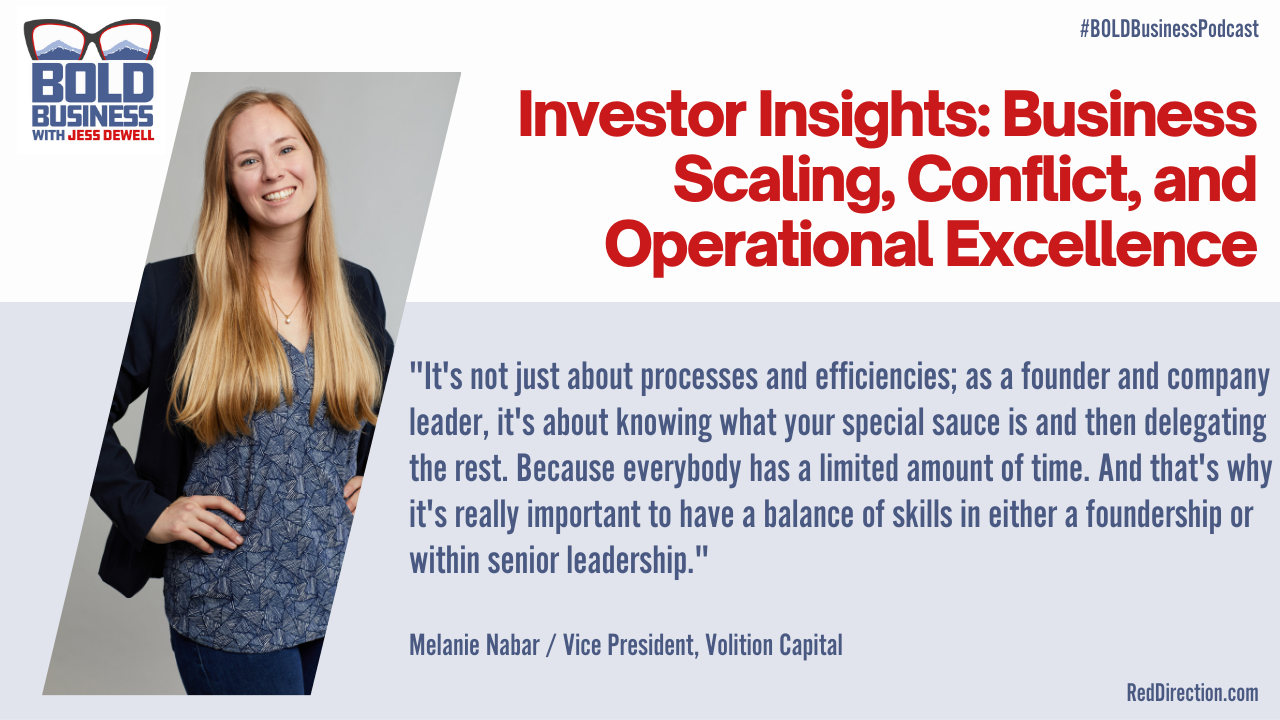
Yeah. And you bring up an interesting point here too. It’s not just about processes and efficiencies, but as a founder, as a leader of a company, it’s about knowing what your special sauce is and then delegating the rest of it because everybody has a limited amount of time.
And no matter how efficient you are, no matter how many processes you have in place, if you’re okay at product vision and an amazing customer relationship builder, and you’re spending all your time on product vision, it’s probably not going to be the best use of time. You probably should augment your capabilities. And that’s why it’s really important to have a balance of skills in either a foundership or within a senior leadership team.
Jess Dewell 21:45
Talk to me about when you’re assessing a company and you’re looking at the leadership team, in addition to the company and the potential within the disrupting product that is out there that has longevity and a big market to grow into, what are you looking at in a founder and a founding team to know that your investment will be a good one?
Melanie Nebar 22:07
Yeah, no, it’s a good question. One of the benefits of being a minority investor that’s typically backing like the founders and the management teams in place is you couldn’t find somebody who cares more about a business than its founder, right? Like they’re going to put everything into it.
But as we’re assessing those founders, there’s two things we look for. One, can you make hard decisions? It is a lot of loyalty when you’re building a business.
There’s a lot of loyalty that comes into getting people to quit their jobs when you’re three people in a garage to build a business, but those same 10 people, they may or may not be the right people to scale at that next stage. And so can you make the hard decisions to know where people are, assess their capabilities and strengths, put them where you need to put them and bring in the right people to bring it to that next stage. So I think having a founder that understands what keeps you up at night, what are you going to do about it?
And who’s exhibited the ability to make some tough calls. The other thing we look for is somebody who has a very clear perspective on their problem set and a passion for solving it. A lot of founders will start presenting to us and we’ll say, oh, our market’s a billion dollars and this is our product.
But the why behind it and that passion for solving that why, that’ll take you a really long way when it comes to scaling and vision. And so that’s something we also look for. Okay.
So I’m here.
Jess Dewell 23:40
I’m guessing you hear a lot of pitches. What else somebody can do when they pitch you? The worst thing.
Or if there’s a bucket of, I know I’m tuning out when I hear these things.
Melanie Nebar 23:55
Yeah, no, I think, I think there’s two things a founder could do on a call that will make an investor kind of tune out. The first is not clearly articulating your problem set. Sometimes I’ll hop on a call and a founder, I feel like we started in the middle.
I feel like we started in, all right, this is how I’m going to scale my go-to-market team, and I believe my company is going to go from one to 20 million next year. And that’s all great, but none of it matters until I understand like the problem you’re solving and not, I could look at your website, but like the real problem and passion that you’re solving. So making sure you start with that’s one problem.
And then the other thing is I think founders are naturally optimistic, which is good. You want to be optimistic. You’re not going to start a company unless you’re optimistic about the potential results.
However, founders will often get overly optimistic when they’re talking to prospective investors, especially really early days. So we’ll talk to a company and it’ll say we’re a million in ARR, which is not an easy thing to accomplish, but is early in the grand scheme of things and too early for where we come in. And they’ll say, we’re going to be 10 million next year.
And instead of hitting 10, they’ll hit three. Now going from one to 3 million of ARR is absolutely phenomenal. If we had never talked to them before and they went from one to three, we’d say that’s amazing.
The concern is, okay, you went from one to three instead of one to 10. Did you build your expense base based off of that 10? Because all of a sudden you’re burning a lot of capital and you lose trust in your skills and trust in what you’re saying from a projections perspective.
Now I’ll caveat that a little bit because when companies are early things happen and you can’t hold people too much to those aspects, but it is something that I think founders do without thinking a lot of times when they’re really early. And I think being a little bit more measured in what you’re sharing and how you’re sharing it could be helpful as you think about capital further down the line. And you’re further down the line.
Yeah. We typically come in when folks are north of four or 5 million in ARR, somewhere between that and 25 million of ARR. So these are businesses with really strong product market fit, a lot of referenceable customers.
You can start to do some math equations behind. If we raised 20 million and we brought on our first marketing hire to finally give our sales reps leads, what could we become? You can start to do math on retention, but it still is pretty early in the grand scheme of the businesses.
Jess Dewell 26:38
For the longevity of your relationships. So once all of the diligence is done, once all of the things are in place, once you’re in, or somebody in your company is sitting on the board of your portfolio companies, right? How transparent are they with you about their problems?
Is there transparency and vulnerability in either board meetings or in one-on-ones? And do they leverage you and the experience and expertise that you can bring them to face challenges?
Melanie Nebar 27:07
Yeah. When we are doing diligence on a company, one of the things we like to try to establish before we even invest is highly transparent information sharing. So you get what you give during diligence.
We’ll play back all of our analyses and say, here’s what we’re seeing in the information you shared. How should we read into this? How do you read into this?
Is this the right way to be looking at things? Cause maybe it’s not, we’re coming in and you know, your business better than we do. And so with that creates a muscle memory of high transparency, because the best board relationships are going to be transparent.
You can’t help a business if you don’t know what’s going on under the scenes. From our perspective as well, once we’re involved, like we’re in it together because the reality is once you bring on a partner, like they’re on your cap table, the only way to get a person off your cap table is to sell your business or sell that stake, which can be quite difficult, making sure that you have a really strong, transparent relationship from our perspective with the founder, but also the founder with their investor is really critical.
Jess Dewell 28:17
Founder singular versus founder plural in your portfolio. What do you tend to work with?
Melanie Nebar 28:24
We, for the most part, it is a mix, but I will say most of our best outcomes have been dual founder relationships where there’s really great co-founders with complimentary skillsets. So you maybe have a technical founder and then you have more of a go to market customer centric founder, but we’ve seen great outcomes come in all different shapes and sizes.
Jess Dewell 28:47
Do you evaluate the, a single founder different than you evaluate co-founders or three or more groups of three or more?
Melanie Nebar 28:58
Yeah, it’s a good question. I do think naturally when you’re working with a co-founder set, you know that there is an ability to disagree, right? With between the management team members, because if you do have co-founders, there’s no way that they agreed all the way through getting to 5 million in ARR, right?
I think sometimes when we’re assessing a singular founder, one of the things we’re assessing is that founder’s ability to take feedback and willingness to take feedback, right? What we don’t want is we don’t want to partner with a founder that doesn’t want to listen to any pieces of advice. Now, not all of our advice are they going to take, nor do we expect folks to a little bit of our job is just pressure testing and if you have a strong opinion, then great, that means that you have conviction.
However, what we don’t want is a singular founder that has, they decide the direction and nobody can tell them otherwise, even if all their other senior leaders are disagreeing and ringing the bells, a lot of our founder discussions when it is a singular founder and this, we do this as well, the same thing when we’re working with co-founders, but is assessing, is there a coachability? Do we feel like we can have a two-way relationship where there’s transparency and trust and we can push on things if we don’t agree and the founders own these businesses, so ultimately they can decide what they want to do, but are they looking for that kind of advice and partnership and are they willing?
Jess Dewell 30:32
And will the teams keep giving them that? Those are my clues when I’m looking at companies that want to scale and they want to get to a place that they can receive investment. Am I using the right phrase when I say secondary investor?
Melanie Nebar 30:44
So we typically do primary capital. So there’s two types of capital. There’s primary capital.
You put it on the balance sheet to drive growth and there’s secondary capital where you’re taking some chips off the table as a founder because, Hey, maybe you didn’t take a salary for a few years or something like that and so we’ll do either and we’re really, the difference being between us and like a private equity buyout shop being that we’re buying minority stakes. So it’s really a minority partner.
Announcer 31:16
If your week feels like you’re being pulled from one demand to the next, this is for you. The daily grind is the number one killer of business instinct, pulling you and your team away from your vision. Reclaim your strategic edge with the present retreat.
This free guide from Red Direction is a simple, powerful framework to carve out the space you need to filter out the noise, make the right decisions and lead with clarity. Visit presentretreat.com.
Jess Dewell 31:45
This is such a great conversation. I’m excited for you to hear the rest of my conversation with Melanie Nabar, the vice president of Volition Capital. Brilliant and a willingness to be able to look a little closer at ourself is as a founder is more important than ever before.
So if we were going to bring somebody on, we’re expecting them to in ownership of a company where I would expect them as a founder to have an opinion, but I would also hopefully have an expectation of myself thinking about the global you instead of just me as yes. Do you offer services to support that development? Because I know there’s a lot of work that if we don’t have for whatever reason, maybe we’re co-founders and we work so well together, we just ended up here and it was a total, it feels like accidental success, even though it was so far from that, but the friction on how do we work through challenges, the problems that we face didn’t feel as big as we’ve heard other companies talk about.
And that’s an, I find that interesting because there are a lot of groups that get to that, and then it comes back to when we were, I was talking about the shape earlier of, we have a new set of constraints and we’re going to take this on and basically who we were and the role we had, it’s the same. We’re doing some of the same stuff yet. It now has much more dimension and it has much more depth and we’re going to have to become new people.
Can we step into that? And I don’t know if there’s a way, clues that you could say, so somebody could really quick go, oh, cool. I don’t have those or, oh, cool.
I do have those.
Melanie Nebar 33:27
Yeah, it’s a good question. I think ideally we are understanding founders during diligence where we’re getting a good sense of, do you know what you don’t know? Because that’s important.
And are you looking for somebody to help you bounce ideas when there are areas you don’t know? Once we’re investors, the way that we approach it is one, your board member relationship, most of our investments, like we’re talking to the founders on a daily basis. We’re texting, we’re calling, now it’s up to management.
They don’t have to talk to us on a daily basis, but the goal is that we have a relationship where if something comes up, you’re getting on the phone and you’re calling your board member because you’re saying like, have you ever seen this before? What did you do? And then what we also try to do is we connect our portfolio companies.
Talk about a group of similar stage and mindset folks, right? Hey, you all work with the same investor. You all took on minority capital at this stage.
We’ll connect our portfolio companies with each other where people want to bounce ideas off of one another. We do an annual meeting every year where we get all of the executives together. So they start to meet each other.
And then there’s a little bit of a more of a natural conversation that happens afterwards. And we’ve also built out an advisory board of executives that we say have been there, done that. So these are people who have been president of HubSpot, for example, where our founders who are not yet at HubSpot scale can reach out and chat with an executive who’s done it in a great way before and see if maybe their experience is helpful.
Now, these aren’t people that are not on your board, so you don’t have to follow their advice, but it’s more meant to be, Hey, you don’t know what you don’t know. So let’s connect you with folks who maybe do have that skillset that you can bounce ideas off of. Okay.
Jess Dewell 35:24
So then that I’m going to like circle way back because I’m thinking about strategic clarity now, maybe once as, as a minority owner of the company, you come in, it gets lost because all of a sudden there’s this bigger picture and we thought we had it, but we don’t. Can you sense it? Really what that comes down to is, is there’s value erosion somewhere along the way.
And my question to you then come becomes, so how does that lack of clarity actually erode measurable value?
Melanie Nebar 35:58
I’m guessing we can measure it. Yeah, no, you can. It’s a great question.
I think lack of clarity results in wasted resources at the end of the day, because if you don’t have clarity on what you’re trying to accomplish and which goals you think are going to have the most impact, then you’re spreading yourself too thin on all your focus areas. It is not uncommon for us to come in and invest in a company and have them try to do every good idea they ever had all at once. We’ll do a planning session and say, what’s your plan for your first year?
Finally, some cash on the balance sheet that you can spend and experiment. And the ideas are flowing. And a lot of them are great ideas, but because there’s a lack of clarity on which ones to go after, they’re all going to suck up a lot of resources, a lot of time, and none of them are actually going to be done with all of the necessary steps and dollars behind them.
And that is where you end up getting value erosion and you end up in a place where you’re burning a lot of capital without a lot of growth or ROI on that capital that you’re expecting in the future. And that can get really messy. I think that is a piece of a board’s job is to try to pressure test focus.
And again, we’re a minority, so it is a line, it is a balance where we’re not controlling the business, we can’t tell you exactly what to do, but typically minority investors will have a say on, hey, do we all agree that this is our budget? And so that can be a place that’s, to your point, measurable around focus areas. What areas of focus are you funding?
Because at the end of the day, that’s really where you’re spending your time.
Jess Dewell 37:41
And then that’s also what was pitched to you, which means that’s got to be something that shows up in your board meetings, which means that’s got to be something that shows up in any strategic time that you as a founder or your executive teams are meeting between those board meetings. It is more of a thread through everything.
Melanie Nebar 37:58
Yeah. And you want to plan, but not, don’t plan blindly either, right? So you might have a plan and you might have a direction and everybody’s aligned across functions, and you might realize halfway through the year, that it’s not right and that’s okay.
It’s better to make a wrong decision than to make no decisions and to go after everything at once, because then you don’t even know which ones were right or which ones were wrong. I’d rather we picked a direction. We identified it wasn’t the right direction.
All right, let’s adjust. Let’s pivot. By no means are people locked into these.
It’s true.
Jess Dewell 38:30
Adjustments and pivots don’t have to lose momentum. We think they do. We’re fearful of them.
We don’t want to tell anybody about them. I’m on the other side of that. I’m like, look what you’ve already done.
There’s gotta be something here that you can use. That’s already, there’s something in motion. Pick it and put a new lens on it.
Let’s go.
Melanie Nebar 38:49
Get out. You’re right. If you don’t make a decision and go in that direction, you won’t know if it was the right direction.
So if you’re six months in and you said, all right, we thought we were going to follow this new ideal customer profile. We funded some sales reps. We made some tweaks in our product and turns out nobody wants it.
It doesn’t solve a problem anyone cares about. Okay. What did we learn then where we can adjust accordingly?
And at least we went in a direction. 50, 50 shots.
Jess Dewell 39:18
I hear what you’re doing. And I hear this is the path you thought you were on. I think you’re one step to the left or to the right of it.
What can you adjust to take that one step? It feels real close. It sounds real close.
I don’t think you’re off. There’s no pivot to do yet. There is a step to the side to see if you can find it.
And it takes time and it takes effort. And I think that’s the thing that we feel is the scarcest. And we’re not always really good at using time that we can’t measure as productive.
How do you talk to your specifically thinking about right. Maintaining autonomy, keeping that vision. There’s an element of it’s fuzzy until it’s not.
And it takes time to understand what shapes are going to come down, what data is actually telling us. And then it comes down to our business instinct. Are we going, what do we think?
Are we on track? Are we not? And how come, what could we be looking at?
So I I’m thinking about that and I’m thinking about that strategic clarity and how much time do you tend to see the founders and executives that you’re working with spend on strategic time weekly?
Melanie Nebar 40:33
It’s a great question. Our jobs as investors is not to micromanage our portfolio. Oh, of course.
I’m definitely not trying to tell our founders like how much time should you be spending every week on strategic planning, for example. But I do think it’s really important for companies and senior leadership teams to be getting together in person on a quarterly basis to be talking about the strategic initiatives that they have. You can’t be going in any direction.
If you don’t have measurable steps along the way. And so while yes, there is an element of like, maybe you don’t know exactly how much time something should take, it needs to be measurable along the way so you know how much progress you’re making and if you have a goal or direction and it doesn’t have something that you can measure to know if you’re headed in that direction, then you don’t really have a goal at all, because you have no idea if you’re actually headed in that way.
Jess Dewell 41:32
I just didn’t know if you had seen a trend or through the conversations that you’ve had with your executives and through the advisory board that there was something that was like, this is the feeling that we’ve seen.
Melanie Nebar 41:45
Yeah. I think the trend we see is when we invest founders are doing too much. They’re still controlling it all, trying to be 10 different hats at once.
The goal is as you scale, as you’re scaling folks to support that founder and the founders spending more time on their special sauce, whatever that is, and less time on everything else that they might be adequate at, but somebody else is really great at.
Jess Dewell 42:14
What makes it bold? What makes it bold to recognize that there’s an opportunity to grow in it with an X factor and still stay focused on clarity to make sure that the problem you’re solving is engaging for you, your investors and your teams?
Melanie Nebar 42:32
I think being a founder in and of itself is the boldest thing you can do to decide to disrupt your entire life with the goal of disrupting an industry and how people are doing things. Like that’s about as bold as it gets. I think, you know, what we do is we try to support those bold visions.
We try to make them closer to a reality by giving founders the resources, allowing them to hopefully skip some mistakes other folks have already made that they can learn from. And by ensuring that boldness, that vision is supported by pressure-tested realities or encouragement to go bolder if maybe they’re not going bold enough and to keep them on that kind of bold path.
Announcer 43:28
And that brings us to the close of another powerful and fresh perspective on the bold business podcast. In today’s volatile landscape, growth is a double-edged sword to truly thrive. You must engage with your strategy, not just react to the day to day without absolute alignment, your company faces a stark choice outmaneuver or be outmaneuvered grow or get left behind.
Thank you for listening. And a special thanks to the Scott Treatment for technical production.