






As a business owner, it’s difficult to do the right work AND guide your company toward its next big initiative.
With Red Direction Business Base Camp, learn how to implement and handle processes to meet your business’s specific needs and better understand your market.

Starting the conversation:
Your character skills outlast and out-value your credentials in a rapidly changing world. Co-Founders and Co-Authors of “The Business of You,” Marnie Stockman and Nick Coniglio, share how to take more ownership during times of friction and lead yourself.
Growth comes from the friction of hard conversations, and you can leverage this discomfort to unlock the potential already in place from the systems and processes and people around you. Honest reflection is necessary for goal setting, adapting to change, and facing uncertainty. A key theme in this conversation is that “enough” is personal, not comparative.
In this episode, you will hear how to ask the hard questions that challenge growth, that “enough” is your connection to your internal values, and how to bring your character skills to face uncertainty. Jess Dewell talks with Marnie Stockman and Nick Coniglio, Co-Founders and Co-Authors of “The Business of You,” about what makes it BOLD to move through friction to drive your success.
Host: Jess Dewell
Guests: Marnie Stockman and Nick Coniglio
What You Will Hear:
04:00 Understanding yourself is the foundation for making big life decisions.
- Students (and Growth- Minded professionals) benefit from beginning self-reflection during pivotal times, like the junior year of high school.
- Making big decisions applies to all ages; it stems from knowing your unique strengths and values.
- The “right“ move in life becomes clearer when you lead yourself, rather than follow external expectations.
12:10 Spotting disconnects between what we say and what we do helps reveal points of friction.
- Team and personal clarity depend on confronting unspoken rules or assumptions that can create confusion.
- Asking challenging, direct questions is necessary, even if it’s uncomfortable for everyone involved.
- Facing uncomfortable truths is a service to both yourself and your team, fostering growth and alignment.
18:20 Storytelling is a powerful tool for setting yourself apart from the competition.
- Sharing your stories demonstrates character and is more memorable than reciting facts or credentials.
- In an era when resumes blur together, stories bring individuality and make people stand out — even in highly competitive environments.
- Employers and decision-makers remember personalised stories, while lists of achievements quickly become forgettable.
25:05 Regular reflection on success and values helps guide decisions and maintain purpose.
- Teams benefit from regularly pausing to align on what success means at any given point in a project or journey.
- Core values should resurface in decision-making, especially when opportunities or challenges arise.
- Individuals often need external accountability or reminders to reflect on their values consistently, not just during big changes.
32:40 Emphasising durable character skills is critical in a rapidly changing, uncertain world.
- Traditional skills may quickly become obsolete, while character skills like adaptability and integrity remain relevant.
- Social studies confirm that success heavily depends on personal qualities, not just hard skills.
- Recalling and celebrating stories that illustrate core values can reinforce confidence and resilience, whether for students or professionals.
39:50 Parents and mentors can best support student growth by shifting away from nagging and sparking reflection on personal stories.
- Asking about pet peeves or childhood joys can reveal underlying values and help reduce stress or burnout.
- Playful, indirect questions encourage openness and self-discovery, making the process more enjoyable and effective.
- Conversations about values and stories are best held in informal, comfortable environments rather than formal, high-pressure settings.
43:55 It is BOLD to take ownership and lead yourself.
Resources
- Marnie Stockman on LinkedIn
- Nick Coniglio on LinkedIn
- Is Your Portrait of a Graduate Missing This Critical Piece?
- Book: The Business of You: Ask the Right Questions, Tell Your Story, and Lead Your Life
Transcript
Jess Dewell 00:00
When we can naturally come to where there’s that resistance, it might be the place for us to lead ourselves, to get to know ourselves.
Nick Coniglio 00:06
The most important thing is that you need to lead yourself first.
Marnie Stockman 00:10
So you will stop just following the path, and you will be taking charge in leading the path for yourself even if you’re not titled the boss because you are the boss of you.
Announcer 00:26
Every leader needs a trusted partner for the moments that matter. This bold business podcast conversation is that partnership. Your go-to resource designed to break the inertia and refresh your perspective so you can start making moves. Here is your host, an insightful truth teller who serves as the catalyst for getting the right work done and who asks the questions that truly matter, Jess Dewell.
Jess Dewell 00:53
In today’s episode, I am talking with Nick Caniglio and Marnie Stockman. They are the builders, former executives in the EdTech space, and they are coauthors of The Business of You. Having led technical teams through rapid scaling and successful acquisitions, they’ve witnessed a recurring gap between checking the boxes and achieving real-world readiness. They are driven by the belief that success is often simple in theory but difficult to execute. And Nick and Marnie have dedicated their careers to helping people close that gap between intention and action. Today, they’re taking the business of you and building Blue, which is a platform designed to replace guesswork with purpose, to provide practical tools and frameworks that people need to develop their own self-judgment and their own self-awareness that actually drives outcomes that they are proud of. In today’s program, we cover quite a bit of things, and I’m gonna call out three so as you’re listening through, you know these are some of the highlights. The first is we talk about how to ask yourself and your team the real hard questions, those challenging questions that you can get to by asking for outside help. The second thing is that enough, while it sounds subjective, is very personal and not subjective. It’s an internal view of our own values and knowing what we as an individual can be best in the world at. And third, in this quickly changing world that we live in, it’s in the way that we show up to uncertainty, our character skills that will make the difference. I’m really excited for you to listen to today’s episode. Here we go. Let’s just talk about this crazy world where we’re at right now. Everything is moving fast. We are expected by the world around us, maybe unrightly so, that there’s so much that we’re supposed to be doing, and it’s really hard to discern the right work to do. And we’re we’ve all done it a few times. Right? We’re here. We’re established in how about this? I’ll pretend to be adulting some days. Showing up the best that I can anyway. I’ll speak for myself in that. And you’re primarily working with high school students and parents of high school students who are starting to do this process of adulting for the first time, and that really does come around college acceptance, go making those big choices. What are all of those things? And so my question to start is, what’s I I feel like there’s a lot of drag. There’s a lot of things we’re supposed to do for our kids or our students are supposed to do. And let’s just cut to the chase. If we were to peel it all away, what is the actual right thing to do the first time we’re going out in the world after something really big, like applying for college to get into the one we want?
Marnie Stockman 03:58
So I think the first thing is to understand who you are because then it won’t seem so big because it’ll feel like the right move. My background was I was a high school math teacher. I’ve been an assistant principal. And juniors in high school are primed for this. They’re ready to start thinking about that. But I think this is true for any big thing. I any big decision in anybody’s life. If you understand who you are, then you can make the big next step that feels right to you. Nick, what were you thinking?
Nick Coniglio 04:30
I absolutely agree. I think we talk a lot about the fact that the traditional thought process is once you’re finished with whatever, once you build up the credentials, whether it’s in high school with GPA or AP credits or even if it’s a job going after a job, it’s the resume, all the certifications, what have you. Once you’re finished, you’re ready. And that’s not necessarily true. Finish does not equal ready. And I think it all boils down to, okay. The thing, like, my 21-year-old son, the most important thing I tell him is that you need to lead yourself first. Right? Because if you’re not, something else will. It might be a fear of something or somebody else’s expectations, which is huge for teenagers, but also huge for adults. Right? The reality of it is that, that the first day everybody has to do, it’s more important than all of the credentials, all the certifications, all the resume line items is to lead yourself first.
Jess Dewell 05:38
So let’s put that into real context. When we make a goal, sometimes people are making goals because that’s what’s expected of them. Here’s the next promotion I have to get. Here’s the next step of life I’m supposed to take. Here’s the linear path. Now, I am a product of beating my own drum from the very beginning. In my family, everybody says on a regular basis in my extended family, oh, that’s just Jess. And that I will claim that. I do know that there is something where when we can naturally come to where there’s that resistance, it might be the place for us to lead ourselves, to get to know ourselves. Is that what you have found in your work?
Nick Coniglio 06:23
I think a lot of people again, this doesn’t just apply to kids, it applies to adults too. Right? They avoid the hard conversations with themselves. Right? And that avoidance is expensive. Right? Every time I adored not having that hard conversation, not doing the reflection, it eventually shows up and then eventually comes back to bite me. So whether it’s establishing a goal, right, or just generally knowing your bag is doing that reflection, right, that’s that’s what I think we’re trying to say. It’s critically important to understand yourself first. And what we see time in and time again is that is not the right thing. That is not what people are doing, whether they’re you’re young adults or experienced adults like us. And that just comes back to hurt you in the long run because at some point, that’s gonna drive stress, anxiety, conflict. And gotta embrace that friction. You yeah. You gotta embrace that friction in, in our opinion.
Jess Dewell 07:29
Even the companies that I’m working with, we also are working together to face the things that have been avoided or not fully faced or embraced because that desire to avoid friction is real. It is viscerally real in a world where everything is changing around us and all we want is a little bit of certainty. So how do you start that process of, okay, I’ve got friction. To get to where I wanna go, I’m gonna need to face it. I know I need to know myself and my values and be able to start from there. But what are those hard questions, and how do we know we’re asking the right ones and not, like, shirking a little around them?
Marnie Stockman 08:12
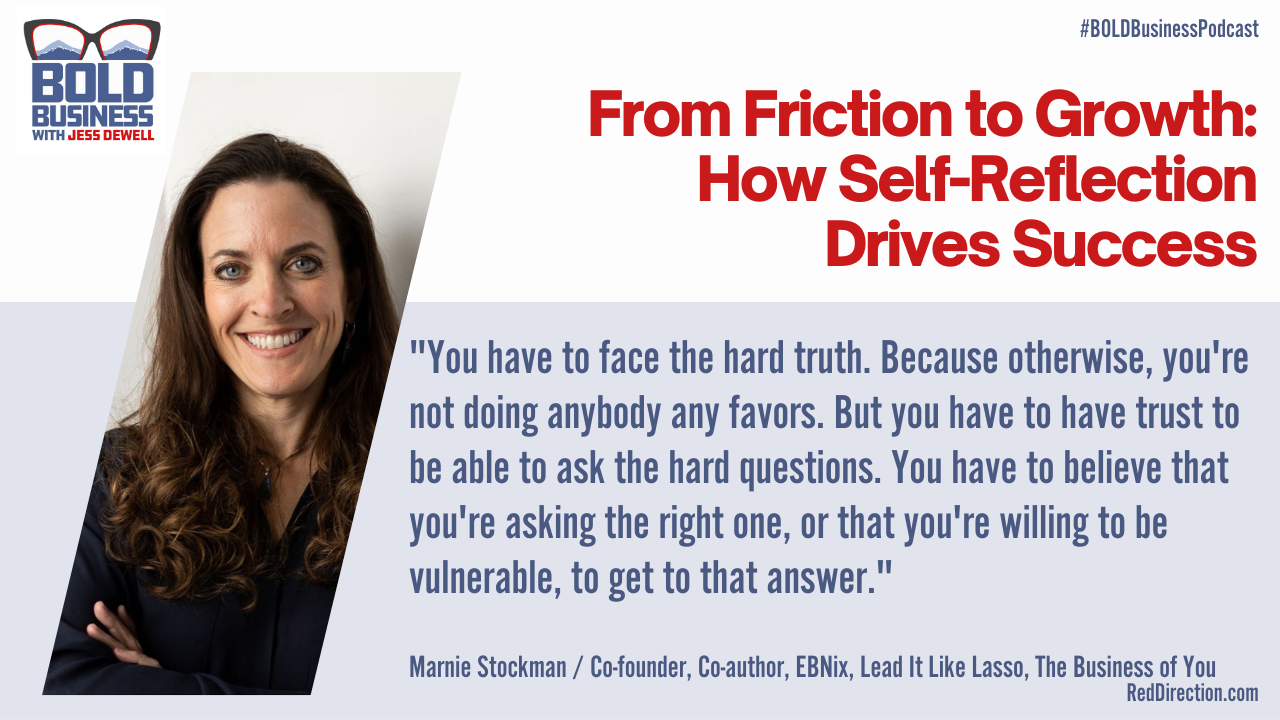
Taking the easy asking the easy. This definitely brings to mind Brene Brown’s book, Dare to Lead, because she says clear is kind. So nice isn’t kind, and clear isn’t nice. Clear is kind. So that means you have to face the hard truth because otherwise you’re not doing anybody any favors. Right? So you do need to get to that challenging question. Now of the team, Nick is the one that asks great questions. But I think you have to have trust to to be able to ask the hard questions in a team of yourself. Like, you have to believe that you’re asking the right or that you’re willing to be vulnerable in order to get to that answer. Vulnerability is the place I would start. Nick, you are better than
Nick Coniglio 09:01
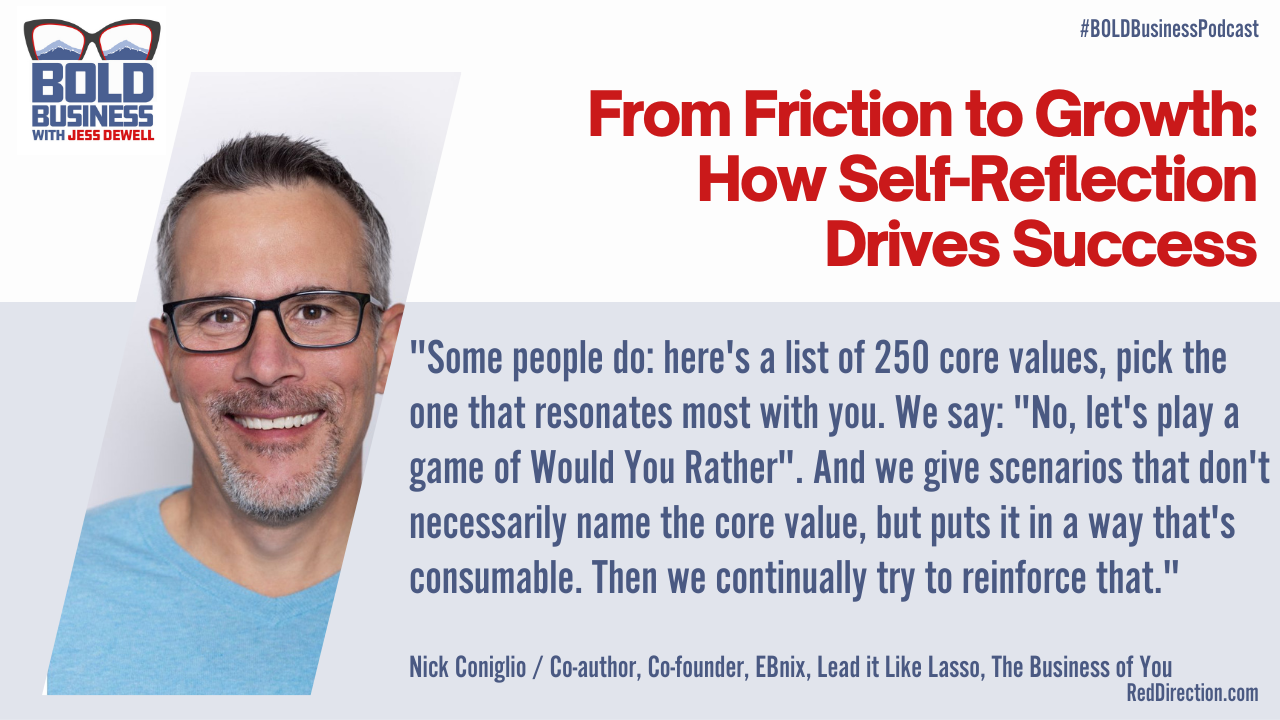
I would just add. Yeah. I think our before our current initiatives that we’re working on, we wrote a book about Ted Lasso, and Ted Lasso has this notion of diamond dogs, right, which is your accountability network. Right? There’s that trust. And I think that’s what Marty is trying to describe a little because Yep. Because, Jess, I think you bring up a good point, which is sometimes you just don’t know where to start. That requires help. And that’s actually the core of what Marnie and I do almost on a daily basis, whether it was our Buckleed at Light Lasso or the Business of You, is we recognize that is a blocker for so many people overcoming that friction because they don’t wanna have those tough conversations or they don’t know how to start with it. We provide in a lot of different ways, different frameworks to pull that out from you and do the reflection. Mhmm. And one of our tendencies to always have fun. So we do this in the form of games. We do it in the form of challenges. In other words, if you’re trying to decide what drives you, what motivates you, what makes you tick, some people just do, okay. Here’s a list of 250 core values. Pick the one that resonates most with you. We say, no. Let’s play a game of would you rather, and we give scenarios, right, that doesn’t necessarily name the core value. Right? But it names it it puts in a way that’s consumable for whatever the the age of the person that’s doing it. And then behind the scenes, we say, okay. If you pick this answer, this answer, this typically means that integrity, pick one. I I don’t know. Empathy is what drives you. And then we continually try to reinforce that. So I think you’re bringing up a big problem that gets Maureen and I out of bed every morning, her and Marilyn, May, and Georgia. Right? How do we teach people how to do this? And not that we’re the experts, but in such a way that has worked for us in the past.
Jess Dewell 10:53
I was having a conversation just the other day. I didn’t even learn their name. We were talking about unwritten agreements in business. And that’s what I hear you talking about and being able to pull out maybe. And because what we do versus what we say we do first has to match up before we can even get to whatever the questions are. And I was telling them, they were like, what do you do? And I said, usually, I’m working with people around a table and or across screens, and we’re having these conversations. And really quick, I’m the one to find the, the place where everybody goes silent.
Marnie Stockman 11:27
Mhmm.
Jess Dewell 11:28
Somebody gets a cringe. You can see the cringe on somebody’s face.
Marnie Stockman 11:31
Are they saying that out loud with a stranger? In the room. Yeah.
Jess Dewell 11:34
And I was telling them, I said, that’s actually something that I’m really good at. I can actually find where things are not matching up really fast. And those unwritten agreements do in a team setting, but also in an individual setting create confusion for that clarity, Marnie, that you were talking about. Yeah. So we have to we were talking about leading ourselves. I’m thinking about this in a marketing perspective. Is marketing the right area to put this work in? Self-marketing, self-branding? Or does it fit in another area like pillar of department of business?
Nick Coniglio 12:10
When we’re talking about understanding who you are, we put that into human resources because that’s where you decide you’re looking out for the team and what they’re all about. I think there’s definitely an important role as we talk about being the CEO of ourselves in the business of Nick Inc. For marketing, and it’s how you have confidence and tell the story about what value you can provide to others. So I would say the core values part, the self-assessment, the learning about yourself is to us, all about human resources. But in our book, we start there, but then we go directly. I think we make a pit stop in product development, but then we go right to marketing, which very much talks about how do we present ourselves in a way that people understand the value that we can bring to others? Because that’s just like you said, Jess, when you go that’s one of the values that you bring when you sit down with a group of the people. Mhmm. Right? You can get them to be like, yeah. You’re right. That is a little bit of a disconnect. There’s some friction there around that. That’s that and that’s a extremely valuable asset to bring to you, any part.
Announcer 13:21
Feeling stuck? Like, what got you here won’t get you there. The pressure to grow is on, yet the path isn’t clear yet. You don’t have to walk that path alone. This is the Bold Business Podcast. Like and subscribe wherever you listen. Your host, Jess Dewell, is the strategic partner you’ve been looking for, asking the questions that truly matter. It’s time to break the inertia and get the perspective you need to make your next move.
Jess Dewell 13:55
You’re listening to the Bold Business Podcast. I’m your host, Jess Dewell. Today, we are talking with Nick Coniglio and Marnie Stockman. When I was hearing how you described the work and how you’re pulling this out of people almost seamlessly, it’s pretty amazing to have a process so complete that it is repeatable. And it’s repeatable enough not only because you not only to be able to put it in a book that somebody could start on their own, but you’re also making an app. Right?
Marnie Stockman 14:23
And it is interesting to as we work through the app, to replay conversations we’ve had with students and watch how they would have responded to this, which is fun to do. But it is it’s like Nick said, it’s in the pattern finding and in the stories you tell. So he talked about the game piece to help us identify patterns in the way people respond. But the way you verify that in fact because there are a lot of core values that sound good, which is why the list idea doesn’t always play out because people are thinking, I want all of them. Right?
Jess Dewell 14:58
I know. Right?
Marnie Stockman 15:00
In the way you tell your stories, you will find how those core values in fact play out. And so that’s what’s interesting and repeatable is where you verify the stories or the core values.
Jess Dewell 15:13
So Marnie, let’s take that a little bit further. Knowing who we are, knowing these values that we have, I’m curious about the storytelling because there’s several approaches. Right? Like when we’re building a resume, we’re talking about straightforward fact impact, more impact-oriented on summary sheet.
Marnie Stockman 15:32
Not a story. Yeah.
Jess Dewell 15:33
We correct. It’s not a story, but it’s delivering a lot of value. It’s showing and telling a lot of information in a short period of time. And we’ve got this story. We’re moving into this marketing piece. And so how do we take advantage of something like this and show up with this with being able to find that next step of when do I tell the story and what’s appropriate based off of what we’re seeing in these patterns that we’re verifying versus what we need to have in a different doorway to basically go, yep, this was our ROI from this amazing work and the stories that we told.
Marnie Stockman 16:05
So done, they are one in the same, And you should do the work ahead of time to figure out the threads that tie the stories together. One of the things that I find funny is that if you talk to people and ask them what games they played when they were growing up, you will start to see some threads like, did they like strategy games? Did they like creative games? If you start getting people thinking about earlier in their lives, they’ll start you usually that when I’m listening, that’s where I start hearing patterns emerge. And then say, oh, so it seems like you’re a bit of a risk taker. Right? Maybe their games, like, they’re bungee jumping, they’re skydiving, whatever. Like, how does that play out based on what you have listed on your resume? I know it might not be skydiving. Right? It might be, oh, you seem to like these types of activities. And that’s when the activity ties into the story because it’s connected to the theme. And then suddenly, like, if you I often start presentations by listing the jobs that I’ve had. And I said, so you might be thinking right out of the gate, this woman can’t hold a job. I’m not sure why we should listen to her. But I will say that in all of them, my goal has been to help people become their best version. That was my teaching philosophy. That was my philosophy in customer success. And I can tell you why all of these jobs are me doing that at another level. And then suddenly your story makes sense. And then the ROI is because this is the way I think of how I’m going to approach this role, this is the outcome I would expect from them. Does that make sense?
Jess Dewell 17:40
It makes complete sense. So how do I go back to when I was 16 years old so that I could have saved myself a lot of trial and error? Let’s just be real about that.
Marnie Stockman 17:48
I don’t think AI has gotten so advanced that we’re there yet. So we’re just gonna have to do the rethinking now. Do a little bit.
Jess Dewell 17:57
Because I’m thinking back. I’m, I’m listening to you and I’m like, oh, yeah. All of these things have something in common. And it’s true to see, but I took and I’m still not great at it. I don’t know if any of us really ever feel like we’ve claimed it based off of our own evolution. Fully, claimed it fully. Can do it might be different. And you can correct me if I’m wrong there, but I’m thinking about this. Nick, why is storytelling 22 times more effective than facts?
Nick Coniglio 18:23
Yeah. That’s a that is a great stat that we talk about quite often. If you think about it, I think the simple answer is facts basically inform where stories transform. A fact on your resume, the certification, it’s just it’s a data point. Right? But a story about solving a problem, failing, and how you demonstrated resilience, how you came back stronger, that’s that demonstrates character. And in turn, that activates something from the person who’s receiving it. It activates emotion. It activates memory where, typically, data points don’t have that same activation process. Right? I think about it. I was in executive leadership for twenty plus years over four startups that all grew beyond our wireless imagination. And I think about it. Everybody that I got value out of that I worked with or that I worked for that worked for me was really good at communicating things in stories as opposed to just facts because I, I viewed that as good communication because I understood it. I remembered it. And that’s what I think you gotta remember. If you’re going in when we talk to high school students, you’re going in for an interview for an internship or their first job or even to get into college, just simply reciting what you’ve done without the meaning behind it is not memorable, and it’s not really that impactful, especially today when people can generate those line items in five seconds or less by going to Cloud or ChatGPT or or Gemini or whatever that they’re doing. So storytelling is also adding a more not that AI can’t generate stories, but it it is truly it’s differentiating people more today in a huger crowd than there’s ever been, like, when you’re trying to achieve something and get a job when 3,000 other people are doing it or start a business when all of a sudden you everybody can start businesses overnight. If you can communicate stories, you have a leg up in, in a way of differentiating yourselves above the frame, as we like to say.
Jess Dewell 20:43
So let’s dig into that a little bit more. If we know friction is a place of growth and we’re willing to take that closer look and ask ourselves the hard questions to get to the threads to be able to see this, how do we how do we what are some maybe two or three tips about starting telling the story or maybe it’s two to three tips about I can’t tell which is right yet, so you’re gonna get it all. About how what is enough? Because sometimes that feeling of not enough just means we’re going overboard and we don’t need to work that hard. What is enough to find that story and stand out? Tipping point, maybe.
Marnie Stockman 21:21
It is like Ted Lasso would say, it’s like the off sides rule. You know it when you see it, which was also something else, but I won’t bring up what that was originally ordered from. It will feel like the authentic version of you. You will be able to own it when it happens. Interesting. I I watch a lot of companies try to come up with their core values, and integrity is one that looks good on the wall. Right? But then I will ask them what behaviors do you have that show that integrity is important to you. And there are only two companies I’ve ever worked with that integrity has stayed on the wall. Interestingly enough, they’re both utility companies because, by golly, you wanna keep the lights on, and they all feel this in their core. I’ve not seen other companies do that. So for me, when the stories you tell match the core values on the wall and the behaviors of the teen or the teams, the company. Right? When those are the same, the policies implemented in a company show that’s what we mean. Case in point, I’ll make it specific. Transparency was one of our core values. And one day, we had an outage, and we immediately emailed all of our thousand clients and told them that we had an outage and that we would tell them again in fifteen minutes what our engineers found. And in fifteen minutes, we said we’d respond back in an hour. In an hour, we were back up. And I would email those same thousand clients every Friday with a newsletter. I’ve never got any responses or rarely did. But that day, I’d sent an email saying that we were down, and I got three positive responses that said in lack of when perfect uptime is the goal. But when that can’t happen, 100% communication makes you a valued company. You guys rock. So the one time we sent, like, bad news, we got you rock instead because we could pinpoint transparency is a core value. We acted it out, and we have stories proving that was effective for us.
Nick Coniglio 23:36
Because you mentioned Jess enough. Right? That’s such a, such an interesting question. I think, Marty, you’re talking to this. And it’s so often framed as a comparison question. Right? What’s enough? And, and I think, like Marnie said, it’s not a comparison question. It’s a values question. Right? If you’re always measuring yourself against everyone else, right, or if you’re a company and you’re measuring yourself against competitors all the time, the hustle’s never gonna stop because there’s always gonna be someone who’s better at something, a company that does something better. But if you truly, like Marneux said, understand who you are and you’re meeting and exceeding that as, as best as you possibly can, I think that’s a pretty good greeting system to what enough is? And believe me, that’s hard to do. Right? So it’s not, okay. I’m 22 years old and, yeah, I need all my values. No. We all make mistakes. We do it constantly. So I think the big thing is when we get asked, what’s enough? What is that finish line? It’s it’s not comparing yourself to anybody else, which so many people do. It’s really comparing it to understanding who you were, cycling all the way back to where you started, Jess, which is core values. Right? That’s why it’s always first on our list of topics when we talk about things.
Jess Dewell 24:53
So you talk about reflection and you talk about asking the hard questions. How often are you two with you with yourselves as a team and with your clients circling back and bringing those core values into the conversation?
Marnie Stockman 25:06
Every day we ask what does success look like today? And that is stemmed from the goals that we set based on our big plan, our vision, etcetera. And then as to specifically how often do we cycle back to a core value, it is probably every time there is a tough decision to be made. Does that align at a minimum quarterly as we’re setting goals for the next quarter? But anytime you’ve got anything that’s not an easy, obvious, like clearly this aligns with our goals. We’re going do these things. I think it pops up sometimes if we have an opportunity and we’ll say, does this opportunity, does this speaking event align with what we want to do? And we don’t necessarily revisit the whole it makes us think at least to confirm the core value, if not rethink it. Nick, what do you have in mind for that?
Nick Coniglio 26:02
Individually, And I’m not speaking for Marnie here, but I’m speaking for myself, which is I don’t ask those questions enough. That’s why I think it’s really important. We, in our book, we talk about the different departments of the business review, but we also talk about the notion that every successful business has a board of advisers. And as an individual, you should have a personal board of advisers because they will hold you accountable to viewing that reflection and viewing that work. And Marnie and I have that. We have that at each other. We have that with people we lean on, mentors. But I don’t think I think it’s a lot to ask for an individual. Marnie probably does this because she’s got this superpower that once she commits into something, she’s doing it. Right? But so many of us don’t, and we need others to hold ourselves accountable. Having others to come into your network and being vulnerable with them and to explain to them what you’re trying to accomplish is really critical to doing enough self-reflection.
Jess Dewell 27:00
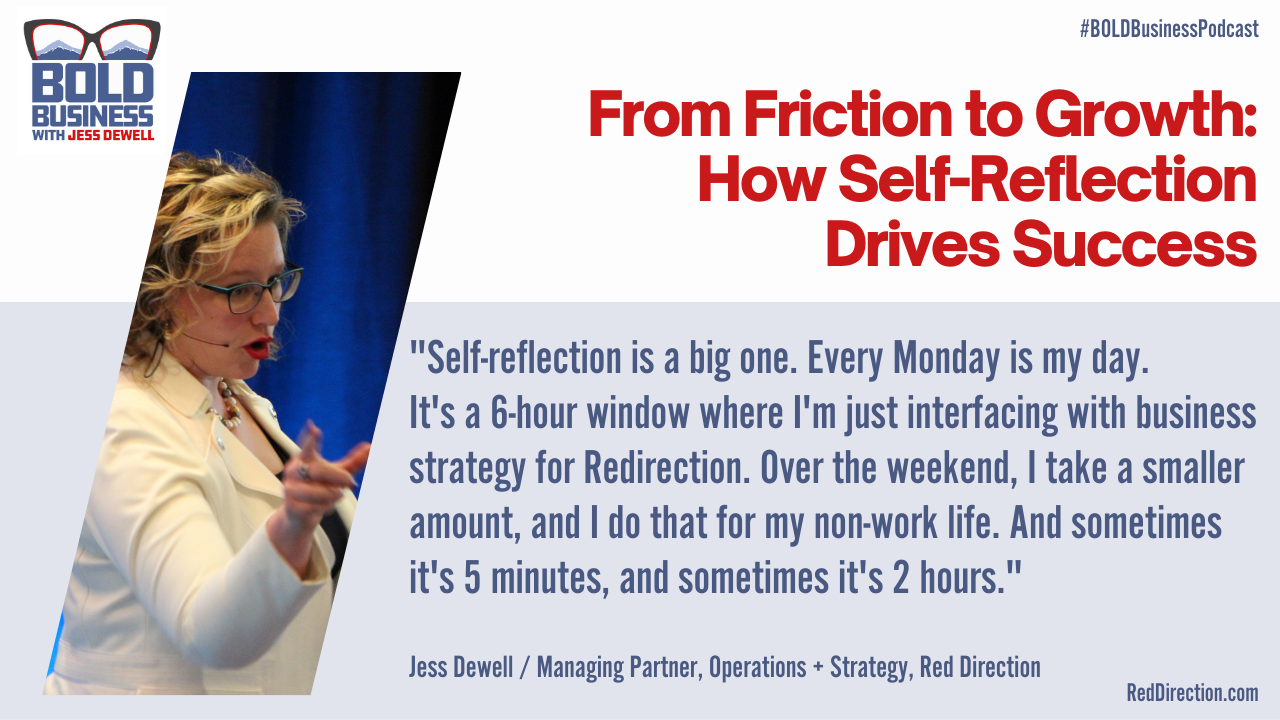
Yeah. Self-reflection is a big one. Every week, I have a day. Monday is my day. It’s a six-hour window where all I’m doing is interfacing with business strategy for Red Direction. Over the weekend, I take a smaller amount and I do that for my not work life and my husband is involved in that. And sometimes it’s five minutes and sometimes it’s two hours. We do whatever we need to do based off of the flow. And in that six hours for work, it doesn’t look the same every week. And that’s one of the things too that I think I will call out for whatever the reflection is, whatever we get to do, if we think we’re doing enough or we wanna do more we think we’re doing too much and maybe we don’t by the way, I’m in agreement with, I don’t know if there is a thing called too much self reflection. It’s that silent it’s that silent piece that really gives us leverage over time. So I wanna shift gears a little because I’m listening to both of you and it reactionally reminds me of a Jim Collins concept of what are you best in the world at.
Nick Coniglio 27:59
Yeah.
Jess Dewell 27:59
It sounds like through all of this work and the way things are going, something is showing up and each person, as well as like what Jim Collins talks about in companies, can be the best at the world at something. And what came to my mind was my husband during acquisition process of one of the companies that our household was involved in, he came home and he said, you’ll never guess what I saw while I was out of town. And he said, I saw a truck and it just said casters on the side. And this company only did casters. And I’m like, where are all the places that casters go? And we sat down, and we came up with this huge list, and we were amazed that somebody could make a business that could live in a fairly it wasn’t a gigantic city, but it was a bigger city that could be profitable off of just that. And I to me, that’s enough. Can we find the one thing? Yeah. And is that the basis for everything else? And is that the enough that when we’re, to your point, authentically ourselves, we can build everything from?
Marnie Stockman 29:07
So first, I have to laugh because so my husband is a collector, and he likes to use things in different ways. And people are always giving him random things. And one time, we got 900 boxes of casters for free. And so I was like, I can tell you what you can put casters on. Let me push my desk out of the way while I tell you this. So it’s interesting as, as we’re developing Blue, that is the name of our app. It definitely would be helpful for all humans. But we talked to two product developers who said you really want to start with the smallest piece of the pie that you can really make it perfect for that subset and expand from there. Business term, the riches are in the niches. Casters, they nailed it. Sounds like they, they got it.
Announcer 29:59
If your week feels like you’re being pulled from one demand to the next, this is for you. The daily grind is the number one killer of business instinct, pulling you and your team away from your vision. Reclaim your strategic edge with the present retreat. This free guide from Red Direction is a simple, powerful framework to carve out the space you need to filter out the noise, make the right decisions, and lead with clarity. Visit presentretreat dot com.
Jess Dewell 30:28
So glad you’re listening to the Bold Business Podcast. Today, I’m talking with Nick Caniglio and Marnie Stockman. Back to the show. If you think about service-based businesses, windows sometimes end up doing something else, or gutters end up doing lights on buildings, or, right, and so they expand out. And there are a lot of reasons to do that.
Marnie Stockman 30:47
Sure.
Jess Dewell 30:47
And all good reasons. There are also a lot of really good reasons to not [Yeah] do that. Yeah.
Nick Coniglio 30:53
Because you’re diluting your services. Right? And that, that can be a problem. But like you said, there is an opportunity to expand your services at the same time. Not all of us have the investment and the resources to be good at everything. I think, I think it’s when we started our last business before we got back into this world that we’re in now, we were focused on the niche, right, of quarterly business review reporting for IT professionals. I don’t know if there is more niche than that. Every leadership meeting we had was, we wanna be the best end QBR company Mhmm. For IT service providers out there. And every time we would try to expand our services, we’d sit back and, you know what? This is this might give us a little more breath, but it’s gonna reduce our depth. We’re diluting ourselves. And I think that applies almost one-to-one with personal the personal approach. Sure. I’d love to learn as much about everything as possible. But you know what? That’s going to cause me not to have as much depth in the areas that are most important to me. There’s a little bit of conflict there because I think learning in problem solving is, is, is what drives me on a day-to-day basis. But learning and problem solving in certain areas has I found that very useful to rein myself in and not be overwhelmed with all the possibilities.
Marnie Stockman 32:30
For me, it takes Nick helping to rein me in because, otherwise, I do all the things, and it’s insanely helpful and, like, necessary for me.
Jess Dewell 32:40
Okay. So now I’m curious. As our world is changing, and it is changing fast, and I can’t imagine what a high school student could be feeling today.
Marnie Stockman 32:51
Just so you know.
Jess Dewell 32:52
It is anxiety. Okay. And maybe even the depth of it because it’s it’s probably different than we’ve ever potentially ever felt in our life. I don’t even know how if I could relate to this feeling
Nick Coniglio 33:02
Yeah.
Jess Dewell 33:02
That I know many feel, which is how do I start out with the things I thought I was gonna do two years ago? They might not even exist two years after I’m done with high school. And so how do I pick something that I’m the best at? What do I do? And I’m listening to both of you, and I’m hearing that it’s not in the what. It is in the way we show up.
Marnie Stockman 33:23
Correct.
Jess Dewell 33:24
Or is it something else even than that?
Marnie Stockman 33:25
You know, it is No.
Nick Coniglio 33:26
I, I think, yeah, I think it’s the way you show up. I’m my son is 21 years old. Right? He started college four years ago. He’s set to graduate this year. He started college, majored in information technology, analytics, maybe one of the hottest career choices that are out there. It is now 2026. Okay. We’re hearing on a daily basis how that job is going to be one of the most affected jobs in the world of AI takeover because that is what all these AI LLM models are built off of is Yeah. That’s what they excel at. It’s analytics and insights and things like that. We’re yes. We’re stressed. I am stressed for him. I’m, I’m an old man. I’m gonna figure this out. But that is one of the reasons that we really not for my son in particular, but for people like him, for Marnie’s children. Right? Because the things that we value and the things that we think are portable and really the only things that we think you can count on for the next however many years are these durable soft skills, character skills. Right? These apply to whatever the job landscape looks like two years from now, ten years from now, twenty years from now because we have no idea what that looks like, and that’s the source of all the anxiety at this point. But I can say I can’t say with absolute certainty because maybe the robot’s gonna take you over the world. But I can say with fairly confident certainty, it is the best bet to invest in yourself with is to develop these skills because these are the skills that is really hard to learn from AI, whereas learning to program, learning how to fix a washing machine, learning how to do whatever trade skill. Right? Those are things that are becoming commoditized because people have access to learn those things in their pocket, on their terminal, what have you.
Marnie Stockman 35:27
And we’re it’s not just us. Like, Carnegie, Harvard Business Review, they’ve done studies. 85% of success based on character skills. Right? So it is in fact like true. That is what’s going to make people successful. I can remember my daughter was 16 and she was a friend had asked her to babysit her two kids and design a summer camp for them that would help them create businesses. And my daughter decided as part of that, was going to start filming herself doing things to teach people how to use Canva. And she said, it’s not going to take luck. And one thing that any parent should do, any good performance review should do is remind students, their children, their employees of the stories that highlight when those core values are shining, because that’s how you get the urban legend behind the stories. And I’ve talked to companies about the fact that you should take the employees that are representative of your culture and core values and highlight how that happens in the same way that a parent should highlight for their teenager of, Oh, you should be so proud that you have done this and it’s not getting an award. It’s how you are.
Jess Dewell 36:44
Okay. So there are so many places I want to go. I’ve got things competing to try and come out my mouth here. Alright. We talked about it. So we’ve moved into this concept of character traits, character skills. How does so give me the highlight, your app Blue. How does that help me or the student I might be find that for myself?
Nick Coniglio 37:14
Yeah. So we do it through we really do it through a number of different ways. Right? We talked about the notion of we have the student or the person playing games where that, that, that motivates them in such a way to uncover things like core values, strengths, weaknesses, motivators, demotivators, hobbies, interests, what have you. Right? And then once we start to get a feel for those types of traits that fall into those buckets, we generate prompts for them to tell short stories about them. Right? So get them to start practicing this whole notion of storytelling, but now in a very stressful environment. 150, 200 words. Tell us it seemed to indicate when you played this game that motive that problem solving was a really a really high strength for you. Tell us a little story about the time you solved a problem in your Eagle Scout camp that you told us was one of your hobby, hobbies or interests. And then once they tell the story, we start pulling more out of it because the story starts in it either raises new traits or it verifies or it enforces the things that they’ve already told us. And then it’s we call it the mentor cycle. Right? We keep going back and forth. And what happens over time is that we start developing patterns. Right? And we start saying, okay. Here’s a pattern that we’re seeing based off of this reflection, the story that you told us of this game. Is this true? If it’s not, tell us why. If it’s true, think about a time when you were really young. Did it apply to you back then? So we start building the, basically, the repetitive patterns. And what comes of them is practice after that. Right? So for high school students, we do a lot around having to write essays, get scholarships, to get into college, for people looking for jobs. Let’s do that character interview simulation. And then that’s where our AI comes in to support, not to dictate. Right? We’re not telling the person what to say, but we’re guiding the person into basically seeing if there’s alignment into what we have figured out about you into how you’re interacting with whatever application, whether it’s an essay, an interview, what have you.
Jess Dewell 39:39
Marnie, what if somebody’s already burnt out by the process? What if it’s a student that’s burnt out by the process? What’s one thing that a parent that wants to help their child do to shift that burnout? What’s something that they could do right now?
Marnie Stockman 39:53
Yeah. I think it would be not nagging. So we’ll pull one thing away. You can stop nagging and maybe ask questions in a different way. Tell me a pet peeve. Great. Tell me a pet peeve. The man said, did when someone else leaves dishes in the in on the in the sink, dirty dishes in the sink. And I barely got why out of my mouth before he said, because that’s somebody else leaving work for me that wasn’t my work to begin with. So I really just wanna be assigned a job, do my job, and I don’t have to have to tell somebody somebody else give me work. Because you can quickly see what’s important to people this way. Ask about a pet peeve, tell them a story about things they love to do when they were little, and reignite for them, like, the thinking about their origin story. Like, that is much more fun and playful if you’re stressed out to just chill out, and let’s try to find some patterns in the stories you tell. Like, what’s something you can do all day? I was playing pickleball the other day, I started playing out with the sun. So I’m playing with the sun, and I was like, what are you majoring in? Environmental science. Okay. Great. What are you doing with that? I don’t know. I said, oh, can I ask? What what do you love to do that you can get lost in? He said, art. Anything creative. And I thought, Went on my merry way. Next thing I know, mom is my partner. I was like, hey. Sounds like Ben is an environmental science major. Literally, the words out of her mouth, yeah, I don’t know why he doesn’t do something in art. I go, yeah, I think you’re gonna find that happens. I I don’t mean to butt into family business right here on the pickleball paddles court, but yeah. So I I think it’s not as hard. It doesn’t have to be stressful. I also recommend doing this on a bike, on a walk, in the car, not face-to-face. Like, I can still remember with dread the day my mom sent my dad and sister out of the house and said, I wanna have a talk. Oh, at the kitchen table, I still I honestly, I just got, like, the heebie jeebies on that one. So don’t do that.
Jess Dewell 41:55
So let’s say somebody’s a little farther in the process. Maybe they’ve already been accepted to a college. Maybe they already have their next promotion or their new job that they’ve just applied to. If they haven’t done this work, what are the blind spots that they might wanna watch out for so that they can continue to be and achieve what they wanna do, not having the same foundation that you’re offering and providing people.
Marnie Stockman 42:20
My first thought was they should go read The Business Review and figure out what see what answers they but that’s not what go ahead, Nick.
Nick Coniglio 42:28
I think the indicators are you really you have no interest in what you’re doing. You’re lacking motivation at work, at your job. Right? I think you’re dreading it. You feels you feel stress and anxiety because you just feel like something is off. Worst case scenario, and I say this because I went through this, is you feel like an impostor. Right? My first several years in leadership, I acted as I thought I was supposed to act. Right? I was first generation executive in, in a leadership position. Right? And nobody in my family really was like that at all. I didn’t know how to lead, and I acted like I, I should be a command and control leader, which wasn’t who I was. And I felt like I had to know all the answers, and that wasn’t who I am. And that’s fearless. That’s anxiety. That’s feeling like an impostor. So not putting the work in becomes evident. You know, to understand what drives you and what motivates you becomes evident real quick, I think, for a lot of people. And what we find is a lot of people that come to us who are looking for a reset in their career after six, seven years in a position that has not got them fired up in years and years is then coming to the consensus pretty quickly when we ask them a few questions. Yeah. I never really thought about that. It kinda makes me tick. Or I thought about it, but I just I didn’t feel like I had the time to put the work in to do anything about it.
Jess Dewell 43:54
Okay. And this is a question for both of you. I wanna know what makes it bold to encourage everyone to fire their old internal boss and actually run their life as their own CEO, the CEO of you.
Marnie Stockman 44:09
So you will stop just following the path and you will be taking charge and leading the path for yourself, even if you’re not titled the boss because you are the boss of you. That’s my take on that.
Nick Coniglio 44:21
Yeah. I think that’s so right. I’ll just say it a different way. Means taking ownership of your values. Right? Your brand, your relationships, your growth, that is bold because ownership removes excuses, and I hate excuses. That’s a demotivator for me.
Announcer 44:46
And that brings us to the close of another powerful and fresh perspective on the Bold Business Podcast. In today’s volatile landscape, growth is a double-edged sword. To truly thrive, you must engage with your strategy, not just react to the day-to-day. Without absolute alignment, your company faces a stark choice. Outmaneuver or be outmaneuvered. Grow or get left behind. Thank you for listening, and a special thanks to the Scott treatment for technical production.