





As a business owner, it’s difficult to do the right work AND guide your company toward its next big initiative.
With Red Direction Business Base Camp, learn how to implement and handle processes to meet your business’s specific needs and better understand your market.

Starting the conversation:
True sacrifice is letting go of the noise and negative influences, not the things or people you love. Our personal narratives (those we share and those we keep private) shape our leadership. Benny Mobley, Legacy Coach, shares his experiences overcoming limiting beliefs and embracing authenticity to build the resilience you need as an entrepreneur.
Setting boundaries and ruthlessly prioritizing, even at the risk of saying no to your comfort zone — and your closest relationships — determines your level of success. Who you were yesterday doesn’t define who you must become to live the fullest while taking action to achieve your biggest goals.
In this episode, you will hear the power of sharing your story even when you are in the midst of living it, that releasing the noise already in you creates space for gratitude, and that sacrifice isn’t what you lose — it is the noise you filter out. Jess Dewell talks with Benny Mobley, Legacy Coach, about reclaiming your authority through small, consistent daily actions.
Host: Jess Dewell
Guests: Benny Mobley
What You Will Hear:
03:10 We know ourselves the best, even if we’re hiding from ourselves.
- Communication isn’t just an outward skill; self-talk and our inner dialogue matter just as much as how we interact with others.
- The power of personal story helps us bring confidence whether addressing familiar faces or total strangers.
- If we’re not honest with ourselves, we risk presenting an inauthentic version of who we are to the world.
14:45 Acknowledge where you are the most human and what you can influence directly.
- Recognizing where we fall back into old patterns gives us a chance to consciously grow and reframe our responses.
- Everyday situations, like driving, reveal where emotional triggers and genuine reactions still surface in our lives.
- Having the ability to notice and shift those “human” moments is a continual practice in self-improvement.
24:05 What we do today is made possible by what our actions were yesterday.
- The choices and mindsets we create now have lasting effects on our future selves, both big and small.
- Sometimes, small habits or forgotten preparations turn into unexpected positive moments later, reinforcing the benefits of mindful action.
- Each thoughtful act — no matter how small — can set us up for more resilience and gratitude in the future.
31:25 If we are not truthful with ourselves, it shows up in our company’s level of success.
- How we address (or ignore) our own emotional state and limiting beliefs directly influences our organization’s atmosphere.
- The way leaders process challenges impacts group performance, conversation openness, and even major business pivots.
- Ownership of one’s inner world is crucial, because unresolved issues at the top filter through every level of a company.
37:50 Ego is so good at disguising what is really happening, and self-awareness helps you find where ego is keeping you comfortable (and limited).
- Sometimes we trick ourselves into thinking we’re productive or evolving when, in truth, we’re stuck due to unexamined beliefs.
- Genuine progress happens only when we’re able to see past ego and honestly assess whether our actions align with our true priorities.
- Relentless focus on the right priorities often means making tough choices and letting go of distractions — something the ego resists.
41:00 Personal growth requires a reframe of “sacrifice.”
- Setting boundaries and learning to say no is more about personal growth than it is about abandoning people or opportunities.
- The real challenge is overcoming the attachment to the parts of our identity that bring comfort, but also create limitations.
- Self-awareness in recognizing and naming these ego barriers empowers us to reduce unnecessary “noise” and move forward.
42:35 Kindness is never weak.
- True humility and generosity of spirit come from a place of self-assurance, not insecurity.
- Treating others well does not mean allowing them to take advantage of us; there is strength in gentle leadership.
- Maintaining healthy boundaries while being compassionate is a learned, intentional practice.
44:10 It is BOLD to make an internal shift to reclaim your authority.
Resources
- Connect with Benny Mobley:
- Morning Mindset With Gratitude
Transcript
Jess Dewell 00:00
Is that truly what it is? I heard you say noise, and so I’m hoping we can challenge that.
Benny Mobley 00:06
Yes and no. The sacrifice that people think that they got to give up the news, they got to give up friends, you’re not actually giving it up. They’re still part of your life.
Announcer 00:24
Every leader needs a trusted partner for the moments that matter. This Bold Business Podcast conversation is that partnership. Your go-to resource designed to break the inertia and refresh your perspective so you can start making moves. Here is your host, an insightful truth teller who serves as the catalyst for getting the right work done and who asks the questions that truly matter, Jess Dewell.
Jess Dewell 00:51
We’re talking about resilience. We’re talking about legacy. We’re talking about actually getting the right work done.
And I’m excited to have you listen to this conversation that I have with Benny Mobley, legacy coach. Benny does a lot of things. He has a fantastic background as well. So definitely check out his YouTube channel. Check him out on LinkedIn. He’s a Navy veteran. He’s a Toastmasters champion, and he is the founder of the Legacy Shift. He’s 61 years old, and he is living proof that vitality, resilience, and faith-rooted transformation are possible at any age. Let me just tell you, he walks his walk and will meet you where you are and want to inspire you to be better wherever you’re at, whatever you have going on.
That life experience and the stories, it comes down to being humble and having a mindset that is unshakable. Now, the conversation that I’m having today with Benny highlights many areas. Here are three places to listen for and tune in a little closer because you’ll be able to take away and use what we’re talking about in those areas right now. Right now, you’ll be able to start working on your inner self and keep doing that work that is necessary to achieve all you want to.
The first is connect with your humanness, even when you’re telling your authentic story as it’s happening to you without becoming the victim. The second area is it’s about releasing the noise that’s already around us so that we can get to what’s in us, and that is where we get to experience gratitude. And the third is that sacrifice isn’t actually what we’ve learned it to mean. Sacrifice is ruthlessly prioritizing and putting boundaries around what you know is important and the right work to do. Because you’re not losing things, you’re attracting and opening space for more of the right things to arrive.
I’m excited for you to listen to this conversation that I’m having with Benny Mobley, Legacy Coach. Before we started recording, we were talking about what we know is comfortable, and it makes it hard to break out of that. It’s still about communication.
Benny Mobley 03:09
It is.
Jess Dewell 03:10
It’s communication here between our ears, right, and in our hearts, instead of with each other, whether we know each other or not. And we know ourselves the best, even if we’re hiding from ourselves, eh? Right. I don’t know what the similarity there.
Benny Mobley 03:27
The similarity?
Jess Dewell 03:31
Between what we were just talking about from a speaking perspective to an internal perspective.
Benny Mobley 03:36
Oh, from a speaker’s perspective, right, the brain is familiar. But then here’s also how we get out of that familiar mindset, is that we all have stories. So to make that easier transition to talk to strangers or in a group of people, have your story. Always be prepared. Listen first and then tell your part, your story. I listen to people. This is what I’ve learned going through Toastmasters. I’ve listened to people.
So the similarity is, even though I know Jess and I don’t know this person, I’m still bringing the same mindset. Because I have stories. I have the experience. It doesn’t make it any different if you’re speaking in front of one person or 20 people. Bring your story and be authentic in what you’re saying to that person or group of people. And they’ll listen.
Jess Dewell 04:40
Can you tell your story if you’re still limited by the beliefs of it?
Benny Mobley 04:46
You can. Just gather your thoughts. Relax yourself. And I get it. So many of us feel like if I tell this person this, they’re going to think less of me. It’s not what they think of you. It’s what you think of yourself. And if we don’t, we’re going to be hiding behind a mask being something we’re not.
So working on being authentic, even though you feel like, hey, I’m going to be judged or somebody’s going to look at me differently. Who pays your life, your rent, your bills, your food? And that’s the way I think too. Because people 35, 40 years old, I thought people were going to go, oh, you grew up on food stamps. Dude, you 40 years old. Ain’t nobody going to make fun of you. That’s life. Most people can’t do that. I understand that because that mindset, if we don’t learn to understand that we’re adults, we will always be afraid of what people think about us.
Jess Dewell 05:53
It’s amazing how many, and we’re talking about stories in two ways, listeners and viewers. We’re talking about our story that we share with others to connect. And we’re also talking about the stories we tell ourselves, which can hold us back. And so if it gets confusing during the process, just listen to what we’ve been talking around, because I think we’re going to be talking about both.
Can we recognize and understand that who we are and the fact that we’re here now matters. And it’s up to how we say it, who we are, what we’re using to connect in the world and what we’re contributing, what we have to offer, what our gifts are, so that we can have some value exchange. And that value exchange is sometimes more than money. It’s connection. It’s career. It’s impact. And the money becomes the result instead of the drive.
Benny Mobley 06:50
Yeah, that’s true. Another part of that is watch what we say about ourselves. Criticism, even talking to other people. I find myself saying, dude, you’ve been healthy all your life. You have a business, people, I inspire people every single day. And that’s how, like you said, it’s about giving back. Right. Why do I look like this?
Jess Dewell 07:19
You don’t. And everybody check the show notes and you gotta go to his YouTube channel and see what he is talking about right now. When he told me his age, we actually met over coffee in real life. It’s one of the coolest things to be able to meet people in real life. And then whether or not they get to come on the podcast is great. But here Benny is. And I will tell you what, I didn’t know he was as old as he is. I thought he was as old as me.
Benny Mobley 07:42
Yeah.
Jess Dewell 07:43
And I’m under 50. I turned 48 in. Oh, really? Yeah.
Benny Mobley 07:47
People have asked me, Benny, how old are you? About 48, 49. I say, no, I’m 61. Even my mentor, my speaking coach, she just recently got married last year, but I’ve been knowing her husband beforehand, before they got married. His name is Todd. And she told me that Todd asked her, “Hey, Jackie, how old is Benny?” About 47, 48. She said, no, what’s weird. I’m one year older than him. So I just turned 61. She just turned 62.
Jess Dewell 08:19
Okay. That’s a cool fit. Thank God. Well, okay. And so there’s something about, there is something to what’s out there around the psychology of the age our body is versus the age we are. And our body can reflect the age we are when it’s not the same, based off of the work that we’re doing for ourselves, physically, mentally, emotionally.
It’s interesting because our story for connection is our hardship, what we had to overcome, how we did that. And in your case, you’re talking about like the psychology of it and what does that mean? And how does that show up for us as entrepreneurs running a $500,000 company, a $2 million company, a $10 million company. And those, regardless of the level of success, that story, if we are not detached from it, does turn into a growth block at some point.
Do you have a tip for somebody, especially if they’re still living the change of that story? I’m going to share the story. I am living and I’m still not a victim of that. What are some things that we can do so that we can use communication as an architecture, not only to connect with others the way we want, but also to ensure we’re honoring ourselves without holding ourselves back?
Benny Mobley 09:35
It’s again, number one, always try to be authentic in everything I do and everything I say. I don’t just lead with words. I connect with them how I lead, how I live, action, and then also help them understand I am human sometimes.
But just waking up in the morning is the first thing about just being alive and then going out in public and saying, “Hey, how are you doing today?” I’ll listen to anyone and you may be negative, positive, whatever. Okay. We can talk. But if you’re negative, I’m going to listen to you. I’m going to meet you where you’re at. And I think I said this at the coffee shop, but I’m sorry, I’m not going to come down there where you’re at.
So those are things us, me, you, Scott, and a lot of people in the world is to not allow someone to steal our identity and make us something that we’re not. Basically meaning we start complaining with them. So being authentic, being grateful, and just sharing with people what you’ve been through in life or how you can help them.
Jess Dewell 10:53
So here I am. I already told everybody my age and they are actually, anybody who listened once in a while knows I’m in my late forties. So here I am, I’m 47. I’m almost turning 48. And I’ve had some experiences recently in the last few months where I had the choice to go back into a story. I had the choice to let myself play small. And by the way, I did that. So I’m glad you didn’t see me on those days, Benny, because you would have been like, okay, just come to the gym. We’re going to figure this out together. It doesn’t even matter.
But here, I nod to you and I will tell you, it took me a little bit to get out of that. And so you keep talking about your humanness and I’m just going to lay it on the table. Just recently, I like, what is this? Where did this come from? How did I allow this? I can’t believe this. I thought I was past that to the point of we’re all human. We don’t know different situations. We can actually do a lot of work and our new normal is higher than it ever was before. But then something comes along and it tests that, and it’s just enough to get into any cracks that were there. So we’re still constantly building that foundation.
What I came across was actually just, it’s something I do anyway, but I hadn’t really been conscious of it. So I brought it back to my consciousness. Every day when I wake up, I say, thank you before I even get out of bed. Yeah, exactly. And sometimes as soon as I open my eyes and sit up, before I even shut my alarm clock off, thank you. I am ready to move today. Instead of doing it while I’m turning my alarm clock off or brushing my teeth or doing my morning workout routine or my meditation routine, whatever it is, I needed to bring it back to this one step, individually, standalone, so I could consciously pay attention to it. And by the way, that’s all it took for me to get that shift back.
So we actually might already have tools or something that if we just bring consciousness back to, now we can use our communication with ourselves, architect what we’re designing. I want to know what your morning routine is.
Benny Mobley 12:52
What you said. I’ll give a story of why a lot of people probably stressed out. They’re depressed. They’re in a poor, poor me. Oh man, I got to go to this job. I got to do this. I got to do that. Because they don’t release the noise, the tension, the stress that they already have in them. So they wake up the next morning and be ungrateful, then waking up saying, you know what? Thank you for the bed. I just woke up. Thank you for my cell phone. That’s right there. Thank you for my car. Thank you for my job. Thank you for my health. Thank you for—that’s my routine.
I wake up very grateful every single morning because of the mindset, no voices saying you ain’t good enough. I tell people, see, believe it or not, I almost committed suicide when I was 23 years old. I used to hide who I really was. I used to walk around with shame and guilt. But if you listen to me, you’d be like, man, that guy is really inspiring. I want to be like him. I don’t think you do because I’m hiding things.
But here’s the reverse of that. I woke up this morning. I’ve been healthy all my life. I look in my refrigerator. I don’t want none of that food in there. Let me drive to the grocery store and buy more food. Oh, you know what? Let me—oh man, that is so much to be thankful for when you first wake up. And it’s a daily routine. It’s a seven day a week. And even when I go out in the world, somebody cut me off. I’m prepared for whatever happens. Someone cut me off. Okay.
Jess Dewell 14:39
Where I’m the most human, Benny, is on the road.
Benny Mobley 14:42
Me too, but I control it too.
Jess Dewell 14:45
And actually, I think that’s an important place to recognize. Can we acknowledge where we’re the most human? And to your point, can we control? Because what do we do? We’re finding a pattern and we’re working on changing a pattern to upgrade ourselves and our stories so that we can even do more. The more that we want to do.
Announcer 14:55
Feeling stuck? Like what got you here won’t get you there. The pressure to grow is on, yet the path isn’t clear yet. You don’t have to walk that path alone. This is the Bold Business Podcast. Like and subscribe wherever you listen. Your host, Jess Dewell, is the strategic partner you’ve been looking for. Asking the questions that truly matter. It’s time to break the inertia and get the perspective you need to make your next move.
Jess Dewell 15:30
You are listening to the Bold Business Podcast, where I am talking to Benny Mobley, legacy coach. Let’s get back to our show. So talk to me about communication patterns, right? What have you seen as an entrepreneur? I know you’ve already started to talk a little bit about that, but what have you seen in yourself as an entrepreneur? What have you seen in the entrepreneurs that you have been working with, whether in any capacity, as a speaking consultant, as a trainer, as a resilience coach?
Benny Mobley 16:14
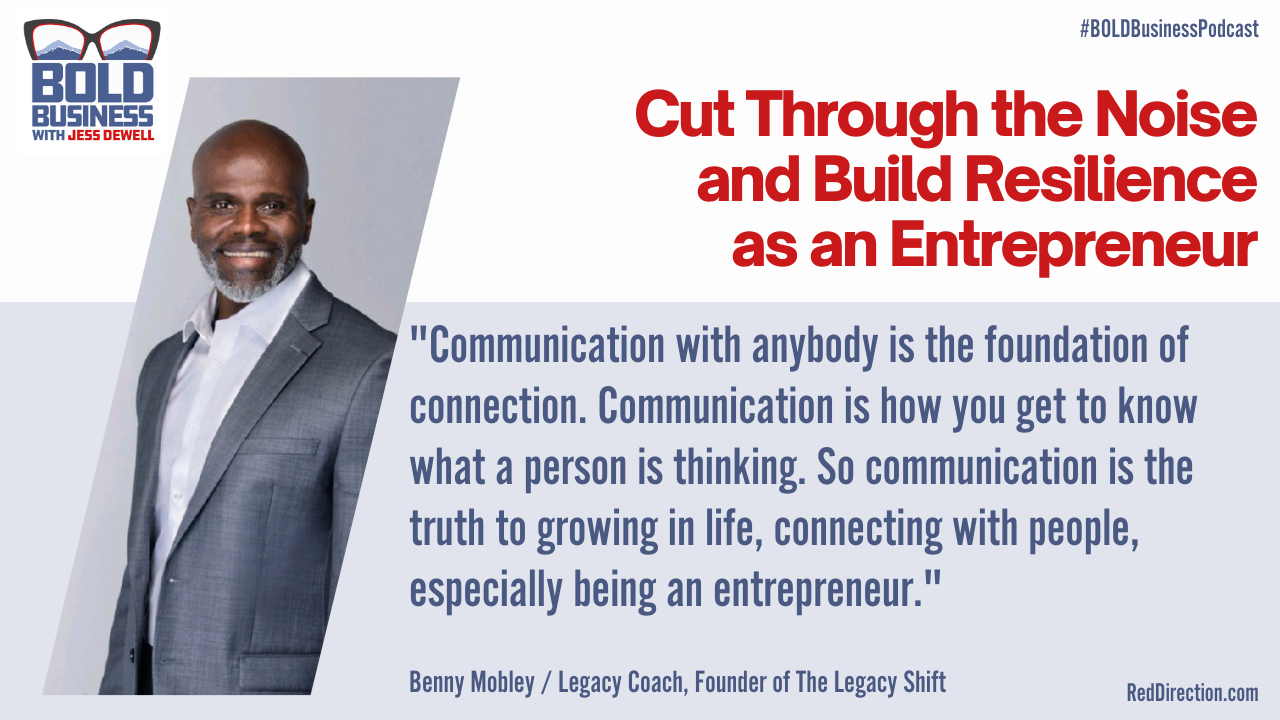
Communication is the foundation to connection. Communication is how you get to know what a person is thinking. Are you a good match for each other? Do you believe in the ceiling? What are they saying—is the glass always empty or half empty? Meaning you’re looking at life. This is where I’m at. I’m going to be content at the moment, but I’m not going to be complacent.
So communication is the truth to growing in life, connecting with people, especially being an entrepreneur. It’s all part of that. Communicating, saying, hey, I’m a master personal trainer. I’m a public speaker. So you get to just be you and learning how to communicate with all people, no matter what background, no matter their nationality, no matter where they’re from.
And here’s a communication for me, which opened up doors to whoever you may be talking to. You don’t know who you may be talking to. It’s like the guy at the grocery store. He checks the receipts. I make Danny feel important. I walk in and I know they see, “Hey, Danny, how you doing, man? How’s your day?” How do I know Danny’s name? Not only that I see his tag there, he probably forgot his tag, but I look at him and I see him sitting there like this. And when I speak to him, Jess, he does this.
So communication is a huge platform for connection and it opened the door to that next level of saying, hey, you know what? I want to—just like Scott. Scott’s been with me a long time. He knows I’ve grown. He knows it’s like, there’s no such thing as a solution to every problem.
Jess Dewell 18:12
I want to tell everybody who’s listening and watching because now we’re talking about Scott, but it’s not Scott who does my technical editing. This is Scott Nelson of Atacrow, a contact connection, friend of mine and very good friend of Benny’s. And he’s the one who introduced us. So Scott, we’re doing a shout out to you because I just realized I was like, I’m saying it every time, but everybody, he couldn’t know another Scott. Scott Scowcroft is great, but we’re talking about Scott Nelson.
Benny Mobley 18:45
We all, we all come up with. Yeah. Communication is so huge. It unlocks just so many avenues of connecting with people and letting people know who you are and they letting you know who they are. Oh yeah, Benny, I’m an entrepreneur. Yeah, definitely. Communication is always huge.
Jess Dewell 19:08
And I appreciated what you were talking about in the morning. What are the first things that we see and the fact that’s noise, that if it’s not neutral to positive, we have claimed and not let go of the noise from yesterday. And so there, I actually really like a morning routine as a starting point.
I’m going to just say, hey, how cool is it that Benny has shared with us that our morning routine can actually set the stage for finding our community. What do we say to ourselves? What do we say out loud? It matters, the words and the phrases. Let’s just be real. You can be a grumpy night owl waking up in the morning and still be kind and caring and filled with gratitude and just be like, isn’t it early?
Benny Mobley 19:54
Yeah.
Jess Dewell 19:54
And so I actually think that’s an interesting distinction to make. Do you see in your experience working in your own entrepreneurial journey, as well as with others, the fact that concept that we lose being kind, not only to ourselves, but in general, that if we’re not kind to ourselves, it seeps out into the world. Is that a pattern that you’ve noticed?
Benny Mobley 20:16
Oh, that is so huge. That’s why you’ll have some people respond in an angry way. I have a client, she’s just recently retired and I won’t say her name, but since she’s been retired, she’s been very pleasant. But before we would come in and we would look like, and I’ve been in the corporate world, so I know how it is being stressed out about the job or bosses or whatever it may be. But now she’s retired. She’s much more relaxed and better.
Instead of waking up in the morning and saying, I don’t like my job, but I’m grateful for my job. We’re still carrying around the stress and the depression and the scars from yesterday, from last month, from the month before that. And how did this spiral continue to happen? Is that first you wake up in the morning and then you turn on the TV, then you start answering email, then you start, you just let the anxiety start all over again. Instead of giving the first two or three hours to yourself. Right?
You do that and then you go out in the world and you say to yourself before you step outside that door. If someone cut me off, I’m not going to let that bother me. Okay. And that’s a continual mindset thing every single day, every day. Me dealing with all these different people every single day, again, like I said, I’ll listen to you, but I’m not going to come down to where you’re at because I’m going to bring that out of you and say, hey.
And I say, not only I say this to myself, Jess, my clients come in all disgruntled and upset about the day. I say, you got a job, right? You got help. You made it here to another training session. You got a nice car. You got—and then after about 15, 20 minutes, they like, well, wow. And I said, why don’t you practice that every day? And because I know my clients, all of them, it’s like a coach, legacy coach. I know their weaknesses and I know their strengths and I know my strengths too, because I’m going to bring you out of it.
Jess Dewell 22:41
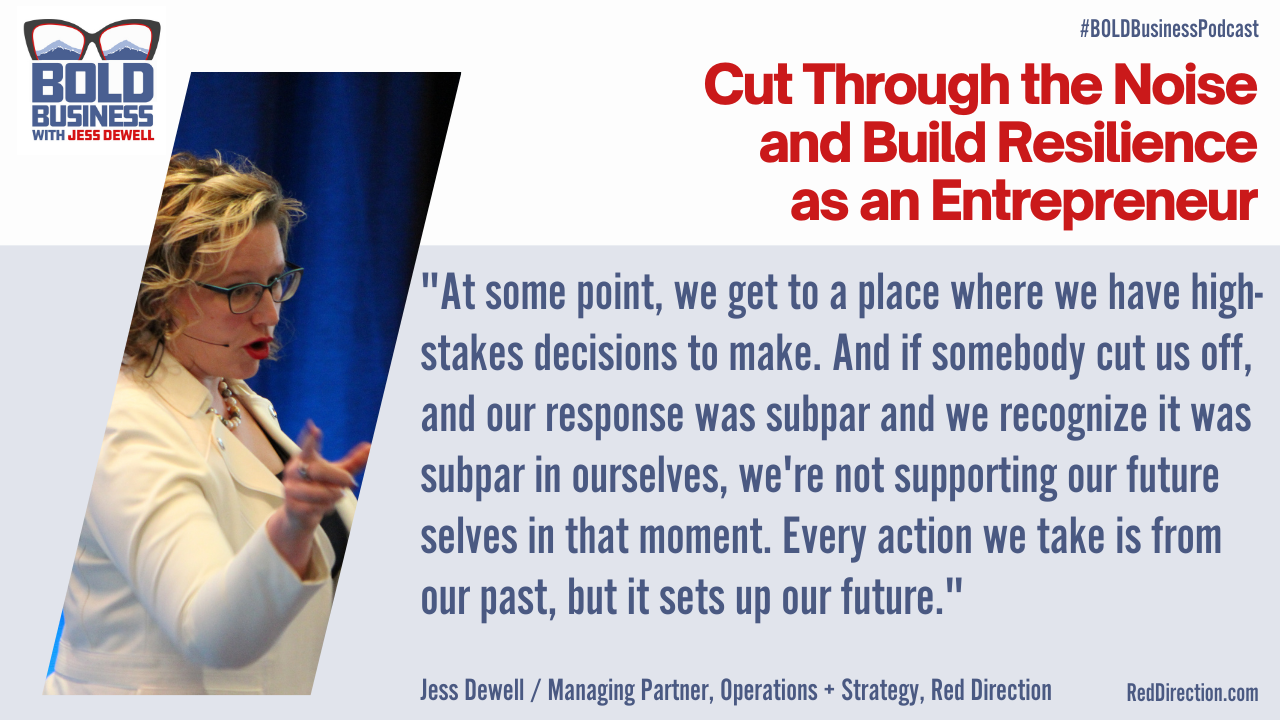
Yeah. Go ahead. What’s coming up for me is that at some point we get to this place where we have high stakes decisions to make. The decision we might have to make that’s high stakes could be later on in the day. And if somebody cut us off and our response was subpar, and we recognize it was probably a subpar in ourselves, we actually are not supporting our future selves in that moment. Every action we take is from our past, but it sets up our future.
You find a $10 bill in your pocket. I know a lot of people don’t use cash anymore, but I still have cash in my wallet. So it resonates with you and me, Benny, which is my past self will leave—I have zippers. So I throw money in zippers when I’m out walking. So I don’t have to take my whole wallet, right? My ID and whatever. And sometimes I get my ID and I forget the money. So there’s a day I’ll just put on and I’ll find myself somewhere. And I reach into this pocket and I’m like, oh look, there’s $10. Thanks past self. You set me up for this. I loved it. This is really great. I don’t have time to go to the coffee shop. So I’ll just stick it back in my wallet or I’m going to go to the coffee shop because I have 10 minutes and I can get myself a tea. It’ll be great.
And so even if it’s something as little as that, that past self that sets up these opportunities for—and I’m going to use the word novelty, but I think it’s more than that. For surprise, for engagement, whether it’s conscious or not, we’re doing it. And so to be able to claim, oh look, my past self set me up for this. So the next time we’re in the car, by the way, I got cut off this morning, the way to my office, Benny. And my response today was a good one. It was—I’ll call it interesting.
I was like, why is your turn signal on? How come you’re in my lane? And I’m right next to you. And then I was like, oh, the exit, the on-ramp was there. And for whatever reason, so I gave some space and I said, I hope the rest of your day isn’t like what you just had to go through crossing all those lanes of traffic to get to where you were going. And what that do—that didn’t—I didn’t have to overcome any negativity or do a reset. I was able to use that in my preparation for our call today to be here and be a hundred percent present and not distracted by the guy who has a story I don’t even understand. And I don’t need to understand. He just needed to go. And how lucky was I there to allow him to get where he needed to go.
Benny Mobley 25:06
Right. That’s so true.
Jess Dewell 25:07
Without having to slam on brakes or cause a ruckus any other way. And so I’m thoughtful about that. I don’t know what you think about any of that, but I’m thinking we can read a lot of meaning into the little things. And if we’re in a neutral place or even a neutral negative place, it might be the right thing to start with because we can find goodness everywhere.
Benny Mobley 25:25
All of that, what you just said, it’s a mindset growth. Because when I did used to work with someone, I used to have to drive from Federal Way to downtown Seattle.
Jess Dewell 25:37
And for those of you who are listening, we’re talking about 20 miles.
Benny Mobley 25:41
Yeah.
Jess Dewell 25:41
But it’s an hour to an hour and a half drive.
Benny Mobley 25:44
And in traffic.
Jess Dewell 25:45
We don’t have a thing called no traffic. So for our listeners and watchers, now they have a short distance, long drive.
Benny Mobley 25:52
And this is what I say about my client that retired. She came in, she comes in talking about the traffic. These stupid people. Instead of having a mindset growth and saying, I got to face this every day and I got to share the road with everybody. It’s not about me. That’s one of those mindset growth things that I have developed over the years because I used to be one of those drivers like her.
I used to—I have tinted windows now, right? I didn’t have, Jess, I didn’t have tinted windows back then. Someone that cut me off, I used to drive beside them and they can read my lips. It wasn’t fun words. But then here’s the mindset growth. Benny, if you keep treating people like this on the freeway, somebody is going to do something to you or somebody is going to—and then I start thinking to myself, you know what, I got to face this traffic every day. Why don’t you just leave two hours ahead of time, chill out in the traffic. And when you get there, here’s the mindset growth. No traffic bothers me now.
Every blue moon when someone cut me off, I’ll go, you idiot, you. Okay. And I got to share the road. I said, growth is everything. That’s that legacy coaching, that life coach. We’re our own worst enemy by what we say, what we listen to, what we put in our mind and figuring out how do I get myself out of these situations and not be so angry at yourself.
Jess Dewell 27:25
Is the shame and guilt that you referenced earlier, does that come in at that end into this at all? A person’s shame and guilt. Does that show up in the anger in the way they’re interacting and their ability to have resilience or lack of resilience?
Benny Mobley 27:42
I think so because shame and guilt could show up in just your anxiety and your depression where, like I say, we don’t wake up being grateful. So the first thing, alarm go off, oh man, I can’t believe this. I just went to sleep. And then you start checking emails and text messages and turn on the news and just all this. And I get it. Like I said, just being authentic of who I am today. I’ve been in those shoes.
Because I think I was molded a little different. Especially starting from my own environment at a young age, I knew I didn’t want to be like my brothers and sisters. So I think that’s what that leadership and that concept of saying, how do I get out of this? But what if my mindset says, in order to make my future better than the situation I’m in right now, I worked for someone and I used to get upset. Well, I got to do that. Why not you? So that question, yes. The shame and the guilt and the anxiety on top of that. Yeah.
Jess Dewell 28:53
It’s big. And going back to this recent past thinking, I think all of us think I’ve done the work. So I’m there. And I will tell you when you even subconsciously think that, which is where I think I was, I know there’s always work to do. I know I will always be evolving, but I got a little too complacent and all the stuff was starting to weigh me down recently and that was getting in the way and that was seeping out everywhere. It comes down to the fact I did get complacent.
And I found with a little bit of extra looking inward, which I don’t really like to do, but it’s still part of the process, is that I did have shame around things and I did have guilt around things. And the result of that is anxiety and depression in varying forms. When we have those, what happens? Then you’re right. For me, I think that brings out our fight, flight, fawn, fine responses, whatever that response is.
And so when we find ourselves, I’m fine, or we find ourselves deer in the headlights, or we find ourselves ready to just, whether it’s verbally or actually I got to go work out because I have all this energy I don’t know what to do with, fight, whatever that response is. I think we have a responsibility to ourselves to acknowledge those, maybe the moments where there was something deeper that we’ve been overlooking is scary because it’s been ignored or avoided, not because it’s actually scary to say, oh, I was embarrassed about doing this thing.
Benny Mobley 30:26
Right.
Announcer 30:26
If your week feels like you’re being pulled from one demand to the next, this is for you. The daily grind is the number one killer of business instinct, pulling you and your team away from your vision. Reclaim your strategic edge with the Present Retreat. This free guide from Red Direction is a simple, powerful framework to carve out the space you need to filter out the noise, make the right decisions and lead with clarity. Visit presentretreat.com.
Jess Dewell 30:55
I’m Jess Dewell, your host of the Bold Business Podcast here. I wanted to just take a quick moment and say, keep enjoying the conversation with Benny Mobley.
Oh, that thing that came up in conversation has stayed with me. Why? Oh, I am actually ashamed of how I was treated or how I treated somebody. And it can go both ways. There are two sides of coins to that. It could be something that happened to us as well as something that we could have done to somebody in guilt and shame.
It’s a big thing to take a look at when we talk about pattern recognition and what we’re talking about. This is our presence. If we are not dealing with this ourselves. Right. Our teams feel it. Our companies are the result of it. The way we make progress in the decisions that are made, the way people talk openly or not is a direct result of the torchbearer. Right. The driver of the mission and the vision. Right.
So this is a really timely conversation because we do make high stakes decisions. We make decisions that cause large pivots or small adjustments. And some of those also come into the way that we show up into the world. Right. So as a CEO yourself, as an entrepreneur yourself, as somebody who is continuing to grow yourself, what are you intentionally leaving behind right now, Benny, as you come into the next year to three years of your journey?
Benny Mobley 32:26
What I’m coming in now is growing in the public’s eye. Being that go-to guy, a solution to solve your problems, your job problems. And now that I’m reading the book that Scott recommended, the Good to Great. Good to Great. It’s not just getting good people, being right. And I know what Scott is saying because I am there. I’m good and I can be great, but I’m still in that phase of who can I trust? So that’s why I’m trying to figure it out on my own.
Being an author, being a speaker, being a former natural champion bodybuilder, being a 61-year-old health nut that still trains very heavy. But the purpose and the legacy is to help people understand that the opinion of the world or someone else, it doesn’t matter. Don’t allow that to become your reality. Benny, you don’t know what it’s like to go through this. Oh yeah. I know what it’s like to go through divorce. I know what it’s like to be broke. I know what it’s like to get let go from a job. I know what it’s like to say, oh, you’re never going to be good enough. I know what it’s like to be labeled for something that you’re not going to be.
So that purpose is to help people to say, hey, God only made one you. Make the best of it. Don’t allow the noise in the world to dictate your journey. So just being that leader of action every single day, man, is he always like this? Again, we go back to gratitude. I’m always like this. Because I grew up with not a lot of nothing. And now here I am going, whoa, I have an opportunity to inspire a lot of people. Everybody may not agree with what I’m saying, but those that do try it.
Man, Benny, ever since I had that talk with you, man, I never really realized this, that I was doing this to myself. I said, because I’ve been through it. I totally understand it. So that purpose is to get my face out in this world and say, that guy still look like that? I got a lot to learn from him. And I’ve had clients that found my website. Lo and behold, he called me up and he met me. He says, oh my God, dude, how do you still look like that? I don’t think you want to know because I don’t think you’re going to sacrifice and give up what I gave up. And that’s all the noise in the world saying you’re never going to be good enough. That’s okay. But I’m not going to worry about what you’re saying. It’s going to keep me growing.
Jess Dewell 35:14
So can we talk sacrifice a minute? People think sacrifice, no pain, no gain. People think sacrifice, giving up a part of life for something more. People think like giving up a relationship or giving up something that we love for something else we love. Is that truly what it is? I heard you say noise. And so I’m hoping we can challenge that. You sacrifice. What are you really sacrificing?
Benny Mobley 35:40
Yeah. Like I said, again, it’s the noise and the chaos that goes on in the world. The news, negative friends, those voices telling you you’re not good enough, shame and guilt, worrying about what someone is going to say about us other than saying to yourself, I’m healthy. I got an awesome job. I got a career. I got an education.
Instead of looking at the things we have accomplished, we look at the things that is the noise of the world. Say you still ain’t good enough. The more stuff you have and the better degrees and the better whatever. That’s what’s going to make you happier. But how long is that going to last? This long.
So it’s just one of those things of being true and real to yourself and not allow the world to dictate your success in life. If you got to give up drinking, you got to give up this. It’s okay. It’s okay. Trying to help people to really love themselves first and not—and it’s not what people hear self, they thinking it’s a narcissistic kind of way. That’s not the case. I’m in control. I’m gonna do things my way. No. You don’t evolve and be open-minded. You’re gonna be stuck.
Jess Dewell 37:11
Okay. So you’re alluding to all of the things that we actually use to disguise progress.
Benny Mobley 37:16
Right.
Jess Dewell 37:17
And real thing. In fact, in my deep work this morning, before we got together to do this recording, Benny, that was on my mind. The thing that is being disguised, because if we go back to authenticity, if we go back to the story, we go back to the beliefs that we have that are limiting us or emboldening us, right? Whatever that is, there can be things in disguise that hold us back. They, and they, by the way, it is noise, but our ego is really good at that. Isn’t it? Our ego is so good at disguise.
Benny Mobley 38:02
Yeah.
Jess Dewell 38:03
I’m making progress or I’m doing the right things, but I’m not. As you were just talking, it made me think of this phrase that I’ve used in the past, the ruthless pursuit of priorities. Right. It’s actually sacrificing. And then I’m adding yours is actually sacrificing the noise helpful. For what I’ve taken—maybe that is the crux of this conversation here and where the magic is. And we do have to be ruthless in our priorities, but that means we’ve got to know about them. Don’t we?
Benny Mobley 38:20
Right.
Jess Dewell 38:20
Because choice. And choice is hard and we’ll disguise everything around not having to make that choice as much as possible, won’t we?
Benny Mobley 38:30
Yes and no. The sacrifice that people think that they got to give up, you know, the news, they got to give up friends. They got to give up this. You’re not actually giving it up. They’re still part of your life. It’s still a part of your life, but you’re setting boundaries and teaching people how to treat you and respect you.
Because I have a client, he’d do well for two or three months. And then all of a sudden he goes out with his sister to a bar and he ended up drinking. And then he comes back and say, oh man, Benny. I said, here’s what’s going on. You’re not having boundaries with your family. You’re not sacrificing saying, no, I’m not doing that.
And here’s the opposite of people following leaders or influencers like myself. I do not back off on my boundaries. Go, oh, one month I’m going to do this in the next month. So here’s what happens. They respect me more. And not in a selfish way, but they’re going like, man, Ben is the real deal. Because one of my clients, he said, if you didn’t know what you know, as a trainer, I wouldn’t be training with you. I said, I already know that because this platform was given to me. And I’m not going to sacrifice my platform for you and nobody else in a nice way.
But it’s part of that being authentic. Just if you’re too authentic, people will go, oh my God. But then at the same time, they’re going like, but he does got a lot of wisdom and knowledge and advice. And he live it. Oh my gosh. So you’re not disowning things, you’re just setting boundaries and saying, I’m not going to do that.
We are all different. We can do it every now and then, but not allow it to be a part of our everyday chaos, our everyday noise. Because that’s how everything builds up. And then you go into the job. So the sacrifice is that you’re not, I mean, you may use it, but sacrifice is saying, I’m not going to do this as much as I used to anymore. I’m just going to set boundaries on it. It’s still there. I still love my family in Houston, but I have big time boundaries and they know that now.
Jess Dewell 40:59
So it’s on the ego thing, isn’t it? The sacrifice is actually our own ego is what I’m hearing you say.
Benny Mobley 41:04
It is. It is. Yeah. Yeah. It’s—and you can tell a person when they have an ego, narcissistic, that’s—they’re gonna name no names, but I know some people that are that way. And my conversations is really short with them. It’s really brief. And here’s the brief. Hey, how you doing? How’s your morning? Cool. Good to hear. Okay, cool. Talk to you later. Boom, gone.
Because I know that narcissistic way of communicating is going to come out. And that’s a nemesis of me. When a narcissistic person try to push their negative controlling stuff on me. And that’s when I almost say something not nice.
Jess Dewell 41:53
And that’s cool that you can name that. Right. And I know that’s your path because of your story and because of the things that you have overcome. So just look where your ego is at everybody, because I love how Benny shared and just was really transparent. Right. This is my nemesis. And when we can name that, we know it, and it is an amazing opportunity to really—here’s the deal. Then we know what we don’t like. If we can name our nemesis, we know what we don’t like. Yeah. And that already just eliminates a ton of noise. I don’t like—oh, look, that’s something that isn’t going to help me. I don’t like that. I can still be kind. I can still be present. And I can do it at arm’s length.
Benny Mobley 42:35
Oh, for sure. I think this is a lot of things that people don’t learn throughout their lives. We continue. And like I said, humility is a big thing, especially for me. And I explained this to my grandkids when I get them every other weekend. I said, do you ever hear me say I’m a health god? Do you ever hear me say I’m the healthiest person in the world? Do you ever hear me say I’m better than this or that?
Because, Jess, this is what I understand about my journey. What I’ve been through, that it ain’t about me. Even that person with that ego, I still will make them feel like, okay, hey, how you doing? How’s your day? At least I give them that little bit of moment, right? That’s also humility. Because I can ignore you. I can act like you don’t exist. But I’m not that selfish person. I’m not that guy going, that’s the idiot over there. And I’m never going to say anything to him. But that’s also putting yourself in some shoes you don’t want to be in. You know? So—
Jess Dewell 43:42
Hold up that mirror. There’s probably some guilt and shame.
Benny Mobley 43:46
And that’s what—oh, man, I’m always—this is, like I said, the humility part of my life is always saying, and who made you, God? And who made you? And I humble myself and I go. And this is every day. It’s always treat someone better than yourself. But don’t allow someone to take your kindness to be weak.
Jess Dewell 44:09
Benny, now I want to know what makes it bold. What makes it bold to make this internal shift for CEOs and entrepreneurs today so that they can reclaim their authority?
Benny Mobley 44:19
Most entrepreneurs and business owners, CEOs, what makes it bold is basically it’s communication. It’s the communication that makes your team move faster. It makes your communication of how you lead. That’s the boldness. And then it’s also not just the boldness. It’s the boundaries that you have set up for yourself to be that entrepreneur, to be that CEO and not be a fork in a road going all these different ways.
So you stand your lane, communicate to your team the strategy, that direction you want to go. And that’s it. That way of keeping doors open or developing new doors and to get to that next level. So communication, I would have to say that is the bold truth of growing in life and communicating to people who you are as a person.
Announcer 45:31
And that brings us to the close of another powerful and fresh perspective on the Bold Business Podcast. In today’s volatile landscape, growth is a double-edged sword. To truly thrive, you must engage with your strategy, not just react to the day to day. Without absolute alignment, your company faces a stark choice. Outmaneuver or be outmaneuvered. Grow or get left behind.
Thank you for listening. And a special thanks to the Scott Treatment for technical production.