





As a business owner, it’s difficult to do the right work AND guide your company toward its next big initiative.
With Red Direction Business Base Camp, learn how to implement and handle processes to meet your business’s specific needs and better understand your market.

Starting the conversation:
Making decisions is more than just picking an option; it’s an art that influences your path forward, impacts your relationships, and challenges your values. By embracing your unique personality and strengths while being mindful of your leadership weaknesses, you can discover the best ways to support your company and uplift your team.
In this exciting episode, you’’ll explore whether you’’re truly taking the right risks.
Get ready to uncover three vital steps for managing mistakes, understand the feeling of being poised to take bold action, and learn about three critical areas you need to watch to protect your business from potential failure.
Join Jess Dewell and her guest, Bew White, Executive Chairman of Summer Classics/Gabby, as they discuss the crucial role of decision-making in business.
They explore the ups and downs of valuable experiences, revealing that while the journey may be tumultuous, the rewards can be incredibly satisfying!
Host: Jess Dewell
Guest: Bew White
What You Will Hear:
Trends or fads? Learn to sense the difference.
Trust your gut and seek information and statistics.
Present yourself well, and portray your personality consistency.
Building a business you may also consider yourself to have an MBA in Mistakes.
The reality of what happens when you start over.
Three steps to handle mistakes.
Ensure you focus on having integrity in the little things.
Use your brain AND gut combination day-to-day.
When you know it is real, you are willing to give up everything you have for it.
Pay attention to subtleties.
Hiring changes happen as scale happens.
Ready to hire versus hiring to match growth.
The true impact of your effort.
Three things to watch to make sure your business does not fail.
Time is the most precious gift, so understand where you spend it – in every area of your life.
Accept you will need help and acknowledge when it is time to ask for it.
True partnership means deeply connected relationships.
Don’t give up, push through and learn from mistakes.
It is BOLD to trust your gut to make decisions.
Transcript
Jess Dewell 00:00
I know you’ve never made a mistake ever in all of history. So what would you tell those of us who are always making mistakes? How do we handle those mistakes?
Bew White 00:11
Well, I made a $30,000,000 mistake one time. No.
Announcer 00:21
Every leader needs a trusted partner for the moments that matter. This Bold Business Podcast conversation is that partnership, your go-to resource designed to break the inertia and refresh your perspective so you can start making moves. Here is your host, an insightful truth teller who serves as the catalyst for getting the right work done and who asks the questions that truly matter. Jess Dewell.
Jess Dewell 00:48
Welcome back to the Bold Business Podcast. We are talking journey. We are talking challenge. We are talking triumph, sometimes without failure first, triumph. We are talking all we can think about and get into the small amount of time that we have today from somebody who’s done it, from somebody who has been there, figured things out along the way, didn’t know there wasn’t any other way to do it except for the way that it got done until after it was done. Right? That’s what most of us are doing. And I have to say, the business that Beau White has built with summer classics speaks for itself and its longevity, company, the culture, the growth, the contraction to get to more growth, the butt puckering challenges to get to where we are today, to be able to have this conversation with Buh and talk about what he’s been doing in the world. That is what I am most excited about today on the Bold Business Podcast. Before we talk about that, he has written a book. He has three kids, two of those grown kids, one of which is the CEO, in his company. And they both started other companies as well. Each of us, right, we all have a journey that gets us to where we are. And there were a couple of things in your past that seemed really pivotal that allowed you to end up here without knowing this was the destination. Is that a fair thing to say?
Bew White 02:21
Yeah. The mistake thing.
Jess Dewell 02:22
Yeah. The mistake thing. Uh-huh. The good ones and the not so good ones. One of the things that we share in common is a desire for style. I don’t know if I have an eye for style, but I know if I’ve got style or I don’t have style. You may know if there’s style or not style in addition to having it yourself. But that’s a big part of where you began and probably, I think, what, what gave you the idea for your first furniture line too?
Bew White 02:47
Well, I was actually selling outdoor furniture, and I knew everybody made in the whole marketplace and kinda went, you know, I don’t like what I’m selling and I don’t, I mean, it’s okay. You know, but I don’t like what anybody else makes. I wonder if anybody would like what I like. The other premise was I want to get off the road. I got some way to get, stop driving 60,000 miles a year and never being at home. I have three small kids, and I’m like, I’m I gotta fix this somehow.
Jess Dewell 03:14
And you come from a background of noticing things. Right?
Bew White 03:17
But did you know what say? Quiet said very little detail that makes something either good or saleable or not. I mean, that’s a part of the design. In fact, we’re working on some things that were done back in the 1930s right now. And I’m kind of going, we’re gonna I can’t tell you what it is, but we’re gonna reinvent this and start over. And everybody went, wow. Yeah. It’s not bad. That’s a good idea. I was like, yeah. Okay. This is gonna work.
Jess Dewell 03:44
When you can see those differences and you can reimagine and when you can update, how do you know today after all of the experience you have, whether it’s gonna be a trend or it’s gonna be a fad?
Bew White 03:55
You wanna start at the beginning?
Jess Dewell 03:57
Let’s go.
Bew White 03:58
Let’s go there. So 1970 well, actually, 1966. I’m gonna date myself. I started the clothing business. I was a kid. I was 16 years old. And so I started selling clothing. I was actually in prep school and I got to like clothing. And so I started selling clothing in a high-end clothing store, you know, kind of a bespoke clothing store. A trend came in then. You’re young enough where you wouldn’t even remember this. Why ties came in.
Jess Dewell 04:26
I do not remember that.
Bew White 04:27
It could have been a fad, but it was a trend. And I kept going to the owner of the store going, dude, we’re missing this. And you got a predator 50 steps away. I’m sending your customers over there and I could probably sell them a shirt because all your shirts have these small collars that don’t fit this gorgeous tie everybody wants to wear now. Oh, and they have two-button suits and all you have is three button suits and jackets. So you’re you’re missing the tie, but the tie back then everybody wore ties, by the way. And so it became a trend and everybody literally threw away their ties except for their wide ties. Wow. That’s how big a trend it was. And so he didn’t see it, and guess what happened?
Jess Dewell 05:10
I believe that we all need to be able to be dressed up. We have to be able to be comfortable in things that we’re not typically comfortable doing. And today, a perfect example of that actually is dress clothes. Do you dress to go to a business meeting? How do you dress to go to a business meeting? What is a fad versus what is a trend versus what gives you credibility versus what are you trying to portray? All of that comes through as in a person, doesn’t it?
Bew White 05:37
About ten years ago, I read George Washington, a life by Ron Chernoy. If you’ve ever read any Ron Chernoy, his books are long, thousands of thousand pages. Anyway, it spends an incredible amount of time on the fact that George Washington stayed in uniform all the time, designed his own uniform, had it made in England, made it different than the British uniform. And he always looked his best. And certainly if you read that book, you’ll say, well, we wouldn’t be here without George Washington, but this whole thing about his clothing, he gave him that air, a leader. And I think even the work, if you look at the pictures or the drawings, they want pictures back in the pictures or drawings of the continental congress, everybody else would be having these clothes that were typical of that time, and he would have a uniform on.
Jess Dewell 06:26
It goes into so many factors. And in fact, I’m working with my 11-year-old son to get used to this. He hates it when I make him dress up. He goes, mom, I look like a waiter. And I said, actually, no. You look different from everybody else. And I said, we can fix that. We will get you a different color jacket than your pants. No problem. And do you wear a tie? Do you not wear a tie? Do you have a pocket square? Do you not have a pocket square? And that’s just awesome young men. You have a pocket square. Yeah. So, yeah, you know what it’s about. Yeah.
Bew White 06:54
Yeah. By the way, no ties, pocket square.
Jess Dewell 06:57
Yeah. Pocket square. And I think that that’s great because you can do so many things and be just as dressed up without feeling stuffy and still being able to move and go with whatever is appropriate in the moment. You have to start to trust your gut around that. I’ve achieved it. I know it. People can expect it. I see this if I dress this way. I know what I’m portraying. And that also then is true for product. When I see it, I know it. Is that something that’s true for you? Do you have that gut?
Bew White 07:23
Well, more of the history. So then I moved into the fabric business, moved to New York City, and I discovered Ralph Lauren when he was first getting started. And so I got to know his business model and I met with his brother several times. He couldn’t actually meet our minimums on our fabrics, but I got fascinated by his business model because he didn’t really make anything. He was very much like apple or Nike is now where they design product, concentrate on the branding, change their designs based on where the market’s going. They’re following the market. They’re constantly smelling the market and they’re not so focused on running a factory that may or may not make what the client wants. And so that’s kind of the model I built the business around. And I’m not bragging, but we’ve grown 40% this year. And it has a lot to do with the business model, which is your factory.
Jess Dewell 08:13
If I remember correctly, it also goes to your international connections. Right? Whether that is South America, whether that is China, your ability to partner with people that have factories compared to being the factory? And what were some of the key decisions in that? Was it specifically talking with the Ralph Lauren company? Was it specifically you had already had this idea and you were testing it out or trying to poke holes in it by soliciting that information?
Bew White 08:43
The key for me is that you have to have symbiotic relationships where the factory depends on you and you depend on the factory. They’re willing to make the quality standards you want because if you look at Asia, it’s fully set up for the masses. So they have to be willing to meet these really high-quality standards. I would say, well, like Louis Vuitton and outdoor furniture, although the volume’s probably higher. You’ve gotta hit certain specifications. Think of this. It’s gotta last outside for twenty years. So that’s a very high spec product that, like, you’re you don’t keep your car for twenty years, but in this case, you could keep your own furniture that long. And, and that’s what really interestingly enough, when I started it, I kinda went, this is gonna take a really long time because people are not gonna wanna pay for it. But once they do and they have it for fifteen years and they go like, wow. I still like it, and it still looks like I bought it. I had to maybe replace my cushions once or twice, but the rest of it looks pretty good. And I don’t wanna change.
Jess Dewell 09:45
What is the purpose of what we’re doing, and what do we want people to know us for? And it sounds like quality and timelessness. And that’s actually true and true of everything that we talked about in the past, everything that I’ve read about you. That’ll be a deal breaker in business relationships for you.
Bew White 09:59
Yeah. Yeah. Yeah. There’s a trend right now towards modern. I started in modern. That’s how I got started in, really in the classics, the Mies van der Rohe, the stuff that was designed by architects primarily back in the fifties, frankly. Oh, nay. I don’t know if you know any of these guys. They designed a lot of unique sort of modern furniture for the time and it got redone. And that’s how I got started selling to the crates and barrels and the storehouses and workbench. I mean, some of these have gone out of business. I’ve said, but back then there was a contemporary group of furniture stores that were opening all over The United States. And so I took that and then using that now to come out with modern furniture, but we’re like the last people that had some traditional left in our line.
Jess Dewell 10:44
You might have to educate me on what that actually means, because I recognize that there are traditional houses. The last house that we lived in had molding above all the doors and all of the windows instead of the crown molding around the ceiling. And I didn’t like it. I wanted it to be cleaner and plainer so that if I wanted traditional furniture, it would go great in the room. If I wanted modern furniture, it would go great in the room. And by the way, I have some of each, and they go really well together too. But if what’s around it doesn’t match, it’s really difficult to do. So understanding those style pieces, I think, is important because it actually I mean, what you’re doing today, you know, you were said, we’re talking about this new thing. I can’t wait. I can’t really tell you a whole lot about it, but we’re really excited about it. When does that actually come to fruition? I mean, that is that in? Is that in the next twelve months or is that like twenty-four months or more away?
Bew White 11:36
2024 It’ll get introduced maybe next summer and production will start shipping in January or ‘4 or maybe later.
Announcer 11:51
Feeling stuck? Like, what got you here won’t get you there. The pressure to grow is on, yet the path isn’t clear yet. You don’t have to walk that path alone. This is the Bold Business Podcast. Like and subscribe wherever you listen. Your host, Jess Dewell, is the strategic partner you’ve been looking for, asking the questions that truly matter. It’s time to break the inertia and get the perspective you need to make your next move.
Jess Dewell 12:27
So in this world of instant gratification, nothing changes that fast. I mean, it’s housing prices, whether it is styles of houses, whether it’s the styles of people decorate inside their houses because we have all of that stuff for a long time and outside of their houses. Right? The outdoor furniture. Those trends don’t change fast. You still have to know the trends and have some concept of how to sniff out what will keep you competitive and exciting to your existing and repeat customers almost two years in advance.
Bew White 12:58
Here’s how you fix that. So we have 21 stores right now. And you go in a store and what you see is the floor sample, but what you get is anything you want. So you can literally design your own furniture, which is what most people do. We do have product you can get right away, but for the floor, it’s set up a certain way and you’re not married to that color way. You’ve done it. If you don’t like a color, don’t walk away from it because if you like the group that you can get it any color way you want it and you get trim and different throw pillows. And so it becomes your product. And that’s really what I call owning Susie because we design our own fabrics too. So we’re designing our fabrics and they’re exclusive and we design the furniture and it’s exclusive. And then it’s high quality level. And so Jess goes in the store and sees this stuff and falls in love with a particular fabric, and it’s ours. And she puts a certain trim on it, and she goes home, and she can’t quit thinking about that. She’s dreaming about it at night. So I call it design your own furniture.
Jess Dewell 14:08
When we’ve done something as long as you’ve done this, it becomes second nature, and it rolls off of our tongue, and we just know, and we feel very confident in that. And sometimes we’re rocked to the core, and sometimes we have to start over. There’s a hard reality to that. Tell us about that.
Bew White 14:26
What? 2008 is how we’re doing it.
Jess Dewell 14:29
Yeah.
Bew White 14:30
So, well, say I have a, an, an PhD or MBA in mistakes. Go through, I think thinking that you’re an entrepreneur is a problem in itself. I’m at, at some point I was doubting the fact that I’m an entrepreneur and there’s six traits to an entrepreneur. You have to have all six of them or you’re, and I didn’t know this. I read about it in the EOS. Gino Wickman wrote about it and I was, wow, I hope to have all these because I’ve been doing this a long time. If you’re missing one of those, you can’t even do it. So I was like, so one of those is risk-taking and it’s the one that most people go, I can’t do that. I can’t. I can’t bet my house every year, which is what I was doing. I was like going, I believe in myself enough to take all the equity out of my house every year and put it in my business. It’s a big dice roll. It’s hundreds of thousands of dollars dice rolls. The end of the year rolls around and you made more money, but you didn’t make enough to get the bank happy enough where you didn’t have to put the money back in every year. You’re like, this is tough, man. I don’t know when I’m gonna get out of Dig. Dig. Dig. You know?
Jess Dewell 15:35
And there’s some stamina to that and some perseverance that’s required.
Bew White 15:40
I think it’s also having support. You’ve gotta have the support of, in my case, it was my wife, but you gotta have enough people around you supporting, believing in what you’re trying to do that you can do it. You can do it. Don’t give up. Ever read anything about Churchill? There’s a never give up gal.
Jess Dewell 15:57
Oh, I know. I’m gonna just chip at it, chip at it. We’ll turn it around, and we’ll chip at it. We’ll turn around, and we’ll chip at it. And sometimes it’s the eleventh hour. I gotta keep going. We’ve gotta keep going. Absolutely.
Bew White 16:07
Kept thinking he was gonna be prime minister, and he was like, well, I guess I’m not gonna be prime minister. And what? And then it came around world war two and he was right. He kept saying Hitler’s terrible and all in boom, he becomes prime minister because they need somebody like that. Even though great leader at the time, I it’s just, that’s a case of a guy that had incredible perseverance.
Jess Dewell 16:28
It’s true. And being okay with not being part of the mainstream. I was actually having this conversation with young company this morning. They were talking about how they’re getting pulled in all different directions from what they want their product to be versus what their customers are saying their product needs to be. What I thought was really interesting, they were saying over here, we’re building this strategy and we know what to do and we’re in this for the long game. We can’t get our customers on board because of whatever, whatever, whatever. And I actually said to them, I said, you know, one of the things that you will have to decide on, and you could be completely wrong, it still has to be decided, is what do your customers need that they don’t know they need? What is your product trying to do to help them solve the problem of something that they’ve been trying all of these things and they’re coming to you with all of these ideas from all the things they’ve tried that haven’t worked? But you’re doing the product. You’re giving that listen to them and what are they really telling you? And tell them what they need.
Bew White 17:32
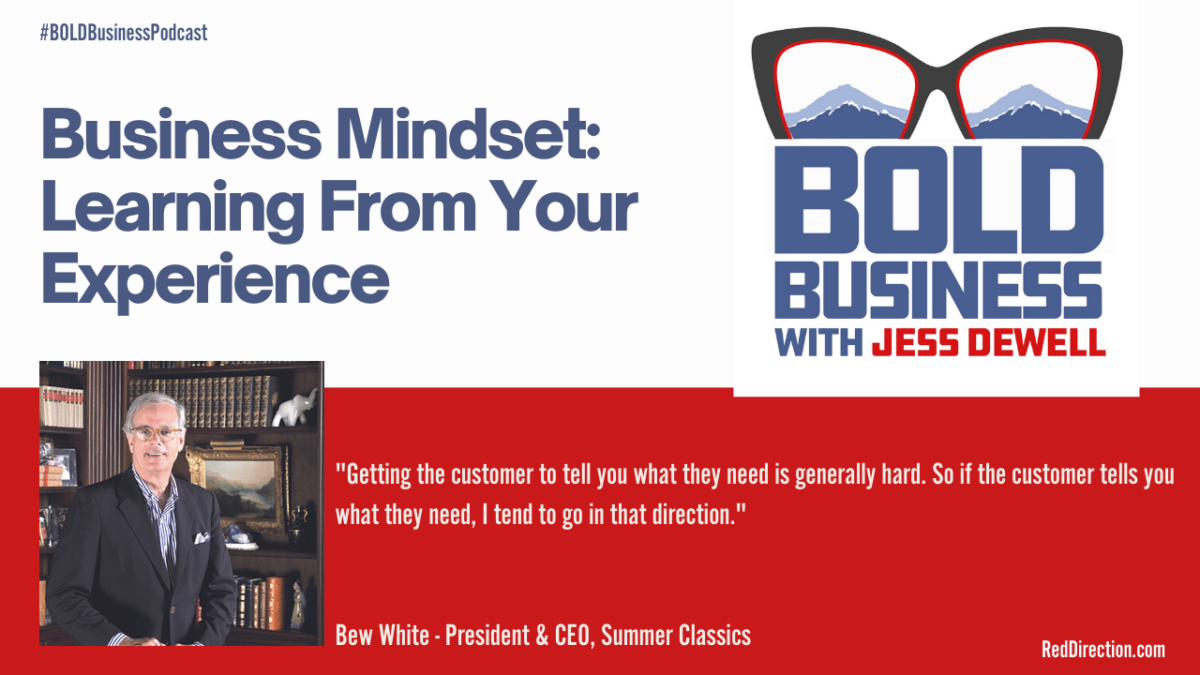
It’s generally hard to get the customer to tell you what they need, so if the customer’s telling me what they need, I would tend to go in that direction. That would be me.
Jess Dewell 17:39
Yeah, exactly, but to give you an idea, it’s more like a service product, so it’s like, give me this feature, this feature, and this feature because I saw it over here, or I cobbled it together in my own process. If you’re saying this is the cornerstone of why this product is the solution, then that problem is, is actually solved this way now instead. Not that it’s not being solved, not that I won’t solve it, but hey, have you thought about it like this? And being able to facilitate that conversation is kind of a tough thing. So we’re going from that two-year range to forty eight hour, maybe six months of a change. Companies get in a lot of trouble because they listen too well and they can’t filter through. And that’s actually something I wish we could recognize and slow down a little. That instant gratification piece is such a it’s a hard thing to navigate.
Bew White 18:26
I got so frustrated with the customers. I just start opening my own stores.
Jess Dewell 18:30
Look at that.
Bew White 18:31
Believe me, the customer did not like that. I mean, they were like Yeah. We’re gonna open a store in my city, and you think I’m gonna buy from you? I said, no. No. I don’t you don’t have to buy from me. However, if you don’t Yeah. You can’t. So if you decide to drop the line, I’m not gonna sell it to you again. What happened is I would come in and open a store. All these people would come in looking for the product and they were, we, we can’t get it. And they leave and they’re like, oh my God. And they call and say, please sell us. And I was like, well, told you that’s like, anyway, you’ve gotta be so bold in a case like that. I don’t know. They can’t open their own stores. That’s the service community. But
Jess Dewell 19:11
No. But they have to make a choice like that. They have to say, this is what we’re gonna do. Period. And so from this, how do we solve that problem? Which is probably different and new and hopefully novel and exciting and easier than anything you could have ever come up with that you’ve been working really hard and not getting the solution you want for.
Bew White 19:29
If you think about what Ralph Lauren and Nike did in Apple opening their own stores. Yep. And they didn’t blatantly say, we’re frustrated with the dealer base. They only buy my knit shirts or they’re only buying my suits. And I’m selling a look. And the only way I can present it is to either have a shop in Bloomingdale’s or own store. And this is the same place. It’s identical to me. And as we started up licensees and that became really what’s driving the brand, now people understand the product and it builds the brand better.
Jess Dewell 20:02
Well, it’s Jim Collins’ flywheel in a sense, right? The whole concept of when you’ve got one thing and it starts to catch and it starts to move, other things get to move too, and when they are working in concert, you actually move farther faster, and they propel themselves.
Announcer 20:21
If your week feels like you’re being pulled from one demand to the next, this is for you. The daily grind is the number one killer of business instinct, pulling you and your team away from your vision. Reclaim your strategic edge with the present retreat. This free guide from Red Direction is a simple, powerful framework to carve out the space you need to filter out the noise, make the right decisions, and lead with clarity. Visit presentretreat.com.
Jess Dewell 20:52
I know you’ve never made a mistake, ever in all of history. So what would you tell those of us who are always making mistakes? How do we handle those mistakes?
Bew White 21:06
Well, I made a $30,000,000 mistake one time. No. It was so bad. The customer service department was coming to me saying, we’re gonna go out of business. And I said, no, we’re not. We’re gonna get through this watch. I’m coming up with a plan and we’re gonna get through it. It’s not gonna be easy. There’s gonna be a lot of negative conversations with clients, but we’re gonna get through. So we worked on a plan. We warrantied the product. There was a problem. Sherwin Williams wouldn’t stand behind the problem, which I thought would, I thought that was my solution. After I gave up, I said, well, they’re not gonna stand behind it. So I’m gonna have to deal with it on my own until they agree to or whatever, which they never did anyway. So I just came up with a plan to help the customers through a period of time with the warranty and got through it. Yeah. I have every year, it seemed like we had something come up that everybody went, okay, well, here we go again. Let’s tell you what happened now. Yeah. About all the mistakes and pushing through. One thing is I was doubling every three and a half years. So what do you need if you’re growing that fast?
Jess Dewell 22:13
You gotta have cash, lots and lots of cash.
Bew White 22:16
Lots of money. So my line would grow from 5,000,000 to 10,000,000 to 15 to 22. And finally, I got the Royal Bank of Scotland came in my office and said, whatever, what do need? Break your ticket. Okay. Well, I need 30,000,000. I need these terms. And they gave me everything I asked for. I was like, wow, this is incredible. Yeah. Nope. Guaranteed. And so now I said, now I can really grow. And I did, I was just starting, I took off. That was 2,004. Well, 2008 rolls around the great recession comes. I’m at the top of my line. I almost owe them $30,000,000 Right. And they’re going, we think we want to get our money back. I was like, well, I’ve got stuff away. Have to land on the, it scared the heck out of me. So I’ve started working every possible angle to try to figure out how I could reduce my inventory, change it into cash, turn my receivables faster, all the things you need to do to pay the bank back. What had happened is my lenders became my suppliers. They came to me and said, we’ll help you. What do you need? I said, well, not pay my bill. You know? You can’t you have to pay it eventually, but we’re gonna raise your line from 200,000 to 2,000,000,000 and just pay us as you can. Don’t stop paying us. Yep. You’re not all you have out of pocket. You can’t pay. But you do that a few times and you get $10,000,000 and then you start reducing your inventory. You get another 10,000,000. So I paid them back all, but about 2,700,000.0 within nine months. I got more nervous when I owed them that little amount than I did the big amount because it would have been much harder for them to get it. And then my bank on the real estate side, I had five over $1,000,000 real estate loans. Yep. They came to me and said, when these come due, you have to find a new bank. I was like, good God. I’m getting hit from all, you know? So I found the blanks and said, we’ll take all of them. I went, oh my God. God is busy. Because I, I was playing so hard. I was like, figure this out. I need some help.
Jess Dewell 24:18
And those even aren’t mistakes. Those are outcomes of things. They end up being handled, in my opinion, like a mistake, but they’re totally out of your control as they show up. So if you’re handling a mistake or you’re handling these hard conversations and you’re coming up with these plans, recognizing that something is happening that has to be addressed, right? That’s one of them. Another one is, well, so what are the options to deal with it? And who do I talk to about this to gauge feedback and to start getting that buy-in to build that support? And then what would the third thing be?
Bew White 24:50
For me, it’s not letting this stuff get in your way. Not you saying I’m gonna get through this one way or the other. Actually, I had a situation with the factoring. I was factoring at the time. CIT got in trouble and, and CNBC is saying, oh, CIT is gonna go bankrupt. I’m gonna wait. Call my bank. I said, CIT owes me $3,000,000 What’s what do you think? So the chance of us getting that now? Like, I don’t know. I was like, wow, what kind of lawyer are you? You’d help me write this contract without. I thought, so I’ll see NBC. I call my senators and congressman like y’all can help me. And then that, and Shelby was, was head of the finance committee. Didn’t know what factoring was. I’m like going to Heath, like wouldn’t even help me. Oh, I’ve gotta do something. So I sent a blind email with the NBC squawk box, which is the morning show. Yeah. And I’m on, but I’m on and under these conditions.
Jess Dewell 25:45
Okay.
Bew White 25:45
The bank jumps me when I do this. Uh-huh. I get to come on again and talk about the bank. Cool. Okay. Done. So I called the bank. I said, okay, you guys have been really nasty to me, and I’ve never lost money. And I’ve always paid you. And this that has I haven’t been a big problem. Here’s what I’m doing. I’m going on CNBC to talk about CIT because I don’t think the world understands back. But if you jump me, I’m gonna come on and talk about you.
Jess Dewell 26:13
I love it.
Bew White 26:14
I was like, I don’t know that. I was doing that to my loan officer. I have no idea if she left the bank, by the way. And I have no idea if she ever told that to her executives. Because they wouldn’t let me call the chairman of the bank who I knew personally. And I’ve always said as a, I remember you call him. Well, definitely. You’ll definitely have. I was like, what?
Jess Dewell 26:34
Wow.
Bew White 26:35
So I was like, I was like, I can’t find myself in a situation. I don’t know what to do. So I went on CNBC and kind of explained what fine print is. And
Jess Dewell 26:44
Yeah.
Bew White 26:45
2009. Mhmm. In the ‘9. And then the market freed up in 2010. Mhmm. The late summer, and I moved my line in one day before it was due at Royal Runkers Garden. One day talk about heart attack stuff. Right. I I had to call who’s end up in my I said, gosh. My other lung goes bad in two day in a in a week if we don’t sign an agreement. I don’t know what I’m gonna do. Yeah. And that was the first deal they had done since the great recession. But I found out later on the golf course. I was like, you mean Wells Fargo Southeast didn’t do it other than with their regular customers? They had not ever hadn’t done a deal in two years.
Jess Dewell 27:35
There was a lot of regrouping to do over there too. That’s just right in the whole thing. Here you were just trying to run a business, support your customers, make a livelihood, employ these people, create these amazing positive ripples throughout your local community, the greater US community, and the global connections and suppliers and relationships that you have. And then it’s all in the subtlety, isn’t it? But you made it through.
Bew White 28:00
Yeah. And when you hit the tipping point, it’s unbelievable. So it’s worth the ride when you get to the tipping point, which is where, like I said, I mean, we grew, we’re larger than we thought already. And then we almost doubled. And when you get to a certain size where you’re breakeven you’re shipping way more than your breakeven the bottom line and it creates, hopefully everybody that you’re talking to understand breakeven. We do when we’re looking at a business to buy or looking at something to start. Where’s our and how do we make money doing this? And
Jess Dewell 28:31
By the way, if you’re listening to this and you don’t know what breakeven is, you better call me or Beau because we need to help you now. This show, we assume certain things, and I actually said, of course, they do. And then I was like, well, let’s just put it out there. We can help you if you don’t because you need to
Bew White 28:50
How about the ownership? You want me to hit that real quick? Yeah. Do it. I’ll you about the big one, which scares most of the risk-taking. It’s the thing that’s to sign a note for more than you’re worth or in all your money and riding on flat and you’re black, you’re red. First one, you’ve got to have an idea that no one’s thought of. That’s a vision that you have that you think might work that nobody else has. Mhmm. Right? So but right. Who’s the biggest risk taker in The United States right now? That’s that’s an easy one. Elon Musk.
Jess Dewell 29:23
Oh, yeah. That’s true.
Bew White 29:25
Yeah. I think the risk I take and that guy is like, oh, passionate is the other one. So you should be awake at night thinking about your ideas and how or what happened during the day or what you’re gonna do tomorrow or whatever it is, and you can’t stop. And that’s thrive. You’ve gotta be driven.
Jess Dewell 29:43
Yes.
Bew White 29:43
Problem solver is one. And that’s pretty much what you’re doing every day is you’re solving problems and moves that, that’s what solve-solve-solve and constantly doing that. And if you’re EOS, I would think a lot of your people you talk to probably have EOS problems part of that. The last one is pretty simple, responsible. In other words, you’re somebody that’s gonna pay your bills, return your phone calls, do what they I’m having a I have to do a speech for the our annual meeting, which is Friday, and and one of our, integrity is one of our core values. And I think everybody thinks that I’m not gonna lie, cheat, or steal, but it’s not. It’s in the big one for me is do what you say you’re gonna do. I wanna be able to tell you something and forget about it. Once I’ve told it’s done, I don’t have to worry about it. You did it. I’m come back to you and say, hey. Did you did you do that?
Jess Dewell 30:39
We’ve been talking about not giving up. We’ve been talking about perseverance. We’ve been talking about learning from mistakes. We’ve been talking about the true impact of our effort. I know all of those things, there are bumps along the way as you grow. I mean, you started out as how many people when you started?
Bew White 30:56
Two.
Jess Dewell 30:57
And how many are you now?
Bew White 31:00
500 something. Yeah.
Jess Dewell 31:02
Yeah. Right? And so that growth, keeping people has probably been a challenge. Hiring well has probably been a challenge. Growing people.
Bew White 31:12
Culture helps fix that. So believe it or not, really have not had a problem finding people, which is and it took us a long time to get there. We have lost people, but so every time we lose somebody, they either don’t like the culture or the money, you know, or their boss. Those are kind of three things that really cause people to move. Right. It’s their boss. I mean so we have to be cognizant of the people that are bosses that they’re behaving according to the culture.
Jess Dewell 31:45
By the way, I’m all about assumptions, especially when you said it earlier, I wanna be able to tell you, and then I don’t wanna think about it. I just wanna know it’s gonna be done. There is an assumption that, that occurs, and the fact that we can recognize that that’s an assumption, and if something stops working, we can go cool. Well, we know what our assumptions are. Let’s go look at that a little closer. So what I hear you just say was you understand the levers where you want things to be working a certain way and where they’re most likely to break down. So you know where to start looking to find the right problem to solve, not any problem to solve.
Bew White 32:22
I was writing, you know, 20-page business plans that are really quick. I’ve said, you know what? I’m just gonna do five things.
Jess Dewell 32:28
Good.
Bew White 32:29
And this is before we did EOS. So I just said, we’re gonna do these five things this year. One of the things I did was something called found stock.
Jess Dewell 32:38
Oh yeah. Uh-huh.
Bew White 32:40
You’ve heard found stock. This would only be created. I had five people that I really wanted to keep. So they got in the found stock program and we had to make a million dollars a year, three years in a row to them to get in. They’re like, we’ll never do that. That’s crazy. I was like, yeah, we roll watch. We’re making like 50,000. And sure enough, we got there and several of them had become millionaires because they had to found stock and I bought them out. It’s amazing to see that the guys that hung in there and said, I believe in what we’re doing. And they found stock, became real. It probably took seven years, seven or eight years, make a million dollars a year, four years on a row, but it happened.
Jess Dewell 33:21
And they were a big part of that.
Bew White 33:23
They’re big part. Yes.
Jess Dewell 33:24
They were a big part of that. That’s huge. What makes it bold? What makes it bold to trust your gut when you’re making decisions, knowing that things can change so quickly?
Bew White 33:34
Have you ever looked listened to Warren Buffett talk about the moat?
Jess Dewell 33:38
Yeah. But refresh me.
Bew White 33:40
I walked somebody into the plant. I said, you’re looking at our moat. He’s like, what do you mean your moat? I said, this is the moat around the castle that protects the castle because I don’t think anybody’s willing to take this kind of bet on inventory before the season starts, for the customer, thinking that the customer’s gonna buy all this stuff and take that debt. And sure enough, you know, we had like 60,000,000 plus dollars of inventory waiting for the customer to buy it. You have to have some history to be able to make those kind of decisions, but those are the things that take you to a different level.
Announcer 34:23
And that brings us to the close of another powerful and fresh perspective on the Bold Business Podcast. In today’s volatile landscape, growth is a double-edged sword. To truly thrive, you must engage with your strategy, not just react to the day-to-day. Without absolute alignment, your company faces a stark choice, outmaneuver or be outmaneuvered, grow or get left behind. Thank you for listening, and a special thanks to the Scott Treatment for technical production.