





A 60-DAY INTERVENTION THAT REPLACES BRUTE-FORCE “HUSTLE” WITH A RESPONSIVE DECISION-MAKING ARCHITECTURE.
FROM MANAGEMENT OVERSIGHT ➔ SYSTEMS-LED EXECUTION
With Red Direction Driving Solutions Strategic Intensive Program, install a responsive execution engine across the 18-36 month strategic horizon via a customized 60-day adaptive framework to command market relevance.
Starting the conversation:
Uncover the secret weapon top leaders use to break out of overwhelm, refocus priorities, and drive lasting achievement — without burning out. Duncan Brand, Author of Mind the Gap and Effectiveness Advisor, shares how to step back and accelerate achievement to your 36-month initiatives.
Your calendar is your biggest tool. We all have the same amount of time in a day, so it is up to you to maximize what you spend your time on. Planning for your week and keeping a cadence maximizes impact. So, if you choose to muster the courage it takes to step back from daily operations you can further adjust where you add the most value.
In this episode, you will hear about the Golden Pause for big decisions, to build your week around your top priorities, and the three ways you will get in your own way and what to do about it. Jess Dewell talks with Duncan Brand, Author of Mind the Gap and Effectiveness Advisor, about why it is BOLD to build systems-led execution and make themselves obsolete in day-to-day operations.
Host: Jess Dewell
Guest: Duncan Brand
What You Will Hear:
07:10 The impact of communication style on asking “why” in organizations.
- How the question “why” can be perceived as accusatory, particularly among indirect communicators.
- Rephrasing the question in a gentler way may facilitate better understanding and less defensiveness.
- Direct communicators may appreciate straightforward questioning, while indirect communicators may require softer language.
13:15 The long-term importance of a people-centric approach in adopting AI.
- Organizations emphasizing people as human beings rather than just employees are more likely to use AI as an enabling tool.
- Different outcomes will happen for organizations that prioritize technology over people versus those that integrate AI to support and empower employees.
- A key theme that emerged was that company culture—whether people-centric or not—determines how AI is leveraged and impacts workforce morale.
21:25 Adapting to work-life integration in a technology-driven world.
- The shift from work-life balance to work-life integration was accelerated by remote work.
- Ability to manage personal and professional responsibilities more flexibly when working from home matters.
- Benefits and challenges of intertwining work and home life, such as increased convenience but also potential for blurred boundaries.
36:25 Prioritizing weekly goals and personal passions for effectiveness.
- Strategies for setting weekly priorities by proactively planning at the start of each week and reviewing progress at the end.
- The importance of including both professional goals and personal projects to maintain motivation.
- Treat each week as a distinct opportunity to allocate time based on what is most important for both work and personal fulfillment.
33:25 The value and practice of intentional listening in today’s noisy world.
- The challenge of listening to understand, rather than just to respond, amid constant distractions.
- The effectiveness of intentionally remaining quiet and prompting others to share more deeply.
- Language choice, discipline, and intentionality support better listening and deeper understanding in professional settings.
35:45 The significance of inner core values and self-awareness in leadership.
- The distinction between the visible outer core (skills and results) and the invisible inner core (values and beliefs) in leaders.
- Self-reflection and understanding personal drivers are necessary for leadership growth beyond technical expertise.
- The importance of self-awareness, particularly about emotional triggers and their effect on others, for effective leadership.
37:35 Common leadership identity traps affecting delegation and execution.
- The belief that tangible involvement is necessary for value, which can prevent effective delegation and scaling.
- The tendency for leaders to overestimate their unique ability to execute tasks, hindering team development.
- Underlying needs for validation can undermine organizational systems unless leaders consciously address these identity issues.
39:10 It is BOLD for a CEO to step back and trust a systems-led execution making themselves obsolete in the day-to-day operations.
Resources
- Connect with Duncan Brand
- Book: MIND THE GAP: How Organizations Can Become People Centric Vs Employee Centric
Transcript
Announcer 00:12
Every leader needs a trusted partner for the moments that matter. This Bold Business Podcast conversation is that partnership. Here is your host, Jess Dewell, an insightful truth teller who serves as the catalyst for getting the right work done and who asks the questions that truly matter.
Jess Dewell 00:31
What you’re going to hear in today’s Bold Business Podcast is about organizational effectiveness. I love this topic. I could have talked with Duncan Brand for hours and hours, and I think we could have made it entertaining and engaging for you as well. Because throughout this conversation, how-tos, questions to ask, and steps that you could be aware of to make yourself better at who you are so you can focus on your achievement will happen. Duncan Brand is a leadership and organizational effectiveness advisor. He’s founder of Intrinsic Leader and author of Mind the Gap. He’s worked with 100 organizations across healthcare, tech, finance, and the public sector, building leaders that build stronger cultures, healthier teams, and people-first leadership. Here’s what you’re going to take away. One, the golden pause. Hint, think present retreat, but very different, and you’re going to really like the differences. I think that this would work for you right now. Two, top priorities are the core of your calendar and your calendar is the thing that will determine how you use your time over the week and you prioritize around those top priorities. So I really want to start with this concept of technology today, including AI and this brute force hustle. Is it really leftovers from yesterday or is there another way we can be looking at it?
Duncan Brand 01:58
Well, because it appears to be a virtue, right? And that was reasonable design when the work was repetitive and people were generally interchangeable on a line. The problem is that isn’t the work today. The work is thinking. You cannot brute force thinking. You can execute the hours, but you can’t raise the quality of a judgment by demanding it louder for example so yeah when i walk into a company in full hustle mode everybody is visibly busy calendars solid nothing actually moving so i don’t go looking for lazy people i look at the structure underneath and it’s nearly always command and control trying to compensate for what the design won’t allow and so it’s an architectural problem wearing a work ethic costume. And the cruel part is that the harder everyone works, the longer it takes anyone to question the architecture.
Jess Dewell 02:57
That noisy part is really interesting. I know one of the things I see a lot is disguising the problem in plain sight. We’re used to it. It’s a comfortable chair. We don’t quite understand it. So we’re making excuses for it. We’re going, there had to have been something that worked here sometime. So let’s just keep doing it just in case it starts to work again and every once in a while just stirring the pot is not a bad thing is it Duncan?
Duncan Brand 03:26
No, absolutely. I don’t believe in org restructuring for the sake of it, only when it makes sense from a structural standpoint and the thing about this is that when the business environment changes the internal engine needs to change as well and oftentimes there’s several moving parts to that and oftentimes what happens is the go-to is the org design and what if that’s not the problem that’s a bit like changing the oil when your radiator is running out of water it’s not going to make any difference right so i think that there is this fallacy and a lot of organizations i’ve worked with fall into this trap of hey it’s that time of year again need to do an org change why the question why doesn’t get asked often enough, in my opinion. Is why the right question? I think a lot of times it is.
Jess Dewell 04:17
It’s hard to separate ourselves from our role and from our position and from what we think we’re supposed to present to those we lead. And so I know there is a lot of weight and a need when that question is asked to know the actual answer, even though it’s okay to not. And so then I was going to say a personal thing. Just personally, if you were to ask me out in the world, why did you decide to whatever you did because you observed me out in the wild outside of a business office or a meeting room, a conference room or a boardroom, right? I would get defensive. My first thought would be, why wouldn’t I do that? And I get in my own way immediately. And that’s out in the wild. So I know some of that, even with all of the personal development, leadership development experience, curiosity that comes, I’m potentially going to get in my own way. So I was asking, I think why is a very good question. I’m wondering if we can actually get to the result that you wish to from that if there are other people out there like me and what percentage of us are there? I don’t know any of the answers to that either.
Duncan Brand 05:16
Yeah, and I don’t think there’s a real solid answer to that. I think it’s that classic, it depends, right? Yeah. Everything is situational and asking the why. There’s a great book written by a guy called Tony Jeary called Strategic Acceleration. And what he talks about in the book is clarity, focus, and execution. And he maintains that we never get enough clarity in order to focus on the things that are going to help complete the task in a timely, efficient, and a budget-conscious way. But if we did, if we got more clarity, those tasks will become much clearer, and therefore execution would become semantic. But we have a pressing need in our culture to get to execution as quickly as possible without true yeah and i tell you it’s a great read because it’s not a massive theoretical thing there’s practical tools in it and i base a lot what i do on asking those questions why are we doing it this way what does success look like what’s the goal here is it reasonable can we get there with the resource you’ve got the timeline you’ve suggested. So it goes on. And I think there’s an unwillingness to ask those tough questions sometimes.
Jess Dewell 06:31
I agree with you. And I actually think sometimes the company, and we may work with different size companies. So we’re working in the smaller mid-market range. And I think Y turns into an exercise to your point of, oh, it’s that time of year again. Let’s look at the org chart. And we have to be careful with that. And I brought up one perspective of something that could be going on. But at the same point in time, what I am hearing you say is probably means we don’t have enough space. If we are so busy and it’s so noisy and we’re missing these clues and cues that we can’t get to clarity, of course, we’re not going to know how to focus.
Duncan Brand 07:13
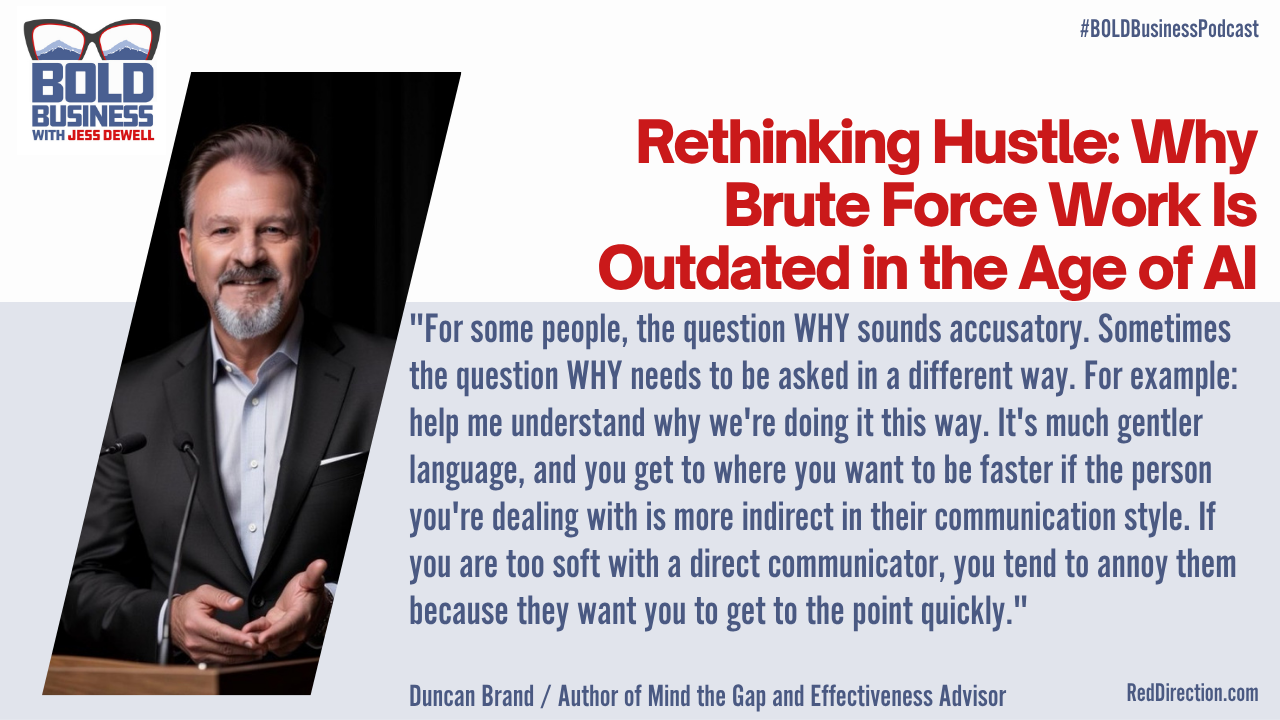
I think I’ll offer you another perspective on this. Yes. For some people, the question why sounds accusatory. Yeah. And there’s a whole study done on this. Strangely enough, there’s this study done that people who tend to be more indirect communicators view the question why as a signal of danger of accusation in a very negative way. People who ask the question why, who are more direct in their communication style, tend to view it as a way of understanding the world. So sometimes the question why needs to be asked in a different way for example help me understand why we’re doing it this way because it’s much gentler language and you get to where you want to be faster if the person you’re dealing with is more indirect in their communication style however if you are too soft with a direct communicator that you’re asking and you tend to annoy them because they want you to get to the point quick, right? Because they’re more direct. So your communication style actually plays a lot into this. And in the consulting world, it’s something that we’re highly attuned to because we deal with all kinds of communication styles. But it never stops us asking the question of why. Why are we doing it this way? Is there a better way? Have you considered this? So it goes on, right? I just don’t think people are either trained in that way or have the desire to push a little bit back on something that seems unreasonable based on their knowledge, their technical skills, but they’re more passive in their approach, their personality, so they won’t push back. And sometimes people who have got it totally wrong and are aggressive will push back for the wrong reasons. So you’ve got everything, clarity, right?
Jess Dewell 09:03
Something that you said in there really captured my attention and we’re going to come back to it unless we take another tangent and that could possibly really truly happen okay Duncan this with things that are so busy and our inability to actually get to focus because it’s noisy it’s fast there’s too many competing priorities we don’t necessarily know what’s happening or the reasons behind them right now because somebody seems to know so here we go and nobody has taken ownership this concept of I’m going to bring in right now I call it the pause, right? The power of the pause, just being like, all right, I got to get out of this day to day so I can actually look at the seat today and I see it for what it is without me in it. Because if I’m in it, I might have a different relationship to it to our point of the why question. I think that’s a really good example of all of those views come to this. How do we look at something from the outside without taking a pause? And it doesn’t have to be big, doesn’t have to be structured. It doesn’t have to be crazy complicated. It just has to happen.
Duncan Brand 10:03
Yeah. And I call it the golden pause because I think that’s a useful tool to take that step back. And maybe I think what you need to do is physically detach, meaning get out of your normal environment, take a walk, think differently while you’re doing that and just take and even bounce an idea off someone else, get a different opinion because sometimes we get heads down in our own world and we don’t seek other viewpoints and we get this tunnel vision around something sometimes i think this is a human disease we have a preconceived idea of what an outcome should look like and sometimes we have these blinkers where it doesn’t matter what’s happening i know i’ve been guilty of that and i try not to be but i think it is a human kind of instinct if you will to do it’s almost like a survival mechanism that we need to do it this way because that’s how I’ve survived in years gone by. But I think we live in a different world today. I think that the whole concept around psychological safety in the workplace is a real valid one where people feel they can make mistakes without being punished. For a long time, mistakes were seen as weaknesses and punishment followed. And the other thing is people don’t want to show their vulnerabilities because we viewed it as weaknesses, whereas more modern thinking says actually it’s good to show your vulnerabilities because you can bring more people into the problem which means you’re going to get a much more rounded view of what a possible solution might look like yeah capacity not ai just if you think about it ai doesn’t have a beating heart it doesn’t have empathy it doesn’t have compassion all the ways we connect as humans and i think a lot of people forget that and think that ai is going to replace everything i don’t think it is. I think that people are still going to be needed to tell AI what you want it to do. And then also once it’s got it for you, what are you going to do with that? It needs human intervention.
Jess Dewell 11:57
And I’m thinking about the short-term and the long-term benefit, right? We’re seeing Wall Street reward short-term benefit for all of this integration, execution, part of the process. And a lot of that has to do with reducing workforce. So what is that short-term sacrifice actually going to play out in your mind? Where do you see that going?
Duncan Brand 12:22
I think what AI is going to do, it’s going to pull back the layers of the Wizard of Oz curtain. It’s going to be pulled back and it’s going to reveal one of two things. The first one, and this is what my book is based upon, is the need for organizations to look at people as human beings first, then employees second, not the other way around, which most do today. So I think the organizations that look at people first will look at, say, or think, how can AI better enable our employees to be more effective? I think that the organization that looks at as being or is more employee-centric, viewing employees as disposable assets, will look at AI and say, who can we replace with AI? Same question, fundamental difference in how it’s viewed. And I think the organizations that just focus on the technical piece of it, the technology, if you will, to the detriment of the people side of it, they will plateau. And I think the organization that looks at how they can enable people to use AI will surpass those organizations that just focus on, but I think the human element will prevail in the long term. So I think that organizations that take a step back, the golden pause, and say, hang on a minute, we really need to connect our leaders to be more effective in their people interactions. Because we don’t want our people to feel AI is a threat to their job. We want them to feel that AI is going to enable them to do their job more effectively. Take some of the mundane stuff off their plate, perhaps. You know, and I think when that happens, you will see that AI is used to its maximum effect, as opposed to the organization that looks to replace people with AI. And that tells you what a cultural company is, right? We are people-centric versus we look at you as a disposable asset that can be vanquished at any time.
Announcer 14:55
Your host, Jess Dewell, is the strategic partner you’ve been looking for, asking the questions that truly matter. It’s time to break the inertia and get the perspective you need to make your next move.
Jess Dewell 15:09
In all of this, one of the things that is coming up for me is your own leadership journey and your own leadership development. So what was it in your journey that made you realize that this episodic event happened with leadership in ongoing evolution of organizational capacity?
Duncan Brand 15:30
Yeah, so when I launched my own firm, I’ve built it around the work I love, which is coaching, consulting, leadership development. That’s really the sweet spot for me. I have a master’s degree in organizational leadership, which essentially is the epicenter of all of that. And for about a year, it felt like the right instinct, delivery, the strong clients, happy. And then I looked up and the pipeline had gone quiet, really, because every hour I had was going to somebody who was already paying me, basically, right?
Jess Dewell 16:06
Yeah.
Duncan Brand 16:06
It’s the classic founder story. And I walked straight into it, really knowing better. And everything with a client attached got done. Everything that built the next six months got moved to a week that never actually arrived. So the fix wasn’t clever. I stopped and got honest about the two or three activities that generally feed the business and rebuilt my week around them before anything else could claim that space. So it’s about prioritization. And your calendar is your strategy. Everything else is intentionality, right? So that’s the lesson for me.
Jess Dewell 16:40
I remember I had something similar too. And I kind of wish I had a mentor that could have helped me get there faster. I felt like in the world that I was in, when I’m going to say growing up in technology, as the internet and commerce and everything started, you have all the regular business stuff. You just have it all being done in a different way. And everything is so fast that there really isn’t connection. And we don’t know what we don’t know. And our superiors don’t necessarily know, don’t know what we don’t know. And they’re not necessarily good at helping us at least know what we’re supposed to know either. Right. In a super-growing company. So I want to know. So is your goal is your golden pause? Because you’ve mentioned this a couple of times. I have a version of this too. So I was like, let’s compare notes. When you are talking to your clients about a golden pause and when you are taking a golden pause, is there a cadence? What does it entail? And what’s its purpose? Anything you want to share a little bit more about that for people who are listening and going, oh, I don’t have a lot of time in my schedule. I can really resonate with taking a step back because I’ve got to be able to see more so I can decide better.
Duncan Brand 17:48
Yeah. What I would say is this is whenever you’re faced with a bit of a conundrum or something you’re not really quite sure about, that to me is a red flag to take the pause. When there’s a big decision involved or something that’s going to affect you downstream, you really need to think about it very seriously And I think thinking is a skill and an instinct that’s been lost to social media and the internet. Because what do we do? We go to Google. So, I don’t know, I’m going to Google something. What’s Google going to tell me? Now we’re going to ask ChatGPT or Claude. What’s that going to tell me, instead of going through the mechanics ourselves and our instincts? There’s a lot to be said for really thinking about it as three instincts we have. We do it through our brain, through our heart, or through our gut.
Jess Dewell 18:39
I did not tell him to say that. People, they hear me talk about this all the time. We’re totally talking about this for the first time. I cannot wait to find out more. Keep going, Duncan.
Duncan Brand 18:49
If you understand how you typically make decisions, the only way you can really do that is do some psychometric testing. And not that there’s one that I recommend above another. You’ve got to take a few to start to understand how you show up, right? But when you start to think about it, the process is always this: I think about whatever the situation is and I say, okay, let’s play it out to its logical conclusion. If I do this, what’s the most likely outcome? If I do that, what’s the most likely outcome? And there’s a classic formula that I really like to use, especially with coaching clients. It’s very simple: you have an event, you have a reaction, and it equals an outcome. Typically, the event you don’t have any control over. So what that says is you have control over how you react to that event; therefore, the outcome you have a say in. So, for example, let’s suppose commuting really upsets you. You find it frustrating driving in traffic, especially in the Seattle area. That’s real. Yeah. And so you go, I get to my destination, I’m all flustered and I’m frustrated and it’s not a good experience. That’s the event. We have no control over traffic flow and the fact that this town is very hard to navigate if you drive. So then if we look at our reaction, the R part of the formula, what could I do differently? You could say, maybe I commute at a different time. Maybe I try Zoom instead of being in person. Maybe I have a calming tape on in the car while I’m driving. You know, there’s four or five different things you can do differently to get a different outcome, right? And so I try and go through this mental process of what-if scenarios, which I do with businesses as well. When we do strategic planning and things of that nature, if we invest this, what’s the likely outcome of that? If we invest heavily here, what might that look like? Blah, blah, blah. So you’ve got to turn it on yourself a little bit and use some of these tools. And I think that just taking a little step back, let me think about your push for a question to an answer. Let me think about that for a minute and I’ll get back to you. You know, how long do you need? Four hours. And oftentimes we live in this society that is promoting anxiety because when someone texts you and you don’t text them back, isn’t it true? They get back, hey, are you ignoring me? Why aren’t you texting me back? It’s like, is someone going to die if I don’t? You know, it’s the emergency here. We’ve created this society where we need instant responses to things, and it’s like, why? There’s no real urgency attached to this. So you’ve got to be able to rationalize everything and do these things. And I think it’s a muscle you build over time, and it’s definitely a skill you can learn. So finding that right balance. Now, the other thing that I think is interesting as a society: when COVID came along, we used to have this thing called work-life balance, right? And now it’s become work-life integration. Because if you work from home, guess what? You can do it all. You can go to your kid’s recital and make up the time later in the day. If the cable guy comes between 8 and 12, okay, come at 11:59. Doesn’t matter to me. I’m going to be here. But guess what? Before, I’d have to burn a day of PTO to wait for this guy, and then sometimes he doesn’t show up. And so we’ve managed our lives much better working from home. For a lot of people, that’s become their preferred mode of working.
Jess Dewell 22:31
I’m going to go back to head, heart, gut because it makes me so happy that you brought that up. I read an article—it was probably in the Harvard Business Review. It was Oka and somebody else. And then they went on to make something called M-braining and there’s a book about it and all this other good stuff. So that one article, the three brains of leadership, I have pulled out over and over again around the, over the years, because when people get stuck, when decisions are unable to be made, when there seems to be friction, even though everybody’s got the right outcome, everybody’s on board about the outcome. They all are like, yes, this is our outcome. And there’s all this friction about how to get there. It’s usually why they’re competing with each other about how they go about how they go about decision-making, and back to the priorities. And that takes me back to something else that you said about the week. What are we doing in our week and what are we building our week around? And I really appreciate you saying that too, because I think it actually leverages. Hopefully, we’re using all of our brains. I think it’s like some of the personality tests. What is it? Myers-Briggs. We’re all of them just in different orders, right? I believe that too, with the kind of decision-making. I also believe we tell ourselves stories about that. Some of us are like, we’re not numbers people. And I used to say I was one of, I was one of those. That’s not true. I’m definitely an okay numbers person. I might even be above average at it. I just don’t like to do it. And if you’re going to throw logic at me first, I’m always going to be like asking the same question. What if we did this? What if we did that? So do you know what my primary decision maker is, Duncan? Then I want to know yours.
Duncan Brand 24:08
Go for it. Tell me.
Jess Dewell 24:09
Oh, okay. I’m a gut decision maker first and a heart second and a brain third. I literally, because there’s enough logic out there for everybody anyway. And I’m like, cool, I’ll just lean into this. And we got all the logic in the world to balance that out.
Duncan Brand 24:21
I go brain.
Jess Dewell 24:23
Interesting that we both lead with something else first, and then we invite our brains to the party. Yeah. How did you first hear about this work?
Duncan Brand 24:31
But more recently, I’ve done some work. I got credentialed with John Mattone. Oh, yeah. Okay. Yeah, he does a thing called the Intelligent Leader. I don’t know if you’re familiar with Enneagram. Enneagram is the kind of engine mind, heart, gut, brain. I just did it recently, and it was really interesting because when I scored, and he went through my score with me, and he said, you scored really well, and I was thinking, Thank you. But there is this thing that says everybody has a masterpiece. And guess what? Yours is 37% complete. You’ve got 63% to go. So I’m like, God, that’s a bit deflating. And he said, it depends on how you view it. He said, would you rather give up and never learn another thing then? And I’m like, no, I’m considering myself a lifelong learner. And he said, look, you’ve got a lot of learning left to do if you so desire. And this is the guy that teaches it. And he said, I’m not anywhere near 100% either. And it’s all about, we have certain skills, but we have a maturity level in those skills. So I have some of the skills, but not the maturity level. And what he views it as is like an engine. For an engine to run smoothly, you need oil to go through the whole engine. And these nine characteristics in Enneagram, we all have them to certain degrees. I like that analogy. Another one of his quotes, which I really like, especially in my world where I’m consulting and doing a lot of coaching, is: you realize that prescription before diagnosis is malpractice in the medical world. He said it should be the same for what we do. And I think that’s absolutely right. We don’t take the time to truly diagnose. We want to get to prescription. And in Tony Jeary’s world, get to execution as quickly as we can.
Jess Dewell 26:28
That’s really interesting. I’m going to come back to the schedule. What are the most important things that you are building your week around, Duncan?
Duncan Brand 26:34
Could you repeat that? I’m sorry, I didn’t catch it.
Jess Dewell 26:36
So what are the two most important things, maybe three, whatever your number is, that you are building your weekly schedule around?
Duncan Brand 26:43
Oh, yeah, absolutely. And so one of my significant moves was to look at the week on a Sunday, look at the week ahead of me and start to prioritize my biggest goals I want to accomplish for that week and then do a kind of audit at the end of the week to look at how I did against that. And also, I take on projects of passion that I really truly enjoy doing, not just from the standpoint of earning money, but things that I actually like to do. For example, I never realized I like to write as much as I do, and it’s been great. So I put time aside to do that. And then other things: exercise and connecting with family, things of that nature. All these things are important that sometimes slip through the cracks. So I look at each week as a block of time. And then when I was in the corporate world, it would be by the month, by the quarter, right?
Jess Dewell 27:44
Quarterly earnings and blah, blah. I was going to say mine is weekly, monthly, quarterly. There’s a slightly different thing on each one of those. But do you actually work six days a week? If you’re doing something on Sunday and then you’re working all week and checking in, is that really six days of air quotes work? Because I know work is how we define it, right?
Duncan Brand 28:05
The good thing about work for yourself, you can weave in and out. And so some days I’ll look up and it’s like, oh my God, I can’t believe the time. And then other days, I don’t. And the thing about that is that I think it fuels you for the sprints that you want to do. He’ll get up and go walk, and he’ll have breakfast. And then write for two hours, take an hour off, and then they do another two hours. So he gets in about six hours of writing every day in these two-hour blocks. And I’m like, that’s too regimented for me. And because I’m not —
Jess Dewell 28:39
I want to know what the rest of his life looks like. I’ve got to go grocery shopping. I have some calls in there. Sounds awesome. I would love to aspire to something like that.
Duncan Brand 28:49
I don’t, because here’s the thing. He’s the brain first guy.
Jess Dewell 28:53
Oh, fair. So there’s no FOMO here anymore.
Duncan Brand 28:56
Square peg round hole. Right. Ebb and flow like Bruce Lee, be like water. Go where you can.
Jess Dewell 29:02
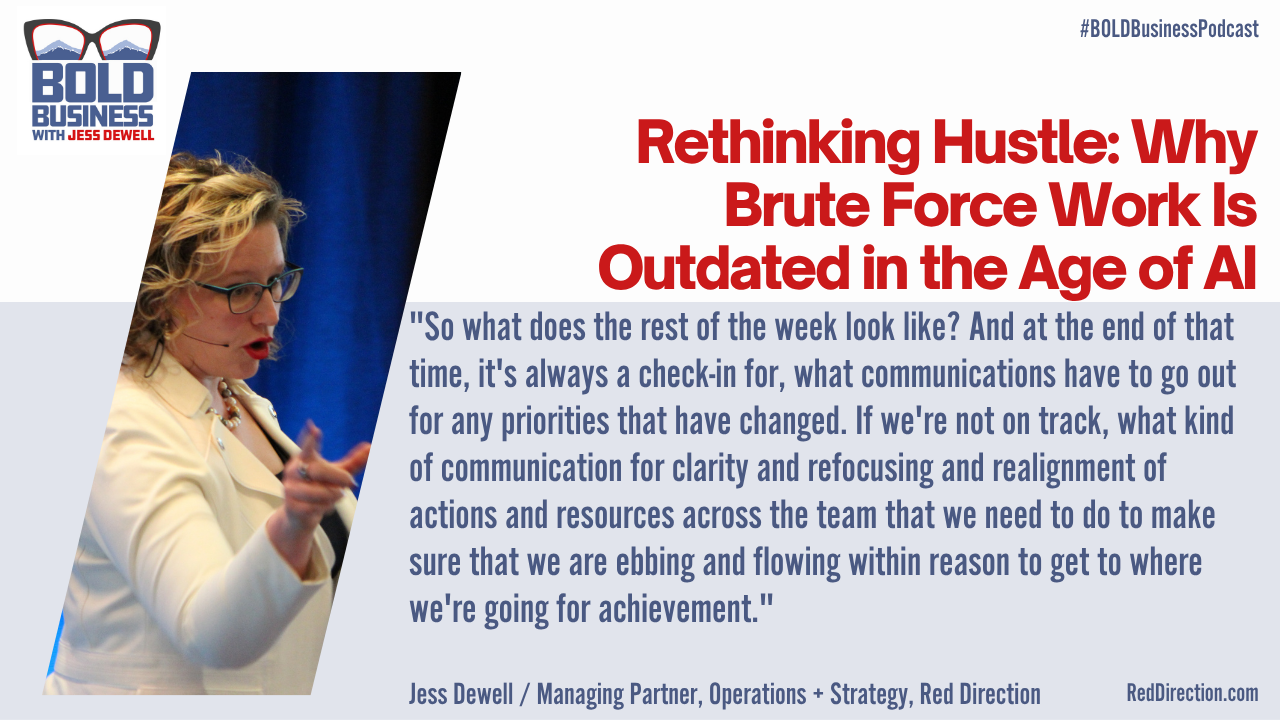
So it’s the same dedicated period of time that it’s, I’m outside of the day-to-day. I’m able to look and question. And then I make decisions. That’s where the money decisions are getting made. That’s where the vendor changes are getting made. That’s where the applications for new clients will get reviewed. All of those types of things that are fairly high level that require a certain kind of mindset, I’m doing on Mondays. And that also includes us, so what does the rest of the week look like? And at the end of that time, it’s always a check-in for what communications have to go out for any priorities that have changed. If we’re not on track, what kind of communication for clarity and refocusing and realignment of actions and resources across the team that we need to do to make sure that we are ebbing and flowing within reason to get to where we’re going for achievement. And then I’m like, I got to get 20%. I have to ensure 20% of my next four working days, Tuesday through Friday, is free. The reason for that, that was what made my whole world shift. Sometimes that 20% if it’s there at the end of the day, I will get in an extra self-care thing. I will go have lunch with a colleague. I will make sure and do some quick check-ins with clients or podcast guests on different things. But on the days, there are a lot of days when there’s a lot of moving pieces, things take longer than you expect. And so whatever the priority was for the day, if you don’t have 20% of time, it’s going to come from someplace else. And so that 20% of time is like my little bit of a reserve so that I can still outside of a sprint, not accidentally end up in one.
Duncan Brand 30:40
Yeah. And that’s a good point. And so your golden pause could become a platinum pause into a diamond pause.
Jess Dewell 30:46
And I call it a present retreat. Like most people are like, retreat. And I’m like, no, back away. And what resources do you have? What do you have to refill in your backpack before you go forward to your next part of the trail? Yeah. It’s cool. Yeah. So I appreciate you sharing some of the how you’re prioritizing things and what’s important to you today, because that’s the thing. Whatever we’re doing is the important work that we’ve decided to do. And wherever and for whomever ourselves or somebody else, our office or somebody else’s, our home or somebody else’s office. Right. It doesn’t matter any of those things as much as it matters. We can honor our commitments. And that’s what I took away from the golden pause and what the priorities are. We’re choosing to keep those priorities and in the clarity to ourselves allows us to show up for others. Yeah.
Duncan Brand 31:38
We have maybe six or seven different roles. We have your work role. If you’re married, you have a partner. Maybe you have kids. Maybe you’re active in your community. Maybe there’s a sport that you like to do. Maybe you’ve got a hobby. You think of it as like a wheel. And then the next piece is: what do I want to accomplish this week in this role? Some weeks it may be nothing, which is fine. But other weeks it may be 60% of your time, or whatever it is, right? And that’s the cool thing about the idea of being able to weave in and out of where the wheel takes you. You’ve got to understand yourself, your values, what’s important to you, what you like to do versus perhaps what you don’t like to do. And just know it can change from day to day, week to week. And that’s cool.
Announcer 32:34
If your week feels like you’re being pulled from one demand to the next, this is for you. The Daily Grind is the number one killer of business instinct, pulling you and your team away from your vision. Reclaim your strategic edge with the present retreat. This free guide from Red Direction is a simple, powerful framework to carve out the space you need to filter out the noise, make the right decisions, and lead with clarity. Visit presentretreat.com.
Jess Dewell 33:03
And we all know what makes our areas successful. We’ve already defined that, too. And so that’s also something to be able to go back and check in on, whether it’s that week, whether that’s that month, whether it’s some other cadence as well. Okay, so how, with all of the deafening noise and overload, like the weight of data and information, how do you find successful listening can actually occur?
Duncan Brand 33:28
Yeah. Think about it. Listening is an undervalued skill and it’s a learned skill. I mean, some people learn it quicker than others, but to consciously listen. The problem you’re fighting against is nature because typically we listen with the intent to respond, not with the intent to understand. The only way you can do that is listen with intent, right? Yeah. And I think that in today’s society, because there’s so much noise with social media, with the news, with the political situation, with the advent of AI and all this stuff going on, it’s very hard sometimes to actually focus and really listen to what someone is saying. And one of the most powerful techniques in listening is to actually say nothing. So if i’m with a client can i help and they’ll say something and what i know almost for a fact in 99.9 of the clients i’ve ever worked with the first thing that comes out of their mouth isn’t the real issue so when they say i’ve got this problem at work and this and that and the other you go tell me more and what you’re doing it’s a pull technique you’re pulling something out of someone and you can’t do that with language that implies pushing. Let me understand what’s going on. You’re inviting someone, right? So it’s about language, intentionality, and it’s about discipline to keep quiet. The very definition of listening is to be quiet, right? So I think it is a learned skill.
Jess Dewell 35:06
Okay. And I know you talk about the inner core and the outer core, right? Tell us a little bit about that?
Duncan Brand 35:11
Yeah, yeah. Most people do this by hitting a ceiling they can’t explain and early on i was well-armed with degrees, frameworks, credentials—all the visible stuff, right? but i was getting stuck in places that equipment should have handled pretty easily so the feedback that finally landed had nothing to do with skill it was about how I showed up under pressure. It sent me underwater, below the waterline in John’s analogy. An iceberg, 90% of it is underwater, 10%. So people see the 10% that you display, your results, your behavior, et cetera. What they don’t see is the inner core that drives that. And what most leaders don’t do is look at, do some introspection, look at their inner core to understand what drives their outer core. And the work with John Mattone is all about diving into that inner core. What are your values and beliefs? What is your natural leadership style? How do you show up to others? All those things, a lot of leaders have never touched that because typically they’ve flown by the seat of their pants, but they plateau. And the thing about that is that if you really want to get to that next level, you have to do the work. You have to dig deep inside and understand how you’re showing up is perceived by others. And then the first pillar of emotional intelligence is self-awareness. And a lot of people just don’t have that self-awareness, meaning they don’t understand what triggers them and how that behavior affects other people. And so all this certification and this idea about the iceberg being the inner core driving the outer core is a very valid one, in my opinion.
Jess Dewell 36:52
So one of the things that we are responsible for as executives in organizations is to execute. And we’ve been talking about all kinds of things that support finding the right path in the right time, the right way right now to do the execution without jumping there too quickly. Yep. And my question to you would be around this belief system conversation is, are there things that the executive, the leadership team that is making all these initiatives happen across the next 36 months for, let’s say, what do they have to really be aware of? Or how do they go about making sure that they don’t get in the way of not only progress, but actual achievement?
Duncan Brand 37:37
Yeah, there’s three things that come up to answer your question on a really consistent basis. I can almost set my watch by. And the first is, if I’m not touching it, I’m not adding value. This is the perception, right? That’s identity talking, not strategy. And it usually forms early, back when touching everything was exactly what got them noticed and promoted for the most part. I would say the second thing is nobody can do this as well as I can. And that’s frequently true today and it’s guaranteed to stay true for as long as they keep doing it themselves, which is the half of the sentence nobody says out loud. And then the quiet one beneath both being needed proves that I matter. That one almost never gets spoken in a boardroom and it’s driving more executive behavior than any strategy deck in the building. And until a CEO or a leader renegotiates those three with themselves, every delegation system you install will fail, because the system says let go while the inner core says hold on. And the inner core usually wins. And that’s why I coached the person before I ever touched the org chart. You got to understand what’s driving some of the things that are happening. And so inner core drives outer core. And so until you understand what the inner core is, you’re always going to rely on the outer core. And sometimes that works. Sometimes it doesn’t. It is about self-awareness, a lot of this. It’s knowing how you show up, how you affect others.
Jess Dewell 39:11
So Duncan, I want to know what makes it bold. What makes it bold to do the center work, to be able to step back, to be able to allow your teams to work with you and even more for you to get to achievement and actually make yourself obsolete in some of the day-to-day operations?
Duncan Brand 39:33
Because it really goes straight to the story about most CEOs have been telling themselves their whole careers, which is that their value is heroic. They’re the ones who catch it, fix it, and save the quarter, save the year, whatever, right? And stepping back, a golden pause, means your fingerprints come off everything, and then one of two things happen. Either the business struggles, which is painful, but at least it confirms you were needed, or it runs perfectly well without you in the middle of it, proving you were replaceable in the day-to-day. So people underestimate how much nerve it takes to risk finding that out about themselves. But the reframe is worth sitting with because making yourself obsolete in operations is precisely what makes you irreplaceable in the two jobs nobody else in the building can do, namely direction and culture. The boldest CEOs I’ve worked with measure themselves by how rarely the business needs them, not how often. That’s a harder scoreboard, but it’s a much better one.
Announcer 40:48
And that brings us to the close of another powerful and fresh perspective on the Bold Business Podcast. In today’s volatile landscape, growth is a double-edged sword. To truly thrive, you must engage with your strategy, not just react to the day-to-day. Without absolute alignment, your company faces a stark choice. Outmaneuver or be outmaneuvered. Grow or get left behind. Thank you for listening, and a special thanks to the Scott Treatment for Technical Production.