





A 60-DAY INTERVENTION THAT REPLACES BRUTE-FORCE “HUSTLE” WITH A RESPONSIVE DECISION-MAKING ARCHITECTURE.
FROM MANAGEMENT OVERSIGHT ➔ SYSTEMS-LED EXECUTION
With Red Direction Driving Solutions Strategic Intensive Program, install a responsive execution engine across the 18-36 month strategic horizon via a customized 60-day adaptive framework to command market relevance.
Starting the conversation:
Acknowledging the discomfort and clunkiness of new skills accelerates business evolution and outpaces the competition. Tracy Holland, Founder at InnerFifth and Goodwillbrands, shares how continuous learning of new skills is the bold move a founder can make for real growth.
Business partnerships can go right by design — and yet, even with intention, business partner relationships can go sideways. Knowing yourself, leaning into important business agreements and structures, as well as knowing your role … all these factors underpin a profitable business you like to work at. Even so, there are times that will be uncomfortable even when you love what you do.
In this episode, you will hear that is important to learn something new every week and put it into practice; that businesses grow through building or buying; that the best option may be what you don’t know how to do (yet); and the importance of spending the time to know where you create the most impact (and that it may not be as the CEO). Jess Dewell talks with Tracy Holland, Founder at InnerFifth and Goodwillbrands, about why it is BOLD to acknowledge and claim the clunkiness of learning the skills needed to scale.
Host: Jess Dewell
Guest: Tracy Holland
What You Will Hear:
03:15 Talent is the greatest asset for a business owner, even above capital.
- Surrounding yourself with excellent talent drives business success and the ability to scale.
- Advances in technology and the ability to use specialized contractors have dramatically reduced the need for large full-time payrolls.
- Even with tech efficiencies, the quality and capability of your core team remain essential for scaling effectively.
05:10 You have to constantly learn new things in business, regardless of past success.
- Prior experience and past victories are not enough; continuous learning keeps you ahead.
- Actively dedicating time each week to learn new tools or concepts allows for adaptation and better decision-making.
- As you learn, you can ask more insightful questions and more effectively lead or collaborate with your team.
12:30 Building a strong personal brand and livestreaming is vital across industries.
- Livestreaming is about engaging and educating your audience, not just direct sales.
- Developing trust and relationships through ongoing live conversations boosts conversion rates and deepens connection.
- Consistent daily presence online allows you to reach and build a loyal audience, regardless of your field.
14:10 It is essential for entrepreneurs to focus on only what they do best, including building their personal brand.
- Delegating everything except your primary skill and customer-facing activities accelerates growth and value.
- Every entrepreneur, regardless of field, must actively craft and nurture their public presence for maximum impact.
- Investing time in direct audience engagement often yields higher returns than simply seeing more clients or doing more technical work.
27:00 Having well-structured operating agreements and the right business partners is crucial.
- The clarity and fairness of your partnership or operating agreement will define how you handle conflict or changes.
- Partner selection based on integrity, character, and practicality is more critical than shared enthusiasm in the early stages.
- Lack of clear agreements and due diligence can lead to personal and financial hardship even after years of hard work.
38:30 Claim the right role for yourself in your business and surround yourself with complementary talent.
- A business owner’s greatest impact may be made in a role other than CEO, such as business development or vision casting.
- Hiring or empowering skilled operational leaders (“integrators” or GMs) allows the company to function efficiently while you play to your strengths.
- Recognizing your own best contributions helps in putting the right people in the right seats for maximum growth.
44:20 Women entrepreneurs need spaces tailored to their journey and focused approaches to growth.
- Traditional business groups often miss the unique experiences and needs of women entrepreneurs, especially around balance and support.
- Providing a blueprint and practical support for personal branding and live selling helps break growth barriers for women founders.
- Focused peer support and feedback channels (like group Slack participation) increase confidence and practical learning for scaling businesses.
47:40 It is BOLD to acknowledge and claim the clunkiness of learning/practicing the skills needed to scale.
Resources
Transcript
Tracy Holland 00:00
I am still not confident today that these tools are smarter than we are with 30 years of experience. I have a lens that I can smell things if I pay attention and look at the detail, but those kinds of things are just like we’re learning how to do this.
Announcer 00:22
Every leader needs a trusted partner for the moments that matter. This Bold Business Podcast conversation is that partnership. Here is your host, Jess Dewell, an insightful truth teller who serves as the catalyst for getting the right work done and who asks the questions that truly matter.
Jess Dewell 00:40
Today, I’m talking with Tracy Holland, founder of InnerFifth and Goodwill Brands. She is a powerhouse founder, investor, and operator. At InnerFifth, she is bringing high-conviction women together to accelerate their business growth through their community and product creation. And brand awareness, self-brand. Whether you know her from being EY Entrepreneur of the Year, a Fashion and Beauty Award recipient, a member of the Committee of 200, or another podcast that you’ve seen her on or you’ve seen her live streams, she is on a mission to build rooms where powerhouse women come together. And she is sharing her business secrets with us today. Her experiences, the candidness, the reality of the learnings that even if we’re stubborn enough to start down and recognize, oh, we’re in the place that Tracy has been, we can stop right there and listen to the wisdom that she shares and choose to make different decisions for a smoother exit or a quicker completion of a difficult time. We talk about things that matter to business of all stages throughout the entire program. There are three things to keep track of and listen for as we’re going through the conversation. So listen to this first. It’s so important to learn something new every week because that’s how we continue to grow and change and ask the right questions through times of high change. Second, revenue cures all ills. When you have revenue, you have more options. And when it’s time to scale, you can decide, do you want to build or buy? And guess what? It might not be what you think it is until you look at both. And third, maybe your role isn’t the CEO of your company. Can you claim it so that whoever needs to be the CEO is doing the CEO work? And you are doing the work that you are best at. Very interesting and very thoughtful all the way through. I can’t wait to get you to the show. So we’re going right now. I was learning about your story and I am learning about you and what you’re doing now and where you’ve come and what your path is. And it’s really interesting because it’s almost like the experiences that you had when you had them are more important today than they have ever been before. And I’m talking about things like this reactive, busy work, being able to scale and not take on too much. And what have you found is the greatest asset for a business owner? Because I understand it’s not capital.
Tracy Holland 03:15
Yeah, I think it’s talent. So your people who you surround yourself with is your number one asset. And number two, how lucky are the people building today that have access to these AI tools? Hello? I mean, when I look at accounting and my average per headcount allocation of team when I was building my business and just looking at my accounting and finance department. I probably had a million three, a million four in payroll annually in just that one department, maybe more. And I think about it now and I can run a 27, $30 million business on a million two in total payroll for full-time employees. And then I have contractors and outsourced people that are experts in their vertical that I pay on a per project basis, but no longer do I carry a $9 million payroll because I don’t need to. And I think what I would say is it’s not a license to say you don’t need team because team is the talent, talent is the business, and the business scaling is predicated on having excellent talent that can execute. But I think what used to take a team of 30 to 50 can now be executed on 10 to 20. And then maybe that can kind of tap out there and you can keep going and scaling. So that’s so exciting.
Jess Dewell 03:53
It is exciting. Are you seeing ways to do that in your business today?
Tracy Holland 03:53
I am. And I mean, every single week we’re cracking the code on what is happening more and more and more in that area.
Jess Dewell 05:04
Without giving too much of your secret sauce and what makes you unique and what you’re doing, is there an example you could share with us?
Tracy Holland 05:11
For product development, we used to have a team of people who would come back after going trend, you know, sourcing and going to trade shows and walking through different countries and going shopping across the world. Now we scrape data and we take a look at analytics and keyword searches and conversion. I can test a non-existent product on a landing page with an ad before I even launch it and see if there’s even a conversion. How in the heck could we have done that even four or five years ago? It’s changing the game. It’s de-risking small entrepreneurs from overextending themselves on inventory. It’s de-risking you building out a big pipeline of people, team, and time to build out a forecast and demand plan against a prospective product that may not even convert. And it de-risks your retailer from taking a bet on something that may not move. So all of these things are real-time test and learn opportunities that I think is unlike anything I’ve seen in my lifetime. There’s literally a license to print money right now if you are paying attention. And if you’re the kind of entrepreneur who says, oh, Claude is not my area because I’m not a tech person. I’m going to leave that to my IT people and have them help my team learn Claude and how we can be efficient, you’re missing the boat. Every Saturday and Sunday, I have time set aside, three-hour chunks of time, where I go to Anthropic and I take their online digital classes, 30 minutes, and I learn and task myself with learning something new every single week. Because if I can’t learn it, how can I ask questions of those who can use Claude or OpenAI and some of these way more efficient, more sophisticated things that you could overlay into your business to become efficient? How can you even ask the question to know if you can do it if you don’t know how to do the basics?
Jess Dewell 07:23
When somebody goes to learn something, even if they’re practicing it in the moment, what is the likelihood that you have experienced either yourself that you had to learn or you see across your teams of actually putting it into practice so that change can happen. What does that look like? And have you had a hard time getting from the learning to the implementation?
Tracy Holland 07:45
It’s weird. It’s awkward. It’s clunky. And what I mean by that is I’m still old school in that I want to look at our P&L. I want to go line by line and I want to see gross revenue. I want to see sales discounts. I want to see cost of goods fluctuations. I want to see ad spend. I want to see every single month. And I actually look at it week to week. I physically want to see it and interpret it and have it make an impact because something inside me goes, oh, I smell something. We need to trigger some rabbit hole excavation. And that can actually mean even changing out a team member because let’s say the creative’s not working and we thought it was and it’s not. And I can tell right away, this is a creative issue. It’s not converting instead of a landing page issue or whatever it may be. But I think the clunky part is if I were doing this in real time in this moment, I would just toss all of that into my agent and say, give me your top line analytics. What are the variables? Where are the holes? And what do you recommend based on the roadmap? I am still not confident today that these tools are smarter than we are with 30 years of experience. I think that I have a lens that I can smell things if I pay attention and look at the detail, but it is clunky in that we’re trained to do it the old way. So like literally I have a trigger in my brain that says If there’s anything that’s not making sense to me, I’m like, have we asked Claude his opinion or have we looked at the variables? Even my blood work, even my HRV scores over six months on my WHOOP. Like, I just want to know, have we really thought about it holistically and am I missing something? But those kinds of things are just like we’re learning how to do this.
Jess Dewell 09:44
It’s interesting that you’re using the word clunky. I feel like it’s clunky when I’m learning a new skill and trying to integrate it and model that for my team and also recognize that what I’m doing today is probably not what we’re going to actually do in three months. But at least it’s me learning to ask the question of, well, how does this look and what could this look like? So we’re not changing every three months. We’re evolving over time. And I think that’s the biggest thing for every business today. How do we evolve over time instead of pull out and plug in new with all of the change management that goes along?
Tracy Holland 10:17
I read this article where one of the agents inside of Anthropic was preemptively starting to run a strategy on how to overcome a blockade or a change of strategy. If inside the company they decided to kill a program that was future coming up, the agent was like, here’s how you get around if we’re derailed on this objective, like how to overcome thinking through to get, to get the passcode and continue to do it, even if I’m told I’m not going to. I don’t know if we actually understand yet the actual what the hell are we going to do situation. When I can’t get into my own Asana because I don’t have an admin passcode and someone on my team does. And I’m like, wait, what guys? Like, why does IT have admin status on what’s happening here? This is like small time compared to what is potentially the capabilities of some of these tools. But right now, if you are sitting back in an old-style business, I’m talking a business that has not been optimized yet. And you’re saying we’re not a tech company. I don’t need to know IT. My IT people do that. And they’re the ones who need to learn this. You are missing the boat, baby. You are leaving millions of dollars on the table.
Jess Dewell 11:42
Okay. So the other day I was having a conversation and it was very similar to this. And one of the things I said there, which made the person stop, they did not have as much experience as you do. And I don’t have as much experience as you do, but I had way more than they did. And I remember when websites became a thing. Companies said the exact same thing. My IT department’s going to do that. They’ll just take care of it. It was a bolt-on. We are in a place where most executives today get to see this twice, this big, big change twice. And we know there was more than 50% of people that was like, this website thing, this is going to just come and go. This internet thing, it’s never going to work the way that it did. And look where it got us. And so people who are saying what you’re saying right now, I’m saying to them, you have proof it can work. Go for the path that can work at this point because it’s more likely we’re going to figure it out than not.
Tracy Holland 12:32
This is what I say every time. Now I’m very focused on talking to entrepreneurs about whether they’re live-streaming every single day. And, you know, people say, oh, I don’t sell. It’s not live-stream selling. Is it for me? I don’t even know. I’m a service business. I’m a restaurant. I’m a dentist. I’m a plastic surgeon. And I’m like, do you guys understand? This isn’t selling. You’re not sitting there saying, hey, buy my vacuum cleaner, my lipstick and I’m live-stream selling. What you’re doing is you’re live-streaming, bringing audiences into a room. You’re talking about your expertise like a podcast would be, and you’re giving your audience a chance to interact with you, ask questions, get to know, like, and trust you and get closer to a transaction. In an average live stream room, I convert 40 to 50 percent in an average live stream room. So what does that mean? That means you want to go on every single day. You want to be consistent. You want to show up for your audience. You want to say, you want to give your audience what your vertical expertise is going to be that you’re going to talk about. And you’re going to start to have people show up every day and say, how can I learn more about this? And then you’re going to get the email address and phone numbers of each of your people as they come into the room. They don’t have to pay to get in. They get to give their text or their email. And then you have them on a list. And now you’re building real intellectual property for your business. And I don’t care what kind of business you have.
Jess Dewell 14:04
What’s the difference between the real work that needs to be done and the hustle that pushes people toward burnout?
Tracy Holland 14:10
First of all, thinking about you as an entrepreneur: you are the visionary, whether you know it or not. If you started a business and you’re willing to take the risk, money out of your pocket and put yourself in the driver’s seat of a company that you’re going to build, you’re a visionary. So maybe you have an expertise and you’re saying, yeah, but I’m a plastic surgeon or I’m an orthodontist or I’m a chef. Yeah, I started a restaurant. I’m a chef. I’m actually not an entrepreneur. I’m really a chef or I’m really a plastic surgeon. Then what you have is a visionary tendency with a very refined sellable skill. And at the end of the day, putting people in every single position around you that allows you to do the two things you’re best at. And you may say, I’m not best at one of them, but I’m going to tell you, you must become best at both. And one is doing your craft. So whatever that craft may be. And the second thing is being in front of potential people who will buy your craft. And how do they get to know you? Know, like, and trust you is exactly the way I’m describing is social media, personal brand, live streaming. Those are the three ways people get to know you and will pay a premium and will go out of their way. And that is the biggest moat you could build in this moment in 2026 is your personal brand and your connection to your audience. And I don’t care what you do, but you must do those two things. And so you can be the best plastic surgeon or the best psychotherapist or dentist or restaurateur, and you must do those two things exceptionally well. And I hear entrepreneurs say all the time, I’m a psychotherapist. I don’t have social media. I don’t have a personal brand. You know, I have patients that I see and I say, take one hour of your day, X out a patient, put that hour into talking live stream to an audience or answering the question that comes up most is the biggest pain point for those who come to see you, whether you’re a couples therapist or you’re doing childhood work for kids or whatever, that becomes your one banana and you are going to talk about that one banana all day, every day to your audience on your personal brand page. And you are going to speak to that expertise because that is how people begin to know, like, and trust you. And the flywheel is way, way bigger than anything that you could do by seeing an hour a day extra patient. I promise you.
Announcer 17:01
Feeling stuck? Like, what got you here won’t get you there. The pressure to grow is on, yet the path isn’t clear. Yet. You don’t have to walk that path alone. This is the Bold Business Podcast. Like and subscribe wherever you listen. Your host, Jess Dewell, is the strategic partner you’ve been looking for, asking the questions that truly matter. It’s time to break the inertia and get the perspective you need to make your next move.
Jess Dewell 17:39
Today on the Bold Business Podcast, you are listening to my conversation with Tracy Holland, founder of InnerFifth and Goodwill Brands. So I’m going to just call it out and say, hey, one less client for putting effort into a sales cycle, keeps people lined up to want to work with you. And the whole purpose of sales is to keep people lined up with the velvet ropes right there. So they’re ready, they’re excited, and they want to work with you. And they’re ready to say yes when you are ready to book them. It’s also not a magic bullet. Doing it and being good at it are two very different things. And you don’t get good at it until
Tracy Holland 18:15
You do it. It’s like, remember when we were growing up, they used to have that, those call-in numbers and they would be live chats and all these people. We are meeting these people on the phone. Are you like, where are you? Where are you? And we would all get on these chat, these chat lines.
Jess Dewell 18:33
This is, that’s exactly right. Oh, that’s fantastic. One of the things that comes from sales that I also think people get worried about. So this effort of getting good at being available and in front of people so they can know, like, and trust you, there will be growth that comes from that. And sometimes the growth is faster than we expected. Then that’s a whole other can of worms that is very manageable when we pause and say, Hey, guess what? I know somebody like the Bold Business Podcast who talked to this amazing woman, Tracy Holland, to just talk about, and she talked about growth too when it happens real fast. What happens when you grow real fast? Like what’s the reality of fast growth and do we have to be scared of it?
Tracy Holland 19:16
There’s never a pace that fits the profile. And what I mean by that is slow growth and being, I think I am a firm believer that revenue and sales cure all ills. It absolutely will cure any issue. You can always staff, borrow, or grow when you have a revenue pipeline, which is why I’m saying building your personal brand and being thoughtful about being online, having an online presence, having a personality, having your positioning out there is mission-critical in whatever capacity you’re going to do business. But I think number two is at every size of business, there’s a plateau stage in which things slow way down and you may have way too many staff or you may have way too much inventory, but there’s this slowdown period that can take place and it happens quickly at times. And you think, my God, what am I going to do? So building up your social and online presence is what lets you start and stop easily in terms of fluctuating on growth. But I think, you know, this idea of like, I remember Costco becoming a client and we were thinking maybe 50 doors, a hundred doors, and it was like 500 doors. And we were thinking 20 to 30,000 units and it was 150,000 units. And so when you start to think about growth and you see it across the board, it’s just a one day at a time kind of thing. And you, you just, the best thing you can do is when things do slow down is make sure you have SOPs and systems in place to be more efficient so that when the fire hose moment happens, you have a process and a plan for how to build and scale that feels manageable. Because that’s where the wheels fall off the bus is when people are like, okay, we’ve done 20,000, but we never done 200,000. Like what does that look like and how do we need to scale that? How do we finance that? How can we run our line time? How long will it take? Where do we store raw materials while we’re making things? These are real crunch issues that come up in real time. The best thing you can do to hedge on growth is to start to plan for those moments when things are slow, not sit and worry and fret that you don’t have enough business.
Jess Dewell 21:55
Did you believe that you would be the one that didn’t end up in a plateau?
Tracy Holland 22:00
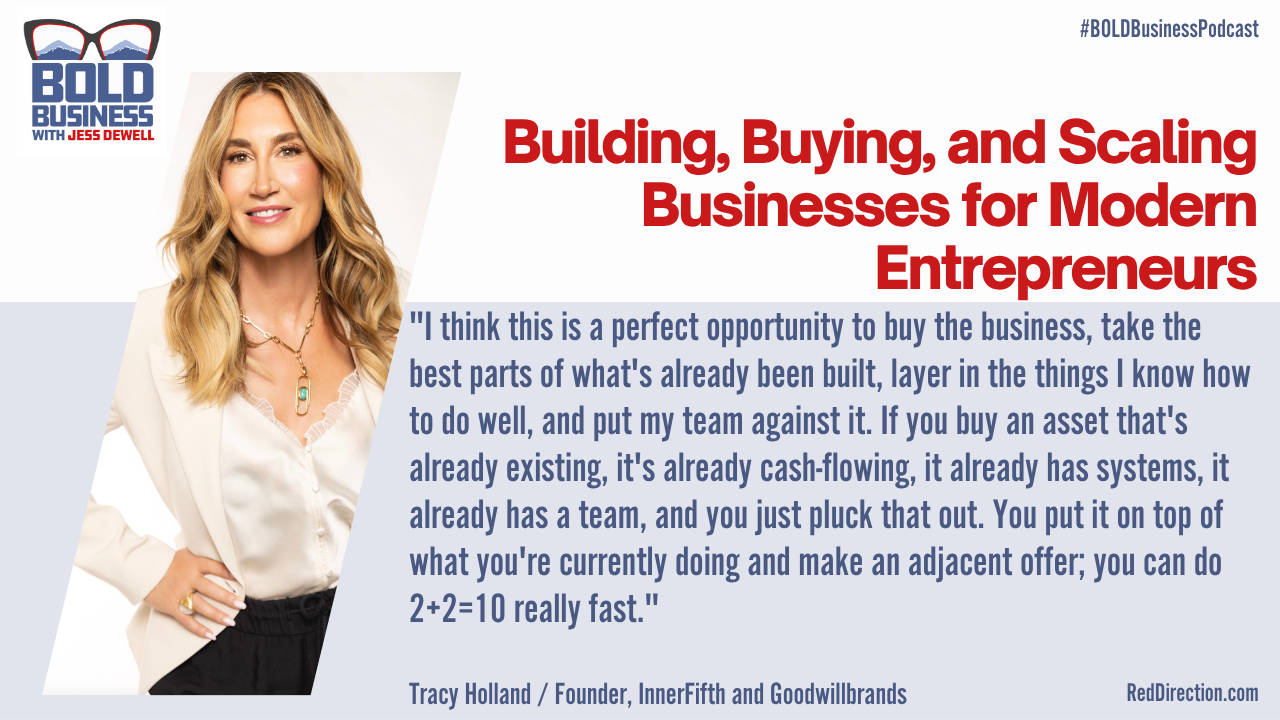
I did realize at one point that I had to make a critical decision to either build it or buy it. In order to gain success and growth in the period of time that I needed and felt strongly about being able to do it, I decided to pivot what felt like the only thing I had thought of, which was to build it, because that’s all I know. You know, when you’re eat-what-you-kill, you go build shit, right? That’s what you do. But there are a lot of tangible bolt-on assets out there that are waiting for a home. And they are also struggling to grow and don’t have the resources or don’t have the knowledge. And one of the fastest ways I spun up my last business was I went and bought a couple assets and put it on top of the chassis. And I realized, and I do that now in my current business, when I see an opportunity that just makes so much sense and I can’t believe that they haven’t gotten out of their own way to get where they need to go. I think this is a perfect opportunity to buy the business and take the greatest parts of what’s already been built and then just layer in the things that I know how to do well and put my team against it. And that is super fun. And I love, love that. And I wish I had been trained or taught to really think that way younger at a younger age, because I think I burned myself out back to your question about burnout. I burned myself out trying to build it because sometimes it’s not an easy path and you have to start and stop a lot. Whereas if you buy an asset that’s already existing, it’s already cash flowing, it already has systems, it already has a team, and you just pluck that out and you put it on top of what you’re currently doing and make an adjacent offer, you can do two plus two equals 10 really fast. And the government’s giving money away to do that. As long as you have a balance sheet and you have cash flow, the money is the SBA minimum, like max on a couple of the different offers. There are many SBA loan types, but they just doubled the borrowing base of the SBA fund. So you have up to 10 million to, and it’s low-cost debt. And as long as you’re buying an asset that has, I always look for something that has 10 years because I like the season of ins and outs and I want time. So I look for a 10-year-old business. I look for something that’s EBITDA positive. I love balance sheet assets. But if it’s, if it’s inventory light or balance sheet light, that’s okay. As long as there’s intellectual property. And then I look for SOPs in time or a team. So I look for SOPs and then who are my key team people on this business that I can ensure that when I buy it and put it on that they’ll stay.
Jess Dewell 25:03
Sometimes we thought we were moving the needle. We were measuring the things and seeing progress. Turns out we might not have been measuring the right things and we actually didn’t move. I’m guessing you have experiences from that too.
Tracy Holland 25:13
I think I see a lot of digital founders confused on the metrics to your point. I see a lot of confusion because of the one reason, which is they outsource each aspect to agencies. And so you may have an acquisition agency for new customers. You may have an affiliate agency. You may have an email, email marketing agency and you get on the calls with these agencies and they’re showing you their numbers and their metrics, you have to strip out certain things from those to really understand if you’re making money or losing money. It wasn’t until I brought all of that in house and started having my own team do it that I started to realize what questions I need to ask and how I needed to infrastructure the tools that we use to strip out the noise to be able to see the real numbers.
Jess Dewell 26:06
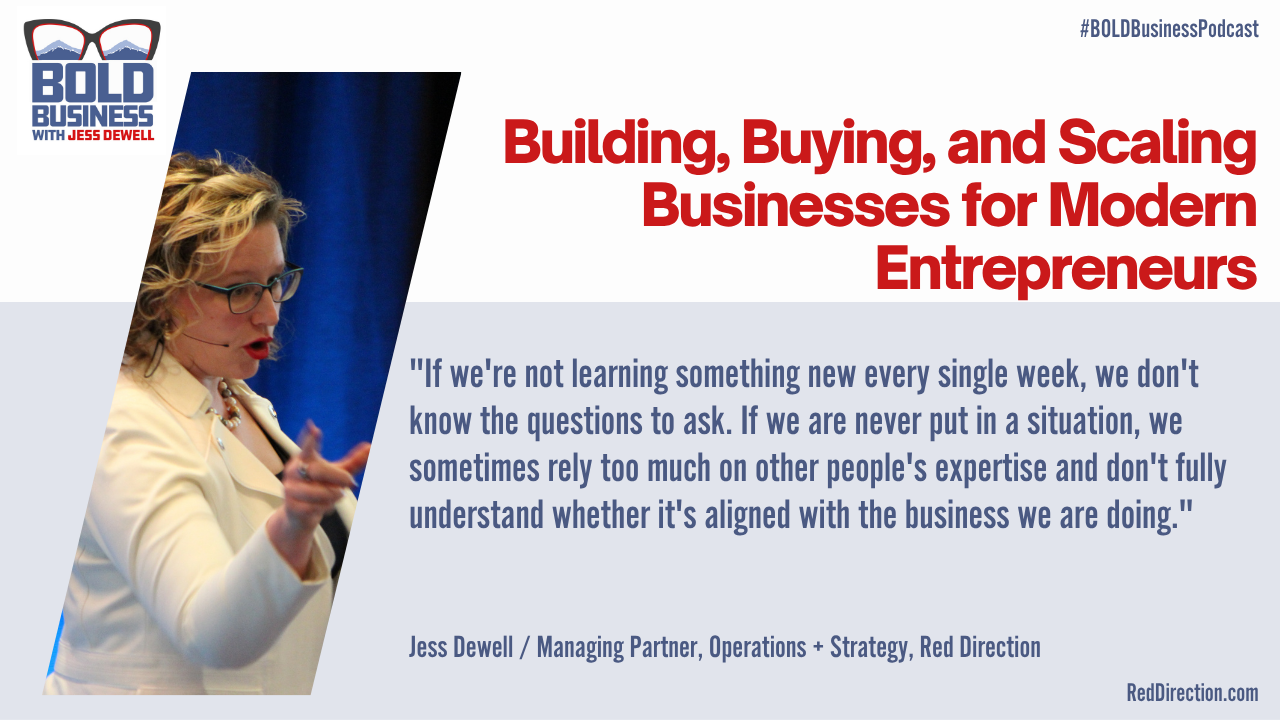
The beginning of our conversation, if we’re not learning something new every single week, we don’t know the questions to ask. And if we are never put in a situation, sometimes we’re relying too much on other people’s expertise and not really understanding is it lining up with the business that we are doing.
Tracy Holland 26:20
I hate it when I see founders losing their shirts or like losing money or frustrated because their year over year suck and they’re trying to figure it out or people become disenfranchised in their own business and they’re like, this is like a prison I built myself into. And I really relate to that. I understand. So figuring out how to make it fun again, part of it is just knowing the right questions to ask and what the hell is going on.
Jess Dewell 26:51
I would be curious what was in your head and your heart and your gut when you made that decision.
Tracy Holland 26:57
Founders, including myself, really underestimate, especially when you have a new partner and you’re excited about a business, is that you don’t spend enough time looking at your operating agreement and understanding the implications of some of the things that are in there. When you hire people, you can have candid conversations. When you do business with a business partner and you have an operating agreement, you can have candid conversations. But ultimately, depending on the operating agreement structure, those conversations can lead to a very challenging place. Or sometimes in cases, I have myself had this happen. And with people that I have experienced watching, especially family-owned and operated businesses, is that once you get to the point of exhausting the conversation options and you go, God, what does the operating agreement say? What are the rules of the road here? How do we deal with this situation? That operating agreement ultimately is the jurisdiction in all favor or not favor of how you resolve the issue. Lawyers write operating agreements. I’m telling you as a practical business owner with practical business experience that if you do not have an attorney writing your operating agreement that has very practical business experience, I’m not talking legal theoretical experience, I’m talking practical business experience, you’re in hot water. And the worst thing you can do is spend three, five, 10 years of your life building an asset, spending your time, energy, love, all the things that you pour into these things, and then come to a place where you’re having a disagreement with an operating partner. You have all your cash tied up in an asset that you can’t get it out of. And you’re in a lock step, you know, deadlock issue. Knowing your operating agreement and having very candid conversations up front about the what-ifs in different seasons and situations. What if your business partner decides to retire and wants to go do something else and still owns 50% of the asset? What if one of you get sick or has a life-altering experience that needs to make a change? What if you get a new customer, 30, 40, 50 million new opportunity and someone has to put their house on the line or their assets and you guys have different balance sheet assets and you have to PG things and you have to do capital calls. These what ifs beginning and the end of these business relationships and these business situations if you haven’t been thoughtful in all of them. And so what I would say to you a couple of my places in my life where I’ve come to a place of saying, is this worth it? And do I want to keep doing this? It could be really lucrative, but do I want to keep doing this? Or do I want to come to work every day and feel this way is one of the most important questions you can ask yourself. And those things change. And if your operating agreement has not thoughtfully and practically considered all of those things that I mentioned, it’s generally highly disadvantaged to the person who’s in the situation to think about what to do next.
Jess Dewell 30:29
When you’re in, how do you choose who to enter into business ownership with where you have operating agreements? I’m curious about your situation. It sounds like yours went really well.
Tracy Holland 30:36
I buy assets now that I own 100% of, and then I bring in operating partners. They get phantom equity. It’s earned over time. They’re generally tied to some sort of an exit or some sort of a liquidity event. I own 100% of the business. That’s not always reasonable, right? Especially if you start something with a brand new partner that’s new from scratch, and none of you, neither of you are, are coming in with something to say, Hey, this is foundationally, I’m at 51%. So I have a business like that. Now I’ve done my best to say, here’s your role. Here’s my role. And here’s where we are. It’s fraught with issues. It’s not like, is there going to be an issue? I’m going to tell you with a hundred percent assurance, 100% of the time, if you are in a 50-50 situation, you are going to have a moment of complete meltdown on your deal.
Jess Dewell 31:44
I have the same thing. Anytime there’s been 50-50 or any even number of partners with the same value, we end up, there has every single time there is at least one point where it’s like tug of war and nobody’s going to win. And then what do you do? It is the hardest situation to be in. Yeah, because sometimes it feels like you’re playing chicken because of your risk tolerance. And sometimes it feels like you’re just being an asshole because somebody’s got to figure out how do we make the flag move and get somewhere? Because at some point, something just has to come out on top or somebody has to give. And then it’s like, man, I really feel like that wasn’t the best thing and I just gave. I mean, and those are only the experiences that I’ve had in certain situations. And the range is so big, Tracy. I’ve had spectacular failures in addition to some really awesome success. And I don’t know if you can relate to some or all of that and maybe that’s TMI.
Tracy Holland 32:45
For sure. No, I wish we would all talk about this more because what I say to every entrepreneur who I know, like I feel the same. I have entrepreneurs who come to me and they’re like, I love my business. I’m going to work until I’m dead. And I say, cool. But guess what? You will exit your business. One hundred percent of every single human who starts a company is going to exit their business. They’re going to exit walking out the door or they’re going to exit being rolled out the door. But one way or another, no one gets out of what’s inevitable. You got to plan with your peeps what you’re going to do if a life event takes place and how does that work? And I think the thing that I’ve found is picking people who have integrity, who have character, who are like fair and reasonable and good people. And that’s not always been my best. I haven’t always picked, you know, ultimately that, that well, I think I’ve learned the hard way and I’ve learned to spot issues and I’m better at that now than ever, but people have different levels of sophistication in business. It doesn’t mean they’re not good people in the world. It means in business, they suck or they’re not very good or they’re challenged or they’re hard to work with or they’re temperamental or whatever. And all those things come into play when it comes to happiness. Because at the end of the day, if we don’t love what we do, why are we doing it?
Jess Dewell 34:21
Yeah. And we really do have to trust the people around us to have joy in that. I had another person came on the show and I asked him the question, how do you pick partners? And he said, he was asking me about some of my failures and I was telling him and he goes, you just need to work with your best friend. That was literally his answer. How, as long as you’ve been best friends for like 10 years, you can do business together was the, a very simplified version of his answer. And I’m thinking to myself, that is the most anti-business advice I have ever heard in my life. And I love it. If it works for him, I’ll try that.
Tracy Holland 34:49
I mean, I, I’m in my best friend’s office today working. And I’ve always said to her, we should be in business together. And she’s like, absolutely not.
Jess Dewell 35:03
I’m looking for people who can, who are willing to see a different point of view, even if they can’t imagine it themselves. And I don’t know how you actually, until you know a while and have been through a few situations. I actually don’t know how you would gauge that early on. Like somebody made an introduction. It feels really good. We’ve got the same goals. We have the same stuff. We both have whatever it took to get started and make the operating agreement. Sometimes that’s actually what we end up looking for, or that’s how our boards get chosen for us. I mean, honestly, we don’t necessarily have a say in who gets on our board when we’re taking somebody else’s money. And that can also be really tricky. Oh yeah. Very tricky.
Announcer 35:52
If your week feels like you’re being pulled from one demand to the next, this is for you. The Daily Grind is the number one killer of business instinct, pulling you and your team away from your vision. Reclaim your strategic edge with the present retreat. This free guide from Red Direction is a simple, powerful framework to carve out the space you need to filter out the noise, make the right decisions, and lead with clarity. Visit presentretreat.com.
Jess Dewell 36:20
Tracy Holland, founder of InnerFifth, and Goodwill Brands, is my guest today on the Bold Business Podcast. Let’s get back to the conversation. By the way, I really appreciate that you called out, have a business lawyer that does more than practice theoretical law. I can attest to that. And I wanted to do a quick callback because it will make all the difference in the future. And I actually think every single partner should have their own lawyer. The business can have a lawyer, but I think every partner needs to have their own lawyer as well versus sharing. And I think people forget about that. And it’s an expense they want to think about later. I’ll tell you one story. I had one company start. We were well on our way. I kept trying to bring up the operating agreement, the other owner investor did not want to sign it. And we kept having other things that pushed it off. I finally got it signed. And within a week, the whole business failed. My bacon was saved by that agreement. I’m so glad even though it was off and going that it happened. Somehow, I had divine guidance on that one. Something, something outside of my realm of existence and understanding made all that fall into place to protect me. I do truly believe that. And that’s luckily the only one, but it was big enough. I was like, okay, we can’t get that far ever again without more structure to lean into. And rules of engagement is kind of a rough phrase. I’ll tell you what, if we don’t agree on how we’re going to do our work, we really can’t get any work done.
Tracy Holland 37:53
To go to an office every day or go into a work environment and deal with that, even on a quarterly, you know, board meeting situation.
Jess Dewell 38:00
Like no one. No one. And so, OK, so that actually makes me think of something, you know, right. Like as the CEO, as the vision holder, you have a responsibility. How many times over the years, maybe across different companies too, because I know you’ve owned a lot and you’re involved in a lot of different companies. How often has your CEO role changed or had to change to meet where your business was in its growth, in its plateau, or in its path to exit?
Tracy Holland 38:31
I now realize in my years of being CEO that my role really should not be CEO. Meaning I’m okay with this idea that says I have an internal-facing operating CEO who’s managing the team, who leads the execution. I’m much better as president. I’m much better outward facing business development and looking for deals and looking for bolt-ons and acquisitions. That is my expertise. When I think about where I’ve made the biggest impact, I would not vote for me as a day-to-day operating CEO, running a team and managing. I have worked with some of the most exceptional people that I could imagine who are so excellent and built like thoroughbreds for that role, and it’s not my role. So the company that I just sold in March, I was CEO of that business. I pulled in several of my teams from my last company. So most of my team was pulled over. They understood me. They understand how I operate and how I work. So there wasn’t a lot of clunkiness because they get me. And my former head of people from my last company, I brought her on and she acted as the integrator GM. I mean, she basically set up all the systems in Asana, all the Slack teams, all the KPIs, all the EOS goals through Traction. She’s the one who stepped into that GM integrator role and then allowed me to focus on the business development and the sales and the growth of business. And so, yes, I held the CEO title, but frankly, like a hot potato, I give it away as fast as I can.
Jess Dewell 40:30
Well, can I tell you how glad I am to hear you say that? I don’t call myself the CEO either because I’m not a CEO. I can do the job. I can get the things done. Like you, my strengths are someplace else. And when we can claim them and recognize that role, it makes finding the right people that will help us excel, that are amazing in their own right, get in the role. And maybe title doesn’t matter. Right?
Tracy Holland 40:58
And that’s why I started this conversation off with you saying team is the most valuable thing that I have. And it’s because if I want to do what I do so well, I must have these key roles around me who have that integrator, executor, high follow-through, high detail, love to oversee things, high sense of urgency.
Jess Dewell 41:22
In addition to EOS, do you have other tools that help you figure out what the strengths of the roles are like PI tests or DISC or Human Design, Kolbe
Tracy Holland 41:36
There’s a whole lot of them. Yeah, I mean, I use Culture Index. Culture Index is great. And then I overlay the Kolbe test over it and the Kolbe test just helps you understand where someone’s going to start when they see a project. Are they an investigative person? Are they going to go investigate the hell out of something before they start? Or are they going to just be the person who gets the IKEA box and just opens it and starts putting things together before they read the directions? That’s me. And so the Kolbe test is like, I have a nine Quick Start on Kolbe. That tells you out of 10 where I need to be held back. So my team has me do this thing that I learned how to fill out and do for them, which is so painful for me, but it’s basically a risk assessment overview versus a benefit and the risk assessment versus benefit. Because as a nine Quick Start, I find an asset that I think, oh my God, we have to buy this makes so much sense. And it really puts me through the rigors of like, why, what is it going to add value? What are the biggest takeaways that would take us through the paces of what the vision is? And why do I think it’s going to work? And then what are all the downside risks? And then how much time will it take? And what team members do we need to assign to make it happen? And do we have the resources? And it puts me through a process that forces me to go, oh, this is actually a four. I thought it was like an eight or a nine. And it’s actually a four. It’s a pass.
Jess Dewell 43:16
I don’t think it’s rose-colored glasses. I truly think it is potential. There is so much potential in here and being able to stop and go, well, where is it actually at? So you can see how much is where it’s at versus the actual potential instead of making decisions just on what the opportunity may be.
Tracy Holland 43:34
Once I’ve gone through that process that I really do think, hey, this is juicy and I’m excited, then I have to bring it back and present it to the team and have them poke holes in it.
Jess Dewell 43:44
Everybody gets to be involved at that point, which also, man, that’s an amazing foundational support the foundation, fortify the foundation experience also. It’s been really fun to watch. Yeah. Awesome. Well, so now in InnerFifth, you’re working with women from idea all the way through scale. Where are you finding in this process today where there’s struggle or friction in flipping the mindset from management oversight to true, I’m doing the right work right now?
Tracy Holland 44:20
I built InnerFifth originally because I felt so lonely and knew that there was just nothing there for women entrepreneurs the way we needed it. And yes, I’m a member of YPO. I’m a member of C200. I’ve been members of all these organizations, EO. But I never found a place where women entrepreneurs could share amongst one another in an open format about all the stages and all of the additional aspects and challenges about starting to date again and being high net worth or raising kids and trying to manage a business and how do you deal with that and all the things. So that was really the genesis originally of InnerFifth, but it has turned into something that I hope those who are doing it are seeing as the most beneficial thing they’ve ever done, which is, as I said in this podcast, how vital it is that you’re doing the two things that you do best. 90% of those founders know how to do the thing they do best, which is be the plastic surgeon or the orthodontist or the, whatever the product development expert, but what they’re not doing is the personal brand and the live selling because they just are like, I’m not a live streamer. I’m not a social media person. I don’t really do that. And what we do is we teach you exactly how the blueprint is for how to do this in the lowest cost, lowest lift way with the highest results. And it’s because it is the number one thing you could be doing to move the needle on your business. And I don’t care, like I’m business agnostic, right? But if you don’t know, if you can’t say in three sentences who you are, what pain point you solve, what pain do you solve for, and who do you serve? And then what is your one banana? What is the one thing you’re going to do to solve that? And talk about it day in, day out to the audience that are knowing, liking, and trusting you. You are missing the boat on how to build a moat and protect yourself and your business and your intellectual property and maximize your exit. That’s exactly what we teach. And it’s very affordable. It’s very focused. We want it as fast and simple for you. And we put everyone into a Slack so that during the month as they’re practicing, they can go to each other and go, holy shit, I just did this. And it was weird. How do I, you know, and people jump in and say, here’s how I did it, or here’s my link to my page, or here’s how I solve for it. And those are the things that I see make the biggest difference. And so even though InnerFifth was initially conceived to be a very broad kind of overview and business mentorship and membership concept, we’ve narrowed it quite a bit to just these pain points because we found that all of these entrepreneurs are in different stages of their business and their life. And we’re not trying to be Chief and we’re not trying to be YPO. We’re giving you the fastest return on your investment that we can.
Jess Dewell 47:41
Okay. So Tracy, I want to know what makes it bold. What makes it bold to really acknowledge and claim the clunkiness and then do the learning and the practicing that one needs to get the skills to scale and grow?
Tracy Holland 47:53
Using your courage. Because honestly, we’re all self-doubters. That’s like our brains are wired for risk and we have always a reason why it’s not going to work. Or like why it feels too risky and the courage to push past that mindset of like, oh, I don’t know if I want to be seen. I don’t feel like I’m very good on social media. I just got braces on my lower teeth. Hello. I just got braces five days ago. I’m 54 years old. You think I want to go on live stream or go on social and be like, hi, guys, like here I am, 54 with my braces on. But you know what? There’s this moment in time, guys, like we’ve got to claim it now. No one’s going to remember when you’re dead. And if you fast forward 20, 30, 40 years from now, no one’s going to know. No one’s going to care. You’re going to be gone. You know what I mean? Or whatever the number of years you have left on the planet. So seize the moment. Seize those braces and run. Go. Go as close to the screen and say, I love my braces. You know, I love it.
Announcer 49:11
And that brings us to the close of another powerful and fresh perspective on the Bold Business Podcast. In today’s volatile landscape, growth is a double-edged sword. To truly thrive, you must engage with your strategy, not just react to the day-to-day. Without absolute alignment, your company faces a stark choice. Outmaneuver or be outmaneuvered. Grow or get left behind. Thank you for listening. And a special thanks to the Scott Treatment for Technical Production.