




STOP REFINING A FAILING STRATEGY – ARCHITECT A RESILIENT ONE.
FROM LINEAR PLANNING ➔ ADAPTIVE ARCHITECTURE
With Red Direction Growth Framework Reset Consultation, audit the strategic foundation via the structural stress-testing to eliminate obsolescence guaranteed by a 10x increase in modal resilience.
Starting the conversation:
Align your actions with desired business outcomes, even when it requires challenging current habits. Chris McShanag, CEO and Founder at Virtual Teammate, shares proven strategies that help owners and executives ditch low-value work, redeploy talent, and fuel business growth — while delivering real client results.
Today it is necessary to actively shape your company because there are challenges you must face to create the future relevance of your business. Prioritizing impact and ensuring you have time to think before taking action ensures you are designing a path forward that puts decision-making and execution responsibilities with the right people on your team.
In this episode you will hear that managing energy is as important as systems, how to remove friction and get out of your own way, and the power of undoing or ending processes that hold growth back. Jess Dewell talks with Chris McShanag, CEO and Founder at Virtual Teammate, about boldly confronting distraction debt and using growth levers to scale.
Host: Jess Dewell
Guest: Chris McShanag
What You Will Hear:
02:35 The evolution of distributed workforces.
- The shift from predominantly office-based roles to a model where many positions can be fulfilled remotely or from nearby locations.
- How virtual teams are serving healthcare, medical, and dental practices to enable business growth without expanding physical office staff.
- The importance of categorizing roles by location—office (here), geographically near (near), and fully remote (far).
06:55 Client experience as the focal point for business process.
- Identify and focus only on their most impactful work rather than attempting to fulfill every possible client request.
- Design business operations in reverse from the ideal client experience, not letting internal processes drive the service model.
- Specializing and doing fewer things better leads to higher client satisfaction and organizational efficiency.
14:00 The pace at which AI will truly be adopted.
- Many people are only lightly experimenting with AI, using it for basic tasks instead of integrating it fully into workflows.
- There will continue to be fast adopters, broad adoption will eventually rebalance as companies realize the best use of AI is productivity, not replacement.
- Perception shift: from AI replacing human roles to AI augmenting work with a focus on human connection and oversight.
19:10 Freeing up skilled professionals for highest value work.
- Administrative and routine tasks can be shifted away from skilled team members, enabling them to spend more time serving clients directly.
- Common pain point in healthcare: insufficient patient-facing time because of operational burdens.
- Reducing unnecessary workload boosts both quality of care and job satisfaction for in-office staff.
26:20 Driving growth by reimagining workflows and client engagement.
- Use technology to replace old methods.
- Adapting roles in response to life events (such as maternity leave) can lead to lasting improvements and greater role specialization.
- Creative solutions maintain relationships and outcomes even when not physically present.
28:50 The critical role of building and empowering the right team.
- The ideal team is a blend of in-office, remote, and geographically diverse members, adapted to specific business needs.
- Clarity of roles and accountability, rather than location, are core to team effectiveness and scalable growth.
- Ongoing monitoring and adjustment of team responsibilities and outcomes.
31:45 It is BOLD to confront your own Strategic Debt and leverage your current leadership to grow and scale.
Resources
- Connect with Chris McShanag
- Virtual Assistants for Health Professionals: Complete Guide to Healthcare VA Services
Transcript
Chris McShanag 00:00
But it’s about defining the outcomes and how do you measure that? How do you measure success in that area? That’s the key focus, whether it’s a person in your office or whether it’s leveraging a remote team member from us. It’s about being very clear on the outcomes being driven because at the end of the day, that’s why we have our workforce, right? To drive outcomes.
Announcer 00:22
Every leader needs a trusted partner for the moments that matter. This Bold Business Podcast conversation is that partnership. Here is your host, Jess Dewell, an insightful truth teller who serves as the catalyst for getting the right work done and who asks the questions that truly matter.
Jess Dewell 00:41
Every business requires strong partnerships and systems and processes to not only have accountability, also to create value with accountability. And Chris McShanag, founder and CEO of Virtual Teammate, is talking with me today about this. He’s talking about his own growth journey, as well as how he is supporting organizations that want to grow, that want to grow sustainably and scale successfully, as well as understanding where he’s bringing in his own experiences into the problems that he’s solving in partnership, his clients. Things to listen for throughout our conversation. What business assumption is it time for you to let go of? to scale and increase productivity. The second thing, how as an individual and as a team, do we do less better to increase what we do and solve the problem of our clients as well as increase the positive experience our clients have with us? And three, how am I spending my time? How are you spending your time in a week? And does that move the business forward or not? When we’re in a time where we want to be smart with our money. We want to grow. We want to have a good culture. We want to have more time, be more efficient and scale without sacrificing what’s most important to us in the solutions that we are providing our customers. He is somebody who practices what he talks about here. And I can’t wait for you to hear my conversation with Chris McShanag of Virtual Teammate. I’m curious, based off of what’s happened in the last few years and what’s continuing to happen as we evolve as businesses and organizations, what do you think is going to happen five years from now with our workforce?
Chris McShanag 02:33
So you go back 10 years, only 5% of our workforce was not in the office. Now, as we fast forward, we’re getting close to 60% of our workforce is not in the office. And a number of folks, obviously customers and clients are having their people come back in the office. But really, our team’s moved from here, 95% of your workforce being in the office here, to what’s referred to as here, near and far. Here, still in the office, there’s still a need for key roles to be in the office. On the medical side, it’s people receiving patients as they come in, introducing them, guiding them into the practice, obviously performing medical treatments. But there’s also a near team, which is maybe geographically in the same area in the United States. Obviously, you’re in the Northwest. I’m in Phoenix, Arizona. But then there’s been this growth, particularly in the small to medium-sized business area, the FAR, which is really where Virtual Teammate plugs in and has done an amazing job of really helping businesses and predominantly healthcare, medical, and dental practices really scale their business without having to expand their here team, expand their office, and still be able to drive productivity and free up time for the work with their patients. So if that’s 10 years, if I now look forward five years, I see huge opportunities for productivity growth. And AI is a big part of that. But also see AI kind of going through a pendulum from like all productivity tools. Think about it. I think there’s huge productivity ability with AI, but also think that there is need for human accountability. We’re noticing a lot of that in the healthcare space with like AI-driven scribing, where there’s inaccuracies. And given the unstructured data of healthcare, I think there’s still a need for, and that’s what Virtual Teammate delivers, is AI productivity with human accountability. And so I think there’s definitely going to be an enrichment from productivity, but I still see a huge need working with our clients to have that human accountability and oversight.
Jess Dewell 04:30
There are things that we are doing that we don’t need to be doing. And then there are some things that we are doing that we’ve got to do, but they’re not necessarily the best use of our time. I’m curious in the evolution and the growth of virtual teams, what is some strategic debt that you’ve had to overcome leading your company to where it is today?
Chris McShanag 04:46
I’ve had to overcome focusing in on what’s urgent and important. Everything can be seen as urgent and important, but what’s the, do you mention this, Jess, what’s the highest and best use of my time? And I believe as a CEO, my job is to continually and responsibly increase the value of the organization. And so how do I go about doing that? Well, that’s me focusing on, as you said, the strategic initiatives, focusing on the business model and how we can continually evolve in that area. I believe it’s really important on the team member’s side is their role is to continually and essentially add value to their role and then ultimately to the company as a whole. The biggest thing for me is being really clear on what are expectations, right? Expectation management is huge, particularly in a distributed remote model that we really need to be better at communicating. And that’s probably one of the things I’m constantly working on is that social and self-awareness to communicate and level set expectations and delegate appropriately on those things that may appear urgent, but maybe not important right now. Or that are important, but maybe not, sorry, urgent, but sorry, unimportant, but urgent that I can delegate to other folks. For me, the way I look at it, Dan Martell talks a lot about this, his Buy Back Your Time. And we really are big philosophers of that and work with our clients is how many of the tasks that I perform are $10 tasks that have been performed by a $100, $200 resource. And is every task I do, is it really focused on driving value for the organization or is it taking value out? And so for me, I’m really evaluating for me personally and for my leadership team, how do we focus on the best work that drives the most value and really brings collaboration. And value for me isn’t just material value, which of course is hugely important. We need to generate funds to pay bills and things like that, but also emotional value creation. And so how can I lean in and really enhance the culture and the environment within the team works in. And then spiritual value creation, which is about enhancing that experience for both my clients and virtual teammates so that they have the opportunity to grow as well.
Jess Dewell 06:45
How often do you just say, we’re just not going to do that anymore. We don’t need to.
Chris McShanag 06:54
I’m a big proponent of do less better. And so let’s focus on what’s the best work we can do and get really good at that. I think a lot of businesses, when they grow and scale, they try to be everything for all partners. For me, I’m always constantly think about what’s the best work we can do to enhance our client experience and then working back from that versus maybe looking at technology or processes internally and then trying to backfit that into the client experience. I’m a big proponent of, you know, look at the end in mind, which is really about how to enhance the client experience. And then how does that work and how can I help them buy back their time? And how can I help them be more efficient and effective? And then what is the solutions that we have in place to be able to achieve that?
Jess Dewell 07:31
Jim Collins talks about the singular thing you are best in the world at. What’s Virtual Teammate’s singular thing that they’re best in the world at?
Chris McShanag 07:40
Personally, obviously a little selfish, but I think we’re best in the world at really doing a great job of matching highly qualified virtual teammates with highly qualified clients and matching that demand. And then providing support and productivity tools that are focused on outcome-driven results, not just placing a person, hope it goes well, but really being accountable and providing evidential information on how we can drive outcomes. And so in the healthcare space, it’s how can we increase claim volume? How can we improve the AR days? How can we reduce denials? How can we help our clients remove no-shows within their system by providing them a highly skilled and capable Virtual Teammate who’s more productive than having, say, somebody on site and, of course, at a lower price point and then being able to deliver that kind of labor arbitrage. Because I can confidently say that we’re about 47% more productive than leveraging somebody in the office, obviously purely because of lack of distractions. And from a cost savings, it’s around 65% because you don’t have those overhead costs, right? And I’m taking on all of the HR responsibilities and really delivering you a service and those outcomes.
Announcer 08:53
Feeling stuck? Like, what got you here won’t get you there. The pressure to grow is on, yet the path isn’t clear. Yet. You don’t have to walk that path alone. This is the Bold Business Podcast. Like and subscribe wherever you listen. Your host, Jess Dewell, is the strategic partner you’ve been looking for, asking the questions that truly matter. It’s time to break the inertia and get the perspective you need to make your next move.
Jess Dewell 09:29
I’m Jess Dewell, your host of the Bold Business Podcast. And today you are listening to me talk with Chris McShanag, CEO and founder of Virtual Teammate. There’s a real thing with AI integration and what technology is becoming. And I use technology and I incorporate AI into that statement. And I’m separating them out because not everybody does that yet. I’m like, well, of course, of course, this is just part of our new tech stack. This is part of what we’re bringing in. This is part of how we’re doing our work. It’s fundamentally changing. There’s a huge move of AI in terms of automation and replacing and increasing productivity. And you’re taking a twist on that. In this twist, what is this sweet spot that you are handling where some companies are like, we’re going to totally be able to have agentic AI do these things and we don’t need people anymore versus the productivity increased with AI as part of the process?
Chris McShanag 10:25
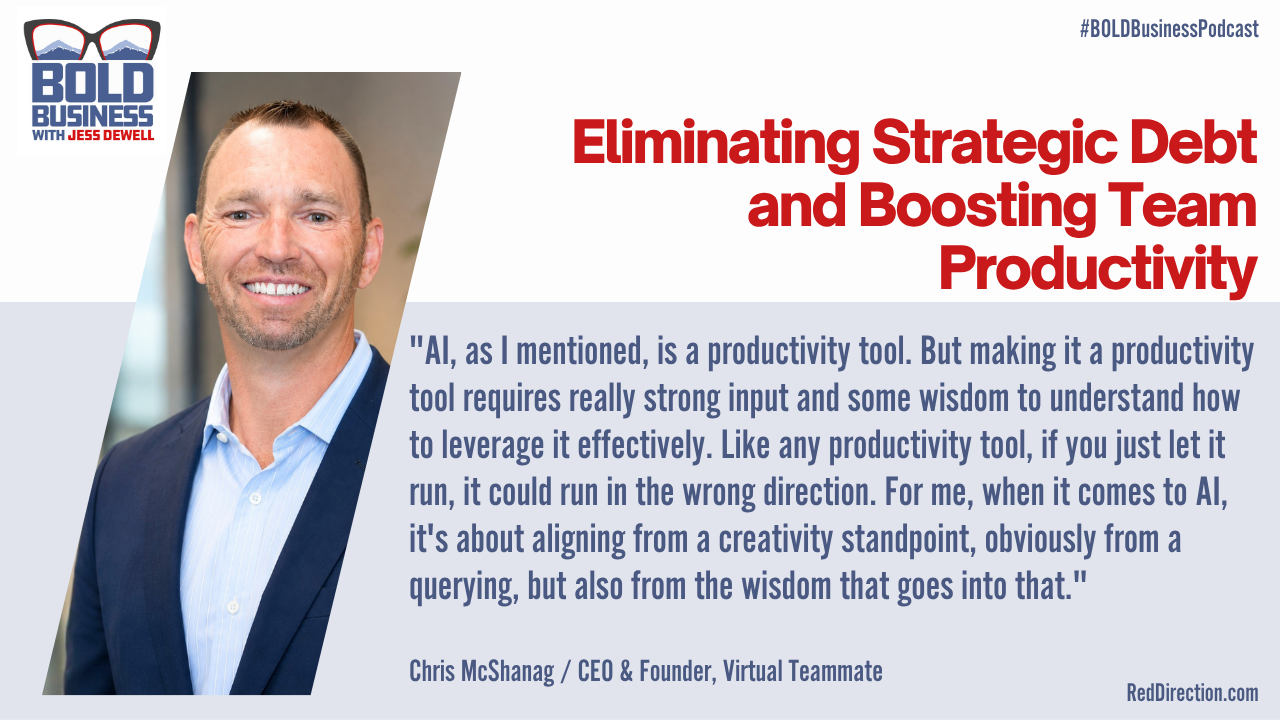
The way we tackle it with us is, you know, AI, as I mentioned, is a productivity tool. But to really make a productivity tool, it requires really strong input, but also requires some wisdom to understand how to leverage and use it, right, from a productivity. Like any productivity tool, if you just let it run, it could run in the wrong direction. And so for me, when it comes to AI, it’s about, you know, aligning from a creativity standpoint, obviously from a querying, but also from the wisdom that goes into that. Because as I talked to a number of my colleagues, from a CEO perspective and clients, it can reaffirm bad thoughts. Like you might say, hey, I’ve got this great idea to do A, B, and C. And if you continue to feed that information to the AI tool, it’s going to continue to respond back to you in a similar format. And so very much in the way we deliver, it’s looking at what are the consistent processes that are rinse and repeat, highly process-oriented and repetitive. That’s where AI does really well. But there’s a human element that goes into it, particularly in the healthcare space. When you think about questions on your bill or you have your concerns in regards to kind of scheduling, there’s so much AI can do, but if you want to have a different focus, there’s a key need in there. And so being able to have AI agents working by allowing our virtual teammates to be over the top of that and monitoring it and having accountability to make sure that it’s going down the right direction and meeting the right outcomes.
Jess Dewell 11:44
What’s a business assumption that you had to completely unlearn?
Chris McShanag 11:48
That everything, I need to be involved in everything or touch everything from an approval basis and really being comfortable to delegate that down the line and realize that when I, then there’s blind spots on my side, really surrounding myself with the right team. And so for me, it’s about building the right team and having the right folks to plug into the right holes I have or blind spots I have and therefore allowing me to do what I do best. And I think that’s probably the biggest one. Initially, when I got started in my career, I came from a consulting background. And so I was really focused on how can I improve. And that’s really how I got into Virtual Teammate and virtual staffing, because I was doing all of this consulting work with health systems, hospitals, delivering all this technology and process. But ultimately, what the clients were telling me is, I love this, but it’s taking away my time with the patients. And at the end of the day, the experience they want is time with their patients. And so this is where this solution, I think, is so much better because staffing is one of the biggest, if not the biggest costs for a medical practice. And this really allows them to get that back.
Jess Dewell 12:48
I actually think you just named what you’re best in the world at, getting your clients more time with their patients.
Chris McShanag 12:55
In a world of reimbursement declines and cost increases, it’s about really helping them with burnout. It’s both time, but I think it’s also financial. You think about healthcare as one of the only industries I’ve really come across that extends credit with the hope of payment. We deliver the service with the hope of payment. It’s like going to a car dealership and saying, I’m going to take this car and I promise I’ll come back and pay you for it.
Jess Dewell 13:14
And on the flip side, people who are developing things medically to help make the world a better place have to go backwards and figure out how will we get paid for this if we actually do this and have to show that proof of concept before it actually gets into production. So all the way around, right? It’s a wild world out there. Saying it differently is getting your clients more time with their clients without burning out the whole thing. And it doesn’t matter who you are, right? When we know what we’re best in the world at and truly the problem that we’re solving, that changes everything. It changes everything. What do you think is an assumption? Like five years from now, you’re going to look back. What’s an assumption that your future self would tell you you had today you didn’t even know you had?
Chris McShanag 13:58
So my future self, what assumption I had that was right or wrong?
Jess Dewell 14:02
It doesn’t matter. Just an assumption.
Chris McShanag 14:04
My assumption is it’s going to take a little longer for people to really embrace AI truly. I think people are dabbling in it today. You know, maybe using ChatGPT as a writing tool, as a Google tool, instead of really as a productivity tool. So I think that’s kind of, you know, assumption. And I think we’ll have really fast adopters, which I think we’re seeing right now. But I think the pendulum will come back where we’ll look at it as a productivity tool, not as a replacement tool. That’s probably my big assumption. I think everybody has this belief, or a lot of people, I shouldn’t say everybody, has this belief that it’s going to replace everything, that agentic AI will replace people. We’re a people business. And I think people staying connected is important. I think as I talk to a number of our clients and we talk about AI, they’re like, one of my biggest frustrations, they would say, is getting on the phone and having to go through a phone tree or having to talk to somebody that doesn’t seem like a real human. I think we’re also needing to come back to that human connection.
Jess Dewell 15:04
Where’s the time you just didn’t let go of it? And what was the outcome?
Chris McShanag 15:07
Really holding on to client relationships, maybe a little longer. And so instead of empowering my team, who are fantastic at client success and engaging and building relationships with clients, a number of my clients would come back to me personally. It wasn’t intentional. I wasn’t controlling intentionally. I really wanted my clients, particularly some of the earlier clients, I had to have more of a human touch and, you know, an enhanced client experience. And so I think that probably impacted the growth of the business a little bit because they, I became a bottleneck. And since I released that, I think that’s really released the business to grow because I can’t be the thing that throttles the business growth.
Jess Dewell 15:47
You’re carrying the strategic vision and how much does your team come into that strategic vision to figure out what to do versus how much are you bringing it and they’re just claiming pieces of it to go do well?
Chris McShanag 15:59
You know, I’m very intentional to engage them up front. And I think we have a kind of a strategic planning session, really looking at on a monthly basis and refining it to say what’s going well, what’s not going well, and what do we need to improve and change? And just constantly having triggers in place that really indicate that. Because I believe a strategy is 5% of the work, it’s really 95% is the execution. And so continually refining and have an ever-evolving strategy, I think, is the key part. And engaging key stakeholders in that because, as I mentioned earlier, you’re making sure you don’t have blind spots. Because I could be saying, look, this is the direction we’re going to head. But if the team, whether it be on the marketing, on the sales side, or on our client success, or nurture sequence, or on our virtual teammate success sequence, they’re saying, hey, Chris, this is what we’re seeing in the market, and this is where we believe we need to pivot. And making sure you leave sufficient space for those open and collaborative conversations.
Jess Dewell 16:51
There’s a piece in here too about decision-making. When you think about strategy and your strategic growth and my strategic growth, just in general, it takes space and time. 5% is strategy and 95% is execution. Is that linear time or is that your whole thinking, your head, heart, and your gut and your people’s heads, hearts, and guts in it? I’m a big proponent of failing forward.
Chris McShanag 17:16
And so A, B testing those results, what’s working, what’s not working, and then how do we pivot? Because it can’t be, I think, a book on the shelf. It’s got to be a process, a playbook that you’re constantly touching and involving in each and every day or weekly and particularly monthly and looking at that and going, okay, what are we smarter than we were last time we looked at this? What do we need to change? What do we need to realign?
Jess Dewell 17:38
How much of your past experience in consulting have you used in your business so far? And are you still relying on growth from I’ve been there before?
Chris McShanag 17:48
For me, it’s really a consultative sale because a number of our clients are looking at how do I best do this, right? How can I best leverage a Virtual Teammate? Even though I think the virtual assistant industry has been around for a while, they’re still like, how do I do this? How do I best do this? And it really comes back to how you ensure alignment from an engagement standpoint, whether they’re physically in your office here or near or leveraging far. It’s about being very clear on those expectations. And so for me, I’m very intentional on when I talk to my clients from a consultative perspective. It’s like, I don’t want necessarily talk about job description. I want to talk about what are the outcomes. What’s the pain point you have today? My reimbursements are down or my claims are escalating or my denials. Okay, let’s talk about that and let’s give you a solution. In this case, an individual that can really focus on improving that versus saying, I need somebody with Epic experience, which is really important. but it’s about defining the outcomes, then looking at what are the capabilities we need to achieve that and what are the duties that they are performing and how do you measure that? How do you measure success in that area? And so very consultative saying that’s the key focus, whether it’s a person in your office or whether it’s leveraging a remote team member from us, it’s about being very clear on the outcomes being driven because at the end of the day, that’s why we have our workforce, right? To drive outcomes.
Jess Dewell 19:02
How do you think we’re going to start measuring productivity and what does that look like in companies going forward?
Chris McShanag 19:10
It’s about the outcomes, right? In our specific case, are we processing more claims? Are we bringing, is the cashflow improving over the defined time? And are the margins improving, right? So the cost to collect, I’m looking at from that perspective is the revenue retention higher. So it’s really looking at productivity as a result of what are the outcomes that are being driven and being able to get more done with less and then allowing those folks in the office, for example, to really focus on what they’re best at, patient care, nurturing the patient through the experience, particularly when you’re talking about healthcare and medical and dental. That’s an area where you’re coming as an individual with some vulnerability. And so the more time they can spend, I mean, when I talk to my clients, their biggest frustration is I don’t get enough time with my patients to really understand where they are to give them the full treatment and care because you’re trying to get number of visits in in a day. And then if you could take all those administrative tasks off, that allows the people you have today to be able to do that and not have to increase your staff internally.
Jess Dewell 20:10
Is there a bigger change that also has to occur to make this kind of productivity shift happen? Because until, and I’m just going to come right on and say it, you mentioned earlier about perform the service and hope to get paid, right? That concept is real. So that turns it into a numbers game and our wellbeing. And on the flip side, when I go to my doctor, I wish we had more time because you are right. There’s never enough time to do the things that need to be done. By the way, I also feel that about strategy. I feel like we break that down into action items and we break that down into productivity and we break that down into things that we can measure when really sometimes there are things that we can’t measure that are equally important because we have to hear through the noise to figure out what other things are going to impact the levers we already have. Or if we have to be changing out our growth levers, our work levers, our productivity levers, because things around us are changing and we don’t want to be taken by surprise.
Chris McShanag 21:06
We’ve struggled as a society to move to value-based care. And because the way the reimbursement happens today, it’s on volume-based, right? It’s so interesting, right? Healthcare wants you to be healthy, but gets paid when you’re unhealthy from a provider standpoint. Whereas the insurance companies, they make money when you are healthy. So you’ve got these competing factors going on, right? And so for us, it’s about how do you support in that transition? And then strategically thinking about how do you morph your clinic or your practice to be able to have less patients, but still drive the same revenue stream and the same margins. Like you said, ties into operationally and strategically how you go about your business. And I do the same with our business clients. And so work with our business clients to say, you know, how do you best focus the right work of the right people at the right time?
Announcer 21:56
If your week feels like you’re being pulled from one demand to the next, this is for you. The Daily Grind is the number one killer of business instinct, pulling you and your team away from your vision. Reclaim your strategic edge with the Present Retreat. This free guide from Red Direction is a simple, powerful framework to carve out the space you need to filter out the noise, make the right decisions, and lead with clarity. Visit presentretreat.com.
Jess Dewell 22:25
Let’s get back to the conversation with Chris McShanag, CEO and founder of Virtual Teammate. How does your team day-to-day find those competing priorities and raise their hand and say, hey, we got something going on here. We’re creating our own friction.
Chris McShanag 22:42
The four quadrants are do, which I look at, which is urgent and important, right? You’ve got to do that. That’s got to be done. And that’s the highest and best use of my time.
Jess Dewell 22:50
Yep.
Chris McShanag 22:50
And then quadrant two is defer, right? That’s important, but it’s not urgent, right? And that might be long-term success, the strategic part, right? It’s important, but it’s not urgent. Like you don’t have to do the strategy every day. And then the third quadrant is delegate, right? What is urgent but not important right now that I can delegate, right? That’s not the highest and best use of my time. And then the other one that’s really key is the fourth D, which is delete. It’s not urgent, it’s not important. And I think what happens is you tend to spend a lot of time on those items that shouldn’t be on your plate or you need to get off your plate, thereby freeing up more time for the other ones. And so that’s really, I think, the key focus. We talk with our clients, like how much of what you do today really can be deferred or delegated or even ultimately deleted. So therefore, you have more time to do the do tasks, which are the highest and best use of your time. Like you talked about working on the business model, working on the strategic initiatives, focusing on the key action items that really move the business forward.
Jess Dewell 23:46
We already talked a little bit about the admin side. Where do you see their biggest strategic debt happening?\
Chris McShanag 23:53
And being able to release control to those folks that are specialized in it. So you can do what you’re specialized in. I think that’s the biggest strategic debt. And then the other one is thinking outside the box. How many of my MAs or others are doing $10 tasks and being comfortable to offload those $10 tasks to a productive teammate from Virtual Teammate to be able to do that and forming the team, right? Understand that your team is here, near and far. Integrating that into the overall organization, because I think that’s the key part. And I think the other is really being comfortable to release control over some of the data processes, because that’s where I think we get hung up today with the insurance, EMR, and the systematic work being in front of the computer versus being in front of the patients.
Jess Dewell 24:38
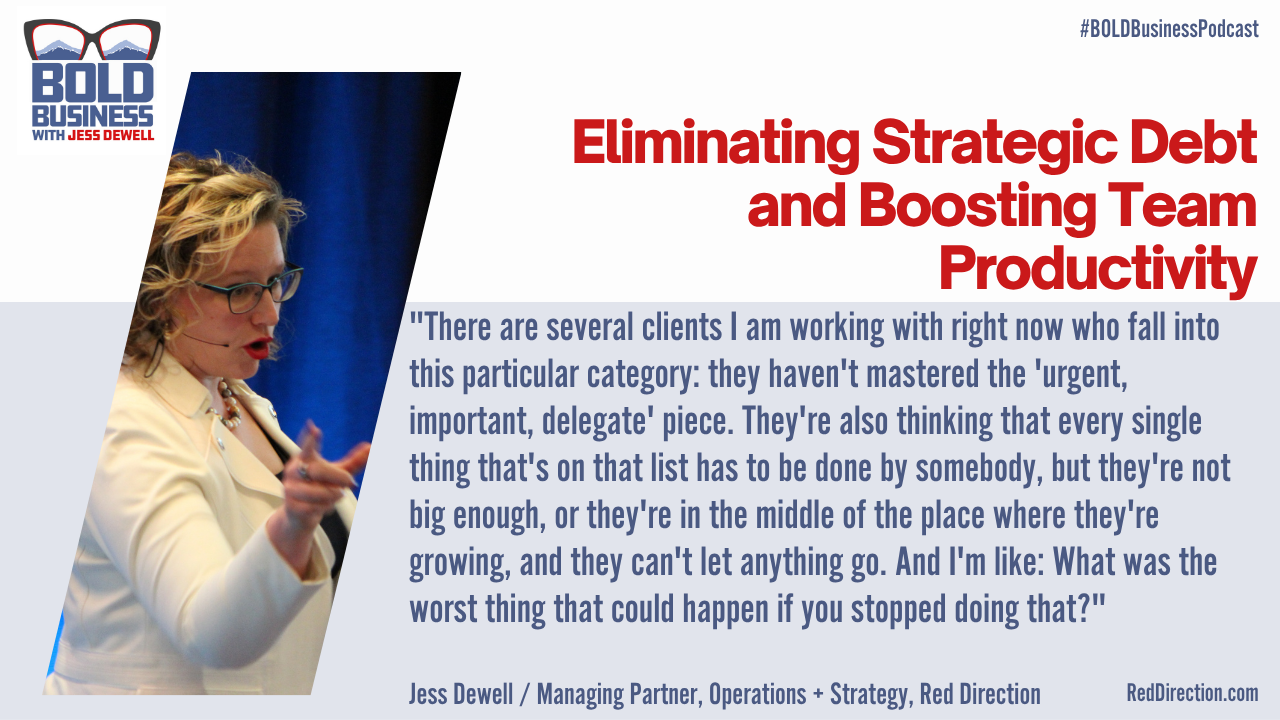
I’m in a mode right now. This is really interesting. You’re going to have to let me know what you think about this. There are several clients that I am working with right now who fall into this one particular category. And this is a category of they haven’t mastered the urgent, important delegate piece that you’ve been speaking about. However, outside of that, they’re also thinking that every single thing that’s in that list that has to be done by somebody, but they’re not big enough or they’re in the middle of the place where they’re growing. And so it’s just painful in this moment and they can’t let anything go. And I’m like, what if, what if you just stopped doing that? What would actually happen? What was the worst thing that can happen if you stopped doing that? the answer surprises them. There is so much on that list that they could just stop doing because it’s not actually helping their clients today. It’s how business was done three years ago, five years ago, seven years ago. And the processes have continued to evolve and the work, the way it’s being done is also evolving. Yet we’ve snagged into this whole concept of let’s just keep it. I find it fascinating to really challenge. And now I’m thinking, oh, in my next present retreat, I’m actually going to be doing this with some of the things that we’ve been doing. Where do we seem to keep getting stuck? And what would happen if we just stopped doing those things? Because that’s where we’re getting stuck. Now, do I think that they’re actually going to go away? No. I actually think we’ll be like, oh, look, we’ve been doing it different. And it’s hard to go back to the way that we think we need to be doing it. How about if we bring our processes, align them back up? And I know you were talking a little bit about that. I’m hoping to find a few that we can just let go of too. Like, we don’t need that anymore. That would be so cool, Chris.
Chris McShanag 26:19
That’s so smart. And I think part of it is taking the time to just look at your week, right? If you look at your week and say, okay, where am I spending my time? How much of my time is really on moving the business forward? And how much of my time is really on kind of administrative back office tasks? I’ll tell you a quick story. So I had a client of ours in Los Angeles, really prominent practice, medical practice, gastroenterologist. And so a big part of their business is referrals, right? Working referrals, getting referred in as a specialist from primary practices. And they had a lady who was working there and that was her job. Well, she went on maternity leave. They said, okay, what are we going to do now? And so we talked with them, we worked with them. We said, what about if you had a Virtual Teammate who would basically, instead of driving to each one of these practices, would set up a Zoom meeting, meet with these referring partners, and at the same time, leverage DoorDash to bring food because this lady was previously bringing food to the office, and providing lunch and they’re in the LA area. How would that work? And so you think about that, she was able to do maybe two to three appointments a day because obviously of driving and all the coordination. Now you get to 10, 15 a day because now virtually they’re coming in, you have the same pitch and spiel, you’re providing food, you’ve got a captive audience, you kind of tell them a little bit about the practice, give them an update. His referrals skyrocket and at a reduced cost, thinking outside the box and going, okay, is it really necessary that I have somebody physically drive in today’s world? Or is there opportunities where that’s not necessary? And I’m still making that connection, not in person, but over Zoom. And it’s a little more respectful, right, to the people in the office and things of that nature, particularly in busy practices. And it became a game changer for them. So I think it’s also thinking outside the box, as we talked about earlier, about how technology can be an enabler and not a replacement. Now, this lady came back from maternity leave, and she ended up running the program. And so now you’ve got her focused on highest and best use of her time and her expertise and knowledge. And then she had a team that could really 10x the referral program.
Jess Dewell 28:20
How would you recommend then somebody start looking at what they’re already doing in these cases? Like, is there a starting question that they can analyze what they’re already doing or places that they’re feeling friction or somebody’s going to step out for leave for a while and the work has to be covered. What are ways that could a starting point to approach that to be thinking out of the box to evolve and use each opportunity to get better at what we’re doing as we’re doing?
Chris McShanag 28:51
Yeah, I mean, I think for me, it’s stepping back and honestly taking a look and saying, what are the things that are holding back my business or my practice today? Right? What are the biggest frustrations I have? And quite often, there’s two or three of those, right? It’s, I don’t have, you know, it’s a lead gen issue, right? I don’t have enough growth or opportunities coming in the door. Or it’s a, I have opportunities, but I don’t have the funnel to really produce or work through them. Or it’s, I’m, you know, on the bottom of the funnel, which is I’m not getting reimbursed for the work that I’m performing today. So really looking at that and saying, okay, where are the biggest pain points? And how much of my time am I spending on those that is adding the most value to fix those, right? And is it me personally jumping in and fixing those? Or is it me wanting to empower my team to do that? And do I have the right people on board to achieve that? And talking about what are the outcomes I want to drive? I want to increase my, let’s say, lead generation by 10% in trailing 12 months. Okay. What’s the best work we can do to do that? And do I have the right people in place? And if not, how can I best source folks to be able to scale in that area versus me as an individual, as CEO or founder, as a leader, jumping in to fix that myself.
Jess Dewell 29:59
I’m thinking about staffing because part of growth is automation. Part of growth is productivity for ourselves and the people that choose to come to work with us every day. What are some clues about team size staffing that come to mind as opportunities to recognize is it is my opportunity for growth in adding people or is it in my process or productivity?
Chris McShanag 30:29
So I think it’s, you know, I tend to not focus as much on the size, but do you have the right people in the right seats, right? I think that’s the key one we want to think about is do I have the right people in the right seats? Because for us, there are definitely key roles that need to be in person, right? I mean, there’s no doubt about that. You know, from an executive perspective or the front office, that I think is the best. You have those right folks. But do you need those folks in every role, right? And so if you think about it, you know, when you kind of start believing in that, you think about all those that are executive leadership, client facing roles are key here. Near, you may have traveling salespeople or regulatory compliance or training. That doesn’t necessarily need to be in the office. And then thinking about FAR, which is your admin support, kind of your customer support, accounting on the business side. And then, of course, you know, insurance verification, billing and admin on the medical side. So I think it’s about what is the right combination of teammates and in which of those three areas are you struggling, right? And what’s holding your business? And quite often, as I talk to my clients, it’s like I have the executives, I have the client facing. I have those folks that are out in the field generating. But what I don’t have is people really the back office support that’s necessary to drive that growth engine, because that’s really the $10-$100 capabilities.
Jess Dewell 31:48
Which sounds like the strategic debt we’ve been talking about, too. So Chris, I want to know what makes it bold. What makes it bold to confront the strategic debt in your own organization and being able to use the leadership that you have today to grow and scale?
Chris McShanag 32:08
Because I think quite often we look at it kind of backwards. Instead of looking at the outcomes first, thinking about the structure and then defining that structure that supports those outcomes and then having the right people to support the structure, we go the other way. We say, okay, who are the people I have? How can I form a structure that maybe gets me to the outcomes? And so I think it’s looking at the end in mind, as I talked about earlier, about kind of the client experience. So that’s what we do internally is the best and highest value use of our time is really how do we nurture that experience for our clients, leveraging remote team members, at the same time, being intentional to invest time, money, and energy into enhancing the experience of our virtual teammates to earn a living wage to support those clients, because it’s really a two-way connection that’s highly important.
Announcer 33:00
And that brings us to the close of another powerful and fresh perspective on the Bold Business Podcast. In today’s volatile landscape, growth is a double-edged sword. To truly thrive, you must engage with your strategy, not just react to the day-to-day. Without absolute alignment, your company faces a stark choice. Outmaneuver or be outmaneuvered. Grow or get left behind. Thank you for listening. And a special thanks to the Scott Treatment for Technical Production.