





A 60-DAY INTERVENTION THAT REPLACES BRUTE-FORCE “HUSTLE” WITH A RESPONSIVE DECISION-MAKING ARCHITECTURE.
FROM MANAGEMENT OVERSIGHT ➔ SYSTEMS-LED EXECUTION
With Red Direction Driving Solutions Strategic Intensive Program, install a responsive execution engine across the 18-36 month strategic horizon via a customized 60-day adaptive framework to command market relevance.
Starting the conversation:
Prepare for the worst, hope for the best. Scenario planning isn’t just for financials. Whether markets drop or your business faces adversity, having thought about the worst-case lets you operate with confidence. Jack Oujo, Founder at Oujo Wealth Strategies, visits the BOLD Business Podcast to talk about how to rethink productivity to cut through the noise.
The toughest leadership calls are often the ones we delay — and how embracing peer feedback and brutal self-assessment catapulted one business to top-tier success. Embracing worst-case scenarios in decision-making and strategic planning are necessary to navigate recessions, market crashes, and disruption. Take this work and focus on your client experience for connection and retention through change.
In this episode, you will hear that success is determined by how you choose to use the extra time you have, how to make tough calls in times of adversity, and what you choose to carry forward from BIG learning shapes how you take calculated risk. Jess Dewell talks with Jack Oujo, Founder at Oujo Wealth Strategies, about why it is BOLD to embrace the concept of less is more, especially in today’s fast-changing world.
Host: Jess Dewell
Guest: Jack Oujo
What You Will Hear:
02:30 Focusing on existing clients drives growth, not chasing new ones.
- Building strong relationships with the clients you already have leads to retention and organic business growth.
- Delivering exceptional service encourages referrals and creates further opportunities.
- Dedication to current clients can result in industry-leading performance over time.
07:45 Transitioning from one career to another can open unexpected doors.
- Leveraging curiosity and available time enables new skills and qualifications to develop.
- Taking risks and embracing academic or professional challenges can lead to entirely new career trajectories.
- Major transitions often contain potential for personal and financial growth not previously imagined.
13:30 Use process and scenario planning over rigid sales goals for business success.
- Focusing on refining and following effective processes creates a stronger, more adaptable organization.
- Planning for multiple outcomes ensures that a business can thrive in good conditions and survive in difficult ones.
- Having process-driven goals instead of only sales targets promotes excellence and a client-centered culture.
20:20 Culture and non-financial aspects matter greatly for long-term business stability.
- Loyalty and team cohesion are indicators of a positive, long-lasting company culture.
- Enjoyment at work and shared values contribute significantly to business longevity.
- A culture of shared success, such as team-based bonuses, can result in higher morale and retention.
22:25 Prepare for worst-case scenarios, even when you’re optimistic.
- Planning for downside risks allows for confidence and resilience when uncertainties arise.
- Effective preparation includes financial safeguards like insurance and steady income sources.
- Being ready for challenging times can help retain clients, grow business, and ensure peace of mind.
32:15 Financial independence is more important than following buzzwords like “retirement.”
- Defining your own financial benchmarks is crucial for long-term satisfaction and security.
- Individual financial strategies should be designed around personal life goals and not just societal expectations.
- Achieving clarity on what it means to “win the game” helps inform risk tolerance and future planning.
35:25 Meetings and outside perspectives can often distract from immediate opportunities within your team.
- Time and attention are often best spent listening directly to internal team members about improvements.
- Excessive meetings can hinder productivity and fail to address core business issues.
- Focusing on the immediate environment and people can provide more valuable insights than relying solely on externals.
37:10 It is BOLD to embrace the concept of less is more to achieve success, especially in today’s always changing world.
- Making decisions based on deeply held principles fosters trust and respect in business.
- Consistently doing the right thing builds a strong reputation over time.
- Seeking validation from trusted peers ensures integrity is maintained, even under pressure.
Resources
Transcript
Jack Oujo 00:00
I learned a marketing strategy that I called client love, which was devoting everything in my power to my existing clients and only spending a little bit trying to get outside clients. And by doing that, I became the number one advisor in our firm for over a decade.
Announcer 00:23
Every leader needs a trusted partner for the moments that matter. This Bold Business Podcast conversation is that partnership. Here is your host, Jess Dewell, an insightful truth teller who serves as the catalyst for getting the right work done and who asks the questions that truly matter.
Jess Dewell 00:42
Here at the Bold Business Podcast, we are all about guiding you to growth and unlocking your ultimate potential. Today, I’m excited to introduce you to a guest who truly knows how to handle the heat, pivot, and win the game of business. Joining us is Jack Oujo, a former professional baseball umpire, founder of a multi-million dollar wealth management firm, and the brilliant mind behind the book, Too Smart to Be an Umpire. Jack recently achieved a massive business milestone by successfully selling his firm to his own employees, and he is here to bring some serious action-oriented wisdom to you. And me, by the way, because I learned some things as well. So here, things to be listening for in the conversation as we’re going along will be how do you maximize your moment? What do you actually do with the time you have? The second thing, command the advisory. Your leadership means you have to have the spine to make those tough calls and work within the constraints that you have. And the third is leveraging your history. How do you actively carry forward the wisdom from your biggest unexpected learning events to take calculated risks? And that’s what we’re here to talk about. Doing what we can, doing less with more, and making bold business decisions day in and day out for ourselves today and the success of our companies tomorrow. Let’s get over to the conversation with Jack. When you realized you were growth-oriented and you were like, I’ve got to do this and this is how I know I grow. Was there a moment in time that showed up for you and you’ve been able to lean into that over the years?
Jack Oujo 02:30
I realized that if I wanted to grow in the wealth management business, it was actually what they say in negotiating and in golf that less is more. I realized I could grow my business by just focusing on what I have, which was my existing clients. And if I focus on taking care of my existing clients, number one, I get to keep them. Number two, as the stock market goes up over time, my revenues will go up. If I provide them with an overwhelmingly wonderful experience, the tentacles that they will provide for me will help me grow my business. So I learned a marketing strategy that I called client love, which was devoting everything in my power to my existing clients and only spending a little bit on trying to get outside clients. And by doing that, I became the number one advisor in our firm for over a decade. I had more business than I knew what to do with by just focusing on the existing clients and trying to take great care of them.
Jess Dewell 03:29
Did you stop taking on new clients or did you just reduce your incoming clients and you grew the clients that you were working with?
Jack Oujo 03:38
When you’re in our business, it’s very easy to say that, but it’s very hard to control that. If you’re referred five new top clients in a month, you’re taking them on. So the question that most financial advisors have, how do I get new clients? And again, I learned by focusing on what I had, I would get new clients. I also learned in our business that down markets is when money moves. So nobody likes when the stock market goes down, but I became somebody that embraced it because I realized our clients were staying. And when money was moving from other places, we got a lot stronger. During 35 years in business, I only had three years where the revenues were lower from one year to the next.
Jess Dewell 04:19
And so that was because of your focus and your directness there.
Jack Oujo 04:24
I also had a focus in my business on worst-case scenarios. When you’re dealing with the stock market, people are always painting rosy pictures. And I had a focus in my business of hoping for the best, but preparing them for worst-case scenarios. And when worst-case scenarios arose, they were prepared for them. And the strategies we put in worked to perfection.
Jess Dewell 04:44
Do you believe the way you chose to focus on your business and find your strength and lean into that and not waver at all? Do you believe somebody starting today could achieve that same thing starting now and have a similar result 30 years from now?
Jack Oujo 05:03
A hundred percent I do. The only thing I regret is I do regret a little bit. I think I could have grown through acquisition as well. I had no idea the business was going to grow into what it grew into. And now that it’s happened, okay, if I had to do it over again, I probably would have tried to acquire other practices along the way. And then it could have became much, even bigger than it was, although it was pretty terrific.
Jess Dewell 05:27
Has it been hard for you now that you’ve sold your business and it’s been several months that you’re all the way out to say, this isn’t what I do anymore?
Jack Oujo 05:36
I feel tremendous gratitude, Jess. I feel very grateful for what’s taken place. I really like having nothing on my schedule besides golf and pickleball and playing with grandkids. And when I was bored, I wrote my book, Too Smart to Be an Umpire, so I had time to do that. I learned when I was in baseball how to use the extra time that I had on my hands. I consider it to be a good problem, and it’s up to me to do something with it. I’m taking my time. I want to focus on giving back to the community, business community, people that help me get to where I am. It’s okay to have less on my plate.
Jess Dewell 06:10
I aspire to that someday. I’m in a place where I don’t think I’m quite in the build mode, but I’m also not in the I’m excited about three potential things I could do, and all of them are pure fun and love.
Jack Oujo 06:24
I’m thinking about the week I’ve had this week. I played pickleball on Monday and Tuesday. I had lunch with the guys I sold my business to. I did a podcast, and I played nine holes of golf this morning. We’re halfway into the week, and I think that’s a pretty good week.
Jess Dewell 06:37
Okay, so as part of this transition, and you wrote a book, Too Smart to Be an Umpire, what was the reason you did that?
Jack Oujo 06:45
The reason I did that is in my business, where I became the number one advisor in our firm for over a decade, a lot of people (and I have a lot of respect in the business community) don’t know my background of how I got there and how I formulated my ideas. And I spent eight years as a professional baseball umpire. And with all these viral videos going online of arguments and all that other sort of thing, I was like, I have eight years of those war stories that I can give to the public and let them know what it’s like from an umpire’s point of view, trying to get to the big leagues. And in getting released, having no money, having a pregnant wife, and then starting what became a multi-million dollar business. I thought the public might be interested in it. And so far the book’s done really well, and I’m gratified by that.
Jess Dewell 07:28
Part of what you said when you first mentioned writing Too Smart to Be an Umpire was when you had extra time, you knew what you could do with it. What did you do with it? And how did you know or learn what to do with it?
Jack Oujo 07:42
I find I’m a very curious person. My children are very curious people. A lot of my friends in baseball thought I was crazy, but I always had a great off-season job working as an accountant in New York City, which I ended up falling back on. I read, but when I got out of baseball, I knocked on the door and got hired by Ernst & Young, EY. I don’t know how many people with eight years in the minor leagues that are umpires that they hire to work in their tax department, but they hired me. I passed the CPA exam in one sitting after being in baseball for eight years, which I think is a good example for people that do time in sports. I passed the CFP exam. I obtained a master’s degree in taxation. I got securities and insurance licenses. I did all that all within a four-year period of time. And rather than watching TV, rather than watching baseball for four years, I decided to do all this work and see where it would lead to. And I found that I had a talent for wealth management. Wealthy people started giving me their finances and taxes to do. And the business just exploded to a level I didn’t realize there was a whole other world that existed out there. And I’m very grateful for it, too.
Jess Dewell 08:49
So that was a big transition. Was that a bigger transition than selling your company and changing your lifestyle this time?
Jack Oujo 08:57
Imagine being in professional sports. You’re walking into Louisville, Kentucky when you’re in AAA. There’s 30,000 people at the ballpark and the organ music’s playing. And you’re under a tremendous amount of pressure calling the 3-2 pitch with the bases loaded. And then transitioning into being an accountant. Okay? That’s a big transition. And now that I’ve done the accounting and wealth management. Now, keep in mind, with the wealth management, though, when I’m dealing with an individual and dealing with their life savings, to that person, that’s the big leagues. And that means everything. So there is just as much of a focus on that. I think it’s what a lot of people are hoping to get out of their life. I think a lot of them, when they’re in their late 60s, like I am, they’d like to be in great physical shape, be in good shape financially, and have great relationships with their adult children and grandchildren. That’s what most people are signing up for, I think.
Announcer 09:50
Feeling stuck like what got you here won’t get you there? The pressure to grow is on, yet the path isn’t clear. Yet you don’t have to walk that path alone. This is the Bold Business Podcast. Like and subscribe wherever you listen. Your host, Jess Dewell, is the strategic partner you’ve been looking for, asking the questions that truly matter. It’s time to break the inertia and get the perspective you need to make your next move.
Jess Dewell 10:24
You are listening to the Bold Business Podcast. I’m your host, Jess Dewell, and today I am speaking with Jack Oujo, founder of Wealth Strategies. I heard you say something that strikes a chord in my heart and that’s, and maybe I’m making it up. So tell me if I’m doing that and it’s just a talking point. Could be that too, Jack. What is the big league issue situation for your customer?
Jack Oujo 10:49
There’s a lot of information on TV that’s being thrown at them. And when markets go down, they get, some people get freaked out by it. And I’ve always advised them that there’s a sale taking place. And I’ve tried to coach people on that. As far as the stock market is concerned, I’ve said theoretically, and I believe this with all my heart and soul, in theory, the stock market should go up every business day of the week. How can I possibly say that? Take Microsoft, for example. Today, they’re selling some software. They’re paying down their debt. And when today ends, Microsoft should be worth more than it was yesterday. So why does it go up and down? Explain that to me. It goes up and down because events could be taking place in the world that helps or hurts that company. Guess if you were a stock, when today ends because you went to work, paid down your debt, made some money, your stock should be at an all-time high. So markets go up over time. People need to realize that. And when these hiccups take place, they should know how to handle it. When people are older like I am, they need to rely on their income, dividend investments, interest from their portfolio, no debt if possible. I haven’t had a mortgage on my house in 25 freaking years. Okay? I’ve had clients fight with me on paying off their house. Now that they’re paid, there’s nobody mad at me over that. That’s protecting the downside, if you will. So when it comes to finance, when people put pencil to paper or spreadsheet or a program and put their finances right in front of them, a lot of decisions in their lives or in their businesses become self-evident in terms of what to do rather than working on feelings. Try to use the left side of your brain to make important decisions in your financial life.
Jess Dewell 12:26
I know money is a hot topic regardless. If we’re business owners, right? Because everybody listening to this is. When we’re business owners, we’re thinking about that. When we are thinking about our own lives outside of our business, because our business is an asset as part of that life, it doesn’t matter. We have ownership. It is part of what we’re doing for our future. There is a lot of emotion in that. And I hear you being very pragmatic in your answers. There is a protecting the downside. There is a what could the worst-case scenario be? Because what I’ve found in other conversations around business that are also heightened emotionally, uncertainty and ambiguity is a big one for the world that I’m working in, which by the way, money is a big part of that too, right? There is this fear. I don’t know enough. Even if I have the right people around me, I’m not sure I’m going to be making the decision. And then there’s a second-guessing. Did I second-guess? And I believe getting over that, that’s a skill we can learn. I’m not sure I know the name of the skill yet, Jack, and maybe there’s one that you could name and say, this is the skill you’re talking about.
Jack Oujo 13:31
On a personality level, again, being the umpire and umpiring 1,500 games in the minor leagues, I was involved in the shithouse, okay, when there’s beanballs and being able to keep your head and making tough calls in the face of adversity. So that’s part of who I am. In terms of a skill set, which, as a CPA, I advise business owners, is, again, these cash flow projections that you have to do over the next three and five years should be done. One, what do we expect to happen? Two, what is a worst case scenario? What does that look like? And what are the things that need to take place, both good and bad? And how do those numbers work? In my business as a financial advisor, many years ago, when I realized a lot of my living was tied into asset management fees, I created a program where I took my revenues down by 30% on a 50% decline in the stock market. And I looked at my numbers. And when I looked at the numbers, I was like, I can live in that world. That’s not really so horrible. And then when I looked, what if things increased by 20% or 30%? What staffing do I need? Who needs to be in here? How does that work? I realize I am now equipped to play in both worlds. I want the happy world, obviously, but if the down world takes place, what do I need to do to get back in the game? You can only control what you can control. And I am a person of deep faith. I believe in the higher being. And so I’m going to do only that which I can control. Okay. And I’m going to try to put in processes. I believe any winner in sports, again, looking at your kids playing baseball. If your kids have a good baseball coach, rather than them trying to motivate them to win, they should be talking to them about their process when they’re hitting, when they’re throwing a ball, how to execute a cutoff. That’s what they should be talking about, not let’s go and win. Okay, what is the process? In my business, again, becoming the number one advisor, you can ask anybody that’s ever worked in our office. I never once had a staff meeting where I said, our goal for the year is to be the number five advisor. Increase sales by 10%. It was always process-driven. What do we need in our process to provide the great client experience? What are our clients saying to us, okay, that we’re not doing well enough? Trying to get to this place you never quite get to, but you try to achieve excellence by trying to achieve perfection. And by changing the mindset of we must have this sales goal, the goal should be on what? Your freaking process. And any winner in sports or in business will tell you that in my view.
Jess Dewell 16:07
We still haven’t named a skill. I’m still fishing for that. I like the definition that you started with there because we do have to make tough calls. Sometimes our tough calls cause the adversity and sometimes we’re in the adversity and have to make a call and neither is a fun place to be. Was there a way that you learned to shake it off, let it go and still be able to keep your head in the game in either situation when it happened to you?
Jack Oujo 16:30
To me, the worst things I ever had to do were firing employees. That’s because I am, while I seem like a cold-hearted umpire here, I have tremendous empathy for people raising children, trying to make a mortgage payment. I get it. So firing employees was really hard for me. And it’s probably, I probably could have let one or two people go earlier than I did, but my heart got in the way. But I realized I need to make these tough calls, okay? Because in the long term, everybody’s going to be better off for it. So I was always looking at what is the best interest of this business. A lot of your listeners or viewers would know Bill Belichick, the NFL coach. Okay. He made every decision. What is the best decision for the team? And when you think that way, you’re going to make good decisions. It can be hard, but you always make every decision on what is in the long-term best interest of this business, family, what have you. That’s what you have to do. And when you do that, you just have to live with it, move forward. But it may not be easy.
Jess Dewell 17:28
Do you look at decisions like that the same way you were describing the numbers? Do you bring that same thing to every decision or is it more the financial side of things for you?
Jack Oujo 17:37
I’m looking at what is the most likely outcome that’s going to be taking place here. I remember when I fired one employee, my son, adult son said, Dad, you know how many college graduates would love to have that job that you’re paying her to do right now? What are you, nuts to be keeping somebody? You’re successful in your business. Why are you keeping somebody around like that? And hearing another voice is good. And I think people in business, one thing I failed to mention, I think speaking to colleagues, people that do the same business as you, competing business, but may not be in your location. For me, I have tons of friends that are other financial advisors and CPAs around the country that I would lean in and say, I have this issue going on in my practice right now. How would you handle that? And getting opinions. And you’ll get that aha moment where you’ll make the right call, if you will, in my view.
Jess Dewell 18:25
What was the most surprising blind spot that you found in yourself or your business over the years?
Jack Oujo 18:31
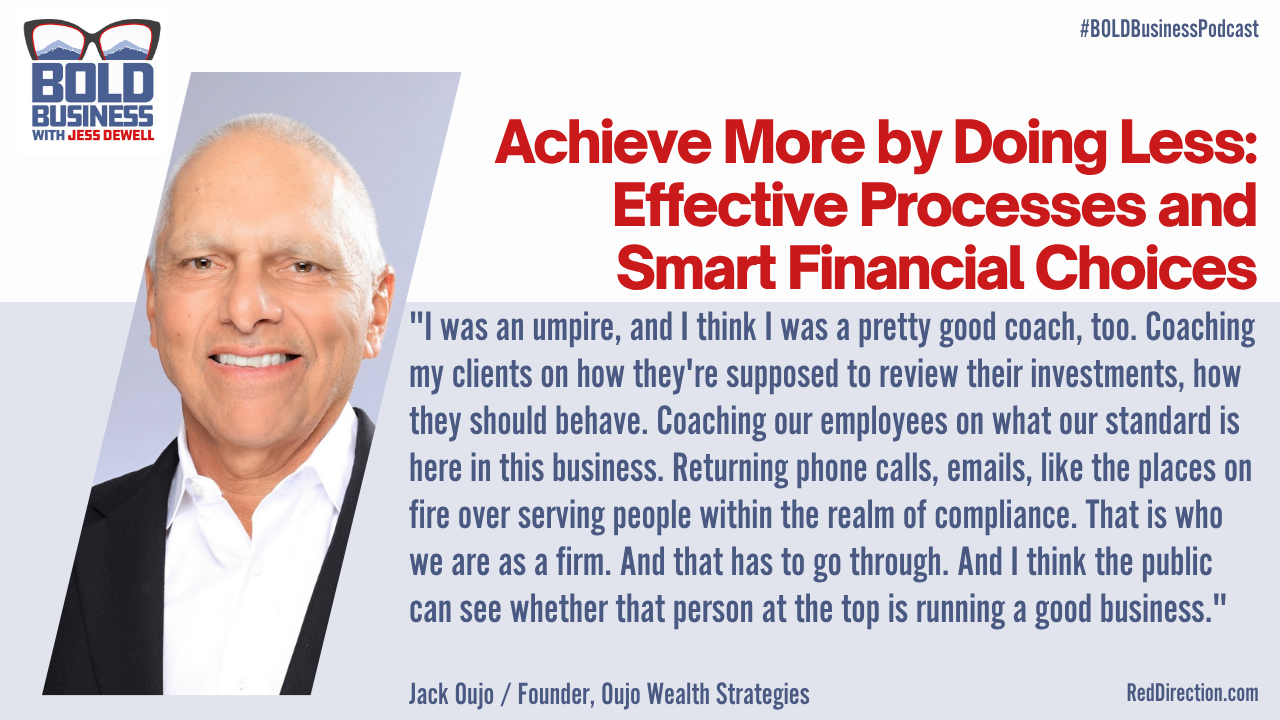
At the beginning, it was thinking that only Jack the Great could be doing the tax returns and all the investing and letting go of things and having other people do the work. And once I got used to that, I got pretty good at it, bringing other people in to help and allowing. I think when you’re a very small business, hiring your first and second employees are a big freaking deal because you’re taking a cutback in pay to move forward. So you’re always taking steps back to go forward, back to go forward. And so you have to, you must get those decisions right. Hiring people that are not like you, that complement you and allowing people to fail. I think I was an umpire, but I also think I was a pretty good coach too. And coaching my clients on how they’re supposed to review their investments and behave. Coaching our employees on what is our standard here in this business. Returning phone calls, emails like the place is on fire. Overserving people within the realm of compliance. That is who we are as a firm. And that has to go through. And I think the public, when they come into a business, can see if that person at the top is running a good business or not. Case in point would be an airline, okay? If you’re flying Delta versus Spirit Airlines, what is the experience you’re getting and where does that come from? It usually comes from the top. And you think of some of the top businesses around. When you think of a Ritz-Carlton or a Four Seasons level of experience, people can identify with what that’s like. And do they say that about you? That’s what I’m thinking about.
Jess Dewell 20:04
That’s interesting. All the things we’ve talked about, they have some sort of friction, right? A blind spot has friction. the need to make a decision has friction. Were you ever at a time where the friction of those decisions became secondary to the day-to-day operations? Operations kind of took over and got stuck and didn’t move forward?
Jack Oujo 20:25
If the operations were a problem, there was a problem with the process that was put in place. And I had to fix the process and let these processes evolve as technology evolved over time. I think trying to have a consistent message with our employees and staff was a big deal. And also there’s a lot to be said for demeanor. It’s like the pitcher on a baseball team. That pitcher has a sad face. The rest of the team is going to let down. And if the pitcher is showing confidence, that affects the rest of the team. I’m very proud to say in my business, most of the employees I hired at the beginning stayed with me for 25 to 35 years. I think culture, a lot of non-financial things to me are a big deal. And by the way, they make the business fun to be in too. If you have a good culture and you have good values and people genuinely enjoy coming to work, even though it can be mundane and boring, but you want to have a pretty good atmosphere where people are happy with their lives. Virtually everybody that works there and we’re on the same team. I did bonus systems where bonuses were tied into how we were doing and there were no feelings involved. It was done on math and everybody got their cut at the end of the quarter. And I think that created a self-policing system where employees felt like they were part of the team because they were part of the team and they were sharing it too.
Jess Dewell 21:38
I’m going to go into a place where knowing your longevity in the industry and your success in the industry over so many years, decades, right? 2001, 2008 are all part of your history. And I’m thinking back to earlier in our conversation when you were talking about pragmatically talking with clients about what’s appropriate and what’s okay and when to start to get worried. Did any of those take you by surprise? And how did your clients respond? Because I’m also thinking about your, we always did everything in service and love to be the best for our clients.
Jack Oujo 22:13
The service and love was always there. And I started that early and I’m glad I did. The 2002 stock market decline of 50% did not surprise me because the S&P 500 was trading at over 30 times earnings. The 2001 terrorist attack surprised me, and I witnessed it from about 20 miles away, quite literally. 2008 did not surprise me because, based on what happened in 2001 with the terrorist attack, I changed my whole focus of my practice to prepare for a non-economic event taking place. I did not know what a reverse credit default swap was. I did not know that was going to be the cause of it. But when 2008 took place, I was prepared for it because of what I learned in 2001. And when 2008 took place, we did not lose one single client. And our business grew by over 400% over the next five years. Because I did not want a client to say to me, Jack, when a terrorist attack took place, we can understand how you weren’t prepared for that. But we’re really shocked you didn’t think that may happen again. And back then, the thinking was not if we’ll get attacked again, when we’ll be attacked again. Fortunately, that really hasn’t happened. But so 2008, I was prepared for. And in my personal life, again, I mentioned this in Too Smart to Be an Umpire, how you can have a positive outlook on life, but still prepare for worst-case scenarios. Having an insurance policy on your house would be an example. We don’t want the house to burn down, but we had the insurance policy. And also handling our finances in a way. A simple example would be owning a stock that pays a dividend. The stock goes down, the dividend is still there so I can still get my income. That would be an example of preparing for paying off your house. People won’t have to be leveraging when they’re in their 70s trying to beat the S&P 500. They should want to be enjoying their life, so to speak.
Jess Dewell 24:05
So we’re talking about real tangible results here, Jack, where there’s the learning and the growing of what’s happening day to day and how we are doing our processes. And then there are these large events. Sometimes it’s acquisitions. Sometimes it’s out of our control and it’s an economic or a non-economic event like 2001 or a downturn in the market. Even if you can think about those, they still seem surprising when they arrive. What I heard you say is there were things that we carried forward that prepared us for that again. Almost like when we get on, just in case something happens. Or what is the fire drill in our house, right? Like in our house, if there’s a fire and we have to get out, we have two meeting places, one close and one not so close, so that we know where we’re going to be if somebody was out and coming back or we all had to get out a different way and meet up, right? Those are like worst-case scenarios, but we really plan those. I have that here at my office. Where are the exits? What are we doing? What is this backup plan? What is going to happen if it is? Can I do business tomorrow?
Jack Oujo 25:11
You have to remember, too, everything carries risk with it. When I’m telling you about I haven’t had a mortgage in 25 years, there could be somebody watching this and going, if he did have a mortgage and he had it at 3% or 4% and put that money in the S&P 500, he could have made more money for himself. I’m not using you as my advisor because you’re not aggressive enough. So when I’m doing my thing, if you will, I’m taking a moderate growth approach. We’re trying to win the game, and we don’t have to win the game by 10 runs. I want to win the game by whatever it takes. I want to make sure our clients achieve their goals and objectives. That was always the speech I gave.
Jess Dewell 25:45
And that’s something I hear coaches talk to my son’s baseball team about. We won the inning. We won this part. Let’s win the next part, right? Each half of the inning.
Jack Oujo 25:54
If we’re going to stick with baseball for a moment, okay, if your kids were in the room, okay, and they’re winning a game 8-0, and it’s the top of the last inning, and the other team has runners on second and third base with nobody out, is the coach going to move the infield in to try and prevent a run, or are they going to play the infield back trying to get outs? They’re going to play the infield back because we don’t care if two runs score, because we’re already winning the game. We want outs, okay? And the same thing with people’s finances. I’m coaching them, are we trying to win this game, Mr. and Mrs. Client, or are you trying to be the richest person in the world? And using math, like I mentioned to a business owner or math to a client, those decisions became self-evident to people where it’s almost comical. They’re like, yeah, you’re right. I can’t believe I’m even thinking about this. And that’s the way a business owner can be thinking too. I put the pencil to paper here and I looked at this and this decision is really easy. I don’t know why I’ve made this so difficult for myself. That’s how business owners should be looking at it too.
Jess Dewell 26:51
And so having that external set of eyes, I do think makes a difference because like you leaning into your peers over the years when you needed to, I do the same, right? Because sure, in something somewhere, I’m like, ooh, there’s friction. Guess what? There’s usually a blind spot there or something that I’m like, yeah, okay. I’m just getting in my own way. Somebody else just needed to say it in different words so I could claim it.
Announcer 27:22
If your week feels like you’re being pulled from one demand to the next, this is for you. The Daily Grind is the number one killer of business instinct, pulling you and your team away from your vision. Reclaim your strategic edge with the present retreat. This free guide from Red Direction is a simple, powerful framework to carve out the space you need to filter out the noise, make the right decisions, and lead with clarity. Visit presentretreat.com.
Jess Dewell 27:50
You are listening to the Bold Business Podcast, and today you are hearing from Jack Oujo, founder and author. Okay, you’ve mentioned your mortgage a couple times. By the way, same. We’ve owned every house, the last several houses we have owned as we’ve moved around, we don’t carry a mortgage either. It’s the same thing, though, right? And so there’s a mindset to that. So now I’m curious. Your mindset was moderate growth, and somebody’s like, why aren’t you leveraging your debt? And I’ve heard people say, I’m so glad I have this low interest rate because it’s like free money right now compared to what the interest rates actually are. And now I have this line of credit to be able to use.
Jack Oujo 28:25
I think that’s freaking insane. But I will say this, which, again, I mentioned in my book. I made a passing comment. I started a business that grew into a multimillion-dollar operation with no money. How’d you do that? We borrowed on credit cards to start. Okay. I borrowed wherever I could, but I did the math on it. If I could pick up a couple of clients a month for a few years, the debt would be sustainable. And I hope someday never have to be dealing with this. Okay. I had a client recently had an $80 million estate and they came to me and their advisor was advising them to borrow money to pay the estate tax. And everything to me is risk and reward. Okay. So the people that are leveraging debt, you have to figure out what are you trying to get out of this thing and is it worth the risk? That’s all.
Jess Dewell 29:08
Yeah, totally. And it comes back down to what are your goals in life and what are you trying to get out of it? I know for us and for you, and actually everybody, real estate is the biggest purchase we’re going to have. So if there is a mortgage, what does that mean for the rest of the choices that we are making? And that’s true for cars. It’s true for accumulation of cars, credit cards, whatever it is. And I know I’m trying to think, how can I say this? I know for us, we wanted to be able to put our risk other places. We didn’t want it in our house. And so that was just the choice we made, right? And I know everybody has a different approach to that. Do you have a reason behind why not having a mortgage was important to you?
Jack Oujo 29:47
From a tax standpoint, the standard deduction for people that are married, filing a joint return is around $30,000. So unless your real estate taxes, charity, and mortgage interest are over $30,000, you’re not even getting a deduction anyway. So you’re not writing it off. And then for people that are older, okay, that are relying on the income from their investments, when stocks go down, you still need to go out and buy your groceries, okay? So if you have enough money coming in from interest and dividends and things along those lines, and somebody wanted to take out a little mortgage, I don’t understand the point of having it. People in their 30s and 40s that are trying to get ahead with their life, I get it, okay? And I believe people should max out their retirement savings in their 401(k)s before they even hit their mortgage, if you will. I agree with him on having debt paid off, but I think it’s got to be reasonable. And these people out there, like my son in California, the airline pilot with a mortgage under three percent: ‘Dad, I really think I should keep it.’ Yes, son, keep it, but make sure you max out your 401(k), and then start an account outside of that so that you’re using it. It doesn’t mean you have to go spend the money because you got this low-interest-rate mortgage. Be smart how you handle that. The thing I always enjoyed about my business is no two situations were alike. We all have different lives, different things we have going on every day. It’s really interesting because I do believe…
Jess Dewell 31:10
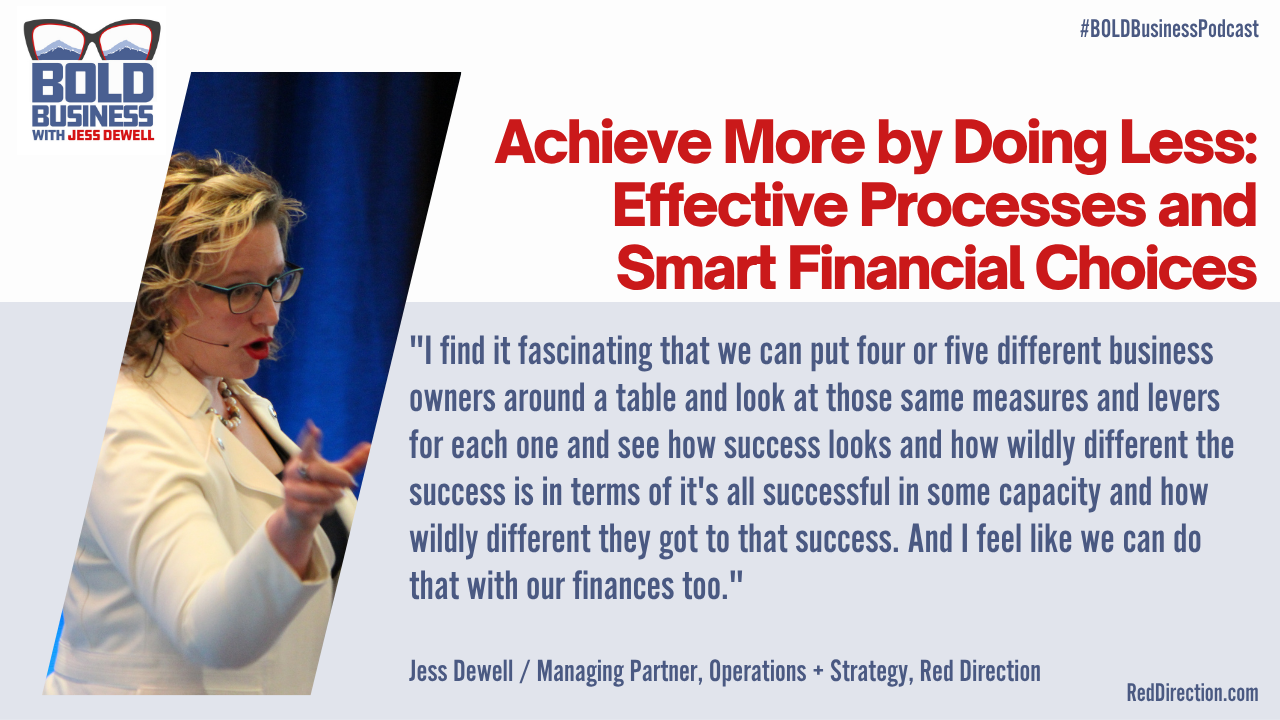
So if I use this word principle, there are these basics of business that is going to be the same in every organization period that will be the same in every organization. And then there’s the way that we show them and how we want to approach those levers, which makes that our value proposition or a unique selling proposition. And I find it fascinating that we can put four or five different business owners around a table and look at those same measures and levers for each one and see how success looks and how wildly different the success is in terms of it’s all successful at some capacity and how wildly different they got to that success. And I’m going to call back to something that you said, which is what can I control? I think that’s a big part of that too, just recognizing am I not over-leveraged, whether that’s debt or growth or vision, because I do think there’s a little bit of a creep that happens with some success that our creeps bigger than our actual success builds. Have you seen that over the years?
Jack Oujo 32:16
Oh, yes. Using the math, people should seek out what their definition of financial success is. Okay? I don’t use the word retirement in my business. I use the word financial independence. And I coach my clients. These are your numbers for financial independence based on the life that we’ve communicated with each other. And if that’s not your life, let’s go back to the drawing board here. So defining what financial independence is. And then deciding when you win the game, again, keeping these sports analogies. Okay, do we want to keep leveraging things? And again, that’s where I’ve talked to business owners and I’ve said, you won. If we stay in this game, okay, here’s the good that can happen. Here’s the bad that can happen. Let’s be smart about how these decisions get made on a go-forward basis. I’m going to take a risk right now and just mention something political. Okay. And one of my biggest concerns with him becoming president was I’m wondering if he’s going to make a big bet. And this Iran situation, I didn’t want to go there. But when he made this big bet where he’s risking his entire presidency on what’s going on with Iran right now, and people have to look at themselves, okay, when they’re making decisions and say, am I willing to make a big bet? I personally am not. I have a lower risk tolerance. I owned a business when I retired with 15 employees, all right, a payroll of 15, not counting myself, okay? And I was comfortable in that risk. I was not about to borrow money and lose everything that I had worked for to try and become a big person.
Jess Dewell 33:49
And it’s also something that we have to be able to set our emotions aside and just look at from the point you’re making, which is this is risky. And whatever situation we find ourselves in, what is risky to us and does it align with our biggest goal? And what I hear you saying is you’re somewhere in the middle of that. I care about risk. I also care about bringing the people that I’ve decided to bring with me along with me. So I look at risk different, right?
Jack Oujo 34:14
That’s how I look at it too. It’s what are the things that I am doing and the risks that I can take and what could that residual effect be? Like going into business, why would I leave Ernst & Young, a big five firm for whatever the heck it is nowadays, to start my own business on credit cards? Why would somebody do that? And it’s because I did the math on it and I realized I think this can work, okay? And then the decision was made, okay?
Jess Dewell 34:37
Yep. And yes, thank you. I actually was thinking about it exactly the way you just said. So thank you for bringing our listeners and viewers along with it, because you’re right. As you’re saying that, I can totally see not everybody was in the same party we were in. We want to be in the same ballpark, even if we’re rooting for different teams, right? Yeah. Gotcha. All right. So I want to talk a minute about, Jack, that you were mentioning less is more. And I know you’ve done that over time in terms of focusing on the love and experience that you’re giving your clients. I know that you did that in terms of being able to make in the moment decisions facing adversity, not only in your business, but also as a professional umpire, right? And then I’m thinking, so is there something that tickles your ear or your little hairs on the back of your neck stand up and say, there’s an opportunity I could be doing less here?
Jack Oujo 35:28
In the business world, I think people waste so much time on meetings with their employees, the rah-rah meetings. I had surprisingly very few meetings with our entire staff. I always thought at meetings, people should have to stand up and make their point and get it over with. I had meetings that were with one or two people, and they were very short and to the point. And I think the meetings that I see people have all over the place, I think a lot of people waste their time on that. And I think a lot of people focus on a lot of outside marketing when a lot of things are right under their own nose. Another thing, bring in business consultants to find out how your business is doing when a lot of people don’t even talk to their own employees. If I was going to any business, the first thing I do is sit down with every single employee and wait and get them to say, I’ll tell you what’s really going on around here. This, that, and the other thing, when the business owner has no freaking idea that’s taken place. There are a few of my pet peeves in business. And again, I think you have to allow your employees to grow and flourish and do well with their careers and create an environment for them to be able to do that. And that’s what’s fun.
Jess Dewell 36:36
It is fun. And it’s challenging. And it’s rewarding. Yes.
Jack Oujo 36:40
Allow people to fail. It doesn’t kill your business. I remember having the two guys that I sold my business to, I remember when they first started doing meetings. And I said, at the beginning, sit there and keep your mouth shut, watch them. And then they can start participating. And then they ran meetings. And when they would run meetings, I would critique them on mistakes that they made, body language, voice inflection, things along those lines, to the point where they could be teaching classes on how to do those things. But if I saw the first meeting go, no, they can’t do that. I can’t have that person that says something about you more than it does them.
Jess Dewell 37:11
Jack, I want to know what makes it bold. What makes it bold to embrace this concept of less is more, knowing that it will achieve success, even today when things are moving faster than they have ever moved before?
Jack Oujo 37:24
You have to have a core belief in what is right and what is wrong. And if you have a core belief in what is right and wrong, sooner or later, things will get to that point. That’s all of it. It’s just the simple knowledge of what is right and what is wrong and doing the right thing over and over again.
Announcer 37:48
And that brings us to the close of another powerful and fresh perspective on the Bold Business Podcast. In today’s volatile landscape, growth is a double-edged sword. To truly thrive, you must engage with your strategy, not just react to the day-to-day. Without absolute alignment, your company faces a stark choice: outmaneuver or be outmaneuvered, grow or get left behind. Thank you for listening, and a special thanks to The Scott Treatment for technical production.