





AS A BUSINESS OWNER, IT’S DIFFICULT TO DO THE RIGHT WORK AND GUIDE YOUR COMPANY TOWARDS ITS NEXT BIG INITIATIVE.
From Fragmented Focus & Reactive Resilience ➔ Unified Intent & High-Performance Rapport
With Red Direction Business Base Camp Consultation, learn how to implement and handle processes to meet your business’s specific needs and better understand your market.
Starting the conversation:
Jess Dewell, Growth Strategist at Red Direction and host of the BOLD Business Podcast, talks about responsible leadership that embraces adaptability, growth, and readiness for challenges they may initially feel unprepared for.
Your accountability habits are undermining business success. The simple fix to double-booked, distracted, and reactive is to lead by example. Committing to self-awareness, honoring promises to yourself, and seeking deeper insight support lasting business relevance.
This happens through regular reevaluation of your strategy and operations to ensure your business stays aligned with evolving customers and markets. It is the foundation for finding and unlocking the potential within your business today to avoid growth plateaus and breakthrough strategic ceilings.
In addition, you will hear about the Business Basecamp framework to use on your own or have facilitated. In this episode, Jess shares a curated 11 Resources for Dynamic Growth, a combination of podcasts and articles, to meet you where you are at and support you as you become what your company needs next as a leader.
Jess Dewell talks about being BOLD — recognizing the powerful result that comes from commitment to yourself and the right next step for your company to create your business’ future relevance.
Host: Jess Dewell
What You Will Hear:
03:10 You can avoid a strategic growth ceiling.
- The pace of change is a factor in decision-making and how you guide your company forward.
- Customer expectations, market shifts, evolution of technology are faster than ever.
06:40 The value of Red Direction’s 11 Resources for Dynamic Growth.
- A curated set of articles and podcasts is available to help address specific stages and needs in your business’s lifecycle.
- These resources are designed to support self-starters, lifelong learners, and leaders aiming to strengthen their business instinct and adaptability.
- These 11 resources are free and intended for you to begin making improvements on your own.
12:40 The importance of understanding your response to stress and busyness.
- Busyness can be a distraction that prevents us from addressing the real issues, especially when innovation or creativity feels stifled.
- Reflection helps to understand both progress and current movement, revealing how tasks and challenges relate to one another.
- Recognizing personal and organizational responses to stress is essential for meaningful growth and self-awareness.
20:40 The effectiveness of short, focused strategic sessions with an outside set of eyes (Your own customized Business Basecamp).
- Effective strategic thinking can happen in brief, focused sessions intended to create space for decision-making.
- Using business goals, ps.
- The priority is determining the right actionable next step rather than developing overly complex plans.
25:45 The speed of business change makes proactive strategy essential.
- The speed of change in today’s business environment makes continuous strategic action essential for future relevance.
- Ensuring your company evolves alongside customer needs and market shifts is crucial to long-term relevance.
- Growth strategies must focus on present action to guarantee ongoing viability and competitive advantage.
30:55 Adapting and growing while maintaining your core priorities.
- Sometimes organizations must adapt and evolve operations while continuing existing work, improving as they go.
- Non-negotiables and core priorities help anchor these adaptations to company values and long-term goals, and initiatives as quick reference points allows you to identify your current position and next step
- Protecting and amplifying the company’s way of working is a key part of re-engagement during strategic change.
34:55 The true focus and outcome of a business basecamp.
- Business basecamp sessions help you understand your present situation, resources, and engagement level.
- These sessions support making intentional, accountable progress toward the most important work.
- The structured approach can be completed in just 30 minutes, making it practical to implement regularly.
38:40 It is BOLD, it is BOLD to commit to self-development, growth and self-awareness.
Resources
Transcript
Jess Dewell 00:00
Here’s the backstory of the Bold Business Podcast. I talk with business owners, mid-market companies, management teams all the time. And the challenges that companies are facing ebb and flow based off of the state of their business, the state of their current team, and the way that they have integrated processes and systems to automate and scale.
Announcer 0:34
Every leader needs a trusted partner for the moments that matter. This Bold Business Podcast conversation is that partnership. Your go-to resource designed to break the inertia and refresh your perspective so you can start making moves. Here is your host, an insightful truth teller who serves as the catalyst for getting the right work done and who asks the questions that truly matter, Jess Dewell.
Jess Dewell 01:01
Regardless of where we’re at, who we are can only get us so far. So there’s a point in every business — at multiple points during a business — that we recognize we’ve hit this plateau. And how do we break through that? What do we look forward to?
There’s always the tech stack go-to. There’s always investment of money and what does smart money spending look like in our organization. Those two things are a given. But the real magic is in what do we do with those things if we choose to be doing those things? And what do we do if maybe we don’t choose those things? There are so many right ways to get to where we want to go based off of our goals. So clarity is key.
That’s what I’ve taken away from not only the nine years that I’ve been doing this, but the eleven or twelve years before the Bold Business Podcast became something I share. So that’s a little bit about the backstory — when we’re sharing and when this information is coming, somebody else is going to want that information later when they get there.
The podcast is for you. You’re there. You’re looking to hear and see and feel and experience what others who have already been through this have done. Not because you’re going to follow their steps — although that might be kind of nice — but to understand: how did they look at the problem? Who did they have to become to get through that? Because in your heart and in your mind and in your gut, you know that’s what needs to happen. Who do I become to take this company to the next level? How do we adjust things we have never experienced, or have adjacent experience, and come through successfully?
Because every time we’re going to do it, it’ll be a little different. Every time we do it, there’s going to be new dynamics at play. And this is true today more than ever before because of the speed of change.
Jess Dewell 3:10
So we get to do this exploration and evolution too. I mentioned that plateau. These are strategic growth ceilings. And it’s not uncommon to arrive and not really realize our company is in it. It feels a little short, or people just aren’t getting it, or everybody gets it but no movement is made.
These are times where if we can’t see it ourselves, it’s time for a business base camp. And that business base camp isn’t just a planning session — it’s specifically to go: where is this opportunity that we just can’t see because we’re so close to what’s going on? Something you can do is always a present retreat. That’s an available solution. Something you can do is to really focus on: when do I need an outside set of eyes? I don’t know if I need an outside set of eyes all the time or on some regular basis — I just need it right now. And that is a business base camp.
So how do we scale without burning out? How do we use this framework to get you off of this plateau and back into the zone of growth?
Jess Dewell 4:35
I already mentioned that the landscape today is moving faster than ever. So as a leader, a guide, a torchbearer — we are facing every single day more uncertainty than our peers did, maybe even than ourselves, because depending on how long we’ve been doing this, even a decade ago. And it’s amazing to think about, and it’s wildly sometimes heavy to carry alone. And I’m glad the Bold Business Podcast exists because you are not alone.
Keeping things running doesn’t have to be a full-time job. Finding where to grow and where that potential in your business is — that is actually your most important work.
I told you a little bit about the backstory of the Bold Business Podcast. It’s actually why I started Red Direction. I’m not here to hand you trends to chase, processes to do, a system that I know works over and over and over again. Because here’s the deal: you got to where you are from hard work. And I see it and I experience that when I speak with companies like yours.
I’m here to help you build the foundation to create your next future with what you’ve already got and where you want to go. You have systems you use. There’s no need to replace them just to replace them because everything has stagnated or changed. Could additions be useful? Yes. Is what you have still useful? Very possibly — until you can take a step back and look, your options are endless.
It’s easy to say, we’ll just change. Well, change of systems on a mass scale introduces other challenges around change management. Changing the way you do things, even incrementally with what you already have, introduces change management challenges. Part of the core work that Red Direction was built to do was to support businesses during those points of change management — to become who they want to become, to get to where they want to go, to create their own future relevance.
Jess Dewell 6:40
I want to make sure you have something tangible in your hands before I jump into a framework that you can use before you call your current coach, your current advisor, even me. And I would invite you to do so. Call me for a one-time session and we will get this on the books and dive in together.
But I’m going to give you the framework here right now. Over the course of all of this time of the Bold Business Podcast, I’ve been searching for different things that I share with clients along the way. What I decided to do is create an 11 Resources document. This is a place with just 11 resources — articles, podcasts — you can have access to them to focus on where you’re at and which part of the business cycle you’re in.
Are you at the place we’re talking about today where an outside set of eyes for a single situation might be useful? Are you at a place where you’re looking at growth strategy? Are you at a place where you might be considering a fairly large adjustment, or you just feel really out of tune and want to get back in tune — and you want to be part of our annual Driving Solutions Intensive? Maybe you want to work one-on-one because you know you want some support along the way.
All of those things are available to you through Red Direction’s services, and these 11 resources will get you started in each of those areas — so that you as a do-it-yourselfer, as a lifelong learner, as somebody who’s adapting and changing and building your business instinct for yourself and your company, can do so. And I’m glad you listened to the Bold Business Podcast, and I’m glad to provide this to you completely free.
Jess Dewell 8:38
You have heard me talk about reflection, reorienting, and re-engaging. In fact, it was on one of our live streams — one that turned into a podcast with Dean and Christy — and those are really good words. So I’m using those words here for this specific part: the three steps for you to get back into your business and to look at challenges and problems that you’re facing in a new way.
This first part — reflection — is incredibly powerful. If we don’t know exactly where we’re at, we don’t know when the right next step is appearing to us or is already in front of us. This is our focus point. This is beyond the quick fix. This is understanding distraction debt and recognizing fake progress.
In this reflection stage, we’re figuring out where we are. We’re deciding where the start line is for whatever we do next — because all of the work we’ve already done, all of the things already in process, all of the challenges that are coming up — we don’t know if they’re the challenges. We don’t know if they’re the opportunities that actually make sense. So reflection is incredibly important here. The baseline to move forward with.
Anytime uncertainty exists around: why aren’t we making progress? Feel like I’m distracted all the time, or we’re focused on the wrong things as a team — it’s the time to pause. It’s the time to reflect so that you can get beyond quick fixes and into the real work.
Jess Dewell 10:14
It’s easy to say we are making progress. It’s easy to dress up through our numbers, through our reports that we choose, that progress is actually happening. It’s harder to say: well, even though these reports are showing us progress, the results we expected because of that progress aren’t where they should be. So we’ll just keep watching the progress here and — really without saying it, but really saying it — hoping that our results start to appear.
This is where I’m a really big believer in your business instinct. The more you can stop and assess and recognize there may be some assumptions being made — even if you choose to say, we’ll wait, we’ll watch these numbers and see — that is a real choice that’s coming from somewhere. And when you’re making that decision, just make it with your eyes wide open. That’s an okay decision. We don’t always have to be in a fix-it mode. We don’t always have to be in an infrastructure mode. It’s a very integral dance.
So using the real data, but seeing differences and feeling how things are versus what other data is showing us — even when we get into the subjective side, maybe there’s a question we haven’t asked yet. Understanding where we’re coming from is great. Understanding that there’s movement happening is great. Finding out where they are in relationship to each other is the job of reflection.
It’s also the job of asking: what else do we need to know that’s going on? Are we going after the same features somebody else has, even though it might not really be who our target market is, because we’re competitors with these people who are doing it? It’s easy to use other people as a guidepost too. We lose sight of our unique selling proposition. We lose sight of the culture that we have, of what the solution is that we’re bringing. And so being able to ask that question is key.
Jess Dewell 12:39
So how do you know if you’re actually making progress or just staying busy? Busyness is something that we do when we don’t have enough time, when we feel pressed for innovation or creativity, and it’s missing for whatever reason. We can use it to avoid what really needs to be addressed.
When we fall into the pattern of, I have all these tasks and I’m just going to get these tasks done — or I have all these tasks so I’m not going to do any of them — all of that is part of who we are and how we show up to stress, which is also part of this reflection piece. How do we show up to the stress around us? What does pressure invoke us to do?
I’ll tell you — for me, when I am under pressure, the tasks and the challenges become secondary to new ideas because I thrive in what else could we be doing. Maybe these are all in existence because we haven’t found the thing yet. So that’s where my default is. And how do I show up to that in a reflect? In a reflect, I’m like: okay, when all of a sudden my now-and-near, my now-and-near from my present retreat every week, is really full all the time — I recognize something else is going on here. It took practice to find that. It took time to accept and integrate it.
Jess Dewell 14:10
We actually had that problem. We had a website authority issue, and totally transparently — we didn’t understand why we were seeing certain things. Expert after expert started saying all the same things and just wanted us to do it a different way. Between what I was sensing, what I knew the problem to be, and the solutions that were being offered to me, I had to find a different question.
Of course, then I’m like, oh well, what if we did this? What if we did that? And then — oops, okay, I’m in generation mode. So how do I pause here? How do I understand what my distractions are? Because new ideas is one of them for me. Then it’s okay: what else do we need to know?
I started asking questions that these experts I had brought on could not answer. And finally, when I couldn’t get the answers I needed, I started asking another question: who else do you know that specializes here? Who else do you know that has a different take that might be helpful to me right now? And guess what — I found the person. I found the company and we’re in the middle of that fix.
It’s not about anything the Red Direction team could create or generate or do. It was about stopping. It was about honoring the fact that there was distraction showing up. Then it was putting in the effort and the intention — which is not necessarily instantaneous — and asking: how do I ask this question, and who do I ask it of?
And now we’re in the process. It is a long process, but it is a solution. And there are things that are changing, and everything still feels ambiguous, yet all the telltale signs of the stresses of the team have settled. It means that some progress has been made. What comes of that, we don’t know yet — our next best step is going to unfold as we go along. We know we are making progress.
Jess Dewell 16:35
That’s a key piece here. We have to understand what our reactions are. Idea generation is just one of the ways that I distract myself, or seem busy, or think I can find a solution — versus recognizing: hey, we have the knowledge around us. We just haven’t found the right question to ask.
It turned out in my case, we had the knowledge around us. We weren’t asking the right questions, and the questions I needed to ask required a different area of expertise to help us. That was pretty empowering and pretty freeing to be able to get through that point.
It’s only because I took time to think that all of this became possible over time. And if you were to do one thing today to figure out where you’re at, it would be in the reflection. It is: are you keeping promises to yourself?
I’m going to come back to that — because if you are double-booked, if every single appointment in your schedule is stacked, you’re not fully present in the whole duration of the appointment that you’re in. Because part of you at some point is going to check out to prepare and go through your own mental checklist. What do I need to be able to get there? Do I need to go stand outside in the sunshine? Do I need to go to the bathroom? Do I need to get a new tea? And we’re not present for the whole meeting.
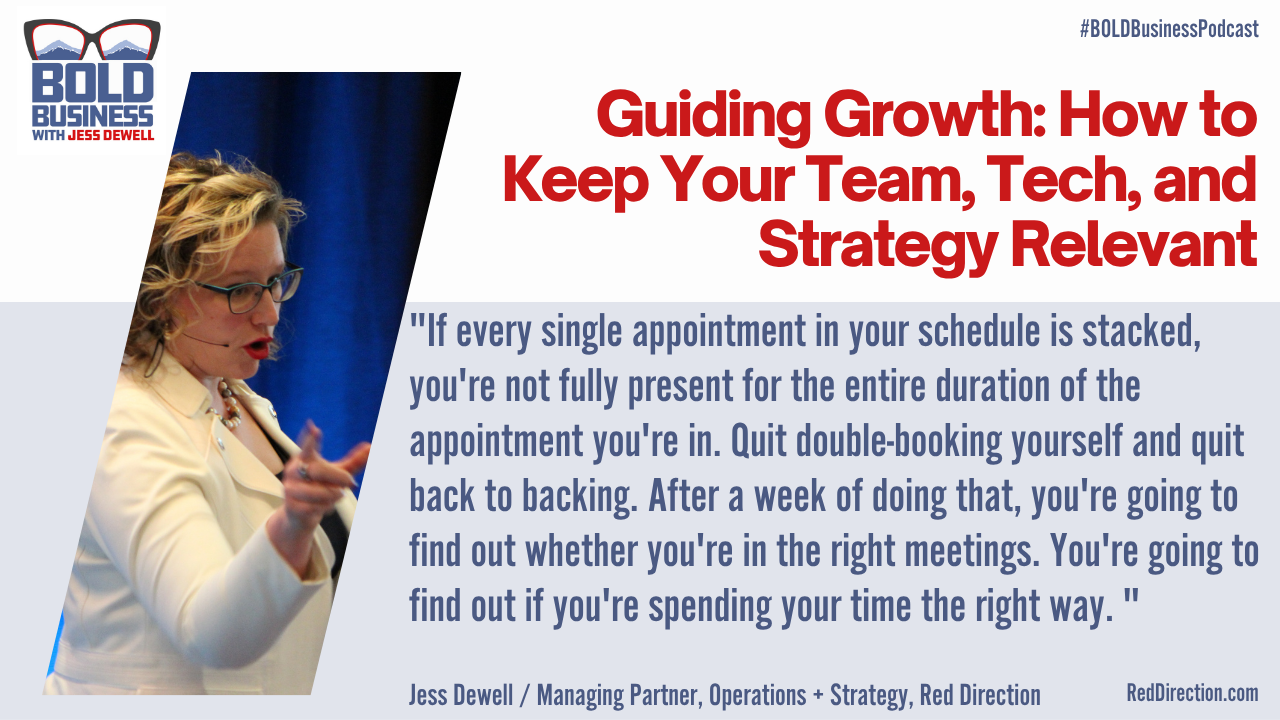
So first thing: quit double-booking yourself and quit back-to-backing. Because if you can do that and keep that promise to yourself, you’re recognizing linear time exists and you are choosing to be in this linear time. So if you’re going to take a meeting, take a meeting with intention and be all in. That is a first step to reflection in the day-to-day. Because after a week of doing that, you’re going to find out if you’re in the right meetings or not. You’re going to find out if you’re spending your time the right way.
Jess Dewell 18:41
You don’t need to really think about this and make big sweeping changes. Just make the change and keep the promise to yourself — because that is the most important piece here. If we can’t keep promises to ourselves, if we say we’re going to double-book or we’re going to be late all the time, our teams are going to start modeling that too. And so we need to understand what our culture is actually saying. Plus that is a stress nobody needs — because when do we do our own work?
By the way, meetings are great. Meetings are powerful. Meetings can make a difference. And having work time that fits with your work style is as important to progress. Otherwise, busyness creeps up. And then we have distraction debt.
I’ll tell you one other thing about this distraction debt: just being accessible and being in the wrong meetings and being in back-to-back things where you’re just going all the time. It used to take around seven minutes to be able to focus after an interruption. Well, it’s now 23 minutes. So if we are checked out at the last part of a meeting and we’re going right into another meeting without having had a chance to look at our texts or emails or do any of the other things in between — this is distraction debt. The meeting right after is actually not going to really hit its stride with you being able to focus and be present for the first 20 minutes. Wow. I’ll stop at wow.
I suggest that you look at that as a part of your overall distractions and interruptions of the day. It’ll help you to stay focused and on task and not stretch too thin, because energy management is a real thing. That is part of this reflection.
Jess Dewell 20:28
Now let’s get into the second part: reflect, reorient, and re-engage for your own business base camp. This is the long-term decision piece — this is the risk and innovation piece. And of course, we’re spending small amounts of time on this. A business base camp doesn’t have to be more than 30 minutes.
The reorient part — our focus is that there are real reasons that we as leaders don’t take action, and it has to do with informed risk. We’re keeping promises to ourselves. We’re reducing our distraction debt and understanding what’s going on as a baseline.
Important: remove a distraction so you can be present and understand what questions to ask and what’s actually holding you up — so that when we get into the reorienting piece, we have space to be strategic. This is where we could quickly pull out our goals, our business plan, our initiatives. Depending on what the focus of your business base camp is, will depend on what you need.
If you’re doing something slightly more strategic — everything we’re doing today is not lined up with where we want to be 18 to 24 months from now — that’s going to be a different set of data than: we’re three-quarters of the way through a project, something has happened that took everybody by surprise, and now how do we overcome the surprise and make progress and get to the finish line? Those are very different things. Both are appropriate for a present retreat as we’re reorienting.
So pull the data you need so that you can just have it out in front of you. You’ve got the space, you’ve got the awareness, you’ve got the data, and you can ask yourself: what are we doing right now? And then what’s the right next step right now?
Jess Dewell 22:27
I think a lot of people want to take these moments of time — whether they’re 30 minutes, three hours, or three days — and make these big elaborate plans. But from the time you start to the time you finish, rarely does it look like the plan. And that’s okay. In fact, it’s really amazing and really important to know that the path to get to the end goal — end goal defined, starting point defined — somewhere in the middle, we’re going to get lost. We’re going to have something unexpected appear.
So if we’re going to get lost and have these unexpected things happen, all we can do is say: cool, here’s where we started, this is where we’re going, here’s where we’re at. As long as we know where we’re going, we can find what is the best next step. This helps remove knee-jerk reactions. This helps remove the next level of distraction debt.
Trying more than one thing at a time is rarely useful. Figuring out what one thing to try and running an experiment — we’re going to try this, we will check in at X date so that we can find out: was it the right next step? Is there the movement we want? Does it tell us what the right next step really is? Or are we on track, and we just make refinements and adjustments to keep moving forward. That means experimenting. That means innovation. That means we can’t get into preservation mode.
It’s comforting to say we’ve built this and we want to stay here right now. By the way, that is an okay stop. Maybe you stay there for a while. Being proactive in that space is okay. We don’t know what’s next. So we’re going to spend more time reorienting by understanding what’s actually happening. We know what we’ve got. We want to protect it. And that’s okay. Just don’t stay there too long.
We live in a world where staying too long puts competitive risk at stake. It also puts being able to catch up at risk — because technology is changing really fast. It’s really easy to say we just need to replace part of our tech stack. The flip side is there’s change management that takes time every time. Whatever you pick, pick it for a while. Understanding how you want technology to support you is a big thing.
Jess Dewell 25:45
As we’re in this reorient mode for the situation we’re talking about, or the strategic thinking that we’re engaging in, we can be sensing these questions — because the quicker we can get comfortable with where we’re at and get out of preservation mode, the quicker we will find the growth zone for our company today.
One of the things I saw over 20 years ago was companies wait too long and then they become irrelevant. And that happens faster today than ever before. And growth strategy remains the same. The definition of a growth strategy is: taking action today to ensure your business’s future relevance tomorrow. Everything I do, everything that is offered to you — that’s what it’s about.
How do we ensure the work we’re doing today is ensuring our business’s relevance tomorrow? Are we changing? Are we adapting? Are we on top of what our customers want? And this is where that right next step can help us. Do we do something new and innovative? Do we have an iteration? Are we seeing a piece of our technology becoming obsolete — not because the technology is obsolete, but because it’s obsolete to maintaining who we are becoming as an organization? That’s a wild shift. And it’s a cool one. This is where innovation actually happens.
Business base camps are where you can find that out — because it might not be the place to decide this is how we’re going to change. But it is informational — it adds to the decision-making process that says, we’ve got to be on the lookout for something new, because the way we do this includes something that is becoming irrelevant to the way we do our work, and to what our customers want, and to the solution we provide. Name it. That is reorienting.
Because when we reorient for what we know will change in the future — what we have today, and what that right next step is — that’s where progress actually starts to happen.
Jess Dewell 27:59
We get rid of the gut reactions. By the way, I like gut decisions. I don’t like gut reactions. They’re very interesting and different. But this podcast isn’t about that, so we won’t stay there.
When we think we’re being innovative — remember when I told you that when I get a lot of ideas, I know it’s time to stop and pause and reflect? This is another thing where when we don’t ask the question, what is the right next step right now, it’s easy to go, I’ve got 10 ideas, or our team generated 10 ideas, and try and do them all. And that’s the quickest way to irrelevance — because we have constraints of time, money, resources, and commitment to the work that we’ve said we’re going to get done.
So saying yes to the one right thing at a time increases innovation. Because put an end on it, and then it’s going to provide new data and new information will come along, and everybody’s contributing to what those ideas might be. Whatever the decision process is, this is the best next step, and it has an end to check in on.
So reorienting is: here’s where we are. Here’s where we think we’re going. And it might be a milestone within, or if we’re closer to the end, how do we get to the actual finish line? Because every small win counts when we’re reorienting. And that’s how we know — we can take the past wins.
By the way, I even consider this a win: we decided to try something, we saw where we were at, we asked the right next step question, we made a decision, and it turned out to fall flat or maybe even feel like it went backwards. Guess what? Cool. Because it’s information. There is more than one right way to do things, which means there is more than one wrong way to do them too. And we don’t have to be worried about which we get — because when we have made a plan, we have taken an idea and said, here’s how long we’re going to do it to get some data and assess. That is a built-in ending.
So when we have built-in endings, it’s easy to engage and be all in — without that distraction debt, without worrying about, did we make the right choice? Because what is happening will have an end-to-check-in point. And that allows us to be present with it. That allows us to engage all in and make decisions in that period of time that way. This is strategic accountability. Endings are part of all accountability — because if we don’t have endings, we can’t really adjust.
Jess Dewell 30:52
There are times, by the way, to build the plane while you’re flying. Hands down, real. To create relevance over time, sometimes we’re replacing the parts on the plane that’s flying, not building more plane.
So in this re-engage piece, we’re talking about protecting the company’s way of working together to amplify and get the most out of it. We’re talking about strategic accountability. And this is how you successfully navigate strategic planning by balancing the work. I’ll tell you — I really dislike the word balance, but in this case it makes sense — because we have to try something different. And I’m not saying balance like make them equal. I’m saying balance like there is a tipping of the scale.
Sometimes we’re going to be innovative and trying new things and having endings over and over and over again. And sometimes we’re going to be iterating on what we already have. And sometimes we’re going to be focused on the end goal. And sometimes we’re going to be focused on the very minute things that are going on right now. So it’s not always a balance — and I don’t know any business that has ever been able to do that successfully.
If you’re one, I really want to have you on my podcast. Let’s just be real about that. I think it would be a really great story. And if there’s more than one of you, let’s do this — because there’s more to learn. And again, there’s more than one way to do something.
Jess Dewell 32:35
It is our responsibility to grow our companies. It is your responsibility to be accountable to growth. What do you see? Is the momentum real? Are you asking what’s the right next step? How does that align with your long-term goal? So your actions today fit your two-year or more initiatives.
Staying engaged is hard enough. Staying engaged for the way that we do our work — once the right next step is defined, it’s how do we do this next step with the way we do our work? What is that process? Everybody has their role. Everybody needs to understand what their role does to get to this next step, this next step in motion to make that forward progress.
We know the way we do our work. We know there are unwritten agreements — I’m going to call them out, but we don’t talk about them in business base camp. Just know that they’re there, because they have to be part of your awareness of decision-making.
Then it’s the doing. It is the right work at the right time. Everybody’s core role, the skills that have come together, the people that have hitched their mission to the business’s mission along with you — this is where everything comes together to work or not. So when you’ve got the right people and the right skills and the right mentality, and everybody understands what their role is to make this experiment, to make this iteration happen and move forward — that’s actually the magic of a really amazing company that’s definitely growing.
So when deadlines get missed or meetings start late or last-minute cancellations leave holes in schedules — remember that 20 minutes. A last-minute cancellation of a meeting means there’s a 20-minute reorientation to be all in. And then really there’s 20 minutes at the end to prepare for whatever was next. That leaves 20 minutes in a 60-minute hour block of time to actually do productive work. So just think about that when we’re talking about the right work at the right time.
Jess Dewell 34:56
So now we’re talking about this: engaging and acting. Everything we do matters, including those cancellations. And there are ripple effects. Understanding the right work, understanding the time to do that work, understanding our role in that work comes back to our growth strategy. The actions we take today are creating our company’s future relevance.
When everybody is clear on their role, there’s no need to delegate. There’s no need to micromanage because everybody’s got their role and they know. And the check-in processes and the meetings that are essential and the conversations that are essential become incredibly catalyzed — where the relational engagement of the team becomes the focus. And then we get to see how we are working together.
It’s an opportunity for clarity. It’s an opportunity for being able to work together that much better. It’s an opportunity all the time for each and every single person — including you in your organization — to opt back into your business, your project, your goals, your work, the most important work your company is doing right now.
And that’s really what a business base camp is about. How do we see where we’re at? How do we understand what we’ve got? And how do we engage in that so we’re doing our most important work by choice, with effort, and with accountability built in?
Jess Dewell 36:26
So let me talk to you about the 11 Essential Resources a little bit more. Because those three steps are really big. And remember, if you do this with me, it took 30 minutes to outline it for you. If it takes longer than 30 minutes the first couple of times you do this, that’s okay. Just know your goal is to be able to — between present retreats, between interactive strategic work deep sessions — when you need something, it could be as simple as a 30-minute mini check-in.
So that what comes out of that re-engagement is: we’re going to clarify this, we need such-and-such done, what is the status of this? Asking those questions so that others can also learn what you are practicing, which is: where are we right now? Is there distraction? How do we keep promises to ourselves? What is the right next step? And this is something that when every single person on your team is doing it, accountability becomes just part of the way that you’re doing your work.
11 Essential Resources for growth — podcast episodes of conversations, articles, they’re going to reference books and other materials, and they’re going to give ideas of how to take action — so that you as a business owner, you as a mid-market leader, can really get comfortable and be extremely proficient in pausing intentionally. Because in the every day, sometimes we do need that pause. Sometimes we do need to just stop and assess.
And your business base camp framework is perfect for that. The conversations, the experiences, and what people have done and how they have shown up and how they have changed — that’s also part of what the 11 Resources is all about. Because wherever we’re at, we know we are growing ourselves in addition to keeping our companies in their growth zone to thrive and survive, and really make a difference today as well as being relevant and making a difference in the future.
Jess Dewell 38:40
What is a bold thought that I could leave you with? I think it would be this: who we are today is incredibly amazing and awesome. And it is bold to recognize that our incredibly amazing and awesome is going to be different tomorrow and in the future.
This business base camp concept, the present retreat concept, all of the things that are shared in the podcast as well — they are to build your business instinct. It is bold to be committed to that, to keep a promise to yourself, to find the pulse, understand the pulse, and then listen — not only to the data, not only to the research, not only to the experiences of all of the people — but what’s surfacing from within yourself. What’s not being said that’s between the lines, to find the questions.
Because if we find ourselves in muscling, we will only get so far. If we find ourselves in the hustle, we will only get so far. So we have to break that cycle when we see it — for ourselves, for our peers, for our teams in our organization. Because you are a decision maker and you do have the responsibility of your company.
So shifting into adapting and growing along the way is being a responsible decision maker too. Because if you haven’t yet, there will be a time you will be asked to take a step forward — or required to take a step forward — and face something you don’t feel ready for. And guess what? I think you are. And a tool like this is something that will help you feel and prepare yourself so that you know you are as well.
Let me know if I can be of help. I am here. Until next time.
Announcer 41:14
And that brings us to the close of another powerful and fresh perspective on the Bold Business Podcast. In today’s volatile landscape, growth is a double-edged sword. To truly thrive, you must engage with your strategy, not just react to the day to day. Without absolute alignment, your company faces a stark choice. Outmaneuver or be outmaneuvered. Grow or get left behind. Thank you for listening. And a special thanks to the Scott Treatment for technical production.