




As a business owner, it’s difficult to do the right work AND guide your company toward its next big initiative.
With Red Direction Business Base Camp, learn how to implement and handle processes to meet your business’s specific needs and better understand your market.
Starting the conversation:
TheIf your job as CEO hasn’t changed in three years, your company might be outgrowing you.
Jess Dewell, Red Direction, Christy Maxfield, Purpose First Advisors, and Dean Barta, Barta Business Group, talk candidly about you being the bottleneck holding your business growth back.
To 10x your business, reassess your role as CEO, make tough decisions, and ruthlessly prioritize. These are the areas where you can unlock greater value for yourself, your team, and your customers.
Here are key notes you don’t want to miss:
- Assess and ruthlessly focus: The biggest bottleneck to growth is avoiding tough decisions. Not making a choice is still a choice — and it dilutes your impact. Carve out dedicated time (like a present retreat) to audit your priorities, get clear on the true value you deliver, and cut the “busywork” that crowds out strategic progress.
- Separate your roles for clarity and growth: Many owners wear the CEO hat by default, and that’s a problem. Would you hire yourself as CEO? Create explicit CEO and Owner job descriptions to clarify your responsibilities, support smart delegation, and pinpoint where you’re most valuable — then ruthlessly focus there.
- Unlock your 10x asset — you: Sustainable, exponential growth starts when leaders authentically evolve, delegate what no longer serves their strategic vision, and build habits that keep them in their zone of genius. Remember: the value you unlock for yourself directly drives the value your company brings to customers and future buyers.
After the discussion, your expert panel shared their biggest takeaway:
- Christy Maxfield: This about making sure that you can unlock more value for your customer, about unlocking more value for you as an owner, about unlocking more value for a future buyer.
- Dean Barta: Separating the roles of owner and CEO: Assess — would you hire yourself to be the CEO of your company?
- Jess Dewell: Your ability to make decisions will get easier, stronger, and clearer. That ensures that you are evolving and assessing as you go.
Your Panelists:
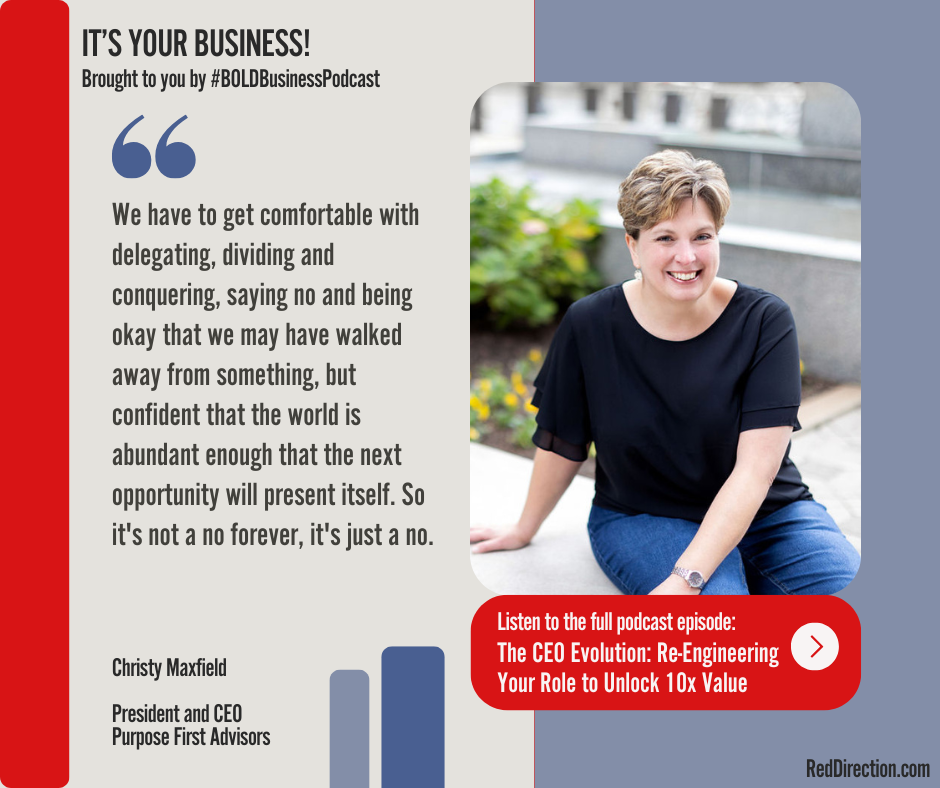
- Christy Maxfield, President and CEO at Purpose First Advisors
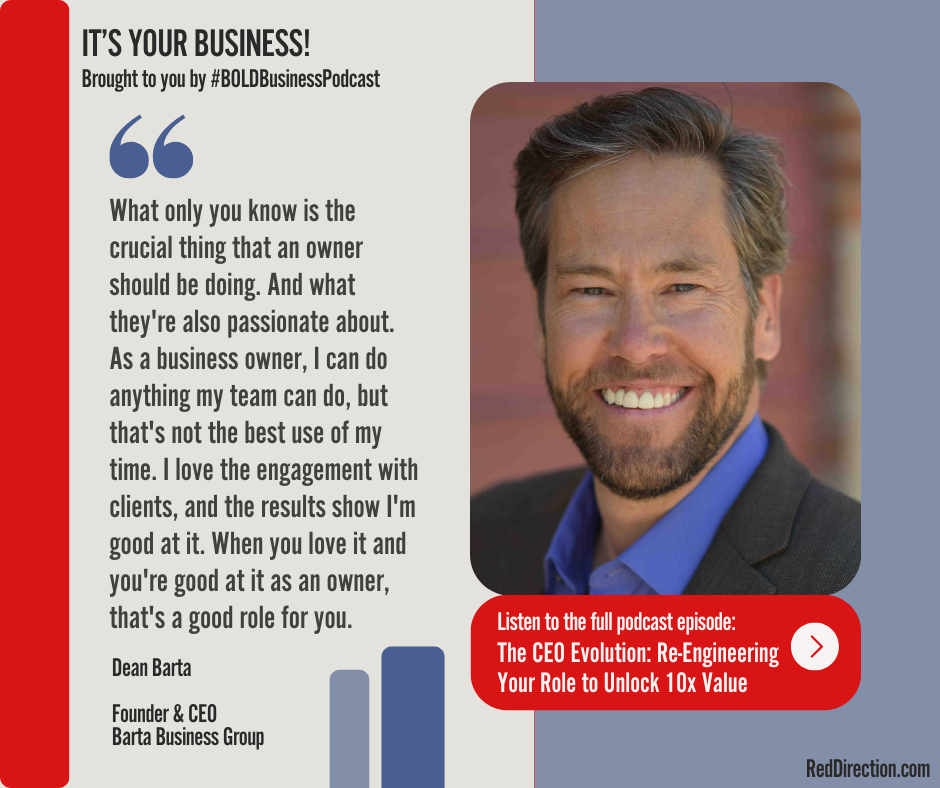
- Dean Barta, Founder and CEO at Barta Business Group
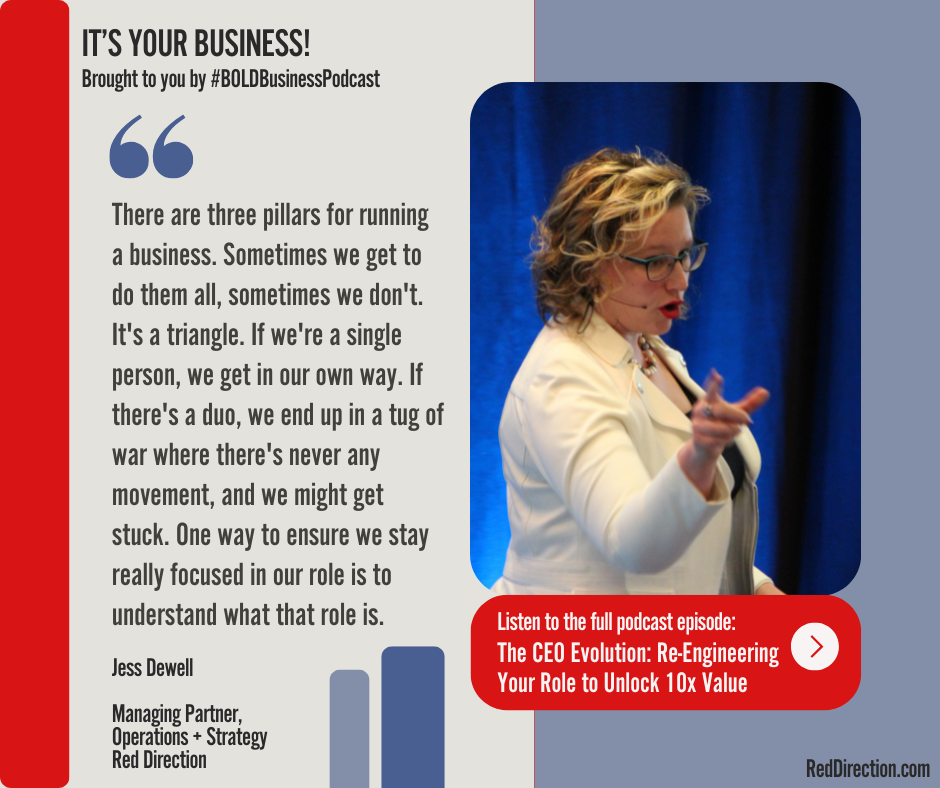
- Jess Dewell, Managing Partner and Growth Strategist at Red Direction
What You Will Hear:
02:10 Why Now? If your role as CEO hasn’t changed much in the last three years you are the bottleneck holding your business back.
06:05 Assessing What You Have Today (Assess & Adjust in Motion)
23:40 The Ruthless Role Focus (Niche Down)
34:40 Unlocking the 10x Asset (Maximize Value)
43:15 3 takeaways:
- Christy Maxfield: It’s that defining what value you really want to unlock is this about making sure that you can unlock more value for your customer, about unlocking more value for you as an owner, about unlocking more value for a future buyer. And, doing all of that while being aligned to your true values, your core values, the things that are your North Star.
- Dean Barta: Separating the roles of owner and CEO and using that to really assess would you hire yourself to be the CEO of your company? And, being rigorous about that evaluation.
- Jess Dewell: Try one or two of the suggestions shared in the discussion. Your ability to make decisions will get easier, stronger, and clearer. That ensures that you are evolving and assessing as you go.
Resources
- Dean Barta on LinkedIn
- Christy Maxfield on LinkedIn
- Jess Dewell on LinkedIn
- LEAD Model for Better Decision-Making and Problem-Solving
- Present Retreat Framework – PresentRetreat.com
- E-Myth Mastery
Transcript
Jess Dewell 0:00
Not making a decision is also a decision.
Christy Maxfield 0:03
And not making decisions is actually accepting excuses. The folks I see struggling the most are the people who say, we can’t stop doing anything. And, actually, we need to start doing more things.
Dean Barta 0:14
If you were the owner, would you hire yourself as the CEO? And if that answer is hesitant at best or no at worst, then that’s a clear indication that there needs to be a change.
Announcer 0:31
Welcome to It’s Your Business brought to you by the Bold Business Podcast. This is your source for navigating today’s ever-evolving business landscape.
In this program, Jess, Christy, and Dean share the realities of current business challenges and triumphs. Get ready to lead with depth, understanding, and achievement.
Jess Dewell 0:53
There we go. Okay, this is hilarious. So I have my cup of tea, was going to take a drink and it said, wait, we’re going live.
So here we are. We are live with It’s Your Business show and I’m so excited today to be talking about having this conversation with Christy and Dean.
Our title of our conversation today, the CEO evolution, re-engineering your role to unlock 10X value. And that’s a big thing, this concept of value. And so we likened it to, well, if the CEO isn’t changing, then how can the company change?
Hello, George Ferrer. Hello, Vision Holder. So if your company’s out-growing you, you’re not growing as much as your company can’t grow as much as you’d like it to be.
And so we’re going to talk about how to evolve your role. I’m super excited to have the three of us introduce ourselves. How about if we do that?
Christy, Dean.
Christy Maxfield 1:45
Well, hello, Christy Maxfield, Purpose First Advisors. We focus on helping business owners grow their business with the end in mind, which means we also talk about succession and exit planning.
Dean Barta 1:58
Dean Barta at Barta Business Group. We handle bookkeeping to Fractional CFO accounting services for small businesses. And we take a guide mentality in helping guide business owners.
Jess Dewell 2:10
And this is the muck I play in every day. I’m Jess Dewell at Red Direction, where I’m working with mid-market CEOs to move from friction to flow. So how do we evolve?
How do we eliminate? How do we secure your company’s future and its relevance? Well, conversations like this is just the start.
I’m super excited to be here with Dean and Christy. So let’s talk about this. Let’s talk about this.
Why now? Now, when I think about this and when we were talking, it was old systems and new goals. So after that conversation, did anything come up for you around this for the why now?
Dean Barta 2:48
Yeah, the first thing that came up for me was opportunity cost. So is the cost of growing as a CEO is leaving behind what we probably have already any CEO who’s gotten into a rut and moving into a new direction that’s growth and can be scary, intrepidation, a little bit of unknown to it, but there is an opportunity cost to just stay in one place.
Christy Maxfield 3:17
And Jess, I think when we were talking, you shared that some of your clients were re-exploring or exploring for the first time the idea of what their CEO job description is. And so many business owners I know play both a employee role and an owner role in addition to being the investor in their own business. So really, there’s three hats at play at a minimum.
And I think redefining what role you’re playing at this stage in your business growth is the way that you’re going to figure out not only how to make the business more valuable to its customers, but more valuable to you as the owner.
Jess Dewell 3:55
Cheers to that. And to both of you, I was thinking about this and I was actually thinking about, well, not making a decision is also a decision. And not making decisions is actually accepting excuses.
I mean, I know where I’m at with what this is. And so if we have broken systems and we have competing priorities and we have all of these gaps, all of the things that all three of us were just talking about actually truly come to pass, right? And then what do we do and how do we get going?
Well, in just a minute, you’re going to find out because I want to make sure I say this is It’s Your Business. Christy, Dean, and I are hosting this for you because there is a real cost. There is a real cost of doing business and continuing to avoid what you have been putting off.
So be here. You’re an active leader. You’re involved, just like Christy was just saying.
And here we go. We’re here. It’s January.
We’re going to either strive and secure our competitive edge or we’re going to be exactly where we were last year, next January. And I think I don’t know about the two of you, but in my business and for my clients and for me, the answer is thank you, no.
Christy Maxfield 5:08
Yeah. And when we were talking and preparing for this, we were also talking about like we are always being asked to do more with less. And we simply can’t put more throughput in the system if the systems aren’t working, if the mindset hasn’t changed, if the roles we’re playing are the same.
And so if we truly have to do more with less, then we need to rethink all of those things. And it starts with the top. It starts with the CEO.
Jess Dewell 5:33
It does. And it starts right there. And so this is a great place to introduce our three sections.
The three parts of our conversation today are going to be about assessing what we already have. Part two is going to be the ruthless role of focus. I have a great conversation about today if it comes back up.
And part three is unlocking the 10x asset. Yes, that’s you. So, so as we go, so how about if we jump into this one, one, right?
We’re assessing what we have today. And Dean, you actually, to me, the opportunity cost fits in there. How do you two feel about that?
Christy Maxfield 6:14
Yeah. Yeah. Dean brought up opportunity costs and that’s where I think we can start the conversation.
I thought that was a great start.
Dean Barta 6:24
Yeah. I actually began the day with a conversation with a business owner about opportunity cost. And, and it was actually in the realm of employees, but also for themselves.
They been doing things a certain way and they’re striving for something different, but they’re, they can’t get out of their own way. It’s that struggle to get out, make that next step that can be scary, but they, you, me, and the person on the street knows that it’s necessary to do. And it’s just getting some support on making that, making that move.
And as a CBO, each one of our companies, but also the clients we work with, you know, we’re the keeper of the vision and what’s moving forward. And if we’ve become stagnant, boy, that’s a, that’s definitely a trickle-down situation.
Christy Maxfield 7:16
And when I look at it, I think opportunity costs, there’s both, if I don’t take this opportunity, what might I be leaving on the table? But if I do take this opportunity, what’s, what doors may close as well as what doors may open. And Dean, if I’m getting, picking up what you’re putting down, I think that’s what I was going to try and say is that we’re also trying to assess, like if your modus operandi is to say yes to everything and try to be everything to everyone, the chances are that’s not going to work for you.
So recognizing that making choices, even not making choices, keeping your options open comes with a cost. And if that cost has traditionally been factored into your business model and you’re not getting the results you want, then you have to really look at what’s driving those decisions and what those hidden costs are.
Jess Dewell 8:08
And I’m going to overlay on top of both of those values, but there’s two kinds of value that we’re going to talk about here, right? There’s the values with which the way we do our work here, which is part one. And then the value we’re actually adding, maintaining to keep that competitive edge.
And I’m sure both of you are going to have some things to insert as well. So just jump right in and I’ll just be one-ing and two-ing this so that we can make sure I don’t forget. So part one, our values, the way we do our work here, when we’re talking about opportunity cost, this is a huge bottleneck.
We accidentally dilute our own worth to our clients when we’re not making decisions. So to what Dean was saying and to what Christy was saying, it might be the hardest thing to make the decision that we don’t want to, or we want to wait, or we want to kick the can down the road just a little bit. If we don’t, it does erode the way we do our work, which leads into this part two of how do we stay competitive?
And what does that look like when change is happening so fast, so fast that we have to pick something and give it a chance to work before we know if it’s actually going to work, which always changing is part of that opportunity cost too. So I’m a how do we do our work, anchor into that, and then how are we making the decisions and doing the evaluation of what support do I need? What if I do this?
What if I don’t? And actually getting to that root piece because we can take what we believe in how we do our work with what we know we can add to stay relevant because the whole purpose of business and competitive edge, whether we don’t want to look at it or not, it’s more important than ever before. So please do start looking at it.
If I’m unable to stay competitive as a company, I’m unable to make it through the noise. I’m unable to serve the clients. So I am unable to make any revenue.
So I have to close my doors. And that is the last thing that I would like to see. So when we’re assessing, we can bring our value set in.
We can bring what value we give to clients as well. Part one, part two. How about that?
Christy Maxfield 10:18
I’d add a third where the values that we operate under how we do business, the value we unlock for the customer, which is our competitive differentiator and the value we unlock for ourselves as the owner or for the actual buyer. But we can’t unlock it for a potential buyer. And so we unlock it for ourselves as an owner.
And so I’ve talked to people just in the last 48 hours who say very successful people who say, I feel chained to my business. I can’t leave. I feel like I’m at the mercy of employees who can leave when they want to.
And I’m actually scared they’re going to leave, which makes me feel even more tracked in my business. So they have not unlocked the value of the business for themselves, even though they are providing value for their customers and they are creating value for their employees. And they may be operating within some of their values.
But if some of their values include being committed to living a life they love and blending work and family and taking care of the people they care about, then they might be creating value for their employees and their customers at the expense of other people they care about. So value goes a long way in business in terms of what we’re talking about and where it impacts the business.
Jess Dewell 11:37
Should we pick one for our dialogue, since there are so many that we’re all working around so we don’t accidentally have to define for all of them? Because that’s true. Chris, you really bring up a good point from the two that I did to then, yes, what is the value of to the owner and what are we unlocking for the owner?
And so what do you think is the most important for today’s conversation? So we’ll just stick with that. What does value mean to us?
Christy Maxfield 12:02
We may differ. And so as we unpack this in real time, I’m going to go to what you outlined as the third prong of our conversation as unlocking the 10x asset. If you are the 10x asset, then you’re 10x-ing for both yourself and for the business.
And by extension, your customer, right? So if by reexamining your role, by watching your role as CEO evolve from employee, primarily employee and owner, small, because first it was your job, and then moving into more of an owner mindset, and perhaps even moving into an investor mindset, those are evolutions of the CEO role and your identity relative to the business. And I think when you do that, you unlock two out of the three, right?
You unlock the value for yourself and you unlock the value for your business. And I hope you’re operating within your values that you’ve set for yourself and your company. But I think where we’re going today is more about, if we’re ruthless in focusing and niching down, if we are assessing what we have and adjusting our mindset and our resource allocation, then to me, it’s about unlocking the value for you as an owner and for your customers who are the benefit of this value you create in the marketplace.
Jess Dewell 13:20
I’m just going to say yes.
Dean Barta 13:21
I’ll just speak for myself. We had this conversation a while back is that as a business owner, I have values about the way we do business and all that. And one of my biggest fears is that, am I the person holding the business back?
And that would be actually my greatest disappointment. I’ve got a great team and all that, but I really have looked at that and I think it starts with some self-assessment and just flat out honesty. Okay.
And it’s the growth of the CEO to be as the leader of the company, to also assess, assessing the people that work with you and all that and clients, but also, Hey, are you the person you’re getting the most out of your employees? But are you getting the most out of you in the capacity that is healthy? And I like how, you know, Christy does a good job of intertwining.
Hey, you have a personal life that there’s other people outside of the business environment that are affected by the way you do business.
Jess Dewell 14:54
So let’s talk about this. Let’s talk about assessing and adjusting in motion, because if we’re going to say it starts and stops with us to reach value, the actual value of a business value of what we’re giving value to the customer, right? To create this value.
Well, how do we assess and adjust in motion?
Christy Maxfield 15:17
I’ll just share a conversation I’ve had recently where clients shared their strategic planning with me, and it was great notes, a lot of good activity that they did, and they left with some very clear action items. And my question was, so who’s in charge of taking these forward? And they said, well, we typically talk about them and then nobody takes them forward.
And then we talk about them again and nobody takes them forward. So part of it is in our initial conversation is there may not be anybody who truly it’s job to take it forward. And therefore, it falls by default to the owner.
And the owner is already occupying two, if not three roles in the business. And there is a gap in the leadership team where no one has the bandwidth to pay attention to how the strategic decisions they have carved out time to make actually get implemented and operationalized. So we can first bring the owner’s attention to that and put this within, make sure it doesn’t get deprioritized.
Then we can look at who else on the team can actually assist in this, because even if the buck stops with them, they can empower other employees or other consultants to contractors to help them do that, right? They work with a fractional CFO, they work with a fractional HR person. What are we getting the fraction we need and how can we do that?
And then do we actually need to add to the team and make it someone’s job to lead and manage these parts of the organization so that the business owner can go do other roles? Or do we bring somebody on to do other roles so that the owner can actually spend more time on operationalizing the strategy? So to me, that’s how it’s unfolding in real time with my clients who want a different outcome, whose teams have identified how they want the business to look different, and who have perpetually not been able to move that ball forward because they haven’t really stepped back and assessed what’s keeping us from doing it.
Dean Barta 17:28
Oh, that’s so important because I’ve been in plenty of different industries where plenty of ideas and the concept of an action plan, but if there’s nobody that’s taking bottom line responsibility and with the guidance of moving forward, then all that brainpower and creativity time and all that is, it’s sitting in the closet and it’s almost wasted really. It’s wasted opportunity.
Christy Maxfield 18:00
Jess, you use the present retreat as your method for really recentering and I would say doing what you just mentioned, like assessing in real time. The thing I asked my clients to do was write down everything as you’re doing as an owner, right? Everything, not just what you’re supposed to be doing, but everything you’re keeping aloft.
And then let’s figure out how many actual functional areas that is, and we might identify where some of the gaps are. But Jess, you.
Jess Dewell 18:30
You know, yes, the present retreat, I agree. And this is something that allows us to touch base, to have a real time moment to moment week to week. If we’re spending one block of time dedicated to what is going on, answering these questions, doing the audit of the team, doing the audit of all of the things, the products, how we are working, how our pipelines are, the reach that we have.
All of those things can come into the present retreat, which means we can say yes or no quickly to decisions on the move, the other working days we are there. So that’s the first part that I really do like. And I actually think that though.
And what’s the present retreat require? Time. What does time what what’s required to work with us to get those things like what Christy said and write down all the things that you’re doing, regardless if it’s your role or not time you it takes time to do that.
So I would say to audit in motion, those dedicated periods of time matter. And so does every day. Are we accidentally running back to back?
Are we pushing things ahead and we’re not making decisions because we don’t have the time? Well, there are things in every single day. I’m not sure about the two of you, but I can even claim today.
There are low priority things that happen today. A lot of them that you could say got in the way, but they were and we can listen to me. I’m rationalizing it.
I’m doing it right here. I am doing it right here. And we are all we are all susceptible to this.
So one thing about that present retreat that I love is the last thing that I’m doing is how do I get 20 more percent in my week before the before I go back to work the next work session? Right. So that end of that present retreat, how do I get 20 percent off my calendar?
Because I know it’s going to be taken up because I’m going to rationalize it otherwise, because if it’s already full, I’m going to get over full because if it’s already there, I can’t think about anything quickly. I have no basis from the work that I’ve done in my present retreat for the other areas of business in terms of growth and value creation. And then what happens?
I’m stuck and I’m in the way I’m the bottleneck. And that is true for every single one of us. So I’m going to say that assess in motion comes down to there’s something to be said for making time so that there’s time for the things that do show up.
Dean Barta 20:59
Go ahead, Christy.
Jess Dewell 21:00
No, go ahead, Dean.
Dean Barta 21:02
Well, I bring a lot back to nature and physical fitness and all that. And one of the things I’ve mentioned if people are like, hey, I want to do a new workout plan is like, have you allocated the time to do it? Because if you’re not committed to allocating the time, then no workout will ever work.
Christy Maxfield 21:17
Yep. Yep. And what kind of habits are you building?
Right. So if the habit you’ve built over time is that you’ve tolerated things because you haven’t had time to deal with them, usually performance issues, right? Tolerated some behaviors because I haven’t had time to deal with them, which then created a cascade of other problems because we didn’t have time to deal with those.
And we’re not working together the way we should be. I’ll just say we’re not working together the way we should be. And some of us are working at cross purposes.
And we haven’t had the hard conversations because we don’t know where to start. But also we’re overwhelmed because we’re still playing a functional role in the business. The reality is a lot of business owners, including the three of us, play functional roles in our business.
But we never actually prioritize the time it takes to step out of the functional role and into the strategic, visionary, and iterative, ideation mode. For yourself, I do the present retreat. I only whisper, say it out loud.
Speak for yourself.
Jess Dewell 22:19
OK.
Christy Maxfield 22:20
So sorry. Well, sorry. Jess?
Jess has figured it out. Well, actually, I really didn’t. And I don’t need to be here other than to explain how not to do it.
Jess Dewell 22:31
Well, I do the present retreat. But I’m like, how about the presence of a chimney fire? If you have a chimney fire, you’ve got to be in action right away, OK?
So even though it might not literally be a chimney fire, but it’s the sense, what Christy was saying about the sense of urgency. You’ve got to move it up on the urgency level.
Dean Barta 22:53
And sometimes you have to bring that energy like it is a chimney fire in order to make it, to motivate your crew that this is important. And we’re doing it instead of, oh, hey, this is important.
Jess Dewell 23:09
That’s a whole- By the way, I really like what you’re saying, and I really like what you’re saying, Christy, and all. Because what does that mean? One of my favorite words is ruthless.
I have a lot of favorite words, so this is just one of them. But ruthless about what? Ruthless about the way we look at our role.
And I’m going to circle back. Dean, the prioritization of time. It’s not going to happen if you don’t prioritize time.
Christy, it’s going to be like write it all down so you can actually see what’s actually happening. Being able to focus in, and this is the second part of the conversation that we set up at the beginning, right? How do we get ruthless about the role?
And in a way, it’s actually a niche. We talk about a niche from a competitive advantage, which is necessary, which is going to be a result of this. But also just a, we can’t do it all, nor should we.
Christy Maxfield 24:02
No, and I think that ruthlessness was, I talked to a lot of people who say, I have to carve out more time to do X, Y, and Z. That means you have to give something else up, right? There has to be a trade-off.
And when you’re consistently unwilling to make the trade-off, you stay stuck in the perpetual, I don’t have enough time to do this. And if I don’t do this, I can’t take the next step. But if I take my, I can’t not be here and I can’t not be here, right?
So we have to get comfortable with delegating, dividing and conquering, saying no, and being okay that we may have actually walked away from something, but confident that the world is abundant enough that the next opportunity will present itself. So it’s not a no forever, it’s just a no right now. The folks I see struggling the most, and it’s affecting their health, and it’s affecting the health of the business, and it’s affecting the ability to actually be there for the long haul, are the people who say, we can’t stop doing anything.
Because, and actually we need to start doing more things, because otherwise we won’t have the pipeline, the cash flow, the backlog that we need going forward. And in fact, I don’t think they can do every, I know they cannot do everything and take advantage of every opportunity. And they’re really good at rational, human beings are not actually logical, rational people.
So they’ll, while they are suffering and feel at their break point, they will also tell me why they can’t stop doing all the things that have to be done.
Jess Dewell 25:39
So true.
Christy Maxfield 25:41
And we often talk about, so what does it take? What’s the practical way to implement this? Those folks are not going to have this dialogue without me.
And even with me, it’s going to take a long time for them to finally come to terms with the fact that they need to stop doing things the same way and expect different results. So the real practical way to implement this is get somebody who’s outside, who has some arm’s length distance, who can sit with you and say, if this has to be true, how can this also be true? And what are we willing to reprioritize?
What are we willing to stop doing so that we can start doing something else or stop doing simply so that we can do the other things that we have on our plate already with a higher fidelity and a better outcome? So I would say the real practical way to operationalize a lot of this is that if you can’t do that introspection on your own, you shouldn’t feel like you have to. That’s where you start to bring in your trusted advisors.
Oh, yeah.
Dean Barta 26:38
Yeah. You see, you got to pick out someone who’s outside the fishbowl.
Jess Dewell 26:43
Exactly. That’s exactly right, Dean. And as you were speaking, Christine, it goes back to one of my favorite books that actually, I might actually have it right here.
Oh, I do. Look, I have it right here. E-Myth Mastery.
There are three pillars to being able to run a business. Sometimes we get to do them all. Sometimes we don’t have to.
I love that it’s a triangle and have always referenced this because it is a triangle. We’re a single person. There’s all kinds of things.
We’re talking to ourselves and we get in our own way. But if there’s a duo, we end up in a like a tug of war where there’s nothing, there’s never any movement and we might get stuck that way. So one way to ensure that we get really focused in our role is understanding what is that role.
And I’m, by the way, business has elements. And so if you were to talk to me in general enough while you listen to enough of me around there and read enough of me, I am a business generalist on the surface. I am far from that.
I am very much into where does the focus go and what are we doing and how are we doing that? What are we saying no to? So we can say yes to the right things.
And it comes from structures like this. How specific will we be? If we like an idea, there can be an awesome way to bring in an experiment with a beginning, middle and an end that does not dissuade or take away from anything else that we have.
Because I think that is some of our biggest opportunity in such a fast moving market today is that our role is let’s collect the opportunities and try some things. But then what happens? We get diluted in the other process.
And we need to do that for our own selves too in the role of vision holder. Being strategic about it.
Dean Barta 28:29
Yeah.
Jess Dewell 28:30
The hardest person to say no to is yourself. Oh, man. You saw me here.
I was like, oh, look, I caught myself in the thing. That’s new, by the way, everybody. I’ve only been doing this for a long time.
And I’m just now starting to be able to interrupt myself and go, oh, look, it’s showing up in the moment. How crazy and amazing is that?
Jess Dewell 28:50
It’s good self-awareness, Jess.
Jess Dewell 28:53
I’m sure I can improve more, Dean. And I bet you have a nature story for me. How about me in the moment?
Dean Barta 29:01
Not right now. But yeah, give me a minute or two.
Christy Maxfield 29:06
Right. I think, honestly, Dean’s the best example of bringing in a specialist. You’re bringing in that fractional CFO, perhaps even pairing it with an external accounting function.
Allows you then to go deeper into your finances. What is the story telling you? Where are we actually losing money?
Where are we making money? How do we need to look at our numbers in a way that makes the most sense to drive the business forward? Are we giving people enough information?
Because business owners like to hold that stuff really close to their chest. Usually financial stuff, they don’t want everybody to have as direct line of sight. But if they have P&L responsibilities, are you giving them enough so that they can really make an informed decision and do what you’ve always asked them to do, which is think like an owner?
Which means weigh the pros and cons of this decision from the lens of what is best for the business. And how does this decision and this expenditure usually get us closer to where we say we want to be as a business in fulfillment of our goals and missions? So I think having a specialist is so important because one of the places where I see people spending a tremendous amount of time is on the people management part of their business, where they should be spending a lot of time, but they usually don’t have a human resources function.
So they’re not even doing the, what I would call the technical aspects of human resources, the performance reviews and all that well. They’re certainly not dealing with performance issues as quickly as they could, or making sure that people are being held accountable in the way that they could be. Because unless somebody’s job is to actually make sure our people are functioning and then support other leaders in making their individual performers as successful as possible, it’s too complex all day, every day to not have it be somebody’s job.
And so you need to start adding those specialties and get the owner out of the things that they had to do because they had to do them, but really aren’t well-suited to do in the long run.
Jess Dewell 31:10
And I’m gonna say, Christy, we need a CEO job description. I’m gonna just put it up. Why not?
Why not? Because I hear you saying, think like an owner, which is great. Sometimes the owner and the CEO are gonna disagree.
And when we’re both, how do we know what our boundaries are for the strategic growth? Because yes, all of those things are there, but to find that middle way to match all of them, what is our job as the CEO? And I like the differentiation.
I’m gonna say, go one step further and have an owner job description. An owner profile and a CEO profile. And when we’re both, that’s great.
And we’ll be able to quickly see, like at the beginning when we were deciding, how do we want value to, how do we want to define value for this and values for this conversation? And Dean, you and Christy were, yeah, you were so close to each other. I was like, we can totally use that because there’s more together than there is not.
And we can do the same thing when we’re talking about, I am doing strategic work and for strategic growth. This is what I need to do as a CEO. I am doing work for understanding how this supports my life, how this supports my community.
What are my bigger goals for having a business and it also? And I am going to think about that. And then where do they align and where do they not?
And then to your point, Christy, bring in the specialists to help answer some of those questions and find the middle way.
Christy Maxfield 32:36
And even if you can play a specialist role, you maybe shouldn’t be playing a specialist role because if you’re already playing an owner role and you’re already paying a CEO role and you’re also the head of sales, you’re gonna do the sales because that’s the thing that drives the economic engine. So you’re not gonna do either of the other two roles well. So now we need to bring in a specialist around sales to get you out of sales, which also unlocks the value for you because now you don’t have as much work to do.
You can focus more of your time and energy. And then we unlock the value of the business, which makes it more valuable on the open market because the thing that devalues a business most is owner dependency. And your customers will get a better product when you’re not trying to do everything, right?
And your employees will have a better experience when you’re not trying to do everything.
Dean Barta 33:25
Well, and I like that separate job descriptions for both the owner and CEO because a good question that I’ve asked owners too is, if you were the owner, would you hire yourself as the CEO? And if that answer is hesitant at best or no at worst, then that’s a clear indication that there needs to be a change. And that’s what a true owner does is makes those hard decisions, not only about employees, but with the roles that they have within the company.
Jess Dewell 33:57
Yes. Hey, check this out. This was a question that came up in one of our LinkedIn posts, and I think it fits right here.
Johanna, she said, what’s a prompt you use to help leaders decide what only they can do right now? I think Dean’s question in relationship to the role descriptions is a perfect one. What do you think?
Dean Barta 34:17
Yeah, I just put that owner hat on. And if you were owning this asset, who would you have in place to move things forward as an owner? And your livelihood is based on it.
And that’s a hard assessment, but it’s honesty. The truth will set you free, I think is the old saying.
Jess Dewell 34:39
We need that reality. And so this moves us into, it’s actually a great transition into the third part of our conversation here, which is actually truly unlocking that 10X asset. You, me, us, we, business owners, CEOs, right?
How do we do that ourselves? I came with it. I came with a thing.
You want to answer, Jess?
Christy Maxfield 35:04
And we can just, do you want me to go first?
Dean Barta 35:08
Go, go for it.
Jess Dewell 35:09
You don’t have to tell me what you think about this. A long time ago, I created this thing called the lead business model. And lead actually stands, actually it’s a lead model for decision-making, not a business model.
And it’s launch effective aligned decisions. And we’ve been talking about this the whole way through. And over the years, I’ve also started to think about this concept of, and we’ve talked about it here on It’s Your Business before, strategic debt.
What is strategic debt? And we’ve used debt in a couple of different ways. Time, debt, I can’t remember the exact phrases, but I thought that was really interesting around strategic debt.
So as I was looking through all of these things, I’m like, oh, look, I have these questions I asked all the time. And I picked three to bring today. The first question for this, do you have strategic debt that you can assess yourself?
Here are your three questions. Does the real meeting happen after the official meeting where two or three people relitigate what the decision is in the hallway or someplace else? Number two, if we’ve asked your top five leaders in your company to name the number one priority, only one, would it be the same?
And number three, how many times are you saying, we’ll circle back on this? Having it be a common phrase in your executive meetings, in your planning meetings, in your present retreats, all of the above. So those are the three questions that I brought to say, hey, are we, if those three questions, and I’m gonna add deans, I’m gonna say deans should be here too.
Would you hire yourself as the CEO? I would put that in here too, to understand how much are you holding yourself back? And by you holding yourself back, are you holding back the growth and the value? Of your company.
Christy Maxfield 37:02
I love those questions. I also think that you could be asking yourself the question of what is there that only I can do because I am the owner and be really real with yourself because you’re gonna say only you can do it because I’m the only one who can do it the way I want it done. But that doesn’t mean you’re the only person who can do it.
I’m the only person who can go out and take on actual investors to come to be part of this company and grow it with me. I’m the only one who ultimately, if it’s a small business and nobody else is taking the action, can fire the people who need to be fired and hire the people who need to be hired. If I have inserted myself in places where decisions aren’t getting made because I’ve said I’m the only one who can do it, there are really only a handful of things that I am the highest and best and perhaps only person who can do them.
And when I get out of my own way, then I can also see that.
Dean Barta 38:03
And I think that’s a great assessment of what only is the crucial things that a owner should be doing. And I’ll add an additional is what they’re also passionate about doing because as a business owner, I can do anything that my team can do, but that’s not the best use of my time. I like the engagement with clients, okay?
I’m just a people person, okay? And it’s what I love to do and I’m good at. Results have shown that I’m good at.
To me, that’s like nuclear fire. You know, when you love it and you’re good at it as an owner and that’s what you’re a good role for you and it’s not hamstringing the business at all, but it’s enhancing it. It’s the, if you will, icing on the cake rather than the cake.
To me, that is like, man, that’s the zone that would be ideal for sure.
Jess Dewell 39:03
And really what we’re getting to is there’s real work here. It is going to take time. So I’m going to go back to the each week.
Can you take 20% out of your calendar so that you have time to be with this? Because this is not something we can check off. This is not something parts of it are.
Sure, we can go through parts of it fast, but to really give ourselves a true assessment, to really sit with the comfort that we are in versus the uncomfort it is going to require to grow, that takes time. And if we don’t take the time to experience it, then no matter our, despite our best efforts, there’s only so much we can do in spite of ourselves, as John Prine would say.
Dean Barta 39:47
Here’s my interjection of nature, okay?
Jess Dewell 39:49
Yes, I knew it was going to come.
Jess Dewell 39:51
I knew it!
Dean Barta 39:53
Ed, this question asked to me actually several years ago, and it was when we were living in Colorado. And he asked, he was a retired guy, and he wanted to get really fit. And he said, how do I get good at climbing 14,000 foot peaks?
And I said, climb 14,000 foot peaks. And no, and he went on some hikes with me. He goes, oh my God, Dean, you ripped the legs off of me.
And I said, hey, you’ll be better after the 10th time and 12th time and 20th time and all that. You know, you’ve got to be patient that there is a progression to this, okay? And the gold is mined in the consistency of that.
Not, hey, we’re going to be great out of the gate. No one is. Or if you are, you’re lucky and it’s awesome.
Move on, launchpad from that. But that consistency over time is, that’s where the gold is at.
Christy Maxfield 40:46
Yeah. I think that applies to your 20% too, Jess. Like the first 20% I take out is not going to be the 20% that 10Xs my revenue or my bottom line.
But every time I get more dialed in and more ruthless about what I really need to pay attention to, what I really need my team to pay attention to and making sure that everything we’re all collectively doing is driving us towards the same goal, then I can unlock, that 20% becomes so much more impactful, right? But it may be the 50th time that we decide, oh, we’re going to really look at what do we need to be doing? What can wait?
Where should we put our energy? That dedication to staying focused and aligned and relentlessly executing versus being distracted. The cumulative effect, it’s compounding, right?
The law of compounding. That’s the truth. Hey, I’m going to take your financial reference.
I like it.
Jess Dewell 41:56
So this is, It’s Your Business. And we’ve been tackling risks that are actually going to impact your business growth today in January, where we’ve got new goals, we’ve got old systems, we’ve got, and those old systems include the way we’re thinking, which is where a lot of our conversation was today, right? And we talked about it in three parts.
We assessed what we had. We talked about the ruthless role focus, and we’ve talked about how do we actually unlock this 10X asset? And I’ll tell you what, I couldn’t do this by myself.
It’s Your Business. Dean and Christy are fantastic co-hosts. Tell us who and what you are all over again.
Christy Maxfield 42:33
Christy Maxfield, Purpose First Advisors. We support owners who are interested in growing with the end in mind.
Dean Barta 42:43
And Dean Barter Business Group, we do bookkeeping to fractional CFO services for small businesses and using a guide mentality in helping the business owner.
Jess Dewell 42:54
And I’m Jess Dewell, working with mid-market CEOs, moving from friction to flow so that we can eliminate bottlenecks, evolve your mindset, and secure your company’s future. Now, this is the thing, we started this with a question. If your job as CEO really hasn’t changed, you might be, your company might be outgrowing you.
And we talked about a lot today. So I wanna come back to, what was the biggest takeaway from each one of us that we can leave this conversation with?
Christy Maxfield 43:28
This is always when we have a pregnant pause and that’s all of us. I think it’s the defining what value you really wanna unlock. Is this about making sure that you can unlock more value for your customer?
About unlocking more value for you as an owner? About unlocking more value for a future buyer? And doing all of that while being aligned to your true values, your core values, the things that are your North Star.
Dean Barta 43:58
I think for me, it was really separating the roles of owner and CEO and using that to really assess, hey, would you hire yourself to be the CEO or retain yourself as a CEO of your own company? Or whatever role you bet that you as a CEO or you’re playing in the company, is that the best use? And really being hard and rigorous about that evaluation.
Jess Dewell 44:28
I can’t pick just one thing today. There are like a lot of things that I have. So I was trying to wrap, I was trying to come up with a phrase or a sentence that would wrap it all up.
My biggest takeaway is that those that are listening, provided you listen, you try out one or two of the suggestions that were offered by all three of us today, your ability to make decisions gets easier, gets stronger, gets clearer as we go. And that ensures that you are evolving as you go and assessing as you go. And then when we take a step back and whatever that capacity is, and we’re looking at as the CEO, as the owner, strategically and purposefully for our whole life here, I could go on and on with those things.
I won’t because I do think, I think that it’s all about recognizing we already wear a lot of hats to make the business go. And we might wanna look at those hats because they may not be the right ones. We really need to be looking at ourselves in the CEO role and in the owner role and asking questions and understanding the value around that, understanding who can help us see that so we can stay out of our own way and grow 10X.
Alrighty, let’s go do it. I was gonna say, here we go. We’re gonna go do it.
Thanks for being here as part of It’s Your Business. Don’t forget, subscribe to the YouTube channel and follow each of us on LinkedIn. That’s your action to save this episode, do something in it, and share it with a business owner.
See you next time.
Announcer 46:17
And that brings us to the close of another powerful and fresh perspective on the Bold Business Podcast. In today’s volatile landscape, growth is a double-edged sword. To truly thrive, you must engage with your strategy, not just react to the day-to-day.
Without absolute alignment, your company faces a stark choice, outmaneuver or be outmaneuvered, grow or get left behind. Thank you for listening. And a special thanks to The Scott Treatment for technical production.